ABSTRACT: The flat pampas in the state of Santa Fe in Argentina have soils with high silt content, variable carbon content, and diverse degrees of structural degradation. Aggregate stability has been used as an indicator of the structural condition of the soil. This study aimed to quantify the effect of the addition of crop residues and root activity on the agents of aggregation and mechanisms of aggregate breakdown in soils with different carbon contents and textures culti-vated under no-till. An experimental trial was conducted on a loamy soil (Typic Hapludoll, Santa Isabel series) and a silty soil (Typic Argiudoll, Esperanza series) under controlled conditions for 112 days with the following treatments: (i) with and without wheat plant growth and (ii) with and without addition of wheat residues. Soil structural stability by a method allowing for differentiation of aggregate breakdown by slaking, mechanical effect and microcracking, total organic carbon content, particulate organic carbon, glomalin and carbohydrate fractions was assessed. In gen-eral, the addition of residues and the presence of plant with active roots increased the presence of all aggregation agents and decreased aggregate breakdown processes in both soils. Soluble carbohydrates and proteins related to glomalin were the most important aggregating agents and their function was to reduce the magnitude of breakdown mechanisms, slaking and microcrack-ing, evidencing a greater impact on the silty soil.
Keywords: glomalin, carbohydrates, crop residues, active roots 1National University of Litoral/Faculty of Agricultural Science
– Dept. of Environmental Science, Kreder 2805 – S3080HOF – Esperanza – Argentina.
2University of Buenos Aires/Faculty of Agronomy – Dept. of Natural Resources and Environment/National Council of Scientific and Technical Researches, Av. San Martín, 4453-C1417DSE – Buenos Aires – Argentina 3National University of Litoral/Faculty of Agricultural Science – Dept. of Environmental Science/National Council of Scientific and Technical Researches, Kreder 2805-S3080HOF – Esperanza – Argentina
*Corresponding author <[email protected]>
Edited by: Leônidas Carrijo Azevedo Melo
Aggregation agents and structural stability in soils with different texture and organic
María Eugenia Carrizo1, Carlos Agustín Alesso1, Diego Cosentino2, Silvia Imhoff3*
carbon contents
Introduction
The flat pampas of the Santa Fe State in Argentina have soils with variable carbon content and non-expand-able minerals (silt and illitic clay) in the upper horizon that entail their low structural regeneration capacity and hence their vulnerability to physical degradation (Pec-orari et al., 1990; Sasal et al., 2006). Thus, the recovery of the soil structure poses a great technological challenge (Varela et al., 2011).
Soil organic matter and texture (clay content) are the main abiotic binding agents in the formation and stabilization of aggregates (Tisdall and Oades, 1982; Chenu et al., 2000; Duchicela et al., 2012; Portella et al., 2012), while soil microbes (bacteria and fungi) and plant roots have been reported as key biotic ag-gregating agents (Chaudhary et al., 2009; Duchicela et al., 2013). The effects of root and the crop residue addition on the stability of soil aggregates were widely evaluated, with varying results that were attributed to the existence of several mechanisms of aggregate breakdown and methodologies (Materechera et al., 1994; Amezketa, 1999; Taboada et al., 2004; De Gryze et al., 2005; Denef and Six, 2005; Abiven et al., 2007). Le Bissonnais (1996) suggested a method to differen-tiate the mechanisms causing aggregate breakdown, the way in which the water acts on the soil, and the soil physical and chemical properties that influence breakdown. This method was very efficient for study-ing silt loam soils, such as those prevailstudy-ing in the flat pampas in Santa Fe (Cosentino et al., 2006; Maqubela et al., 2012).
Aggregating agents have also been quantified by means of various indicators, such as those that depend on soil organic matter (total carbon, particulate carbon) and those that are related to microorganism activity (glomalin, total carbohydrates) (Wright and Upadhyaya, 1998; Six et al., 2000; Annabi et al., 2007). However, few studies have evaluated binding agents that affect aggregate stability and their influence on aggregate breakdown mechanisms. Our hypothesis is that incor-porating organic matter in the soil favors the increase of substances involved in aggregate stability and decreases slaking mechanisms and mechanical breakdown; this being more evident in soils with higher silt content. This study aimed to quantify the effect of incorporating crop residues and plants (active roots) on the presence of sev-eral aggregation agents and on the aggregate breakdown mechanisms in soils with different carbon contents and textures cultivated under no-till.
Materials and Methods
Soils used in this experiment were a Typic Argi-udoll, Esperanza series, and a Typic HaplArgi-udoll, Santa Isa-bel series, located at the center (31°26'08" S, 60°56'43" W) and south (33°93'62" S, 61°57'87" W) of the state of Santa Fe, Argentina. At each location, soil samples (N = 20) were collected from the top layer (0-20 cm) of a plot whose soil had been managed under no-till for the last ten years with agricultural rotations. This study was carried out manually, using a shovel, to avoid disturbing the natu-ral structure of the soil as far as possible. The vegetation cover and litter layer were pushed aside prior to sampling.
Soil samples were placed into bags and shipped to the laboratory. On arrival they were immediately crum-bled by hand at field moisture along their natural fis-sures. After that, soil samples were air-dried and sieved to obtain soil aggregates of less than 2 mm. Then, they were bulked to obtain a composite sample of each soil (about 100 kg) that was used to set up the greenhouse experiment. This procedure was adopted as it both facili-tates the evaluatation of the formation and stabilization of soil aggregates, and has a starting point that is a con-trolled soil structure, thereby avoiding confusion with previously uncontrolled disaggregation of the sample in the field or during subsequent sampling (Le Bissonnais, 1996).
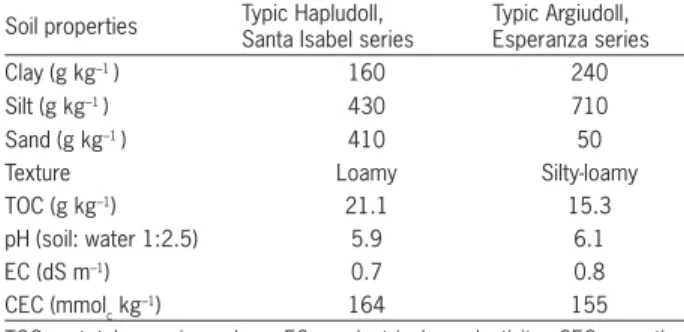
A subsample from each composite sample was taken for measuring the following: particle size distribu-tion (Gee and Or, 2002), total organic carbon (TOC) esti-mated from readily oxidable carbon (IRAM, 2007), soil reaction (pH) by potentiometric method in a 1:2.5 soil-water ratio, electrical conductivity (EC) in the saturation extract and cation exchange capacity (CEC) by extraction with ammonium acetate 1M pH 7 and ammonium post-determination by Kjeldahl distillation. The analytical methods follow standardized Argentinian methodology (SAMLA, 2004). The chemical and physical characteris-tics of the soils are shown in Table 1.
Greenhouse experiment
Experimental setup and treatments - Two green-house experiments were carried out simultaneously, one for each kind of soil (Table 1). The experiments were conducted under controlled temperature (10-30 ºC) and humidity (50-80 %) conditions. The composite samples, consisting of aggregates less than 2 mm in size, were placed in 5 L capacity pots, with an approximate bulk density of 1.3 g cm–3. The additional contribution of or-ganic substances to the soils was applied using the roots of wheat in active growth (+pl) and residues (+res) which, in turn, differentially affected soil organic matter fractions and the microorganism activity. The following treatments were administered in triplicate: (i) without wheat plant growth and without addition of residues
(-pl -res), (ii) without wheat (Triticum aestivum L.) plant growth and with addition of residues (-pl +res), (iii) with wheat plant growth and without addition of residues (+ pl -res) and (iv) with wheat plant growth and with addi-tion of residues (+pl +res). In treatments with plants, four wheat plants were grown per pot adding all nec-essary nutrients with Hoagland solution (Hoagland and Arnon, 1950). For stubble treatments 1-cm long wheat residues were manually mixed into the top 10 cm soil layer at a rate equivalent to 5,000 kg ha–1 dry matter, be-fore sowing the seeds. All pots were subjected to wetting and drying cycles varying the water content between the humidity corresponding to 10 % aeration and one third of the total water content at field capacity moisture. Re-plenishment was carried out with deionized water or Hoagland solution until the set value was reached.
When wheat plants began their senescence (day 112) the experiments were concluded to prevent signifi-cant root decomposition (Denef and Six, 2005). The aer-ial part of the plant was cut and the soil of each pot was allowed to dry off in the air until soil moisture was about 20 %. The top ten centimeter soil layer of each pot was extracted and gently crumbled by hand through its natu-ral weakness planes. Great care was taken to avoid dam-aging the natural aggregates. Then, the soil was sieved to obtain an adequate amount of aggregates between 3 and 5 mm. After sieving, coarse organic matter (free roots and plant debris) was removed and soil samples were screened for each determination.
Determination of soil physical and chemical pa-rameters - Aggregate stability was determined in ac-cordance with the method described by Le Bissonnais (1996) since this method takes the various mechanisms of aggregate breakdown into account (i.e. slaking, break-down by differential swelling, mechanical breakbreak-down and physicochemical dispersion), and it was designed to enable comparison of soils or climatic conditions for a given soil. This method consolidates several existing methods of measuring aggregate stability into the fol-lowing three disruptive pre-treatments with different moisture and energy conditions: fast wetting (FW), me-chanical breakdown (MB) and slow wetting (SW). Each pre-treatment was performed in triplicate on 3-5 mm ag-gregates dried at 40 °C for 24 h to standardize the initial moisture content obtained from each pot.
For the fast wetting (FW) pre-treatment, about 5 g aggregates were quickly submerged in 50 mL of deion-ized water for 10 min. In the case of the mechanical breakdown (MB) pre-treatment, aggregates were sub-merged in ethanol for 30 minutes. The ethanol was then removed and aggregates were immersed in 250 mL dis-tilled water in an Erlenmeyer flask and quickly shaken ten times making semicircular movements. Subsequent-ly, samples were kept at rest to allow particle sedimenta-tion and excess water removal. In the slow wetting (SW) pre-treatment, 5 g aggregates were capillary wetted at -3 cm suction table for 30 min.
Table 1 – Physical and chemical characterization of soils.
Soil properties Typic Hapludoll, Santa Isabel series
Typic Argiudoll, Esperanza series
Clay (g kg–1 ) 160 240
Silt (g kg–1 ) 430 710
Sand (g kg–1 ) 410 50
Texture Loamy Silty-loamy
TOC (g kg–1) 21.1 15.3
pH (soil: water 1:2.5) 5.9 6.1
EC (dS m–1) 0.7 0.8
CEC (mmolc kg
–1) 164 155
After each pre-treatment, samples were gently transferred to a 0.05 mm sieve and submerged in etha-nol for five cycles with a Feodoroff mixer. Aggregates re-tained on the sieve were dried at 40 °C and gently sieved using a column of six sieves (2, 1, 0.5, 0.2, 0.1 and 0.05 mm) for aggregate size distribution. The mean weight diameter (MWD) was calculated as follows:
n
i 1 MWD x .wi i
=
=
∑
where: xi is the mean diameter of the size fraction i that corresponds to the mean aperture of the adjacent sieves, and wi is the proportion of the total sample weight re-maining on each sieve after sieving.
Total organic carbon (TOC) was estimated in trip-licate from easily oxidable carbon with a recovery factor of 0.77 (IRAM, 2007). This method consists of an oxida-tion of organic carbon by wet excess of potassium di-chromate and spontaneous heating by sulfuric acid and final assessment of the chromium reduced to Cr3+ with a ferrous salt. Particulate organic carbon (POC) by physi-cal fractionation was obtained as described by Irizar et al. (2010). In the material retained on the 0.053 mm sieve organic carbon content was determined according to IRAM (2007).
Carbohydrate content was determined in triplicate in each sample from 1 g of soil (<1 mm) using the sul-furic acid-phenol procedure (Dubois et al., 1956). Hot water extractable carbohydrates (HWEC) were digested with 10 mL distilled water at 80°C for 24 h. Total car-bohydrates (TC) were obtained from a concentrated acid hydrolysis which consisted in treating the soil with 2 ml 12 M H2SO4 for 16 h at room temperature. Subsequently, this mixture was diluted to obtain a concentration of 1 M H2SO4 and then placed in a culture oven at 100 °C for 5 h (Puget et al., 1999). Hydrolysis carbohydrate content
was measured by colorimetry with glucose solutions as standards.
Glomalin has been operationally defined as gloma-lin-related soil protein (GRSP) (Rillig, 2004). This desig-nation is used since the Bradford method is not a spe-cific test for a particular protein. We used the procedure described by Wright and Upadhyaya (1996), through an extraction with sodium citrate in an autoclave at 121 °C, centrifuged at 10,000 x g for 20 min. For the easily ex-tractable fraction (EE-GRSP) 20 mM sodium-citrate pH 7.0 were used, autoclaved for 30 min. The total fraction (GRSP) was extracted with 50 mM citrate pH 8.0 auto-claved for 60 min, repeating cycles until a clear color extract was obtained. Quantification of both fractions was performed by applying the Bradford method using bovine serum albumin as standard.
Statistical analysis
To determine the effect of treatments a variance analysis and subsequent multiple comparison Tukey´s test (p < 0.05) were performed. The relationship be-tween the mean weight diameter (MWD) resulting from different pre-treatments and aggregation agents was as-sessed by using canonical correlation analysis.
Results and Discussion
Effect of the treatments on different aggregating agents
All variables were different (p < 0.05) in the soils tested, except for the concentration of EE-GRSP (Table 2). Total organic carbon did not present any differences between treatments. In contrast, particulate organic car-bon (POC) increased in both soils with the addition of residues or the presence of active roots. The greater POC enhancement was observed in +pl +res, with 61 % in
Table 2 – Total organic carbon (TOC), particulate organic carbon (POC), hot water-extractable carbohydrates (HWEC), total carbohydrates (TC), glomalin-related soil proteins (GRSP) and easily extractable soil proteins (EE-GRSP) for each Typic Hapludoll, Santa Isabel series, and Typic Argiudoll, Esperanza series, treatment.
Variables Typic Hapludoll, Santa Isabel series
-pl -res -pl +res +pl -res +pl +res
TOC (g kg–1) 17.9 Aa 18.5 Aa 18.5 Aa 18.6 Aa
POC (g kg–1) 3.3 Ac 3.8 Ab 4.1 Ab 5.3 Aa
HWEC (mg C kg–1) 28.1 Ad 33.7 Ac 50.5 Ab 54.4 Aa
TC (mg C kg–1) 1059.7 Ad 1282.0 Ac 1203.3 Ab 1430.7 Aa
GRSP (mg g–1) 3.35 Ac 3.54 Ab 3.51 Ab 3.62 Aa
EE-GRSP (mg g–1) 0.93 Ac 1.06 Ab 1.09 Ab 1.27 Aa
Typic Argiudoll, Esperanza series
TOC (g kg–1) 16.1 Ba 17.0 Ba 16.7 Ba 17.5 Ba
POC (g kg–1) 2.9 Bc 3.4 Bb 3.5 Bb 4.3 Ba
HWEC (mg C kg–1) 24.3 Bc 21.7 Bc 36.9 Bb 43.4 Ba
TC (mg C kg–1) 859.3 Bd 1170.7 Bc 1035.0 Bb 1276.0 Ba
GRSP (mg g–1) 1.11 Bd 1.25 Bc 1.83 Bb 1.86 Ba
EE-GRSP (mg g–1) 0.92 Ac 1.06 Ab 1.08 Ab 1.24 Aa
the Typic Hapludoll, Santa Isabel series, and 48 % in the Typic Argiudoll, Esperanza series, evidencing the high sensitivity of this variable to changes in land manage-ment.
Concentrations of HWEC and TC increased in the following order: -pl -res < -pl +res < +pl -res < +pl +res in Typic Hapludoll, Santa Isabel series. The increase in HWEC was notably smaller with the addition of residues (22 %) than that measured with plant roots (82 %). The best result was obtained when both sources of carbon were combined, i.e. +pl +res (96 %). This treatment also exhibits the larger value of TC, although the difference from -pl -res was notably smaller (35 %).
A similar trend was observed in the Typic Argi-udoll, Esperanza series, except for the concentration of HWEC that did not differ between -pl -res and -pl +res treatments. However, the increase in HWEC caused by the presence of plant roots was 67 %, while the one veri-fied with the +pl +res combination was 79 %. These values are unexpectedly inferior to those measured in the other soil, and may highlight the influence of soil texture on the activity of microorganisms and roots. The inclusion of residues and/or the existence of active roots also caused increases in concentration, to an even higher level (48 %) as compared with the value determined in Typic Hapludoll, Santa Isabel series.
Fungal activity, estimated through GRSP and EE-GRSP, had a similar pattern to that of POC. In both soils the +pl +res treatment had a positive effect on EE-GRSP production. In contrast, the presence of active roots either alone or associated with residues stimulated the production of GRSP in Typic Argiudoll, Esperanza series (69 %).
The addition of organic matter (residues) to the soil increases the activity of decomposer microorgan-isms that produce mainly polysaccharides, which cor-roborates the findings of Cosentino et al. (1998). In con-trast, the presence of active roots stimulates principally the activity of arbuscular mycorrhizal fungi and in some way the generation of HWEC, even though this activity seems to be strongly controlled by soil texture. Rillig and Steinberg (2002) found that the glomalin-related soil pro-tein was produced in greater concentrations in poorly aggregated soils, as in the case of the Typic Argiudoll, Es-peranza series. Moreover, fungal species (and communi-ties) can differ to the extent to which they influence soil aggregation since fungal functioning depends strongly on the host plant identity (Rillig and Mummey, 2006; Duchicela et al., 2012). The enhancement of soil stability has been recently linked to shifts in soil fungal commu-nity composition (Duchicela et al., 2013). More studies are needed to establish the real contribution of the group of root-associated fungi (i.e. arbuscular mycorrhizal fun-gi) and the bacteria communities to the production of soil aggregating agents. This distinction may contribute to better definition of land management strategies that focus on recovering soil stability.
Effect of the treatments on the disaggregation mechanisms
Mean weight diameter for each pre-treatment did not differ in soils evaluated (FW p < 0.437, MB
p < 0.449, SW p < 0.217). In Typic Hapludoll, Santa Isabel series, aggregate stability decreased in the fol-lowing order: SW (average MWD 1.92 mm), >MB (average MWD 0.82 mm), >FW (average MWD 0.37 mm) (Figure 1). A similar trend was observed in the Typic Argiudoll, Esperanza series, in which the aver-age MWDs were 1.56, 0.88 and 0.33 mm after SW, MB and FW pre-treatments, respectively (Figure 2). These variations are probably due to the conditions of wetting speed and energy applied to aggregates in each pre-treatment, as mentioned by Le Bissonnais (1996).
Figure 1 – Mean weight diameter (MWD) determined by fast wetting (FW), mechanical breakdown (MB) and slow wetting (SW) pre-treatments on Typic Hapludoll, Santa Isabel series. Bars represent the standard error. Treatments with different letters indicate differences (p < 0.001).
In FW pre-treatment MWD ranged approximately between 0.2 and 0.5 mm in both soils. FW pre-treatment was the most destabilizing mechanism for structure breakdown which generated the lowest average MWD, while aggregates showed a more stable behavior against mechanical agitation (MB) and slow wetting (SW). Mean weight diameter values below 0.5 mm indicate gates slaking when wetted quickly. Therefore, aggre-gates from both soils exhibited very low stability against slaking, according to the classification proposed by Le Bissonnais (1996).
In MB pre-treatment MWD ranged approximate-ly between 0.6 and 1.1 mm in both soils. Aggregates showed intermediate stability when they were subjected to mechanical agitation, which indicates they possess a degree of normal cohesion when occurrence of the slak-ing phenomenon is avoided.
In SW pre-treatment the highest MWD values were obtained regardless of soil and treatment; val-ues ranged approximately between 0.9 and 2.5 mm. SW involved a weak disruptive energy since aggregate wetting is performed progressively by capillary action and allows the escape of air with less aggregate destruc-tion. These results may be due to the fact that non-expandable clays predominate in both soils; thus, the differential colloid swelling which induces aggregate microcracking is limited. Soil behavior can be consid-ered stable to very stable from the point of view of ag-gregate microcracking.
In general, ranges are in agreement with those re-ported by Cosentino et al. (2006) and Maqubela et al. (2012), who used the same method in silty-loam soils. In both soils, there was an MWD increase (p < 0.05) due to the effect of plant root (+pl) and the addition of residues (+res) that caused an increase in aggregate re-sistance against the strong disruptive energy of the FW pretreatment compared to the control treatment (-pl -res) (Figures 1 and 2). Chenu et al. (2000) found that disinte-gration of intensively cultivated loam soils was predomi-nantly attributed to the slaking forces. Cosentino et al. (2006) and Annabi et al. (2011) also observed that the slaking was the dominant process in reducing aggrega-tion in silty-loam soils.
Figure 1 indicates that in Typic Hapludoll, San-ta Isabel series, soil aggregate cohesion improved (p 0.001) with the presence of plants and/or addition of residues regardless of the treatment. On the contrary, in the Typic Argiudoll, Esperanza series, all treatments showed a similar MWD, except for the +pl +res treat-ment which presented aggregates with higher (p 0.001) MWDs (Figure 2). Aggregate resistance can be attributed to the presence of polysaccharide which in-creased particle cohesion as well as the effect produced by physical entanglement derived from root and fungal hyphae.
In the Typic Hapludoll, Santa Isabel series, the MWD of control treatment was lower (p < 0.001) than that observed in treatments with addition of crop
resi-dues or plant root or a combination of both. In Typic Argiudoll, Esperanza series, the effect of the addition of crop residues alone did not result in significant differ-ences compared with control. However, the treatment +pl showed higher MWD than control, and when it was combined with crop residues the highest MWD was ob-tained, similar to those found in the Typic Hapludoll, Santa Isabel series. These results indicate that the Typic Argiudoll, Esperanza series, presents less structural sta-bility when confronting disruptive processes. Probably the greater fine silt content in the Typic Argiudoll, Espe-ranza series, (almost 30 %) and its reduced sand content have influenced results negatively. Soils with these char-acteristics have reduced structural stability and resil-ience, as indicated by Taboada et al. (2008), with little or no microcracking formation due to the predominance of a matrix that presents no expansion-contraction process-es and little skeleton. Cosentino et al. (2006) and Annabi et al. (2011) also found limited aggregate breakdown in silty loam soils due to differential swelling in clay.
The presence of plants with active roots and/or organic residue addition tempers the effect of disintegra-tion processes, although the mode of acdisintegra-tion appears to be different, as evidenced by the differential behavior of aggregates when faced with the breakdown mecha-nisms analyzed. In general, results show the biotic ag-gregation mechanism was more relevant than the abiotic one, which corroborates the results found by Chaudhary et al. (2009).
Relationship between structural stability and ag-gregating agents
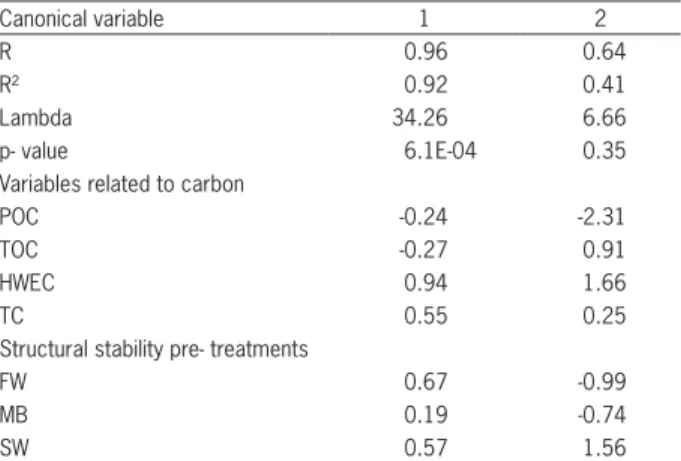
The relationship between the various structural stability pre-treatments and aggregating agents in both soils was evaluated using canonical correlation analysis (Tables 3 and 4). Only the first canonical correlations
Table 3 – Canonical correlation analysis of variables related to carbon and variables of different structural stability pre-treatments in Typic Hapludoll, Santa Isabel series, and Typic Argiudoll, Esperanza series.
Canonical variable 1 2
R 0.96 0.64
R² 0.92 0.41
Lambda 34.26 6.66
p- value 6.1E-04 0.35
Variables related to carbon
POC -0.24 -2.31
TOC -0.27 0.91
HWEC 0.94 1.66
TC 0.55 0.25
Structural stability pre- treatments
FW 0.67 -0.99
MB 0.19 -0.74
SW 0.57 1.56
were significant (p < 0.0001). In Table 3, the first ca-nonical correlation accounted for 92 % of the variability between the two groups of variables. The concentration of HWEC and CT were the variables most related to FW and SW pre-treatment MWDs, while TOC and POC had less importance. These results show quickly biode-gradable organic fractions were those that conditioned structural stability the most, corroberated by the results found in soils of similar textures (Cosentino et al., 2006; Abiven et al., 2007; Maqubela et al., 2012).
Several researchers have shown that aggregate stability is positively correlated with TOC (Tisdall and Oades, 1982), while others indicate that it is more close-ly related to the content of water-extractable and/or total carbohydrates (Haynes, 2005; Degens, 1997; Liu et al., 2005). Furthermore, these substances are shown to act mainly on two out of the three mechanisms which cause aggregate breakdown: the slaking and microcracking. This effect is attributed to increased soil aggregate cohe-sion (Chenu and Guérif, 1991; Degens, 1997). HWEC, which represent a part of the soil organic carbon labile pool, and polysaccharides are basically produced by the activity of microorganisms, and act as active bind-ing agents in relatively short periods of time, which has also been confirmed in this study since the effects were observed in one crop cycle (Haynes, 2005; Martins et al., 2009)
.
In relation to fungal variables, the first canonical correlation accounts for 88 % of the variability between these two groups of variables (Table 4). The most influ-ential fungal variable on MWD of the different pre-treat-ments was EE-GRSP. EE-GRSP fraction was positively associated to soil structural stability (p 0.001). EE-GRSP decreased all aggregate breakdown mechanisms, even if the effect was greater on the slaking (Table 4).
Fungal activity, evaluated by means of biomass, fungal hyphae length and ergosterol concentration, de-termine aggregate stability (Cosentino et al., 2006;
Abiv-en et al., 2007; Annabi et al., 2007), although recAbiv-ent find-ings have been shown that mycorrhizal fungal species vary in their ability to aggregate the soils (Duchicela et al., 2012; Duchicela et al., 2013). The abundant produc-tion of glomalin by arbuscular mycorrhizal fungi, which are hydrophobic and recalcitrant by nature, contribute to the aggregate being stable (Wright and Upadhyaya, 1998; Rillig, 2005). These substances reduce slaking by way of altering the aggregate wetting rate and conse-quently increase structural stability (Guggenberger et al., 1999), which corroborates our observations in the present study. EE-GRSPs, by congregating together on aggregate particles, appear to form a protective film that helps to reduce microcracking and subsequent break-down (Miller and Jastrow, 2000).
The presence of active roots, crop residues, and the biological activity that takes place associated with these components are key to improving aggre-gate formation and stabilization. The HWEC, TC and EE-GRSP seem to be determining elements in these processes, especially in loamy soils with scarce sand content. To achieve an improvement of silty loam soil structural quality it is necessary to establish a high rate of land use rotations, with crops producing high volumes of plant with active roots during the vegeta-tive stage and subsequently crop residues since these aggregation biotic mechanisms are the most important in these soils.
Conclusions
Residue addition and the presence of active plant roots conditioned aggregation agents in both soils. The presence of polysaccharides and fungal activity linked to the production of proteins of the glomalin type were rel-evant in reducing soil disintegration, mainly the slaking mechanisms. Its effects were associated with increases in aggregate cohesion and alteration of the rate of wet-ting. Biotic aggregation mechanisms were the most im-portant, especially in silty soils.
References
Abiven, S.; Menasseri, S.; Angers, D.A.; Leterme, P. 2007. Dynamics of aggregate stability and biological binding agents during the decomposition of organic material. European Journal of Soil Science 58: 239-247.
Amezketa, E. 1999. Soil aggregate stability: a review. Journal of Sustainable Agriculture 14: 83-151.
Annabi, M.; Houot, S.; Francou, C.; Poitrenaud, M.; Le Bissonnais, Y. 2007. Soil aggregate stability improvement with urban composts of different maturities. Soil Science Society of America Journal 71: 413-423.
Annabi, M.; Le Bissonnais, Y.; Le Villio-Poitrenaud, M.; Houot, S. 2011. Improvement of soil aggregate stability by repeated applications of organic amendments to a cultivated silty loam soil. Agriculture, Ecosystems and Environment 144: 382-389.
Table 4 – Canonical correlation analysis of fungal variables and various structural stability pre-treatments in Typic Hapludoll, Santa Isabel series, and Typic Argiudoll, Esperanza series.
Canonical variable 1 2
R 0.87 0.59
R² 0.88 0.35
Lambda 43.05 13.46
p-value 2.9E-04 0.68
Fungal variables
GRSP 0.06 -1.03
EE-GRSP 0.98 0.31
Structural stability pre-treatments
FW 0.46 0.25
MB 0.37 -1.58
SW 0.28 1.34
Chaudhary, V.; Bowker, M.; O’ dell, T.; Grace, J.; Redman, A.; Rillig, M.; Johnson, N. 2009. Untangling the biological contributions to soil stability in semiarid shrublands. Ecological Applications 19: 110-122.
Chenu, C.; Guérif, J. 1991. Mechanical strength of clay minerals as influenced by an adsorbed polysaccharide. Soil Science Society of America Journal 55: 1076-1080.
Chenu, C.; Le Bissonnais, Y.; Arrouays, D. 2000. Organic matter influence on clay wettability and soil aggregate stability. Soil Science Society of America Journal 64: 1479-1486.
Cosentino, D.; Costantini, A.; Segat, A.; Fertig, M. 1998. Relationships between organic carbon fractions and physical properties of an argentine soil under three tillage systems. Pesquisa Agropecuaria Brasileira 33: 981-986.
Cosentino, D.; Le Bissonnais, Y.; Chenu, C. 2006. Aggregate stability and microbial community dynamics under drying-wetting cycles in a silt loam soil. Soil Biology and Biochemistry 38: 2053-2062.
De Gryze, S.; Six, J.; Brits, C.; Merckx, R. 2005. A quantification of short-term macroaggregate dynamics: influences of wheat residue input and texture. Soil Biology and Biochemistry 37: 55-66.
Degens, B.P. 1997. Macro-aggregation of soils by biological bonding and binding mechanisms and the factors affecting these: a review. Australian Journal of Soil Research 35: 431-459.
Denef, K.; Six, J. 2005. Clay mineralogy determines the importance of biological versus abiotic processes for macroaggregate formation and stabilization. European Journal of Soil Science 56: 469-479.
Dubois, M.; Gilles, K.; Hamilton, J.; Rebers, P.; Smith, F. 1956. Colorimetric method for determination of sugar and related substances. Analytical Chemistry 28: 350-356.
Duchicela, J.; Vogelsang, K.; Schultz, P.; Kaonongbua, W.; Middleton, E.; Bever, J. 2012. Non-native plants and soil microbes: potential contributors to the consistent reduction in soil aggregate stability caused by the disturbance of North American grasslands. New Phytologist 196: 212-222.
Duchicela, J.; Sullivan, T.; Bontti, E.; Bever, J. 2013. Soil aggregate stability increase is strongly related to fungal community succession along an abandoned agricultural field chronosequence in the Bolivian Altiplano. Journal of Applied Ecology 50: 1266-1273.
Gee, G.W.; Or, D. 2002. Particle-size analysis. p. 255-293. In: Dane, J.H.; Topp, G.C., eds. Methods of soil analysis. Part 4. Physical methods. Soil Science Society of America. Madison, WI, USA.
Guggenberger, G.; Elliott, E.T.; Frey, S.D.; Six, J.; Paustian, K. 1999. Microbial contributions to the aggregation of a cultivated grassland soil amended with starch. Soil Biology and Biochemistry 31: 407-419.
Haynes, R.J. 2005. Labile organic matter fractions as central components of the quality of agricultural soils: an overview. Advances in Agronomy 85: 221-268.
Hoagland, D.; Arnon, D. 1950. The water-culture method for growing plants without soil. University of California, Berkeley, CA, USA. (California Agricultural Experiments Station Circular, 347).
Instituto Argentino de Normalización y Certificación [IRAM]. 2007. IRAM-SAGPYA 29571-2. 2007 - Determination of Organic Matter in Soils. Part 2. Determination of Oxidable Organic Carbon by Sulfochromic Mixture in Soils. IRAM-SAGPYA, Buenos Aires, Argentine (in Spanish).
Irizar, A.; Andriulo, A.; Cosentino, D.; Améndola, C. 2010. Comparison of two physical fractionation methods for soil organic matter. Ciencia del Suelo 28: 115-121 (in Spanish, with abstract in English).
Le Bissonnais, Y. 1996. Aggregate stability and assessment of soil crustability and erodibility. I. Theory and methodology. European Journal of Soil Science 47: 425-437.
Liu, A.; Ma, B.L.; Bomke, A.A. 2005. Effects of cover crops on soil aggregate stability, total organic carbon, and polysaccharides. Soil Science Society of America Journal 69: 2041-2048. Maqubela, M.; Muchaonyerwa, P.; Mnkeni, P. 2012. Inoculation
effects of two South African cyanobacteria strains on aggregate stability of a silt loam soil. African Journal of Biotechnology 11: 10726-10735.
Martins, M.; Corá, J.E.; Jorge, R.F.; Marcelo, A.V. 2009. Crop type influences soil aggregation and organic matter under no-tillage. Soil and Tillage Research 104: 22-29.
Materechera, S.A.; Kirby, J.M.; Alston, A.M.; Dexter, A.R. 1994. Modification of soil aggregation by watering regime and roots growing through beds of large aggregates. Plant and Soil 160: 57-66.
Miller, R.M.; Jastrow, J.D. 2000. Mycorrhizal fungi influence soil structure. p. 4-18. In: Kapulnik, Y.; Douds, D., eds. Arbuscular mycorrhizas: physiology, molecular biology and ecology. Kluwer, Dordrecht, The Netherlands.
Pecorari, C.; Guerif, J.; Stengel, P. 1990. Phytoliths in soils of the pampean region. Influence on the physical properties determining the elementary mechanisms of structure evolution. Ciencia del Suelo 8: 135-141 (in Spanish, with abstract in English).
Portella, C.; Guimarães, M.; Feller, C.; Batista Fonseca, I.; Tavares Filho, J. 2012. Soil aggregation under different management systems. Revista Brasileira de Ciência do Solo36: 1868-1877 (in Portuguese, with abstract in English).
Puget, P.; Angers, D.; Chenu, C. 1999. Nature of carbohydrates associated with water-stable aggregates of two cultivated soils. Soil Biology and Biochemistry 31: 55-63.
Rillig, M.C. 2004. Arbuscular mycorrhizae, glomalin, and soil aggregation. Canadian Journal of Soil Science 84: 355-363. Rillig, M.C. 2005. A connection between fungal hydrophobins
and soil water repellency? Pedobiologia 49: 395-399.
Rillig, M.C.; Steinberg, P.D. 2002. Glomalin production by an arbuscular mycorrhizal fungus: a mechanism of habitat modification. Soil Biology and Biochemistry 34: 1371-1374. Rillig, M.C.; Mummey, D.L. 2006. Mycorrhizas and soil structure:
Tansley review. New Phytologist 171: 41-53.
Sasal, M.C.; Andriulo, A.; Taboada, M. 2006. Soil porosity characteristics and water movement under zero tillage in silty soils in Argentinean Pampas. Soil and Tillage Research 87: 9-18. Six, J.; Elliott, E.; Paustian, K. 2000. Soil structure and soil organic
South Atlantic Modern Language Association [SAMLA]. 2004. Methodological Support System for Soil Testing Laboratories. SAMLA, Atlanta, GA, USA (in Spanish).
Taboada, M.; Barbosa, O.; Rodríguez, M.; Cosentino, D. 2004. Mechanisms of aggregation in a silty loam under different simulated management regimes. Geoderma 123: 233-244. Taboada, M.; Barbosa, O.; Cosentino, D. 2008. Null creation of
air-filled structural pores by soil cracking and shrinkage in silty loamy soils. Journal of Soil Science 173: 130-142.
Tisdall, J.M.; Oades, J.M. 1982. Organic matter and water-stable aggregates in soils. Journal of Soil Science 33: 141-163.
Varela, M.; Fernandez, P.; Rubio, G.; Taboada, M. 2011. Cover crops: effects on soil macroporosity and soil structural stability in a silt loam soil. Ciencia del Suelo 29: 99-106 (in Spanish, with abstract in English).
Wright, S.; Upadhyaya, A. 1996. Extraction of and abundant and unusual protein from soil and comparison with hyphal protein of arbuscular mycorrhizal fungi. Journal of Soil Science 161: 575-586.