.
Survey of bryophytes in Serra da Canastra National Park,
Minas Gerais, Brazil
Dimas Marchi do Carmo1* and Denilson Fernandes Peralta1
Received: September 9, 2015 Accepted: March 23, 2016
ABSTRACT
Serra da Canastra National Park is located in southwestern Minas Gerais State and contains several phytophysiognomies of the Brazilian Cerrado. To date, no study on bryophytes has been conducted in this area and the present study is the fi rst to be carried out in this major biological reserve of Cerrado located on the Brazilian Plateau. Th is study found 289 species of bryophytes, including mosses, liverworts, and one species of hornwort, representing fourty-one Brazilian endemic species and 56 new records for Minas Gerais State. Most species are widely distributed in Brazil, with only 16% having restricted distributions. Regarding worldwide distribution, 31% are Neotropical. Lejeuneaceae had the highest species richness among liverwort families with 53 species, whereas Sphagnaceae had the highest richness among moss families with 26 species. Phaeoceros laevis was the only hornwort species found in the park. Th is study contributes to the understanding of bryophyte species richness and distribution, and provides the worldwide and Brazilian distribution of the bryophyte fl ora of Serra da Canastra National Park, an important center for biodiversity conservation.
Keywords: cerrado, fl oristic, hornwort, liverworts, mosses, mountain areas
Introduction
Serra da Canastra National Park was created in order to protect the source of the São Francisco River, which is the watercourse arising in the huge chest-shaped plateau. Serra da Canastra divides two watersheds: the south portion is the beginning of the Paraná River and the north portion is the beginning of the São Francisco River (Souza & Costa 2011). Th e predominant vegetation is represented by grasslands and rocky fields (campos rupestres) (Carvalho-Silva & Guimarães 2009), which ensure a high degree of endemism since they occur in areas with particular ecological conditions infl uenced by geographic isolation and biotic and abiotic factors (Harley & Simmons 1986; Giulietti et al. 1987; Pirani et al. 1994; Stannard 1995). Since the park is open to visitors there is some anthropic disturbance, such as the
installation of unpaved roads and buildings; nevertheless, there is a relatively high degree of endemism among some angiosperm species, and so a great need for the permanent preservation of the area as a conservation unit (Romero & Nakajima 1999).
Floristic surveys conducted in areas of Minas Gerais that are similar to Serra da Canastra include Yano & Carvalho (1995) who found 46 species in Serra da Piedade; Yano & Peralta (2009) who found 42 species of mosses and hepatics in the Grão-Mogol mountains; Yano & Peralta (2011a) found 114 species in Serra de São José at the city of Tiradentes; Yano & Peralta (2011b) found 237 species in Serra do Cipó; Luizi-Ponzo et al. (2013) found 209 species in Ibitipoca State Park and, recently, Souza & Câmara (2015) who studied the mosses of gallery forest in Serra do Cipó National Park. Th ese works contain relevant fl oristic data and are useful in the
1 Instituto de Botânica, Núcleo de Pesquisa em Briologia, P.O. Box 68041, 04045-972, São Paulo, SP, Brazil
identification of some species. Furthermore, they provide species lists and document the location of bryophytes in these regions, resulting in knowledge of about 766 species of bryophytes in Minas Gerais State (Costa & Peralta 2015).
These works notwithstanding, floristic inventories of bryophytes in mountainous areas of Minas Gerais are still sparse considering the extensive area of the Cerrado domain in the state and in comparison to other terrestrial plant groups. Therefore, Serra da Canastra is an interesting area with great potential for the study of bryophytes (Costa et al. 2011). Furthermore, there are few compilations of the occurrence of Brazilian bryophytes among phytogeographic domains that also include their distribution within Brazil and worldwide.
To date there has been no study of the bryophytes in this significant biological reserve of Minas Gerais. Therefore, this study aimed to carry out a floristic survey of the bryophytes in Serra da Canastra National Park by analyzing bryophyte species richness, occurrence among phytogeographic domains and Brazilian and worldwide geographical distributions.
Materials and methods
Study area
The Serra da Canastra National Park is situated on a mountain range located in southwestern Minas Gerais and encompasses parts of the municipalities of Sacramento, São Roque de Minas and Delfinópolis (20°00’-20°30’S and 46°15’-47°00’W). It contains 71,525 ha with average altitude ranging from approximately 800 to 1,200 m, with the highest point of the park being Serra Brava at 1,496 m. The average temperature is around 17°C in the winter and 23°C in the summer, but varies between higher and lower regions. Average annual rainfall ranges from approximately 1,300 to 1,700 mm, with most rainfall being concentrated from December to February (IBDF 1981).
There are several phytophysiognomies in Serra da Canastra National Park, which provide many conditions for the development of bryophytes, such as rocky fields (campos rupestres), rocky cerrado (cerrado rupestre), grasslands , “dirty fields” (campos sujos), cerrado sensu stricto, gallery forests (matas de galerias), slope forests (matas de encosta), moist fields (campos úmidos), and waterfall areas (Couto Júnior et al. 2010 ).
Data collection and identification
Twenty samples from the study area were found in SP herbaria (Holmgren et al. 1981) and four one-week long expeditions were made to the park during to make collections in 2012 to 2014.
Collections were made by walking freely through the
main phytophysiognomies of the park including waterfalls, rocky fields (campos rupestres), gallery forest (matas de galeria) and slope forest (matas de encosta) (Couto Júnior et al. 2010). Substrates suitable for bryophyte colonization were classified according to Robbins (1952) and Bates (2009) with some modifications. The methodology for collection, herborization and preservation of material followed Gradstein et al. (2001), and all samples collected were deposited in SP.
Identification of the species followed Frahm (1991), Sharp et al. (1994), Yano & Carvalho (1995), Buck (1998), Vilas Bôas-Bastos & Bastos (1998), Bastos et al. (2000), Gradstein et al. (2001), Castro et al. (2002), Gradstein & Costa (2003), Câmara & Costa (2006), Câmara (2008a; b), Ballejos & Bastos (2009), Yano & Peralta (2009), Valente et al. (2011), Yano & Peralta (2011a; b), Bordin & Yano (2013), Luizi-Ponzo et al. (2013) and Valente et al. (2013).
The classifications followed herein are those of Renzaglia et al. (2009) for Anthocerotophyta, Crandall-Stotler et al. (2009) for Marchantiophyta and Goffinet et al. (2009) for Bryophyta.
The list of species is organized in alphabetical order by family, then genus and then species, and provides the Brazilian geographical distribution as proposed by Valente & Pôrto (2006), who considered as “rare” those bryophythes occurring in one to four Brazilian states; as “moderate” those occurring in five to nine states; and as “wide” those occurring in ten or more Brazilian states. The distribution and biogegraphical domains followed Gradstein & Costa (2003), Yano (2008), Forzza et al. (2010), Costa et al. (2011) and Costa & Peralta (2015).
Results and discussion
Species richness
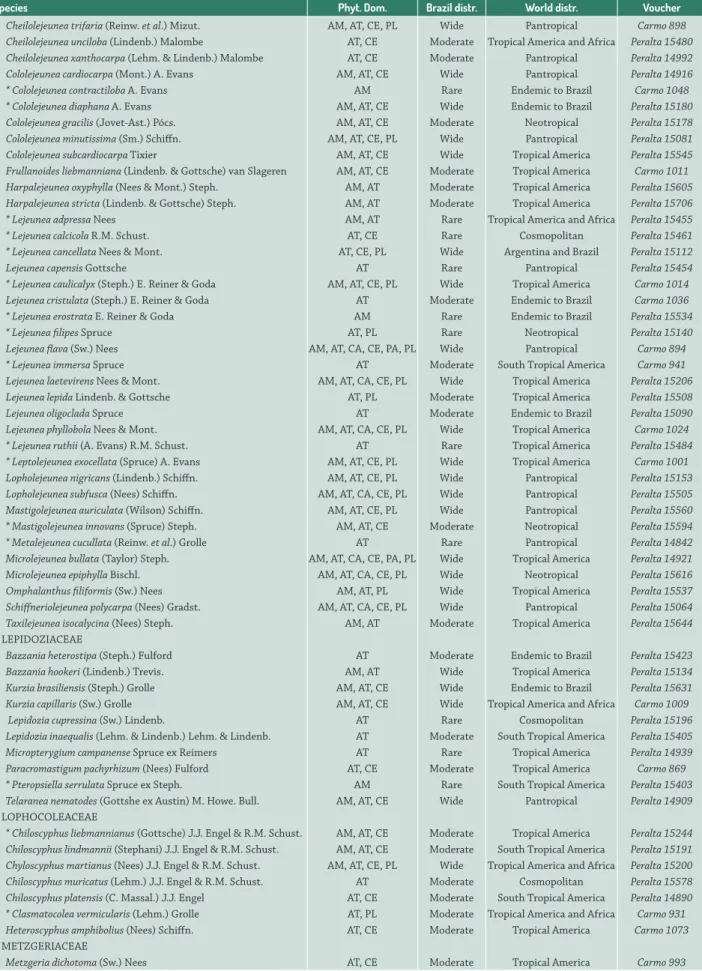
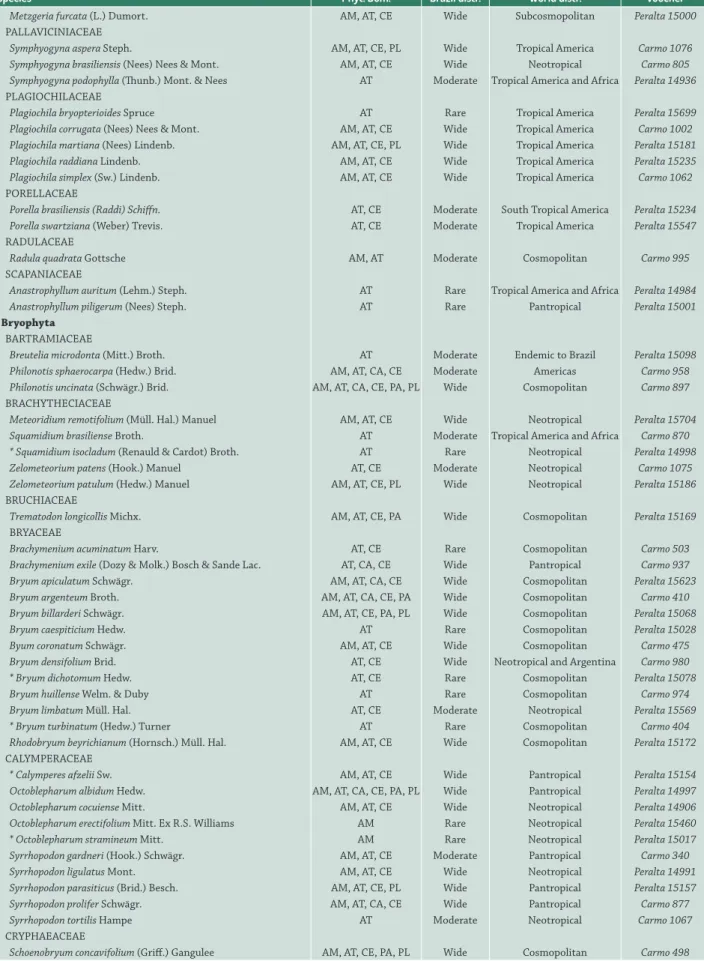
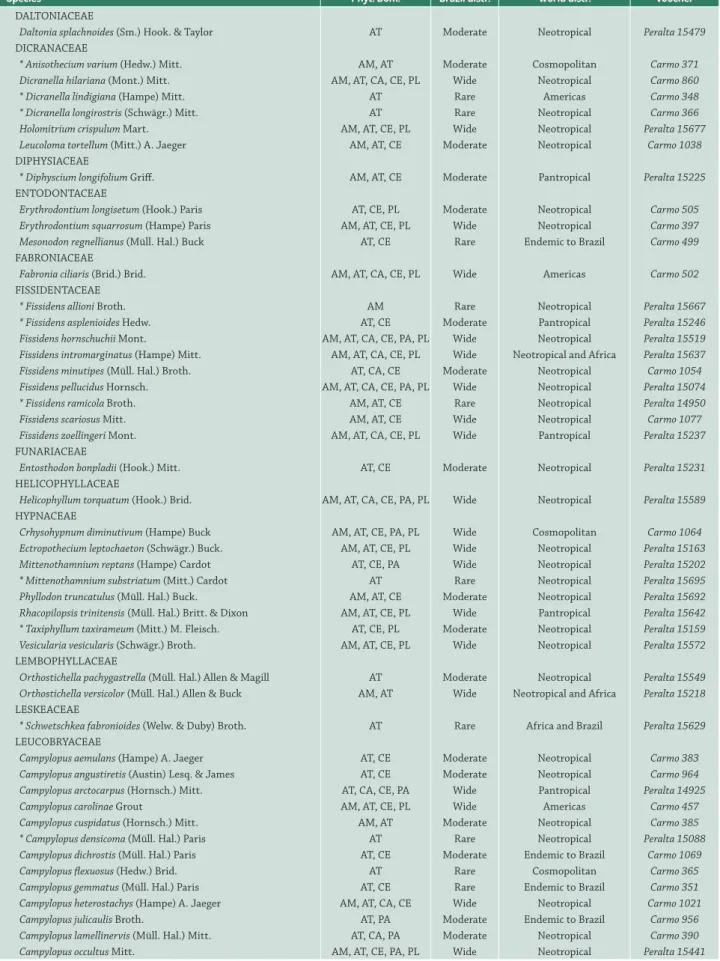
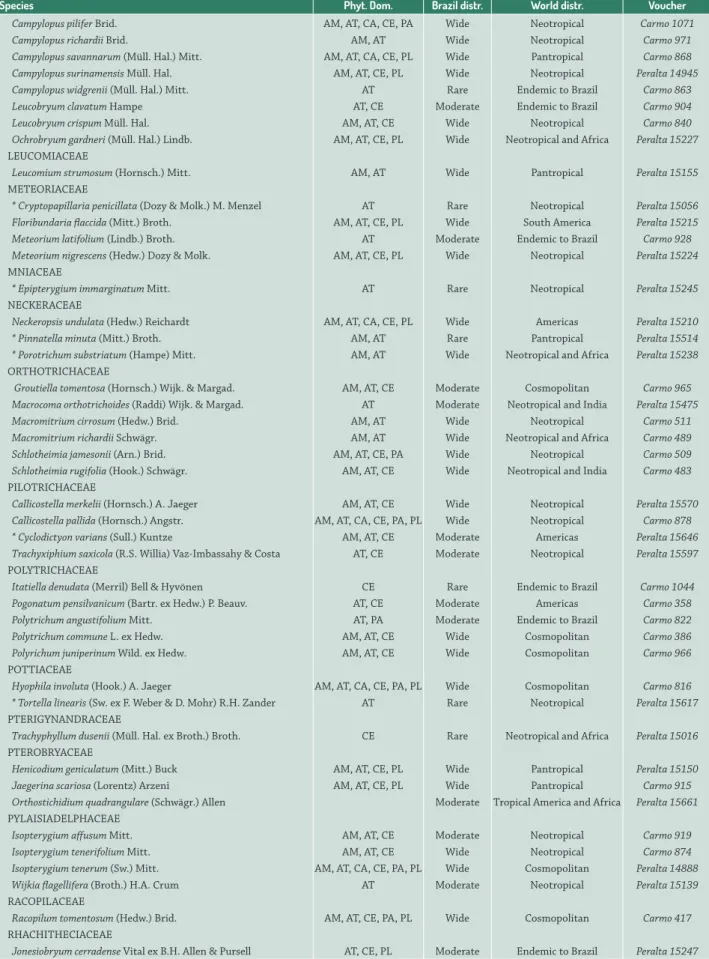
One thousand one hundred and seventy-seven (1,177) samples were analyzed, with 722 samples of mosses (Bryophyta), 454 of liverworts (Marchantiophyta) and only one of a hornwort (Anthocerotophyta). Two hundred and eight-nine species of bryophytes were found, representing 128 genera and 57 families, accounting for approximately 38% of the species estimated for the state and 19% for the country (Tab. 1) (Costa & Peralta 2015).
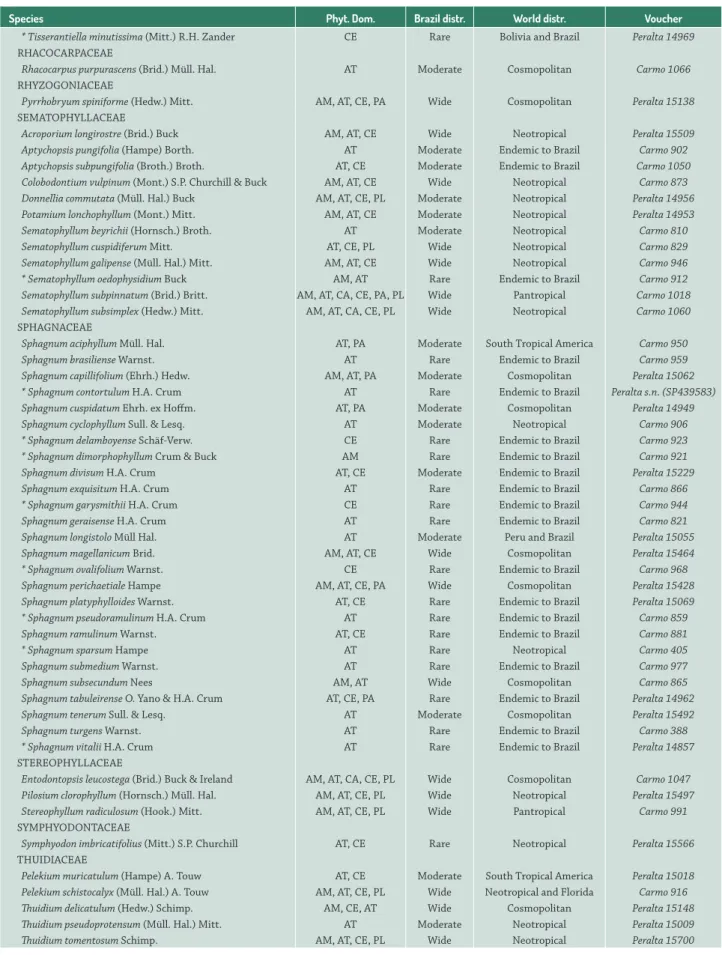
Table 1. List of species found in Serra da Canastra National Park. Phytogeographic domains (Phyt. dom.): Amazon Rainforest = AM, Atlantic Forest = AT, Cerrado = CE, Caatinga = CA, Pampa = PA, Pantanal = PL; Geographical distribution of Brazil (Brazil distr.); Geographical distribution worldwide (World distr.); * = New record for Minas Gerais State.
Species Phyt. Dom. Brazil distr. World distr. Voucher
Anthocerotophyta
NOTOTHYLADACEAE
Phaeoceros laevis (L.) Prosk AM, AT, CE, PA, PL Wide Subcosmopolitan Peralta 15167
Marchantiophyta
ACROBOLBACEAE
* Tylimanthus laxus (Lehm. & Lindenb.) Steph. AT, CE, PL Moderate Tropical America Peralta 15198
ANEURACEAE
Aneura pinguis (L.) Dumot. AM, AT, PL Wide Subcosmopolitan Peralta 15027
Riccardia cataractarum (Spruce) Schiffn. AT, CE, PL Wide Tropical America Carmo 1008
Riccardia digitiloba (Spruce ex. Steph.) Pagán AM, AT, CE, PL Wide Tropical America Peralta 15703
Riccardia regnellii (Angstr.) Hell AT, CE Wide Endemic to Brazil Carmo 415
BALANTIOPSIDACEAE
Isotachis multiceps (Lindenb. &Gottsche) Gottsche AT Moderate Tropical America Carmo 839
Isotachis serrulata (Sw.) Gottsche AM, AT Moderate Tropical America Carmo 896
Neesioscyphus argillaceus (Nees) Grolle AT, CE Moderate Tropical Andes and Brazil Carmo 1037
Neesioscyphus homophyllus (Nees) Grolle AT Rare Argentina and Brazil Carmo 948
CALYPOGEIACEAE
Calypogeia grandistipula (Steph.) Steph. AT Rare Endemic to Brazil Carmo 802
Calypogeia laxa Gottsche & Lindenb. AM, AT Wide Tropical America Peralta 14940
Calypogeia peruviana Nees & Mont. AM, AT, CE Wide Tropical America Carmo 823
CEPHALOZIACEAE
Odontoschisma denudatum (Nees) Dumort. AM, AT, CE Moderate Cosmopolitan Carmo 1042
Odontoschisma longiflorum (Taylor) Steph. AT, CE Moderate Tropical America Carmo 809
FOSSOMBRONIACEAE
Fossombronia porphyrorhiza (Nees) Prosk. AT, CA, CE, PL Wide Tropical America Carmo 833
FRULLANIACEAE
Frullania arecae (Spreng.) Gottsche AM, AT, CE Wide Pantropical Carmo 399
Frullania atrata (Sw.) Nees AM, AT Wide Tropical America Peralta 15705
Frullania brasiliensis Raddi AT, CE Wide Tropical America Carmo 1030
* Frullania breuteliana Gottsche AT Moderate Neotropical Peralta 15683
Frullania ericoides (Nees) Mont. AM, AT, CA, CE, PA, PL Wide Pantropical Peralta 15096
Frullania gibbosa Nees AM, AT, CA, CE, PL Wide Tropical America Carmo 1052
Frullania glomerata (Lehm. & Lindenb.) Mont. AT, CA, CE, PL Wide Tropical America Peralta 15417
Frullania kunzei (Lehm. & Lindenb.) Lehm. & Lindenb. AM, AT, CE, PL Wide Tropical America Carmo 969
Frullania schaefer-verwimpii Yuzawa & Hatt. AT Rare Endemic to Brazil Peralta 15060
HERBETACEAE
Herbertus bivittatus Spruce AM, AT Moderate Tropical America Peralta 15639
* Herbertus sendtneri (Nees) A. Evans AT Rare Tropical America Peralta 15628
JUNGERMANNIACEAE
Jungermannia amoena Lindenb. & Gottsche AM, AT Moderate Tropical America Carmo 884
Jungermannia hyalina Lyell AT, CE, PL Moderate Cosmopolitan Peralta 15082
* Jungermannia sphaerocarpa Hook. AT Rare Cosmopolitan Carmo 1046
LEJEUNEACEAE
* Acanthocoleus trigonus (Nees & Mont.) Gradst. AT Moderate Neotropical Carmo 481
Acrolejeunea torulosa (Lehm. & Lindenb.) Schiffn. AM, AT, CE, PL Wide Tropical America Peralta 15107
Anoplolejeunea conferta (C.F.W. Meissn.) A. Evans AM, AT Wide Tropical America Carmo 804
* Archilejeunea auberiana (Mont.) A. Evans AM, AT, CE Wide Tropical America Peralta 15611
Archilejeunea parviflora (Nees) Schiffn. AM, AT, CE, PL Wide Tropical America Peralta 15132
Brachiolejeunea leiboldiana (Gottsche & Lindenb.) Schiffn. AT Rare Tropical America Carmo 400
* Ceratolejeunea confusa Schust. AM, AT Moderate Neotropical Peralta 15550
Ceratolejeunea cornuta (Lindenb.) Schiffn. AM, AT Wide Tropical America Carmo 1016
Cheilolejeunea acutangula (Nees) Grolle AM, AT, CE Wide Neotropical Peralta 15063
* Cheilolejeunea beyrichii (Lindenb.) Reiner CA, CE Rare Endemic to Brazil Peralta 15049
Cheilolejeunea clausa (Nees & Mont.) Schust. AM, AT, CE, PL Wide Tropical America Peralta 15554
Cheilolejeunea comans (Spruce) Schust. AM, AT Rare South Tropical America Carmo 1028
Cheilolejeunea discoidea (Lehm. & Lindenb.) Kachr. & Schust. AT, CE, PL Moderate Tropical America Carmo 841
Cheilolejeunea revoluta (Herzog) Gradst. & Grolle AT, CE Rare Neotropical Peralta 15116
Species Phyt. Dom. Brazil distr. World distr. Voucher
Cheilolejeunea trifaria (Reinw. et al.) Mizut. AM, AT, CE, PL Wide Pantropical Carmo 898
Cheilolejeunea unciloba (Lindenb.) Malombe AT, CE Moderate Tropical America and Africa Peralta 15480
Cheilolejeunea xanthocarpa (Lehm. & Lindenb.) Malombe AT, CE Moderate Pantropical Peralta 14992
Cololejeunea cardiocarpa (Mont.) A. Evans AM, AT, CE Wide Pantropical Peralta 14916
* Cololejeunea contractiloba A. Evans AM Rare Endemic to Brazil Carmo 1048
* Cololejeunea diaphana A. Evans AM, AT, CE Wide Endemic to Brazil Peralta 15180
Cololejeunea gracilis (Jovet-Ast.) Pócs. AM, AT, CE Moderate Neotropical Peralta 15178
Cololejeunea minutissima (Sm.) Schiffn. AM, AT, CE, PL Wide Pantropical Peralta 15081
Cololejeunea subcardiocarpa Tixier AM, AT, CE Wide Tropical America Peralta 15545
Frullanoides liebmanniana (Lindenb. & Gottsche) van Slageren AM, AT, CE Moderate Tropical America Carmo 1011
Harpalejeunea oxyphylla (Nees & Mont.) Steph. AM, AT Moderate Tropical America Peralta 15605
Harpalejeunea stricta (Lindenb. & Gottsche) Steph. AM, AT Moderate Tropical America Peralta 15706
* Lejeunea adpressa Nees AM, AT Rare Tropical America and Africa Peralta 15455
* Lejeunea calcicola R.M. Schust. AT, CE Rare Cosmopolitan Peralta 15461
* Lejeunea cancellata Nees & Mont. AT, CE, PL Wide Argentina and Brazil Peralta 15112
Lejeunea capensis Gottsche AT Rare Pantropical Peralta 15454
* Lejeunea caulicalyx (Steph.) E. Reiner & Goda AM, AT, CE, PL Wide Tropical America Carmo 1014
Lejeunea cristulata (Steph.) E. Reiner & Goda AT Moderate Endemic to Brazil Carmo 1036
* Lejeunea erostrata E. Reiner & Goda AM Rare Endemic to Brazil Peralta 15534
* Lejeunea filipes Spruce AT, PL Rare Neotropical Peralta 15140
Lejeunea flava (Sw.) Nees AM, AT, CA, CE, PA, PL Wide Pantropical Carmo 894
* Lejeunea immersa Spruce AT Moderate South Tropical America Carmo 941
Lejeunea laetevirens Nees & Mont. AM, AT, CA, CE, PL Wide Tropical America Peralta 15206
Lejeunea lepida Lindenb. & Gottsche AT, PL Moderate Tropical America Peralta 15508
Lejeunea oligoclada Spruce AT Moderate Endemic to Brazil Peralta 15090
Lejeunea phyllobola Nees & Mont. AM, AT, CA, CE, PL Wide Tropical America Carmo 1024
* Lejeunea ruthii (A. Evans) R.M. Schust. AT Rare Tropical America Peralta 15484
* Leptolejeunea exocellata (Spruce) A. Evans AM, AT, CE, PL Wide Tropical America Carmo 1001
Lopholejeunea nigricans (Lindenb.) Schiffn. AM, AT, CE, PL Wide Pantropical Peralta 15153
Lopholejeunea subfusca (Nees) Schiffn. AM, AT, CA, CE, PL Wide Pantropical Peralta 15505
Mastigolejeunea auriculata (Wilson) Schiffn. AM, AT, CE, PL Wide Pantropical Peralta 15560
* Mastigolejeunea innovans (Spruce) Steph. AM, AT, CE Moderate Neotropical Peralta 15594
* Metalejeunea cucullata (Reinw. et al.) Grolle AT Rare Pantropical Peralta 14842
Microlejeunea bullata (Taylor) Steph. AM, AT, CA, CE, PA, PL Wide Tropical America Peralta 14921
Microlejeunea epiphylla Bischl. AM, AT, CA, CE, PL Wide Neotropical Peralta 15616
Omphalanthus filiformis (Sw.) Nees AM, AT, PL Wide Tropical America Peralta 15537
Schiffneriolejeunea polycarpa (Nees) Gradst. AM, AT, CA, CE, PL Wide Pantropical Peralta 15064
Taxilejeunea isocalycina (Nees) Steph. AM, AT Moderate Tropical America Peralta 15644
LEPIDOZIACEAE
Bazzania heterostipa (Steph.) Fulford AT Moderate Endemic to Brazil Peralta 15423
Bazzania hookeri (Lindenb.) Trevis. AM, AT Wide Tropical America Peralta 15134
Kurzia brasiliensis (Steph.) Grolle AM, AT, CE Wide Endemic to Brazil Peralta 15631
Kurzia capillaris (Sw.) Grolle AM, AT, CE Wide Tropical America and Africa Carmo 1009
Lepidozia cupressina (Sw.) Lindenb. AT Rare Cosmopolitan Peralta 15196
Lepidozia inaequalis (Lehm. & Lindenb.) Lehm. & Lindenb. AT Moderate South Tropical America Peralta 15405
Micropterygium campanense Spruce ex Reimers AT Rare Tropical America Peralta 14939
Paracromastigum pachyrhizum (Nees) Fulford AT, CE Moderate Tropical America Carmo 869
* Pteropsiella serrulata Spruce ex Steph. AM Rare South Tropical America Peralta 15403
Telaranea nematodes (Gottshe ex Austin) M. Howe. Bull. AM, AT, CE Wide Pantropical Peralta 14909
LOPHOCOLEACEAE
* Chiloscyphus liebmannianus (Gottsche) J.J. Engel & R.M. Schust. AM, AT, CE Moderate Tropical America Peralta 15244
Chiloscyphus lindmannii (Stephani) J.J. Engel & R.M. Schust. AM, AT, CE Moderate South Tropical America Peralta 15191
Chyloscyphus martianus (Nees) J.J. Engel & R.M. Schust. AM, AT, CE, PL Wide Tropical America and Africa Peralta 15200
Chiloscyphus muricatus (Lehm.) J.J. Engel & R.M. Schust. AT Moderate Cosmopolitan Peralta 15578
Chiloscyphus platensis (C. Massal.) J.J. Engel AT, CE Moderate South Tropical America Peralta 14890
* Clasmatocolea vermicularis (Lehm.) Grolle AT, PL Moderate Tropical America and Africa Carmo 931
Heteroscyphus amphibolius (Nees) Schiffn. AT, CE Moderate Tropical America Carmo 1073
METZGERIACEAE
Metzgeria dichotoma (Sw.) Nees AT, CE Moderate Tropical America Carmo 993
Species Phyt. Dom. Brazil distr. World distr. Voucher
Metzgeria furcata (L.) Dumort. AM, AT, CE Wide Subcosmopolitan Peralta 15000
PALLAVICINIACEAE
Symphyogyna aspera Steph. AM, AT, CE, PL Wide Tropical America Carmo 1076
Symphyogyna brasiliensis (Nees) Nees & Mont. AM, AT, CE Wide Neotropical Carmo 805
Symphyogyna podophylla (Thunb.) Mont. & Nees AT Moderate Tropical America and Africa Peralta 14936
PLAGIOCHILACEAE
Plagiochila bryopterioides Spruce AT Rare Tropical America Peralta 15699
Plagiochila corrugata (Nees) Nees & Mont. AM, AT, CE Wide Tropical America Carmo 1002
Plagiochila martiana (Nees) Lindenb. AM, AT, CE, PL Wide Tropical America Peralta 15181
Plagiochila raddiana Lindenb. AM, AT, CE Wide Tropical America Peralta 15235
Plagiochila simplex (Sw.) Lindenb. AM, AT, CE Wide Tropical America Carmo 1062
PORELLACEAE
Porella brasiliensis (Raddi) Schiffn. AT, CE Moderate South Tropical America Peralta 15234
Porella swartziana (Weber) Trevis. AT, CE Moderate Tropical America Peralta 15547
RADULACEAE
Radula quadrata Gottsche AM, AT Moderate Cosmopolitan Carmo 995
SCAPANIACEAE
Anastrophyllum auritum (Lehm.) Steph. AT Rare Tropical America and Africa Peralta 14984
Anastrophyllum piligerum (Nees) Steph. AT Rare Pantropical Peralta 15001
Bryophyta
BARTRAMIACEAE
Breutelia microdonta (Mitt.) Broth. AT Moderate Endemic to Brazil Peralta 15098
Philonotis sphaerocarpa (Hedw.) Brid. AM, AT, CA, CE Moderate Americas Carmo 958
Philonotis uncinata (Schwägr.) Brid. AM, AT, CA, CE, PA, PL Wide Cosmopolitan Carmo 897
BRACHYTHECIACEAE
Meteoridium remotifolium (Müll. Hal.) Manuel AM, AT, CE Wide Neotropical Peralta 15704
Squamidium brasiliense Broth. AT Moderate Tropical America and Africa Carmo 870
* Squamidium isocladum (Renauld & Cardot) Broth. AT Rare Neotropical Peralta 14998
Zelometeorium patens (Hook.) Manuel AT, CE Moderate Neotropical Carmo 1075
Zelometeorium patulum (Hedw.) Manuel AM, AT, CE, PL Wide Neotropical Peralta 15186
BRUCHIACEAE
Trematodon longicollis Michx. AM, AT, CE, PA Wide Cosmopolitan Peralta 15169
BRYACEAE
Brachymenium acuminatum Harv. AT, CE Rare Cosmopolitan Carmo 503
Brachymenium exile (Dozy & Molk.) Bosch & Sande Lac. AT, CA, CE Wide Pantropical Carmo 937
Bryum apiculatum Schwägr. AM, AT, CA, CE Wide Cosmopolitan Peralta 15623
Bryum argenteum Broth. AM, AT, CA, CE, PA Wide Cosmopolitan Carmo 410
Bryum billarderi Schwägr. AM, AT, CE, PA, PL Wide Cosmopolitan Peralta 15068
Bryum caespiticium Hedw. AT Rare Cosmopolitan Peralta 15028
Byum coronatum Schwägr. AM, AT, CE Wide Cosmopolitan Carmo 475
Bryum densifolium Brid. AT, CE Wide Neotropical and Argentina Carmo 980
* Bryum dichotomum Hedw. AT, CE Rare Cosmopolitan Peralta 15078
Bryum huillense Welm. & Duby AT Rare Cosmopolitan Carmo 974
Bryum limbatum Müll. Hal. AT, CE Moderate Neotropical Peralta 15569
* Bryum turbinatum (Hedw.) Turner AT Rare Cosmopolitan Carmo 404
Rhodobryum beyrichianum (Hornsch.) Müll. Hal. AM, AT, CE Wide Cosmopolitan Peralta 15172
CALYMPERACEAE
* Calymperes afzelii Sw. AM, AT, CE Wide Pantropical Peralta 15154
Octoblepharum albidum Hedw. AM, AT, CA, CE, PA, PL Wide Pantropical Peralta 14997
Octoblepharum cocuiense Mitt. AM, AT, CE Wide Neotropical Peralta 14906
Octoblepharum erectifolium Mitt. Ex R.S. Williams AM Rare Neotropical Peralta 15460
* Octoblepharum stramineum Mitt. AM Rare Neotropical Peralta 15017
Syrrhopodon gardneri (Hook.) Schwägr. AM, AT, CE Moderate Pantropical Carmo 340
Syrrhopodon ligulatus Mont. AM, AT, CE Wide Neotropical Peralta 14991
Syrrhopodon parasiticus (Brid.) Besch. AM, AT, CE, PL Wide Pantropical Peralta 15157
Syrrhopodon prolifer Schwägr. AM, AT, CA, CE Wide Pantropical Carmo 877
Syrrhopodon tortilis Hampe AT Moderate Neotropical Carmo 1067
CRYPHAEACEAE
Schoenobryum concavifolium (Griff.) Gangulee AM, AT, CE, PA, PL Wide Cosmopolitan Carmo 498
Species Phyt. Dom. Brazil distr. World distr. Voucher
DALTONIACEAE
Daltonia splachnoides (Sm.) Hook. & Taylor AT Moderate Neotropical Peralta 15479
DICRANACEAE
* Anisothecium varium (Hedw.) Mitt. AM, AT Moderate Cosmopolitan Carmo 371
Dicranella hilariana (Mont.) Mitt. AM, AT, CA, CE, PL Wide Neotropical Carmo 860
* Dicranella lindigiana (Hampe) Mitt. AT Rare Americas Carmo 348
* Dicranella longirostris (Schwägr.) Mitt. AT Rare Neotropical Carmo 366
Holomitrium crispulum Mart. AM, AT, CE, PL Wide Neotropical Peralta 15677
Leucoloma tortellum (Mitt.) A. Jaeger AM, AT, CE Moderate Neotropical Carmo 1038
DIPHYSIACEAE
* Diphyscium longifolium Griff. AM, AT, CE Moderate Pantropical Peralta 15225
ENTODONTACEAE
Erythrodontium longisetum (Hook.) Paris AT, CE, PL Moderate Neotropical Carmo 505
Erythrodontium squarrosum (Hampe) Paris AM, AT, CE, PL Wide Neotropical Carmo 397
Mesonodon regnellianus (Müll. Hal.) Buck AT, CE Rare Endemic to Brazil Carmo 499
FABRONIACEAE
Fabronia ciliaris (Brid.) Brid. AM, AT, CA, CE, PL Wide Americas Carmo 502
FISSIDENTACEAE
* Fissidens allioni Broth. AM Rare Neotropical Peralta 15667
* Fissidens asplenioides Hedw. AT, CE Moderate Pantropical Peralta 15246
Fissidens hornschuchii Mont. AM, AT, CA, CE, PA, PL Wide Neotropical Peralta 15519
Fissidens intromarginatus (Hampe) Mitt. AM, AT, CA, CE, PL Wide Neotropical and Africa Peralta 15637
Fissidens minutipes (Müll. Hal.) Broth. AT, CA, CE Moderate Neotropical Carmo 1054
Fissidens pellucidus Hornsch. AM, AT, CA, CE, PA, PL Wide Neotropical Peralta 15074
* Fissidens ramicola Broth. AM, AT, CE Rare Neotropical Peralta 14950
Fissidens scariosus Mitt. AM, AT, CE Wide Neotropical Carmo 1077
Fissidens zoellingeri Mont. AM, AT, CA, CE, PL Wide Pantropical Peralta 15237
FUNARIACEAE
Entosthodon bonpladii (Hook.) Mitt. AT, CE Moderate Neotropical Peralta 15231
HELICOPHYLLACEAE
Helicophyllum torquatum (Hook.) Brid. AM, AT, CA, CE, PA, PL Wide Neotropical Peralta 15589
HYPNACEAE
Crhysohypnum diminutivum (Hampe) Buck AM, AT, CE, PA, PL Wide Cosmopolitan Carmo 1064
Ectropothecium leptochaeton (Schwägr.) Buck. AM, AT, CE, PL Wide Neotropical Peralta 15163
Mittenothamnium reptans (Hampe) Cardot AT, CE, PA Wide Neotropical Peralta 15202
* Mittenothamnium substriatum (Mitt.) Cardot AT Rare Neotropical Peralta 15695
Phyllodon truncatulus (Müll. Hal.) Buck. AM, AT, CE Moderate Neotropical Peralta 15692
Rhacopilopsis trinitensis (Müll. Hal.) Britt. & Dixon AM, AT, CE, PL Wide Pantropical Peralta 15642
* Taxiphyllum taxirameum (Mitt.) M. Fleisch. AT, CE, PL Moderate Neotropical Peralta 15159
Vesicularia vesicularis (Schwägr.) Broth. AM, AT, CE, PL Wide Neotropical Peralta 15572
LEMBOPHYLLACEAE
Orthostichella pachygastrella (Müll. Hal.) Allen & Magill AT Moderate Neotropical Peralta 15549
Orthostichella versicolor (Müll. Hal.) Allen & Buck AM, AT Wide Neotropical and Africa Peralta 15218
LESKEACEAE
* Schwetschkea fabronioides (Welw. & Duby) Broth. AT Rare Africa and Brazil Peralta 15629
LEUCOBRYACEAE
Campylopus aemulans (Hampe) A. Jaeger AT, CE Moderate Neotropical Carmo 383
Campylopus angustiretis (Austin) Lesq. & James AT, CE Moderate Neotropical Carmo 964
Campylopus arctocarpus (Hornsch.) Mitt. AT, CA, CE, PA Wide Pantropical Peralta 14925
Campylopus carolinae Grout AM, AT, CE, PL Wide Americas Carmo 457
Campylopus cuspidatus (Hornsch.) Mitt. AM, AT Moderate Neotropical Carmo 385
* Campylopus densicoma (Müll. Hal.) Paris AT Rare Neotropical Peralta 15088
Campylopus dichrostis (Müll. Hal.) Paris AT, CE Moderate Endemic to Brazil Carmo 1069
Campylopus flexuosus (Hedw.) Brid. AT Rare Cosmopolitan Carmo 365
Campylopus gemmatus (Müll. Hal.) Paris AT, CE Rare Endemic to Brazil Carmo 351
Campylopus heterostachys (Hampe) A. Jaeger AM, AT, CA, CE Wide Neotropical Carmo 1021
Campylopus julicaulis Broth. AT, PA Moderate Endemic to Brazil Carmo 956
Campylopus lamellinervis (Müll. Hal.) Mitt. AT, CA, PA Moderate Neotropical Carmo 390
Campylopus occultus Mitt. AM, AT, CE, PA, PL Wide Neotropical Peralta 15441
Species Phyt. Dom. Brazil distr. World distr. Voucher
Campylopus pilifer Brid. AM, AT, CA, CE, PA Wide Neotropical Carmo 1071
Campylopus richardii Brid. AM, AT Wide Neotropical Carmo 971
Campylopus savannarum (Müll. Hal.) Mitt. AM, AT, CA, CE, PL Wide Pantropical Carmo 868
Campylopus surinamensis Müll. Hal. AM, AT, CE, PL Wide Neotropical Peralta 14945
Campylopus widgrenii (Müll. Hal.) Mitt. AT Rare Endemic to Brazil Carmo 863
Leucobryum clavatum Hampe AT, CE Moderate Endemic to Brazil Carmo 904
Leucobryum crispum Müll. Hal. AM, AT, CE Wide Neotropical Carmo 840
Ochrobryum gardneri (Müll. Hal.) Lindb. AM, AT, CE, PL Wide Neotropical and Africa Peralta 15227
LEUCOMIACEAE
Leucomium strumosum (Hornsch.) Mitt. AM, AT Wide Pantropical Peralta 15155
METEORIACEAE
* Cryptopapillaria penicillata (Dozy & Molk.) M. Menzel AT Rare Neotropical Peralta 15056
Floribundaria flaccida (Mitt.) Broth. AM, AT, CE, PL Wide South America Peralta 15215
Meteorium latifolium (Lindb.) Broth. AT Moderate Endemic to Brazil Carmo 928
Meteorium nigrescens (Hedw.) Dozy & Molk. AM, AT, CE, PL Wide Neotropical Peralta 15224
MNIACEAE
* Epipterygium immarginatum Mitt. AT Rare Neotropical Peralta 15245
NECKERACEAE
Neckeropsis undulata (Hedw.) Reichardt AM, AT, CA, CE, PL Wide Americas Peralta 15210
* Pinnatella minuta (Mitt.) Broth. AM, AT Rare Pantropical Peralta 15514
* Porotrichum substriatum (Hampe) Mitt. AM, AT Wide Neotropical and Africa Peralta 15238
ORTHOTRICHACEAE
Groutiella tomentosa (Hornsch.) Wijk. & Margad. AM, AT, CE Moderate Cosmopolitan Carmo 965
Macrocoma orthotrichoides (Raddi) Wijk. & Margad. AT Moderate Neotropical and India Peralta 15475
Macromitrium cirrosum (Hedw.) Brid. AM, AT Wide Neotropical Carmo 511
Macromitrium richardii Schwägr. AM, AT Wide Neotropical and Africa Carmo 489
Schlotheimia jamesonii (Arn.) Brid. AM, AT, CE, PA Wide Neotropical Carmo 509
Schlotheimia rugifolia (Hook.) Schwägr. AM, AT, CE Wide Neotropical and India Carmo 483
PILOTRICHACEAE
Callicostella merkelii (Hornsch.) A. Jaeger AM, AT, CE Wide Neotropical Peralta 15570
Callicostella pallida (Hornsch.) Angstr. AM, AT, CA, CE, PA, PL Wide Neotropical Carmo 878
* Cyclodictyon varians (Sull.) Kuntze AM, AT, CE Moderate Americas Peralta 15646
Trachyxiphium saxicola (R.S. Willia) Vaz-Imbassahy & Costa AT, CE Moderate Neotropical Peralta 15597
POLYTRICHACEAE
Itatiella denudata (Merril) Bell & Hyvönen CE Rare Endemic to Brazil Carmo 1044
Pogonatum pensilvanicum (Bartr. ex Hedw.) P. Beauv. AT, CE Moderate Americas Carmo 358
Polytrichum angustifolium Mitt. AT, PA Moderate Endemic to Brazil Carmo 822
Polytrichum commune L. ex Hedw. AM, AT, CE Wide Cosmopolitan Carmo 386
Polyrichum juniperinum Wild. ex Hedw. AM, AT, CE Wide Cosmopolitan Carmo 966
POTTIACEAE
Hyophila involuta (Hook.) A. Jaeger AM, AT, CA, CE, PA, PL Wide Cosmopolitan Carmo 816
* Tortella linearis (Sw. ex F. Weber & D. Mohr) R.H. Zander AT Rare Neotropical Peralta 15617
PTERIGYNANDRACEAE
Trachyphyllum dusenii (Müll. Hal. ex Broth.) Broth. CE Rare Neotropical and Africa Peralta 15016
PTEROBRYACEAE
Henicodium geniculatum (Mitt.) Buck AM, AT, CE, PL Wide Pantropical Peralta 15150
Jaegerina scariosa (Lorentz) Arzeni AM, AT, CE, PL Wide Pantropical Carmo 915
Orthostichidium quadrangulare (Schwägr.) Allen Moderate Tropical America and Africa Peralta 15661
PYLAISIADELPHACEAE
Isopterygium affusum Mitt. AM, AT, CE Moderate Neotropical Carmo 919
Isopterygium tenerifolium Mitt. AM, AT, CE Wide Neotropical Carmo 874
Isopterygium tenerum (Sw.) Mitt. AM, AT, CA, CE, PA, PL Wide Cosmopolitan Peralta 14888
Wijkia flagellifera (Broth.) H.A. Crum AT Moderate Neotropical Peralta 15139
RACOPILACEAE
Racopilum tomentosum (Hedw.) Brid. AM, AT, CE, PA, PL Wide Cosmopolitan Carmo 417
RHACHITHECIACEAE
Jonesiobryum cerradense Vital ex B.H. Allen & Pursell AT, CE, PL Moderate Endemic to Brazil Peralta 15247
Species Phyt. Dom. Brazil distr. World distr. Voucher
* Tisserantiella minutissima (Mitt.) R.H. Zander CE Rare Bolivia and Brazil Peralta 14969
RHACOCARPACEAE
Rhacocarpus purpurascens (Brid.) Müll. Hal. AT Moderate Cosmopolitan Carmo 1066
RHYZOGONIACEAE
Pyrrhobryum spiniforme (Hedw.) Mitt. AM, AT, CE, PA Wide Cosmopolitan Peralta 15138
SEMATOPHYLLACEAE
Acroporium longirostre (Brid.) Buck AM, AT, CE Wide Neotropical Peralta 15509
Aptychopsis pungifolia (Hampe) Borth. AT Moderate Endemic to Brazil Carmo 902
Aptychopsis subpungifolia (Broth.) Broth. AT, CE Moderate Endemic to Brazil Carmo 1050
Colobodontium vulpinum (Mont.) S.P. Churchill & Buck AM, AT, CE Wide Neotropical Carmo 873
Donnellia commutata (Müll. Hal.) Buck AM, AT, CE, PL Moderate Neotropical Peralta 14956
Potamium lonchophyllum (Mont.) Mitt. AM, AT, CE Moderate Neotropical Peralta 14953
Sematophyllum beyrichii (Hornsch.) Broth. AT Moderate Neotropical Carmo 810
Sematophyllum cuspidiferum Mitt. AT, CE, PL Wide Neotropical Carmo 829
Sematophyllum galipense (Müll. Hal.) Mitt. AM, AT, CE Wide Neotropical Carmo 946
* Sematophyllum oedophysidium Buck AM, AT Rare Endemic to Brazil Carmo 912
Sematophyllum subpinnatum (Brid.) Britt. AM, AT, CA, CE, PA, PL Wide Pantropical Carmo 1018
Sematophyllum subsimplex (Hedw.) Mitt. AM, AT, CA, CE, PL Wide Neotropical Carmo 1060
SPHAGNACEAE
Sphagnum aciphyllum Müll. Hal. AT, PA Moderate South Tropical America Carmo 950
Sphagnum brasiliense Warnst. AT Rare Endemic to Brazil Carmo 959
Sphagnum capillifolium (Ehrh.) Hedw. AM, AT, PA Moderate Cosmopolitan Peralta 15062
* Sphagnum contortulum H.A. Crum AT Rare Endemic to Brazil Peralta s.n. (SP439583)
Sphagnum cuspidatum Ehrh. ex Hoffm. AT, PA Moderate Cosmopolitan Peralta 14949
Sphagnum cyclophyllum Sull. & Lesq. AT Moderate Neotropical Carmo 906
* Sphagnum delamboyense Schäf-Verw. CE Rare Endemic to Brazil Carmo 923
* Sphagnum dimorphophyllum Crum & Buck AM Rare Endemic to Brazil Carmo 921
Sphagnum divisum H.A. Crum AT, CE Moderate Endemic to Brazil Peralta 15229
Sphagnum exquisitum H.A. Crum AT Rare Endemic to Brazil Carmo 866
* Sphagnum garysmithii H.A. Crum CE Rare Endemic to Brazil Carmo 944
Sphagnum geraisense H.A. Crum AT Rare Endemic to Brazil Carmo 821
Sphagnum longistolo Müll Hal. AT Moderate Peru and Brazil Peralta 15055
Sphagnum magellanicum Brid. AM, AT, CE Wide Cosmopolitan Peralta 15464
* Sphagnum ovalifolium Warnst. CE Rare Endemic to Brazil Carmo 968
Sphagnum perichaetiale Hampe AM, AT, CE, PA Wide Cosmopolitan Peralta 15428
Sphagnum platyphylloides Warnst. AT, CE Rare Endemic to Brazil Peralta 15069
* Sphagnum pseudoramulinum H.A. Crum AT Rare Endemic to Brazil Carmo 859
Sphagnum ramulinum Warnst. AT, CE Rare Endemic to Brazil Carmo 881
* Sphagnum sparsum Hampe AT Rare Neotropical Carmo 405
Sphagnum submedium Warnst. AT Rare Endemic to Brazil Carmo 977
Sphagnum subsecundum Nees AM, AT Wide Cosmopolitan Carmo 865
Sphagnum tabuleirense O. Yano & H.A. Crum AT, CE, PA Rare Endemic to Brazil Peralta 14962
Sphagnum tenerum Sull. & Lesq. AT Moderate Cosmopolitan Peralta 15492
Sphagnum turgens Warnst. AT Rare Endemic to Brazil Carmo 388
* Sphagnum vitalii H.A. Crum AT Rare Endemic to Brazil Peralta 14857
STEREOPHYLLACEAE
Entodontopsis leucostega (Brid.) Buck & Ireland AM, AT, CA, CE, PL Wide Cosmopolitan Carmo 1047
Pilosium clorophyllum (Hornsch.) Müll. Hal. AM, AT, CE, PL Wide Neotropical Peralta 15497
Stereophyllum radiculosum (Hook.) Mitt. AM, AT, CE, PL Wide Pantropical Carmo 991
SYMPHYODONTACEAE
Symphyodon imbricatifolius (Mitt.) S.P. Churchill AT, CE Rare Neotropical Peralta 15566
THUIDIACEAE
Pelekium muricatulum (Hampe) A. Touw AT, CE Moderate South Tropical America Peralta 15018
Pelekium schistocalyx (Müll. Hal.) A. Touw AM, AT, CE, PL Wide Neotropical and Florida Carmo 916
Thuidium delicatulum (Hedw.) Schimp. AM, CE, AT Wide Cosmopolitan Peralta 15148
Thuidium pseudoprotensum (Müll. Hal.) Mitt. AT Moderate Neotropical Peralta 15009
Thuidium tomentosum Schimp. AM, AT, CE, PL Wide Neotropical Peralta 15700
(nine species). Fifty-six species (19%) were considered new ocurrences in the state, while 14% of bryophytes species (41 species) were considered endemic to Brazil.
Other studies in high altitude areas of Minas Gerais State, also found greater species richness of mosses than liverworts (Yano & Carvalho 1995; Yano & Peralta 2009; Yano & Peralta 2011a; b; Luizi-Ponzo et al. 2013). This is probably due to mosses having more morphologically complex gametophytes and sporophytes, which increases the possibilities for occupation of varied environments. Furthermore, mosses are more resistant to dessication than most of liverworts (Goffinet et al. 2009), thereby they can occur and predominate in areas where the availability of water is more restricted, and conditons of moisture and rainfall are relatively low, unlike the Atlantic Forest where the species richness of mosses is lower than that of liverworts (Gradstein et al. 2001).
Sphagnaceae was the most species rich moss family and, in including a number of Brazilian endemics and new occurrences, of significant importance to Serra da Canastra (Tab. 1). Although this family is often associated with watercourses and water-soaked soils (Schofield 1985), it can also be found on rocky and extremely dry surfaces, with soil and rocks as their main substrates.
Leucobryaceae (21 species) and Bryaceae (13 species) were the bryophyte families with the greatest richness in high altitudes areas in Minas Gerais (Yano & Carvalho 1995; Yano & Peralta 2011b). This is supported by the fact that representatives of these families are constantly found in mountain regions (Gradstein et al. 2001). These families have in common an acrocarpous growth habit of the gametophyte, and are found in more exposed areas, such as the vast rocky fields of the Cerrado (Bastos & Vilas Bôas-Bastos 2008). Sematophyllaceae and Hypnaceae were the most represented pleurocarpous moss families and are widely distributed worldwide, mainly in the tropics, and are very diverse morphologically (Buck 1998; Ramsay et al. 2002; Ireland & Buck 2009).
The family of liverworts with the greatest species richness was Lejeuneaceae, which has 56 genera and 285 species in Brazil (Costa et al. 2015). In the present study the family accounted for 47% of the liverworts found, and has frequently been among the most abundant families of liverworts in other studies on mountainous areas of Minas Gerais (Yano & Carvalho 1995; Yano & Peralta 2009; Yano & Peralta 2011a; b; Luizi-Ponzo et al. 2013). This family is known to have originated relatively recently during bryophyte evolution, and includes many independent diversifications resulting in great morphological variation, several forms of substrate occupation and different taxonomic conceptulizations which have resulted in this great diversity presented by the family (Groth-Malonek et al. 2004).
Phaeoceros laevis was the only species of hornwort (Anthocerotophyta) found in Serra da Canastra National
Park, where it was collected growing on rocks among rocky outcrops near streams of the lower portion of the Casca D’anta waterfall. Only one of the previous studies in Minas Gerais also found this species (Yano & Peralta 2011b). In Serra do Cipó, this species was found growing on soil and was associated with the thallose liverwort Fossombronia porphyrorhyza.
Substrate colonization
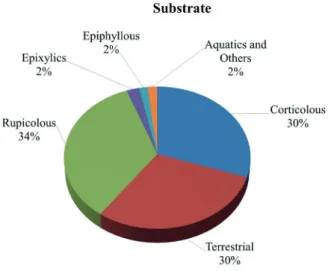
Regarding substrate colonization, a predominance of rupicolous bryophytes was observed in Serra da Canastra National Park. Among the 1,177 bryophyte samples collected, 406 were on rocky substrates, 356 were corticolous, 349 terrestrial, 27 epiphyllous and 18 epixylic (Fig. 1). Mosses that were found growing submerged or under the water were considered aquatic and, with other different substrates types (termite mound, litter), represented 21 samples (Fig. 1).
In other studies conducted in Minas Gerais, species of bryophytes showed a preference for corticolous substrates (Yano & Peralta 2011b; Luizi-Ponzo et al. 2013), such as growing on the trunks of living trees. In their study focusing on gallery forests of Serra do Cipó, Souza & Câmara (2015) also observed a preference for corticicolous substrates and explanained this finding on the abundance of this substrate in the area, but concluded that ecological studies are needed to verify this hypothesis. Following this reasoning, the large amount of rupicolous species in Serra da Canastra National Park is likely due to the presence of many rocks, especially in areas near waterfalls and in rocky fields, since the methodology of collection was the same for all vegetation types. However, as with the gallery forest of Serra do Cipó, ecological study is necessary to conclude this hypothesis.
Our study collected 27 samples (Fig. 1) of epiphyllous bryophytes, which are those species that grow on living leaves. The family Lejeuneaceae was the only family found
growing on this type of substrate in Serra da Canastra National Park. According to Gradstein et al. (2001), this family can colonize many types of substrates, but the epiphyllous habit is common in preserved native areas, which highlights the exigency for the protection of Serra da Canastra National Park.
Worldwide and Brazilian distribution
Concerning worldwide distribution, a predominance of Neotropical species was observed in Serra da Canastra National Park, with 89 species. This was followed by 61 tropical America species, 41 Brazilian endemic species, 39 cosmopolitan species, 33 pantropical species and 26 with disjunct distributions with the Andes, Africa and other countries of South America (Fig. 2) (Tab. 1).
Most of these species (132) have a wide geographic distribution in Brazil, accounting for 46% of bryophytes found in the area (Tab. 1). These species are typically generalists and easily occupy a variety of environments and several types of substrates. Examples of such mosses (Bryophyta) include Bryum argenteum, Hyophila involuta, Octoblepharum albidum, Sematophyllum subpinnatum and Syrrhopodon prolifer. Example of such liverworts (Marchantiophyta) include Frullania ericoides and Lejeunea flava (Forzza et al. 2010). Ninety species (31%) had a moderate distribution and 67 (23%) were considered rare (Tab. 1).
We found 56 new species for the state of Minas Gerais, which represents 19% of the total bryophyte species collected. Among these, 36 species (64%) have a “rare” distribution in Brazil, 13 (23%) a “moderate” distribution and seven (13%) a “wide” distribution (Tab. 1). Campylopus densicoma was first recorded for Minas Gerais and has a “rare” distribution, being previously found only in Rio de Janeiro, and is considered an endangered species (Costa et al. 2013).
The data obtained through this study show that the Serra da Canastra National Park is an important area for bryophyte diversity and conservation, especially since there remain many species to be discovered.
Phytogeographic domains
Serra da Canastra National Park is located in the Cerrado domain (IBDF 1981). However, most of the species (62) found in the park are considered exclusive to the Atlantic Forest domain, such as Bryum caespiticium, Squamidium brasiliense, Syrrhopodon tortilis and Wijkia flagellifera for Bryophyta (Souza & Câmara 2015) and Bazzania heterostipa, Calypogeia grandistipula, Frullania schaefer-verwimpii and Lejeunea cristulata for Marchantiophyta (Yano 2008).
Moreover, the present study also found some Brazilian endemic species, which had so far been only recorded for the Amazon Rainforest domain, such as Cololejeunea contractiloba and Lejeunea erostrata of Marchantiophyta, and Sphagnum dimorphophyllum for Bryophyta (Costa et al. 2011). Perhaps these results are due to gaps in collections of material from areas of the Brazilian Highlands, such as Serra da Canastra (Gradstein et al. 2001; Costa et al. 2011), which is reflected in the great number of new occurrences observed in this study.
Some typical Cerrado species were found, such as Riccardia regnelli, Mesonodon regnellianus, Campylopus dichrostis, Leucobryum clavatum and Jonesiobryum cerradense, as well as some species exclusive to the Cerrado, for example, Itatiella denudata, Sphagnum delamboyense and Sphagnum garysmithii (Costa et al. 2011).
The two species endemic to Serra da Canastra National Park, Itatiella denudata and Sphagnum geraisense, were recollected during this study reinforcing the importance of maintaining Serra da Canastra National Park for the conservation of endemic species (Romero & Nakajima 1999) as well as the great diversity of other bryophytes found in this study.
This study has provided new information on bryophyte richness, occurrence, occupied phytophysiognomies and worldwide and Brazilian distributions, particularly those occurring in mountain areas of the Brazilian Highlands, where more floristic studies on bryophytes are needed. The large number of species found in the park (289 spp.), accounting for approximately 38% of the species known in Minas Gerais and 19% in Brazil, the new records for this state (56 spp.) and the number of Brazilian endemic species (41 spp.), stress the importance of performing floristic inventories in Brazil and maintaining Serra da Canastra National Park for conservation as a biological reserve.
Acknowledgments
We acknowledge the Botanical Institute of São Paulo (Instituto Botânico deSão Paulo) and the Bryology Section
(Seção de Briologia) for the support of all the necessary equipment throughout the study. We also acknowledge CAPES for financial support and ICMBIO for the license n° 39601-2 granted collecting in the area.
References
Ballejos J, Bastos CJP. 2009. Musgos Pleurocárpicos do Parque Estadual das Sete Passagens, Miguel Calmon, Bahia, Brasil. Hoehnea36: 479-495. Bastos CJP, Vilas Bôas-Bastos SB. 2008. Musgos Acrocárpicos e Cladocárpicos (Bryophyta) da Reserva Ecológica da Michelin, Igrapiúna, Bahia, Brasil. Stientibus Série Ciências Biológicas 8: 275-279.
Bastos CJP, Yano O, Vilas Bôas-Bastos SB. 2000. Briófitas de Campos rupestres da Chapada Diamantina, Estado da Bahia, Brasil. Revista Brasileira de Botânica 23: 357-368.
Bates JW. 2009. Mineral nutrition and substratum ecology. In: Goffinet B, Shaw AJ. (eds.) Bryophyte Biology. 2nd. edn. New York, Cambdrige University Press. p. 299-356.
Bordin J, Yano O. 2013. Fissidentaceae (Bryophyta) do Brasil. Boletim do Instituto de Botânica22: 1-72.
Buck WR. 1998. Pleurocarpous Mosses of the West Indies. Memoirs of The New York BotanicalGarden 1: 1-401.
Câmara PEAS. 2008a. Musgos pleurocárpicos das matas de galeria da Reserva Ecológica do IBGE, RECOR, Distrito Federal, Brasil. Acta Botanica Brasilica 22: 573-581.
Câmara PEAS. 2008b. Musgos acrocárpicos das Matas de Galeria da Reserva Ecológica do IBGE, RECOR, Distrito Federal, Brasil. Acta Botanica Brasilica 22: 1027-1035.
Câmara PEAS, Costa DP. 2006. Hepáticas e antóceros das matas de galeria da Reserva Ecológica do IBGE, RECOR, Distrito Federal, Brasil. Hoehnea 33: 79 - 87.
Carvalho-Silva M, Guimarães EF. 2009. Piperaceae do Parque Nacional da Serra da Canastra, Minas Gerais, Brasil. Boletim de Botânica da Universidade de São Paulo 27: 235-245.
Castro NMCF, Pôrto KC, Yano O, Castro AAJF. 2002. Levantamento florístico de bryopsida de cerrado e mata ripícola do parque nacional de Sete Cidades, Piauí, Brasil. Acta Botanica Brasilica 16: 61-76. Costa DP, Peralta DF. 2015. Briófitas In: Lista de Espécies da Flora do
Brasil. Jardim Botânico do Rio de Janeiro. http://floradobrasil.jbrj. gov.br/jabot/floradobrasil/FB128472. 19 Aug. 2015.
Costa DP, Pôrto KC, Luizi-Ponzo AP, et al. 2011. Synopsis of the Brazilian moss flora: checklist, distribution and conservation. Nova Hedwigia 93: 277-334
Costa DP, Fernandez EP, Monteiro NP, Messina T. 2013. Dicranaceae. In: Martinelli G, Moraes MA. (eds.) Livro Vermelho da Flora do Brasil. Rio de Janeiro, CNCFLORA. p. 477-478.
Costa DP, Bastos CJP, Schäfer-Verwimp A. 2015. Lejeuneaceae In: Lista de Espécies da Flora do Brasil. Jardim Botânico do Rio de Janeiro. http://www.floradobrasil.jbrj.gov.br/jabot/floradobrasil/FB97355. 19 Aug. 2015.
Couto Jr AFC, Souza VV, Junior OAC, et al. 2010. Integração de parâmetros morfométricos e imagem aster para a delimitação das fitofisionomias da Serra da Canastra, Parque Nacional da Serra da Canastra, MG. Revista Brasileira de Geomorfologia 11: 57- 68.
Crandall-Stotler B, Stotler RE, Long DG. 2009. Morphology and classification of the Marchantiophyta. In: Goffinet B, Shaw AJ. (eds.) Bryophyte Biology. 2nd. edn. New York, Cambdrige University Press. p. 1-54.
Forzza RC, Leitman PM, Costa AF, et al. 2010. Introdução. In: Forzza RC, Baumgratz JFA, Bicudo CEM, et al. (eds.) Lista de espécies da Flora do Brasil. Jardim Botânico do Rio de Janeiro. Vol. 1. Rio de Janeiro, Jardim Botânico do Rio de Janeiro.
Frahm JP. 1991. Dicranaceae: Campylopodioideae, Paraleucobryoideae. Flora Neotropica Monograph54: 1-237.
Giulietti AM, Menezes NL, Pirani JR, Meguro M, Wanderley MGL. 1987. Flora da Serra do Cipó, Minas Gerais: caracterização e lista das espécies. Boletim de Botânica da Universidade de São Paulo 9: 1-151.
Goffinet B, Buck WR, Shaw AJ. 2009. Morphology, anatomy and classification of the Bryophyta. In: Goffinet B, Shaw AJ. (eds.) Bryophyte Biology. 2nd. edn. New York, Cambdrige University Press. p. 56-138.
Gradstein SR, Costa DP. 2003. The Hepaticae and Anthocerotae of Brazil. Memoirs of The New York Botanical Garden 87: 1-318.
Gradstein SR, Churchill, SP, Salazar-Allen N. 2001. Guide to the Bryophytes of Tropical America. Memoirs of The New York Botanical Garden 86: 1-577.
Groth-Malonek M, Heinrichs J, Schneider H, Gradstein SR. 2004. Philogenetic relationships in the Lejeuneaceae (Hepaticae) inferred using ITS sequences of nuclear ribosomal DNA. Organisms, Diversity and Evolution 4: 51-57.
Harley RM, Simmons NA. 1986. Florula of Mucugê. Chapada Diamantina - Bahia, Brazil. Kew, Royal Botanical Garden.
Holmgren PK, Keuken W, Schofield EK. 1981. Index Herbariorum. Part I. The herbaria of the world. 7th. edn. Utrecht/Antwerpen, Bohn, Scheltema & Holkema.
IBDF – Instituto Brasileiro de Desenvolvimento Florestal. 1981. Plano de manejo. Parque Nacional da Serra da Canastra. Brasília, IBDF. Ireland RR, Buck WR. 2009. Some Latin American Genera of Hypnaceae.
Smithsonian Contributions to Botany 93: p. 1–97.
Luizi-Ponzo AP, Siviero TS, Amorim ET, et al. 2013. Briófitas do Parque Estadual do Ibitipoca no Herbário Prof. Leopoldo Kriegeer. In: Forzza RC, Neto LM, Salimena FRG, Zappi D. (eds.) Flora do Parque Estadual do Ibitipoca e seu entorno. Vol. 4. 1st. edn. Juiz de Fora, Editora UFJF. p. 95-122.
Pirani JR, Giulietti AM, Mello-Silva R, Meguro M. 1994. Checklist and patterns of geographic distribution of the vegetation of Serra do Ambrósio, Minas Gerais, Brazil. Revista Brasileira de Botânica 17: 133-147.
Ramsay HP, Schofield WB, Tan BC. 2002. The family Sematophyllaceae (Bryopsida) in Australia. Part 1: Introduction, family data, key to genera and the genera Wijkia, Acanthorrynchium, Trismegistia and
Sematophyllum. The Journal of Hattori Botanical Laboratory 92: 1-50.
Renzaglia KS, Villarreal JC, Duff RJ. 2009. New insights into morphology, anatomy and systematics of hornworts. In: Goffinet B, Shaw AJ. (eds.) Bryophyte Biology. 2nd. edn. New York, Cambdrige University Press. p. 139-171.
Robbins RG. 1952. Bryophyte Ecology of a Dune Area in New Zealand. Vegetatio, Acta Geobotanica 4: 1-31.
Romero R, Nakajima JN. 1999. Espécies endêmicas do Parque Nacional da Serra da Canastra, Minas Gerais. Revista Brasileira de Botânica 22: 259-265
Schofield WB. 1985. Introduction to Bryology. New York, Macmillan Publisching Company.
Sharp AJ, Crum H, Eckel P. 1994. The Moss Flora of Mexico. Memoirs of The New York Botanical Garden 69: 1-1113.
Souza A, Costa M. 2011. Parque Nacional da Serra da Canastra. http:// www.serradacanastra.com.br/. 19 Aug. 2015.
Souza RV, Câmara PEAS. 2015. Survey of the bryophytes of a gallery forest in the National Park of Serra do Cipó, Minas Gerais, Brazil. Acta Botanica Brasilica 29: 24-29.
Stannard BL. 1995. Flora of the Pico das Almas, Chapada Diamantina - Bahia, Brazil. London, Kew, Royal Botanic Gardens.
Valente EB, Pôrto KC. 2006. Hepáticas (Marchantiophyta) de um fragmento de Mata Atlântica na Serra da Jibóia, município de Santa Terezinha, BA, Brasil. Acta Botanica Brasilica 20: 433-441.
Valente EB, Pôrto KC, Bastos CJP. 2011. Checklist of bryophytes of Chapada Diamantina, Bahia, Brazil. Boletim do Instituto de Botânica 21: 111-124.
Valente EB, Pôrto KC, Bastos CJP. 2013. Species Richness and Distribution of bryophythes within different phytophysiognomies in the Chapada Diamantina region of Brazil. Acta Botanica Brasilica 27: 294-310. Vilas Bôas-Bastos SB, Bastos CJP. 1998. Briófitas de uma área de cerrado no
município de Alagoinhas, Bahia, Brasil. Tropical Bryology 15: 101-110. Yano O. 2008. Catálogo de antóceros e hepáticas brasileiros: literatura
Brasil. In: Anais do 9o Congresso da Sociedade Botânica de São Paulo. São Paulo, Universidade Estadual Paulista. p.15-25.
Yano O, Peralta DF. 2009. Flora de Grão-Mogol, Minas Gerais. Briófitas (Bryophyta e Marchantiophyta). Boletim de Botânica da Universidade de São Paulo 27: 1-26.
Minas Gerais, Brasil. Boletim de Botânica da Universidade de São Paulo 21: 141-172.