Reliability and Construct Validity of the
Psychopathic Personality Inventory-Revised
in a Swedish Non-Criminal Sample
–
A
Multimethod Approach including
Psychophysiological Correlates of Empathy
for Pain
Karolina Sörman1*, Gustav Nilsonne1,2, Katarina Howner1, Sandra Tamm1,2,
Shilan Caman1, Hui-Xin Wang3, Martin Ingvar1, John F. Edens4, Petter Gustavsson5, Scott O Lilienfeld6, Predrag Petrovic1, Håkan Fischer7, Marianne Kristiansson1
1Department of Clinical Neuroscience, Karolinska Institutet, SE-171 77, Stockholm, Sweden,2Stress Research Institute, Stockholm University, SE-106 91, Stockholm, Sweden,3Aging Research Center, Karolinska Institutet and Stockholm University, SE-113 30, Stockholm, Sweden,4Department of
Psychology, Texas A&M University, College Station, TX, 77843, United States of America,5Department of Psychology, Karolinska Institutet, SE-171 77, Stockholm, Sweden,6Department of Psychology, Emory University, Atlanta, GA, 30322, United States of America,7Department of Psychology, Stockholm University, SE-106 91, Stockholm, Sweden
Abstract
Cross-cultural investigation of psychopathy measures is important for clarifying the nomo-logical network surrounding the psychopathy construct. The Psychopathic Personality Inventory-Revised (PPI-R) is one of the most extensively researched self-report measures of psychopathic traits in adults. To date however, it has been examined primarily in North American criminal or student samples. To address this gap in the literature, we examined PPI-R’s reliability, construct validity and factor structure in non-criminal individuals (N= 227) in Sweden, using a multimethod approach including psychophysiological correlates of empathy for pain. PPI-R construct validity was investigated in subgroups of participants by exploring its degree of overlap with (i) the Psychopathy Checklist: Screening Version (PCL: SV), (ii) self-rated empathy and behavioral and physiological responses in an experiment on empathy for pain, and (iii) additional self-report measures of alexithymia and trait anxiety. The PPI-R total score was significantly associated with PCL:SV total and factor scores. The PPI-R Coldheartedness scale demonstrated significant negative associations with all empathy subscales and with rated unpleasantness and skin conductance responses in the empathy experiment. The PPI-R higher order Self-Centered Impulsivity and Fearless Domi-nance dimensions were associated with trait anxiety in opposite directions (positively and negatively, respectively). Overall, the results demonstrated solid reliability (test-retest and
a11111
OPEN ACCESS
Citation:Sörman K, Nilsonne G, Howner K, Tamm S, Caman S, Wang H-X, et al. (2016) Reliability and Construct Validity of the Psychopathic Personality Inventory-Revised in a Swedish Non-Criminal Sample–A Multimethod Approach including Psychophysiological Correlates of Empathy for Pain. PLoS ONE 11(6): e0156570. doi:10.1371/journal. pone.0156570
Editor:Ulrich S Tran, University of Vienna, School of Psychology, AUSTRIA
Received:March 4, 2015
Accepted:May 17, 2016
Published:June 14, 2016
Copyright:© 2016 Sörman et al. This is an open access article distributed under the terms of the
Creative Commons Attribution License, which permits unrestricted use, distribution, and reproduction in any medium, provided the original author and source are credited.
Data Availability Statement:All relevant data are available at Dryad:10.5061/dryad.qh8c9.
Funding:The authors have no support or funding to report.
internal consistency) and promising but somewhat mixed construct validity for the Swedish translation of the PPI-R.
Introduction
Psychopathy is associated with a constellation of affective, interpersonal, and behavioral traits including egocentricity, dishonesty, fearlessness, lack of empathy and guilt, and poor impulse control [1]. However, consensus is lacking about the role of certain core features of psychopa-thy. The nature and manifestation of antisocial behavior in relation to psychopathy remains unclear [1], however see [2] for findings that antisociality is an integral part of psychopathy across diverse international samples. Moreover opinions diverge regarding whether seemingly adaptive features (e.g., lack of anxiety, social poise, emotional resilience) are part of the psy-chopathy construct [1,3,4]. These conceptual uncertainties stem partly from the dominance of one measure in the field during the past three decades: the Psychopathy Checklist-Revised (PCL-R) [5–6]. The PCL-R is an extensively validated interview and file-based measure that captures both the affective/interpersonal traits and behavioral features of psychopathy. During the last decade, some critics have argued that the heavy focus on antisocial and criminal behav-ior in PCL-based instruments has contributed to an underemphasis on affective and interper-sonal features in psychopathy (e.g., lack of empathy, fearlessness), unconfounded by
criminality [7], but see [8] for a competing view.
To obtain an improved understanding of the conceptualization and correlates of psycho-pathic traits in different settings, several self-report measures for psychopsycho-pathic traits in non-clinical samples have been developed, see [9] for a review. Moreover, new theoretical models of psychopathy have recently been developed that accord greater emphasis to affective and inter-personal psychopathic traits, with less emphasis on antisocial and criminal behavior [10–11]. To date, the Psychopathic Personality Inventory-Revised (PPI-R) [12] is the most widely researched self-report instrument for psychopathic traits in adults [13]. It has primarily been used in North American undergraduate or criminal samples [4], although some cross-cultural work is beginning to be conducted (e.g., [14–15]). Nevertheless, relatively little is known about the psychometric properties of this widely used measure in European nations.
In Sweden, previous research on psychopathy has mainly used PCL-based instruments to investigate violent behavior in institutionalized samples (e.g., [16–17]), or the Youth Psycho-pathic Traits Inventory (YPI) [18] to explore psychopathic traits in adolescent community samples (e.g. [19]). Research is needed on the prevalence and manifestation of psychopathic traits in non-criminal adults in Scandinavian samples. In this study, we translated the PPI-R into Swedish and investigated its psychometric properties; an important research endeavor given the dearth of research on cross-cultural manifestations of psychopathy (cf., [20–21]).
The Psychopathic Personality Inventory-Revised (PPI-R)
The PPI-R is a well-validated measure designed to capture core affective and interpersonal dis-positions of psychopathy (e.g., lack of empathy, guilt, and fear), with a less explicit focus on antisocial and otherwise deviant behaviors, which may be largely nonspecific to psychopathy [22]. The PPI-R is well-suited for use with both criminal and noncriminal groups [12]. It encompasses eight lower order factors/content scales [12] which some investigators have orga-nized into two higher-order factors (e.g., [23]): 1) Fearless Dominance (FD), encompassing the subscales Social Influence (SOI), Fearlessness (F) and Stress Immunity (STI), 2) Self-Centered
Impulsivity (SCI), encompassing the subscales Machiavellian Egocentricity (ME), Rebellious Nonconformity (RN), Blame Externalization (BE), and Carefree Nonplanfulness (CN). Several studies have failed to replicate this two-factor structure, however, [15], or have proposed alter-native factor structures [24]. In the two-factor structure, the Coldheartedness subscale (CH) has not loaded highly on either factor and tends to be discarded from analyses. The CH scale is proposed to be part of a wider personality domain with several content areas of relevance to empathic ability (e.g., affective detachment, sentimentality and guilt) [25]. At present however, the precise conceptualization of the CH scale remains uncertain and research is needed on its correlates using assessments from several domains (e.g., personality based, behavioral, physio-logical) [25].
Across studies, the PPI-R higher order factors tend to be orthogonal or weakly correlated, and are often associated with measures of personality and behavior in opposite directions [23,
26]. For example, FD has been associated with positive social adjustment and an outgoing per-sonality style (e.g., extraversion, venturesomeness) and low levels of anxiety, but also certain maladaptive outcomes including self-reported narcissism. In contrast, SCI has been associated with neuroticism and negative emotionality as well as externalizing behaviors (e.g., aggression and antisocial behavior) [23,27].
In this study, the construct validity of the PPI-R was investigated in relation to self-report measures of theoretically relevant criterion variables: primarily empathy; but also alexithymia and anxiety-proneness in subgroups of participants. Associations between psychopathic traits and empathic ability were further investigated in relation to behavioral and physiological mea-sures in an experiment examining empathy for pain [28]. The investigation of relations among measures drawn from different domains (e.g., self-report and interview based, behavioral and biological variables) is in line with a contemporary movement in broader personality research emphasizing the need to explore neurobiologically influenced transdiagnostic mechanisms [29–30]. Consistent with this approach, the“dual process model”proposes that the affective/ interpersonal and impulsive/antisocial component of psychopathy are underpinned by sepa-rate etiological mechanisms (i.e., trait fearlessness and externalizing vulnerability, respectively) characterized by distinct physiological correlates [30–31]. Bolstering this theory, several studies investigating PPI-assessed psychopathic traits have demonstrated unique associations between elevated FD and diminished fear reactivity (cf. [14,31–32]). Moreover, unique associations have been demonstrated between elevated SCI and different aspects of disinhibitory proneness, including higher skin conductance responses in a social stress test and diminished P3 ampli-tude [31,33]. Nevertheless, the dual process model largely omits the role of emotional detach-ment, as assessed by the PPI CH scale. Given that emotional detachdetach-ment, which includes impaired empathy, has long been proposed as one defining feature of psychopathy [34], research is needed on the psychophysiological correlates of the CH scale.
Current conceptualizations of empathy vary with respect to their emphasis on different components of the emotional response (e.g., affective response, emotional contagion, sympa-thy, cognitive perspective taking, motor empathy) [35]. More specifically, the nature of the emotional deficits in psychopathy is unclear. A prevailing view is that psychopaths demon-strate a specific deficit in emotional empathy [36]. Some recent findings, however, suggest that psychopathy may also be associated with an inadequate understanding of others’beliefs and intentions, often referred to as cognitive empathy [37]. In this study, empathy for pain was examined in light of the underlying premise that a core neurophysiological network becomes activated not only while experiencing pain, but also when observing others in pain [38–39].
describe one’s emotions [40]. Overlap between the emotional and interpersonal deficits in alex-ithymia and certain features of psychopathy (e.g., lack of insight, warmth and empathy), has been proposed, although the nature of this association remains unclear [40]. The conceptual relevance of diminished anxiety proneness to the psychopathy construct is controversial [1,13,
41–42]. Because the PCL-R was not explicitly designed to capture low anxiety as a feature of psychopathy, but see [43] for findings that low anxiety and fearlessness is indirectly incorpo-rated in the PCL-R factors, the PPI-R and several other instruments which capture a broader range of emotional and social features of psychopathy, may be more relevant for investigating associations between psychopathic traits and anxiety [44]. Because the PPI (the predecessor of the PPI-R) was designed in part to capture some of the more presumably adaptive features of psychopathy [45], low anxiety-proneness is of theoretical relevance to the PPI-R nomological network. Previous research has demonstrated that SCI and FD are associated with self-rated anxiety in opposite directions (positively and negatively, respectively) [15].
Aims
This study aimed to investigate reliability (test-retest and internal consistency), construct valid-ity, and factor structure of the Swedish translation of the PPI-R. The PPI-R’s construct validity was investigated in subgroups of participants by examining its degree of overlap with (i) the Psychopathy Checklist: Screening Version (PCL:SV), (ii) self-rated empathy as well as behav-ioral and physiological responses in an experiment on empathy for pain, and (iii) additional self-report measures of alexithymia and trait anxiety. Based on previous literature [23], we hypothesized that scores on the PPI-R would be positively related to PCL:SV total scores, par-ticularly with its affective/interpersonal Part 1. The CH-scale, which was developed to detect an absence of tender social emotions and a callous incapacity to sympathize with other’s suffer-ing [12], was expected to demonstrate a negative association with self-rated emotional empathy and with behavioral/physiological outcomes in the empathy for pain experiment, but a positive association with alexithymia. Based on community research [15], we further hypothesized that SCI and FD would be associated with self-rated trait anxiety in opposite directions (positively and negatively, respectively).
Materials and Methods
Participants
The sample consisted of 227 individuals (81.1% men;M= 31.7 years,SD= 17.6, range 18–75). All participants were fluent in Swedish and reported no current or previous neurological/psy-chiatric illness or substance abuse. Most participants were pursuing university/college studies (n= 127, 57.2%), or had completed an advanced degree (n= 43, 19.4%) at the time of inclusion. Nine participants had missing information about educational background. Most participants (n= 184) were male. The nature and correlates of psychopathy in women remain controversial and largely unexplored [1,46], but see [47–48], for findings that the manifestation and corre-lates of psychopathy may differ between genders.
potential participants received the PPI-R via mail, of whom 59 completed the form. In Wave 4, participants were recruited from a brain imaging study on the effects of sleep loss. 90 partici-pants were invited to complete the PPI-R, and 83 did. The PPI-R was sent to participartici-pants by mail after their participation or handed over in person, and was completed by the participants in their own homes when they were not undergoing sleep deprivation. The Regional Ethical Review Board of Stockholm approved the studies (#2009/1128-31/3; 2009/1128-31/3; 2012/ 1098-31/2) and all participants provided informed consent.
Five participants had high scores (>45) on the Inconsistent Responding-40 (IR; described
below) scale, which assesses random or careless responding (see“Measures”), and were there-fore excluded [12]. Nineteen participants (8.4%) in the test- and two participants (3.8%) in the re-test session obtained an IR-40 score between 39 and 44, which could imply impaired validity of the PPI-R protocol [12].
Measures
ThePsychopathic Personality Inventory-Revised(PPI-R) [12] is a 154-item self-report measure using a Likert type scale (1 = false,2 = mostly false,3 = mostly true,4 = true). The PPI-R yields a total score as well as scores on eight content scales. The PPI-R also includes three validity scales; Deviant Responding, Virtuous Responding, and Inconsistent Responding-40, measur-ing aberrant respondmeasur-ing/malmeasur-ingermeasur-ing, socially desirable respondmeasur-ing, and random or careless responding, respectively. We translated the PPI-R and an authorized translator, blind to the original version, conducted back-translation. The back-translation was evaluated by the author of the original test and 10th author of this paper (SOL). The final translation was approved by the test publisher (Psychological Assessment Resources; PAR).
TheInterpersonal Reactivity Index(IRI) [49] is a 28-item self-report measure divided into four scales developed to capture different aspects of empathy: Empathic Concern (EC), reflect-ing other-oriented feelreflect-ings of warmth, compassion, and concern: Perspective Takreflect-ing (PT), reflecting a tendency to understand and adopt other’s psychological view; Personal Distress (PD), reflecting self-oriented feelings of anxiety and discomfort in tense interpersonal situa-tions; and Fantasy (FS), reflecting a tendency to imagine oneself in fictional situations. Factor analysis of the Swedish version showed that EC, PT and FS formed a common factor, whereas PD formed a largely separate factor [50].
The 20-itemToronto Alexithymia Scale(TAS-20) [51–52] encompasses three factors; Diffi-culty Identifying Feelings (DIF), reflecting difficulties distinguishing feelings from bodily sen-sations of emotions; Difficulty Describing Feelings (DDF), reflecting an inability to
communicate feelings to other individuals; and Externally Oriented Thinking (EOT), reflecting a cognitive preoccupation with the details of external events, rather than content associated with feelings and fantasies. Each item is rated on a 5-point Likert scale (from1 = strongly dis-agreeto5 = strongly agree). The scale has been validated in Swedish [53].
TheState-Trait Anxiety Inventory(STAI) [54] is a widely used 40-item self-report instru-ment for measuring anxiety in adults. It consists of two scales: the State Anxiety Scale (STAI-S), measuring current anxiety by asking respondents to rate how they feel at present, and the Trait Anxiety Scale (STAI-T), which assesses anxiety-related manifestations over extended periods by asking people how they typically feel. Items are scored using a 4-point Likert Scale (from0 = almost neverto4 = almost always).
PCL:SV interviews
and community groups [6]. The PCL:SV encompasses 12 items that are scored using a 3-point scale (0 = clearly not present,1 = maybe present,2 = clearly present). The items are parsed into two higher order factors: Part 1, reflecting affective and interpersonal features, and Part 2, reflecting social deviance.
A subgroup of randomly selected participants (n= 51) from waves 1–3 were invited to par-ticipate in a PCL:SV interview. Interviews were conducted by the first author (KS). For inter-rater reliability purposes, a random sub-sample of participants (n= 11) underwent a second, independent rating by another author (KH). Both interviewers underwent formal PCL-R train-ing and were blind to all other self-reported data when they performed the interviews.
Behavioral and physiological measures of empathy for pain
Participants in wave 1 underwent a behavioral experiment using a well-researched paradigm for empathy for pain [39,56]. In this experiment, participants received pain stimulation by electrical shocks to the forearm alternately with a confederate seated next to them, and we recorded their rated unpleasantness, skin conductance responses (SCRs), heart rate (only in a subsample), and activity of the superciliary corrugator muscle using electromyography (EMG). Detailed methods and main results have been reported elsewhere [28]. Empathic responses refer here to responses to viewing painful stimuli to the other person, compared with receiving shocks oneself. For the purpose of the present study, we examined the associations between the PPI-R higher order factors, including the CH scale, on the one hand, and experimental out-comes, on the other. In total, 61 participants were included in the behavioral experiment. Rea-sons for exclusion were as follows: pilot participants (n= 8); failure to understand instructions, or reported suspicions at debriefing that the confederate was not a naïve participant, or failure to reach sufficiently high pain (VAS 80,n= 14), exclusion due to technical problems (n= 1), and markedly high score (>45) on the Inconsistent Responding-40 subscale (see above)
(n= 1).
Missing data
Scales on any of the self-report measures with more than 20% missing item responses (two IRI-protocols, i.e. 1.2%, and four TAS-20 protocols, i.e. 2.4%) were excluded. Scales with less than 20% missing items were prorated based on means of completed items in the respective subscales (21 PPI-R test protocols, i.e. 9.2%; six PPI-R re-test protocols, i.e. 12.5%; one IRI-pro-tocol, i.e. 0.6%, and three TAS-20 protocols, i.e. 1.8%).
Analyses
Construct validity was investigated by correlating PPI-R subscales to the other measures included in the study. Interrater reliability of PCL:SV ratings was determined using intraclass correlation coefficients (ICCs) [57]. We used a two-way random effects model (ICCA1) for a
single rater with absolute agreement [58]. Independent samplest-tests were used to examine differences in PPI-R total scores between (a) participants who completed the PPI-R retest and those who did not and (b) participants who underwent a PCL:SV interview and those who did not. Cronbach’sαwas calculated using R version 2.15.2 (2012) with the ltm package [59], with
confidence intervals based on a bootstrap procedure with 1000 iterations.
RN, CN, BE), proposed by Benning and co-authors [23]. The second model (1b) permitted the subscale F to cross-load, given that it tends to load positively on both FD and SCI (e.g., [23]). The third model (2a) was a 3-factor model encompassing Factor 1 (SOI, STI); Factor 2 (ME, RN, BE, F); and Factor 3 (CH, CN) based on [24]. The fourth model (2a) was a restricted two-factor model, in which the CH scale was dropped and several alterations were made to the Fac-tor-2 scales: RN and F were permitted to cross load on Factor 1, and STI had a negative loading on Factor 2, also proposed by [24]. Estimations were carried out in the Mplus program version 7.1 using the maximum likelihood estimator [61] with the target rotation [60]. Model fit was evaluated by theχ2, Comparative Fit Index (CFI), Root Mean Square Error of Approximation
(RMSEA) and the Standardized Root Mean Square Residual (SRMR). CFI values>.95,
RMSEA<.06, and SRMR<.08 are generally considered indicators of adequate fit [62]. These
cut-offs were used as rule of thumb to compare the fit for the different models of PPI-R sub-scale associations.
Associations between the PPI-R higher-order factors and the behavioral/physiological mea-sures were calculated using mixed-effects models, as there were repeated meamea-sures from each participant. Analyses were performed in R with the nlme package [63]. Standardized regression coefficients were estimated for the PPI-R factors and the CH scale, as predictors of empathic responding.
Results
PPI-R descriptive statistics
The average PPI-R total score was 291 (SD= 32.9, range 201–368). Males obtained higher total scores on the PPI-R (M= 297.10,SD= 31.83) than females (M= 266.0,SD= 24.95);t(225) = 5.99,p<.01, Cohen’sd= 1.09.
Reliability: Test-retest and internal consistency
The PPI-R was mailed to all participants from Wave 1 for which current addresses were known (n= 82). Forty-eight individuals returned it (58.5%). Test-retest intervals averaged 95.5 days (range 6–199 days,SD= 46.3). Participants who did not complete the retest had higher PPI-R raw scores in the test session (M= 313.72,SD= 32.24) than participants who completed the retest (M= 299.00,SD= 27.03);t(78) = 2.21,p= .03, Cohen’sd= .49. PPI-R retest scores ran-ged from 240 to 377 (M= 300.31,SD= 31.05). Total score test-retest correlation was .89, p<.01. Test-retest correlations for PPI-R subscales ranged from .79 (CN) to .94 (F and FD), all
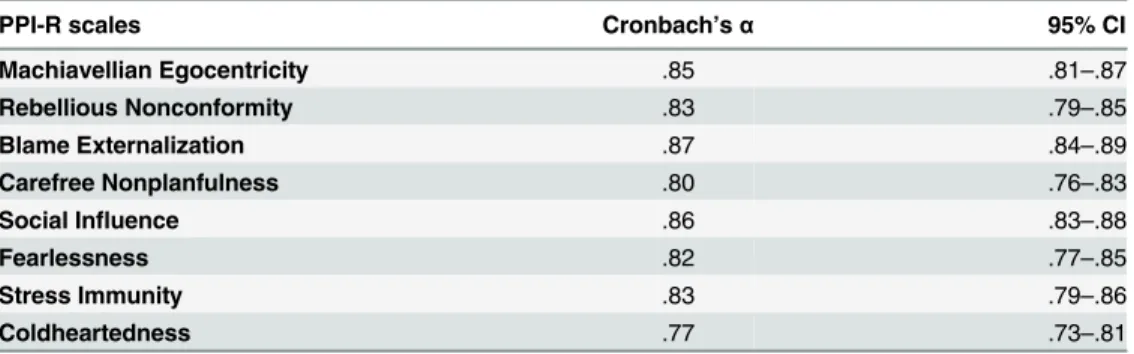
p<.01. All scales demonstrated good internal consistency (α= .80-.87, seeTable 1), although
the value for CH was slightly lower (α= .77).
PPI-R construct validity
Associations between PPI-R and PCL:SV. The PPI-R’s construct validity was
investi-gated primarily by examining associations between PPI-R and PCL:SV with Pearson correla-tions. PCL:SV total scores ranged between 0–15 (M= 1.49,SD= 2.75); Part 1 ranged between 0–10 (M= .57,SD= 1.69) and Part 2 ranged between 0–7 (M= .92,SD= 1.53). Most partici-pants (72.5%) obtained a total score of 0 or 1 and only six (11.8%) obtained a score of 5 or higher. No participant reached the suggested cutoff score for psychopathy (18). One partici-pant obtained a score of 15 which is above the suggested cutoff for“possible psychopathy”
[55]. Interrater reliability (ICCA1) was .90 for the total score, .92 for Part 1 and .85 for Part 2.
received a PCL:SV interview (M= 299.62,SD= 32.08) and participants who did not receive a PCL:SV interview (M= 300.83,SD= 31.12);t(144) = .22,p= .83, Cohen’sd= .04.
The two major PPI-R higher-order factors were significantly correlated, although this asso-ciation was only small to medium in magnitude (r= .26,p<.01). The PPI-R total score
demon-strated moderate correlations with PCL:SV total and Part 1 (Table 2). Neither FD nor CH demonstrated significant associations with PCL:SV total or factor scores. One outlier had a dis-proportionate impact on the PCL:SV total score as well as the score for Part 1 (e.g., the stan-dardized residual for PPI-R total score and PCL:SV Part 1 was 5.11), and was therefore removed from the analysis.
Associations between PPI-R factors and criterion measures. The PPI-R CH-subscale
demonstrated a strong negative association with the IRI-scale Empathic Concern (EC). It also demonstrated small to moderate negative associations with the three remaining empathy sub-scales (i.e., Perspective Taking, Personal Distress, Fantasy;Table 3). In the behavioral experi-ment, CH predicted low responses in empathy for pain on three out of four outcomes: rated unpleasantness, skin conductance responses, and corrugator activity (Table 4). Further regard-ing the empathy indices, FD was associated with the empathy subscales PT and PD in opposregard-ing directions (positively and negatively, respectively). Moreover, in the empathy experiment, FD predicted high self-rated unpleasantness in empathy for pain. SCI demonstrated a small posi-tive association with the Fantasy subscale of the IRI, but small negaposi-tive associations with the subscales Empathic Concern and Perspective Taking. Regarding the remaining criterion mea-sures, the PPI-R factors SCI and FD were associated with trait anxiety in opposing directions
Table 2. Pearson Correlations between PPI-R and PCL:SV, Total and Factor Scores (n= 50).
PPI-R PCL:SV Total Part 1 Part 2
Total .38** .43** .21
Fearless Dominance .13 .15 .05
Self-Centered Impulsivity .43** .48** .27
Coldheartedness .13 .19 .04
Note. Results presented without the outlier. PPI-R = Psychopathic Personality Inventory-Revised; PCL: SV = Psychopathy Checklist-ScreeningVersion.
*p<.05, **p<.01.
doi:10.1371/journal.pone.0156570.t002
Table 1. Internal Consistency for the PPI-R Content Scales.
PPI-R scales Cronbach’sα 95% CI
Machiavellian Egocentricity .85 .81–.87
Rebellious Nonconformity .83 .79–.85
Blame Externalization .87 .84–.89
Carefree Nonplanfulness .80 .76–.83
Social Influence .86 .83–.88
Fearlessness .82 .77–.85
Stress Immunity .83 .79–.86
Coldheartedness .77 .73–.81
Note.n= 227. PPI-R = Psychopathic Personality Inventory-Revised.
(positively and negatively, respectively). Finally, FD demonstrated a moderate negative associa-tion with self-reported alexithymia (Table 3).
PPI-R factor structure. Subscale correlations are shown inTable 5. With the 2-factor
model as a reference [23], (a) subscales in the SCI-dimension (i.e, RN, BE, ME) demonstrated weak to moderate correlations, withrs = .13–.55, (b) subscales in the FD-factor also correlated moderately (rs = .29-.35), and c) the F subscale correlated weakly to moderately with two of the SCI-scales (ME and RN). We analyzed the factor structure using four different ESEM models based on prior work. Two of them converged, but with poor fit (Table 6). We re-ran the ESEM-analyses with men separately. In line with the original finding, the results demonstrate that two of the models (1b and 2a) did not converge. The remaining models had a poor fit, with only minor changes in the fit indices (Table A inS1 File).
Discussion
This study made use of a multi-method approach that included (a) self-report measures (i.e., one measure of psychopathic traits and measures of criterion variables), (b) an interview based measure of psychopathic traits, and (c) behavioral and physiological indicators in an experi-ment of empathy for pain, to investigate the construct validity of the Swedish translation of the PPI-R. Previous research has examined cross-cultural manifestations of psychopathic traits in criminal and non-criminal samples using the PCL-R and its derivatives, including self-report measures [64–66]. A relatively recent study examined self-reported psychopathic traits in a large sample (N= 33,016; mainly encompassing college students or individuals from the com-munity) from multiple world regions [66]. In this study, psychopathic traits were assessed with the Self-Report Psychopathy (SRP) [67] scale, and the results demonstrated cultural differences
Table 3. Pearson Correlations between the PPI-R Factors, IRI-scales, STAI-T and TAS-20.
IRI STAI-T TAS-20
EC PT PD FS
Fearless Dominance .05 .22** -.41** .14 -.21** -.39**
Self-Centered Impulsivity -.16* -.21** .15 .29** .54** -.10
Coldheartedness -.63** -.36** -.26** -.18* .01 -.08
Note. IRI = Interpersonal Reactivity Index; EC = Empathic Concern; PT = Perspective Taking; PD = Personal Distress; FS = Fantasy; STAI-T = State Trait Anxiety Inventory-Trait; TAS-20; Toronto Alexithymia Scale.nvaries between 159 and 163, due to some missing cases. *p<.05,
**p<.01
doi:10.1371/journal.pone.0156570.t003
Table 4. Associations between PPI-R subscales and behavioral/physiological responding in empathy for pain (standardized regression coeffi-cientβ[95% CI]),n= 61 for all outcomes except heart rate responses, for whichn= 26.
Rated unpleasantness Skin conductance responses Heart rate responses Corrugator EMG responses
Fearless Dominance .15 [.07, .23]*** -.01 [-.10, .08] -.00 [-.20, .19] .04 [-.04, .12] Self-Centered Impulsivity -.06 [-.15, .02] .03 [-.06, .13] -.06 [-.31, .19] .05 [-.04, .14] Coldheartedness -.23 [-.31, -.15]*** -.14 [-.23, -.05]** -.01 [-.21, .19] -.08 [-.17, .00]
*p<.05, **p<.01, ***p<.001
in the expression of psychopathic traits. For example, individuals with elevated levels on the affective SRP-facet were more common among females from Western Europe, compared to females from other world regions [66]. Cross-cultural research on the PPI-R is lacking to date however. More specifically, research is needed in Scandinavian non-criminal adult samples. The findings in the current study contribute to knowledge regarding the PPI-R’s psychometric properties in a Swedish context, in which it has not been previously examined in research. Our mean PPI-R scores were comparable to those of a previous community study from Belgium [15] (Table B inS1 File). They are also lower than what has been reported from several delin-quent samples (cf. [24,68]). Our findings also add to knowledge regarding the correlates of psychopathic traits that are relevant to broader conceptualizations of psychopathy. This goal is important given that the PPI-R encompasses features (e.g., fearlessness, lack of anxiety) that have been emphasized in historical definitions of psychopathy but that are not explicitly included in PCL-based measures.
Overall, the results support reliability and construct validity of the PPI-R in a Swedish non-criminal setting. Reliability (test-retest and internal consistency) scores were similar to those obtained in the original validation studies [12]. The PPI-R’s construct validity was largely sup-ported by its positive correlation with the PCL:SV total and factor scores, which corroborates our hypothesis and replicates previous research [44]. The study also contributes new data regarding the correlations of the PPI-R CH-scale, a measure that remains underresearched and poorly understood [25].
Table 5. PPI-R subscale correlations total sample (n= 227).
Subscale 1 2 3 4 5 6 7 8
SCI FD CH
1.Rebellious Nonconformity (RN) - .42** .50** .30** -.16* .29** .46** -.04
2.Blame externalization (BE) - .55** .15* -.20** .19** .13* .05
3.Machiavellian Egocentricity (ME) - .13* -.13 .34** .34** .25**
4.Carefree Nonplanfulness (CN) - -.09 -.15* .07 .04
5.Stress Immunity (STI) - .30** .29** .28**
6.Social Influence (SOI) - .35** .01
7.Fearlessness (F) - .18**
8.Coldheartedness (CH)
-Note. *p<.05, **p<.01
doi:10.1371/journal.pone.0156570.t005
Table 6. Fit indices for proposed PPI-R factor structures analysed by Exploratory Structural Equation Modeling (ESEM).
Model Chi2 df P RMSEA CFI SRMR
1a 132.7 13 <.001 .201 .642 .116
1b* - - -
-2a* - - -
-2b 57.2 10 <.001 .144 .859 .061
Note.
*Model did not converge
Construct validity: associations with the PCL:SV
To evaluate construct validity, it is important to investigate convergent and discriminant asso-ciations between the target construct and theoretically relevant measures [68]. In our sample, SCI was the only PPI higher-order factor that correlated significantly with the PCL:SV and its factors. This finding dovetails with research suggesting that externalizing factors account largely for the covariation between PPI-R and PCL-R/SV [68]. SCI also demonstrated a corre-lation with PCL:SV Part 1 in the moderate to large effect range (r= .43). This finding ran counter to our prediction, as well as recent meta-analytic work demonstrating only modest cor-relations (averager= .21) between SCI and PCL-R F1 [26].
To explore this unexpected finding, we conducted supplementary analyses which revealed that the PPI-R subscale Machiavellian Egocentricity (ME) accounted for most of this covari-ance. This finding may be interpreted within the framework of the recently formulated triarchic model of psychopathy [11]. According to this model, ruthless exploitation of others, captured in the ME subscale, is encompassed within the triarchic domain of meanness (reflect-ing tendencies of callousness, lack of empathy, and aggression) and also in PCL-R factor 1 [11]. However, CH, which is proposed to reflect aspects of meanness not captured by SCI [11], did not demonstrate a significant correlation to the PCL:SV or its factor scores. This is an unex-pected finding given that meta-analytic work has demonstrated at least modest positive associ-ations between CH and both PCL-R factors [26]. More specifically, a preferential correlation has been demonstrated between CH and affective domains of psychopathy measures, assessing deficient empathy and guilt [15,44]. Another notable finding is that FD did not correlate sig-nificantly with the PCL:SV total or its factor scores. We predicted a preferential association between FD and PCL:SV Part 1, given that they both ostensibly assess core traits within Cleck-ley’s [69] conceptualization of psychopathy. Previous research has demonstrated at least mod-est associations between FD and PCL-R Factor 1, ranging from .20 and .45 [3]. Even though the lack of convergence in our study is surprising it is important to keep in mind that the differ-ent instrumdiffer-ents are based on partly diverging conceptualizations of psychopathy. More specifi-cally, the affective/interpersonal features in PCL-based assessments reflect largely maladaptive features of psychopathy. In contrast, the subscales in the FD factor encompass traits (fearless-ness, stress immunity, social poise) that are more explicitly adaptive. These quasi-adaptive fea-tures are also reflected in the boldness domain of the triarchic model of psychopathy [11]. Even though the construct validity of PPI-FD/boldness remains controversial, given that it appears to assess aspects of positive adjustment not captured by other measures [4,26], con-ceptualizations of PPI-FD/boldness are based on seminal models of psychopathy that empha-size certain adaptive characteristics, such as lack of nervousness and superficial charm (e.g., [69]). The relevance of boldness to the psychopathy construct was supported by a recent meta-analysis of 32 samples. The review yielded medium to large correlations between measures of boldness and non-PCL based psychopathy measures, which in contrast to the PCL, were not developed and validated in prison samples, which tend to be characterized by largely unsuc-cessful individuals [70]. In light of these partly divergent conceptualizations o psychopathy, the lack of overlap between PPI-R and PCL:SV should be interpreted in light of the degree to which the latter is used as a“benchmark”for psychopathy [44,71].
Additional self-rated criterion measures: empathy and anxiety
In line with our hypothesis, CH demonstrated significant negative associations with all four empathy subscales. This finding suggests that CH may assess deficient reactivity to others’
respectively). This finding replicates previous research [26] and suggests that trait anxiety is relevant to some features of the psychopathy construct. Even though a conceptual debate is ongoing regarding the role of deficient anxiety to psychopathy [1,41–43], lack of anxiety has been emphasized in historical definitions of psychopathy (cf. [72]), and is explicitly covered in the emergent conceptual models of psychopathy, particularly in the boldness domain in the triarchic model of psychopathy [11]. Moreover, recent research on psychopathic traits in com-munity groups has indicated that trait anxiety could be a marker to distinguish between differ-ent subgroups of individuals with elevated levels of psychopathic traits [73]. Therefore, more knowledge is needed on the association between trait anxiety and psychopathic traits in differ-ent groups.
FD correlated positively with one empathy scale (PT), and negatively to PD. Previous research has demonstrated a negative association between FD and emotional empathy [74], but see [15] for a partial positive correlation between FD and empathy total score encompass-ing both cognitive and emotional reactivity. In addition, FD was negatively associated with alexithymia, which may reflect the tendency of individuals with alexithymia to be prone to anx-iety [40].
Behavioral and physiological criterion measures: empathy for pain
Perceiving pain in others is considered to be a necessary component of empathic concern and a motivating factor for prosocial behavior [75]. Brain imaging research has demonstrated altered activity in neural networks crucial to empathic processing in psychopathic offenders compared to controls [75]. Skin conductance responses (SCRs) is an established physiological indicator of the affective component of empathy [76]. Attenuated emotional processing assessed with SCRs has been demonstrated in offenders with various psychiatric diagnoses however without psy-chopathy [77]. In a similar vein, a recent study on empathy for pain demonstrated reduced SCRs following the experimental stimuli in incarcerated offenders compared to controls, regardless of the offenders’degree of psychopathic traits [76]. In this same study, degree of PPI-assessed psychopathic traits in the control subjects were unrelated to SCRs [76]. It is important to further investigate emotion processing in relation to different subfactors of psy-chopathy, given that they might be underpinned by different etiological processes [78]. Research is lacking on physiological correlates of the CH-scale specifically. In our study, the CH-scale predicted lower rated unpleasantness and smaller SCRs to others’pain, further sup-porting the validity of the subscale. This is in line with previous research demonstrating a nega-tive association between elevated scores on the CH-scale and motor cortex excitability in an experiment on empathy for pain among healthy community participants [79].
Factor analyses
demonstrated in previous research [24,74,81]. This finding is interesting in light of the ongo-ing debate regardongo-ing whether FD reflects aspects of positive adjustment (cf. [82]), or whether it also encompasses maladaptive features captured by SCI.
Limitations
Despite its strengths, including our use of multiple methods, this study was marked by several limitations. In particular, the results are not easily generalizable to broader community groups, due to highly selected participants (i.e., mainly degree holders). Another potential limitation of the study is its inclusion of a mixed gender sample. In principle, some of our positive findings could have been spurious, reflecting an“admixture problem”, in which a correlation between two variables emerges when combining two samples in which these variables are uncorrelated [83]. To address this concern, in subsidiary analyses we conducted subgroup analyses by gen-der (Tables C-D inS1 File) and found that there are instances (e.g., the correlation between FD and IRI-EC), where the results for the entire group is inflated or deflated. Due to these addi-tional tests, we report both uncorrected significance and false discovery rate (FDR)-corrected significance (Tables C-D inS1 File). Overall however, the subgroup analyses did not change substantively the interpretations of the correlations. It is also worth noting that several previous studies on PPI-R assessed subclinical psychopathic traits have used mixed-gender samples (e.g., [84–85]). Hence, our major positive results appear to apply to both men and women. To account for the multitude of tests, the analyses in Tables2and4were also re-computed using FDR-corrected significance (Tables E-F inS1 File).
Some of the analyses were underpowered. Overall therefore, results that replicate or contra-dict previous research might be due to the relatively small sample size. Findings regarding the PPI-higher order factors should be interpreted with some caution, given that the factor analysis failed to demonstrate the two-factor structure previously proposed [23]. The lack of factor structure replication could reflect problematic aspects on the item level, given that researchers thus far have examined the PPI-scales in factor analyses [24,86]. Our sample was not large enough, however, to investigate factor loadings of individual items. Future studies should investigate the Swedish translation of the PPI-R in large community and correctional samples, including both men and women.
Future studies would benefit from additional behavioral correlates of the criterion variables of interest, such as indices of physical aggression.
Conclusion
This study demonstrated good reliability and promising but somewhat mixed construct valid-ity for the Swedish translation of the PPI-R. Even though the factor findings should be inter-preted with some caution given the failure to replicate the proposed factor structure, the results provide preliminary evidence that the PPI-R higher-order factors reflect distinct dimensions given their convergent and discriminant relations with external variables of relevance to psychopathy.
Supporting Information
S1 File. TABLE A, Fit indices for proposed PPI-R factor structures analysed by Exploratory
PCL:SV, Total and Factor Scores (n= 50). TABLE F, Associations between PPI-R subscales and behavioral/physiological responding in empathy for pain (standardized regression coeffi-cientβ[95% CI]),n= 61 for all outcomes except heart rate responses, for whichn= 26. (DOC)
Acknowledgments
The authors are grateful to Mikael Granlöf, authorized translator, for assistance in back transla-tion of the PPI-R, and to Hanna Thuné for valuable contributransla-tions to data collectransla-tion.
Author Contributions
Conceived and designed the experiments: KS GN KH PP HF MK MI. Performed the experi-ments: KS GN KH ST PP HF MK. Analyzed the data: KS GN HXW JFE PG SOL. Wrote the paper: KS GN KH ST SC HXW JFE PG SOL PP HF MK MI.
References
1. Skeem J, Polaschek D, Patrick C, Lilienfeld S. Psychopathic personality: Bridging the gap between sci-entific evidence and public policy. Psychol Sci Public Interest, 2011; 12: 95–162. doi:10.1177/ 1529100611426706PMID:26167886
2. Neumann CS, Hare RD, Pardini DA. Antisociality and the Construct of Psychopathy: Data From Across the Globe. J Pers, 2015; 83: 678–92. doi:10.1111/jopy.12127PMID:25181550
3. Lilienfeld SO, Patrick CJ, Benning SD, Berg J, Sellbom M, Edens JF. The role of fearless dominance in psychopathy: confusions, controversies, and clarifications. Personal Disord, 2012; 3: 327–40. doi:10. 1037/a0026987PMID:22823232
4. Miller JD, Lynam DR. An examination of the Psychopathic Personality Inventory's nomological network: a meta-analytic review. Personal Disord, 2012; 3: 305–26. doi:10.1037/a0024567PMID:22452764 5. Hare RD (1991). The Hare Psychopathy Checklist—Revised. Toronto: Multi-Health Systems 6. Hare RD (2003). The Hare Psychopathy Checklist-Revised manual ( 2nd ed.). North Tonawanda, NY:
MHS
7. Skeem JL, Cooke DJ. Is criminal behavior a central component of psychopathy? Conceptual directions for resolving the debate. Psychol Assess, 2010; 22: 433–445. doi:10.1037/a0008512PMID:20528069 8. Hare RD, Neumann CS. Psychopathy as a clinical and empirical construct. Annu Rev Clin Psychol,
2008; 4:217–46 doi:10.1146/annurev.clinpsy.3.022806.091452PMID:18370617
9. Lilienfeld SO, Fowler KA. The self-report assessment of psychopathy: Problems, pitfalls, and promises. In: Patrick CJ, editor. Handbook of psychopathy. New York: NY: Guilford Press; 2006. pp. 107–132. 10. Cooke DJ, Hart SD, Logan C, Michie C. Explicating the Construct of Psychopathy: Development and
Validation of a Conceptual Model, the Comprehensive Assessment of Psychopathic Personality (CAPP). Int J Forensic Ment Health, 2012; 11: 242–252.
11. Patrick CJ, Fowles DC, Krueger RF. Triarchic conceptualization of psychopathy: Developmental origins of disinhibition, boldness, and meanness. Dev Psychopathol, 2009; 21: 913–938. doi:10.1017/ S0954579409000492PMID:19583890
12. Lilienfeld SO, Widows MR (2005).Psychopathic Personality Inventory—Revised (PPI-R) professional
manual. Odessa, FL: Psychological Assessment Resources
13. Derefinko KJ. Psychopathy and Low Anxiety: Meta-Analytic Evidence for the Absence of Inhibition, Not Affect. J Pers, 2015; 83: 693–709. doi:10.1111/jopy.12124PMID:25130868
14. López R, Poy R, Patrick CJ, Moltó. Deficient fear conditioning and self-reported psychopathy: The role of fearless dominance. Psychophysiology, 2013; 50: 210–218. doi:10.1111/j.1469-8986.2012.01493.x PMID:23240559
15. Uzieblo K, Verschuere B, Van den Bussche E, Crombez G. The validity of the psychopathic personality inventory—revised in a community sample, Assessment, 2010; 17: 334–46. doi:10.1177/
1073191109356544PMID:20040727
17. Långström N, Grann M. Psychopathy and violent recidivism among young criminal offenders. Acta
Psy-chiatr Scand Suppl, 2002; 412: 86–92 PMID:12072135
18. Andershed H, Kerr M, Stattin H, Levander S. Psychopathic traits in non-referred youths: A new assess-ment tool. In: Blau E, Sheridan L, editors. Psychopaths: Current international perspectives. Amster-dam, Netherlands: Elsevier; 2002. pp. 131–158.
19. Forsman M, Lichtenstein P, Andershed H, Larsson H. Genetic effects explain the stability of psycho-pathic personality from mid- to late adolescence. J Abnorm Psychol, 2008; 117: 606–17. doi:10.1037/ 0021-843X.117.3.606PMID:18729612
20. Cooke DJ, Michie C, Hart SD, Clark D. Assessing psychopathy in the UK: concerns about cross-cul-tural generalizability. Br J Psychiatry, 2005; 186: 335–41. PMID:15802692
21. Sullivan EA, Abramowitz CS, Lopez M, Kosson DS. Reliability and Construct Validity of the Psychopa-thy Checklist—Revised for Latino, European American, and African American Male Inmates. Psychol Assess, 2006; 18: 382–392. PMID:17154759
22. Lilienfeld SO. Conceptual problems in the assessment of psychopathy. Clin Psychol Rev, 1994; 14: 17–38.
23. Benning SD, Patrick CJ, Hicks BM, Blonigen DM, Krueger RF. Factor structure of the Psychopathic Personality Inventory: Validity and implications for clinical assessment. Psychol Assess, 2003; 15: 340–350. PMID:14593834
24. Neumann CS, Malterer MB, Newman JP. Factor Structure of the Psychopathic Personality Inventory (PPI): Findings from a Large Incarcerated Sample. Psychol Assess, 2008; 20: 169–174. doi:10.1037/ 1040-3590.20.2.169PMID:18557694
25. Berg JM, Hecht LK, Latzman RD, Lilienfeld SO. Examining the Correlates of the Coldheartedness Fac-tor of the Psychopathic Personality InvenFac-tory-Revised. Psychol Assess, 2015: 27: 1494–9. doi:10. 1037/pas0000129PMID:25915788
26. Marcus DK, Fulton J, Edens JF. The Two-Factor Model of Psychopathic Personality: Evidence From the Psychopathic Personality Inventory. Personal Disord, 2013; 4: 67–76. doi:10.1037/a0025282 PMID:23355982
27. Patrick CJ, Edens JF, Poythress NG, Lilienfeld SO, Benning SD. Construct Validity of the Psychopathic Personality Inventory Two- Factor Model With Offenders. Psychol Assess, 2006; 18: 204–208. PMID: 16768596
28. Nilsonne G, Tamm S, Golkar A, Olsson A, Ingvar M, Petrovic P. No effect of 25 mg oxazepam on physi-ological and self-rated responses to pain in others: a randomized controlled experiment; 2015. Data-base: figshare [Internet. Accessed: doi:10.6084/m9.figshare.1558201
29. Patrick CJ, Venables NC, Yancey JR, Hicks BM, Nelson LD, Kramer MD. A construct-network approach to bridging diagnostic and physiological domains: application to assessment of externalizing psychopathology. J Abnorm Psychol, 2013; 122: 902–16. doi:10.1037/a0032807PMID:24016026 30. Venables NC, Hall JR, Yancey JR, Patrick CJ. Factors of psychopathy and electrocortical response to
emotional pictures: Further evidence for a two-process theory. J Abnorm Psychol, 2015; 124: 319–28. doi:10.1037/abn0000032PMID:25603361
31. Dindo L, Fowles D. Dual temperamental risk factors for psychopathic personality: evidence from self-report and skin conductance. J Pers Soc Psychol, 2011; 100: 557–66. doi:10.1037/a0021848PMID: 21186933
32. Vaidyanathan U, Patrick CJ, Bernat EM. Startle reflex potentiation during aversive picture viewing as an indicator of trait fear. Psychophysiology, 2009; 46: 75–85. doi:10.1111/j.1469-8986.2008.00751.x PMID:19055499
33. Venables NC, Patrick CJ. Reconciling discrepant findings for P3 brain response in criminal psychopa-thy through reference to the concept of externalizing proneness. Psychophysiology, 2014; 51: 427–36. doi:10.1111/psyp.12189PMID:24579849
34. McCord W, McCord J. The psychopath: An essay on the criminal mind. Princeton, NJ: Van Nostrand; 1964.
35. De Vignemont F, Singer T. The empathic brain: how, when and why? Trends Cogn Sci, 2006; 10: 435–
41. PMID:16949331
36. Blair RJ. Fine cuts of empathy and the amygdala: Dissociable deficits in psychopathy and autism. Q J Exp Psychol, 2008; 61: 157–170.
37. Brook M, Kosson DS. Impaired Cognitive Empathy in Criminal Psychopathy: Evidence From a Labora-tory Measure of Empathic Accuracy. J Abnorm Psychol, 2013; 122: 156–166. doi:10.1037/a0030261 PMID:23067260
39. Lamm C, Decety J, Singer T. Meta-analytic evidence for common and distinct neural networks associ-ated with directly experienced pain and empathy for pain. Neuroimage, 2011; 54: 2492–502. doi:10. 1016/j.neuroimage.2010.10.014PMID:20946964
40. Haviland MG, Sonne JL, Kowert PA. Alexithymia and Psychopathy: Comparison and Application of California Q-set Prototypes. J Pers Assess, 2004; 82: 306–16. PMID:15151806
41. Schmitt WA, Newman JP. Are all psychopathic individuals low-anxious? J Abnorm Psychol, 1999; 108: 353–358. PMID:10369046
42. Visser BA, Ashton MC, Pozzebon JA. Is low anxiety part of the psychopathy construct? J Pers, 2012; 80: 725–747. doi:10.1111/j.1467-6494.2011.00745.xPMID:22091687
43. Neumann CS, Johansson PT, Hare RD. The Psychopathy Checklist-Revised (PCL-R), Low Anxiety, and Fearlessness: A Structural Equation Modeling Analysis. Personal Disord, 2013; 4: 129–137. doi: 10.1037/a0027886PMID:22642462
44. Poythress NG, Edens JF, Lilienfeld SO. Criterion-Related Validity of the Psychopathic Personality Inventory in a Prison Sample. Psychol Assess, 1998; 10: 426–430.
45. Lilienfeld SO, Andrews BP. Development and preliminary validation of a self report measure of psycho-pathic personality traits in noncriminal populations. J Pers Assess, 1996; 66: 488–524. PMID:8667144 46. Cale EM, Lilienfeld SO. Sex differences in psychopathy and antisocial personality disorder: A review
and integration. Clin Psychol Rev, 2002; 22: 1179–207. PMID:12436810
47. Kreis MK, Cooke DJ. Capturing the psychopathic female: a prototypicality analysis of the comprehen-sive assessment of psychopathic personality (CAPP) across gender. Behav Sci Law, 2011; 29: 634–
48. doi:10.1002/bsl.1003PMID:21928398
48. Miller JD, Watts A, Jones SE. Does psychopathy manifest divergent relations with components of its nomological network depending on gender? Pers Individ Dif, 2011; 50: 564–569.
49. Davis MH. A multidimensional approach to individual differences in empathy. JSAS Catalog of Selected Documents in Psychology, 1980; 10, 85.
50. Cliffordson C. The hierarchical structure of empathy: Dimensional organization and relations to social functioning. Scand J Psychol, 2002; 43: 49–59. PMID:11885760
51. Bagby RM, Parker JDA, Taylor GJ. The Twenty-Item Toronto Alexithymia Scale-I. Item Selection and Cross-Validation of the Factor Structure. J Psychosom Res, 1994; 38: 23–32. PMID:8126686 52. Bagby RM, Taylor GJ, Parker JDA. The Twenty-Item Toronto Alexithymia Scale-II. Convergent,
Dis-criminant, and Concurrent Validity. J Psychosom Res, 1994; 38: 33–40. PMID:8126688
53. Simonsson‐Sarnecki M, Lundh LG, Törestad B, Bagby RM, Taylor GJ, Parker JD. A Swedish Transla-tion of the 20‐item Toronto Alexithymia Scale: Cross‐validation of the Factor Structure. Scand J Psy-chol, 2000; 41: 25–30. PMID:10731840
54. Spielberger CD. Manual for the State-Trait Anxiety Inventory. Palo Alto, CA: Consulting Psychologists Press; 1983.
55. Hart S, Cox D, Hare RD. Manual for the Psychopathy Checklist: Screening Version (PCL:SV). Toronto, Ontario, Canada: Multi-Health Systems; 1995
56. Singer T, Seymour B, O’Doherty J, Kaube H, Dolan RJ, Frith CD. Empathy for pain involves the affec-tive but not sensory components of pain. Science, 2004; 303: 1157–62. PMID:14976305
57. Shrout PE, Fleiss JL. Intraclass correlations: Uses in assessing rater reliability. Psychol Bull, 1979; 86: 420–428. PMID:18839484
58. McGraw KO, Wong SP. Forming inferences about some intraclass correlation coefficients. Psychol Methods, 1996; 1: 30–46.
59. Rizopoulos D. ltm: An R package for Latent Variable Modeling and Item Response Theory Analyses. J Stat Softw, 2006; 17: 1–25.
60. Marsh HW, Morin AJ, Parker PD, Kaur G. Exploratory structural equation modeling: an integration of the best features of exploratory and confirmatory factor analysis. Annu Rev Clin Psychol, 2014; 10: 85–
110. doi:10.1146/annurev-clinpsy-032813-153700PMID:24313568
61. Muthén B, Muthén L. Mplus User’s Guide v7 ( 6 ed.). Los Angeles, CA: Muthén & Muthén: 1998–2014. 62. Brown TA. Confirmatory Factor Analysis for Applied Research. New York: Guilford; 2006
63. Pinheiro J, Bates D, DebRoy S, Pinheiro J, Bates D, DebRoy S, et al. nlme: Linear and Nonlinear Mixed Effects Models; 2015. Accessed:http://CRAN-R-project.org/package=nlme
65. Mokros A, Neumann CS, Stadtland C, Osterheider M, Nedopil N, Hare RD. Assessing measurement invariance of PCL-R assessments from file reviews of North American and German offenders. Int J Law Psychiatry, 2011; 34: 56–63. doi:10.1016/j.ijlp.2010.11.009PMID:21122915
66. Neumann CS, Schmitt DS, Carter R, Embley I, Hare RD. Psychopathic traits in females and males across the globe. Behav Sci Law, 2012; 30: 557–74. doi:10.1002/bsl.2038PMID:22996170 67. Paulhus DL, Neumann CS, Hare RD. Manual for the Hare Self-Report Psychopathy scale. Toronto,
ON, Canada: Multi-Health-Systems; In press.
68. Malterer MB, Lilienfeld SO, Neumann CS, Newman JP. Concurrent Validity of the Psychopathic Per-sonality Inventory with Offender and Community Samples. Assessment, 2010; 17: 3–15. doi:10.1177/ 1073191109349743PMID:19955107
69. Cleckley H. The mask of sanity. St. Louis: C.V. Mosby; 1941
70. Lilienfeld SO, Smith SF, Sauvigné KC, Patrick CJ, Drislane LE, Latzman RD, et al. Is Boldness Rele-vant to Psychopathic Personality? Meta- Analytic Relations With Non-Psychopathy Checklist-Based Measures of Psychopathy. Psychol Assess, 2015. In press.
71. Hall JR, Drislane LE, Patrick CJ, Morano M, Lilienfeld SO, Poythress NG. Development and validation of Triarchic construct scales from the psychopathic personality inventory. Psychol Assess, 2014; 26: 447–61. doi:10.1037/a0035665PMID:24447280
72. Karpman B. On the need of separating psychopathy into two distinct clinical types: the symptomatic and the idiopathic. J Crim Psychopathol, 1941; 3: 112–137.
73. Drislane LE, Patrick CJ, Sourander A, Sillanmäki L, Aggen SH, Elonheimo H, et al. Distinct variants of extreme psychopathic individuals in society at large: evidence from a population-based sample. Per-sonal Disord, 2014; 5: 154–63. doi:10.1037/per0000060PMID:24512459
74. Benning SD, Patrick CJ, Blonigen DM, Hicks BM, Iacono WG. Estimating facets of psychopathy from normal personality traits: a step toward community epidemiological investigations. Assessment, 2005; 12: 3–18. PMID:15695739
75. Decety J, Skelly LR, Kiehl KA. Brain response to empathy-eliciting scenarios involving pain in incarcer-ated individuals with psychopathy. JAMA Psychiatry, 2013; 70: 638–45. doi:10.1001/jamapsychiatry. 2013.27PMID:23615636
76. Pfabigan DM, Seidel EM, Wucherer AM, Keckeis K, Derntl B, Lamm C. Affective empathy differs in male violent offenders with high- and low-trait psychopathy. J Pers Disord, 2015; 29: 42–61. doi:10. 1521/pedi_2014_28_145PMID:24932875
77. Wahlund K, Sorman K, Gavazzeni J, Fischer H, Kristiansson M, Attenuated subjective ratings and skin conductance responses to neutral and negative pictures in non-psychopathic mentally disordered offenders with various diagnoses. Psychiatry Res, 2010; 180: 30–4. doi:10.1016/j.psychres.2009.09. 009PMID:20493542
78. Veit R, Konicar L, Klinzing JG, Barth B, Yilmaz O, Birbaumer N. Deficient fear conditioning in psychopa-thy as a function of interpersonal and affective disturbances. Front Hum Neurosci, 2013; 25. doi:10. 3389/fnhum.2013.00706
79. Fecteau S, Pascual-Leone A, Théoret H. Psychopathy and the mirror neuron system: preliminary find-ings from a non-psychiatric sample. Psychiatry Res, 2008; 160: 137–44. doi:10.1016/j.psychres.2007. 08.022PMID:18599127
80. Hopwood CJ, Donnellan MB. How should the internal structure of personality inventories be evaluated? Pers Soc Psychol Rev, 2010; 14: 332–46. doi:10.1177/1088868310361240PMID:20435808 81. Edens JF, McDermott BE. Examining the construct validity of the Psychopathic Personality
Inventory-Revised: Preferential correlates of fearless dominance and self-centered impulsivity. Psychol Assess, 2010; 22: 32–42. doi:10.1037/a0018220PMID:20230149
82. Blonigen DM. Is fearless dominance relevant to the construct of psychopathy? Reconciling the dual roles of theory and clinical utility. Personal Disord, 2013; 4: 87–8. doi:10.1037/a0027152PMID:23339319 83. Lutz M, Kenakin T. Quantitative molecular pharmacology and informatics in drug discovery. John
Wiley & Sons; 1999.
84. Anderson JL, Sellbom M, Wygant DB, Salekin RT, Krueger RF. Examining the associations between DSM-5 section III antisocial personality disorder traits and psychopathy in community and university samples. J Pers Disord, 2014; 28: 675–97. doi:10.1521/pedi_2014_28_134PMID:24689766 85. Smith ST, Edens JF, Vaughn MG. Assessing the external correlates of alternative factor models of the
Psychopathic Personality Inventory-short form across three samples. J Pers Assess, 2011; 93: 244–
56. doi:10.1080/00223891.2011.558876PMID:21516583