Updating versus Exposure to Prevent
Consolidation of Conditioned Fear
Victoria Pile1, Thorsten Barnhofer1¤, Jennifer Wild2*
1Department of Psychology, Institute of Psychiatry, King’s College London, London, United Kingdom, 2Department of Experimental Psychology, University of Oxford, Oxford, United Kingdom
¤ Current address: Dahlem Institute for Neuroimaging of Emotions, Freie Universitaet Berlin, Berlin, Germany
Abstract
Targeting the consolidation of fear memories following trauma may offer a promising meth-od for preventing the development of flashbacks and other unwanted re-experiencing symp-toms that characterise Posttraumatic Stress Disorder (PTSD). Research has demonstrated that performing visuo-spatial tasks after analogue trauma can block the consolidation of fear memory and reduce the frequency of flashbacks. However, no research has yet used verbal techniques to alter memories during the consolidation window. This is surprising given that the most effective treatments for PTSD are verbally-based with exposure therapy and trauma-focused cognitive behavioural therapy gaining the most evidence of efficacy. Psychological therapies aim to reduce the conditioned fear response, which is in keeping with the preliminary finding that an increased propensity for fear conditioning may be a vul-nerability factor for PTSD. Our research had two aims. We investigated the degree to which individual differences in fear conditioning predict the development of PTSD symptoms. We also compared the preventative effects of two clinically informed psychological techniques
administered during the consolidation window:exposureto the trauma memory and
updat-ingthe meaning of the trauma. 115 healthy participants underwent a fear conditioning
para-digm in which traumatic film stimuli (unconditioned stimuli) were paired with neutral stimuli (conditioned stimuli). Participants were randomly allocated to an updating, exposure or con-trol group to compare the effects on the conditioned fear response and on PTSD symptom-atology. The results showed that stronger conditioned responses at acquisition significantly predicted the development of PTSD symptoms. The updating group, who verbally devalued the unconditioned stimulus within the consolidation window, experienced significantly lower levels of PTSD symptoms during follow-up than the exposure and control groups. These findings are consistent with clinical interventions for chronic PTSD and have important impli-cations for identifying those at risk as well as for designing novel early interventions to pre-vent the development of PTSD.
OPEN ACCESS
Citation:Pile V, Barnhofer T, Wild J (2015) Updating versus Exposure to Prevent Consolidation of Conditioned Fear. PLoS ONE 10(4): e0122971. doi:10.1371/journal.pone.0122971
Academic Editor:Melissa Norberg, Macquarie University, AUSTRALIA
Received:August 15, 2014
Accepted:February 17, 2015
Published:April 22, 2015
Copyright:© 2015 Pile et al. This is an open access article distributed under the terms of theCreative Commons Attribution License, which permits unrestricted use, distribution, and reproduction in any medium, provided the original author and source are credited.
Data Availability Statement:Data have been uploaded to the UK data archive (www.data-archive. ac.uk) with the data acquisition number 851654. Data requests may also be made to Dr. Jennifer Wild.
Funding:Work by JW is supported through Wellcome Trust grant 069777 (http://www.wellcome. ac.uk). The funders had no role in study design, data collection and analysis, decision to publish, or preparation of the manuscript.
Introduction
The majority of people (74% of women and 81% of men) will experience a traumatic event in their lifetime [1,2]; almost all of these people will initially develop post-traumatic stress symp-toms [3] and most will recover over time [4,5]. However, 9% will go on to develop post-trau-matic stress disorder (PTSD) [2]. The three most common traumas for men and women are the violent death of a friend or family member, witnessing severe injury or death and being in-volved in a serious motor vehicle accident [1]. PTSD is a distressing and debilitating condition which has serious long-term health implications for the individual, such as increased risk for cardiovascular disease [6,7], diabetes [8], Alzheimer’s disease [9] and early death [6] and cost implications for society, such as losses in work productivity. Re-experiencing symptoms are the hallmark feature of PTSD and include involuntary highly emotive and intensely distressing intrusions about the trauma. Meta-analyses indicate that peri-traumatic processes (occurring at or near the time of the trauma) and post-traumatic processes might be particularly impor-tant in understanding who develops PTSD and why [10,11].
There is a considerable body of research that has elucidated the memory processes involved in the development and maintenance of PTSD, including research on fear conditioning and memory consolidation [12], yet there have been surprisingly few attempts to investigate these processes in the context of prevention. This is important since there are currently no estab-lished interventions to prevent development of the disorder following exposure to trauma.
Conditioning theory and PTSD
Conditioning theory provides a compelling account of how re-experiencing symptoms may de-velop [12]. Fear conditioning is a process in which a neutral stimulus (conditioned stimulus; CS e.g. a tone) gains the ability to evoke fear following repeated pairing with an aversive stimu-lus (unconditioned stimustimu-lus; US, e.g. a shock). This is because the CS+ (CS paired with the US) becomes a signal for US onset by activating the memory representation of the US. In general, fear conditioning is an adaptive and highly important form of learning. However, it may also be at the heart of the pathogenic mechanisms leading to anxiety disorders and has been strong-ly implicated in theories for anxiety disorders [13,14].
Conditioning theories offer a promising explanation of some of the central features of PTSD including why previously neutral stimuli are capable of provoking physiological and emotional arousal. Consistent with conditioning theory, evidence suggests that people with PTSD show greater physiological reactivity to trauma-related cues following trauma exposure [15], PTSD severity moderates responsively to these cues [16–18] and changes in psychophysiology can predict development and persistence of PTSD as well as treatment outcome [19–21]. Increased acquisition of fear learning (i.e. larger conditioned responding to the CS+) has been demon-strated in people with anxiety disorders [22] and there is preliminary evidence that reduced ex-tinction learning may be a pre-trauma vulnerability factor for PTSD development [23]. A large prospective study illustrated that reduced extinction learning in soldiers before deployment to Afghanistan predicted PTSD symptom severity more strongly than neuroticism, pre-deploy-ment stress and exposure to stressors on deploypre-deploy-ment [24].
investigate whether increased acquisition of conditioned responding predicted the develop-ment of analogue PTSD symptoms.
Modifying the conditioned fear response is a central aim in therapies for PTSD with extinc-tion proposed as a method to achieve this. However, extincextinc-tion is not permanent and re-emer-gence of the original fear memory can occur. Re-emerre-emer-gence is commonly thought to happen under three general conditions:renewaloccurring when the CS+ is presented outside of the ex-tinction context [25],reinstatementoccurring when the US is administered unexpectedly and spontaneous recoveryoccurring when a substantial amount of time has passed [26]. These pro-cesses imply that extinction involves the creation of new memories (inhibitory stimulus associ-ation CS+/noUS) that compete with the original fear memory (CS+/US) rather than changing the memory directly [27,28]. An alternative to extinction, US devaluation, may offer a more fundamental way to reduce the conditioned fear response and prevent it from returning [29].
US devaluation involves changing the mental representation of the US, for example through information or experience with the US. Conditioning theory suggests that the CS+ does not di-rectly produce a conditioned response (CR) but rather triggers a representation of the US and that the evaluation of this US mediates the CR [30]. Therefore, the strength of the CR depends on the evaluation of the US and so altering this evaluation will modulate the CR’s strength, in-dependent of the CS/US contingency [30]. For example, if rats are habituated to the US, follow-ing CS/US pairfollow-ing, then they show less fear to the CS+ compared to controls [31]. Devaluation can occur even without direct exposure to the US and results in changes to the CR when the CS + is presented [32,33]. Effects in the opposite direction have also been documented, for exam-ple mild PTSD symptoms might become more severe if the person has reason to re-evaluate the danger of the original trauma (e.g. they found out that the person who assaulted them was a convicted murderer) [34]. The advantage of US devaluation, compared to extinction, is that it acts directly on the US representation and so may be less vulnerable to the return of fear and may more easily generalise.
Imagery rescripting, a therapeutic technique, has been proposed to act through US devalua-tion [29] and has been successfully applied to treating a number of anxiety disorders [35–37], including PTSD [38]. The technique involves activation of the distressing memory and then updating/rescripting of the memory with neutral or positive information. Two recent analogue studies illustrated that adding imagery rescripting to extinction training could reduce intrusion frequency [39] and the conditioned fear response at renewal as measured by US expectancy rat-ings but not skin conductance response (SCR) [33]. Therefore, US devaluation offers a promis-ing technique to optimise early interventions but requires further investigation.
Disrupting the consolidation of fear memories
the stored memory trace (or access to it) and/or learning a new interpretation of the CS. It is frequently proposed that the adaptive function of reconsolidation is to enable the updating of old memories with new information [44,46].
Targeting consolidation may offer a mechanism to re-write fear memories and protect against the long-term psychological and physiological effects of traumatic fear memories. Re-cently, promising results have arisen from studies using visuo-spatial tasks to block the consoli-dation of fear memory [47]. However, no research has yet used verbal techniques to alter memories during the consolidation window. This is surprising given that the most effective treatments of chronic PTSD are verbally-based and include a particular focus on the meaning of events. Leading cognitive theories suggest that re-experiencing symptoms and intrusions are due to the fear memory lacking sufficient integration with other autobiographical memories, a deficit that may arise as a consequence of shifts in information processing under high stress [48,49].
Therapeutic tools for early intervention
Cognitive behavioural techniques administered to people with acute stress disorder (ASD) in the first month after trauma have been shown to reduce rates of PTSD and anxiety [50,51] and are considered as the most effective early intervention so far [52]. The relative effectiveness of exposure to the trauma memory versus updating (a technique that combines exposure to the memory and cognitive restructuring) and whether these utilise different therapeutic mecha-nisms is contentious. Studies that have compared exposure and cognitive therapy at early inter-vention have shown mixed results: one illustrated comparable results in reducing PTSD [53] whilst another found that those receiving exposure were more likely to be in full remission at follow-up and achieve higher functioning than those receiving cognitive restructuring [54]. Some researchers suggest that exposure may be the critical component in CBT to prevent ASD developing into PTSD [51]. How similar the active treatment mechanism for these two tech-niques are, is debated and it might be that their relative effectiveness changes depending on PTSD chronicity and severity.
Therefore, the second aim of the current research was to compare common therapeutic techniques in order to inform the development of more effective interventions for early preven-tion. This was investigated by using trauma films to induce fear memories in healthy volun-teers. The trauma film paradigm offers an ecologically valid trauma analogue to investigate causal factors in PTSD development. Previous research using this paradigm has shown that changes in appraisal style [55] leads to fewer intrusions consistent with the assumption that verbal strategies to update the meaning of the US may serve as an effective strategy to prevent re-experiencing symptoms. In order to compare the effects of the different techniques, we used a US devaluation paradigm with a range of measures, using self-reports as well as a physiologi-cal measure, to capture the complexity of PTSD. Participants underwent a fear conditioning paradigm in which traumatic film stimuli (US) were paired with neutral stimuli (CS) in the ac-quisition phase, and participants were then allocated to one of three groups. The groups were designed to build on one another in an additive fashion: no intervention (control group), fur-ther exposure to the trauma films (exposure group) and furfur-ther exposure to the films plus addi-tional information aimed at updating the meaning of the trauma (update group).
Hypotheses
participants who have a smaller conditioned fear response following acquisition will experience fewer intrusions, be less distressed by them and report fewer PTSD symptoms in the week fol-lowing the trauma paradigm when trait anxiety is controlled for. As pre-trauma anxiety is asso-ciated with the development of PTSD [4,11] and people with higher trait anxiety have been shown to acquire aversive conditioning more strongly and more rapidly [56,57], it is important to control for trait anxiety when investigating this relationship. Second, that participants in the update group will (a) have the largest reduction in physiological responding and subjective dis-tress ratings following US devaluation compared to those in the exposure and control groups and will (b) experience fewer intrusions, be less distressed by them and have fewer PTSD symp-toms in the week following the trauma paradigm than the exposure or control groups.
Methods
Participants
We recruited healthy participants by poster and email advertisements. Exclusion criteria in-cluded being less than 18 years of age, having completed similar trauma studies, working in a hospital emergency department and having a clinically significant mental health problem as as-sessed by standardised self-report measures of anxiety, depression and PTSD. Twenty-five par-ticipants were excluded due to having clinically significant mental health problems and six participants were excluded for having previously completed a similar study or for having expe-rience in an emergency department. One hundred and fifteen participants met inclusion crite-ria and completed the experimental task: 28 males and 87 females with a mean age of 26.72 (SD = 7.84; range 18–56). Of these, two participants did not complete the follow-up question-naires leaving a sample of 113 participants for analyses involving follow-up data. All partici-pants gave informed consent and were paid for their participation. The Psychiatry, Nursing and Midwifery Research Ethics Committee at Kings College London gave approval for the study. All participants provided written informed consent prior to their participation in the study.
Procedure
We used an experimental between-subjects design with three main stages: a screening stage, ex-perimental session and a one-week follow-up period. After having time to read and consider the information sheet, participants were asked to complete the baseline measures and screening questionnaires on-line before attending the session. The experimental session comprised two consecutive phases: (1) acquisition and (2) US devaluation (Fig 1). During acquisition, all par-ticipants underwent a Pavlovian discrimination fear conditioning paradigm. Fear conditioning was measured using SCR amplitude and subjective distress ratings. Participants then took part in one of three US devaluation conditions, to which they had been allocated based on a prede-termined sequence produced by random number generation. In the week following the experi-mental phase, participants were asked to complete an intrusion diary to record any
spontaneously occurring memories that they experienced related to the film clips and to com-plete the follow-up questionnaires.
All participants took part in the acquisition phase. During acquisition, participants watched a series of six short film clips with introductory narratives and the CS+s embedded within them. The films contained real-life footage of humans and animals in distress. Each film con-tained an introductory voice-over which gave a narrative and context for the film (seeS1 Ap-pendix), as suggested by previous research [58]. The CS+ was inserted into the films to signal the most distressing part of the film. The length of the film clips ranged from 76 to 150 seconds, with a mean length of 108.5 seconds (SD 33.09). After watching the six trauma films, partici-pants viewed anintensive presentation phasein which the image and sound bite from the parts of the films previously paired with the CS+ (the worst moments) were presented again with the CS+. In this phase, the CS- was paired with neutral images. The CS+ was presented 10 times and the CS- presented 6 times during this phase. The US (an image and sound bite of the worst moment from each of the trauma films) was displayed for 3 seconds.
In the US devaluation phase, participants were randomly allocated to one of three US deval-uation groups: (1) update group (exposure plus verbal update): participants viewed the same films again but the introductory passage was elaborated to contain additional information about what happened to the protagonists in the films, (2) exposure group: the trauma films with the introductory passages were viewed again by participants, (3) control: participants viewed non-traumatic films of related content. Reinforced CSs were not presented for any of the groups in this phase.
The control group viewed films whose content was similar to the trauma films and would be commonly encountered by the participant, i.e. car journeys. In order to ensure that the control films alone did not provoke significant levels of distress and fear and that the content was rated as neutral, they were viewed by six pilot participants. The participants were asked to rate the control films for feelings of distress and fear (measured on a scale of 0 being not at all distress-ing/fear provoking to 100 being extremely distressdistress-ing/fear provoking) and rate the valence of Fig 1. Summary of procedure.
the films (with 0 being very positive and 100 being very negative). The films were rated as not producing significant distress (mean 2.50; SD 4.18) or fear (mean 2.50; SD 4.18) and their va-lence was rated as neutral (mean 48.67; SD 2.16). No intrusions related to the control films were reported by pilot participants.
Psychophysiological Assessment
Skin conductance response (SCR) signals were amplified with a BrainVision Quickamp with 22-bit A/D conversion and a resolution of 71.5 nV (range7150 mV) and digitised at a rate of 125 Hz. SCR was recorded through an auxiliary channel.
Electrodermal activity (EDA) was measured as skin conductance response (SCR) in con-stant voltage technique using the GSR module produced by Brain Products, which applied a constant voltage of 0.5 V. Sintered silver-silver chloride (Ag-AgCl) cup electrodes were at-tached to volar surfaces of the medial phalanges of the second and third finger of the non-dom-inant hand, using MedCaT skin conductance electrode paste (0.05M NaCL saturation) as electrolyte. The electrodes were metal discs set in cylindrical plastic cases that were filled with electrode gel and fixed to the skin using double-sided adhesive circular collars. A bandpass fil-ter of 0.0Hz to 2.00Hz was applied.
EDA data were segmented into 2 second epochs (beginning 2 seconds pre-stimulus) and 8 second epochs (beginning post-stimulus). SCR amplitude was calculated as the difference be-tween the mean SCR level for the 2 seconds preceding stimulus onset and the highest SCR value during the 8 seconds following stimulus onset, as has been done in recent studies [59]. A minimum response criterion of 0.02μs was applied in this study. Participants who did not
show an SCR above this minimum on the acquisition trials were scored as zero and included in the analysis, consistent with recent studies [59–61].
Demographic and Screening Measures
Participants were asked to complete screening measures and a questionnaire to assess demo-graphic factors before attending the experimental session. This was to exclude participants with clinically significant levels of mental health problems and to match the groups according to demographic factors, levels of anxiety, PTSD and depression and trauma history. The mea-sures that were used to screen for clinically significant mental health problems are those rou-tinely used in primary care in the UK.
The Patient Health Questionnaire—nine items (PHQ-9 [62,63]). The PHQ-9 is a widely used, reliable and well-validated nine item self-report measure of depression in the general population [63]. On the PHQ-9, participants are required to rate how often they have experi-enced symptoms of depression in the last 7 days on a scale of 0 (not at all) to 3 (nearly every day). Scores range from 0 to 27 with higher scores indicating more severe depression. A cut-off score of 10 or above (suggests moderate depression) is used in primary mental health services in the UK (http://www.iapt.nhs.uk) and was used in this study.
The Trauma Screener (unpublished). The Trauma Screener is a self-report checklist of traumatic events. It was administered to match the groups for prior trauma exposure and to identify the participant’s most stressful life event for them to reference when completing the baseline IES-R. The Trauma Screener has been used in previous studies [66] and was based on the trauma checklist from the Clinician-Administered Post-Traumatic Scale [67].
The Impact of Events Scale-Revised (IES-R [68]). The IES-R is a twenty-two item mea-sure that asks participants to rate the distress caused by their symptoms from 0 (not at all) to 4 (extremely) over the last 7 days with respect to a traumatic event that they have experienced. Higher scores indicate greater PTSD symptom severity with a total score of 88. The trauma screener was used to identify the index trauma for completion of the IES-R at baseline and a clinical cut-off of 33 was used as recommended by previous research [69].
Other Measures
Spielberger State-Trait Anxiety Inventory-Trait version (STAI-T [70]). The STAI-T is a twenty item self-report measure of trait anxiety i.e. a tendency to perceive situations as threat-ening and to increase state anxiety in response to them. The STAI is frequently used in research and clinical practice with internal consistency coefficients ranging from 0.86 to 0.95 and test-retest reliability coefficients ranging. 65 to. 86 [70]. Studies have also demonstrated construct and concurrent validity [71]. Participants were asked to complete the STAI-T before taking part in the experimental session. The STAI-T was used as predictor of analogue PSTD symp-toms and not as a screening tool.
Subjective ratings of distress (unpublished). Visual analogue scales were used to assess subjective distress to the conditioned and unconditioned stimuli. Participants were asked to rate how distressing they found the stimuli anchored with 0 (not at all) to 100 (extremely dis-tressing) at 4 different time-points in the films. Previous studies have indicated that a general term for emotion (e.g. distress) is a reliable index for gauging shifts in emotion in response to experimental manipulation and subjective units of distress (SUDS) are commonly used in clini-cal research and cliniclini-cal settings [55,72,73].
Intrusions diary. After viewing the films, participants were asked to keep a daily intrusion diary for one week to assess the number of intrusive memories and distress experienced. This method of assessing intrusions has been used frequently in analogue trauma paradigms [74]. Participants are asked to record the number of intrusions they experienced and their level of subjective distress (rated as 0–10) in relation to the intrusions. At follow-up, Participants were asked to rate how accurately and reliably they had completed the intrusions diary (diary com-pliance). Participants were asked to rate two questions (accuracy and reliability) on a 10 point likert scale from 0 (not at all) to 10 (extremely).
The Impact of Events Scale-Revised (IES-R [68]). At follow-up, participants were asked to complete the IES-R with reference to the trauma films. Adapting the IES or IES-R to provide a measure of responses to the trauma films has been done in previous studies [47,75,76]. The IES has been shown to correlate with frequency of intrusions [76] further indicating that it is a valid measure for assessing intrusion symptomatology in analogue studies.
Power analysis
approximately 25% would fail to produce a SCR above 0.02μs (which the power analysis is
based on) and so the required sample size was estimated to be 84.
Statistical analysis
A two-tailed significant level ofα= 0.05 was used throughout analysis. For baseline
character-istics, differences between the groups were analysed using Chi-squared analysis for categorical variables and a combination of one-way ANOVAs and their non-parametric equivalent for age, screening questionnaires, CS+ACQ (SCR and distress ratings) and SCR during the films and diary compliance.
In order to test our first hypothesis, we used a multivariate analysis of covariance (MAN-COVA) to analyse the relationship between an individual’s conditioned acquisition response, trait anxiety and their intrusion frequency, intrusion distress and PTSD symptomatology whilst controlling for the effect of group allocation. This analysis was conducted with group as a categorical variable, conditioned SCR following acquisition and trait anxiety as co-variates and IES-R, intrusion frequency and distress as dependent variables. The analysis was repeated with differential subjective distress following acquisition as a predictor variable.
There were two stages of analysis to test our second hypothesis. First, to compare the changes in SCR amplitudes between the groups, an ANCOVA for analysis of repeated mea-sures was used with SCR following US devaluation as the dependent variable, group as the fixed factor and SCR following acquisition as the covariate. This method of analysis is consis-tent with recommendations [77]. Only unreinforced trials of CS+ were included in the analysis in order to assess response to the CS+ alone separate from unconditioned responses to the trauma films. The data did not meet distributional assumptions of a regression and so boot-strapping was used for inference. Bootboot-strapping is a non-parametric, computer-intensive ap-proach to statistical inference that gives valid standard errors, confidence intervals and p values for hypothesis tests without the normality assumption. It is based on building a sampling dis-tribution for a statistic by resampling with replacement from the sample data. It only assumes that the sampled data provide a reasonable representation of the population from which they came and therefore do not have distributional assumptions [78]. The analysis was repeated with subjective distress following US devaluation as the dependent variable, distress following acquisition as the covariate and group as the fixed factor.
Second, a multivariate analysis of variance (MANOVA) was used to compare intrusion fre-quency, intrusion distress and IES-R scores for the three groups with follow-up tests using sep-arate univariate ANOVAs and independent t-tests to examine individual group differences.
Results
Of the 115 participants,n= 37 were allocated to the update group,n= 41 to the exposure group, andn= 37 to the control group. The groups were well-matched on criteria related to the hypotheses examined in this study (i.e. demographics, the screening measures, fear condi-tioning following acquisition, SCR during the trauma films and reliability in completing the in-trusions diary). At baseline, the groups did not differ in terms of demographic variables, self-reported anxiety, depression, trauma history and PTSD symptoms (allp>. 10;Table 1).
Participants all received the same acquisition conditioning and there were no significant differences between the groups in SCR or self-reported distress to the CS+ at acquisition (CS+ACQ) (Table 2) or SCR during the worst moments in the trauma films (Table 3).
Fear conditioning, as measured by SCR amplitude and subjective distress ratings, occurred using trauma film stimuli as the US. There was a significant difference in response to CS+ and CS- at acquisition as measured by both SCR, t(114) = 4.49, p<0.01, r = .39, and subjective rat-ings of distress, t(114) = 15.49, p<0.01, r = .82 (seeTable 5). In addition, the paradigm success-fully elicited intrusive memories of the films with 95% of participants reporting at least one.
Conditioned fear: a biomarker for PTSD
The differential conditioned fear response following acquisition was calculated as the mean SCR amplitude to the unreinforced CS+ACQ minus the SCR amplitude to the unreinforced CS-ACQ. The analysis was then repeated using ratings of subjective distress rather than SCR. A MANCOVA was conducted with group as a categorical variable, intrusion frequency, intru-sion distress and IES-R as the dependent variables and differential SCR as a covariate. Analysis (N= 113), using Pillai’s trace, revealed a significant effect of the covariate, differential SCR, on the dependent variables,V= 0.12,F(3, 107) = 3.48,p<. 01, partialη2= .12. There was a signifi-cant effect of group after controlling for differential SCR,V= 0.18,F(6, 216) = 3.46,p<. 01, partialη2= .09. When trait anxiety (as measured by the STAI-T) was included as a covariate in the above analysis, the relationship between trait anxiety and the dependent variables was at trend level significance,V= 0.01,F(3, 106) = 2.51,p= .06. The significant effect of group and differential SCR on the dependent variables remained when trait anxiety was taken into ac-count. Follow-up tests revealed that differential SCR was significantly related to intrusion fre-quency,F(1, 109) = 1.49,p<. 01, partialη2= .08, intrusion distress,F(1, 109) = 3.52,p<.01, partialη2= .08, and IES-R score,F(1, 109) = 1.15,p<. 01, partialη2= .07.
Differential subjective distress was calculated using the same method (subjective distress rat-ing to the CS+ at acquisition minus subjective distress ratrat-ing to the CS- at acquisition). Analy-sis, using Pillai’s trace, revealed a significant effect of differential subjective distress on the dependent variables,V= 0.14,F(3, 107) = 5.64,p<. 01, partialη2= .14 and a significant effect of group,V= 0.18,F(6, 216) = 3.62,p<. 01, partialη2= .92. Follow-up tests revealed that dif-ferential subjective distress was significantly related to intrusion frequency,F(1, 109) = 7.69, p<. 01, partialη2= .066 and intrusion distress,F(1, 109) = 14.21,p<.01, partialη2= .12. Table 1. Baseline measures.
Update Mean (SD) (n = 37) Exposure Mean (SD) (n = 41) Control Mean (SD) (n = 37) Statistical analysis
Age 25.49 (8.34) 27.12 (8.86) 26.97 (7.51) H(2)=2.01, p = .904
Sex 27 females 32 females 28 females χ2(2) = .272,p= .962
STAI-T 34.54 (8.17) 35.78 (9.44) 33.76 (9.11) F(2,112) = .505, p = .605
IES-R 6.81 (8.68) 7.48 (8.69) 6.14 (8.27) F(2,112) = .207, p = .814
PHQ-9 1.49 (1.98) 2.00 (2.33) 1.65 (2.37) F(2,112) = .996, p = .373
GAD-7 1.57 (1.74) 1.70 (1.97) 1.35 (1.98) F(2,112) = .848, p = .431
Trauma screener 2.23 (1.87) 1.83 (1.75) 2.24 (2.08) F(2,112) = .39, p = .678
Data were log transformed prior to analysis. Untransformed values are reported.
doi:10.1371/journal.pone.0122971.t001
Table 2. Subjective distress ratings and SCR to CS+ following acquisition (means and bootstrapped standard errors).
CS+ Acquisition Update (n = 37) Exposure (n = 41) Control (n = 37) One way ANOVA
Subjective distress rating 53.83 (5.17) 41.34 (4.20) 42.70 (4.47) F(2,112) = 2.23, p = .113
SCR 0.19 (0.053) 0.24 (0.048) 0.20 (0.050) F(2,112) = 0.27, p = .76
These findings imply that participants who acquired a stronger conditioned fear response, as measured either by SCR or subjective ratings of distress, experienced more intrusions and were more distressed by them. Further to this, participants with a stronger conditioned fear re-sponse as measured by SCR experienced more PTSD symptoms following the trauma
film paradigm.
Targeting the consolidation of fear conditioning
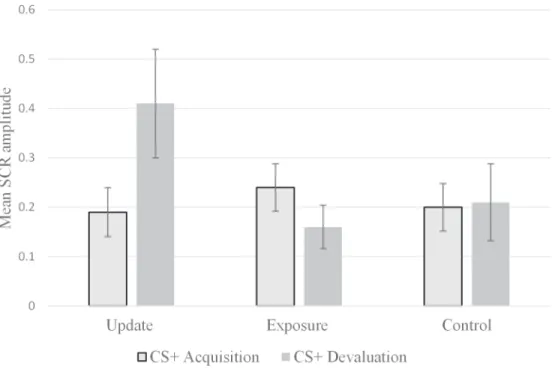
SCR amplitude to the CS+ at acquisition and at US devaluation is represented inFig 2(see
Table 6for descriptive statistics). Analysis with bootstrapped data revealed that there was a sig-nificant difference between the groups in SCR following devaluation after controlling for effect of SCR at acquisition,F(2,111) = 6.57, p<0.01, partialη2= .11. SCR following acquisition was
also significantly related to SCR following US devaluation,F(3,111) = 99.74, p<0.01, partial
η2= .473. Post-hoc tests revealed that the update group showed a significantly larger increase
in SCR amplitude to the unreinforced CS+ following US devaluation compared to the exposure group, (mean difference: 0.31; bootstrapped confidence intervals: 0.14 to 0.48; p<0.01) and control group (mean difference: 0.21; bootstrapped confidence intervals: 0.022 to 0.41; p<0.05).
The same analysis was repeated with subjective distress ratings at US devaluation as the dependent variable. There was a significant main effect of group on distress ratings at US devaluation after controlling for distress ratings at acquisition,F(2,111) = 3.52, p<0.05, partial
η2= .60. Subjective ratings of distress at acquisition were also significantly related to ratings at
devaluation,F(1,111) = 111.75, p<0.01, partialη2= .50. Post-hoc tests revealed that the update
group had a significantly larger drop in subjective ratings of distress to the CS+ at US devalua-tion than the exposure group (mean difference: -11.55; bootstrapped confidence intervals: -19.46 to -3.33; p<0.01) and the difference between the update and control group was at trend level significance (mean difference: -7.28; bootstrapped confidence intervals: -16.06 to 1.14; p<0.1).
To investigate group differences in PTSD symptomatology, a MANOVA was conducted with intrusion frequency, intrusion distress and PTSD symptom scores as dependent variables and group as a fixed factor.Fig 3illustrates the relative group differences (seeTable 7for Table 3. SCR during acquisition films (means and bootstrapped standard errors).
Update (n = 37) Exposure (n = 41) Control (n = 37) One way ANOVA
Film 1 0.54 (0.089) 0.45 (0.069) 0.45 (0.090) F(2,112) = 0.37, p = .69
Film 2 0.33 (0.087) 0.37 (0.070) 0.37 (0.093) F(2,112) = 0.79, p = .92
Film 3 0.50 (0.086) 0.61 (0.11) 0.55 (0.11) F(2,112) = 0.25, p = .78
Film 4 0.11 (0.031) 0.20 (0.039) 0.13 (0.063) F(2,112) = 0.91, p = .41
Film 5 0.33 (0.068) 0.36 (0.069) 0.34 (0.075) F(2,112) = 0.034, p = .97
Film 6 0.24 (0.057) 0.30 (0.066) 0.25 (0.062) F(2,112) = 0.33, p = .72
doi:10.1371/journal.pone.0122971.t003
Table 4. Self-reported diary compliance at follow-up.
diary compliance Update (n = 37) Mean (SD) Exposure (n = 41) Mean (SD) Control (n = 36) Mean (SD) ANOVA
Accurate 8.68 (1.20) 8.29 (1.23) 7.86 (1.87) F(2,111) = 1.916, p = .152
Reliable 2.3 (1.94) 2.12 (1.58) 2.17 (1.65) F(2,111) = 0.72, p = .931
Data were log transformed. Untransformed values are reported.
descriptive statistics). This revealed, using Pillai’s trace, a significant effect of group on the de-pendent variables,V= 0.18,F(6, 218) = 3.50,p<. 01, partialη2= .08. Separate univariate ANOVAs were conducted on the dependent variables and showed significant differences be-tween the groups on intrusion frequency,F(2, 110) = 5.99,p<. 01,r= .31, and PTSD symptom scores,F(2, 110) = 7.70,p<. 01,r= .35. Follow-up analysis using independent t-tests revealed that the update group reported significantly fewer intrusions and PTSD symptom scores than the exposure group (intrusion frequency:t(75) = -3.35,p<. 01,r= .36; PTSD symptom score: t(75) = -3.73,p<. 01,r= .40) or the control group (intrusion frequency:t(71) = -2.61,p<. 05, r= .30; PTSD symptom score:t(71) = -2.71,p<. 01,r= .31). These results imply that verbally devaluing the US reduces subjective distress, intrusion frequency and PTSD symptomatology but increases SCR to the CS+.
Discussion
Prospective experimental studies are needed to better understand causal factors in PTSD and to develop early interventions but it is clearly unethical to induce real trauma in people. There-fore, the well-established trauma-film paradigm was used to investigate causal factors in ana-logue PTSD symptom development and the relative effectiveness of clinically-informed psychological techniques. Trauma films have not previously been used as a US with most Table 5. CS+ compared to the CS- following Acquisition using SCR and subjective distress ratings (means and bootstrapped standard errors).
CS+ Acquisition CS Acquisition Paired Sample T-Test
SCR 0.21 (0.028) 0.075 (0.017) t(114) = 4.49, p = 0.00, r = .39
Subjective rating (all cases) 45.80 (2.61) 4.96 (1.13) t(114) = 15.49, p = 0.00, r = .82
doi:10.1371/journal.pone.0122971.t005
Fig 2. Verbally updating the trauma memory increases SCR response to CS+.A significantly larger increase in SCR to the CS+ from acquisition to US devaluation was found in the update as opposed to the exposure and control groups. The three groups were equivalent at acquisition. Error bars represent bootstrapped standard errors.
conditioning studies using electric shocks as the US [44,60]. Using trauma film stimuli as the US has advantages of being a better analogue of real-life trauma, being more readily experi-mentally manipulated (e.g. they can be devalued cognitively) and allowing the concurrent in-vestigation of conditioned fear and PTSD symptomatology. This study demonstrated that trauma film stimuli can be used as the US to induce conditioned fear as measured by SCR and distress ratings. The trauma paradigm was effective in inducing intrusive memories of the films with 95% of participants reporting at least one intrusion. Therefore, this current study suggests that trauma film and conditioned fear paradigms can be effectively combined.
Table 6. SCR and distress ratings for the CS+ for each group following acquisition and devaluation (means and bootstrapped standard errors).
Measure CS+ Acquisition CS+ Devaluation
Update (n = 37) SCR 0.19 (0.0496) 0.41 (0.11)
Distress ratings 53.84 (4.95) 36.54 (4.04)
Exposure (n = 41) SCR 0.24 (0.048) 0.16(0.044)
Distress ratings 41.34 (4.13) 39.70 (4.29)
Control (n = 37) SCR 0.20 (0.048) 0.21 (0.078)
Distress ratings 42.70 (4.44) 36.35 (4.49)
doi:10.1371/journal.pone.0122971.t006
Fig 3. Verbally updating the trauma memory reduces intrusion frequency, distress and PTSD symptoms.Mean intrusion frequency, distress associated with the intrusions and PTSD symptom scores over the week following the experimental session for each group (update, exposure and control). The update group reported significantly fewer intrusions and PTSD symptoms than the other two groups.*p<0.05 (between updating and exposure groups
or between updating and control groups). The difference in intrusion distress between the groups approached significance,p<0.075. Error bars represent
standard errors.
In terms of hypothesis one, participants who acquired a stronger conditioned fear response experienced more intrusions, were more distressed by them and experienced more PTSD symptoms following the trauma film paradigm. Differential SCR at acquisition predicted all three of the outcome variables whilst differential subjective ratings of distress predicted num-ber of intrusions and distress in response to the intrusions. This is consistent with conditioning theories of PTSD which highlight the role of CS-US contingencies in the development of PTSD [26,56] and previous research demonstrating that people with anxiety disorders acquire fear conditioning more strongly than those without [22]. The relationship between enhanced fear conditioning and anxiety disorders may operate at a number of stages e.g. a stronger associa-tion may mean that the fear response is more readily triggered to cues, triggered to more loose-ly associated cues, is more difficult to extinguish or that the return of fear is more likeloose-ly following extinction. This current finding is consistent with the proposal that individual differ-ences in the ease of acquisition can explain why some people develop anxiety disorders and some people do not [79]. To our knowledge, this is the first study to combine a conditioning paradigm with the trauma film paradigm to enable a prospective analogue design investigating how individual differences in fear conditioning impact on PTSD symptom development. Therefore, these results indicate that, in the non-clinical population, conditioned acquisition response is a better predictor of intrusion frequency, intrusion distress and PTSD symptoms than trait anxiety.
In terms of hypothesis two, the results indicate that verbally devaluing the US reduces sub-jective distress, intrusion frequency and PTSD symptomatology but increases SCR to the CS+. This finding is consistent with SCR reflecting an orienting attentional response [80]. There is evidence to suggest that successful therapy results in an increase in attentional allocation to threat cues to enable the re-appraisal of the threat cue [81]. Early elevations in psychophysiolo-gy during imaginal flooding have been shown to predict improvements in intrusions [82]. Therefore, the larger SCR may represent increased fear-related arousal in the update group compared to the exposure or control groups, which is likely to be due to reduced attentional avoidance to the CS+, and, from the above perspective, corresponds well with the subsequent fall in subjective ratings of distress and the reduced number of analogue PTSD symptoms. New information and verbally enhanced representation of the trauma films may initially prevent a reduction of the conditioned fear response in the update group. Yet, in therapy, emotional arousal is considered to be important for therapeutic change [83] and the construction of new meaning is needed for lasting changes [84]. Therefore, the update condition may have facilitat-ed higher emotional arousal (i.e. SCR) alongside new information leading to fewer intrusions and PTSD symptoms at follow-up.
Theoretically, the reduction of analogue PTSD symptoms in the updating group provides support for the idea that altering negative appraisals of the film content and enhancing verbal-conceptual processing of the trauma memory can reduce development of PTSD symptoms. This is consistent with cognitive models of PTSD which highlight the role of negative apprais-als of the trauma [48] and the disorganised nature of the trauma memory in the development Table 7. Intrusion frequency, Intrusion Distress and IES-R for each group.
Update mean (SD) Exposure mean (SD) Control mean (SD)
Intrusion Frequency 5.60 (7.66) 11.15 (11.45) 10.64 (11.86)
Intrusion Distress 19.68 (40.25) 27.15 (32.18) 25.50 (35.63)
IES-R at FU 4.54 (4.94) 9.47(7.73) 7.72 (6.28)
Data were log transformed. Untransformed values are reported.
of PTSD symptoms [48,85]. These results also support the idea that the most effective treat-ments for PTSD are those that pay attention to the trauma memory and its meaning [86].
There are other possible explanations for the reduction in analogue PTSD symptoms in the update group yet these appear less plausible. First, the update group may have had a higher working memory (WM) capacity load than the other two groups. However, working memory demands were well matched in the groups and a previous study with a similar design conclud-ed that these groups would have similar WM demands [39]. Second, the update group may have had a more positive mood than the other groups when finishing the task, as low mood is linked to greater intrusion frequency [87]. However, any impact on intrusion frequency from changes in mood would be short-lived (less than 24 hours) as illustrated by studies aiming to induce low mood [88,89] and participants in this study experienced intrusions over the entire week.
Limitations and future directions
There are several limitations to this research. One limitation is the degree to which the findings can generalize to people who are exposed to real-life trauma and who develop PTSD since the study used non-clinical participants with films as the analogue trauma. In therapy, exposure and updating techniques are more complex than the analogue interventions used in this study. This study externally generated the updated meaning whilst, in therapy, time would be spent generating a subjective meaning with the patient and the techniques would be part of a much longer individually formulated intervention. However, the experimental interventions were generated based on those used in evidence-based therapy and the aims of both experimental techniques were in keeping with aims of evidence based therapies. The non-specific nature of SCR is another limitation and this study would have been enhanced by having additional indexes of fear conditioning, such as startle responses [60]. A further limitation is that the CS+ and CS- were not counterbalanced in this study, however as response to the CS+ following ac-quisition was used as a covariate, this is unlikely to impact on the findings.
As this study appears to be the first to have combined conditioning and trauma film para-digms, the results require replication. Further studies investigating whether increased condi-tioned fear acquisition predicts the development of PTSD in experimental settings, in at-risk groups prior to trauma exposure and in settings targeting people shortly after trauma exposure (e.g. hospital emergency departments) would illustrate whether this could be a reliable index for identifying people vulnerable to PTSD development. It would be useful to expand on pilot studies investigating whether acquisition response is associated with treatment outcome [90]. For example, it might be predicted that those who show a stronger acquisition response are more likely to develop PTSD and also more likely to derive therapeutic gain from
early intervention.
of effective early intervention, including visually compared to verbally updating the meaning of the trauma films and receiving the verbal update alone without exposure.
It would be important to investigate whether varying the time between acquisition and US devaluation/extinction has an impact on treatment effect. Some studies have included a thirty minute delay between trauma films and the intervention to mirror average waiting times in emergency departments [47]. Based on previous research, it is assumed that an intervention taking place in the consolidation window (approximately 6 hours) may be more effective in re-writing the trauma memory than one administered outside it [44,47]. However, further investi-gation is warranted into whether effectiveness changes both within this six-hour window and outside it.
If the results are replicated and experimental effect is established, a study using cognitive behavioural techniques as early interventions in real-life settings (such as hospital emergency departments) would be warranted to establish whether updating techniques can limit the de-velopment of PTSD. It is important in this context to see that the verbal updating used in the current study differs significantly from debriefing techniques that advertently or inadvertently elaborate trauma memories, and instead is aimed at containing meaning and changing it in a more benign direction, akin to the mechanisms of memory re-scripting techniques, which have proven highly effective in the treatment of anxiety disorders [91,92]. For example, debriefing occurs in group or individual format and typically includes asking participants to speak about their experience and how it has affected them, focusing on normalising symptoms and brain-storming coping strategies. In contrast, if the verbal updating used in the current study was ap-plied clinically, it would focus on exposure to the trauma memory through reliving techniques, identifying the meaning of the event for the person and using cognitive restructuring tech-niques to verbally elaborate the memory past the worst moments.
Conclusions
Consistent with conditioning theories of PTSD [26,56], we have demonstrated that individual differences in acquiring CS/US contingencies predict subsequent PTSD symptoms. Further to this, as predicted by cognitive models [48,49], devaluing the trauma memory with a verbal in-tervention successfully reduced distress associated with the conditioned stimulus and pre-vented development of symptoms. This supports the idea that the most effective treatments for PTSD are those focusing on the trauma memory and its meaning [86]. Verbally enhancing the trauma memory is proposed to reduce intrusion frequency via increased integration and con-textualisation of the memory allowing better top-down control. Previous research has sug-gested that exposure to the trauma memory may be the key ingredient for therapeutic change [52,93]. This study provides initial evidence that changing the meaning of the US may devalue the US more effectively than exposure alone. The increase in SCR amplitude in the update group is consistent with treatment studies illustrating initial increases in psychophysiological responding predicting improvements in intrusions [82]. Successful therapy may initially lead to an increase in attentional allocation to threat cues to allow re-appraisal of the threat cue [81] and this would be reflected in a larger SCR.
Supporting Information
S1 Appendix. Trauma film narratives.
(DOCX)
Acknowledgments
We gratefully acknowledge the contribution of Dr Andrew Brand for developing software rou-tines to analyse SCR data.
Author Contributions
Conceived and designed the experiments: VP TB JW. Performed the experiments: VP. Ana-lyzed the data: VP. Contributed reagents/materials/analysis tools: TB JW. Wrote the paper: VP JW TB. Created the stimuli: JW. Supervised the project: JW.
References
1. Stein MB, Walker JR, Hazen AL, Forde DR. Full and partial posttraumatic stress disorder: findings from a community survey. Am J Psychiatry. 1997; 154: 1114–1119. PMID:9247398
2. Breslau N, Kessler RC, Chilcoat HD, Schultz LR, Davis GC, Andreski P. Trauma and Posttraumatic Stress Disorder in the Community. Arch Gen Psychiatry. 1998; 55: 626–632. PMID:9672053
3. Rothbaum BO, Foa EB, Riggs DS, Murdock T, Walsh W. A prospective examination of post-traumatic stress disorder in rape victims. J Trauma Stress. 1992; 5: 455–475.
4. Breslau N, Davis GC, Andreski P, Peterson E. Traumatic Events and Posttraumatic Stress Disorder in an Urban Population of Young Adults. Arch Gen Psychiatry. 1991; 48: 216–222. PMID:1996917
5. Kessler RC, Sonnega A, Nelson CB, Bromet E. Posttraumatic stress disorder in the National Comorbid-ity Survey. Arch Gen Psychiatry. 1995; 52: 1048–1060. PMID:7492257
6. Xue Y, Taub PR, Iqbal N, Fard A, Wentworth B, Redwine L, et al. Cardiac biomarkers, mortality, and post-traumatic stress disorder in military veterans. Am J Cardiol. 2012; 109: 1215–1218. doi:10.1016/j. amjcard.2011.11.063PMID:22305506
7. Kubzansky LD, Koenen KC, Spiro A, Vokonas PS, Sparrow D. Prospective study of posttraumatic stress disorder symptoms and coronary heart disease in the Normative Aging Study. Arch Gen Psychi-atry. 2007; 64: 109–116. PMID:17199060
8. Lukaschek K, Baumert J, Kruse J, Emeny RT, Lacruz ME, Huth C, et al. Relationship between posttrau-matic stress disorder and type 2 diabetes in a population-based cross-sectional study with 2970 partici-pants. J Psychosom Res. 2013; 74: 340–345. doi:10.1016/j.jpsychores.2012.12.011PMID:23497837
9. Yaffe K, Vittinghoff E, Lindquist K, Barnes D, Covinsky KE, Neylan T, et al. Posttraumatic stress disor-der and risk of dementia among US veterans. Arch Gen Psychiatry. 2010; 67: 608–613. doi:10.1001/ archgenpsychiatry.2010.61PMID:20530010
10. Brewin CR, Andrews B, Valentine JD. Meta-analysis of risk factors for posttraumatic stress disorder in trauma-exposed adults. J Consult Clin Psychol. 2000; 68: 748–766. PMID:11068961
11. Ozer EJ, Best SR, Lipsey TL, Weiss DS. Predictors of Posttraumatic Stress Disorder and Symptoms in Adults: A Meta-Analysis. Psychol Trauma Theory, Res Pract Policy. 2008;S(1: ): 3–36.
12. Pitman RK, Rasmusson AM, Koenen KC, Shin LM, Orr SP, Gilbertson MW, et al. Biological studies of post-traumatic stress disorder. Nat Rev Neurosci. 2012; 13: 769–787. doi:10.1038/nrn3339PMID:
23047775
13. Pavlov I. Conditioned reflexes. London Oxford Univ Press.1927
14. Watson JB, Rayner R. Conditioned emotional reactions. J Exp Psychol. 1920; 3: 1–14.
15. Shalev AY, Rogel-Fuchs Y. Psychophysiology of the posttraumatic stress disorder: from sulfur fumes to behavioral genetics. Psychosom. Med. 1993; 55: 413–423. PMID:8265742
16. Keane TM, Kolb LC, Kaloupek DG, Orr SP, Blanchard EB, Thomas RG, et al. Utility of psychophysio-logical measurement in the diagnosis of posttraumatic stress disorder: results from a Department of Veterans Affairs Cooperative Study. J Consult Clin Psychol. 1998; 66: 914–923. PMID:9874904
18. Kleim B, Wilhelm FH, Glucksman E, Ehlers A. Sex differences in heart rate responses to script-driven imagery soon after trauma and risk of posttraumatic stress disorder. Psychosom Med. 2010; 72: 917– 924. doi:10.1097/PSY.0b013e3181f8894bPMID:20947782
19. Shalev AY, Sahar T, Freedman S, Peri T, Glick N, Brandes D, et al. A prospective study of heart rate re-sponse following trauma and the subsequent development of posttraumatic stress disorder. Arch Gen Psychiatry. 1998; 55: 553–559. PMID:9633675
20. Blanchard EB, Hickling EJ, Galovski T, Veazey C. Emergency room vital signs and PTSD in a treat-ment seeking sample of motor vehicle accident survivors. J Trauma Stress. 2002; 15: 199–204. PMID:
12092911
21. Holmes EA, Brewin CR, Hennessy RG. Trauma Films, Information Processing, and Intrusive Memory Development. J Exp Psychol. 2004; 133: 3–22. PMID:15355149
22. Lissek S, Powers AS, McClure EB, Phelps EA, Woldehawariat G, Grillon C, et al. Classical fear condi-tioning in the anxiety disorders: a meta-analysis. Behav Res Ther. 2005; 43: 1391–1424. PMID:
15885654
23. Guthrie RM, Bryant RA. Extinction learning before trauma and subsequent posttraumatic stress. Psy-chosom Med. 2006; 68: 307–311. PMID:16554398
24. Lommen MJJ, Engelhard IM, Sijbrandij M, van den Hout MA, Hermans D. Pre-trauma individual differ-ences in extinction learning predict posttraumatic stress. Behav Res Ther. 2013; 51: 63–67. doi:10. 1016/j.brat.2012.11.004PMID:23261706
25. Bouton ME, Bolles R. Contextual Control of the Extinction of Conditioned Fear. Learn Motiv. 1979; 10: 445–466.
26. Rothbaum BO, Davis M. Applying Leaning Principles to the Treatment of Post-Trauma Reactions. Ann N Y Acad Sci. 2003; 1008: 112–121. PMID:14998877
27. Bouton ME. Context and behavioral processes in extinction. Learn Mem. 2004; 11: 485–494. PMID:
15466298
28. Bouton ME. Context, Ambiguity, and Unlearning: Sources of Relapse after Behavioral Extinction. Biol Psychiatry. 2002; 52: 976–986. PMID:12437938
29. Arntz A. Imagery Rescripting for Personality Disorders. Cogn Behav Pract. 2011; 18: 466–481. 30. Davey GCL. UCS Revaluation and Conditioning Models of Acquired fears. Behav Res Ther. 1989; 27:
521–528. PMID:2684133
31. Rescorla RA. Effect of US habituation following conditioning. J Comp Physiol Psychol. 1973; 82: 137– 143. PMID:4684968
32. Field AP. Is conditioning a useful framework for understanding the development and treatment of pho-bias? Clin Psychol Rev. 2006; 26: 857–875. PMID:16472895
33. Dibbets P, Poort H, Arntz A. Adding imagery rescripting during extinction leads to less ABA renewal. J Behav Ther Exp Psychiatry. 2012; 43: 614–624. doi:10.1016/j.jbtep.2011.08.006PMID:21907686
34. Mineka S, Zinbarg R. A contemporary learning theory perspective on the etiology of anxiety disorders: it’s not what you thought it was. Am Psychol. 2006; 61: 10–26. PMID:16435973
35. Wild J, Hackmann A, Clark DM. When the present visits the past: updating traumatic memories in social phobia. J Behav Ther Exp Psychiatry. 2007; 38: 386–401. PMID:17765865
36. Hunt MG, Fenton M. Imagery rescripting versus in vivo exposure in the treatment of snake fear. J Behav Ther Exp Psychiatry, 2007; 38: 329–344. PMID:17949681
37. Holmes EA, Arntz A, Smucker MR. Imagery rescripting in cognitive behaviour therapy: images, treat-ment techniques and outcomes. J Behav Ther Exp Psychiatry. 2007; 38: 297–305. PMID:18035331
38. Arntz A, Tiesema M, Kindt M. Treatment of PTSD: a comparison of imaginal exposure with and without imagery rescripting. J Behav Ther Exp Psychiatry. 2007; 38: 345–370. PMID:18005935
39. Hagenaars MA, Arntz A. Reduced intrusion development after post-trauma imagery rescripting; an ex-perimental study. J Behav Ther Exp Psychiatry. 2012; 43: 808–814. doi:10.1016/j.jbtep.2011.09.005
PMID:22178473
40. Mcgaugh JL. Memory—a Century of Consolidation. Science. 2000; 287: 248–251. PMID:10634773
41. Squire LR, Davis HP. The Pharmacology of Memory: A Neurobiological Perspective. Annu Rev Phar-macol Toxicol. 1981; 21: 323–326. PMID:7016009
42. Monfils M-H, Cowansage KK, Klann E, LeDoux JE. Extinction-reconsolidation boundaries: key to per-sistent attenuation of fear memories. Science. 2009; 324: 951–955. doi:10.1126/science.1167975
PMID:19342552
44. Schiller D, Monfils M-H, Raio CM, Johnson DC, Ledoux JE, Phelps EA. Preventing the return of fear in humans using reconsolidation update mechanisms. Nature. 2010; 463: 49–53. doi:10.1038/ nature08637PMID:20010606
45. Norrholm SD, Vervliet B, Jovanovic T, Boshoven W, Myers KM, Davis M, et al. Timing of extinction rela-tive to acquisition: a parametric analysis of fear extinction in humans. Behav Neurosci. 2008; 122: 1016–1030. doi:10.1037/a0012604PMID:18823159
46. Hupbach A, Gomez R, Hardt O, Nadel L. Reconsolidation of episodic memories: A subtle reminder trig-gers integration of new information. 2007; 14: 47–53. PMID:17202429
47. Holmes EA, James EL, Coode-Bate T, Deeprose C. Can Playing the Computer Game“‘Tetris’”Reduce the Build-Up of Flashbacks for Trauma? A Proposal from Cognitive Science. PLoS One. 2009; 4: e4153. doi:10.1371/journal.pone.0004153PMID:19127289
48. Ehlers A, Clark DM. A cognitive model of posttraumatic stress disorder. Behav Res Ther. 2000; 38: 319–345. PMID:10761279
49. Brewin CR, Gregory JD, Lipton M, Burgess N. Intrusive Images in Psychological Disorders: Character-istics, Neural Mechanisms, and Treatment Implications. Psychol Rev. 2010; 117: 210–232. doi:10. 1037/a0018113PMID:20063969
50. Foa EB, Zoellner LA, Feeny NC. An Evaluation of Three Brief Programs for Facilitating Recovery After Assault. J Trauma Stress. 2006; 19: 29–43. PMID:16568461
51. Bryant RA, Sackville T, Dang ST, Moulds M, Guthrie R. Treating Acute Stress Disorder: An Evaluation of Cognitive Behavior Therapy and Supportive Counseling Techniques. Am J Psychitary. 1999; 156: 1780–1786. PMID:10553743
52. Rothbaum BO, Kearns MC, Price M, Malcoun E, Davis M, Ressler KJ, et al. Early intervention may pre-vent the development of posttraumatic stress disorder: a randomized pilot civilian study with modified prolonged exposure. Biol Psychiatry. 2012; 72: 957–963. doi:10.1016/j.biopsych.2012.06.002PMID:
22766415
53. Shalev AY, Ankri Y, Israeli-Shalev Y, Peleg T, Adessky R, Freedman S. Prevention of posttraumatic stress disorder by early treatment: results from the Jerusalem Trauma Outreach And Prevention study. Arch Gen Psychiatry. 2012; 69: 166–176. doi:10.1001/archgenpsychiatry.2011.127PMID:21969418
54. Bryant RA, Mastrodomenico J, Felmingham KL, Hopwood S, Kenny L, Kandris E. Treatment of Acute Stress Disorder: A Randomized Controlled Trial. Arch Gen Psychiatry. 2008; 65: 659–667. doi:10. 1001/archpsyc.65.6.659PMID:18519824
55. Schartau PES, Dalgleish T, Dunn BD. Seeing the bigger picture: training in perspective broadening re-duces self-reported affect and psychophysiological response to distressing films and autobiographical memories. J Abnorm Psychol. 2009; 118: 15–27. doi:10.1037/a0012906PMID:19222310
56. Mineka S, Oehlberg K. The relevance of recent developments in classical conditioning to understand-ing the etiology and maintenance of anxiety disorders. Acta Psychol (Amst). 2008; 127: 567–580. doi:
10.1016/j.actpsy.2007.11.007PMID:18226795
57. Zinbarg RE, Mohlman J. Individual Differences in the Acquisition of Affectively Valenced Associations. J Pers Soc Psychol. 1998; 74: 1024–1040. PMID:9569657
58. Krans J, Naring G, Becker ES. Count out your intrusions: effects of verbal encoding on intrusive memo-ries. Memory. 2009; 17: 809–815. doi:10.1080/09658210903130780PMID:19657961
59. Pineles SL, Orr MR, Orr SP. An alternative scoring method for skin conductance responding in a differ-ential fear conditioning paradigm with a long-duration conditioned stimulus. Psychophysiology. 2009; 46: 984–995. doi:10.1111/j.1469-8986.2009.00852.xPMID:19558401
60. Kindt M, Soeter M. Reconsolidation in a human fear conditioning study: a test of extinction as updating mechanism. Biol Psychol. 2011; 92: 43–50. doi:10.1016/j.biopsycho.2011.09.016PMID:21986472
61. Zeng X-X, Du J, Zhuang C-Q, Zhang J-H, Jia Y-L, Zheng X-F. Unconditioned stimulus revaluation to promote conditioned fear extinction in the memory reconsolidation window. PLoS One. 2014; 9: e101589. doi:10.1371/journal.pone.0101589PMID:25033450
62. Spitzer RL, Kroenke K, Williams JBW. Validation and Utility of a Self-report Version of PRIME-MD: The PHQ Primary Care Study. J Am Med Assoc. 1999; 282: 1737–1744.
63. Kroenke K, Spitzer RL, Williams JBW. The PHQ-9. J Gen Intern Med. 2001; 16: 606–613. PMID:
11556941
64. Spitzer RL, Kroenke K, Williams JBW, Löwe B. A brief measure for assessing generalized anxiety dis-order: the GAD-7. Arch Intern Med. 2006; 166: 1092–1097. PMID:16717171
66. Ehlers A, Clark DM, Dunmore E, Jaycox L, Meadows E, Foa EB. Predicting response to exposure treat-ment in PTSD: the role of treat-mental defeat and alienation. J Trauma Stress. 1998; 11: 457–471. PMID:
9690187
67. Blake D, Weathers F, Nagy L, Kaloupek D, Klauminzer G, Keane T. Clinician-Administered PTSD Scale (CAPS). National Center for Post-Traumatic Stress Disorder, Behavioral Science Division Bos-ton-VA, Boston, MA; 1990.
68. Weiss DS, Marmar CR. The Impact of Events Scale—Revised. In: Wilson P, Keane TM, editors. As-sessing Psychological Trauma and PTSD: A handbook for practitioners. New York: Guildford Press; 1997. pp. 399–411.
69. Creamer M, Bell R, Failla S. Psychometric properties of the Impact of Event Scale—Revised. Behav Res Ther. 2003; 41: 1489–1496. PMID:14705607
70. Spielberger CD, Gorsuch RL, Lushene R, Vagg P, Jacobs GA. Manual for the state-trait anxiety inven-tory. Palo Alto, CA Consult Psychol; 1983.
71. Smeets G, Merckelbach H, Griez E. Panic disorder and right-hemisphere reliance. Anxiety, Stress Cop-ing. 1997; 10: 245–255.
72. Richards JM, Gross JJ. Emotion regulation and memory: the cognitive costs of keeping one’s cool. J Pers Soc Psychol. 2000; 79: 410–424. PMID:10981843
73. Dalgleish T, Yiend J. The effects of suppressing a negative autobiographical memory on concurrent in-trusions and subsequent autobiographical recall in dysphoria. J Abnorm Psychol. 2006; 115: 467–473. PMID:16866587
74. Holmes EA, Bourne C. Inducing and modulating intrusive emotional memories: A review of the trauma film paradigm. Acta Psychol. 2008; 127: 553–566. doi:10.1016/j.actpsy.2007.11.002PMID:18234153
75. Woud ML, Holmes EA, Postma P, Dalgleish T, Mackintosh B. Ameliorating Intrusive Memories of Dis-tressing Experiences Using Computerized Reappraisal Training. Emotion. 2012; 12: 778–784. doi:10. 1037/a0024992PMID:21859193
76. Laposa JM, Alden LE. An analogue study of intrusions. Behav Res Ther. 2006; 44: 925–946. PMID:
16125135
77. Vickers AJ, Altman DG. Analysing controlled trials with baseline and follow up measurements. Br Med J. 2001; 323: 1123–1124.
78. Davison AC, Hinkley DV. Bootstrap Methods and their Application. Cambridge University Press; 2006. 79. Orr SP, Metzger LJ, Lasko NB, Macklin ML, Peri T, Pitman RK. De novo conditioning in
trauma-ex-posed individuals with and without posttraumatic stress disorder. J Abnorm Psychol. 2000; 109: 290– 298. PMID:10895567
80. Dawson ME, Schell AM, Filion DL. The Electrodermal System. In: Cacioppo JT, Tassinary LG, Bernt-son G, editors. Handbook of Psychophysiology. Cambridge University Press; 2008. pp. 159–181. 81. Adenauer H, Catani C, Gola H, Keil J, Ruf M, Schauer M, et al. Narrative exposure therapy for PTSD
in-creases top-down processing of aversive stimuli- evidence from a randomized controlled treatment trial. BMC Neurosci. 2011; 12: 1–13. doi:10.1186/1471-2202-12-1PMID:21208416
82. Pitman RK, Orr SP, Altman B, Longpre RE, Poiré RE, Macklin ML, et al. Emotional processing and out-come of imaginal flooding therapy in Vietnam veterans with chronic posttraumatic stress disorder. Compr Psychiatry. 1996; 37: 409–418. PMID:8932965
83. Greenberg LS, Pascual-leone A. Emotion in Psychotherapy: A Practice-Friendly Research Review. J Clin Psychol Sess. 2006; 62: 611–630.
84. Whelton WJ. Emotional processes in psychotherapy: evidence across therapeutic modalities. Clin Psy-chol Psychother. 2004; 11: 58–71.
85. Brewin CR, Dalgleish T, Joseph S. A Dual Representation Theory of Posttraumatic Stress Disorder. Psychol Rev. 1996; 103: 670–686. PMID:8888651
86. Ehlers A, Clark DM. Post-traumatic stress disorder: The development of effective psychological treat-ments. Nord J Psychiatry. 2008; 62: 11–18. doi:10.1080/08039480802315608PMID:18752113
87. Davies MI, Clark DM. Predictors of Analogue Post-Traumatic Intrusive Cognitions. Behav Cogn Psy-chother. 1998; 26: 303–314.
88. Watkins E. Adaptive and maladaptive ruminative self-focus during emotional processing. Behav Res Ther. 2004; 42: 1037–1052. PMID:15325900
89. Hunt MG. The only way out is through: emotional processing and recovery after a depressing life event. Behav Res Ther. 1998; 36: 361–384. PMID:9670599
91. Wild J, Hackmann A, Clark DM. Rescripting early memories linked to negative images in social phobia: a pilot study. Behav Ther. 2008; 39: 47–56. doi:10.1016/j.beth.2007.04.003PMID:18328869
92. Wild J, Clark DM. Imagery Rescripting of Early Traumatic Memories in Social Phobia. Cogn Behav Pract. 2011; 18: 433–443. PMID:22298942
93. Rothbaum BO, Houry D, Heekin M, Leiner AS, Daugherty J, Smith LS, et al. A pilot study of an expo-sure-based intervention in the ED designed to prevent posttraumatic stress disorder. Am J Emerg Med. 2008; 26: 326–330. doi:10.1016/j.ajem.2007.07.006PMID:18358945