CLINICAL SCIENCE
I Department of Ophthalmology, Faculdade de Ciências Médicas da Univer-sidade Estadual de Campinas (UNICAMP) – Campinas/SP, Brazil. II Department of Ophthalmology, Universidade Federal do Triângulo Mineiro (UFTM) – Minas Gerais, Brazil.
III Universidade de São Paulo (USP) - São Paulo/SP, Brazil. Tel: 55 34 3318-5000
Email: [email protected]
Received for publication on September 14, 2009. First review completed on October 19, 2009. Accepted for publication on February 30, 2010.
PERCEPTION OF DIFFICULTIES WITH VISION-RELATED ACTIVITIES OF DAILY LIVING
AMONG PATIENTS UNDERGOING UNILATERAL POSTERIOR CAPSULOTOMY
Firmani M. B. de Senne,I,II Edméa R. Temporini,III Carlos E. L. Arieta,I Karla D. PachecoII
doi: 10.1590/S1807-59322010000500002
Senne FMB, Temporini ER, Arieta CEL, Pacheco KD. Perception of dificulties with vision-related activities of daily living among patients undergoing unilateral posterior capsulotomy. Clinics. 2010;65(5):459-68.
OBJECTIVES: To assess the inluence of Nd:YAG (neodymium: yttrium-aluminum- garnet) laser unilateral posterior capsulotomy on visual acuity and patients’ perception of dificulties with vision-related activities of daily life.
METHODS: We conducted an interventional survey that included 48 patients between 40 and 80 years of age with uni- or bilateral pseudophakia, posterior capsule opaciication, and visual acuity <0.30 (logMAR) in one eye who were seen at a Brazilian university hospital. All patients underwent posterior capsulotomy using an Nd:YAG laser. Before and after the intervention, patients were asked to complete a questionnaire that was developed in an exploratory study.
RESULTS: Before posterior capsulotomy, the median visual acuity (logMAR) of the included patients was 0.52 (range 0.30-1.60). After posterior capsulotomy, the median visual acuity of the included patients improved to 0.10 (range 0.0-0.52). According to the subjects’ perceptions, their ability to perform most of their daily life activities improved after the intervention (p<0.05).
CONCLUSIONS: After patients underwent posterior capsulotomy with an Nd:YAG laser, a signiicant improvement in the visual acuity of the treated eye was observed. Additionally, subjects felt that they experienced less dificulty performing most of their vision-dependent activities of daily living.
KEYWORDS: Posterior capsule opaciication; Capsulotomy; Nd:YAG lasers; Patients’ perception; Daily activities.
INTRODUCTION
Posterior capsule opaciication is the most common long-term complication that occurs after extracapsular extraction. It is also referred to as a secondary cataract, capsular ibrosis, or epithelial pearls.1,2 It usually leads to a decrease
in visual acuity due to a direct blockade of the visual axis, at times also leading to a deterioration of contrast sensitivity, glare disability, and monocular diplopia.3
Clinical studies have shown different incidence rates of posterior capsule opaciication, some of which reach
almost 50%.1,3 There is an age-related trend concerning
opacification; in general, older patients have a lower incidence of posterior capsule opacification.4 In an
ophthalmological follow-up exam that was performed 26 months after surgery, Senne et al.5 found that posterior
capsule opaciication was the second cause of visual acuity <20/100 (17% of 62 eyes) . In another follow-up study performed 43 months after surgery, the same authors found that posterior capsule opaciication was the irst cause of visual acuity <20/100 (50% of 42 eyes).
Since the 1980s, neodymium: yttrium-aluminum-garnet (Nd:YAG) lasers have been the most widely used therapeutic modality for treatment of posterior capsule opaciication and have largely replaced invasive surgery.6,7 From the clinical
standpoint, the visual symptoms of secondary cataract may vary greatly in terms of the degree of posterior capsule opaciication.1
visual function and visual deiciency.8
Ocular diseases have a substantial impact on patients’ quality of life because visual loss affects multiple aspects of functionality.9 A series of tools has been developed to assess
health-related quality of life. Despite the large amount of literature on the subject, no uniied approach to evaluating patients’ quality of life has been established, and there is little consensus on its relevance.10 These instruments only
apply to patients from the cultural background in which they were developed, and whenever there is a need to use them in other populations, translation, adaptation, and validation are required.11,12
The adaptation of questionnaires that have been used for patients with visual disturbances allows us not only to explore speciic aspects of visual deiciency but also to compare the risk-beneit ratios of different therapies.11 The
administration of these questionnaires via interviews seems to be the best approach in some countries, especially because the low education level of the assessed population limits the use of self-administered questionnaires.
The present study was conducted on a sample of patients with unilateral posterior capsule opaciication who were seen at a Brazilian university hospital. Our goal was to assess the inluence of Nd:YAG laser posterior capsulotomy on patients’ visual acuity and their perception of the dificulties they experienced with vision-related activities of daily life.
METHODS AND MATERIALS
The study was designed as an interventional cross-sectional survey. A readily accessible sample of patients was selected from all of the patients who were scheduled for consultation at the Outpatient Ophthalmology Unit (YAG Laser Service, Faculdade de Medicina da Universidade Federal do Triângulo Mineiro in Uberaba, Brazil) between September 2004 and March 2006. The study was performed in accordance with the tenets of the Declaration of Helsinki.
To be included in the study, patients had to meet the following criteria: (1) be between 40 and 80 years of age; (2) have uni- or bilateral pseudophakia with an intraocular posterior chamber lens implant that was placed without previous surgical complications; (3) have unilateral posterior capsule opaciication and corrected visual acuity in the affected eye of <0.30 (logMAR); and (5) be capable of providing consent to answer the questionnaire.
The survey excluded the following: (1) patients suffering from ocular disorders other than cataracts; (2) patients with a history of amblyopia and strabismus; and (3) patients with mobility, hearing, and/or speech impairment(s).
The questionnaire was developed based on the results of an exploratory study, which was conducted according to
the methodological procedures proposed by Piovesan and Temporini.13 Based on open-ended questions that were asked
during individual interviews to a population that had similar characteristics to the subjects in this study, closed-ended questions concerning vision-related daily activities were developed. The patients were asked if they had dificulties carrying out a certain activity due to their visual impairment even if they wore glasses. Visual function subscales were used with various activities chosen as references for the following types of vision: (1) near vision (e.g., needle and thread chores, picking rice/beans, washing vegetables/ fruits, shaving, reading price tags, reading books/newspaper/ magazines/the Bible, driving nails/repairing things at home/ stripping wire); (2) mid-range vision (e.g., walking up and down stairs, picking out clothes to wear, washing dishes/ clothes, ironing, bathing, cooking, or combing hair); (3) distance vision (e.g., walking down the street, crossing the street, recognizing people from across the street, watching television, reading the name or number on a nearby bus, or reading street signs); and (4) depth perception (e.g., pouring water into a glass). The questionnaire was tested prior to use in this study in a sample of eight patients who had characteristics that were similar to those of the study sample. Patients underwent their scheduled ophthalmological examination and answered the questions on the questionnaire before and up to three months after secondary unilateral capsulotomy with an Nd:YAG laser (YC 1200, NIDEK, Gamagori, Japan). We used the technique of shooting the laser through a Peyman lens to perform the capsulotomy. This process was continued until an opening slightly larger than the pupil (as previously evaluated under dynamic conditions) was obtained.
For analysis of visual acuity data, the logarithm of the reciprocal to the Snellen fraction with extended scale was used, which is equivalent to the logarithm of the minimal angle of resolution (logMAR). We assumed that “finger count” is equivalent to 0.025, whose logMAR is equal to 1.6.14
The results of the visual acuity analysis were also converted into percentages of loss of central vision. Because an eye with good vision can compensate for a contralateral eye with worse vision, we calculated the percentage of visual impairment (PVI) as described by Applegate et al.15, who
created the following standardized disability formula used by the American Medical Association that assigns a greater weight for the eye with better visual acuity: ([three times the better eye’s percent disability] plus [the worse eye’s percent disability]) divided by four.
For statistical analysis, we used the Wilcoxon matched pairs test to compare data obtained before and after capsulotomy. A value of p<0.05 was considered statistically signiicant. The data obtained from the questionnaire were also statistically analyzed. We reduced the values of a distribution to one single value, called the mean scale value (MSV).16 Each answer was assigned a certain number of
points, such that a lower score meant worse impairment/ more influence of visual impairment on the subject’s quality of life. A score of 0 corresponded to “does not do”, a score of 1 corresponded to “very dificult”, a score of 2 corresponded to “some dificulty”, and a score of 3 corresponded to “no dificulty”.
RESULTS
The sample included 20 male (42%) and 28 female (58%) subjects. The mean age of the patients was 68 years, and the median was 70 years. Prior to the laser procedure, a total of 27 patients (Group 1) had visual acuity of >0.30 (logMAR) in the unaffected eye. These patients had a median age of 68 years. The other 21 patients (Group 2) had visual acuity of <0.30 (logMAR) in the unaffected eye and a median age of 73 years.
The visual acuity of the capsulotomized eye was measured before and after the Nd:YAG laser procedure, and the changes in those values are summarized in Table 1. There was signiicant improvement in the visual acuity of the capsulotomized eye (p<0.01). The median visual acuity of the contralateral eye of each patient, which was measured prior to capsulotomy, was 0.22 (range 0.0 to 1.00).
Table 1 also summarizes the change in the percentage of visual impairment and stereoacuity that patients experienced
before and after the Nd:YAG laser procedure. There was a signiicant decrease in PVI and a signiicant improvement in stereoacuity following capsulotomy (p<0.01).
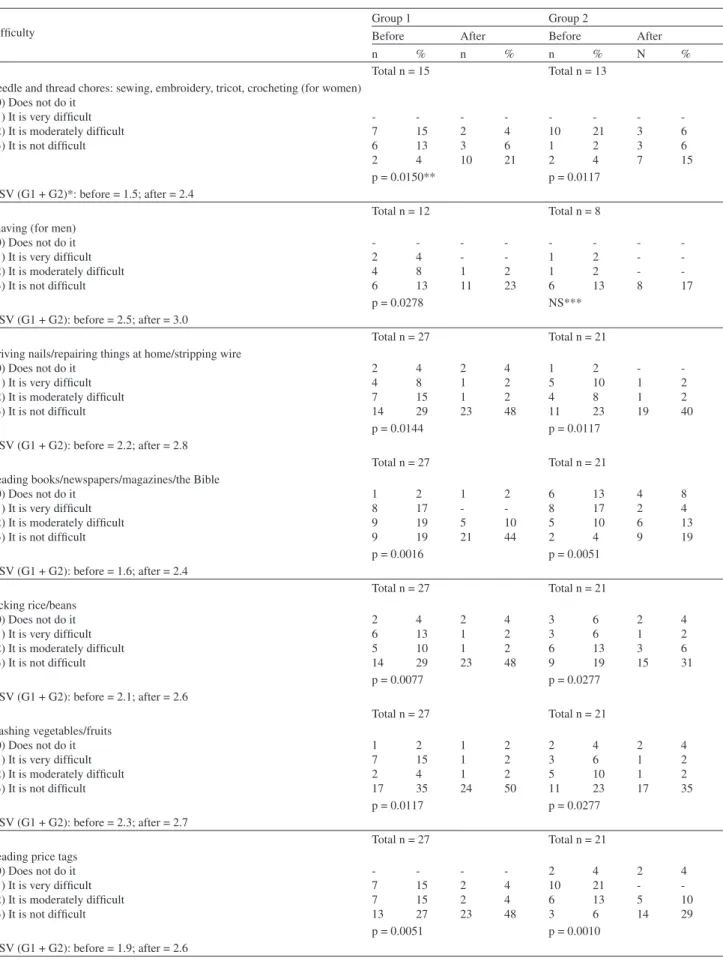
Activities related to near vision [e.g., (1) needle and thread chores (for women), (2) shaving (for men), (3) driving nails/repairing things at home/stripping wire, (4) reading books/newspapers/magazines/the Bible, (5) picking rice/beans, (6) washing vegetables/fruits, and (7) reading price tags] were described as very or moderately dificult by 86% of the women (MSV = 1.5, category 1) and 40% of the men (MSV = 2.5, category 2), and by 41% (MSV = 2.2, category 3), 63% (MSV = 1.6, category 4), 42% (MSV = 2.1, category 5), 35% (MSV = 2.3, category 6), and 64% (MSV = 1.9, category 7) of all subjects (i.e., Group 1 + Group 2). Almost all of these parameters changed after posterior capsulotomy, except for those related to shaving (Group 2) (Table 2).
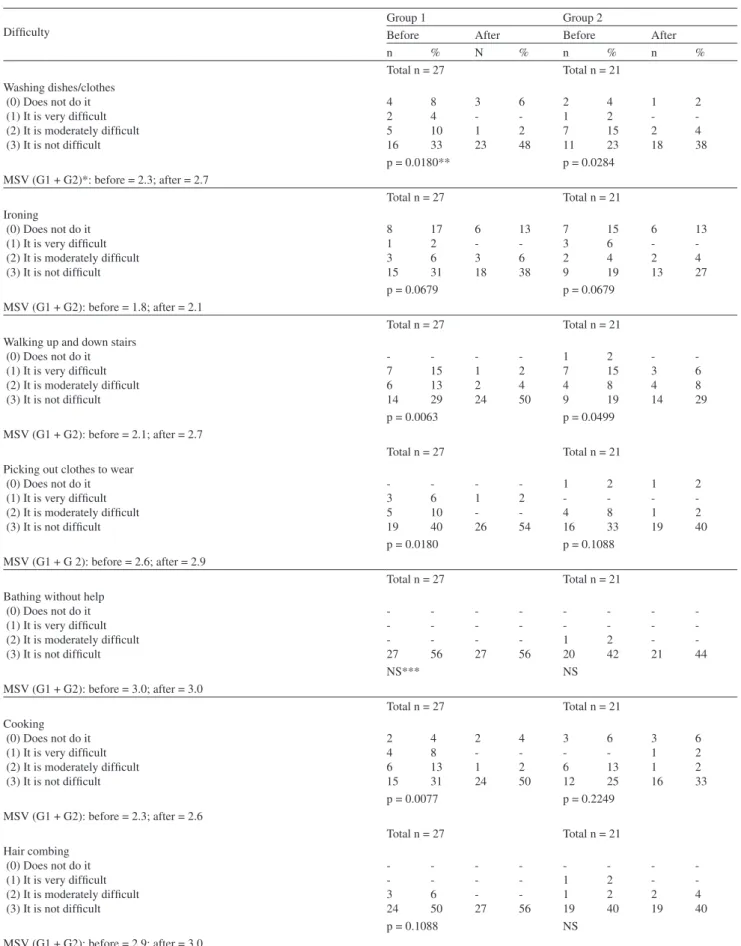
Concerning activities related to mid-range vision, the following activities were perceived as moderately or very dificult by the following percentages of included subjects [i.e., (Group 1 + Group 2)]: (1) washing dishes/clothes (31%, MSV = 2.3); (2) ironing (18%, MSV = 1.8); (3) walking up and down stairs (51%, MSV = 2.1); (4) picking out clothes to wear (24%, MSV = 2.6); (5) bathing without help (2%, MSV = 3.0); (6) cooking (34%, MSV = 2.3); and (7) hair combing (10%, MSV = 2.9). After the Nd:YAG laser procedure, patients’ perceived ability of dificulty with performing these tasks changed, except for tasks related to ironing, bathing without help, and hair combing (both groups) as well as picking out clothes to wear and cooking (Group 2) (Table 3).
The differences concerning patients’ difficulty in performing activities related to distance vision before and
Table 1 - Visual acuity (VA), percentage of vision impairment (PVI), and stereoacuity before and after capsulotomy.
Before Capsulotomy After Capsulotomy
Median Range Median Range
VA (logMAR*) 0.52 0.30 – 1.60 0.10 0 – 0.52
Group 1 0.52 0.30 – 1.60 0.10 0 – 0.52
Group 2 0.52 0.40 – 1.60 0.15 0 – 0.52
PVI (%) 20.00 3.75 – 57.50 6.25 0 – 27.50
Group 1 12.50 3,75 – 27.50 2.50 0 – 16.25
Group 2 27.50 16.25 – 57.50 10.00 0 – 27.50
Stereoacuity (”) 400 40 - 3000 70 40 – 800
Group 1 400 40 - 3000 50 40 – 400
Group 2 400 50 - 3000 100 40 – 800
Table 2 - Subjects’ perceptions of dificulties with activities related to near vision before and after capsulotomy.
Dificulty
Group 1 Group 2
Before After Before After
n % n % n % N %
Total n = 15 Total n = 13
Needle and thread chores: sewing, embroidery, tricot, crocheting (for women) (0) Does not do it
(1) It is very dificult (2) It is moderately dificult (3) It is not dificult
-7 6 2 -15 13 4 -2 3 10 -4 6 21 -10 1 2 -21 2 4 -3 3 7 -6 6 15
p = 0.0150** p = 0.0117
MSV (G1 + G2)*: before = 1.5; after = 2.4
Total n = 12 Total n = 8
Shaving (for men) (0) Does not do it (1) It is very dificult (2) It is moderately dificult (3) It is not dificult
-2 4 6 -4 8 13 -1 11 -2 23 -1 1 6 -2 2 13 -8 -17
p = 0.0278 NS***
MSV (G1 + G2): before = 2.5; after = 3.0
Total n = 27 Total n = 21
Driving nails/repairing things at home/stripping wire (0) Does not do it
(1) It is very dificult (2) It is moderately dificult (3) It is not dificult
2 4 7 14 4 8 15 29 2 1 1 23 4 2 2 48 1 5 4 11 2 10 8 23 -1 1 19 -2 2 40
p = 0.0144 p = 0.0117
MSV (G1 + G2): before = 2.2; after = 2.8
Total n = 27 Total n = 21
Reading books/newspapers/magazines/the Bible (0) Does not do it
(1) It is very dificult (2) It is moderately dificult (3) It is not dificult
1 8 9 9 2 17 19 19 1 -5 21 2 -10 44 6 8 5 2 13 17 10 4 4 2 6 9 8 4 13 19
p = 0.0016 p = 0.0051
MSV (G1 + G2): before = 1.6; after = 2.4
Total n = 27 Total n = 21
Picking rice/beans (0) Does not do it (1) It is very dificult (2) It is moderately dificult (3) It is not dificult
2 6 5 14 4 13 10 29 2 1 1 23 4 2 2 48 3 3 6 9 6 6 13 19 2 1 3 15 4 2 6 31
p = 0.0077 p = 0.0277
MSV (G1 + G2): before = 2.1; after = 2.6
Total n = 27 Total n = 21
Washing vegetables/fruits (0) Does not do it (1) It is very dificult (2) It is moderately dificult (3) It is not dificult
1 7 2 17 2 15 4 35 1 1 1 24 2 2 2 50 2 3 5 11 4 6 10 23 2 1 1 17 4 2 2 35
p = 0.0117 p = 0.0277
MSV (G1 + G2): before = 2.3; after = 2.7
Total n = 27 Total n = 21
Reading price tags (0) Does not do it (1) It is very dificult (2) It is moderately dificult (3) It is not dificult
-7 7 13 -15 15 27 -2 2 23 -4 4 48 2 10 6 3 4 21 13 6 2 -5 14 4 -10 29
p = 0.0051 p = 0.0010
MSV (G1 + G2): before = 1.9; after = 2.6
Table 3 - Subjects’ perceptions of dificulties with activities related to mid-range vision before and after capsulotomy.
Dificulty
Group 1 Group 2
Before After Before After
n % N % n % n %
Total n = 27 Total n = 21
Washing dishes/clothes (0) Does not do it (1) It is very dificult (2) It is moderately dificult (3) It is not dificult
4 2 5 16 8 4 10 33 3 -1 23 6 -2 48 2 1 7 11 4 2 15 23 1 -2 18 2 -4 38
p = 0.0180** p = 0.0284
MSV (G1 + G2)*: before = 2.3; after = 2.7
Total n = 27 Total n = 21
Ironing
(0) Does not do it (1) It is very dificult (2) It is moderately dificult (3) It is not dificult
8 1 3 15 17 2 6 31 6 -3 18 13 -6 38 7 3 2 9 15 6 4 19 6 -2 13 13 -4 27
p = 0.0679 p = 0.0679
MSV (G1 + G2): before = 1.8; after = 2.1
Total n = 27 Total n = 21
Walking up and down stairs (0) Does not do it (1) It is very dificult (2) It is moderately dificult (3) It is not dificult
-7 6 14 -15 13 29 -1 2 24 -2 4 50 1 7 4 9 2 15 8 19 -3 4 14 -6 8 29
p = 0.0063 p = 0.0499
MSV (G1 + G2): before = 2.1; after = 2.7
Total n = 27 Total n = 21
Picking out clothes to wear (0) Does not do it (1) It is very dificult (2) It is moderately dificult (3) It is not dificult
-3 5 19 -6 10 40 -1 -26 -2 -54 1 -4 16 2 -8 33 1 -1 19 2 -2 40
p = 0.0180 p = 0.1088
MSV (G1 + G 2): before = 2.6; after = 2.9
Total n = 27 Total n = 21
Bathing without help (0) Does not do it (1) It is very dificult (2) It is moderately dificult (3) It is not dificult
-27 -56 -27 -56 -1 20 -2 42 -21 -44 NS*** NS
MSV (G1 + G2): before = 3.0; after = 3.0
Total n = 27 Total n = 21
Cooking (0) Does not do it (1) It is very dificult (2) It is moderately dificult (3) It is not dificult
2 4 6 15 4 8 13 31 2 -1 24 4 -2 50 3 -6 12 6 -13 25 3 1 1 16 6 2 2 33
p = 0.0077 p = 0.2249
MSV (G1 + G2): before = 2.3; after = 2.6
Total n = 27 Total n = 21
Hair combing (0) Does not do it (1) It is very dificult (2) It is moderately dificult (3) It is not dificult
-3 24 -6 50 -27 -56 -1 1 19 -2 2 40 -2 19 -4 40
p = 0.1088 NS
MSV (G1 + G2): before = 2.9; after = 3.0
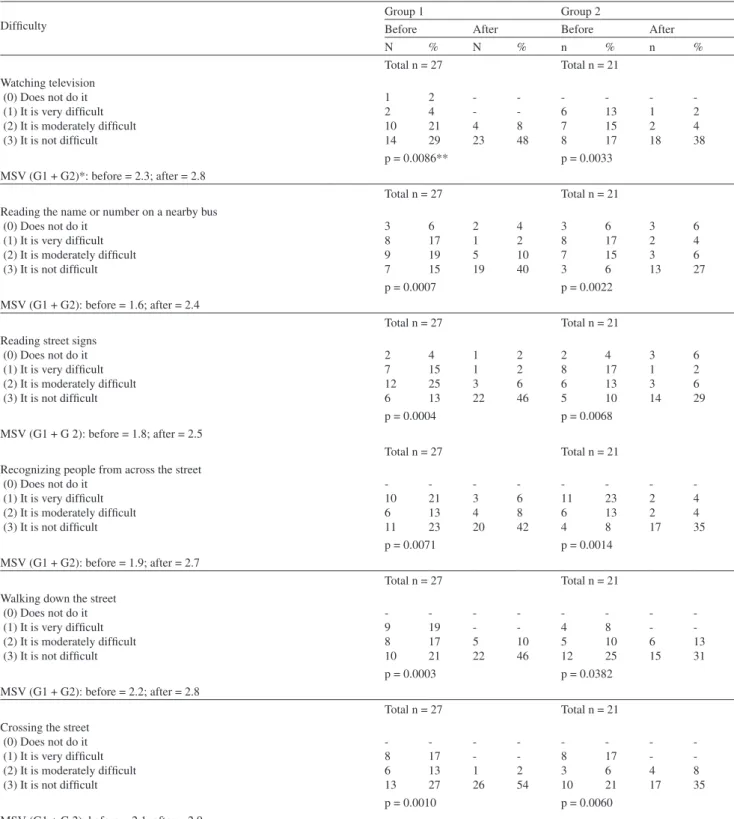
after posterior capsulotomy were the most significant. For example, watching television was rated as very or moderately dificult by 53% (MSV = 2.3) of the subjects before capsulotomy and by only 14% (MSV = 2.8) of the subjects after the procedure (Group 1 + Group 2) (p<0.01).
Reading the name or number on a nearby bus was rated as very or moderately dificult for 68% (MSV = 1.6) of the subjects before capsulotomy and by only 22% (MSV = 2.4) of the subjects after capsulotomy (Group 1 + Group 2) (p<0.005) (Table 4).
Table 4 - Perception of dificulties with activities related to distance vision before and after capsulotomy.
Dificulty
Group 1 Group 2
Before After Before After
N % N % n % n %
Total n = 27 Total n = 21
Watching television (0) Does not do it (1) It is very dificult (2) It is moderately dificult (3) It is not dificult
1 2 10 14 2 4 21 29 -4 23 -8 48 -6 7 8 -13 15 17 -1 2 18 -2 4 38
p = 0.0086** p = 0.0033
MSV (G1 + G2)*: before = 2.3; after = 2.8
Total n = 27 Total n = 21
Reading the name or number on a nearby bus (0) Does not do it
(1) It is very dificult (2) It is moderately dificult (3) It is not dificult
3 8 9 7 6 17 19 15 2 1 5 19 4 2 10 40 3 8 7 3 6 17 15 6 3 2 3 13 6 4 6 27
p = 0.0007 p = 0.0022
MSV (G1 + G2): before = 1.6; after = 2.4
Total n = 27 Total n = 21
Reading street signs (0) Does not do it (1) It is very dificult (2) It is moderately dificult (3) It is not dificult
2 7 12 6 4 15 25 13 1 1 3 22 2 2 6 46 2 8 6 5 4 17 13 10 3 1 3 14 6 2 6 29
p = 0.0004 p = 0.0068
MSV (G1 + G 2): before = 1.8; after = 2.5
Total n = 27 Total n = 21
Recognizing people from across the street (0) Does not do it
(1) It is very dificult (2) It is moderately dificult (3) It is not dificult
-10 6 11 -21 13 23 -3 4 20 -6 8 42 -11 6 4 -23 13 8 -2 2 17 -4 4 35
p = 0.0071 p = 0.0014
MSV (G1 + G2): before = 1.9; after = 2.7
Total n = 27 Total n = 21
Walking down the street (0) Does not do it (1) It is very dificult (2) It is moderately dificult (3) It is not dificult
-9 8 10 -19 17 21 -5 22 -10 46 -4 5 12 -8 10 25 -6 15 -13 31
p = 0.0003 p = 0.0382
MSV (G1 + G2): before = 2.2; after = 2.8
Total n = 27 Total n = 21
Crossing the street (0) Does not do it (1) It is very dificult (2) It is moderately dificult (3) It is not dificult
-8 6 13 -17 13 27 -1 26 -2 54 -8 3 10 -17 6 21 -4 17 -8 35
p = 0.0010 p = 0.0060
MSV (G1 + G 2): before = 2.1; after = 2.9
Pouring water in a glass, an activity related to depth perception, was rated as very or moderately dificult (Group 1 + Group 2) by 27% (MSV = 2.6) of the subjects before and by only 8% (MSV = 2.9) of the subjects after the Nd:YAG laser procedure (Table 5).
The average level of laser energy used was 131.9 mJ. Four patients had ocular hypertension after posterior capsulotomy, one patient presented tiny cracks in the intraocular lens, and one patient had hernia of the vitreous body into the anterior chamber of the eye without displacement of the intraocular lens.
All of the subjects who were interviewed stated that the posterior capsulotomy procedure had been “worthwhile”, and 83% stated that they had no further visual dificulties after the procedure.
DISCUSSION
Posterior capsulotomy with an Nd:YAG laser is one of the most frequently performed ophthalmological procedures in the United States. It should be considered to be an important public healthcare issue because of the frequency with which it is performed and because it may be associated with occasional morbidity.17
Visual disability has the potential to affect several areas that are related to quality of life.9 With aging, a
gradual deterioration of social, psychological, and physical (including visual) functioning occurs. The decline in visual function itself has been associated with physical and mental decline, and there is growing recognition of the importance of patient-reported visual results because objective measurements may fail to relect the degree of deterioration that patients experience in their daily activities.18
Instruments used to assess quality of life are important and have been widely accepted as resources that can be used to evaluate potential healthcare interventions. In the ield of ophthalmology, an emphasis has been placed on determining the functional improvement that patients submitted to
cataract surgery experience through the use of tools that are used to assess patients’ quality of life and visual function. Such studies have been performed mostly in the United States and in Europe, where several such instruments have been developed and tested.14,19,20 In Brazil, studies have been
conducted about the inluence that a second cataract surgery has on patients’ visual function and their perception of the inluence of the cataract and the surgery on their quality of life.21
Improving visual acuity is the primary endpoint by which success is measured for Nd:YAG laser capsulotomy in the treatment of posterior capsule opaciication.22 There is little
information available in the literature regarding the visual function parameters and daily life activities that may be improved by laser treatment. As with any surgical procedure, the decision to perform a posterior capsulotomy with the YAG laser should be based on the potential risk-beneit ratio for the individual patient.23
The present study sought to identify the inluence that unilateral Nd:YAG laser posterior capsulotomy had on visual acuity and on patients’ perceptions of dificulties they experienced carrying out their activities of daily living. The mean age of the patients in our study was 68 years (range 40 to 80 years), which is similar to the mean age of 70 years that was reported by Sundelin et al.24 Although
the age ranges for cataract surgery and posterior capsule opaciication development differ between countries and cultures, these data are compatible with the nature of procedure studied, i.e., Nd:YAG laser posterior capsulotomy after cataract surgery.
Most patients who were interviewed were retired and no longer participating in professional activities at the time of the study. Thus, the impact of the procedure was assessed by analyzing subjects’ perceptions of the dificulties they experienced performing vision-related activities of daily living.
There was signiicant improvement in visual acuity in the capsulotomized eye after the laser treatment, indicating
Table 5 - Subjects’ perception of dificulties with activities related to depth perception before and after capsulotomy.
Dificulty
Group 1 Group 2
Before After Before After
N % n % n % n %
Total n = 27 Pouring water into a glass
(0) Does not do it (1) It is very dificult (2) It is moderately dificult (3) It is not dificult
-3 6 18
-6 13 38
-1 1 25
-2 2 52
-1 3 17
-2 6 35
-1 1 19
-2 2 40
p = 0.0469** 0.3613
MSV (G1 + G2)*: before = 2.6; after = 2.9
that this procedure had a beneicial impact on visual acuity, which is in agreement with previous reports.25 The median
percentage of visual impairment of the subjects decreased signiicantly from 20 to 6.25%, thereby also conirming the positive effect that laser capsulotomy has on binocular vision.
After the procedure, the median stereoacuity of the included subjects showed signiicant improvement (Table 3). A total of 68.8% of the subjects achieved stereoacuity equal to or better than 100 arc seconds, which has been stated by Kwapiszeski et al.26 as reined stereoscopic vision.
The unilateral posterior capsule opaciication in this study was associated with reduced stereopsis, causing symptoms related to difficulties judging distances. A secondary posterior capsulotomy can restore normal stereoacuity and reduce the functional limitations that these patients experience. This beneicial result of posterior capsulotomy was observed in this study.
The subjects reported dificulties performing activities that were dependent on near and distance visual function. After capsulotomy, there was a clear perception among patients that they had less dificulty performing most of their daily activities (p<0.05), suggesting an improvement in their quality of life that was possibly related to their improved visual acuity, as well as to improvements in peripheral vision and/or stereopsis. Sundelin et al.24 also reported a reduction
in patients’ perceived dificulties performing activities of daily living following posterior capsulotomy. Their study included patients who had visual acuity >0.25 in the eye that was affected by posterior capsule opaciication, but they also included patients with other ocular diseases. They used the CatQuest questionnaire, which was developed by Lundström et al.27 to test visual disabilities in patients with cataracts.
With regard to mid-range vision, of the seven activities assessed, there was no signiicant change after capsulotomy for ive of the activities that were queried in the study: ironing, bathing without help, and combing of hair (both groups); picking out clothes to wear, and cooking (Group 2). It is possible that the activities “combing of hair” and “bathing without help” are considered very private and are therefore linked to self-esteem. About one third of the patients interviewed before the procedure (32%; MSV = 1.8), and one fourth of the ones interviewed after capsulotomy (24%; MSV = 2.1) stated “does not do it” for “ironing”. Perhaps the reply “does not do it” relects the cultural belief that this activity is a feminine one rather than an activity that a patient does not do because they have visual impairment, a inding that was not detected previously in our exploratory study. There were no signiicant changes observed in subjects’ perceptions of the vision-related dificulties they experienced related to the tasks of picking out clothes to wear and cooking, which may be explained
by the higher median age of patients in Group 2 and the lower visual acuity of the contralateral eye in that group. Furthermore, no subject reported that they had a lot of difficulty picking out clothes to wear before or after capsulotomy. Additionally, several patients said that they did not cook. The small sample size of our study may explain the lack of change in the perceptions of patients in Group 2 regarding vision-related dificulties with shaving. As for the only task directly related to depth vision (pouring water into a glass), there was no perception of improvement among patients in Group 2 who showed lesser change in the degree of stereopsis after surgery. Other studies have reported similar problems with depth perception among subjects with monocular vision.28 In such patients, even activities that are
not obviously related to binocular vision, such as watching television, may be affected, due to the phenomenon of suppression or binocular rivalry, which could make binocular vision worse than monocular vision in the eye with the better visual acuity.The four patients in this study who had ocular hypertension after posterior capsulotomy were controlled with antihypertensive drugs and ultimately recovered a normal level of intraocular pressure. The subject who had cracks in the intraocular lens and the one who presented hernia of the vitreous body into the anterior chamber of the eye were satisied with the inal visual acuity that they achieved (0.05 and 0.00, respectively). These complications have been cited in earlier studies and are compatible with the results of this research.1,23,25
Studies conducted in patients with cataracts have shown that common activities of daily living have different degrees of importance to patients and that some activities that are only seldom carried out are very important to certain individuals, based on their personal preferences. This inding suggests that a questionnaire that includes the most frequent activities that most individuals perform and is complemented with open-ended questions regarding personal issues of special interest to individual patients as well as their hobbies would be quite useful in this ield of research.29 When adapting this questionnaire to patients
with cataracts in Brazil, the authors experienced similar problems after the exploratory study and decided to replace some questions concerning dificulties that patients might experience while performing their activities of daily living, resulting in a more appropriate instrument for the local conditions.30 Translation and cultural adaptation of such
questionnaires are recommended, but we should emphasize that even after this process is accomplished, the inal version must be shown to have the same psychometric properties as the original instrument.
known that an eye with good vision can compensate for a contralateral eye with weaker vision, the results obtained in this study allow us to state that, from the subjects’ point of view, the Nd:YAG laser unilateral posterior capsulotomy improved several aspects of their quality of life. The beneits might have been even greater if the median visual acuity of the fellow eye (logMAR = 0.22) had been better because of the binocular vision improvement. For elderly
people, quality of life is believed to be more important than a prolonged lifetime,21 thereby justifying the growing
interest in assessing therapies from the subjective as well as the objective point of view. It is important to note that in this study, most of the patients who underwent the laser capsulotomy reported that they had no visual impairment after the procedure and all patients stated that they were satisied with it.
REFERENCES
1. Apple DJ, Kerry SD, Tetz MR, Assia EI, Holland EY, Legler, et al. Posterior capsule opaciication. Surv Ophthalmol. 1992;37:73-116.
2. Powe NR, Schein OD, Gieser SC, Tielsch JM, Luthra R, Javitt J, et al. Synthesis of the literature on visual acuity and complications following cataract extraction with intraocular lens implantation. Arch Ophthalmol. 1994;112:239-52.
3. Schaumberg DA, Dana MR, Christen WG, Glynn RJ. A systematic overview of the incidence of posterior capsule opacification. Ophthalmology. 1998;105:1213-21.
4. Maltzman BA, Haupt E, Notis C. Relationship between age at time of cataract extraction and time interval before capsulotomy for opaciication. Ophthalmic Surg. 1989;20:321-4.
5. Senne FMB, Cardillo JA, Rocha EM, Kara-José N. Long-term visual outcomes in the cataract-free zone project in Brazil. Acta Ophthalmol Scand. 2002;80:262-6.
6. Aron-Rosa D, Aron JJ, Griesemann M, Thyzel R. Use of the neodymium-YAG laser to open the posterior capsule after lens implant surgery: a preliminary report. J Am Intraocul Implant Soc. 1980;6:352-4.
7. Fankhauser F, Roussel P, Steffen J, Van der Zypen E, Chrenkova A. Clinical studies on the eficiency of high power laser radiation upon some structures of the anterior segment of the eye. First experiences of the treatment of some pathological conditions of the anterior segment of the human eye by means of a Q-switched laser system. Int Ophthalmol. 1981;3:129-39.
8. Rubin GS, Adamsons IA, Stark WJ. Comparison of acuity, contrast sensitivity, and disability glare before and after cataract surgery. Arch Ophthalmol. 1993;111:56-61.
9. Scott IU, Schein OD, West S, Bandeen-Roche K, Enger C, Folstein MF. Functional status and quality of life measurement among ophthalmic patients. Arch Ophthalmol. 1994;112:329-35.
10. Gill TM, Feinstein AR. A critical appraisal of the quality of life measurementes. JAMA. 1994;272:619-26.
11. Kuyken W, Orley J, Hudelson P, Sartorius N. Quality of life assessment across cultures. Int J Ment Health. 1994;23:5-27.
12. Schemann JF, Leplege A, Keita T, Resnikoff S. From visual function deiciency to handicap: measuring visual handicap in Mali. Ophthalmic Epidemiol. 2002;9:133-48.
13. Piovesan A, Temporini ER. Pesquisa exploratória: procedimento metodológico para o estudo de fatores humanos no campo da saúde pública. Rev Saúde Publica. 1995;29:318-25.
14. Fletcher AE, Ellwein LB, Selvaraj S, Vijaykumar R, Rahmathullah R, Thulasiraj RD. Measurements of vision function and quality of life in patients with cataract in Southern India: report of instrument development. Arch Ophthalmol. 1997;115:767-74.
15. Applegate WB, Miller ST, Elam JT, Freeman JM, Wood TO, Gettleinger TC. Impact of cataract surgery with the lens implantation on vision and physical function in elderly patients. JAMA. 1987;257:1064-6.
16. Russ HHA, Temporini ER, Kara-José N. Impacto da Campanha Olho no Olho em escolhas de ensino: percepção do pessoal de ensino. Arq Bras Oftalmol. 2004;67:311-21.
17. Lane SS. Posterior capsule opaciication and YAG capsulotomy. Am J Ophthalmol. 2004;138:635-6.
18. Brenner MH, Curbow B, Javitt JC, Legro MW, Sommer A. Vision change and quality of life in the elderly. Response to cataract surgery and treatment of other chronic ocular conditions. Arch Ophthalmol. 1993;111:680-5.
19. Bernth-Petersen P. Visual functioning in cataract patients. Methods of measuring and results. Acta Ophthalmol. 1981;59:198-205.
20. Abrahamsson M, Carlsson B, Tornqvist M, Sterner B, Sjostrand S. Changes of visual function and visual ability in daily life following cataract surgery. Acta Ophthalmol Scand. 1996;74:69-73.
21. Avakian A, Temporini ER, Kara-José N. Second eye cataract surgery: perceptions of a population assisted at a university hospital. Clinics. 2005;60:401-6.
22. Terry AC, Stark WJ, Maumenee AE, Fagadau W. Neodymium-YAG laser for posterior capsulotomy. Am J Ophthalmol. 1983;96:716-20.
23. Aslam TM, Devlin H, Dhillon B. Use of Nd:YAG laser capsulotomy. Surv Ophthalmol. 2003;48:594-612.
24. Sundelin K, Lundström M, Stenevi U. Self-assessed visual function for patients with posterior capsule opacification before and after capsulotomy. Acta Ophthalmol Scand. 2005;83:729-33.
25. Stark WJ, Worthen D, Holladay JT, Murray G. Neodymium:YAG lasers; an FDA report. Ophthalmology. 1985;92:209-12.
26. Kwapiszeski BR, Gallagher CC, Holmes JM. Improved stereoacuity: An indication for unilateral cataract surgery. J Cataract Refract Surg. 1996;22:441-5.
28. Coday MP, Warner MA, Jahrling KV, Rubin PA. Acquired monocular vision: functional consequences from the patient’s perspective. Ophthal Plast Reconstr Surg. 2002;18:56-63.
29. Lundström M, Fregell G, Sjöblom A. Vision related daily life problems in patients waiting for a cataract extraction. Br J Ophthalmol. 1994;78:608-11.