The Structural and the Magnetic Properties of Aluminum Substituted Yttrium Iron Garnet
Qassem I. Mohaidata*, Mahdi Lataifeha, Khozima Hamashab, Sami H. Mahmoodc, Ibrahim Bsould,
Mufeed Awawdeha,e
Received: September 06, 2017; Revised: December 30, 2017; Accepted: February 17, 2018
In this paper, Y3AlxFe5-xO12 powders with x = 0.0, 0.2, 0.4, 0.6, 0.8, and 1.0 were prepared via
solid state reaction method. X-ray diffraction, Vibrating Sample Magnetometry, and Mössbauer Spectroscopy were used to study their structural and magnetic properties. The XRD patterns of the samples show single phase structure with decreasing lattice constant when increasing Al concentration.
The saturation magnetization decreases from 28.0 to 10.1 emu/g with increasing Al3+ from 0.0 to 1.0
due to the reduction of the superexchange interactions between iron ions in the a and d sublattices.
Room temperature Mössbauer spectra for the samples were collected and analyzed. The hyperfine field values for octahedral and tetrahedral sites of the samples decreased with increasing Al concentration.
Moreover, Mössbauer results have shown that Al3+ ions prefer to replace Fe+3 at the octahedral sites.
Keywords: Mössbauer Spectroscopy, Hyperfine Interactions, Magnetic Properties, X-ray
Diffraction.
*e-mail: [email protected]
1. Introduction
Yttrium iron garnet (YIG) has received intensive studies
since its discovery in 19561. YIG and substituted YIG provide remarkable performance in microwave devices due
to their tunable magnetization and low dielectric losses2,3.
The magnetic properties of YIG with chemical composition
{Y33+}
c[Fe2 3+]
a(Fe3 3+)
dO12
2-, where Y3+ ions occupy dodecahedral
sites and magnetic Fe3+ ions occupy octahedral [a-sublattice]
and tetrahedral (d-sublattice) sites, are determined by
the strength of the superexchange interactions between
magnetic ions in the various sublattices4-7. Accordingly,
the substitution of Y3+ ions by other rare earth ions, and/or
Fe3+ ions by nonmagnetic ions were adopted for successful
modification of the magnetic properties of YIG for potential technological applications3.
Garnets were functionalized in either the form of bulk materials for microwave passive devices, or in the form of thin films for magnetic-bubble-type digital memories. Although the magnetization of the garnet films for bubbles is essentially the same as in the bulk state, the magnetic anisotropy of the films is quite different, depending on the characteristics of the films, and their synthesis routes. For details on the parameters of bubbles which play an important role in solid state device applications, and the relation of these parameters to the magnetic and physical characteristics of the films, the reader is referred to the review article by Eschenfelder8.
The replacement of Fe3+ magnetic ions with non-magnetic
ions such as Al3+ has caught the attention of many researchers.
The site selectivity of Al3+ ions in Al-substituted YIG was
first reported by Gilleo and Geller in 19589,10, where it was
found that Al3+ ions substitute Fe3+ ions preferentially at the tetrahedral (d) sites. In later detailed studies of the crystal
chemistry of garnets, it was reported that the fraction of
Al3+ ions at the tetrahedral sites decreased smoothly with
the increase of Al concentration from 1.0 at x = 0 to 0.6
at x = 511,12. In addition, Cohen and Chegwidden (1966)
concluded from their magnetization data that the Al3+ ions
redistributed themselves among tetrahedral and octahedral sites with the increase of the temperature at which the garnet
was heat treated13. In a more recent study, Kim et al. have investigated the magnetic and structural properties of the
substituted Y3Fe5-xAlxO12 (x = 0.0, 0.25, 0.50, 0.75, and 1.0)
garnets prepared by sol-gel method. In their study, both
the lattice constant a and the saturation magnetization Ms
decreased with increasing Al concentration. Moreover, room temperature (RT) Mössbauer spectra reflect cation distribution
of Fe3+ and Al3+ at tetrahedral sites where six components
were used to fit the sample with x = 114.
Thongmee et al. have reported the hyperfine parameters and the saturation magnetization of the system Y3Fe5-xAlxO12 (0 < x < 1 and x = 1.5, 2.0, and 2.5). It was shown that the
aPhysics Department, Yarmouk University, Irbid 21163, Jordan
bDepartment of Basic Sciences, Al-Huson University College, Al-Balqa Applied University, Irbid, Jordan cPhysics Department, The University of Jordan, Amman 11942, Jordan
dPhysics Department, Al al-Bayt University, Mafraq 13040, Jordan
eCollege of Science and Health Professions, King Saud Bin Abdulaziz University for Health Sciences, Jeddah,
saturation magnetization decreased with Al3+ substitution
for Fe3+. In addition, RT Mössbauer spectra for the samples
with 0 ≤ x ≤ 0.8 were fitted with three magnetic components,
two corresponding to octahedral sites and one to tetrahedral
sites15. On the other hand, Motlagh et al. have shown that a systematic line broadening was observed in the Mössbauer
spectra with the increase of Al3+ concentration, which can
be attributed to the presence of hyperfine field distribution
because of the random distribution of Al3+ in the octahedral
and tetrahedral sites16.
Based on the previous studies, aluminum-substituted iron
in YIG were synthesized by different methods such as sol-gel
method14,17,18, co-precipitation method19, and ball milling16. Mössbauer spectra for synthesized garnets were fitted with
different numbers of components corresponding to Fe3+ in
octahedral and tetrahedral sites. The results of the previous studies indicated that the site selectivity of Al3+ ions may be
sensitive to the preparation method, heat treatment, and the
level of Al substitution. In the present study, investigation of the structural, magnetic, and hyperfine interactions of
Y3Fe5-xAlxO12 (0.0 ≤ x ≤ 1.0) synthesized by solid state
reaction was carried out. Mössbauer spectroscopy was used to investigate the effect of Al substitution on the hyperfine
magnetic fields and on the site preferred by the Al3+ ions.
In addition, X-ray diffraction (XRD), scanning electron microscope (SEM), and Vibrating Sample Magnetometer (VSM) were used to characterize all the samples to examine their structural and magnetic properties.
2. Experimental Procedures
Y3AlxFe5-xO12 powders with x = 0.0, 0.2, 0.4, 0.6, 0.8,
and 1.0 were synthesized by solid state reaction method. Metallic oxides Y2O3, Fe2O3 and Al2O3 were used to prepare
Y3AlxFe5-xO12 powder samples. Appropriate weighted
amounts of the metallic oxides were loaded into a hardened stainless-steel cup with ball to powder ratio of 10:1. The milling process was carried out at 250 rpm for 16 h. The resulting precursor was annealed at 1300°C for 2 h. X-ray diffraction (XRD) patterns were collected using Philips PW 1720 X-ray diffractometer operating at (40 kV, 40 mA), with Cu-Kα radiation (λ = 1.5405 Å). The samples were scanned over the angular range 15° < 2θ < 75° with 0.02° scanning step and speed of 1 deg/min. The XRD patterns were carried out using X’pert HighScore 2.0.1 software for phase identification, and Rietveld refinement of the crystal structure was performed using FullProf suite 2000 software.
The magnetic measurements at room temperature were performed using Vibrating Sample Magnetometer (VSM MicroMag 3900, Princeton Measurements Cooperation), providing a maximum applied magnetic field of 10 kOe. Room temperature (RT) Mössbauer spectra were collected over 1024 channels using a standard constant acceleration
Mössbauer spectrometer, with a 50 mCi 57Co in a Rhodium
matrix γ-ray source. The spectra were calibrated using room
temperature Mössbauer spectrum of α-Fe foil, and then
analyzed using fitting routines based on least-squares analysis.
3. Results and Discussion
3.1 XRD Analysis
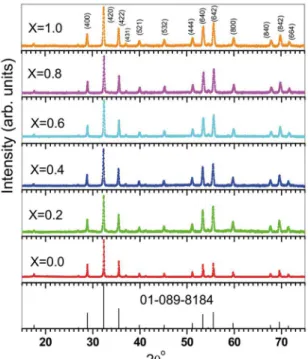
Figure 1 shows the powder XRD patterns of pure and Al substituted YIG with different Al concentrations (x = 0.0, 0.2,
0.4, 0.6, 0.8, and 1.0). Rietveld analysis of all patterns was used to determine the refined crystal parameters of all pure and the Al substituted YIG samples. The analysis revealed the presence of a single garnet phase (space group cubic symmetry Ia-3d) without any impurity phase.
Figure 1. Powder X-ray diffraction patterns of Y3AlxFe(5-x)O12
garnet samples.
Figure 2 shows representative Rietveld refined patterns for
the samples with x = 0 and 1. The theoretical pattern (black
continuous line) is in good agreement with the experimental data (red dots), where the residual difference curve (in blue) is a straight horizontal line with small ripples only around the main structural peak positions. The goodness- of-fit quality
determined by the value of χ2, Bragg factor (R
B), as well as
the refined lattice parameter a and unit cell volume V, and
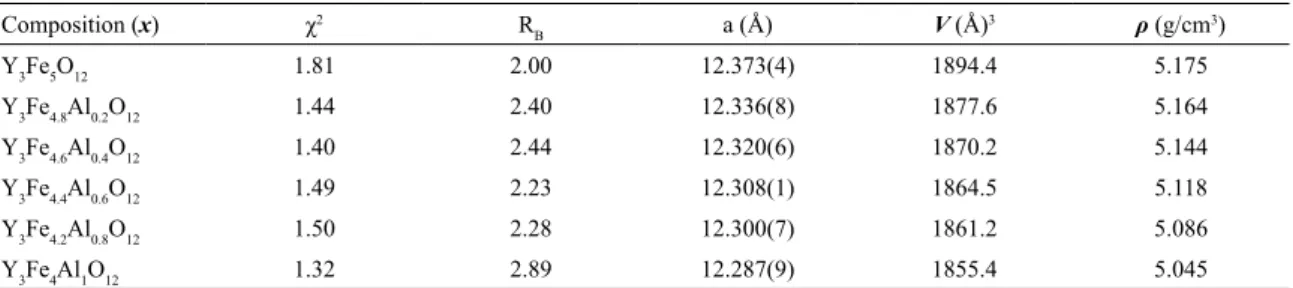
the x-ray density for all samples are listed in Table 1. The
lattice constant and the cell volume decreased monotonically
with increasing the concentration x of the doped Al3+ ion.
Such decrease can be attributed to the smaller ionic radius
Figure 2. Refined XRD patterns for Y3AlxFe(5-x)O12 garnet samples
with x = 0 and x = 1. The residual difference (Yobs - Ycalc) between the experimental (Yobs) and calculated data (Ycalc) is given in the lower part of the plots (blue line).
Table 1. Bragg factor RB, χ
2, lattice constant a, unit cell volume, and density ρ for all garnet samples.
Composition (x) χ2 R
B a (Å) V (Å)
3 ρ (g/cm3)
Y3Fe5O12 1.81 2.00 12.373(4) 1894.4 5.175
Y3Fe4.8Al0.2O12 1.44 2.40 12.336(8) 1877.6 5.164
Y3Fe4.6Al0.4O12 1.40 2.44 12.320(6) 1870.2 5.144
Y3Fe4.4Al0.6O12 1.49 2.23 12.308(1) 1864.5 5.118
Y3Fe4.2Al0.8O12 1.50 2.28 12.300(7) 1861.2 5.086
Y3Fe4Al1O12 1.32 2.89 12.287(9) 1855.4 5.045
whereas Fe3+(a) - O2- = 2.02 Å, and Al3+(d) - O2- = 1.76 Å,
whereas Fe3+(d) - O2- = 1.87 Å12. Also, the x-ray density obtained from the refinement analysis exhibited a similar
monotonic decrease with increasing x, contrary to what is
expected as a result of the decrease of the cell volume. This is due to the fact that the rate of decrease of the molecular weight with Al-substitution is higher than the rate of decrease
of the cell volume as x increases. In addition, the observed
broadening of the diffraction peaks for the Al-substituted YIG samples indicates that the substitution results in a poorer crystallinity of the YIG phase.
3.2 SEM Analysis
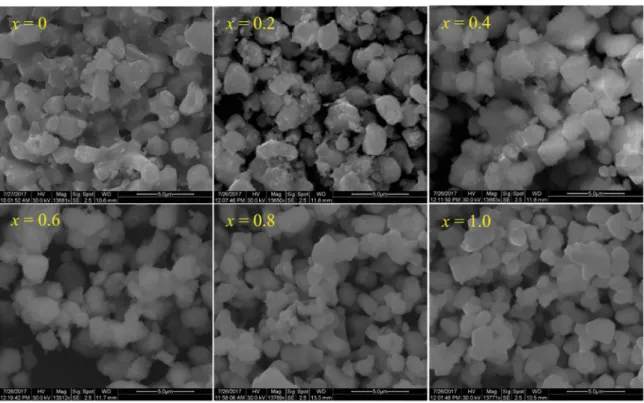
SEM images of pure YIG and Al doped YIG samples for different concentrations are shown in Figure 3. The figure indicates that all samples are composed of particles with irregular shapes and relatively narrow particle size
distribution. As x increased, however, the particle size became
more uniform and exhibited a small reduction. Specifically,
the sample with x = 0 consisted of particles with size in the
range from ~ 0.8 µm to ~ 4 µm. The images of the samples
with x = 0.2, 0.4, and 0.6 are generally similar to the image
of the sample with x = 0, but they revealed the presence of a
larger fraction of smaller particles with size ~ 1 µm, and an
upper limit of particle size of nearly 3 µm. The SEM images
of the samples with x = 0.8, and 1.0 showed further reduction
of particle size, and the particles became almost spherical in shape. The particle size distribution in these samples is narrower and more uniform, and the majority of particles
are characterized by particle size ≤ 1 µm in diameter. These
results indicated that the Al substitution in YIG resulted in a small reduction of the particle size, uniform particle shape, and narrow particle size distribution.
3.3 Magnetic Measurements
The magnetic hysteresis loops at RT of Y3AlxFe5-xO12 samples are shown in Figure 4. From the hysteresis loops, it can be noticed that all samples have negligible coercivity regardless of Al concentration x20. This is indicative of the
low RT crystal anisotropy of YIG21 , and demonstrates that
Al substitution has negligible effect on the crystal anisotropy. That magnetization of all samples is almost saturated at an applied field of 10 kOe, and the saturation magnetization
(Ms) was determined directly from the hysteresis loops and
listed in Table 2. The saturation magnetization for the pure YIG sample is consistent with previously reported results3,21, and the saturation magnetization of the substituted samples decreased with the increase of Al3+ ions substituting Fe3+ ions at (d) and (a) sublattices. The monotonic decrease of Ms with
increasing x (Figure 5) can be attributed to the progressive
reduction of the superexchange interactions between iron
ions at a and d sites, and the reduction of the magnetic
dipole-dipole interaction14,15. In an earlier investigation of the magnetic behavior of substituted garnets, it was proposed
Figure 3. SEM images for all synthesized garnet samples.
Figure 4. Magnetic hysteresis loops for Y3AlxFe(5-x)O12 garnet samples.
a given sublattice leaves the moments of the Fe3+ ions in
that sublattice in parallel alignment, while the consequent
weakening of the a-d interactions leads to a more important
role played by intra-sublattice interactions and randomization of the canting of the Fe3+ moments of the other sublattice22.
This tendency occurs at low substitution levels, and as x
increases, the continued depletion of the iron sublattice by nonmagnetic ions reaches a point beyond which the
intra-sublattice interactions become dominant over the a-d
interactions3,22. These effects may explain the deterioration of the saturation magnetization of YIG with increasing the level of Al substitution for Fe, where the magnetization behavior is dictated by the progressively increased importance of intra-sublattice interactions with increasing x.
Table 2. The saturation magnetization (Ms in emu/g) for Y3AlxFe5-xO12
garnet samples.
x 0.0 0.2 0.4 0.6 0.8 1.0
Ms(emu/g) 28.0 22.3 19.0 15.5 12.1 10.1
Figure 5. The saturation magnetization as a function of concentration for Y3AlxFe(5-x)O12 garnet samples.
3.4 Mössbauer spectroscopy
Mössbauer spectroscopy was used to investigate the preferential site occupation of Al3+ ions in the garnet lattices. Accordingly, Mössbauer spectra (MS) of the system
Y3AlxFe5-xO12 with x = 0.0, 0.2, 0.4, 0.6, 0.8, and 1.0 were
Figure 6. Mössbauer spectra for the Y3AlxFe5-xO12 samples (filled
circles) together with the theoretical spectrum obtained from the
fitting software (continuous red line). The component corresponding to octahedral sites is represented by the blue sextet, while that
corresponding to tetrahedral sites is represented by the green sextet
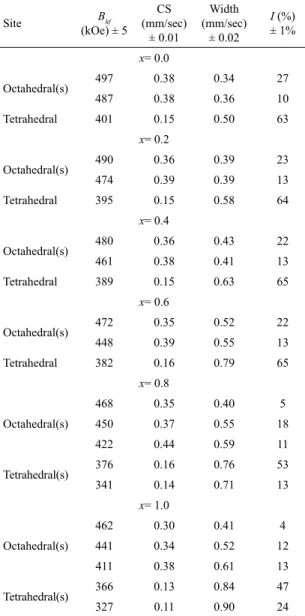
Table 3. The hyperfine parameters and the percentage relative
intensities (I) obtained at room temperature for Y3AlxFe5-xO12
garnet samples.
Site Bhf
(kOe) ± 5
CS
(mm/sec) ± 0.01
Width (mm/sec)
± 0.02
I(%)
± 1%
x= 0.0
Octahedral(s) 497 0.38 0.34 27
487 0.38 0.36 10
Tetrahedral 401 0.15 0.50 63
x= 0.2
Octahedral(s) 490 0.36 0.39 23
474 0.39 0.39 13
Tetrahedral 395 0.15 0.58 64
x= 0.4
Octahedral(s) 480 0.36 0.43 22
461 0.38 0.41 13
Tetrahedral 389 0.15 0.63 65
x= 0.6
Octahedral(s) 472 0.35 0.52 22
448 0.39 0.55 13
Tetrahedral 382 0.16 0.79 65
x= 0.8
Octahedral(s)
468 0.35 0.40 5
450 0.37 0.55 18
422 0.44 0.59 11
Tetrahedral(s) 376 0.16 0.76 53
341 0.14 0.71 13
x= 1.0
Octahedral(s)
462 0.30 0.41 4
441 0.34 0.52 12
411 0.38 0.61 13
Tetrahedral(s) 366 0.13 0.84 47
327 0.11 0.90 24
The spectrum of pure YIG (x = 0) was fitted with three
magnetic sextets corresponding to iron ions (Fe3+) in three
different environments, two octahedral sites with Bhf = 497
kOe and 487 kOe and one tetrahedral site with Bhf = 401 kOe23. The intensity ratio of %37: % 63 for the two sublattices
is close to 2:3, which is consistent with previously reported results23-26.
The spectrum for the sample with x = 0.2 was fitted also
with three magnetic sextets as mentioned above. A reduction was observed in the values of the hyperfine magnetic field
at the iron nucleus in both sublattices due to the substitution
of Al3+ 20,27,28. Specifically, the hyperfine fields associated
with Fe3+ ions at octahedral sites reduced to 490 kOe and
474 kOe, and that associated with Fe3+ ions at tetrahedral sites reduced to 395 kOe. Moreover, a little broadening in the line widths was observed for all components, resulting from the statistical distribution of nonmagnetic ions around
the Fe3+ occupied sites.
Three magnetic components were also used to fit the Mössbauer spectra for the samples with x = 0.4 and x = 0.6.
The hyperfine field values for all sites continue to decrease
with increasing the concentration of Al3+ ions. This result
is consistent with the drop in the saturation magnetization values compared to that of the pure YIG sample. The relative
intensities of the octahedral and tetrahedral components suggest
that Al3+ ions may replace the Fe3+ ions at the octahedral sites. This result can be also confirmed by the large broadening in the sextet of the tetrahedral site, which could be due to the local fluctuation of the chemical environment of this site arising from the substitution of Al3+ at the octahedral sites28.
The spectrum for the sample with x = 0.8 was fitted with
five magnetic components, three octahedral components with
Bhf = 468 kOe, 450 kOe, and 422 kOe and two tetrahedral components with Bhf = 376 kOe and 341 kOe with intensity
ratio of %32: % 68. The evolution of the new component
with Bhf = 422 kOe could be attributed to Fe in the octahedral sites with Al in its environment which causes a reduction in
Bhf from about 500 kOe down to this value. This also can be
associated with Bhf = 468 kOe. Moreover, a new component,
with Bhf = 341 kOe, was observed, and could be associated with Fe3+ ions in tetrahedral sites surrounded with a chemical environment involving Al3+ ionic substitution for Fe3+ ions. The spectrum for the sample with x = 1.0 can be fitted as
a superposition of five magnetic components as in the case
for x = 0.80, in addition to a weak magnetic component, with
intensity less than 1%, attributed to an α-Fe2O3 phase. The fact that this phase was not detected by XRD is an indication that
its fraction in the sample was below the delectability limit of the diffraction technique, and that Mössbauer spectroscopy is more sensitive to detecting traces of Fe-containing phases. The increase in the intensity, 71%, and the line broadening
of the tetrahedral components supports also the fact that Al3+
ions replaced Fe3+ ions in the octahedral sites. Moreover, the center shifts of the octahedral and tetrahedral sites show some decrease. This can be attributed also to the local fluctuation of the chemical environment induced by the statistical distribution of Al3+ ions in the garnet lattice.
4. Conclusions
The Y3AlxFe5-xO12 garnets with Ia3d space group were been prepared by solid state reaction and. The lattice constant
was found to decrease with increasing Al3+ concentration. The
substitution of Fe3+ by Al3+ at octahedral sites was confirmed
by Mössbauer spectroscopy. The distribution of Al3+ ions
among octahedral and tetrahedral sites, contrary to the reported preference for tetrahedral sites, may indicate the sensitivity of the ionic distribution to the preparation procedure and heat treatment, in agreement with the results of Cohen and Chegwidden (1966). Moreover, the saturation magnetization
Ms decreased with the increase of the concentration of Al3+
ions due to the weakening of the superexchange interactions
between the Fe3+ ions induced by the depletion of the Fe
sublattices by nonmagnetic Al3+ substitution.
5. References
1. Bertaut F, Forrat F. Structure des ferrites ferrimagnetiques des
terres rares. Comptes Rendus de l' Academie des Sciences. 1956;242:382-384.
2. Mahmood SH. Permanent Magnet Applications. In: Mahmood
SH, Abu-Aljarayesh I, eds. Hexaferrite Permanent Magnetic
Material. Millersville: Materials Research Forum LLC; 2016. p. 153-165.
3. Gilleo MA. Ferromagnetic insulators: Garnets. In: Wohlfarth
PE, ed. Ferromagnetic Materials: a Handbook on the Properties
of Magnetically Ordered Substances, Volume 2. Amsterdam:
North-Holland; 1980. p. 1-53.
4. Paoletti A. Physics of Magnetic Garnet. In: Proceedings of the
International School of Physics "Enrico Fermi"; Course LXX; 1977 Jun 27- Jul 9; Varenna on Lake Como, Villa Monastero, Italy. Amsterdam: North Holland; 1978.
5. Jha AR. Rare Earth Materials: Properties and Applications.
Boca Raton: CRC Press; 2014.
6. Lataifeh MS. Room temperature magnetization measurements of some substituted rare earth iron garnets. Applied Physics A.
2008;92(3):681-685.
7. Xu H, Yang H, Xu W, Yu L. Magnetic properties of Bi-doped
Y3Fe5O12 nanoparticles. Current Applied Physics. 2008;8(1):1-5.
8. Eschenfelder A. Crystalline films for bubbles. In: Wohlfarth PE,
ed. Ferromagnetic Materials: a Handbook on the Properties of Magnetically Ordered Substances, Volume 2. Amsterdam:
North-Holland; 1980. p. 297-343.
9. Gilleo M, Geller S. Substitution for Iron in Ferrimagnetic
Yttrium-Iron Garnet. Journal of Applied Physics. 1958;29(3):380-381.
10. Gilleo M, Geller S. Magnetic and Crystallographic Properties of Substituted Yttrium-Iron Garnet. 3Y2O3.xM2O3.(5-x)Fe2O3. Physical Review. 1958;110(1):73-78.
11. Geller S, Williams HJ, Espinosa GP, Sherwood RC. Importance of Intrasublattice Magnetic Interactions and of Substitutional Ion Type in the Behavior of Substituted Yttrium Iron Garnets.
Bell Labs Technical Journal. 1964;43(2):565-623.
12. Geller S. Crystal chemistry of the garnets. Zeitschrift für
Kristallographie-Crystalline Materials. 1967;125:1-47.
13. Cohen HM, Chegwidden RA. Control of the Electromagnetic Properties of the Polycrystalline Garnet Y3Fe3.75Al1.25O12. Journal
of Applied Physics. 1966;37(3):1081-1082.
14. Kim CS, Min BK, Kim SJ, Yoon SR, Uhm YR. Crystallographic and magnetic properties of Y3Fe5-xAlxO12. Journal of Magnetism
and Magnetic Materials. 2003;254-255:553-555.
15. Thongmee S, Winotai P, Tang IM. Local field fluctuations in the substituted aluminum iron garnets, Y3Fe5-xAlxO12. Solid
State Communications. 1999;109(7):471-476.
16. Motlagh ZA, Mozaffari M, Amighian J, Lehlooh AF, Awawdeh M, Mahmood S. Mössbauer studies of Y3Fe5-xAlxO12 nanopowders
prepared by mechanochemical method. Hyperfine Interactions.
2010;198(1-3):295-302.
17. Kim CS, Min BK, An SY, Uhm YR. Mössbauer studies of
Y3Fe4.75Al0.25O12. Journal of Magnetism and Magnetic Materials.
2002;239(1-3):54-56.
18. Garskaite E, Gibson K, Leleckaite A, Glaser J, Niznansky D, Kareiva A, et al. On the synthesis and characterization of iron-containing garnets (Y3Fe5O12, YIG and Fe3Al5O12, IAG).
Chemical Physics. 2006;323(2-3):204-210.
19. Rodic D, Mitric M, Tellgren R, Rundlof H. The cation distribution and magnetic structure of Y3Fe(5-x)AlxO12. Journal of Magnetism
and Magnetic Materials. 2001;232(1-2):1-8.
20. Bouziane K, Yousif A, Widatallah HM, Amighian J. Site occupancy and magnetic study of Al3+ and Cr3+ co-substituted
Y3Fe5O12. Journal of Magnetism and Magnetic Materials.
2008;320(19):2330-2334.
21. Smit J, Wijn HPJ. Ferrites. Eindhoven: Philips Technical
Library; 1959.
22. Geller S. Magnetic Behavior of Substituted Ferrimagnetic
23. Mohaidat QI, Lataifeh M, Mahmood SH, Bsoul I, Awawdeh M. Structural, Mössbauer Effect, Magnetic, and Thermal
Properties of Gadolinium Erbium Iron Garnet System Gd
3-xErxFe5O12. Journal of Superconductivity and Novel Magnetism. 2017;30(8):2135-2141.
24. Lataifeh MS, Lehlooh AFD. Mossbauer spectroscopy study of
substituted yttrium iron garnets. Solid State Communications.
1996;97(9):805-807.
25. Lataifeh MS, Lehlooh AFD, Mahmood S. Mössbauer spectroscopy of Al substituted Fe in holmium iron garnet. Hyperfine Interactions. 1999;122(3-4):253-258.
26. Lataifeh MS, Mahmood S, Thomas MF. Mössbauer spectroscopy study of substituted rare-earth iron garnets at low temperature.
Physica B: Condensed Matter. 2002;321(1-4):143-148.
27. Murumkar VD, Shengule DR, Bichile GK, Jadhav KM. Mössbauer study of Al and Cr co-substituted Yttrium iron
garnets. Hyperfine Interactions. 2009;192(1-3):93-100.
28. Lehlooh AF, Mahmood S, Mozaffari M, Amighian J. Mössbauer Spectroscopy Study on the Effect of Al-Cr Co-Substitution
in Yttrium and Yttrium-Gadolinium Iron Garnets. Hyperfine