Informal work, unemployment and
health in Brazilian metropolitan areas,
1998 and 2003
Trabalho sem proteção social, desemprego e
saúde em regiões metropolitanas brasileiras,
1998 e 2003
1 Gerência de Epidemiologia, Secretaria Municipal de Saúde de Belo Horizonte, Belo Horizonte, Brasil. 2 Faculdade de Medicina, Universidade Federal de Minas Gerais, Belo Horizonte, Brasil.
3 Instituto de Ciências Exatas, Universidade Federal de Minas Gerais, Belo Horizonte, Brasil.
Correspondence L. Giatti
Departamento de Medicina Preventiva e Social, Faculdade de Medicina, Universidade Federal de Minas Gerais.
Av. Prof. Alfredo Balena 190, 10o andar, Belo Horizonte, MG 30130-100, Brasil. [email protected]
Luana Giatti 1,2 Sandhi Maria Barreto 2 Cibele Comini César 3
Abstract
This study investigates whether employment with no social security, as well as short and long term unemployment are associated with worse health among Brazilians. The representative study sam-ple was taken from two National Health Surveys and included men aged between 15 and 64 who lived in one of the eight metropolitan regions of Brazil in 1998 (n = 31,870) and 2003 (n = 32,887). Both surveys showed that full and part time workers with no social security, as well as those in short and long term (≥ 12 months) unemploy-ment had worse health indicators, regardless of age or schooling, when compared with full-time workers (≥ 40 hours/week) who had some form of social security through their employment. Hepat-ic cirrhosis was the disease most strongly associ-ated with labor market status. Its prevalence was higher among individuals in long term unem-ployment and those with no social security. Labor market status was also negatively associated with the use of health care services, especially medical visits. The present study shows that the absence of social security at work, unemployment and length of unemployment, characterize heteroge-neous groups of individuals in relation to health. Results reinforce the need to incorporate labor market status in research into health inequalities.
Unemployment; Health Insurance; Health In-equalities
Introduction
Work is one of the most important determinants of people’s way of life, strongly influencing their health and longevity 1. Flexibility in the labor
market is one of the most significant changes to impact on social and economic conditions around the world 2, particularly in developing
countries. To a large extent, the typical sala-ried job that is a guarantor of stability and of the rights of the employee has been replaced by temporary and part-time employment, and by other, precarious forms of employment includ-ing jobs with no contract and self employment 3.
Workers with precarious employment are more likely to suffer from adverse socioeconomic conditions and to be exposed to worse environ-ments and working conditions. Their risk of un-employment is also greater 4.
Little is known about the impact of precari-ous employment on health and investigations of this theme represent a challenge to research-ers 4. Studies carried out in countries such as
England and Finland have placed a priority on the relationship between perceived work inse-curity and health, and have identified associa-tions with greater morbidity and worse mental health 5,6. There are limitations with such an
relationship between health and labor market status. In a Finnish cohort, precarious links between work and unemployment presented higher risk of death from diseases related to al-cohol and from smoking-related neoplasia 8.
The situation of access to work and employ-ment related social guarantees in Brazil is both diverse and excluding. Since the 1980s, a pro-gressive breakdown of the labor market struc-ture has occurred 9. An important factor in this
process is the increase in the number of jobs that are not state regulated or do not guarantee access to the social protection system, includ-ing unregistered jobs and those who are self-employed or work in cooperatives 10. In 1989
registered, salaried workers represented 64% of the economically active population. In 1995, this figure had dropped to 58.2%. During this period, unregistered employment increased at a rate of 3.12% a year, generating about 541,500 unregistered jobs 11. Between 1992 and 2002, the
unemployment rate rose from 7.2% to 9.9% in Brazil as a whole, and from 9.7% to 13.5% in the country’s metropolitan regions. In these metro-politan regions, unregistered employment and self employment increased by a greater margin than in the rest of the country 12.
In the present study, we consider social pro-tection at work and weekly hours of work to be two distinct categories that define labor market status. The principal study hypothesis is that unprotected work, unemployment and length of unemployment are associated with worse health status. Our main objective is to verify this by testing associations between labor market status and indicators for health and healthcare in two recent years.
Methods
Study population
The present study includes men aged between 15 and 64 who live in Brazilian metropolitan re-gions and were included in the economically active population among participants of the 1998 and 2003 National Household Surveys, carried out by Brazilian Institute for Geogra-phy and Statistics (IBGE). The surveys are based on complex probabilistic samples described elsewhere 13 and contain data on
socio-demo-graphic factors and health and healthcare use. The information was obtained through inter-views, though these were not always given by the individual subject.
Study variables
In this study, response variables were health and healthcare use indicators. The health indicators were: report of low back pain, tendonitis, hyper-tension, arthritis/rheumatism, cancer, diabetes, bronchitis/asthma, heart disease, chronic kid-ney disease, depression, cirrhosis and chronic disease, the latter referring to the reporting of at least one of the nine conditions listed above. Healthcare use indicators were: medical visit and hospitalization in the past 12 months.
The explanatory variable that is of most interest to this study was labor market status, classified in six groups: full-time (≥ 40 hours/ week) employment with social protection; part time (< 40 hours/week) employment with so-cial protection; full time unprotected employ-ment (informed work); part-time unprotected employment (informed work); short term (< 12 months) and long term (≥ 12 months) unemployment. Employment with social pro-tection includes those jobs with a signed work-ing agreement and/or social protection cover. Unprotected employment refers to situations where the employee is not registered or receives no social benefits. Unemployment corresponds to the condition in which the individuals were not working and were seeking a job in the refer-ence week.
Other socio-demographic characteristics in-cluded were age, schooling, head of household, income from the main job and from all jobs held during the year, expressed as a multiple of the monthly Brazilian minimum wages (MW) and self-reported color (white, mixed-race/black, in-digenous and yellow). Individuals who declared themselves mixed-race or black were grouped as they have similar characteristics in relation to positions in the labor market. Private health plan was considered as an intermediate variable between labor market status and healthcare uti-lization.
Data analysis
instance, 0.25% for cirrhosis in 1998 and 0.16% in 2003; 3.2% for depression in 1998 and 2.3% in 2003), multiple regressions were used to in-vestigate the independent associations between each response variable of interest and labor market status, adjusting for age and schooling. The reference category for analysis was full-time employment with social protection. When the response variable was healthcare use, chronic disease was also used as an adjusted variable. In order to compare the results, prevalence ratios were also calculated using Poisson regression. There were no difference regarding the asso-ciations seen, and only very minor ones in the magnitude and confidence intervals of odds ra-tios and prevalence rara-tios. For this reason and because the main objective of the study was to investigate the associations rather than to esti-mate the magnitude, we present the results by means of the odds ratio.
Data were analyzed using Stata version 9.0 (Stata Corp., College Station, U.S.A.) for com-plex sample surveys. Normalized weights were used to correct different probabilities of indi-vidual selection, without sample expansion. The percentages shown are weighted. Sampling design effects on variance estimates were also considered. To do so, strata presenting only one primary sampling unit were paired using similar strata sizes in the same metropolitan region 15.
The present study uses data from two nation-al surveys and was annation-alyzed in accordance with the principles of the Helsinki Declaration.
Results
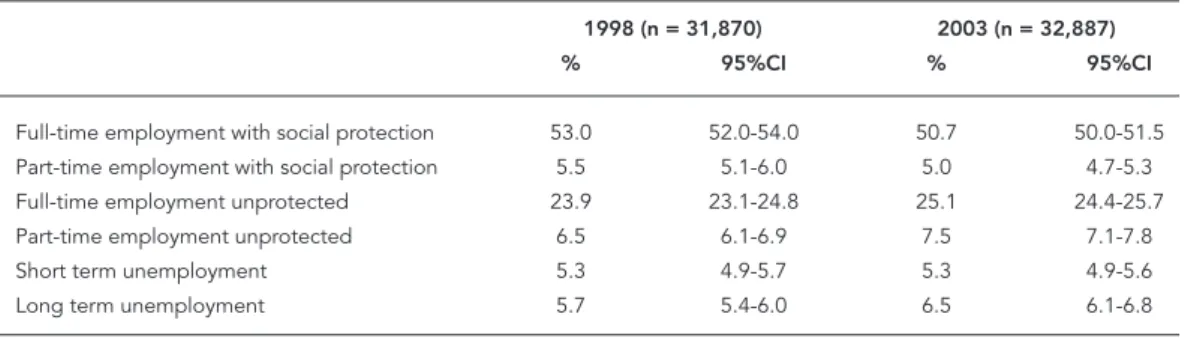
Atotal of 31,870 men from the economically active population participated in the study in 1998 and 32,887 in 2003. Between these two pe-riods, the proportion of full-time workers with
social protection fell from 53% to 50.7%; the proportion of part-time unprotected employ-ees increased from 6.5% to 7.5% and long term unemployment rose from 5.7% to 6.5%. These changes were all statistically significant. Full-time unprotected employment increased from 23.9% to 25.1% and part-time employment with social protection dropped from 5.5% to 5%, while short term unemployment remained more or less stable at about 5.3%, but these variations were not statistically significant (Table 1).
In both periods, the young represented a larger proportion of those who were in some form of unemployment, especially in long term unemployment, and in part-time unprotected employment. In 2003, there was an increase in the percentage of unemployed individu-als who were aged 45 or more. Full and part-time workers with social protection include a higher proportion of individuals with ≥ 15 years of schooling in both years. Compared to 1998, the percentage of individuals with 11+ years of schooling increased in 2003 among all labor categories and the unemployed. There was no change in the distribution of heads of house-hold according to labor market status in the two years analyzed. The percentage of men who declared themselves as black or mixed race in-creased in all studied groups in 2003. Monthly incomes were also greater amongst those who received social protection at work. In 2003 the mean income fell across all working categories (Table 2).
Table 3 presents the associations between labor market status and health indicators. In 1998, socially protected part-time employees had a greater probability of reporting tendonitis, arthritis/rheumatism, cirrhosis and depression. None of these associations were found in 2003. In 1998, full-time unprotected employment was positively associated with depression and
Table 1
Labor market status of Brazilian men living in metropolitan regions, 1998 and 2003.
1998 (n = 31,870) 2003 (n = 32,887)
% 95%CI % 95%CI
Full-time employment with social protection 53.0 52.0-54.0 50.7 50.0-51.5 Part-time employment with social protection 5.5 5.1-6.0 5.0 4.7-5.3
Full-time employment unprotected 23.9 23.1-24.8 25.1 24.4-25.7
Part-time employment unprotected 6.5 6.1-6.9 7.5 7.1-7.8
Short term unemployment 5.3 4.9-5.7 5.3 4.9-5.6
Table 2
Distribution of sociodemografi c characteristics by labor market status in Brazilian males residing in metropolitan region, 1998 and 2003 (percentages).
1998 (p < 0,00001) *
Employment with social protection Employment with no social protection Unemployment
Full-time Part-time Full-time Part-time Short term Long term
(n = 16,202) (n = 1,855) (n = 7,962) (n = 2,400) (n = 1,739) (n = 1,712)
Age (years)
15-24 18,7 20,6 26,2 37,5 39,9 58,9
25-34 29,7 28,7 25,8 20,8 27,4 16,3
35-44 28,6 27,0 24,4 17,1 19,2 11,1
45-54 17,0 16,2 15,5 13,9 10,6 9,5
55-64 6,0 7,5 8,2 10,8 3,0 4,2
Median 35 (27-44) 35(26-44) 34 (24-44) 30 (20-44) 28 (21-38) 22 (18-34)
Schooling (years)
0-3 11,7 6,1 22,3 19,1 16,0 14,0
3-7 28,0 16,8 39,3 34,6 39,3 35,6
8-10 21,9 20,2 18,7 20,5 25,1 30,6
11-14 26,4 33,4 15,2 18,1 17,7 17,1
≥ 15 12,0 23,5 4,5 7,7 1,9 2,6
Median 9 (6-12) 12 (9-15) 7 (5-10) 8 (5-12) 8 (5-11) 9(6-11)
Household head
Yes 68,2 61,8 61,0 48,5 42,9 21,5
No 31,8 38,2 39,0 51,5 57,1 78,5
Color
White 62,8 68,4 53,5 55,0 50,9 53,0
Brown/Black 36,0 30,3 45,3 43,7 48,2 46,5
Indigenous 0,1 0,1 0,1 0,2 0,2 0,3
Yellow 1,1 1,2 1,1 1,1 0,7 0,3
Income
Main job 4,0 (2,4-7,7) 4,6 (2,3-8,5) 2,7 (1,5-4,6) 1,5 (0,6-3,1) -
All jobs 4,1 (2,5-7,7) 4,6 (2,6-10,0) 2,7 (1,5-4,6) 1,5 (0,6-3,5) -
2003 (p < 0,00001) *
Employment with social protection Employment with no social protection Unemployment
Full-time Part-time Full-time Part-time Short term Long term
(n = 15,911) (n = 1,748) (n = 8,495) (n = 2,858) (n = 1,763) (n = 2,133)
Age (years)
15-24 18,1 19,0 23,8 35,9 35,0 58,4
25-34 29,9 25,7 25,1 19,9 29,3 16,2
35-44 27,5 27,5 24,1 18,0 19,5 10,7
45-54 18,3 19,1 18,1 14,7 12,0 9,8
55-64 6,2 8,7 9,1 11,6 4,1 4,9
Median 35 (27-44) 36 (27-46) 35 (25-45) 31 (21-45) 29 (22-40) 22 (18-35)
Schooling (years)
0-3 8,1 6,2 18,8 17,1 13,5 * 10,6
3-7 21,7 13,7 33,3 28,5 31,3 24,9
8-10 20,1 16,3 22,0 24,0 26,1 32,5
11-14 36,6 40,6 21,3 23,4 25,1 28,6
≥ 15 13,5 23,2 4,6 7,0 4,1 3,4
Median 12 (7-12) 12 (9-15) 8 (5-12) 9 (5-12) 9 (6-12) 9 (7-12)
Household head
Yes 67,8 64,9 62,5 49,1 48,0 22,5
No 32,2 35,1 37,5 50,9 52,0 77,5
Color
White 61,1 63,5 52,1 51,8 46,7 48,0
Brown/Black 37,9 35,4 46,9 46,9 52,4 51,5
Table 2 (continued)
2003 (p < 0,00001) *
Employment with social protection Employment with no social protection Unemployment
Full-time Part-time Full-time Part-time Short term Long term
(n = 15,911) (n = 1,748) (n = 8,495) (n = 2,858) (n = 1,763) (n = 2,133)
Indigenous 1,7 1,5 0,3 2,8 0,4 0,2
Yellow 0,9 1,0 0,8 1,0 0,5 0,4
Income
Main job 2,7 (1,7-5,0) 2,9 (1,7-5,4) 1,7 (1,0-2,9) 1,0 (0,4-1,9) -
All jobs 2,7 (1,7-5,0) 3,2 (1,8-6,3) 1,7 (1,0-2,9) 1,0 (0,4-2,1) -
-Note: p value (Pearson chi-square test for difference between 1998 and 2003) – age (p < 0,00001); schooling (p < 0,00001); household head (p = 0,6723); color (p < 0,00001); income (p < 0,0001).
* Pearson chi-square test for difference sociodemografic characteristics distribution by labor market status.
Table 3
Odds ratio (OR) and 95% confi dence interval (95%CI) for health indicators by labor market status, 1998 and 2003.
1998 2003
OR 95%CI OR 95%CI
Low back pain
Full-time employment with social protection 1,00 - - 1,00 -
Part-time employment with social protection 1,04 0,90 1,01 0,99 0,84 1,17
Full-time employment unprotected 0,99 0,91 1,11 0,89 0,81 0,98
Part-time employment unprotected 1,03 0,89 1,20 1,06 0,91 1,22
Short term unemployment 1,09 0,93 1,27 1,02 0,84 1,24
Long term unemployment 0,80 0,67 0,96 0,90 0,75 1,09
Tendinitis
Full-time employment with social protection 1,00 - - 1,00 -
-Part-time employment with social protection 1,58 1,04 2,39 1,05 0,78 1,42
Full-time employment unprotected 0,93 0,68 1,26 0,61 0,49 0,78
Part-time employment unprotected 0,65 0,38 1,09 0,99 0,73 1,35
Short term unemployment 0,90 0,60 1,36 0,87 0,58 1,30
Long term unemployment 0,53 0,29 0,97 0,76 0,50 1,15
Arthritis/Rheumatism
Full-time employment with social protection 1,00 - - 1,00 -
-Part-time employment with social protection 1,55 1,18 2,05 1,29 0,92 1,82
Full-time employment unprotected 1,14 0,96 1,37 1,22 1,00 1,49
Part-time employment unprotected 1,92 1,47 2,51 1,44 1,08 1,92
Short term unemployment 1,23 0,82 1,85 1,16 0,77 1,74
Long term unemployment 1,58 1,09 2,30 1,26 0,83 1,92
Bronchitis/Asthma
Full-time employment with social protection 1,00 - - 1,00 -
-Part-time employment with social protection 1,17 0,81 1,68 1,30 0,97 1,74
Full-time employment unprotected 1,04 0,82 1,33 0,99 0,82 1,19
Part-time employment unprotected 1,52 1,17 1,98 1,34 1,04 1,73
Short term unemployment 1,25 0,89 1,76 1,23 0,88 1,72
Long term unemployment 1,67 1,24 2,24 1,27 0,96 1,70
Cancer
Full-time employment with social protection 1,00 - - 1,00 -
Part-time employment with social protection 0,93 0,21 4,03 1,73 0,62 4,83
Full-time employment unprotected 0,42 0,17 1,04 1,20 0,51 2,82
Part-time employment unprotected 0,47 0,17 1,60 3,44 1,49 7,93
Short term unemployment 0,28 0,04 2,17 1,60 0,30 8,61
Long term unemployment 1,06 0,17 6,46 4,43 1,58 12,47
Table 3 (continued)
1998 2003
OR 95%CI OR 95%CI
Diabetes
Full-time employment with social protection 1,00 - - 1,00 -
Part-time employment with social protection 1,28 0,91 1,79 0,83 0,55 1,26
Full-time employment unprotected 0,84 0,62 1,15 0,97 0,77 1,23
Part-time employment unprotected 1,08 0,73 1,61 1,07 0,76 1,49
Short term unemployment 0,88 0,45 1,73 0,72 0,41 1,27
Long term unemployment 1,26 0,75 2,09 1,38 1,00 2,13
Hypertension
Full-time employment with social protection 1,00 - - 1,00 -
Part-time employment with social protection 0,91 0,77 1,09 1,06 0,87 1,29
Full-time employment unprotected 0,87 0,76 0,99 0,83 0,74 0,92
Part-time employment unprotected 0,88 0,76 1,03 1,06 0,90 1,25
Short term unemployment 1,05 0,81 1,37 0,70 0,54 0,90
Long term unemployment 0,89 0,68 1,16 1,08 0,86 1,35
Heart disease
Full-time employment with social protection 1,00 - - 1,00 -
Part-time employment with social protection 1,04 0,77 1,42 1,36 0,97 1,91
Full-time employment unprotected 1,09 0,89 1,32 0,94 0,76 1,16
Part-time employment unprotected 1,41 1,03 1,92 1,49 1,12 2,00
Short term unemployment 1,54 1,09 2,20 1,41 0,95 2,09
Long term unemployment 1,22 0,81 1,83 1,31 0,87 1,96
Kidney disease
Full-time employment with social protection 1,00 - - 1,00 -
Part-time employment with social protection 1,25 0,72 2,17 0,97 0,56 1,67
Full-time employment unprotected 1,21 0,94 1,57 0,82 0,60 1,12
Part-time employment unprotected 1,35 0,93 1,95 1,54 1,00 2,36
Short term unemployment 0,91 0,58 1,43 1,54 0,90 2,57
Long term unemployment 0,84 0,54 1,30 0,48 0,23 1,12
Cirrhosis
Full-time employment with social protection 1,00 - - 1,00 -
Part-time employment with social protection 3,52 1,09 11,36 2,27 0,63 8,11
Full-time employment unprotected 1,77 0,82 3,81 2,71 1,14 6,44
Part-time employment unprotected 4,94 2,26 10,83 4,64 1,60 13,44
Short term unemployment 3,11 0,97 9,94 2,39 0,43 13,44
Long term unemployment 4,61 1,93 11,00 4,06 0,88 18,82
Depression
Full-time employment with social protection 1,00 - - 1,00 -
Part-time employment with social protection 1,83 1,40 2,41 0,90 0,62 1,31
Full-time employment unprotected 1,31 1,11 1,54 1,10 0,87 1,39
Part-time employment unprotected 1,87 1,48 2,36 1,84 1,38 2,46
Short term unemployment 1,96 1,43 2,69 2,03 1,44 2,88
Long term unemployment 1,98 1,44 2,72 2,22 1,55 3,17
Chronic disease
Full-time employment with social protection 1,00 - - 1,00 -
Part-time employment with social protection 1,09 0,95 1,27 1,05 0,91 1,22
Full-time employment unprotected 1,00 0,91 1,09 0,94 0,87 1,02
Part-time employment unprotected 1,35 1,18 1,55 1,22 1,07 1,39
Short term unemployment 1,11 0,92 1,35 1,05 0,88 1,26
Long term unemployment 1,26 1,04 1,53 1,26 1,06 1,49
negatively associated with hypertension. In 2003, it was strongly and positively associated with cirrhosis and negatively associated with hypertension, low back pain and tendonitis. In 1998, unprotected part-time workers report-ed arthritis/rheumatism, bronchitis/asthma, heart disease, cirrhosis, depression and chronic disease more often than full-time workers with social protection. These findings were gener-ally in line with those found in 2003, with the exception of cancer. In 1998, short term unem-ployment was positively associated with heart disease and depression when compared with full-time employment with social protection. In 2003 it was still associated with depression and came to be negatively associated with hyper-tension. In 1998, long term unemployment was positively associated with arthritis/rheuma-tism, bronchitis/asthma, cirrhosis, depression and chronic disease and negatively associated with lower back pain and tendonitis. In 2003, it came to be positively associated with can-cer, while the association with depression and chronic disease remained significant.
In both years, with the exception of part-time employment with social security, individuals in all other categories had a lower probability of re-porting a medical visit in the past 12 months. As for hospitalization, no differences were identified in 1998, but in 2003, unprotected full-time work-ers reported fewer hospitalizations (Table 4).
Discussion
The present study investigated the associa-tion between labor market status and both the reported medical diagnosis of diseases and healthcare use among men living in metro-politan regions of Brazil in 1998 and 2003. Our results show that workers differ in relation to diseases and healthcare use according to their labor situation defined by social protection at work or length of unemployment.
Among the changes identified in the two pe-riods, we identify an increase in the proportion of individuals over 45 years of age, reflecting the trend towards an ageing of the economically-ac-tive population 16 and a drop in income affecting
all forms of employment studied. In spite of the increase in mean schooling years in 2003, pre-carious employment links and long term unem-ployment increased. This means greater levels of exclusion from the social rights that are guaran-teed by employment contracts and welfare con-tributions, and a greater number of unemployed men, especially young ones. Improvements in educational rates occurred in all labor market groups. These facts suggest that access to work or better working conditions are not solely deter-mined by an individual’s level of schooling. For instance, the proportion of those with 15 or more years of schooling increased even among the un-employed. In an adverse economic environment, schooling improvement proves to be not enough
Table 4
Odds ratio (OR) and 95% confi dence interval (95%CI) for healthcare use indicators by labor market status, 1998 and 2003.
1998 2003
OR 95%CI OR 95%CI
Medical visit
Full-time employment with social protection 1,00 - - 1,00 -
Part-time employment with social protection 1,02 1,00 1,17 0,99 0,87 1,12
Full-time employment unprotected 0,62 0,57 0,70 0,60 0,56 0,64
Part-time employment unprotected 0,75 0,66 0,86 0,74 0,67 0,82
Short term unemployment 0,87 0,77 0,99 0,76 0,67 0,85
Long term unemployment 0,65 0,57 0,75 0,59 0,52 0,66
Hospitalization
Full-time employment with social protection 1,00 - - 1,00 -
Part-time employment with social protection 1,32 0,99 1,75 0,95 0,69 1,30
Full-time employment unprotected 0,92 0,75 1,14 0,82 0,68 0,98
Part-time employment unprotected 0,98 0,71 1,36 1,15 0,89 1,49
Short term unemployment 1,13 0,78 1,64 0,92 0,65 1,29
Long term unemployment 0,85 0,54 1,32 0,77 0,56 1,11
to guarantee access to work 17 or to reverse the
increasing trend towards greater employment insecurity.
Labor market status and health
The association between unemployment and bad health has already been identified in several longitudinal studies 5,18,19,20. The frequency and
length of unemployment intensify its negative effects on health. At any time in life, unemploy-ment is associated with future unemployunemploy-ment, and the number of times an individual has been unemployed has been observed to be strongly associated with the risk of long term disabling diseases 21. Long term unemployment results in
greater deprivation, less chances of getting a new job 22 and greater health risks among youngsters
and adults 23. The high percentage of young
in-dividuals unemployed in Brazil is particularly striking, as unemployment in the early stages of life is associated with future unemployment 24.
Furthermore, the longer the period of unemploy-ment the greater its negative effect on health. Our results show that an important fraction of young adults in Brazil are at risk of having poor social and health conditions in the future.
Recent epidemiological research suggests that precarious employment, in a variety of forms, is associated with adverse effects on health. Greater mortality risks have been observed in temporary workers 8, worse mental health in workers without
contracts 7 and greater reported chronic diseases
and depression in workers with atypical jobs 25.
In the present study, precarious employment has been considered as the one with no guarantee of social rights. It has been shown that working with no contract or social protection coverage is associated with worse health conditions. This re-sult suggests that social inclusion guaranteed by formal employment contracts and/or by having social benefits rights influences or is influenced by health conditions. Considering the high per-centage of people in such conditions in Brazil, it is unlikely that health determines an individual’s exposure to precarious work situations.
Part-time work is often considered as an atypical or precarious form of employment 22. In
this study, 40 hours per week was adopted as the cut off point for full time employment. Part time unprotected employment was strongly associ-ated with worse health indicators in 1998 and 2003. Unlike unprotected workers, part-time workers with social protection had better school-ing and income and were more likely to declare themselves as white, suggesting that part-time employment on its own is not enough to classify work as precarious, as has been suggested
else-where 3. In occupations with social protection,
part time employment may represent a choice or opportunity, while in unprotected jobs it tends to indicate more precarious circumstances and hazardous working conditions, thus explaining the association with worse health indicators.
The health indicators investigated in this study express different aspects of the health-work relationship. Low back pain and tendonitis, for instance, are conditions frequently associated with working activities. In both years, hepatic cir-rhosis was the disease most strongly associated with labor market status, but because of the low prevalence of the disease, confidence intervals are very wide. Excessive alcohol intake is an im-portant risk factor for cirrhosis and may explain its greater occurrence in this group. Workers who frequently switch jobs appear to have a greater probability of high alcohol consumption 26.
Fur-thermore, a higher risk of death from alcohol-re-lated diseases has already been identified among temporary workers and the unemployed 8.
This study’s results suggest that unemploy-ment and precarious employunemploy-ment have an ad-verse effect on mental health. The association between mental health problems and unment, as well as atypical and temporary employ-ment has been observed in studies carried out in Brazil 28 and elsewhere 7,25,27. In one study among
English civil servants, employment characteris-tics were the most influential factors in the in-verse gradient between “employment grade” and depressive symptoms 29. Unemployment and job
insecurity are considered to have a negative in-fluence on mental health not only on account of the financial implications, but also due to the psychosocial aspects such as the breakdown of an individual’s time structure, a lack of future perspectives, lower self-esteem and dissatisfac-tion with the working situadissatisfac-tion 30.
The main study limitation is its cross-section-al design, which does not cross-section-allow for an assessment of a temporal relationship between labor market status and health conditions. Reverse causality may be considered in explaining these results, es-pecially because we studied reported morbidity and current labor market status, which may have been altered by worse health condition. However, studies show that reverse causality contributes little to inequalities in health 31,32. For instance,
Chandola et al. 30 observed in a longitudinal
study of civil servants, that the effect of health on social position changes is much lower than the influence of social positions on health. The healthy-worker effect may also explain, in part, why fewer healthy individuals are unemployed or in precarious occupations 33,34. However,
lon-gitudinal studies suggest a causal association be-tween unemployment, precarious employment and worse health condition 5,35. Furthermore,
the selective and excluding effects of work are in-fluenced by the overall economic environment. In periods of economic recession, economically active populations tend to be even more selec-tive regarding health because more vulnerable health workers tend to be excluded from the ac-tive work force, and consequently the health con-trasts between those active, i.e., unemployed and employed individuals, is minimized 21. The high
unemployment rate and the increased number of people in precarious employment in Brazil may blur the studied groups, thus diluting the asso-ciations between labor market status and health, and even justifying the smaller number of asso-ciations observed in 2003.
The relationship between work and illness is a dynamic and complex process. Work is a de-terminant of health conditions and, at the same time, is interrelated with other socioeconomic indicators. In causal pathways analysis between socioeconomic indicators and health, schooling was seen as directly associated with better health conditions as it positively influences healthier ways of life. At the same time, it was indirectly associated with health because it increases ac-cess to better working conditions and higher in-come 36. Considering schooling as a confounding
variable, we identified independent associations between labor market status and health, but we were not able to clarify the temporal relationship between schooling and labor market status.
The outcomes analyzed in the present study were based on self-reported morbidity. The ques-tion relating to morbidity changed between the two surveys. In 1998, the question was “Do you
have” followed by a list of diseases. In 2003, the question became more specific: “Has any doc-tor or health professional said that you have”, fol-lowed by the same list of diseases. This greater specificity of the question in 2003 may explain, at least in part, the reduction in the prevalence of most diseases in 2003 (data no shown). The frequency and magnitude of statistically signifi-cant associations also reduced in 2003 and might be related to differences in access to health care among working categories.
In the two surveys, information was ob-tained by household interviews using a proxy informant, when necessary. There seems to be a reasonable agreement between objective health information given by the interviewee himself and by proxy informants 37. In Canada,
preva-lences estimated by proxy respondents were very similar to those obtained from the individ-uals themselves for conditions such as diabetes, epilepsy, heart diseases, glaucoma and cancer
38. However, unfortunately, there are no studies
of this in Brazil. In the present study, the propor-tion of proxy informants was higher among the long term unemployment and full-time work-ers, with and without social protection. Thus, the use of a proxy was equally important among the worst and best working conditions being compared. If we consider that the use of a proxy has a non differential distribution, then the as-sociations seen would be diluted.
The drastic changes in the nature and mean-ing of work have introduced new ways of seg-menting the work force. The traditional division between the employed and unemployed is not enough to describe the complexity of modern employment in the world. The study of the re-lationship between precarious employment and health is a recent issue in public health 39 and
Resumo
Este estudo investiga se trabalho sem proteção social assim como desemprego menor do que 12 meses e su-perior a 12 meses estão associados à pior condição de saúde. Foram estudados homens com idades entre 15 e 64 anos, residentes em oito regiões metropolitanas que participaram da Pesquisa Nacional por Amostra de
Domicílios em 1998 (n = 31.870) e 2003 (n = 32.887).
Comparados ao trabalho com proteção social (≥ 40 horas/semana), trabalho sem proteção social, e de-semprego de curta e longa durações foram associados à pior condição de saúde independentemente da ida-de e escolaridaida-de. Cirrose hepática foi a doença mais fortemente associada com a situação no mercado de trabalho. Sua prevalência foi mais alta entre aqueles inseridos no trabalho sem proteção e com desemprego de longa duração. A situação no mercado de trabalho também foi negativamente associada ao uso de servi-ços de saúde, especialmente consultas médicas. O pre-senteestudo mostrou que a inserção no trabalho sem proteção social, o desemprego e o tempo de desempre-go caracterizam grupos heterogêneos de indivíduos em relação à saúde. Resultados reforçam a necessidade de incorporar a situação no mercado de trabalho nos es-tudos de desigualdades em saúde.
Desemprego; Seguro Saúde; Desigualdades em Saúde
Contributors
L. Giatti participated in the study design and was in charge of data analysis and the writing of the paper. S. M. Barreto participated in the study design, data analy-sis and discussion of the results. C.C. César participated in the data analysis and discussion of the results. All the authors reviewed the manuscript.
Acknowlegments
The study represents part of L. Giatti’s doctoral thesis. S. M. Barreto is a research fellow at the Brazilian Council for Scientific and Technological Development (CNPq, grant nº. 300908/95). L. Giatti has a CNPq research
fello-wship within the Estudo Longitudinal de Saúde do Adulto
(Projeto ELSA; grant nº. 386184/2006-2).
References
1. Wilkinson R, Marmot M, editors. Social determi-nants of health: the solid facts. Copenhagen: Re-gional Office for Europe, World Health Organiza-tion; 2003.
2. Ferrie J, Marmot M, Griffiths J, Ziglio E, editors. Labour market changes and job insecurity: a chal-lenge for social welfare and health promotion. Copenhagen: Regional Office for Europe, World Health Organization; 1999.
3. Benach J, Gimeno D, Benavidez FG, Martínez JM, Torné MM. Types of employment and health in the Europe Union: changes from 1995 to 2000. Eur J Public Health 2004; 14:314-21.
4. Benach J, Amable M, Munttaner C, Benavidez FG. The consequences of flexible work for health: are we looking at the right place? J Epidemiol Commu-nity Health 2002; 56:405-6.
5. Bartley M, Sacker P, Clarke P. Employment sta-tus, employment conditions and limiting illness: prospective evidence from the British household panel survey 1991-2001. J Epidemiol Community Health 2004; 58:501-6.
6. Virtanen P, Vahtera J, Kivimäki M, Pentti J, Ferrie J. Employment security and health. J Epidemiol Community Health 2002; 56:569-74.
7. Artazcoz L, Benach J, Borrell C, Cortès I. Social in-equalities in the impact of flexible employment on different domains of psychosocial health. J Epide-miol Community Health 2005; 59:761-7.
8. Kivimäki M, Vahtera J, Virtanen M, Elovainio M, Pentti J, Ferrie J. Temporary employment and risk of overall and cause-specific mortality. Am J Epide-miol 2003; 158:663-8.
9. Antunes R, Alves G. As mutações no mundo do tra-balho na era da mundialização do capital. Revista Educação & Sociedade 2004; 25:335-51.
10. Pochmann M. Proteção social na periferia do ca-pitalismo: considerações sobre o Brasil. São Paulo Perspect 2004; 8:3-16.
11. Pochman M. O trabalho sob fogo cruzado.São
12. Ramos L, Britto M. O funcionamento do mercado de trabalho metropolitano brasileiro no período 1991-2002: tendências, fatos estilizados e mudan-ças estruturais. Rio de Janeiro: Instituto de Pesqui-sa Econômica Aplicada; 2004.
13. Giatti L, Barreto SM. Saúde, trabalho e envelhe-cimento no Brasil. Cad Saúde Pública 2003; 19: 759-71.
14. Pearce N. Effect measures in prevalence studies. Environ Health Perspect 2004; 10:1047-50. 15. Risto L, Erkki JP. Practical methods for design and
analysis of complex surveys. New York: John Wiley and Sons; 1996.
16. Wajnman S. Tendências prospectivas de cresci-mento da população economicamente ativa no Brasil. Belo Horizonte: Centro de Desenvolvimen-to e PlanejamenDesenvolvimen-to Regional, Faculdade de Ciên-cias Econômicas, Universidade Federal de Minas Gerais; 1997.
17. Pochmann M. Educação e trabalho: como desen-volver uma relação virtuosa? Revista Educação & Sociedade 2004; 25:383-99.
18. Voss M, Nylén L, Floderus B, Diderichsen F, Terry PD. Unemployment and early cause-specific mor-tality: a study based on the Swedish twin registry. Am J Public Health 2004; 94:2155-61.
19. Ferrie J, Shipley MJ, Stansfeld SA, Smith GD, Mar-mot M. Future uncertainty and socioeconomic in-equalities in health; the Whitehall II Study. Soc Sci Med 2003; 57:637-46.
20. Hammarström A. Health consequences oh youth unemployment. Public Health 1994; 108:403-12. 21. Bartley M, Plewis I. Accumulated labour market
disadvantage and limiting long-term illness: da-ta from the 1971-1991 Office for National Sda-tatis- Statis-tics’ Longitudinal Study. Int J Epidemiol 2002; 31: 336-41.
22. International Labour Organization. International labour indicators: key indicators of labour market. http://www.ilo.org/public/english/employment/ strat/kilm/index.htm (accessed on Aug/2004). 23. Reine M, Hammarström A. Does the association
between ill health and unemployment differ be-tween young people and adults? Results from a 14-year folow-up study with a focus on psycho-logical health and smoking. Public Health 2004; 118:337-45.
24. Hammarström A, Janlert U. Do early unemploy-ment and health status among young men and Women affect their chances of later employment? Scand J Public Health 2000; 28:10-5.
25. Virtanen P, Liukkonem V, Kivimäki M, Koskenvuo M. Health inequality in the workforce: the labour market core-periphery structure. Int J Epidemiol 2003; 32:1015-21.
26. Grzywacz JG, Dooley D. “Good jobs” to “bad jobs”: replicated evidence of an employment continu-um from two large surveys. Soc Sci Med 2003; 56: 1749-60.
27. Dooley D. Unemployment, underemployment and mental health: conceptualizing employment status as a continuum. Am J Community Psychol 2003; 32:9-20.
28. Ludemir AB, Lewis G. Informal work and common mental disorders. Soc Psychiatry Psychiatr Epide-miol 2003; 38:485-9.
29. Stansfeld SA, Head J, Wardle J, Cattell V. Social in-equalities in depressive symptoms and physical functioning in the Whitehall II Study: exploring a common cause explanation. J Epidemiol Commu-nity Health 2003; 57:361-7.
30. Chandola T, Bartley M, Sacker A, Jenkinson C, Mar-mot M. Health selection in the Whitehall II Study, UK. Soc Sci Med 2003; 56:2059-72
31. Benzeval M, Judge K. Income and health: the time dimension. Soc Sci Med 2001; 52:1371-90. 32. Lynch J, Kaplan G, Shema SJ. Cumulative impact of
sustained economic hardship on physical, cogni-tive, psychological, and social functioning. N Engl J Med 1997; 337:1889-95.
33. Carpenter LM. Health-related selection and mor-tality in employees of the United Kingdom atomic energy authority, 1946-79 and the atomic weapons establishment, 1951-82 [Doctoral Dissertation]. London: London School of Hygiene and Tropical Medicine, University of London; 1990.
34. Checkoway H, Pearce N, Crawford-Brown DJ. Re-search methods in occupational epidemiology. New York: Oxford University Press; 1989.
35. Chandola T, Bartley M, Wiggins R, Schofield P. So-cial inequalities in health by individual and house-hold measures of social position in a cohort of healthy people. J Epidemiol Community Health 2003; 57:56-62.
36. Singh-Manoux A, Clarke P, Marmot M. Multiple measures of socio-economic position and psycho-social health: proximal and distal measures. Int J Epidemiol 2002; 31:1192-9.
37. Armstrong BK, White E, Saracci R. Principles of exposure measurement in epidemiology. mono-graphs on epidemiolgy and bioestatistics. Oxford: Oxford University Press; 1994.
38. Shields M. Proxy reporting in the National Popula-tion Health Survey. Health Rep 2000; 12:21-39. 39. Benavides FG, Delclos GL. Flexible employment
and health inequalities. J Epidemiol Community Health 2005; 59:719-20.
Submitted on 11/Apr/2007