CLINICAL SCIENCE
Demographic, etiological, and histological
pulmonary analysis of patients with acute
respiratory failure: a study of 19 years of autopsies
Alexandre de Matos Soeiro,IAline D. Ruppert,IIMauro Canzian,IEdwin R. Parra,II Cecı´lia Farhat,II Vera L. CapelozziIIIDepartamento de Cardiopneumologia, Hospital das Clinicas da Faculdade de Medicina da Universidade de Sa˜o Paulo, Sa˜o Paulo/SP, Brazil.
IIDepartamento de Patologia Hospital das Clı´nicas da Faculdade de Medicina da Universidade de Sa˜o Paulo, Sa˜o Paulo/SP, Brazil.
INTRODUCTION: Acute respiratory failure has been one of the most important causes of death in intensive care units, and certain aspects of its pulmonary pathology are currently unknown.
OBJECTIVES: The objective was to describe the demographic data, etiology, and pulmonary histopathological findings of different diseases in the autopsies of patients with acute respiratory failure.
METHOD: Autopsies of 4,710 patients with acute respiratory failure from 1990 to 2008 were reviewed, and the following data were obtained: age, sex, and major associated diseases. The pulmonary histopathology was categorized as diffuse alveolar damage, pulmonary edema, alveolar hemorrhage, and lymphoplasmacytic interstitial pneumonia. The odds ratio of the concordance between the major associated diseases and specific autopsy findings was calculated using logistic regression.
RESULTS: Bacterial bronchopneumonia was present in 33.9% of the cases and cancer in 28.1%. The pulmonary histopathology showed diffuse alveolar damage in 40.7% (1,917) of the cases. A multivariate analysis showed a significant and powerful association between diffuse alveolar damage and bronchopneumonia, HIV/AIDS, sepsis, and septic shock, between liver cirrhosis and pulmonary embolism, between pulmonary edema and acute myocardial infarction, between dilated cardiomyopathy and cancer, between alveolar hemorrhage and bronchopneumonia and pulmonary embolism, and between lymphoplasmacytic interstitial pneumonia and HIV/ AIDS and liver cirrhosis.
CONCLUSIONS:Bronchopneumonia was the most common diagnosis in these cases. The most prevalent pulmonary histopathological pattern was diffuse alveolar damage, which was associated with different inflammatory conditions. Further studies are necessary to elucidate the complete pathophysiological mechanisms involved with each disease and the development of acute respiratory failure.
KEYWORDS: Acute Respiratory Failure; Autopsy; Lung Disease; Diffuse Alveolar Damage; Pulmonary Edema.
Soeiro AM, Ruppert AD, Canzian M, Parra ER, Farhat C, Capelozzi VL. Demographic, etiological, and histological pulmonary analysis of patients with acute respiratory failure: a study of 19 years of autopsies. Clinics. 2011;66(7):1193-1197.
First review completed onFebruary 21, 2011;Received for publication onJanuary 23, 2011;Accepted for publication onMarch 4, 2011
E-mail: [email protected]
Tel.: 55 11 3061-7427
INTRODUCTION
Acute respiratory failure (ARF) is a major cause of death in patients with a variety of primary underlying diseases. In addition, the prevalences of comorbidities and mortality have been reported to be higher than 40-50% in ARF patients, especially in those with diffuse infiltrates as seen on chest X-rays.1-3The clinical and radiological findings in ARF are nonspecific,4-6 and prompt investigation and
diagnosis are essential to improving patient survival.7-9 In
this context, the complexity of clinical presentations makes diagnosis a constant challenge for the clinician. Despite recent advances, most types of diagnostic support are still expensive. Clinicians often initiate treatment to avoid the rapid progression of the disease and to spare the patient from more invasive procedures. Therefore, it is important to determine the leading causes of death in this population to establish correct prophylactic actions, which is the least expensive strategy for preventing further pulmonary dysfunction and avoiding the need for lung biopsies.10
We performed a retrospective study of 4,710 autopsies on patients whose cause of death was ARF to better describe the demographic and etiological data and the associated histological pulmonary findings and diseases.
MATERIAL AND METHODS
Autopsies. This study was conducted at a tertiary health care center. From 1990 to 2008, 26,560 medical autopsies were performed at this center, with an annual mean of 1,889. We examined the autopsies of the 4,710 (17.7%) patients in whom ARF was the cause of death. In 980 of these patients, the histological pulmonary findings could not be reviewed because the pulmonary tissue was not available (it was classified as ‘‘without analysis’’); histological pulmonary analyses were performed in the remaining 3,730 (79.2%) cases. In this study, we reviewed all of the available microscopic and macroscopic diagnoses of death at autopsy, along with the patient medical records. The only inclusion criterion for the definition of ARF was based on arterial blood gases (PaO2,60 mmHg or PaCO2.50 mmHg with pH,7.30) while breathing room air.1-3 We excluded patients younger than one year of age and individuals not diagnosed with ARF.
We also obtained data regarding each patient’s age, sex, and major underlying associated diseases (as determined at autopsy).
The clinical data from the patients enrolled in the study were collected with the approval of the Internal Review Board for this study, and informed consents were obtained from family members to perform the autopsies.
After a complete review, the pulmonary pathological reports were categorized as follows:
Ndiffuse alveolar damage (DAD), which was defined as
diffuse involvement and a uniform temporal appearance of alveolar collapse, hyaline membranes, obliterative fibrosis, neo-septal formation, and moderately organizing fibrosis;
Npulmonary edema (PE), which was defined as the
accumulation of proteinaceous fluid in the alveolar spaces that gave the appearance of a granular, pink coagulate within such spaces;
Nalveolar hemorrhage (AH), which was defined as the
presence of blood in the alveolar spaces; and
Nlymphoplasmacytic interstitial pneumonia (LPIP), which
was defined as widened and edematous alveolar septa, usually accompanied by a mononuclear inflammatory infiltrate of lymphocytes, histiocytes, plasma cells, and neutrophils.
All the lungs were analyzed by microscopy, even when the medical records indicated the patient’s diagnosis. The lungs were fixed in 10% formalin prepared in 0.9% saline for at least four weeks. We studied a minimum of five sections per lung for a total of ten sections per person, regardless of the presence or absence of morphologically demonstrable lesions. The paraffin-embedded tissue sections were assessed following hematoxylin and eosin staining. To document the presence and distribution of the wide spectrum of infectious agents and neoplasms to which this population was susceptible, we prepared a variety of special stains (periodic acid-Schiff staining, immunohistochemical analysis, fluorescence, Ziehl-Neelsen acid-fast staining, Gram acid-fast staining, Mucicarmine acid-fast staining, and Gomori’s methenamine silver acid-fast staining) for selected tissue sections. Bacterial bronchopneumonia (BBP) was defined as the presence of cell consolidation with polymorphonuclear leukocyte accumulation in bronchioles and adjacent alveoli. For the diagnoses of cytomegalovirus and fungal pneumonia, histological evidence of lung involvement was required, with or without tissue culture.
Severe sepsis and septic shock were defined as sepsis with the addition of organ dysfunction or the clinical diagnosis of arterial hypotension, which may or may not have been responsible for the aggressive fluid resuscitation. The diagnoses ofMycobacterium tuberculosisinfection and atypi-cal mycobacterial infection were confirmed using fluores-cence, the Ziehl-Neelsen techniques and a Lowenstein-Jensen culture. The proportion method and biochemistry were used to identify all of the positive cultures.
Statistical analysis. The descriptive analysis of the data included median, minimum, and maximum values. The probabilities (odds ratios) that patients with underlying diseases and comorbidities would develop specific pul-monary histopathological patterns and die of ARF-related pulmonary alterations were determined by logistic regressions. The independent variables included the following major diseases and/or comorbidities: BBP, cancer, liver cirrhosis, HIV/AIDS, acute myocardial infarction, systemic arterial hypertension, dilated cardiomyopathy, pulmonary embolism, chronic obstructive pulmonary disease, diabetes mellitus, sepsis and septic shock, chronic kidney failure, and tuberculosis. All the statistical procedures were performed using the SPSS v10.0 statistical software. Statistical significance was set at ap-value of 5%.
RESULTS
ARF was described in 4,710 autopsies (17.7%) from 1990 to 2008. The patients’ ages ranged from 1 to 99 years (with a median of 52). A total of 2,713 (57.6%) men and 1,997 (42.4%) women were included in the study. The demo-graphic data are listed in Table 1.
We observed a single associated disease in 1,793 (38.0%) of the cases, 2 diseases in 1,505 (32.0%), 3 in 797 (16.9%), 4 in 349 (7.4%) and 5 diseases in 184 (3.9%) of the cases. A diagnosis could not be determined after autopsy in 82 (1.7%) of the cases.
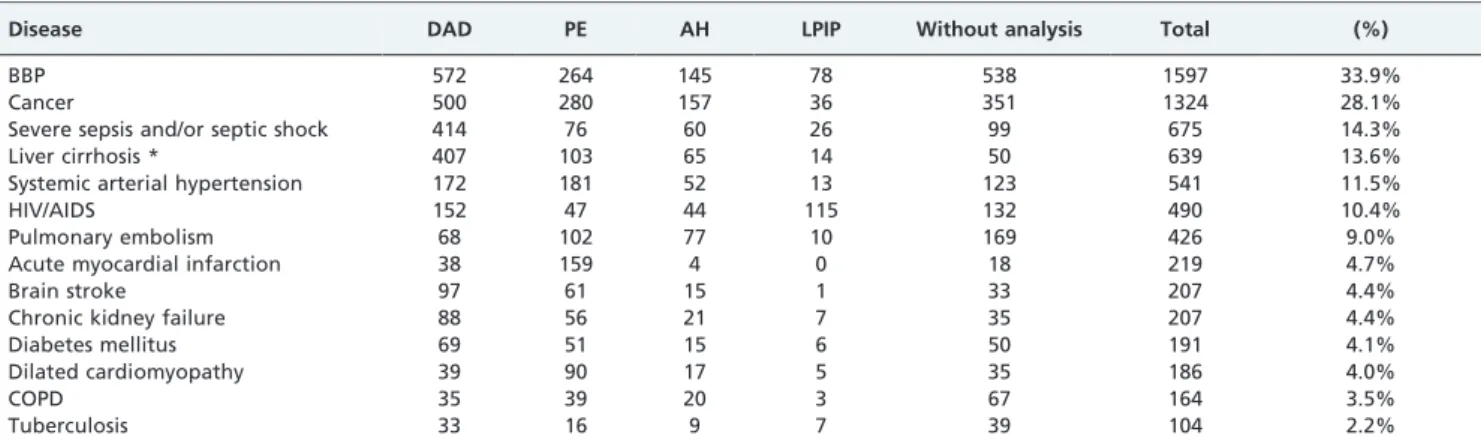
The pulmonary histopathological analysis showed DAD in 40.7% (1,917) of the patients, PE in 23.5% (1,107), AH in 10.4% (491) and LPIP in 4.6% (215) of the patients. The pulmonary histopathological findings and the most pre-valent diseases in the 4,710 patients are shown in Table 2.
The major underlying diseases and comorbidities in the ARF patients are shown in Table 2. BBP was present in 33.9% of the patients (1,597 cases) and was the most frequent pulmonary complication found at the time of autopsy. Cancer was the second most frequent complica-tion; it was observed in 28.1% of the patients (1,324 cases), followed by severe sepsis and/or septic shock in 14.3% (675), liver cirrhosis in 13.6% (639), HIV/AIDS in 10.4% (490), pulmonary embolism in 9.0% (426), acute myocardial
Table 1 -The demographic analysis by sex and age of the patients with acute respiratory failure who underwent autopsies.
Sex
Age group
(years) Male Female Total
1 to 20 198 165 363 (7%)
21 to 49 1073 750 1823 (38.7%)
.50 1442 1082 2524 (53.5%)
infarction in 4.7% (219), stroke in 4.4% (207), and tubercu-losis in 2.2% (104 cases) of the patients. The main associated comorbidities were systemic arterial hypertension in 11.5% (541 cases), chronic kidney failure in 4.4% (207), diabetes mellitus in 4.1% (191), dilated cardiomyopathy in 4.0% (186), and chronic obstructive pulmonary disease in 3.5% (164) of the patients.
The multivariate analysis, with the statistically significant associations between the most prevalent diseases/comor-bidities and the different histopathological findings, is shown in Table 3.
DISCUSSION
The early and accurate treatment of ARF remains an important problem in the management of critically ill patients. Despite recent technological diagnostic advances, the autopsy remains an important complementary tool for identifying and
understanding diseases. Autopsy studies have shown impor-tant differences between autopsy findings and theantemortem
clinical diagnoses.11-13Such diagnostic disagreement can vary from 10% to 90%, depending on the disease and the population involved.4-10,14-19 These discrepancies may be attributable to different clinical manifestations of a single disease or to poor-quality medical care.4Recently, ARF was reported to be one of the leading causes of morbidity and mortality in critically ill patients.4,9,14-16 In this study, we observed a high prevalence (17.7%) of ARF patients. Most of the study patients were males (57%), and the mean age was 52 years. Others studies have shown similar results.4,9,14-16 A retrospective study carried out between 1996 and 2002 in 58 patients with DAD diagnosed by surgical lung biopsy found that 52% of the patients were male and that the mean age was 61 years.20
We observed a single disease in 38% of the patients with ARF and two or more diseases in 62% of the patients. The
Table 2 -The etiological diagnoses observed in the autopsies of the acute respiratory failure patients, along with the main pulmonary histopathological findings.
Disease DAD PE AH LPIP Without analysis Total (%)
BBP 572 264 145 78 538 1597 33.9%
Cancer 500 280 157 36 351 1324 28.1%
Severe sepsis and/or septic shock 414 76 60 26 99 675 14.3%
Liver cirrhosis * 407 103 65 14 50 639 13.6%
Systemic arterial hypertension 172 181 52 13 123 541 11.5%
HIV/AIDS 152 47 44 115 132 490 10.4%
Pulmonary embolism 68 102 77 10 169 426 9.0%
Acute myocardial infarction 38 159 4 0 18 219 4.7%
Brain stroke 97 61 15 1 33 207 4.4%
Chronic kidney failure 88 56 21 7 35 207 4.4%
Diabetes mellitus 69 51 15 6 50 191 4.1%
Dilated cardiomyopathy 39 90 17 5 35 186 4.0%
COPD 35 39 20 3 67 164 3.5%
Tuberculosis 33 16 9 7 39 104 2.2%
* = No cause identified; DAD = Diffuse alveolar damage; PE = Pulmonary edema; AH = Alveolar hemorrhage; LPIP = Lymphoplasmacytic interstitial pneumonia; BBP = Bacterial bronchopneumonia; HIV/AIDS = Human immunodeficiency virus/acquired immunodeficiency syndrome; COPD = Chronic obstructive pulmonary disease.
Table 3 -The multivariate analysis of the main associated diseases found in the autopsies of the patients with acute respiratory failure, showing the relationships with the respective pulmonary histopathological findings.
DAD PE AH LPIP
OR p** CI 95% OR p** CI 95% OR p** CI 95% OR p** CI 95%
BBP 1.5 ,0.001 1.31–1.72 1.64 ,0.001 1.39–1.93 1.24 0.04 1.00–1.53 1.21 NS 0.88–1.65
HIV/AIDS 2.14 ,0.001 1.72–2.68 2.04 ,0.001 1.47–2.82 1.4 NS 0.99 – 1.97 10.05 ,0.001 7.16–14.11
Severe sepsis and/or septic shock
2.67 ,0.001 2.24–3.20 2.29 ,0.001 1.77–2.96 1.19 NS 0.89 – 1.58 1.5 NS 0.95–2.37
Liver cirrhosis 2.24 ,0.001 1.86–2.70 1.69 ,0.001 1.33–2.14 1.06 NS 0.79 – 1.42 2.01 0.02 1.14–3.55
Cancer 1.09 NS 0.94–1.26 1.27 0.006 1.07–1.50 1.23 NS 0.99 – 1.52 1.33 NS 0.90–1.96
Pulmonary embolism 3.67 ,0.001 2.79–4.85 1.22 NS 0.95–1.56 2.14 ,0.001 1.62 – 2.82 1.64 NS 0.84–3.19 Acute myocardial
infarction
3.14 ,0.001 2.18–4.54 6.19 ,0.001 4.50–8.52 5.67 0.001 2.08 – 15.44 4.94 NS 0.71–6.32
Systemic arterial hypertension
1.02 NS 0.73–1.44 1.3 NS 0.90–1.90 1.14 NS 0.67 – 1.94 0.54 NS 0.24–1.20
Dilated
cardiomyopathy
2.3 ,0.001 1.58–3.34 2.54 ,0.001 1.84–3.49 1.05 NS 0.62 – 1.76 1.03 NS 0.41–2.60
COPD 2.04 0.001 1.36–3.05 1.38 NS 0.93–2.04 1.58 NS 0.96 – 2.60 1.4 NS 0.43–4.55
Diabetes mellitus 1.13 NS 0.81–1.58 1.07 NS 0.75–1.54 1.03 NS 0.64 – 1.64 0.95 NS 0.39–2.32
Chronic kidney failure
1.11 NS 0.82–1.51 1.38 NS 0.98–1.94 0.98 NS 0.61 – 1.57 1 NS 0.45–2.24
Tuberculosis 1.54 NS 0.98–2.40 1.22 NS 0.70–2.14 1.24 NS 0.61 – 2.49 1.48 NS 0.65–3.35
high prevalence of multiple diagnoses illustrates the complexity and critical status of the patients that presented with ARF as the cause of death; it may indicate the need for a different therapeutic strategy with these patients.21-22
Our study specifically showed that the patients who developed ARF had underlying diseases such as BBP (33.9%), cancer (28.1%), sepsis and septic shock (14.3%), liver cirrhosis (13.6%), HIV/AIDS (10.4%), pulmonary embolism (9.0%), acute myocardial infarction (4.7%), brain stroke (4.4%), chronic kidney failure (4.4%), and diabetes mellitus (4.1%). Infectious diseases were the most common diagnoses, as has also been described by other authors.6,9,14-20,23,24
Interestingly, these findings are not consistent with our previously published study in 2008 that reported related cases of ARF in autopsies from 1990 to 2000 only; it reported the following associated diseases or complications in descending order: HIV/AIDS (31.4%), BBP (21.8%), sepsis and septic shock (11.7%), liver cirrhosis (11.5%), pulmonary embolism (5.7%), acute myocardial infarction (5.5%), brain stroke (4.6%), tuberculosis (3.6%), cancer (2.3%), chronic kidney failure (1.9%), and leukemia (0.2%).22
BBP was present in 33.9% of the patients and was the most frequent pulmonary complication found during autopsy. Frequently, the ARF patients had BBP as the initial cause of pulmonary disease, but BBP often occurs as a complication of other pathologies, usually in immunocom-promised and intubated patients. Other studies have described similar findings and reported BBP as the most common disease in ARF patients.20,23-25 Gross et al25 analyzed 234 autopsies of elderly patients and found that 33% of them had BBP, which is exactly the same prevalence observed in our study but in an elderly-only population.25
Cancer was the second most important complication diagnosis in our study; it was present in 28.1% of the autopsies. This incidence rate was higher than that observed in other studies.25The most interesting observation was the increase compared with the incidence found in our previously published survey (2.3%).22This finding suggests
that the number of diagnoses and the severity of cancer presentations have increased. These patients had been exposed to immunocompromised conditions from the use of quimioterapic agents and anorexia. Both these conditions increase the risk of associated infections, which are one of the major causes of death in this population.20,26 Consequently, pulmonary manifestations are one of the most common causes of death in these patients; there is a high incidence of BBP, including atypical bacterias.20,25,26
In this study, HIV/AIDS was present in 10.4% of the patients with ARF. Pulmonary involvement has been reported in between 80 and 94% of the patients with HIV/ AIDS. The classical evolution of patients with HIV/AIDS to ARF and its importance have been reported in several other studies.11-13,21,22 As in patients with cancer, immunocom-promised conditions substantially increase the risk of infection. Associated bacterial BBP is the major cause of respiratory failure, but tuberculosis, cytomegalovirus and
Pneumocystis jirovecipneumonia are also important causes of
pulmonary commitment.11-13,21 In contrast to our previous
publication, the rate of HIV/AIDS infection has declined over the last ten years from 16-31% to only 10.4%.21,22 Modern diagnostic methods, antibiotics and antiretroviral therapy have been reported to be the major causes of this modification of the HIV/AIDS prevalence in critically ill patients.21
We observed liver cirrhosis in 13.6% of the autopsies in this study; a similar association in ARF patients was not found in the literature. We realize that liver cirrhosis can result in an immunocompromised or inflammatory status similar to that of other pathologies and predispose patients to infectious diseases.
Others diseases, such as pulmonary embolism and acute myocardial infarction, were significantly associated with ARF. The underdiagnosis of pulmonary embolism has been a significant problem in critical care units until recently.22
Based on the pulmonary histopathological analysis, DAD was the most common pattern observed (40.7% of cases), which is consistent with our previous study.22 No similar results have been previously found in other studies of ARF patients. Parambil et al20 described a 90% prevalence of
DAD in patients with acute respiratory distress syndrome who underwent surgical lung biopsies.20,27However, these findings are consistent with the higher prevalence and the significant association with BBP of sepsis and/or septic shock, HIV/AIDS and other infectious and inflammatory diseases. Other contributing factors include impeded mechanical ventilation, which can accelerate the develop-ment of these histopathologies.21,22Unexpectedly, DAD was also associated with conditions such as liver cirrhosis, acute myocardial infarction, pulmonary embolism, dilated cardi-omyopathy and chronic obstructive pulmonary disease. We did not find that this association has been reported elsewhere in the literature, and it probably indicates that a common inflammatory response is present in these distinct pathologies.
As expected, PE was mostly associated with myocardial infarction and dilated cardiomyopathy; regardless, isolated PE was still observed and was associated with almost all of the major diseases studied. PE was the most specific pattern in the cancer patients, a finding that has not been previously reported.
AH was present in 10.4% of the patients and was associated with BBP and pulmonary embolism. We think that the association with myocardial infarction is not as relevant because of the small number of patients (four cases). AH was also associated with severe pulmonary complications and the presence of large necrotic areas and hemorrhaging, as is expected to result in cases of massive pulmonary embolism.22One group has described pulmon-ary embolisms in 5% of the patients who died from ARF.14 Two other groups have reported pulmonary embolisms in 14% and 20% of the patients who died from ARF.15,16
Finally, LPIP showed an important association and was the most specific pattern in the HIV/AIDS patients, a finding that has been previously reported.11-13,21 These findings are consistent with the higher prevalence of opportunistic infections, mainly viral, fungal and mycobac-terial, that frequently cause LPIP to develop.21,28 Liver cirrhosis was also associated with LPIP, although the possible reasons are unknown.
Limitations
to prepare the final reports. Different observers can have different opinions; some studies have shown significant interobserver variability in about 15% to 35% of the autopsies analyzed.4,7In addition, the accuracy of autopsy findings depends on the interest and skill of the pathologist.
CONCLUSIONS
Despite recent advances in diagnostic technological, the autopsy has remained an important complementary tool for identifying and understanding diseases in ARF patients. BBP was the most common diagnosis in our ARF patients, followed by cancer. The most prevalent pulmonary histo-pathological pattern was DAD, which was associated with different inflammatory conditions.
Further studies are necessary to elucidate the complete pulmonary pathophysiological mechanisms involved in each disease and in the development of ARF.
REFERENCES
1. Barbas CS, Capelozzi VL, Hoelz C, Magaldi RB, Souza R, Sandeville ML, et al. Impacto de bio´psia pulmonar a ce´u aberto na insuficieˆncia respirato´ria aguda refrata´ria. J Bras Pneumol. 2006;32:418-23, doi: 10. 1590/S1806-37132006000500008.
2. Milberg JA, Davis DR, Steinberg KP, Hudson LD. Improved survival of patients with acute respiratory distress syndrome (ARDS): 1983-1993. JAMA. 1995;273:306-9, doi: 10.1001/jama.273.4.306.
3. Behrendt CE. Acute respiratory failure in the United States: incidence and 31-day survival. Chest.2000;118:1100, doi: 10.1378/chest.118.4.1100. 4. Castellanos Ortega A, Ortiz Melo´n F, Garcı´a Fuentes M, Prieto Valderrey F, Santidria´n Miguel JP, Mazorra Macho F. The evaluation of autopsy in the pediatric intensive unit. An Esp Pediatr. 1997;46:224-8.
5. Fernandez-Segoviano P, La´zaro A, Esteban A, Rubio JM, Iruretagoyena JR. Autopsy as quality assurance in the intensive care unit. Crit Care Med. 1988;16:683-5, doi: 10.1097/00003246-198807000-00007.
6. Stevanovic G, Tucakovic G, Dotlic R, Kanjuh V. Correlation of clinical diagnoses with autopsy findings: a retrospective study of 2,145 consecutive autopsies. Hum Pathol.1986;17:1225-30, doi: 10.1016/S0046-8177(86)80564-0.
7. Blosser SA, Zimmerman HE, Stauffer JL. Do autopsies of critically ill patients reveal important findings that were clinically undetected? Crit Care Med. 1998;26:1332-6, doi: 10.1097/00003246-199808000-00015. 8. Kumar P, Taxy J, Angst DB, Mangurten HH. Autopsies in children: are
they still useful? Arch Pediatr Adolesc Med. 1998;152:558-63. 9. Mort TC, Yeston NS. The relationship of pre mortem diagnoses and post
mortem findings in a surgical intensive care unit. Crit Care Med. 1999;27:299-303, doi: 10.1097/00003246-199902000-00035.
10. Canzian M, Soeiro AM, Taga MF, Barbas CS, Capelozzi VL. Correlation between surgical lung biopsy and autopsy findings and clinical data in
patients with diffuse pulmonary infiltrates and acute respiratory failure. Clinics. 2006;61:425-32, doi: 10.1590/S1807-59322006000500009. 11. Afessa B, Green W, Chiao J, Frederick W. Frederick. Pulmonary
complications of HIV infection: autopsy findings. Chest. 1998;113:1225-9. 12. Lanjewar DN, Duggal R. Pulmonary pathology in patients with AIDS: an autopsy study from Mumbai. HIV Med. 2001;2:266-71, doi: 10.1046/j. 1468-1293.2001.00079.x.
13. Canzian M, Soeiro AM, Taga MFL, Farhat C, Barbas CSV, Capelozzi VL. Semiquantitative assessment of surgical lung biopsy: predictive value and impact on survival of patients with diffuse pulmonary infiltrate. Clinics. 2007;62:23, doi: 10.1590/S1807-59322007000100005.
14. Gerain J, Sculier JP, Malengreaux A, Rykaert C, The´melin L. Causes of deaths in an oncologic intensive care unit: a clinical and pathological study of 34 autopsies. Eur J Cancer.1990;26:377-81, doi: 10.1016/0277-5379(90)90237-N.
15. To´th T, Szo¨ts I, Juha´sz M, Benedek G. The importance of pulmonary complications as a cause of death in surgical patients. Int Surg. 1984;69:35-7.
16. Motsay GJ, Lillehei RC. Acute respiratory distress syndrome in adults. Definition, etiology and treatment. Int Surg.1973;58:304-7.
17. Friederici HH, Sebastian M. Autopsies in a modern teaching hospital. A review of 2,537 cases. Arch Pathol Lab Med. 1984;108:518-21. 18. Thornton CM, O’Hara MD. A regional audit of perinatal and infant
autopsies in Northern Ireland. Br J Obstet Gynaecol. 1998;105:18-23, doi: 10.1111/j.1471-0528.1998.tb09344.x.
19. Demling RH, Nerlich M. Acute respiratory failure. Surg Clin North Am. 1983;63:337-55.
20. Parambil JG, Myers JL, Aubry MC, Ryu JH. Causes and prognosis of diffuse alveolar damage diagnosed on surgical lung biopsy. Chest.2007;132:50-57, doi: 10.1378/chest.07-0104.
21. Soeiro AM, Hovnanian ALD, Parra ER, Canzian M, Capelozzi VL. Post-mortem histological pulmonary analysis in patients with HIV/AIDS. Clinics.2008;63:497-502, doi: 10.1590/S1807-59322008000400014. 22. Soeiro AM, Parra ER, Canzian M, Farhat C, Capelozzi VL. Alterac¸o˜es
histopatolo´gicas pulmonares em pacientes com insuficieˆncia respirato´ria aguda: um estudo em auto´psias. J Bras Pneumol. 2008;34:67-73. 23. Pinheiro BV, Muraoka FS, Assis RVC, Lamin R, Pinto SPS, Ribeiro Ju´nior
PJ, et al. Accuracy of clinical diagnosis of acute respiratory distress syndrome in comparison with autopsy findings. J Bras Pneumol. 2007;33:423-8, doi: 10.1590/S1806-37132007000400011.
24. Rao VK, Ritter J, Kollef MH. Utilty of transbronchial biopsy in patients with acute respiratory failure – a postmortem study. Chest. 1998;114:549-55, doi: 10.1378/chest.114.2.549.
25. Gross JS, Neufeld RR, Libow LS, Gerber I, Rodstein M. Autopsy study of the elderly institutionalized patient. Review of 234 autopsies. Arch Intern Med. 1998;148:173-6, doi: 10.1001/archinte.148.1.173.
26. Marruchella A, Fiorenzano G, Merizzi A, Rossi G, Chiodera PL. Diffuse alveolar damage in a patient treated with gemcitabine. Eur Respir J. 1998;11:504-6, doi: 10.1183/09031936.98.11020504.
27. Nicholls JM, Poon LLM, Lee KC, Ng WF, Lai ST, Leung CY, et al. Lung pathology of fatal severe acute respiratory syndrome. Lancet. 2003;361:1773-8, doi: 10.1016/S0140-6736(03)13413-7.