Key words:
Nephrostomy, Percutaneous; Frail Elderly; Ureteral Calculi
Int Braz J Urol. 2013; 39: 692-701
__________________ Submitted for publication: February 25, 2013
__________________ Accepted after revision: August 01, 2013 Background and purpose: Percutaneous nephrolithotomy (PCNL) in elderly patients is
challenging due to the high prevalence of comorbidity and single kidney. We compared the results and complications of patients who were submitted to PCNL according to age (higher than and lower than 65 years old).
Materials and Methods: A total of 61 patients aged more than 65 years old (group I) and 385 patients aged 65 years old or less (group II) were treated with PCNL. PCNL was per-formed by a standard technique under fluoroscopic guidance. The operative time, length of hospital stay, success rate, auxiliary treatment and complications of both groups were compared.
Results: Patients older than 65 years old (group I) had more comorbidities mainly diabetes mellitus, hypertension and higher level of ASA classification (P < 0.001). The success rate was 85.24% and 86.24% of groups I and II, respectively. Four patients (6.56%) of group I and 55 patients (14.29%) of group II needed auxiliary treatment (P = 0.098). Among the complications, only sepsis was significantly higher in group I (6.56% of group I and 1.3% of group II, P = 0.007). The operative time, success rate, hospital stay and complications except sepsis episode did not significantly differ between the two groups.
Conclusion: Percutaneous nephrolithotomy is effective and safe in elderly patients even though with more comorbidities. Sepsis is the only more frequent common complication following PCNL in elderly.
INTRODUCTION
Percutaneous nephrolithotomy (PCNL) is the procedure of choice for the treatment of large renal and upper ureteral calculi (1-3). Incidence of urinary stone in elderly patients is increasing with the longer life expectancy. Prevalence of medical and surgical diseases as single kidney and comor-bid diseases are higher which affect the decision of the operation in elderly (4). PCNL in elderly pa-tients is challenging due to worse cardiovascular reserve and anesthetic risks (5). We compared the efficacy and safety of PCNL in elderly patients
(age > 65 years old) and younger patients (age < 65 years old).
MATERIALS AND METHODS
Patients
A series of 61 patients older than 65 years old (group I) and 385 patients aged between 18-65 years old (group II) who were treated with PCNL at faculty of Medicine, Chiangmai University, be-tween January 2007 and December 2011 were re-trospectively studied. The mean ages of group I and group II were 70.72 + 4.82 years (range 66-87
Outcomes of percutaneous nephrolithotomy: Comparison
of elderly and younger patients
_______________________________________________
T. Nakamon, P. Kitirattrakarn, B. Lojanapiwat
Division of Urology, Department of Surgery, Chiangmai University, Chiangmai,Thailand
ABSTRACT
ARTICLE
INFO
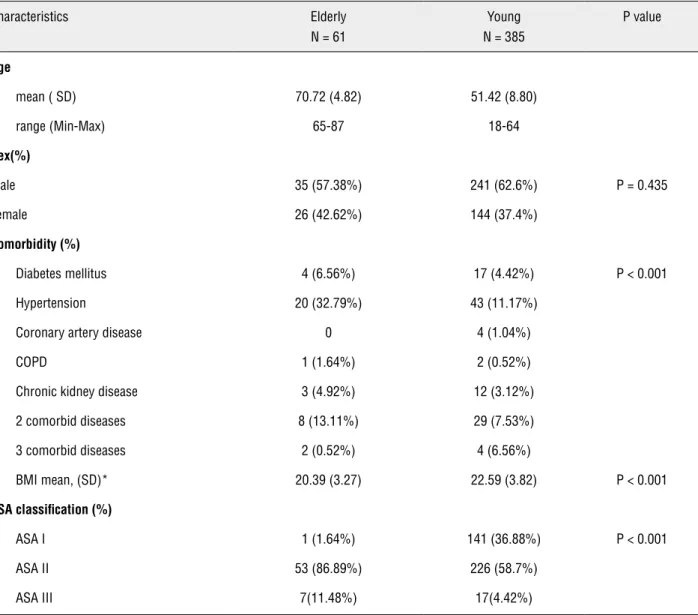
years) and 51.42 + 8.80 years (range 18-64 ye-ars), respectively. Patient’s profiles are shown in Table-1. All patients were operated by one surge-on (Lojanapiwat B) and surge-one assistant (Nakamsurge-on T). The protocol for this study was reviewed and approved by the ethics committee (Institutional Review Board) of the Faculty of Medicine, Chiang Mai University.
Methods
All patients underwent PCNL in single stage after routine evaluation of the function and anatomy of the kidneys. All patients were
opera-ted under general anesthesia. Two grams of cef-triaxone were given as prophylactic antibiotic in negative urine culture cases. Patients with positive urine culture were treated with antibiotics based on the antibiogram at least 48 hours before sur-gery. The percutaneous access was performed in prone position following the contrast media in-jection via the open-ended ureteral catheter which was placed transurethrally in supine position prior to the renal access. Most patients needed only a single tract. Both working and safety guide wires were inserted after successful access. Tract dilata-tions were performed by Amplatz fascial dilators
Table 1- Patient’s profile.
Characteristics Elderly
N = 61
Young N = 385
P value
Age
mean ( SD) 70.72 (4.82) 51.42 (8.80)
range (Min-Max) 65-87 18-64
Sex(%)
Male 35 (57.38%) 241 (62.6%) P = 0.435
Female 26 (42.62%) 144 (37.4%)
Comorbidity (%)
Diabetes mellitus 4 (6.56%) 17 (4.42%) P < 0.001
Hypertension 20 (32.79%) 43 (11.17%)
Coronary artery disease 0 4 (1.04%)
COPD 1 (1.64%) 2 (0.52%)
Chronic kidney disease 3 (4.92%) 12 (3.12%)
2 comorbid diseases 8 (13.11%) 29 (7.53%)
3 comorbid diseases 2 (0.52%) 4 (6.56%)
BMI mean, (SD)* 20.39 (3.27) 22.59 (3.82) P < 0.001
ASA classification (%)
ASA I 1 (1.64%) 141 (36.88%) P < 0.001
ASA II 53 (86.89%) 226 (58.7%)
or metallic Alken dilators until 30 Fr and Amplatz sheath was used in all cases. A standard nephros-cope was used with ultrasound and pneumatic li-thotripsy for stone disintegration.
At the end of the procedure, 7 patients in group I and 47 patients in group II were tubeless (no nephrostomy tube). For the remaining patients, 20 F nephrostomy tubes were inserted for 48 to 72 hours. All patients had postoperative chest X-ray and laboratory investigation. The operative cha-racteristics are shown in Table-2. Stone free status was determined by postoperative plain KUB.
The statistical analysis used Chi-square and student t-tests, using Software STATA version
11 for estimation of the significant differences be-tween the two groups. Multivariate was analyzed with Rog risk regression. A p-value < 0.05 was considered significant.
RESULTS
The mean stone size in group I was 4.09 + 1.66 cm and 3.94 + 1.78 cm in group II. The posi-tion of the calculi, associated anomalies, history of previous surgery and degree of hydronephrosis are listed in Table-3. The average operative time was 52.62 + 20.68 min and 47.85 + 18.83 min in groups I and group II, respectively (P = 0.07). Most of the
Table 2 - Operative Characteristics.
Characteristics Elderly
(N = 61)
Young (N = 385)
P value
Renal Puncture site
Upper pole 39 (63.93%) 272 (70.65%) P = 0.664
With supracostal 13 (21.31%) 106 (27.53%) P = 0.341
Middle pole 8 (13.11%) 43 (11.17%)
Lower pole 13 (21.31%) 61 (15.84%)
Multiple pole 1 (1.64%) 9 (2.34%)
Number of tract
1 57 (93.44%) 346 (89.87%) P = 0.655
2 4 (6.56%) 38 (9.87%)
3 0 1 (0.26%)
Additional treatment
Endopyelotomy 2 (3.28%) 10 (2.6%) P = 0.597
Infundibulotomy 1 (1.64%) 6 (1.56%)
Operative time
mean(min), (SD)* 52.62 (20.68) 47.85 (18.83) P = 0.070
Postoperative nephrostomy
Tubeless 7 (11.48%) 47 (12.21%) P = 0.871
Table 3 - Stone and Clinical Characteristics.
Characteristics Elderly
N = 61
Young N = 385
P-value
Side (%)
Left 24 (39.34%) 191 (49.61%) P = 0.136
Right 37 (60.66%) 194 (50.39%)
Size
mean (cm), (SD)* 4.09 (1.66) 3.94 (1.78) P = 0.547
Location (%)
Staghorn calculi 24 (39.34%) 124 (32.21%) P = 0.634
Renal pelvic calculi 11 (18.03%) 54 (14.03%)
Calyceal calculi 13 (21.31%) 115 (29.87%)
Renal Pelvic + Calyceal calculi 13 (21.31%) 82 (21.3%)
Other location 0 10 (2.6%)
Associated anomaly (%)
Calyceal diverticulum 2 (3.28%) 4 (1.04%) P = 0.414
Infundibular stenosis 1 (1.64%) 8 (2.08%)
UPJO 4 (6.56%) 10 (2.6%)
Single Kidney 4 (6.56%) 23 (5.97%)
Horseshoes Kidney 0 8 (2.08%)
Double collecting system 1 (1.64%) 8 (2.08%)
Positive pre-operative
Urine culture 24 (39.34%) 115 (29.87%) P = 0.138
Previous surgery 19 (31.15%) 127 (32.99%) P = 0.776
Degree of hydronephrosis
Mild 20 (32.79%) 144 (37.4%) P = 0.828
Moderate 21 (34.43%) 135 (35.32%)
renal access tracts were performed at the upper pole (63.93% in group I and 70.65% in group II) whi-ch was supracostal above twelfth rib in 21.31% of group I and 27.53% of group II. The stone free rate and rate of fragment < 4 mm were 70.49%, 14.75%, and 72.73%, 13.51% in group I and group II, respec-tively. Four patients of group I and 55 patients of group II had adjunctive shock wave lithotripsy for treatment of the retained stone.
Four patients (6.55%) of group I and 16 patients (4.15%) of group II required blood trans-fusion. Four patients of group I and five patients of group II developed sepsis (P = 0.007). Length of hospital stay was 5.19 + 2.65 and 4.78 + 2.65 days in groups I and II, respectively (Table-4).
At multivariate analysis, stone size and previous surgery were the factors that affected the success rate. Stone size, urine culture, renal access and operative time were the factors that influenced complications (Tables 5 and 6).
DISCUSSION
The prevalence of nephrolithiasis in male and female elderly aged over 65 years are 47.3/1000 and 34.2/1000, respectively (6,7). Me-tabolic abnormality is common in elderly patients with high incidence of isolated hypocitraturia and previous parathyroidectomy. Most common stone analysis in geriatric patients are calcium oxalate (79%) followed by uric acid (10%), calcium phos-phate (5%) and cystine (5%) (8).
Since cardiopulmonary and renal func-tions are compromised, elderly patients could not tolerate the invasive surgery. The complications following PCNL might become important com-pared to younger patients. The worse cardiopul-monary reserve in elderly leads to less toleration to bleeding and septic complication in elderly patients and anesthetic risks are more serious as well (9). In general patients, major complications
Table 4 - Outcome Characteristics.
Characteristics Elderly
(N = 61)
Young (N = 385)
P value
Success rate 52 (85.24%) 331 (86.24%) P = 0.750
Stone free 43 (70.49%) 280 (72.73%)
CIRF 9 (14.75%) 52 (13.51%)
Auxiliary treatment with ESWL 4 (6.56%) 55 (14.29%) P = 0.098
Complication rate 8 (13.11%) 60 (15.58%) P = 0.618
Bleeding 4 (6.55%) 28 (7.27%)
Blood transfusion 4 (6.55%) 16 (4.15%) P = 0.400
Change of Hematocrit mean (SD)* 3.34 (2.99) 3.18 (3.29) P = 0.720
Pulmonary complication 1 (1.64%) 15 (3.9%)
Need Intercostal drainage 1 (1.64%) 3 (0.78%) P = 0.508
Sepsis 4 (6.56%) 5 (1.3%) P = 0.007
Length of hospital stay
Table 5 - Multivariate analysis of success rate in association with demographics, stone, pre-operative and operative characteristics.
Factors IRR 95% CI P value
Age 0.829 0.53 - 1.27 P = 0.394
Sex 0.815 0.60 - 1.10 P = 0.185
ASA classification 1.076 0.83 - 1.38 P = 0.572
Comorbidity 1.032 0.96 - 1.10 P = 0.380
Stone size 1.090 1.00 - 1.18 P = 0.039
Urine culture 0.865 0.64 - 1.15 P = 0.333
Previous surgery 0.710 0.53 - 0.94 P = 0.020
Renal access 0.920 0.68 - 1.23 P = 0.581
Number of tract 1.280 0.86 - 1.90 P = 0.222
Operative time 1.005 0.99 - 1.01 P = 0.134
Table 6 - Multivariate analysis of complication rate in association with demographics, stone, pre-operative and operative characteristics.
Factors IRR 95% CI P value
Age 0.794 0.48 - 1.29 P = 0.358
Sex 0.833 0.60 - 1.15 P = 0.273
ASA classification 0.785 0.59 - 1.04 P = 0.098
Comorbidity 1.023 0.94 - 1.11 P = 0.581
Stone size 0.893 0.80 - 0.99 P = 0.032
Urine culture 0.693 0.50 - 0.95 P = 0.024
Previous surgery 0.882 0.64 - 1.21 P = 0.443
Renal access 0.424 0.31 - 0.56 P < 0.001
Number of tract 0.992 0.63 - 1.55 P = 0.973
of PCNL are bleeding that requires intervention (0.6% - 1.4%), infection (0.9 - 4.7%), pulmonary complication (3.1 - 23%) and adjacent organ in-jury (0.2%) (10).
The prevalence of diabetes, hypertension, dyslipidemia, coronary artery disease, congestive heart failure, cerebrovascular disease, peripheral vascular disease, cancer and chronic kidney dise-ase with its complication are higher in elderly pa-tients especially those older than 75 years old (11). A significant number of elderly patients use an-ticoagulant for cardiovascular and other chronic disease (12). These factors lead to the worsening of the cardiopulmonary reserve and increasing of anesthetic risks for operation in elderly patients. Solitary kidney is common in elderly patients that develop renal function deterioration by the delay in diagnosis and treatment. Stone treatment in so-litary kidney is challenging, but PCNL in soso-litary kidney of elderly patients was reported to be safe and effective but with higher requirement of blood transfusion (13).
Advances in medical technology leaded to the effective treatment in elderly with less morbi-dity and mortality. Similar to the standard treat-ment of urolithiasis, extracorporeal shock wave li-thotripsy is the most common modality in elderly for small stone with safety and efficacy (14). Ak-man et al. (9) compared the outcome of retrograde intrarenal surgery with percutaneous nephrolitho-tomy in elderly. Mean hospital stay, fluoroscopic time, drop in hemoglobin level were significantly higher in PCNL patients. Only operative time was longer in RIRS patients. Intraoperative and pos-toperative complications such as blood transfu-sion requirement, fever, renal colic episode were not different between both groups. This study demonstrated the safety of PCNL in elderly with short operative time.
The clinical research office of the Endou-rological Society Percutaneous Nephrolithotomy (PCNL) study reported a prospective observation of the outcome of PCNL in elderly patients (age over 70 years old) in comparison with younger patients (ages between 18-70 years old) (15). The analysis was subgrouped into unmatched (334 elderly, 2976 young) and matched samples (344 patients). The matched samples were selected
ba-sed on the assessment of stone free status, the presence of staghorn stone, location, and number of stones. Demographic characteristics of patients were similar in matched and unmatched analysis. The patients with comorbidities of diabetic melli-tus, cardiovascular diseases, use of anticoagulant and prednisolone were significantly higher in elderly. In addition, patients with ASA II, III, IV were higher while preoperative EGFR was inferior in elderly. Of unmatched analysis, staghorn stone, upper pole access, operative time, length of stay and complication according to Clavien score IVA and IVB were significantly higher in elderly. Of matched analysis, stone burden, minor complica-tions (Clavien I and II) and major complicacomplica-tions (Clavien III, IV) were higher in elderly. More pa-tients with supine PCNL were performed in young patients. The results and complications of PCNL in elderly patients were comparable to younger patients. This study confirms that the stone free status after PCNL in elderly is similar to those in younger patients even though comorbidity is hi-gher with slightly increase of complication.
Sahin et al. compared the results of PCNL in 27 patients aged 60 years old or older with 178 PCNL patients younger than 60 years old (4). The incidence of solitary kidney in patients aged over 60 years old was higher (29% vs. 7%, P = 0.003). Hypertension was the most common medical his-tory in elderly patients (26%) followed by diabe-tes mellitus (22%), coronary artery disease (15%), peptic ulcer (15%), cerebrovascular disease (4%) and Parkinson’s disease (4%). Sixty-one percent of elderly patients were female whereas only 33% fe-male of younger patients. The history of previous stone surgery was not different between both groups. The success rate, complication, and hospi-tal stay were similar in both groups. Fever without bacteremia and drop of hemoglobin were relative higher in elderly patients but not significantly di-fferent. Rate of blood transfusions were 21% and 18% in elderly and younger patients, respective-ly (P = 0.662). No renal deterioration was found following PCNL in solitary kidney. The findings demonstrate the efficacy and safety of PCNL in elderly even in patients with solitary kidney.
classification in elderly. The prevalence of single kidney in this study was not different between el-derly and younger patients, which is contradict to a previous report (4). Gender, size of stone, stone location, associated anomalies, percentage of po-sitive operative urine culture, history of pre-vious stone surgery, degree of hydronephrosis, site of renal puncture, number of renal access tract, operative time and number of tubeless PCNL were not significantly different between both groups. In addition, the success rate, auxiliary treatment, length of stay and change of hematocrit were also not significantly different between both groups. Sepsis is more common in elderly compare to younger patients (13% vs. 6.56%, P = 0.007). The higher incidence of sepsis following PCNL in el-derly may be explained by the higher positive preoperative urine culture compared with those in younger patients even though it is not significan-tly different. The criteria of the postoperative sep-sis is defined as systemic inflammatory response syndrome (SIRS) which presents more than one of the following clinical findings: body temperature > 38 °C or < 36 °C, heart rate > 90 beats per mi-nute, respiratory rate > 20 breaths per minute or PaCO2 < 32 mmHg, and white blood cell count > 12,000/cu mm, < 4000/cu mm (16). Three of 4 el-derly patients with postoperative sepsis had E-coli (ESBL) positive in the preoperative urine culture, and one patient had changed to new antibiotic ba-sed on evidence from intraoperative stone cultu-re. Among younger patients, 3 of 5 patients had positive pelvic urine and stone culture which had the same result of preoperative urine culture. We confirmed our previous study that intraoperative culture is important for postoperative infective complication following PCNL. The technique of PCNL in elderly was not different from the techni-que in general patients. One of the major concerns is the anesthetic risk associated with surgery. This specific group of patients needs to be carefully evaluated preoperatively.
We have found that stone size and status of previous surgery are the factors that affect the success rate. Factors that affect the complication rate include stone size, urine culture, renal access and operative time. PCNL in previous open surgery patients can be safely performed in elderly patients
even though technical difficulties in the step of tract dilatation may affect the success rate. Most renal access sites in the present study were in the upper pole and can explain the effect of renal access on complications. Tubeless PCNL following PCNL is safe in uncomplicated elderly cases with no need of second nephroscopy, no significant bleeding and extravasation and no distal obstruction. The hospi-tal stay was longer than the previous study due to our routine discharge protocol of our hospital to let the patients to stay for one more day following the PCNL tube removal and may also due to complica-tion following the treatment.
The limitation of this study is the retros-pective nature with small number of the sample size. Nevertheless, the increasing number of elder-ly patients with stone disease, the positive result of PCNL in these specific patients with a larger sample size is valuable and worth to carry out a prospective study.
CONCLUSIONS
PCNL in elderly is effective and safe com-parable to PCNL in younger patients even though with more comorbidity and slightly increase of complications. Sepsis is common in elderly follo-wing PCNL.
CONFLICT OF INTEREST
None declared.
REFERENCES
1. Segura JW, Patterson DE, LeRoy AJ, Williams HJ Jr, Barrett DM, Benson RC Jr, et al.: Percutaneous removal of kidney stones: review of 1,000 cases. J Urol. 1985; 134: 1077-81. 2. Preminger GM, Assimos DG, Lingeman JE, Nakada SY, Pearle
MS, Wolf JS Jr, et al.: Chapter 1: AUA guideline on manage-ment of staghorn calculi: diagnosis and treatmanage-ment recommen-dations. J Urol. 2005; 173: 1991-2000.
3. Turk C, Knoll T, Petrik A, Sarica K, Skolarikos A, Straub M, et al.: Guidelines on Urolithiasis. http://www.uroweb.org/guide-lines/online-guidelines/
5. Akman T, Binbay M, Sari E, Yuruk E, Tepeler A, Akcay M, et al.: Factors affecting bleeding during percutaneous nephrolithoto-my: single surgeon experience. J Endourol. 2011; 25: 327-33. 6. Serio A, Fraioli A: Epidemiology of nephrolithiasis. Nephron.
1999; 81: 26-30.
7. Scales CD Jr, Smith AC, Hanley JM, Saigal CS; Urologic Dis-eases in America Project: Prevalence of kidney stones in the United States. Eur Urol. 2012; 62: 160-5.
8. Gentle DL, Stoller ML, Bruce JE, Leslie SW: Geriatric urolithia-sis. J Urol. 1997; 158: 2221-4.
9. Akman T, Binbay M, Ugurlu M, Kaba M, Akcay M, Yazici O, et al.: Outcomes of retrograde intrarenal surgery compared with percutaneous nephrolithotomy in elderly patients with moderate-size kidney stones: a matched-pair analysis. J En-dourol. 2012; 26: 625-9.
10. Skolarikos A, de la Rosette J: Prevention and treatment of complications following percutaneous nephrolithotomy. Curr Opin Urol. 2008; 18: 229-34.
11. Ng CF: The effect of age on outcomes in patients undergoing treatment for renal stones. Curr Opin Urol. 2009; 19: 211-4.
12. Stevens LA, Li S, Wang C, Huang C, Becker BN, Bomback AS, et al.: Prevalence of CKD and comorbid illness in elderly pa-tients in the United States: results from the Kidney Early Evalu-ation Program (KEEP). Am J Kidney Dis. 2010; 55(3 Suppl 2): S23-33.
13. Fihn SD, Callahan CM, Martin DC, McDonell MB, Henikoff JG, White RH: The risk for and severity of bleeding complications in elderly patients treated with warfarin. The National Consor-tium ofAnticoagulation Clinics. Ann Intern Med. 1996; 124: 970-9.
14. Stoller ML, Bolton D, St Lezin M, Lawrence M: Percutaneous nephrolithotomy in the elderly. Urology. 1994; 44: 651-4. 15. Okeke Z, Smith AD, Labate G, D’Addessi A, Venkatesh R,
As-simos D, et al.: Prospective comparison of outcomes of per-cutaneous nephrolithotomy in elderly patients versus younger patients. J Endourol. 2012; 26: 996-1001.
16. Lojanapiwat B, Kitirattrakarn P: Role of preoperative and intra-operative factors in mediating infection complication following percutaneousnephrolithotomy. Urol Int. 2011; 86: 448-52.
_____________________
Correspondence address:
Lojanapiwat Bannakij, MD Division of Urology, Department of Surgery, Chiangmai University, Chiangmai, 50200, Thailand.
EDITORIAL COMMENT
The longer life expectancy of the popu-lation can provide a number of patients with lithiasis in older ages and thus candidates for interventional treatments. For this reason, it is interesting to analyze the results of surgical pro-cedures in this older population.
The article in question aims to compare the results of percutaneous renal surgery in el-derly and younger subjects. Although this is a retrospective analysis, which could reduce the value of this study, the procedures were well standardized and similar in all patients, with homogeneous and comparable groups, which makes it attractive.
Comorbidities and surgical risk were high-er in the eldhigh-erly, but this fact did not directly influ-ence the results. We might even suggest that this makes the elderly more susceptible to complica-tions, especially infectious and hemodynamic.
Despite the radiological method used (X-ray) is not ideal to assess the presence of
resid-ual calculi and therefore determine the outcome, this was the method used for the two groups and the stone -free rates were similar. Unsurprising-ly size calculation interfere in the success rate, as previous publications have reported. Besides this, the authors found influence on the results of previous surgeries, probably due to retroperi-toneal fibrosis and perirenal, which hinder the puncture and dilatation of reno-cutaneous route.
The percentage of urinary tract infec-tion (UTI) preoperatively was similar between groups, although the evolution infectious / SIRS after the procedure was statistically higher in the older age.
The results of this study guide us to take greater care in the elderly as infectious events, pre- treating UTIs, performing procedures short-er and more economical access. Thshort-erefore con-sider that in elderly patients, may be useful col-lect urine culture renal pelvis, which in previous studies was shown harvested different from the bladder. This measure can guide which antibiotic use in case of any infectious evolution.
Dr. Antonio Corrêa Lopes Neto