ORIGIN
AL RESEAR
CH
Scientiic research with individuals post stroke:
diiculties in recruitment, allocation and adherence
on two diferent protocols of physiotherapy
intervention
Pesquisas cientíicas com indivíduos pós Acidente Vascular Encefálico: diiculdades no
recrutamento, alocação e aderência em dois diferentes protocolos de intervenção isioterapêutica
Las investigaciones cientíicas con sujetos que sufrieron accidentes cerebrovasculares:
diicultades para el reclutamiento, destinación y adherencia en dos diferentes protocolos de
intervención isioterapéutica
Raquel Pinheiro Gomes1, Stella Maris Michaelsen2, Letícia Cardoso Rodrigues1,
Nayara Correa Farias1, Rudney da Silva3
Corresponding author: Stella Maris Michaelsen – Rua Pascoal Simone, 358 – Coqueiros – CEP: 88080-350, Florianópolis (SC), Brasil – E-mail: [email protected] Presentation: Feb. 2014 – Accepted for publication: Jan. 2015 – Financing source: nenhuma – Conlict of interests: nothing to declare – Approved by the Committee for Ethics in Research involving Humans at UDESC (protocol no. 111/2009 and 250/2009) – Brazilian Clinical Trials Registry: U1111-1122-0220 (Study I) and U1111-1122-0411 (Study II).
Study conducted at Center for Health and Sport Sciences (CEFID), State University of Santa Catarina (UDESC), Florianópolis (SC), Brazil.
1MSc, Master in Human Movement Science.
2PhD, Associate Professor, Department of Physiotherapy, Doctor in Rehabilitation.
3EngD, Associate Professor, Department of Physical Education, Doctor in Human Movement Science. 34
ABSTRACT | This study analyze the diiculties in recruit-ment, allocation and adherence of individuals with hemi- paresis after stroke in the development of two rand-omized clinical trials (RCTs). For this, data were extracted from two RCTs that investigated patients with hemiparesis due to stroke, living in Florianópolis, aged over 40 years. RCTs interventions were based to task-oriented training and were performed evaluations at three diferent times (pre, post, follow-up). The sample calculations determined the need of 54 participants for Study I and 36 for Study II. The quantitative data were analyzed using descriptive statistics and qualitative information through the content analysis. It was found that of 127 potential participants, it was not possible to contact 18.1%, and 5.5% came to death. In preselection 6.3% were hospitalized/bedridden, 7% had no interest and 4.7% were unable to transport. During al-location 33% were excluded for not meeting the eligibility criteria. Among 32 patients who remained in the study, 16% missed the Study I and 2.5% the Study II. Wrong con-tact data, lack of resources for transportation, eligibility criteria and lack of interest were the factors that hindered the recruitment of subjects. Therefore, we suggested that the relations improvement between research centers and
institutions, the proper recording of contacts, access to clinical records, the availability of inancial resources to support the recruitment and transportation and increased funding for RCTs can improve the viability of this type of study in Brazil.
Keywords | Patient Selection; Clinical Trials as Topic; Paresis.
participantes, não foi possível contatar 18,1%, e 5,5% vieram a óbito. Na pré-seleção, 6,3% estavam internados/acamados, 7% não tinham interesse e 4,7% não tinham condições de transpor-te. Durante a alocação, 33% foram excluídos por não atende-rem aos critérios de elegibilidade. Dentre os 32 pacientes que permaneceram nos estudos, 16% faltaram ao Estudo I e 2,5% ao Estudo II. Dados de contato equivocados, falta de recursos para transporte, critérios de elegibilidade e ausência de interesse fo-ram os fatores que mais diicultafo-ram o recrutamento dos indiví-duos. Portanto, pode-se sugerir que a melhora entre os centros de pesquisa e as instituições, o registro adequado dos contatos, o acesso aos registros clínicos, a disponibilidade de recursos i-nanceiros para auxílio ao recrutamento e transporte e o aumento do inanciamento para ECR podem melhorar a viabilidade deste tipo de estudo no Brasil.
Descritores | Seleção de Pacientes; Ensaios Clínicos como Assunto; Paresia.
RESUMEN | Esta investigación tuvo por objetivo analizar las diicultades en el reclutamiento, destinación y adherencia de sujetos con hemiparesia post accidente cerebrovascular (ACV) en el desarrollo de dos Ensayos Clínicos Aleatorizados (ECA). Para eso, se recolectó informaciones de dos ECAs los que hicie-ron estudios con pacientes portadores de hemiparesia debido al ACV, que vivían en la ciudad de Florianópolis, Brasil, con edad superior a 40 años. En los ECAs se han hecho intervenciones
basadas en la capacitación orientada a la tarea y evaluaciones en tres ocasiones distintas (pre, post, seguimiento). Los cálcu-los de la muestra determinan la necesidad de 54 participantes para el Estudio I y 36 para el Estudio II. Los datos cuantitativos se han tratados a través de la estadística descriptiva y las in-formaciones cualitativas a través del análisis del contenido. Se han comprobado que de los 127 potenciales participantes, no ha sido posible contactarse con el 18,1%, el 5,5% fallecieron. En la preselección, el 6,3% estaban hospitalizados/encamados, el 7% no tenían interés y el 4,7% no tenían condiciones de trans-porte. Durante la determinación, el 33% han sido excluidos por no cumplir los criterios de elegibilidad. Entre los 32 pacientes que han permanecido en los estudios, el 16% no han compare-cido al Estudio I y el 2,5% al Estudio II. Los datos de contacto equivocados, la falta de recursos para el transporte, los criterios de elegibilidad y el ausente interés en participación han sido los factores que más causaron diicultades al reclutamiento de los sujetos. Por lo tanto, se puede hacer una sugerencia a la mejora entre los centros de investigación y las instituciones, el registro adecuado de contactos, el acceso a los registros clíni-cos, la disponibilidad de recursos inancieros para auxiliar en el reclutamiento y transporte y el aumento de los fondos para la ECA pueden ayudar a mejorar la viabilidad de este tipo de estudio en el Brasil.
Palabras clave | Selección de Pacientes; Ensayos Clínicos como Temas; Paresia.
INTRODUCTION
Clinical research, especially randomized clinical tri-als (RCTs), has the potential to provide real evidence regarding the efects of diferent treatments in health care. It is possible for records that hold information about the problems encountered in the recruitment and retention of patients, for purposes of performing clini- cal trials, to aford assistance in terms of developing strategies to overcome such challenges1.
Recruitment refers to the process of selection that begins with communication between the researcher and potential participants, the objective of which is to ob-tain a representative number of the target population so to meet the demands of the sample size and the power of the study. Patient association or retention is the pro-cess of maintaining participants within the study2.
Recruiting patients may be considered one of the most diicult aspects of the research process3,4. Half
of all clinical trials fail in their objective to meet the quantitative sampling target5. Such diiculty in
re-cruiting or retaining participants can have a negative efect on the statistical power of the study, leading to inconclusive results, increasing the evaluation dura-tion, delaying the response of an appropriate inter-vention or resulting in a premature termination of the tests3-6.
Clinical studies involving post-stoke (cerebrovascu-lar accident) participants may experience several dii-culties in recruitment, the main reasons being due to a lack of desire to participate, complex protocols, strict eli- gibility criteria, exhaustive testing and lack of resources, such as transport for the participants4.
the objective of this study was to examine diiculties in terms of the recruitment, allocation and adherence of patients with post-stroke hemiparesis while developing two RCTS.
METHODOLOGY
he data analyzed in this article were provided by two RCTS, approved by the Committee for Ethics in Research in Humans, registered under the Brazilian Registry for Clinical Trials (ReBEC) and developed by the Laboratory for Motor Control, at the State University of Santa Catarina (UDESC) between November 2010 and November 2011.
he participants who showed post-stroke hemipa-resis lived in Greater Florianópolis, they were over 40 years of age and had been identiied at the Municipal Physiotherapy Clinic of Biguaçu/SC, the Catarinense Rehabilitation Center, the CEFID/UDESC Clinical Physiotherapy School and the “Health Care for Persons after a Cerebral/Encephalic Vascular Accident” exten-sion project, totaling 127 individuals.
Individuals were recruited in order to partici-pate in two RCTS, who used interventions based on task-oriented training with a view to improve paretic upper limb activity. Evaluations were performed in three distinct periods: pre-, post-training and follow-up.
After the data collections were completed, analysis began regarding the diiculties encountered during the recruitment, allocation and adherence of participants during the interventions proposed by the RCTs.
Study Descriptions
he quantitative samples from studies I and II were delineated according to criteria appropriated to experi- mental research in the health area7, this in accordance
with the following equation: n=Z2×S2÷d2, in which “n”
is the sample size, “Z” is the number of standard de-viations, “S” is the value of standard deviation and “d” is the diference in acceptable tolerance. After apply-ing the compensation percentage for possible samplapply-ing losses, the sample calculations determined that 54 and 36 participants would be needed for studies I and II, re-spectively. his number represented approximately 70% of the 127 subjects who were identiied as candidates to participate in the research.
Study I examined the efects of training with a mir-ror associated with symmetric functional tasks and sys-tematic progression compared to the control group. he training was based on visual feedback through the mir-ror (Mirror herapy), in which the mirror is positioned at right angles between the two upper limbs, the indi-vidual is then advised to carry out simultaneous bilater-al and symmetricbilater-al movements with their hands, while watching their arm’s relection in the mirror8.
Study II assessed efect-oriented training on bilater-al tasks during upper limb function recovery in patients with hemiparesis, compared to conventional physio-therapy. Intervention was based on bilateral training aiming at including the paretic upper limb (UL) in dai-ly life activities.
Individuals who were in the chronic phase follow-ing a unilateral stroke (≥6 months post-stroke) were included in studies I and II. hose capable of perform-ing rudimentary holdperform-ing tasks, with moderate impair-ment of the UL, were included in Study I (between 30 and 49 points by the Fugl-Meyer-Scale (FMS)); Study II included those with severe impairment (<30 FMS points).
he following individuals were excluded: those who had other neurological disorders, orthopedic problems in the upper limbs that interfere with their function, bilateral impairment, painful shoulders, dif-iculty in understanding simple commands and for already being a member of other study involving the upper limbs.
All clinical evaluations for studies I and II were performed by trained physiotherapists. he interven-tions were performed at the participant’s home or at the CEFID/UDESC Clinical Physiotherapy School. Follow-up assessments were performed two weeks after the interventions were completed.
Information extraction procedures
Information handling
he variable analyses from studies I and II were han-dled by means of descriptive statistics (mean, standard deviation and percentile). he information collected during the telephone interviews were handled through a content-analysis technique, this was performed so as to describe the reported information and to allow knowledge to be inferred relative to response interpre-tation conditions9. Following the data systematization,
the information content to be categorized into thematic blocks was selected.
he diiculties encountered during the RCTs (stud-ies I and II) were evaluated by means of ‘a priori’ es-tablished categories. his procedure’s adoption made it possible to understand the diiculties and extract the most signiicant elements by means of systematizations and objectivations which provided inferences regarding the processed information9. For both, the categories
were deined as: a) recruitment; b) allocation, and c) ad-herence (Table 1).
Table 1. Study Feasibility Categories
Clinical Study Feasibility
Recruitment Telephone access number and evaluation scheduling, interest and diiculties to reach the evaluation location, individuals who are bedridden hospitalized or had passed away
Allocation Inclusion and exclusion criteria, random drawing and allocation of experimental and control groups
Adherence Acceptance (Term of Free and Informed Consent); Presence and permanence (attendance during evaluation and intervention sessions and reason for absence)
RESULTS
Recruitment
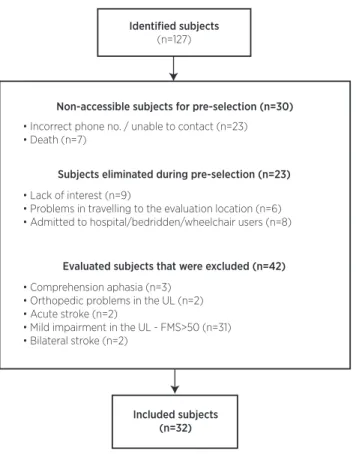
Figure 1 shows the recruitment diiculties. he irst diiculty came from incorrectly reported phone num-bers or it being impossible to contact the individuals (18.1%). During the pre-selection, 7.2% of the total number of individuals demonstrated no interest in par-ticipating, 6.3% were hospitalized or bedridden and 4.7% reported diiculties with transportation.
Identified subjects
(n=127)
Included subjects (n=32)
Subjects eliminated during pre-selection (n=23) Non-accessible subjects for pre-selection (n=30)
• Incorrect phone no. / unable to contact (n=23) • Death (n=7)
• Lack of interest (n=9)
• Problems in travelling to the evaluation location (n=6) • Admitted to hospital/bedridden/wheelchair users (n=8)
Evaluated subjects that were excluded (n=42)
• Comprehension aphasia (n=3) • Orthopedic problems in the UL (n=2) • Acute stroke (n=2)
• Mild impairment in the UL - FMS>50 (n=31) • Bilateral stroke (n=2)
Figure 1. Schematic representation of patient recruitment
Allocation
Following the assessments, 42 individuals (33% of the total) were excluded because they did not conform to the eligibility criteria. Of these, 31 were excluded be-cause they had a light impairment of the UL (FMS>50) (24.4% of the total and 73.8% of those excluded by the eligibility criteria).
16 individuals with moderate motor impairment and 16 with severe motor impairment of the UL were eligible to participate in studies I and II, these were randomly di-vided into the experimental group (EG) and the control group (CG) (Figure 2). he randomization was based on a sequence of computer generated random numbers that were placed inside numbered and sealed opaque envelopes.
Adherence
he total number of sessions in Study I was 192 (12 sessions per patient), out of which 32 were missed, representing 16% of the total. Among the recorded reasons for the absences were: patient illness (28.1%), deaths in or problems with the family (18.7%), for-getfulness (12.5%), medical appointments (9.3%), un-scheduled trips (9.3%) and house moving (6.2%).
Study II totaled 160 sessions (10 sessions per pa-tient) with four absenteeisms, representing 2.5% of the total. Medical appointments were the only recorded reason for these absences (100%). Only two patients in this study who attended appointments at the CEFID/ UDESC Physiotherapy clinic did not miss a session. he other participants were treated at home.
hese absences were resolved through timetable re-scheduling. All 32 patients had the same number of ses-sions as per the proposed interventions. No individual abandoned or withdrew from the treatment.
DISCUSSION
Recruitment
Data from the Brazilian national health system, DATASUS10 and the Brazilian Institute of Geography
and Statistics11 have shown that during 2010 and 2011
the total population in Greater Florianópolis was 877,116 people. he hospitalization rate caused by stroke in the region’s hospitals was 8.1%11, which
rep-resents 71,046 individuals who were interned during this time in Florianópolis. Among these, only 127 in-dividuals registered themselves on the contact waiting lists at the clinics for this research. he assumption is that the reduced number of patients identiied is either because the researchers failed to obtain access to the re-cords for stroke individuals that are made available by
DATASUS, thereby limiting the patient list submitted through the Polyclinics in Florianópolis to the CEFID Clinical Physiotherapy School and/or the long list at the Catarinense Rehabilitation Center, where patient registration data might not have been recorded.
he fact that incorrect phone numbers were given proved to be the greatest factor that hindered recruit-ment. It is likely that the patients did not update their data or health professionals responsible for re-registering individuals did not do so correctly. his failure to obtain patient registration data from rehab clinics relects the lack of training of the health professionals at these units - who are the irst contact for patients in terms of gath-ering important data. As a result, 18.1% of individuals could not be contacted due to registration errors.
Among the main obstacles encountered in recruit-ing patients, it is possible to highlight the lack of direct access to the data of patients who had high hospital-ization rates, this in order for them to be referred to re-hab clinics or health centers, and the lack of connection between clinics and research centers. As a strategy, the research projects could be extended to hospitals, which are responsible for irst contacts and follow-up of tients in the irst few months. In addition, many pa-tients end up not going through the Brazilian National Health Service (SUS) network for many diferent rea-sons, such as: transportation diiculties to the consulta-tion locaconsulta-tions, diiculties to physically move, by being bedridden or hospitalized, lack of family support, delays in being seen, among others6,12.
One of the main reasons for non-participation in studies I and II was found to be the diiculty in terms of transport. As a result, some individuals reported to not be interested, but actually they were not able to get to the location where the evaluations and interventions were held. Similarly, another study4 reported that the
lack of resources for transportation was singled out as the main barrier to post-stroke individuals’ participa-tion and presence during research projects in Brazil. Among the 150 patients who were selected for clinical trials, 40% did not participate because of transport dif-iculties, while 32% missed their sessions because of the same diiculties, thereby compromising adherence. In contrast, in this study, such absences were minimized because most patients had their treatment at home and all participants completed all evaluation and treatment stages. Transportation diiculty was only a factor for a few evaluations during the pre-selection (4.7%) and for some appointments that were performed at the clinics.
Subjects Included (n=32)
Pre
Post
Follow-up
Study II (n=16)
EG (n=8) CG(n=8)
n=8 n=8
Randomization (n=16)
n=8 n=8
Study I (n=16)
EG (n=8) CG(n=8)
n=8 n=8
Randomization (n=16)
n=8 n=8
Meanwhile, the costs incurred from commuting to the patient’s homes were bore by the researchers themselves.
A study involving post-stroke individuals in Australia13, which provided transportation for patients
throughout the intervention period, had a recruitment rate of 51%; the rate for this study was 25.2%. Research performed in developed countries depend not only on investment for patient transport, but also on inancial compensation for patients who decide to be involved in the surveys, which means that participation is even greater. In Brazil, the diiculty in inding funds for transportation and/or to pay a technician to perform the recruitment hinders the progress of many stud-ies. However, although it might be said that there is lack of resources for investment in research, it should be noted that often inancial resources do exist, but they are used for other purposes. During other RCTs, conducted at the patients’ homes, it was observed that only 3 of the 20 subjects treated would have had the means to travel, if the test had not been performed at home14.
As a result, it is possible to suggest that providing transport for patients would increase recruitment and retention rates4, but would not completely solve the
problem. his possibility is based on the fact that fami- ly attitude often ends up discouraging the retention of these patients in research groups, this happens due to the families not accompanying them to sessions, not encouraging them to participate and restricting them, this could be due to fear or for ignoring the importance of these studies in terms of improving rehabilitation. Sometimes, the patient is able to take the bus, but the family does not allow this to happen.
One study on the diiculties in patient recruitment rates for those with Parkinson’s disease in an RCT re-ported that one of the main obstacles to recruitment, in addition to the lack of inancial resources for transport to the training location, was the lack of interest and by not being accompanied6.
he lack of interest regarding participation can come from a lack of inancial resources, low or a lack of fami- ly encouragement, a lack of instruction regarding the importance of treatment and no motivation, which is caused by the depression that the disease itself causes. One study, which involved 3,626 post-stroke patients in the United States, observed that only 6% of individuals agreed to participate in the study, even when reimburse-ment of expenses for transportation, parking and food was available3.
Allocation
In this study, 33% of the total number of individuals were excluded due to not meeting the eligibility criteria. his barrier was imposed by the researchers themselves in order to make the study even more thorough, the i-nal objective being to reduce the biases caused by inter-ested individuals being excluded.
Similarly, during recruitment for one RCT, after se-lecting 552 patients, only 49 were eligible15. Other
re-search project selected 582 stroke patients, and from these, only 100 (17%) were eligible16. Whereas, in
an-other study which identiied 150 stoke patients, 77% were excluded because they did not meet the inclusion criteria as deined in that study4. It soon became clear
that eligibility criteria constitute a factor that contributes to patient recruitment and allocation limitation, despite both being necessary in order to achieve more consistent results.
Adherence
Studies I and II showed that those subjects who had their own car and those who underwent treatment in their own homes missed less sessions. he largest num-ber of missed sessions in Study I was due to the fact that there were four weeks of intervention and most patients did their intervention sessions at physiotherapy clinics. In Study II, the reduced number of absences, compared with Study I, may have been a result of the fact that there were only two weeks of intervention and only two patients received their treatment at the clinic; the others received home treatment.
he researchers encouraged participant attendance at the sessions through motivational exercises with pro-gression, patient-centered functional goals and activities performed with real objects. he team’s characteristics, in terms of their welcoming attitude and friendliness, created a trusting atmosphere that is essential for pro-moting patient motivation and retention during RCTs7.
Based on all the data, it is possible to understand that, in order to achieve the greatest participation from post-stroke individuals in an RCT, the best method would be to perform interventions at the patient’s resi- dence. However, given all the diiculties already refer-enced, especially those that note that many pieces of necessary equipment are not portable, it seems that ofering indiscriminate in-house interventions would produce incomplete results.
CONCLUSION
Incorrect contact information, lack of transportation resources, stringent eligibility criteria and lack of inter-est were the factors that most hampered the recruitment of individuals. Despite the aforementioned diiculties, performing RCTs must be encouraged. Closer contact between health managers and researchers is required, because if more accurate information about registered stroke patients in cities and hospitals is obtained, it can provide, among others things, greater accuracy regard-ing contact records. In order to improve adherence, home interventions and patient-centered goals were determining factors, despite the various constraints that may occur. However, funding to supply a member of staf for recruitment at the hospital and resources being made available by inancial agencies for longer periods of time can still improve the viability of this type of study in Brazil.
REFERENCES
1. Gul RB, Ali PA. Clinical trials: the challenge of recruitment and retention of participants. J Clin Nurs. 2010;19(1-2):227-33.
2. Keith SJ. Evaluating characteristics of patient selection and dropout rates. J Clin Psychiatry. 2001;62(9):11-4.
3. Blanton S, Morris DM, Prettyman MG, Mcculloch K, Redmond S, Light KE. Lessons learned in participant recruitment and retention: the EXCITE trial. Phys Ther. 2006;86(11):1520-33.
4. Scianni A, Teixeira-Salmela LF, Ada L. Challenges in recruitment, at-tendance and adherence of acute stroke survivors to a randomized trial in Brazil: a feasibility study. Braz J PhysTher. 2012;16(1):40-5. 5. Easterbrook PJ, Matthews DR. Fate of research studies. J R Soc
Med. 1992;85(2):71-6.
6. Lima LO, Rodrigues-de-Paula F. Recruitment rate, feasibility and safety of power training in individuals with Parkinson’s disease: a proof-of-concept study. Braz J Phys Ther. 2013;17(1):49-56.
7. Weyne GRS. Determinação do tamanho da amostra em pesquisas experimentais na área de saúde. Arq Med ABC. 2004;29(2):89-90. 8. Ramachandran VS, Rogers-Ramachandran D, Cobb S. Touching the
phantom limb. Nature. 1995;377(6549):489-90.
9. Bardin L. Análise de conteúdo. Lisboa: Edições 70; 2000. 10. Ministério da Saúde. Departamento de Informática do SUS.
Disponível em: <http://www2.datasus.gov.br/DATASUS/index. php?area=02>
11. Instituto Brasileiro de Geograia e Estatística. Censo Demográico 2010. Disponível em: <http://cod.ibge.gov.br/1P2>
12. Ribeiro MCSA, Barata RB, Almeida MF, Silva, ZP. Peril socio-demográico e padrão de utilização de serviços de saúde para usuários e não-usuários do SUS – PNAD 2003. Cien Saude Colet. 2006;11(4):1011-22.
13. Lloyd G, Dean CM, Ada L. Issues in recruiting community-dwelling stroke survivors to clinical trials: the AMBULATE trial. Contemp Clin Trials. 2010;31(4):289-92.
14. Duncan PW, Richards L, Wallace D, Stoker-Yates J, Pohl P, Luchies C, et al. A randomized, controlled pilot study of a home-based exer-cise program for individuals with mild and moderate stroke. Stroke. 1998;29(10):2055-60.
15. Werner RA, Kessler S. Efectiveness of an intensive outpatient re-habilitation program for post acute stroke patients. Am J Phys Med Rehabil. 1996;75(2):114-20.
16. Studenski S, Duncan PW, Perera S, Reker D, Lai SM, Richards L. Daily functioning and quality of life in a randomized controlled trial of therapeutic exercise for sub acute stroke survivors. Stroke. 2005;36(8):1764-70.