Inluence of clinical variables on the functional capacity of
women undergoing chemotherapy
Inluência de variáveis clínicas na capacidade funcional de mulheres em tratamento quimioterápico
Inluencia de variables clínicas en la capacidad funcional de mujeres en tratamiento quimioterápico
Thaís Crisina Elias1 Lorena Campos Mendes1
Maurícia Brochado Oliveira Soares1
Vanderlei José Haas1
Sueli Riul da Silva1
1. Universidade Federal do Triângulo Mineiro.
Uberaba, MG, Brazil.
Corresponding author: Sueli Riul da Silva.
E-mail: [email protected]
Submited on 06/23/2015. Accepted on 10/18/2015.
DOI: 10.5935/1414-8145.20150076
A
bstrActObjective: To evaluate how the chemotherapy protocol and tumor type inluence the functional capacity of women diagnosed with gynecological cancer, breast cancer and gestational trophoblastic disease during chemotherapy. Methods: This was an observational and retrospective study with a quantitative approach and longitudinal design. The study included 438 women undergoing chemotherapy in a general hospital from January 2000 to December 2012. Results: The functional capacity of the study population had a mean score of 70 on the Karnofsky Performance Scale. A higher decline was noted in the functional capabilities of patients with gynecological cancer, and in women who used taxane chemotherapy protocols. Conclusion: It is germane to establish measures aimed at ensuring the prevention of side efects caused by chemotherapy, providing comprehensive and efective care for oncology patients.
Keywords: Karnofsky Performance Status; Activities of Daily Living; Drug Therapy; Women's Health.
r
esumoObjetivo: Avaliar a inluência do protocolo quimioterápico e tipo tumoral sobre a capacidade funcional de mulheres diagnosticadas com câncer ginecológico, câncer de mama e doença trofoblástica gestacional durante o tratamento quimioterápico. Métodos: Trata-se de um estudo observacional e retrospectivo com abordagem quantitativa e delineamento longitudinal. Participaram do estudo 438 mulheres em tratamento quimioterápico, em um hospital de clínicas no período de janeiro de 2000 a dezembro de 2012. Resultados: A capacidade funcional da população estudada apresentou um escore médio de 70,00 no índice de Karnofsky. Notou-se maior impacto pontual no declínio da capacidade funcional das pacientes com câncer ginecológico e nas mulheres que utilizaram protocolos baseados em quimioterápicos taxanos. Conclusão: É oportuno o estabelecimento de medidas capazes de garantir a prevenção dos efeitos colaterais causados pelo tratamento quimioterápico, proporcionando uma assistência integral e de qualidade às pacientes oncológicas.
Palavras-chave: Avaliação de Estado de Karnofsky; Atividades Cotidianas; Quimioterapia; Saúde da Mulher.
r
esumenObjetivo: Evaluar la inluencia del protocolo quimioterápico y tipo tumoral en la capacidad funcional de mujeres diagnosticadas con cáncer ginecológico, cáncer de mama y enfermedad trofoblástica gestacional durante el tratamiento quimioterápico. Métodos: Se trata de estudio observacional y retrospectivo con abordaje cuantitativa y delineamiento longitudinal. Participaron del estudio 438 mujeres en tratamiento quimioterápico, en un hospital de clínicas en el período de enero de 2000 a diciembre de 2012. Resultados: La capacidad funcional de la población estudiada presentó un escore promedio de 70,00 en el índice de Karnofsky. Se notó mayor impacto puntual en el declino de la capacidad funcional de las pacientes con cáncer ginecológico y en mujeres que utilizaron protocolos embazados en quimioterápicos taxanos. Conclusión: Es oportuno el establecimiento de medidas capaces de garantizar la prevención de los efectos colaterales causados por el tratamiento quimioterápico, proporcionando una asistencia integral y de calidad a las pacientes oncológicas.
INTRODUCTION
Due to the extended life expectancy enabled by technological advances in health, cancer has become a global public health problem, and its incidence is increasingly common among the populations1.
Among the Brazilian female population, breast cancer present the highest incidence rate of neoplasia and mortality. In turn, gynecological cancer accounts for more than half the deaths by cancer among Brazilian women, and cervical cancer has the highest incidence rate among these types of cancer1. Additionally to the malignant tumors that affect
women, it is also important to observe that gestational trophoblastic disease (GTD) is included in this group, and this includes several pathologies. The non-malignant form of the disease includes the hydatidiform mole and the malignant form includes the gestational trophoblastic neoplasia. This is divided into invasive mole, choriocarcinoma and placental site trophoblastic tumors. The non-malignant forms are likely to become malignant2,3.
In this context, chemotherapy is a chemical and systemic treatment that has been widely used for cancer control and treatment. However, the general aggression to the cells eventually leads to the occurrence of several toxicities4-6 that, as a result, may adversely affect functional capacity (FC), which is directly related to the quality of life of patients submitted to this therapeutics7.
In the perspective of managing the functional state, a growing use and development of assessment tools that may measure the aspects pertinent to FC4 is observed. The Karnosfky's tool, developed by David A. Karnofsky and Joseph H. Burchenal in 1948 in order to assess the physical performance of patients undergoing chemotherapy treatment from the perception of the professional, contributes to a safer administration of the chemotherapy6,8. This tool has a 0-100 scale, where 0 represents death and 100 represents preservation of FC. This is the most commonly used tool to assess cancer patients, representing a guiding element for care and an evaluator for the response to the treatment. It is essential for assessing the capacity to perform activities of daily living, the symptoms of the disease, and the required level of care. Also, it indicates the tolerance and the response to the treatment, thus contributing to the selected therapy4. Nursing has been actively participating in all initiatives for cancer control and FC management presented by patients during the therapy, consistently managing care actions in the administration of the various modalities of treatment of the disease5,6.
The present study aimed at assessing factors that affected the functional capacity of women diagnosed with gynecological cancer, breast cancer and GTD during chemotherapy treatment in the oncogynecology department of a public hospital.
METHODS
This observational, retrospective study with a quantitative approach and longitudinal design wasdeveloped in the Center of Chemotherapy of the Clinical Hospital of the Federal University of Triângulo Mineiro (CQT/HC/UFTM) in the city of Uberaba, state of Minas Gerais. The study had the participation of women undergoing treatment against gynecological cancer, breast cancer and GTD in the CQT/HC/UFTM within the period from January 2000 to December 2012. Patients who did not complete at least three cycles of the chemotherapy treatment were excluded due to the analytical impossibility of data. The period of compilation and analysis of data was from January to April 2014.
Initially, the patients were identiied by means of a follow-up form of patients submitted to antineoplasic chemotherapy containing sociodemographic and clinical characterization, information related to the identiication of the patient, and a database about the disease and the proposed treatment.
The tool proposed by Karnofsky was used to assess the impact of the treatment in the FC presented by such patients during the antineoplastic therapy. The assessment of FC of patients was performed continuously during the chemotherapy cycles, being concluded at the end of the treatment or due to death of the patient4,5. The utilized form and tools were illed by the same professional during the entire period, as this professional monitored the patients in the oncologic service between 2000 and 2012, thus ensuring the quality of the study.
The Karnofsky's tool consists of three major areas, each one covering the scores related to the FC presented by the patient. In this context and in relation to the ability to perform daily activities, the irst area is related to patients that require minimum assistance, corresponding to the scores between 80 and 100. The second condition is related to patients that sometimes require some kind of assistance, corresponding to scores between 50 and 70. The third condition is related to patients that require a higher level of support, being unable to self-care and requiring hospital care, corresponding to the scores between 0 and 40. Score 0 indicates death5.
The software Statistical Package for the Social Sciences (SPSS) version 16.0 was used to store and codify the data. The univariate descriptive analysis of the qualitative variables was performed through absolute and relative frequencies analysis. Measures of central tendency (mean and median) and measures of dispersion (standard deviation) were used for the quantitative variables. The development of the functional capacity for the diferent cycles included the analysis of variance (ANOVA) with repeated measures. The multiple linear regression model was used to statistically analyze the impact of some variables in the progress of the scores related to FC. The level of signiicance for all inferential procedures was 5%.
Mineiro and approved in 2010 according to statement 1698/2010. Confidentiality of data of the individuals was guaranteed according to Resolutions 1196/1996 and 466/20129. A Free and
Informed Consent Form was not required from patients as this was a retrospective study, that is, data were collected from the iles of the service.
RESULTS
This study had the participation of 438 women; 273 (62.3%) were from the city of Uberaba. Their mean age was 50.62 years, ranging between 16 and 84 years old and with a standard deviation of 13.70. The most prevalent type of tumor was breast cancer, with a total of 224 (51.1%) cases of the disease, followed by 194 (44.3%) cases of gynecological cancer and 20 cases of GTD (4.57%). The patients of the present study underwent a minimum of three and a maximum of twelve chemotherapy cycles (Table 1).
A higher number of patients was between the first and sixth chemotherapy cycle; thus, after the sixth cycle a significant reduction of the population undergoing this treatment was observed. Therefore, only the period between the first and sixth chemotherapy cycle was considered in the present research (Table 2).
Analysis of multiple comparisons using Bonferroni method presents the cycles in which the comparisons of means of FC were statistically significant, showing that the last two cycles presented a higher decline in the evolution of FC. In addition, the differences were found to be more important between the extremes; therefore, the use of mean scores of the three first and the three last chemotherapy cycles is pertinent considering the similarity between the three first and three last mean scores of FC.
The patients were divided into two groups for the assessment of the influence of the number of therapeutic modalities on FC: the first group included those who underwent chemotherapy exclusively; the second group included those who underwent chemotherapy associated with other treatment methods. In general, four treatments were performed during the present study: chemotherapy. radiotherapy. surgery and curettage.
In relation to the chemotherapeutics corresponding to the utilized protocol, groupings of protocols were made according to the similarity with the main base of treatment. These measures were adopted for a better analysis of the adopted protocols, which were allocated into four groups: Anthracycline group: corresponding to fluorouracil, doxorubicin or epirubicin and cyclophosphamide (FAC); doxorubicin or epirubicin and cyclophosphamide (AC); platinum group: related to cisplatin, doxorubicin or epirubicin and cyclophosphamide (PAC); cisplatin and cyclophosphamide; cisplatin and etoposide; carboplatin and etoposide; cisplatin and doxorubicin (PA); cisplatin, etoposide and bleomycin (PEB); cisplatin and fluorouracil (PLA-FLU); cisplatin and vincristine; cisplatin; taxanes group: paclitaxel and carboplatin; docetaxel and carboplatin; doxorubicin and paclitaxel; paclitaxel; 'others' group: with the drugs melphalan; cyclophosphamide, vincristine and epirubicin; cisplatin, topotecan and cytarabine; vinorelbine, actinomycin and cyclophosphamide; cisplatin and vinorelbine; topotecan and cytarabine; cyclophosphamide. methotrexate and fluorouracil (CMF); methotrexate (MTX); etoposide, methotrexate, actinomycin-D, cyclophosphamide and vincristine (EMA-CO).
The diagnoses were divided into three groups: the group of patients with breast cancer corresponding to women
Table 1.
Measures of posiion and variability of funcional capacity scores of women with gestaional trophoblasic
disease, breast cancer and gynecological cancer according to the Karnofsky’s tool between chemotherapy cycles.
Uberaba, Minas Gerais, Brazil, 2014
Scores
N
Mean
Median
Standard deviaion
Minimum
Maximum
Score corresponding to Cycle 1
438
78.22
80.00
11.482
30
100
Score corresponding to Cycle 2
438
78.11
80.00
9.980
30
100
Score corresponding to Cycle 3
438
77.67
80.00
9.642
40
100
Score corresponding to Cycle 4
390
77.28
80.00
9.556
40
100
Score corresponding to Cycle 5
339
77.02
80.00
9.372
40
100
Score corresponding to Cycle 6
316
76.09
80.00
9.008
40
100
Score corresponding to Cycle 7
57
75.26
80.00
11.512
40
90
Score corresponding to Cycle 8
45
75.78
80.00
11.380
40
90
Score corresponding to Cycle 9
21
75.71
80.00
13.256
40
90
Score corresponding to Cycle 10
14
73.57
80.00
12.774
40
90
Score corresponding to Cycle 11
8
76.25
80.00
11.877
50
90
Score corresponding to Cycle 12
4
77.50
80.00
5.000
70
80
diagnosed with this type of cancer; the GTD group, involving patients with MH and choriocarcinoma; and the group of patients with gynecological cancer, including patients with ovarian cancer, uterine cancer, cervical cancer, vaginal cancer, fallopian tubes cancer and vulvar cancer (Table 3).
Descriptively, the most commonly used protocols by patients were FAC and AC, both classiied as anthracyclines, and the group of patients using taxanes, which presented the worst score of FC.
Gynecological tumor was the type responsible for the worst FC presented by the patients, followed by breast cancer and GTD. In turn, the latter presented the best mean scores of FC.
Regarding the adopted therapeutics, patients that used chemotherapy associated with other therapies presented the worst FC.
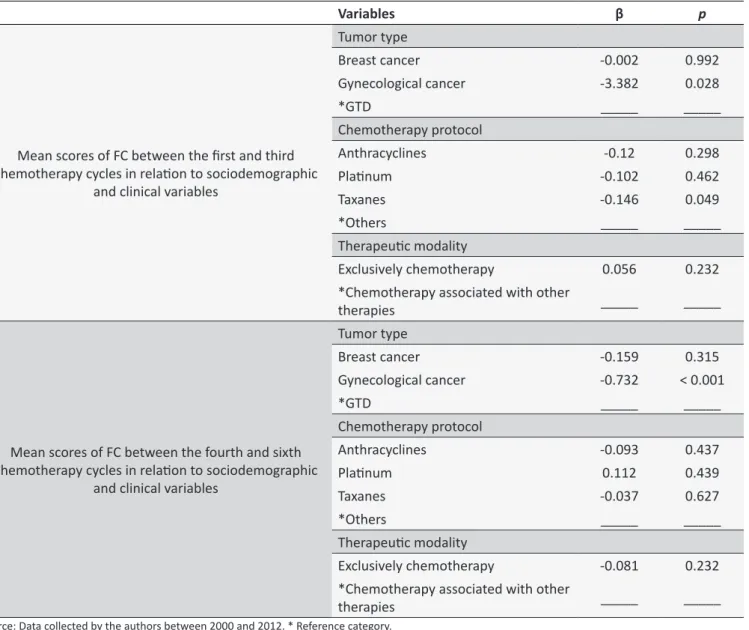
Using the multiple linear regression analysis to assess the factors that may afect the decline of FC, the variables with better mean scores of FC were selected as a reference category for the analysis of inluence of higher impact factors on FC (Table 4). In the regression, each predictor was adjusted in Table 4 for the following variables: medical diagnosis, chemotherapy protocol, and therapeutic modality.
In the group that received the taxane-based protocol it was evidenced that the taxane chemotherapy only caused a signiicant impact on the decline of FC of women between the irst and third treatment cycle.
Regarding the variable related to tumor type, it is possible to airm that the FC presented by patients with breast cancer, gynecological cancer and GTD presented no similarity between them, thus indicating that patients with gynecological cancer presented worst mean scores of FC throughout the treatment. In addition, given the similarity presented between the protocols, the use or non-use of chemotherapy associated with other types of treatment showed no signiicant impact on the decline of FC.
DISCUSSION
In general, the women presented mean scores of FC of 70, indicating that the patients showed incapacity to perform
activities of daily living, although their capacity for self-care remained preserved5. Furthermore, reduced FC was observed in the irst cycles of treatment. This event may be certainly related to the presence of side efects caused by the use of chemotherapy. A study showed that early in the beginning of the treatment there is a loss of FC that may reach approximately 30% of its totality, making the patient vulnerable during the treatment10.
Data analysis of multiple linear regression showed that the group that received the taxane-based protocol showed that the taxane chemotherapeutic agents caused a signiicant impact on the decline of FC in women only between the irst and third treatment cycles. Thus, the use of taxanes by women in this study was directly associated with the worst FC, possibly due to its toxicity potential4.
In this perspective, a cross-sectional study conducted with 21 women diagnosed with breast cancer concluded that patients using paclitaxel presented higher levels of symptoms when compared to those using FAC and CMF protocols, respectively, in the groups' anthracycline and others11. The study
also pointed out that fatigue11 was the most recurrent symptom
presented by women using taxane-based chemotherapy. It is important to emphasize that fatigue is directly associated with reduced FC12.
In addition, descriptive analysis of the group of women that received taxane- and platinum-based protocols indicated similarity between the mean scores, but the analysis of their influence on the FC showed that only the use of taxanes significantly affected functional impairment. Thus, although platinum chemotherapeutic agents are nephrotoxic13, they present lower functional impact when compared to the taxanes.
Regarding the variable related to tumor type, it is possible to airm that there was a signiicant diference between the mean scores of FC during both analyzed moments. It showed that the FC presented by patients with breast cancer, gynecological cancer and GTD had no similarity between them, and indicating that patients with gynecological cancer presented the worst mean scores of FC throughout the treatment. Therefore,
Table 2.
ANOVA test with repeated measures for comparison between the mean scores of funcional capacity of
women with gestaional trophoblasic disease, breast cancer and gynecological cancer according to the Karnofsky’s
tool in the six irst chemotherapy cycles. Uberaba, Minas Gerais, Brazil, 2014
Variable
Cycle 1
Cycle 2
Cycle 3
Cycle 4
Cycle 5
Cycle 6
Cycle 1
_____
p
= 0.63
p
= 0.812
p
= 0.211
p
= 0.004
p
≤ 0.001
Cycle 2
p
= 0.63
_____
p
= 1.000
p
= 1.000
p
= 0.016
p
≤ 0.001
Cycle 3
p
= 0.812
p
= 1.000
_____
p
= 1.000
p
= 0.001
p
≤ 0.001
Cycle 4
p
= 0.211
p
= 1.000
p
= 1.000
_____
p
= 0.005
p
≤ 0.001
Cycle 5
p
= 0.004
p
= 0.016
p
= 0.001
p
= 0.005
_____
p
≤ 0.001
Cycle 6
p
≤ 0.001
p
≤ 0.001
p
≤ 0.001
p
≤ 0.001
p
≤ 0.001
_____
gynecological cancer was found to signiicantly afect the FC of these patients in both analyzed moments.
It is appropriate to point out that the group of patients with gynecological cancer included aggressive types of cancer, many of which present diicult diagnosis or high incidence, and together with late diagnosis this eventually leads to a worse prognosis. In this context, a study pointed out that the high incidence rate and the late diagnosis of cervical cancer remain real14. In addition, through the analysis of national secondary databases, a cross-sectional study showed that between 2000 and 2009, respectively, 70.6% of the women with cervical cancer were diagnosed at an advanced stage of the disease15, thus contributing to the functional impairment caused by the advance of the neoplasia itself. Therefore, these indings certainly collaborated to the inluence of the variable gynecological cancer in the decline of FC of patients diagnosed with this neoplasia. In this study, the therapeutic modality was not found to signiicantly afect the FC.
It is appropriate to mention that the choice of chemotherapy protocol and the tumor type are not the exclusive factors responsible for the presented score. Other factors include previous FC, tumor stage, number of chemotherapeutic cycles, prescribed dosage, and other individual aspects that, combined with the chosen protocol and the tumor type, represent the score of FC.
Understanding the aspects of functional capacity of oncologic patients undergoing chemotherapeutic treatment enables nurses and other nursing professionals to plan and schedule the care, thus enabling patients to improve their capacity to deal with the health-disease process16.
CONCLUSION
The studied population maintained a linear FC throughout the therapy; therefore, the population presented similar progress. In addition, in general and according to the mean FC scores presented by the Karnofsky's tool, the patients were not found to be able to perform activities of daily living and active tasks; they were able to self-care only.
In addition, punctual evaluation of the impact caused by the variables, chemotherapy protocols, tumor type, and oncologic treatment on FC showed that patients who sufered a greater impact were, in order of importance, those diagnosed with gynecological cancer and those who used taxane-based chemotherapy protocols. Therefore, it was observed that the type of cancer was the main inluencing factor for the reduction of FC in these patients.
Therefore, it is necessary to provide appropriate care to the needs of each patient, aiming at a comprehensive and individual view as well as respecting the individuality of the patient undergoing anticancer treatment.
Limitations of this study include the approach, which was restricted to physical examination. Psychological, social, economic, and spiritual contexts of the patients were not
Table 3.
Clinical characterizaion and funcional capacity
of women with gestational trophoblastic disease,
breast cancer and gynecological cancer according to the
Karnofsky’s tool in relaion to the chemotherapy protocol,
type of tumor and therapeuic modality. Uberaba, Minas
Gerais, Brazil, 2014
Variable
N
%
Mean
(Karnofsky)
Chemotherapy protocol
Anthracyclines
206
47.03
81.29
Plainum
163
37.21
73.90
Taxanes
30
6.85
71.88
Others
39
8.9
82.39
Total
438
100
77.99
Tumor type
Breast cancer
224
51.14
81.38
Gynecological cancer
194
44.29
73.50
GTD
20
4.6
83.66
Total
438
100
77.99
Therapeuic modality
Exclusive chemotherapy
41
9.4
74.31
Chemotherapy associated
with other therapies
397
90.63
78.38
Total
438
100
76.34
Mean scores of FC between
the fourth and sixth
chemotherapy cycle
Chemotherapy protocol
Anthracyclines
204
52.3
79.43
Plainum
125
32.05
72.36
Taxanes
28
7.18
72.02
Others
33
3.55
81.21
Total
390
100
76.78
Tumor type
Breast cancer
220
56.41
79.65
Gynecological cancer
153
39.23
71.77
GTD
17
4.36
84.70
Total
390
100
76.78
Therapeuic modality
Exclusively chemotherapy
34
9.4
74.07
Chemotherapy associated
with other therapies
356
90.63
77.05
Total
390
100
75.56
Table 4.
Muliple linear regression test for the analysis of inluence of clinical variables on the funcional capacity of
women with gestaional trophoblasic disease. breast cancer. and gynecological cancer according to the Karnofsky’s
tool. Uberaba, Minas Gerais, Brazil, 2014
Variables
β
p
Mean scores of FC between the irst and third
chemotherapy cycles in relaion to sociodemographic
and clinical variables
Tumor type
Breast cancer
-0.002
0.992
Gynecological cancer
-3.382
0.028
*GTD
_____
_____
Chemotherapy protocol
Anthracyclines
-0.12
0.298
Plainum
-0.102
0.462
Taxanes
-0.146
0.049
*Others
_____
_____
Therapeuic modality
Exclusively chemotherapy
0.056
0.232
*Chemotherapy associated with other
therapies
_____
_____
Mean scores of FC between the fourth and sixth
chemotherapy cycles in relaion to sociodemographic
and clinical variables
Tumor type
Breast cancer
-0.159
0.315
Gynecological cancer
-0.732
< 0.001
*GTD
_____
_____
Chemotherapy protocol
Anthracyclines
-0.093
0.437
Plainum
0.112
0.439
Taxanes
-0.037
0.627
*Others
_____
_____
Therapeuic modality
Exclusively chemotherapy
-0.081
0.232
*Chemotherapy associated with other
therapies
_____
_____
Source: Data collected by the authors between 2000 and 2012. * Reference category.
taken into account. Although essential, it is clear that quality of life is not associated exclusively with physical functions.
ACKNOWLEDGEMENT
To CAPES DS, for inancial support with a master’s scho -larship to the irst author.
REFERENCES
1. Instituto Nacional de Câncer José Alencar Gomes da Silva. Estimativa 2014: Incidência de câncer no Brasil. [online]. 2014. Disponível em: http://www.inca.gov.br/estimativa/2014/estimativa-24042014.pdf
2. Garner EIO, Goldstein DP, Feltmate CM, Berkowitz RS. Gestational trophoblastic disease. Clin. Obstet. Gynecol. [online]. 2007 Mar; 50(1):112-22. Available from: http://ac.els-cdn.com.ez33.periodicos. capes.gov.br
3. Maestá I, Braga A. Desafios do tratamento de pacientes com doença trofoblástica gestacional. Rev Bras Ginecol Obstet. [online]. 2012 Abr; 34(4):143-6. Disponível em: http://www.scielo.br/pdf/rbgo/ v34n4/01.pdf
4. Bonassa EMA, Gato MIR. Terapêutica oncológica para enfermeiros e farmacêuticos. 4ª ed. São Paulo: Atheneu; 2012.
5. Instituto Nacional de Câncer José Alencar Gomes da Silva. Ações de enfermagem para o controle do câncer: uma proposta de integração ensino-serviço. 3ª ed. Rio de Janeiro: INCA; 2008.
7. Roque VMN, Forones NM. Avaliação da qualidade de vida e toxicidades em pacientes com câncer colorretal tratados com quimioterapia adjuvante baseada em luoropirimidinas. Arq. Gastroenterol. [online]. 2006 Abr/Jun; 43(2):94-101. Disponível em: http://www.scielo.br/pdf/ag/v43n2/31129.pdf 8. Grincenkov FRS, Fernandes N, Chaoubah A, Bastos K, Qureshi AR,
Pecoits-Filho R, et al. Factors associated with the quality of life of incident patients on PD in Brazil (BRAZPD). J Bras Nefrol. [on line]. 2011 jan/ mar; 33(1): 38-44. Available from: http://www.scielo.br/pdf/jbn/v33n1/ en_v33n1a05.pdf
9. Resolução 466 de 12 de dezembro de 2012. Diretrizes e normas regulamentadoras de pesquisas envolvendo seres humanos [online]. 2012;[citado em 2015 abr 01]. Disponível: http://conselho.saude.gov. br/resolucoes/2012/Reso466.pdf
10. Sawada NO, Nicolussi AC, Okino L, Cardozo FMC, Zago MMF. Avaliação da qualidade de vida de pacientes com câncer submetidos à quimioterapia. Rev. Esc. Enferm. USP [online]. 2009 Set; 43(3):581-7. Disponível: http://www.scielo.br/pdf/reeusp/v43n3/a12v43n3.pdf 11. Silva CB, Albuquerque V, Leite J. Qualidade de vida em pacientes
portadoras de neoplasia mamária submetidas a tratamentos quimioterápicos. Revista Brasileira de Cancerologia. [online]. 2010 Mar; 56(2):227-36. Disponível: http://www1.inca.gov.br/rbc/n_56/v02/ pdf/08_artigo_qualidade_vida_portadoras_neoplasia_mamaria.pdf
12. Campos MPO, Hassan BJ, Riechelmann R, Giglio A. Cancer-related fatigue: a review. Rev Assoc Med Bras. [on line]. 2011 Mar./Apr.; 57(2):211-9. Available from: http://www.scielo.br/pdf/ramb/v57n2/ en_v57n2a21.pdf
13. Peres LAB, Cunha-Junior AD. Nefrotoxicidade aguda da cisplatina: mecanismos moleculares. J Bras Nefrol. [online]. 2013 Out./Dez.; 35(4):332-40. Disponível em: http://www.scielo.br/pdf/jbn/v35n4/ v35n4a13.pdf
14. Alves CMM, Guerra MR, Bastos RR. Tendência de mortalidade por câncer de colo de útero para o Estado de Minas Gerais, Brasil, 1980-2005. Cad. Saúde Pública. [online]. 2009 Ago; 25(8):1693-700. Disponível: http://www.scielo.br/pdf/csp/v25n8/05.pdf
15. Thuler LC, Aguiar SS, Bergmann A. Determinantes do diagnóstico em estagio avançado do câncer do colo do útero no Brasil. Rev. bras. ginecol. obstet. [online]. 2014 Jun; 36(6):237-43. Disponível: http://www. scielo.br/pdf/rbgo/v36n6/0100-7203-rbgo-36-06-00237.pdf