Job satisfaction in a hospital context: an analysis according to
gender
Satisfação no trabalho no contexto hospitalar: uma análise segundo o gênero
Satisfacción laboral en el contexto hospitalario: un análisis según el género
Angela Maria Bacha1,2 Oswaldo da Rocha Grassioto2 Denis Barbosa Cacique1,2 Gislaine Aparecida Fonsechi Carvasan1,2 Helymar da Costa Machado1,2
1. Hospital da Mulher-Professor Dr. José
Aristodemo Pinoi Caism.
2. Universidade Estadual de Campinas.
Campinas, SP, Brazil.
Corresponding author:
Angela Maria Bacha.
E-mail: [email protected]
Submited on 03/25/2015. Accepted on 11/08/2015.
DOI: 10.5935/1414-8145.20150073
A
bstrActObjective: To assess job satisfaction in a public hospital according to workers' gender. Methods: It was conducted a secondary
analysis with mixed method, from a sample of 308 subjects: 240 women and 68 men. Results: Almost half of women played
functions of nursing. The most common function among men was the administrative. Men showed greater overall satisfaction, as well as for the three domains assessed. In adjusted analyses, statistical signiicance was observed only for the "Working Conditions" domain, indicating that the physical aspects of the job generate the larger asymmetries between the genders, especially in relation to toilets and level of noise in the environment. Conclusion: Since the other diferences between the groups did not
result signiicant in the adjusted analysis, it is concluded that the lower levels of satisfaction of women have been inluenced by their expressive concentration in nursing functions, the most dissatisied professional group in this study.
Keywords: Women, Working; Job Satisfaction; Working Conditions; Working Environment; Nursing Staf, Hospital.
r
esumoObjetivo: Avaliar a satisfação no trabalho em um hospital público universitário segundo o gênero dos(as) trabalhadores(as). Métodos: Realizou-se análise secundária com enfoque misto e amostra de 308 sujeitos, sendo 240 mulheres e 68 homens. Resultados: Quase metade das mulheres desempenhavam funções de enfermagem. A função mais comum entre os homens
era a administrativa. O grupo masculino apresentou maior satisfação geral e nos três domínios avaliados. Na análise ajustada, só se observou signiicância estatística para o domínio "Condições de Trabalho", indicando que os aspectos físicos do trabalho geram as maiores assimetrias entre os gêneros, principalmente em relação a banheiros e nível de barulhos no ambiente.
Conclusão: Uma vez que as demais diferenças entre os grupos não resultaram signiicativas na análise ajustada, conclui-se
que os menores níveis de satisfação das mulheres tenham sido inluenciados pela expressiva concentração feminina em funções da enfermagem, que constituíam o grupo proissional mais insatisfeito do estudo.
Palavras-chave: Trabalho feminino; Satisfação no emprego; Condições de trabalho; Ambiente de trabalho; Recursos Humanos de Enfermagem no Hospital.
r
esumenObjetivo: Evaluar la satisfacción laboral en un hospital público universitario a partir del género de los(as) trabajadores(as). Métodos: Se realizó un análisis secundario con enfoque mixto. Participaron 308 sujetos, habiendo 240 mujeres y 68 hombres. Resultados: Casi mitad de las mujeres tenían trabajos de enfermería. La función más común entre el género masculino era la
administrativa. Los hombres mostraron mayor satisfacción general y en los tres dominios evaluados. En el análisis ajustado, se observó solamente la signiicación estadística para el dominio "Condiciones de Trabajo", indicando que los aspectos físicos generan las mayores asimetrías entre los sexos, especialmente para los aseos y el nivel de ruido ambiente. Conclusión: Dado
que las otras diferencias entre géneros no resultaron signiicativas en el análisis ajustado, se concluye que los niveles inferiores de satisfacción femenina fueran inluenciados por la concentración predominante en funciones de enfermería, grupo profesional que ha demostrado mayor insatisfacción en el estudio.
Palabras clave: Trabajo de Mujeres; Satisfacción en el Trabajo; Condiciones de Trabajo; Ambiente de Trabajo; Personal de Enfermería
INTRODUCTION
Despite the remarkable achievements made by women over the last decades, certain disparities remain striking when comparing genders in the labor market, such as wage discrimination, occupational segregation and the diiculty of professional growth1. In the professional world, the perception
of equities and inequalities between genders focuses on job satisfaction (JS), as a study carried out in the city of Rio de
Janeiro1 has veriied. JS is traditionally described as an emotional
state resulting from the evaluation of one's own work or work experience, from which the work can generate a pleasant or
unpleasant emotional state2.
In studies on JS, the attention has been driven its determinants, for example, the gender of workers. Among them, researches conducted in England, in the US and in Spain have found that women had higher levels of satisfaction when
compared to men3-5. In Brazil, in the city of Rio de Janeiro, it
wasn't identiied diferent levels of JS among female and male
nurses6. In the same city, another study, this time conducted with
professionals from a Mental Health Service, has found lower JS level among women7. Similarly, a research conducted with 130
nursing professionals from companies and from the ive Brazilian regions has found that men had more JS than women8.
These indings indicate that the literature on the relationship between JS and gender is still inconsistent, as it sometimes presents higher JS in women, and sometimes the contrary. Meanwhile, the pressure for inclusion and justice among genders remains growing in the professional world. Confronting the discrimination sufered by women is increasingly becoming an imperative for organizations1. In this context, the objective of this
study consisted of comparing the JS between men and women who worked in the Women's Hospital Professor Aristodemo Pinotti - Caism/Unicamp (Caism), which is a public university hospital that fully assists the National Health System and that is located in the city of Campinas, in the state of São Paulo. Caism is a tertiary and quaternary levels hospital, specialized in women's and newborns' health. Its coverage area includes more than 100 municipalities, which corresponds to about ive millions of people. The hospital has 139 beds and 1,157 employees, where 922 (79.7%) are women and 235 (20.3%) are men.
METHODS
We developed a secondary analysis of previously collected
data in the validation study of the "Job Satisfaction Questionnaire at the Women's Hospital Professor José Aristodemo Pinotti-Caism/Unicamp" (QST-Caism)9. As the objective of the original
study was to validate the referred questionary, this study further examined the original database in order to scale possible differences in job satisfaction according the gender of the participants.
The QST-Caism, used in the collection of the original data, contains 19 items divided into three domains ("Interpersonal Re
-lationship", "Personal achievement" and "Working Conditions"),
as well as a space for registering the participants' comments. The questionnaire has also a space for the participants to freely write about the aspects of work that cause them satisfaction or insatisfaction. Although this questionnaire can be tested in other health institutions, it is important to note that its content was drawn from the speciic context of the Women's Hospital Profes
-sor José Aristodemo Pinotti-Caism/Unicamp. All data analyzed in this study (qualitative and qualitative) were collected through this questionnaire.
The QST-Caism was made available to the hospital workers over the internet through the Lime Survey software Version 1.91. To access the questionnaire, the subjects used a password that was provided to them after signing the Informed Consent (IC). The printed version of the QST-Caism was answered by the individuals without internet access.
As for the processing of the data, this study used mixed methods, with concomitant collection, primacy of the quantitative approach and encrusted design10. In other words, this was
a quantitative and qualitative study, with the simultaneous collection of two types of data, and where the quantitative interpretation was prioritized for the analysis, being then corroborated by the qualitative data. The speeches of the subjects were submitted to thematic content analysis, through which the texts were grouped in the following units of meaning, "dissatisfaction with the restrooms", "sense of injustice by the diferences between workers from Unicamp and Funcamp", "hierarchical relationships", "presence of noise in the workplace" and "working hours". In the second phase, these lines, after being group, were encrusted in an quantitative data analysis, which allowed the enrichment of its interpretation. The subject whose speeches are reproduced in this study were named by acronyms, according to the following coding: "NFE" to "nurse", "TEC" for "nursing technician" and "ADM" to "administration worker".
With respect to the sample, the validation study of the QST-Caism included 328 subjects. From this total, only the participants who had responded at least 70% of the speciic questions on JS and who had responded about their gender were considered eligible for the study.
This study was funded by the Caism itself, with the ap
-proval of the research project by the Ethics Committee of the Medical Science College from the University of Campinas (Opinion 306.348, on 06.20.2013), as well as by the Research Committee of the Caism. All participants in the study signed an informed consent form. The passwords for accessing to the online questionnaire were distributed randomly and without any information that could identify the subjects, such as their names or registration numbers.
RESULTS
From the total of 328 subjects who participated in the validation of the QST-Caism, 19 did not respond at least 70% of the speciic questions about the JS and were excluded from it. One participant who didn't respond the question about the gender was also excluded. Of the remaining 308 subjects, 240 were women and 68 men, yielding a ratio of 3.5 between the groups. This result is close to the proportion between the genders in the hospital, 3.9 women for every man. Moreover, as for the proportion of 3.5, this value is in the acceptable range of the ratio between groups, that is from 2 to 411. Besides, through the hypotheses
tests for proportion, it was veriied that there was no statistically signiicant diference in the percentage between the sample and the population, with p = 0.441.
The comparison between the genders in terms of age, educa
-tion, posi-tion, working hours, employment relationship(i.e. con
-tracted by Unicamp or outsourced), working arrangements (CLE or CLT), contract time and position is shown in Table 1. Males and females showed statistically signiicant diferences regarding the function performed, working hours and type of employment relatonship. Almost half of the women performed tasks related to nursing, whereas most men wielded administrative functions (such as programmers, secretaries, archivists, receptionists and statistics, among others).
Slightly over 70% of the men worked in full-time, while less than half of the women worked in the same hours. Approximately 70% of the women were hired by the State University of Campinas (Unicamp), while 53.7% of men had this type of work relationship. There weren't any statistically signiicant diferences between the genders in terms of education, job, work type, age and working time in the hospital.
As for the JS levels between genders, men had a higher overall score than women, with statistically signiicant difer
-ence in the bivariate analysis but not in the multivariate analysis (Table 2). The highest SJ of the men was also expressed in the three evaluated domains. In relation to the domain "Interpersonal Relationship", this diference was statistically signiicant in the bi
-variate analysis. In "Working Conditions", the diference between the groups obtained signiicance in both bivariate analysis and multivariate analysis. In " Personal achievement", the diference between the groups was only 0.6, with statistical signiicance in the bivariate analysis only to the work schedule, in which men showed higher ST.
Regarding the other evaluated items, it was also observed signiicant diferences in the bivariate analysis for the boss's ability to solve problems, the manners which co-workers treat each other, the access to restrooms and the level of noises at the workplace. In all these cases, the highest scores were referring to the group of men. Women had higher JS in items about job stability, professional achievement, employee beneits and salary. None of these cases, however, presented statistical signiicance. Among the items that comprise the domain "Working Conditions", the one that refers to the restrooms also showed signiicance in the comparison between genders (Table 2).
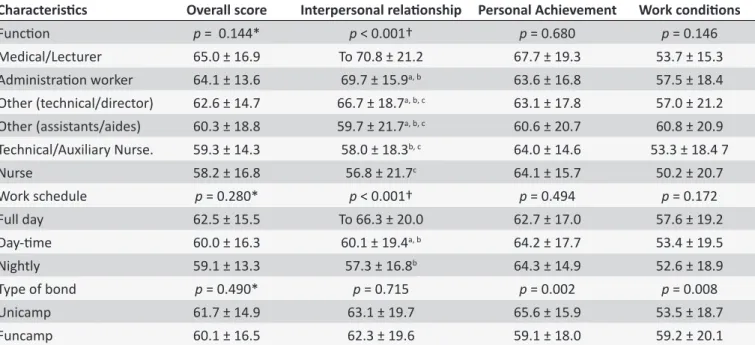
The general ST scores and domain for the characteristics "position", "working hours" and "type of work relationship" are described in Table 3, which does not stratify the sample between men and women. The lowest scores were obtained by workers who worked in the nursing area, working on the night shift and had been hired by Funcamp (not by the Unicamp).The exception was the domain "Working Conditions" in which the Unicamp workers were dissatisied.
DISCUSSION
This study found that the female group when compared to male, had lower levels of the three JS domains evaluated, and so in the overall score of the QST-Caism. These results are similar to two other Brazilian studies that compared the JS of health professionals by gender, where it was identiied higher levels of JS
among men7,8. However, similarly to the study by Rebouças and
his collaborators7, this study found that many of these diferences
were statistically signiicant in the bivariate analysis but not in multivariate analysis. Thus, it can be assumed that some of the diferences identiied in this study are not directly related to the gender of the subjects, but the characteristics "position", "working hours" and "type of employment relationship", which presented signiicant diferences between men and women. It's necessary, therefore, to examine how these properties would have inluenced the JS according to the genders of the workers.
Regarding the duties performed by the study subjects, it is important to note that women occupied mostly assistance posi
-tions (particularly in nursing).They had thus direct contact with patients and worked in places such as ambulatories, wards, ICU, surgery center and obstetric center. In contrast, most of the men worked in administrative positions, usually in places like oices, using the computer as their main working tool.
It's unquestionable that, at the care, the delicate nature of the work requires the employees less autonomy and lexible schedules, and often require professionals to remain standing for long periods (e.g. during surgery). In addition, the work is done in places that, given their own physical structure, not always allow adequate air conditioning (a spacious hall from an ambulatory, for example). Moreover, administration workers tend to remain seated most of the time. Besides that, they clearly have more autonomy and lex
Table 1.
Characterizaion of the sample by the gender of the subjects (n = 308). Campinas, SP, Brazil, 2013
Characterisics
Women
Men
p-value*
n (%)
n (%)
Educaion
High school
125 (53.2)
33 (49.3)
0.500†
Graduaion
81 (34.5)
22 (32.8)
Postgraduate studies
29 (12.3)
12 (17.9)
Posiion
Administraive
55 (25.0)
24 (38.1)
0.002†
Nurse
39 (17.7)
2 (3.2)
Technical/Auxiliary Nurse.
65 (29.6)
11 (17.5)
Medical/Lecturer
10 (4.5)
7 (11.1)
Other (technician/directors)
20 (9.1)
5 (7.9)
Other (helper/assistant)
31 (14.1)
14 (22.2)
Work schedule
Full day
108 (46.6)
47 (70.2)
0.003†
Day-ime
85 (36.6)
13 (19.4)
Night ime
39 (16.8)
7 (10.5)
Holds a posiion**
Yes
33 (14.1)
9 (13.6)
0.923†
No
201 (85.9)
57 (86.4)
Type of work relaionship
Funcamp
72 (30.6)
31 (46.3)
0.017†
Unicamp
163 (69.4)
36 (53.7)
Work type
CLE
10 (4.3)
5 (7.5)
0.338‡
CLT
224 (95.7)
62 (92.5)
Age (years)
Mean (standard deviaion)
44.1 (9.9)
43.7 (9.1)
0.705§
Median (minimum, maximum)
44.7 (21.0; 67.6)
41.7 (24.2; 62.8)
Working ime in the hospital (years)
Mean (standard deviaion)
15.4 (9.6)
16.4 (9.0)
0.494§
Median (minimum, maximum)
14.1 (0.5; 31.5)
15.1 (0.5; 31.5)
* p-value refers to the chi-squared tests; †, ‡ Fisher's exact test and Mann-Whitney; § number of paricipants: female (n = 240) and male (n = 68). There was a
lack of informaion provision in some sociodemographic variables. ** Supervision of secions and directors of departments or divisions.
It's not surprisingly, therefore, that the lowest general levels and of domain of JS have been identified among nursing professionals, who are mostly females. That is, even if it's supposed that there isn't any asymmetry in the JS according to the gender of the hospital staff, it must be recognized that many from the women's group focuses is
Table 2.
Comparison of the saisfacion levels at work between genders in the three assessed domains, in descending
order of saisfacion in each of the domains (0-100 point scale). Campinas, SP, Brazil, 2013
Domain
Items QST-Caism
Women
Men
p-value
p
c-value
Average
SD*
Average
SD
Interpersonal relaionship
Respect for the boss
74.5
23.5
77.2
28.1
0.102
0.808
Boss' abiliies
66.0
26.2
73.1
25.9
0.028
0.558
Educaion of colleagues
59.7
25.3
68.0
20.2
0.012
0.055
Boss’s moivaion
58.2
28.2
59.7
28.5
0.648
0.298
Opinions’ value
55.5
25.9
60.8
23.9
0.134
0.524
Insituional Communicaion
55.4
28.3
62.5
23.1
0.090
0.471
Domain score
61.5
19.8
67.1
18.9
0.012
0.370
Personal fulillment
Job stability
77.5
20.9
73.1
25.9
0.347
0.705
Work schedule
69.7
27.2
77.2
23.6
0.035
0.095
Workload
66.1
21.1
67.2
20.5
0.582
0.995
The educaional use
65.7
27.0
70.8
27.2
0.110
0.103
Professional achievement
64.8
25.3
62.9
27.8
0.659
0.472
Employee beneits
58.3
26.9
53.7
23.1
0.129
0.255
Salary
52.2
26.2
50.0
26.1
0.461
0.861
Recogniion
50.3
27.7
54.5
29.8
0.289
0.906
Domain score
63.1
16.7
63.7
17.7
0.623
0.719
Work condiions
Access to PPE**
72.4
22.8
73.8
23.7
0.587
0.350
Toilets
53.3
33.4
68.0
33.1
< 0.001
0.007
Temperature
52.0
28.7
57.0
31.7
0.154
0.463
Safety
48.4
25.5
53.4
25.7
0.123
0.606
Noises
43.4
26.2
55.6
24.9
< 0.001
0.061
Domain score
53.7
18.8
61.5
19.8
0.002
0.023
Total score
60.1
15.5
64.2
15.4
0.031
0.277
* SD: Standard deviaion. p-value refers to the Mann-Whitney test. Value-pc is related to the analysis of covariance (ANCOVA) adjusted to occupaion, working
hours and type of employment relaionship. Number of paricipants: female (n = 240) and male (n = 68). ** Personal Protecive Equipment (PPE).
Firstly, it is important to emphasize that professional au
-tonomy is considered one of the factors that contribute the most to the JS of nursing workers12. In contrast, one of the components
that can harm the autonomy of these professionals- and that was identiied in this study - is the management style, especially when it's marked by aggressiveness, although perpetrated by profes
-sionals in the same category12. In this sense, a nurse reported:
The supervisors [...] leave much to be desired, some are very friendly, polite, whereas others are very rough and and gets easily irritated. (ENF1)
Another nurse reported:
There has been very frequently abuse of authority and moral abuse. (ENF2)
And one nursing technician said:
We are threatened all the time. (TEC1)
Considering these reports, all from women, it's noteworthy that studies have found that, indeed, the female group sufers more psychological harassment in the workplace than men13,14.
However, It's also identiied in the literature researches in which men had the highest prevalence of this problem15,16. Given this
Table 3.
General ST Scores and by domain according to their funcion, working hours and type of employment
relaionship. Campinas, SP, Brazil, 2013
Characterisics
Overall score
Interpersonal relaionship
Personal Achievement
Work condiions
Funcion
p
= 0.144*
p
< 0.001†
p
= 0.680
p
= 0.146
Medical/Lecturer
65.0 ± 16.9
To 70.8 ± 21.2
67.7 ± 19.3
53.7 ± 15.3
Administraion worker
64.1 ± 13.6
69.7 ± 15.9
a, b63.6 ± 16.8
57.5 ± 18.4
Other (technical/director)
62.6 ± 14.7
66.7 ± 18.7
a, b, c63.1 ± 17.8
57.0 ± 21.2
Other (assistants/aides)
60.3 ± 18.8
59.7 ± 21.7
a, b, c60.6 ± 20.7
60.8 ± 20.9
Technical/Auxiliary Nurse.
59.3 ± 14.3
58.0 ± 18.3
b, c64.0 ± 14.6
53.3 ± 18.4 7
Nurse
58.2 ± 16.8
56.8 ± 21.7
c64.1 ± 15.7
50.2 ± 20.7
Work schedule
p
= 0.280*
p
< 0.001†
p
= 0.494
p
= 0.172
Full day
62.5 ± 15.5
To 66.3 ± 20.0
62.7 ± 17.0
57.6 ± 19.2
Day-ime
60.0 ± 16.3
60.1 ± 19.4
a, b64.2 ± 17.7
53.4 ± 19.5
Nightly
59.1 ± 13.3
57.3 ± 16.8
b64.3 ± 14.9
52.6 ± 18.9
Type of bond
p
= 0.490*
p
= 0.715
p
= 0.002
p
= 0.008
Unicamp
61.7 ± 14.9
63.1 ± 19.7
65.6 ± 15.9
53.5 ± 18.7
Funcamp
60.1 ± 16.5
62.3 ± 19.6
59.1 ± 18.0
59.2 ± 20.1
* p-value refers to the Mann-Whitney test for the type of relaionship and the Kruskal-Wallis test for posiion and working hours. Medium Values and Standard Deviaion.
† Signiicant diference by the Dunn test (p < 0.05) (categories with the same leter are not diferent).
Another aspect that may have inluenced the JS diference between genders is the work schedule, where over 50% of women work at night or in shifts (mornings, evenings and/or weekends and holidays). In this scenario, men achieved a score of nearly eight points above the women regarding satisfaction with working hours, with statistical signiicance in the bivariate analysis but not in the multivariate analysis. These results refer again to the higher concentration of women acting in nursing when compared to men. It turns out that the work at night and/or in shifts is a characteristic of the nursing ield because the care provided by this category needs to be ofered continuously at night, on weekends and holidays, periods in which other workers may be sleeping, resting, enjoying leisure or enjoying social and family activities. It's not by accident that this study has found that a recurring reason of nursing professionals' dissatisfaction linked to the Family Health Strategy and the Primary Care was the work schedule17. In this regard, a nurse
recorded the following:
We know we have chosen a profession that works on weekends and holidays [...] the family environment is healthy and relected at work [it is required ] the hiring of more employees, coverage for the irst absence, overtime pay. (ENF3)
In addition to the function performed and the working hours, the JS of the total study sample was inluenced by the type of employment relationship. For the domain "Personal achievement," the highest levels of JS were identiied among employees linked to Unicamp, with p < 0.05. On the other hand,
as for the domain "Working Conditions", the Funcamp workers were the ones more satisied, also with statistically signiicant diferences. However, the inluence of the type of relationship did not remain signiicant in the comparison between men and women. It should be clariied that while the Unicamp workers are admitted through civil servant examinions, the Funcamp are employed by the selection process and constitute a outsourced work force. The diference in the rights between these two types of relationship include greater stability and better wages for the Unicamp group, which also has a career plan established, while Funcamp employees don't. In this scenario it may be noted that both men and women employed by Funcamp expressed their discontent regarding the diferences in their rights between these two saw employment relationship. An administration worker evaluated:
The diference between Funcamp and Encamp is the salary and contract, however, the service is the same, so I'm sometimes a letter of the deck. (ADM1)
A nursing technician explained:
Such diference between Funcamp and Unicamp, since wages and beneits, makes me a little sad about this situation. (TEC2)
signiicant diference were observed in relation to restroom, with greater JS from the male group. It is worth noting that this study was developed in a hospital specialized in women's health, which is the reason why almost all of the public assisted by the institution are female. From that point, it was mentioned that the restrooms with free access are used by patients, which makes employees to use those whose access is only possible through keys. For men, the restrooms with free access are little used by the patients, and the users are mostly of drivers or patients`s companions. Consequently, the availability of toilets for the female works arias tend to seem smaller than for the male group, even though there are restrooms for exclusive use of both genders. Therefore, it is probable that by improving the dissemination of the availability of exclusive use of toilets for workers can signiicantly improve the SJ in women. Still, there shall be deemed to be discussed with the workers the distance and ease of access to these toilets, especially in the case of older professionals or with some limited mobility.
In the domain "Working Conditions", it was also observed a statistically signiicant diference between men and women regarding the level of noises. Despite this differences, it is important that workers of both sexes have complained of this problem. An administration worker, for example, reported:
There is a motor that is all day and every day making noises, one bad factor related to noise. (ADM2)
A nursing technician said:
The noise level is high, either in the outdoor units, or in units [...] some people speak too loud [...] and disproportionate laughs are frequent among employees. (TEC3)
The greater the dissatisfaction of women regarding this issue, it can be assumed that this was due to the predominance of the female group in the care. In hospitals, the noise pollution is responsible for increasing anxiety, loss of sleep, pain perception and prolonging the convalescence of patients18. Aware of this,
the female group engaged in the care may, in fact, show greater concern about the noise level in the workplace.
As for the limitations of this study, we can highlight the secondary analysis of the data. In this type of research, once the data are analyzed in order to meet diferent purposes from those of the original study, the adjustment between the new issues and the data efectively available, may face some obstacles. In this work, this was expressed at low power pf the sample to compare the JS between genders, considering that the minimum recommended value is 80%11. The sample showed satisfactory
power (85.3%) only to compare the JS in "Working Conditions", conirming the statistical signiicance identiied in this domain. For the overall score of the QST-Caism, this power was 48.9%, with signiicance level of 5%. For the domains "Interpersonal Relationship" and "Personal achievement," the power of the sample was 57.5% and 5.8%, respectively.
The absence in the literature of studies that report the use of the QST-Caism in other hospitals is also a limitation to be highlighted, since it prevents the discussions about results of the research using other types of instruments. In addition to that, the design of the study itself, for being cross-sectional imposes some known biases, especially the impossibility of establishing a causal relationship between the independent variables and the outcome studied, in this case, gender and job satisfaction.
CONCLUSION
This study found that the female group had lower levels of JS in all domains and in the overall score of the QST-Caism. In an multivariate analysis, this diference remained signiicant only in regards to the domain "Working Conditions", indicating that the physical aspects of the work are the ones that generate the biggest diferences between men and women. Among these aspects, the access to toilets and the level of noises constituted the largest asymmetries, always to the detriment of the female portion of the sample.
Once the remaining diferences between the groups weren't signiicant in the adjusted analysis, we assume that the lowest levels of JS of women have been inluenced by the signiicant female concentration in nursing roles, which constitute the most dissatisied group of the study. Among the factors that may have reduced the JS of these professionals, stood out the critics to the management style adopted by some supervisors and work in shift, on holidays and on weekends.
On the "personal achievement" domain, which addresses issues such as salary, job stability and employment beneits, there were no statistically signiicant diferences between men and women. This result shows that, in the Caism, there isn't an unequal relationship between men and women in relation to these aspects.
REFERENCES
1. Cavazotte FdSCN, Oliveira LBd, Miranda LCdM. Desigualdade de gênero no trabalho: relexos nas atitudes das mulheres e em sua intenção de deixar a empresa. Rausp. 2010 Jan./Mar.;45(1):70-83. 2. Locke EA. The nature and causes of job satisfaction. In: Dunnet MD
(Org.). Handbook of industrial and organizational psychology. Chicago: Rand McNally College Publishing Company; 1976. p. 1297-350. 3. Clark AE. Job satisfaction and gender: Why are women so happy at
work? Labour Economics. 1997 Dec.;4(4):341-72.
4. Hodson R. Gender Differences in Job Satisfaction: Why Aren't Women More Dissatisied? The Sociological Quarterly. 1989 Sep./ Nov.;30(3):385-99.
5. Carrillo-Garcia C, Solano-Ruiz MdC, Martinez-Roche ME, Gomez-Garcia CI. Job satisfaction among health care workers: the role of gender and age. Rev. Latino-Am. Enfermagem. 2013 Nov./Dec.;21(6):1314-20. 6. Griep RH, Fonseca MdJMd, Melo ECP, Portela LF, Rotenberg L. Enfermeiros dos grandes hospitais públicos no Rio de Janeiro: características sociodemográicas e relacionadas ao trabalho. Rev. Bras. Enferm. 2013;66 (n. spe):151-7.
8. Chaves LD, Ramos LH, Figueiredo ENd. Satisfação proissional de enfermeiros do Trabalho no Brasil. Acta Paul. Enferm. 2011;24(4): 507-13.
9. Bacha AM, Grassioto OdR, Fonsechi-Carvasan GA, Machado HdC, Cacique DB. Validação do Questionário de Satisfação no Trabalho do Hospital da Mulher Prof. Dr. José Aristodemo Pinotti-Caism/Unicamp (QST-Caism). Rev. adm. saude. 2013;15(60):95-104.
10. Creswell JW. Research Design: Qualitative, Quantitative, and Mixed Methods Approaches. 3nd ed. London (GBR): SAGE Publications; 2009.
11. Hulley SB, Cummings SR, Browner WS, Grady DG, Newman TB. Designing Clinical Research. 3nd ed. Philadelphia (EUA): Lippincott Williams & Wilkins; 2007.
12. Finn CP. Autonomy: an important component for nurses' job satisfaction. Int J Nurs Stud. 2001 Jun.;38(3):349-57.
13. Caran VCS, Secco IAdO, Barbosa DA, Robazzi MLdCC. Assédio moral entre docentes de instituição pública de ensino superior do Brasil. Acta Paul. Enferm. 2010;23(6):737-44.
14. Justicia FJ, Benítez Muñoz JL, Fernández de Haro E, Berbén AG. El fenómeno del acoso laboral entre los trabajadores de la universidad. Psicol. estud. 2007;12(3):457-63.
15. Cezar ES, Marziale MHP. Problemas de violência ocupacional em um serviço de urgência hospitalar da Cidade de Londrina, Paraná, Brasil. Cad. Saúde Pública. 2006 Jan.;22(1):217-21.
16. Xavier ACH, Barcelos CRV, Lopes JP, Chamarelli PG, Ribeiro SdS, Lacerda LdS, et al. Assédio moral no trabalho no setor saúde no Rio de Janeiro: algumas características. Rev. Bras. Saúde Ocup. 2008;33(117):15-22.
17. Lima Ld, Pires DEPd, Forte ECN, Medeiros F. Job satisfaction and dissatisfaction of primary health care professionals. Esc. Anna Nery. 2014 Jan./Mar.;18(1):17-24.