I
Rev Bras Cir Cardiovasc | Braz J Cardiovasc Surg n 2013, the Brazilian Journal of Cardiovascular
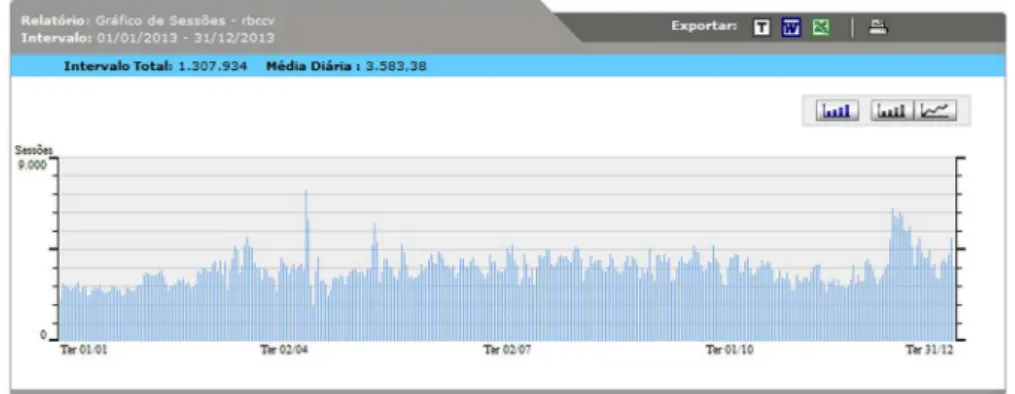
Sur-gery (BJCVS) had special reasons to celebrate: the growth of over 65% in the number of visits to our site (www.rbccv.org.br) when compared to 2012. We went from 788,564 to 1,307,934 hits, averaging over 3,500 visitors/day, with a peak in April, 7,420 in just one day (Figure 1)! If we add the access via our website at SciELO (www.scielo.br/rbccv) there were over 1.9 million visits last year, averaging nearly 5,300 visitors per day. Internet users from over 110 countries were on our site.
Editorial
BJCVS has record access in 2013
Domingo M. Braile*
DOI: 10.5935/1678-9741.20140001
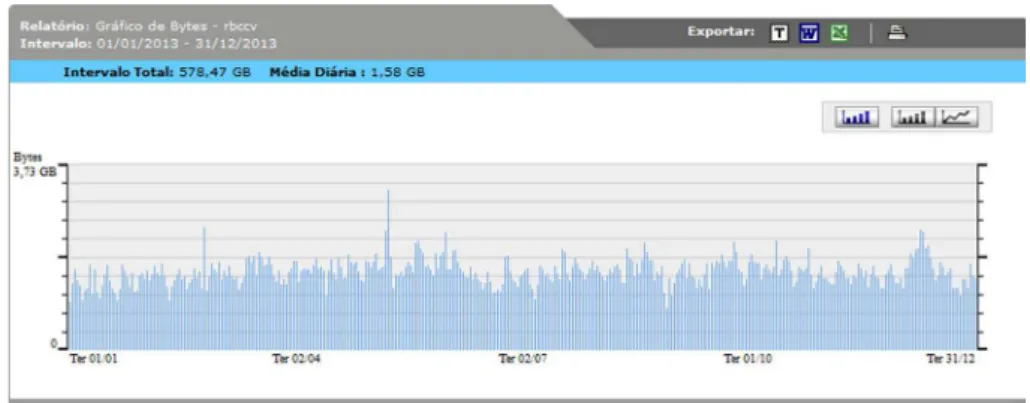
The total number of page impressions in 2013 (request from a visitor’s browser to a web page that can be displayed) was 55,020,119, an increase of 16% over the previous year (47,232,073), an average of 150,740 in 2013, 11 per day (Figure 2). Regarding gigabytes (GB) transferred the increase reached 23%, up from 469.65 GB in 2012 to 578.47 GB last year. The daily average was 1.58 GB (Figure 3). There is a tendency to val-ue the publications by the number of hits or by the number of GB arising from such hits. Certainly, this modern resource would be another marker of the importance and spread of a journal.
RBCCV tem acesso recorde em 2013
I
Fig. 1 – Graph showing the access to the RBCCV / BJCVS site in 2013.
II
Rev Bras Cir Cardiovasc | Braz J Cardiovasc Surg
This performance leaves us extremely satisied by prov -ing the increas-ing visibility of BJCVS, and the importance of having the journal available in various media, enabling
ac-cess anytime and anywhere. We inished the implementation
of new technologies for online editing, as applications for smartphones and tablets, both on the iOS operating systems or Android. Thus, on any device connected to the Internet, our journal can be fully seen in its PDF extension. In all of them a symbol (Figure 4) will appear, and just click on it to access BJCVS Editions. We ask the readers to experience such ease and give us their feedback, which will be very use-ful for the constant improvement of our Journal.
H index, among others, that broaden the range of options and would give breath to hundreds of journals in the area of health, which, being restricted to specialty publications, as BJCVS (only consulted by a restricted community), cannot be compared to the New England Journal of Medicine, for example, that is of interest of different medical specialties, as
well as researchers and professionals in related ields.
Thus, the number of citations of specialty Journals never reaches the levels of a generic journal. The journals like ours,
even in the irst world, are irrelevant in general compute of
IF (IF of the Journal of Thoracic and Cardiovascular Surgery is 3,526, the Annals of Thoracic Surgery, 3454, and the Euro-pean Journal of Cardio-Thoracic Surgery, 2674) and cannot be compared to the aforementioned New England Journal of Medicine IF, which is 51,658! As obvious as these facts, CAPES is impervious to this reasoning.
No Brazilian journal now reaches the level A1 or A2 de-manding Qualis CAPES.
The Brazilian Journal of Psychiatry, with 1,856, is the one with the highest IF among the 100 nation-al publications that underlie the Thomson Reuters! Over three articles published in BJCVS were promi-nent among the “top 20” search from BioMedLib (www. biomedlib.com) site. This time, the performance is up to the
articles of “Cardiac surgery: the ininite quest” series, by Dr.
Rodolfo Neirotti, published in editions 27.4, 28.1 and 28.2. Another novelty is that, after 2 years, our journal was again awarded with editorial support from CNPq. The sum of R$ 30,000, although it is far from required, is useful to help pay the costs, ever increasing.
Encouraged by the growth of accesses and this good news, we will continue to improve BJCVS, so that we can offer read-ers the best content and the best features that the computer has to offer. In this issue, two studies (“Proposal of renal artery’s ostial projection under virtual geometric correction in
infra-renal aneurysms: initial results of a pilot study”, pag. 78, and
“Mammary artery harvesting with the da Vinci Si robotic
sys-tem”, pag. 107) add videos in their content. Moreover, the performance of our journal reinforces my
perception, as described above, that this kind of access to the contents of the journals should be taken into account by CAPES and by development agencies when classifying pub-lications. So, a journal is not assessed only by current crite-ria, such as the Impact Factor (IF), SCImagoJournal Rank,
Fig. 3 - Graph showing Gigabytes (GB) transferred in RBCCV / BJCVS site in 2013.
III
Rev Bras Cir Cardiovasc | Braz J Cardiovasc Surg
We are inalizing, along with GN1, our partner since
2005, a tool that will allow the video to be sent by the website at the time of article submission.
Change in the print edition
Due to increased printing costs, driven by the rising dol-lar, the Editorial Board of the Journal, with approval of the Board of BSCVC decided that the images of the print edition will be published in black and white, even if they are sent in colors. Thus, it can reduce the value of print. When an article has originally sent pictures in color, there will be the notice in its end referring the reader to the online edition, where the
igures, graphs and tables are presented in color, and can be
copied with ease.
BSCVS Congress
From 3 to April 5, the 41st Congress of the Brazilian Soci-ety of Cardiovascular Surgery (BSCVS) will be held in Porto de Galinhas, PE, along with 4th Symposium of Nursing in Cardiovascular Surgery, the 4th Symposium of Physical Ther-apy in Cardiovascular Surgery, the 4th Perfusion Symposium on Cardiovascular Surgery, in addition to the 3rd Academic Congress on Cardiovascular Surgery, demonstrating the im-portance of contact of students with professionals.
The theme of this edition is “Heart Team - the patient
irst”. Professionals from different specialties, working to-gether in order to provide the most appropriate treatment, of which derives the best outcome.
I want to compliment the Board of BSCVS, chaired by Dr. Marcelo Cascudo, with support from other members, and the Organizing Committee, coordinated by Dr. Fernando Ribeiro Moraes Neto, who devoted all his efforts in its formatting.
Meeting of the Editorial Board of BJCVS with Associ-ate Editors and Members of the Editorial Board
On April 3, from 14h to 15h, in the auditorium 6, the meeting of the Editorial Board of BJCVS with the Associate Editors and members of the Board will take place, also open to all members wishing to participate. The effect of adop-tion of technologies will be discussed, as new applicaadop-tions for smartphones and tablets, both operating systems like iOS and Android. I count on the participation and suggestions from everyone.
CME
We have the following items with Continuing Medical Education in this issue: “EuroSCORE II and the impor-tance of a local model, InsCor and the future SP-SCORE”
(pag. 1), Use of EuroScore as a predictor of morbidity after
cardiac surgery (pag. 9), “Advanced age and incidence of
atrial ibrillation in the postoperative period of aortic valve
replacement” (pag. 45) e “Comparison of the solution of
histidine-tryptophan-alfacetoglutarate with histidine-trypto-phan-glutamate as cardioplegic agents in isolated rat hearts:
an immunohistochemical study” (pag. 83). We ask the
read-ers to disclose this important learning teaching tool among students, residents, and anyone who wants to increase their knowledge.
My warmest regards!