Veronica Kei Len Chin Adriana Shinagawa
Maria da Graça Naclério-Homem
Department of Oral and Maxillofacial Surgery, Prosthodontics and Traumatology, School of Dentistry, Universidade de São Paulo - USP, São Paulo, SP, Brazil.
Corresponding Author: Veronica Kei Len Chin E-mail: [email protected]
Bone healing of mandibular critical-
size defects in spontaneously
hypertensive rats
Abstract: Few articles have shown changes in bone metabolism caused by hypertension. The objective of this study was to investigate the rela-tionship between hypertension and bone healing. Circular critical-size defects 5 mm and 2 mm in diameter were created, respectively, on the left and right side of the mandible in 40 spontaneously hypertensive and 40 control Wistar-Kyoto rats. Five animals from each strain were killed 2, 3, 5, 10, 15, 30, 60 and 90 days after surgery. The macroscopic evalu-ation showed great mandibular angle deformevalu-ation on the left side and non-healed defects on both sides and groups. Histological evaluation re-vealed similar bone healing on both sides, with initial necrosis in the central area, and ibrosis and angiogenesis within the irst 5 days. From the 10th postoperative day on, the newly formed bone displayed
progres-sive thickening until the 90th postoperative day, when the defect margins
presented a compact bone structure. Furthermore, the statistical analysis of the histometric data did not reveal any signiicant hypertension ef-fect on bone healing in the deef-fect area. These results suggest that bone healing was not different between spontaneously hypertensive rats and control rats.
Descriptors: Bone Regeneration; Hypertension; Rats, Inbred SHR; Rats, Inbred WKY.
Introduction
According to a World Health Organization (WHO) report, one in three adults worldwide has raised blood pressure, and the projections for 2025 are that one third of all adults will have this condition.1,2
Hyper-tension is important not only because of its high prevalence, but also because it is an asymptomatic disease whose diagnosis and treatment are frequently delayed. As pointed out by the WHO,2 several
diseases—espe-cially obesity, hyperglycaemia and hyperlipidemia—are also related to or have their risk modiied by the presence of high blood pressure.
Abnormalities in calcium metabolism have been also associated with essential hypertension, but the results are controversial. Hypercalciuria and a higher calcium/creatinine ratio are found mainly in osteoporotic groups, but bone mineral density (BMD) and osteoporosis percentages in the postmenopausal period are similar between hypertensive and nor-motensive women.3 Urinary calcium excretion is inversely correlated to
BMD, whereas serum total and ionized calcium levels in hypertensive
Declaration of Interests: The authors certify that they have no commercial or associative interest that represents a conflict of interest in connection with the manuscript.
Submitted: Feb 08, 2013
women are not different from those observed in normotensive women.4,5 Diastolic hypertensive men
have reduced bone mineral content when compared with normotensive subjects.6,7 On the other hand,
some reports have failed to reveal a consistent rela-tion between urinary calcium excrerela-tion and hyper-tension in men as well.8 Recent data show reduced
BMD in hypertensive subjects with arterial stiff-ness.9
Investigations with spontaneously hypertensive rats (SHR) have added to the knowledge of calcium metabolism and its relation to bone status. During growth and maturity, SHRs have a smaller body and skeletal mass, as well as lower calcium con-tent, irrespective of age or gender; however, when skeletal mass is calculated as a percentage of body mass, these values prove greater among normoten-sive rats.10,11 Resorptive activity seems to be reduced
in old animals and shows different rates between genders. Between the ages of 8 and 24 weeks, SHR males have shown a 60% to 70% reduction in the resorption rate, whereas the percentages for females have ranged from 15% to 35%. However, 24-weeks-old, female SHR have shown higher bone turnover rates than male rats.12,13 This resorptive rate is still
high when compared to that of normotensive ani-mals.11
Old SHR have hypercalciuria and low serum ionized calcium, but normal serum total calcium.14
Bone density and bone calcium content are signii-cantly reduced in male SHR compared with Wis-tar-Kyoto rats (WKY).11,15 Old female SHR possess
a higher percentage of cancellous bone, less net cortical bone, smaller tissue area, and thinner cor-tex than those of the WKY strain; they have also presented age-related cancellous and cortical bone loss.16
Since several changes have been described in the bone metabolism of hypertensive subjects, the pur-pose of this study was to evaluate bone healing in defects created in the mandibles of SHR and control WKY rats.
Methodology
This study was approved by the Research Eth-ics Committee (Subcommittee for Animal BioethEth-ics)
of our institution, under protocol number 05/05. All procedures were carried out according to the Ethical Principles of our National Board of Animal Experi-mentation.
Forty SHR and 40 WKY rats were enrolled in this investigation. All animals were males, and about 4 months old, an age when hypertension is effective-ly established. They were housed in a colony room, 5 animals per cage, at 25°C, under a 12h light/dark cycle, and had free access to rodent chow and tap water. For the surgical procedures, they were anes-thetized with 100 mg/kg of ketamine hydrochloride and 10 mg/kg of dihydrothiazine hydrochloride; both drugs were injected by the intraperitoneal route. While they were in an unconscious state, the skin on the ventral region below their mandibles was shaved and washed with alcohol 70%.
A 15 mm linear incision was then made on the skin along the line of the mandibular basal bone; the masseter muscle below was blunt dissected to expose the lateral surface of the angle region. A full-thickness round defect 5 mm in diameter was cre-ated on the left side with a rotary drill, and a similar defect 2 mm in diameter was created on the right side. The muscle was then repositioned and only the skin layer was sutured. Benzylpenicillin (16 000 IU) was administered by the intramuscular route, and acetaminophen (1 mg/ml) was given through drink-ing water in the irst 2 days after surgery.
Five animals of each strain were killed on the 2nd,
3rd, 5th, 10th, 15th, 30th, 60th and 90th postoperative
day (POD), with a lethal dose of carbon dioxide, de-livered at a low rate of 6 L / minute. The animals were exposed for at least one minute after apparent clinical death.17 The entire mandible was removed
by careful disarticulation, preserving the masseter muscle and the soft tissue around the mandibular angle. The specimens were ixed with 10% buffered formalin for at least 24 hours, and then decalciied in 20% formic acid for 7 days. The samples were embedded in parafin, and 7 µm thick serial sections were cut parallel to the ramus surface. The sections were then processed for hematoxylin-eosin staining.
in the WKY group and 4 animals died in the SHR group. Recovery from anaesthesia occurred after 4–6 hours and full motion was recovered within the irst 24 hours. Rats showed some facial swell-ing, that lasted no more than 4 days, and no signs of infection or postoperative sequelae.
Gross macroscopy
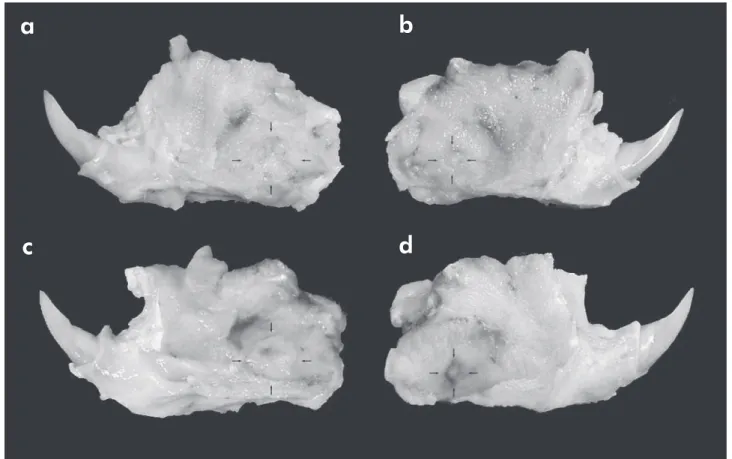
In both groups, WKY and SHR, a great bone de-formation was observed on the left side, which be-came particularly evident as of the 30th POD. On
the 90th POD, neither the 5 mm defect on the left
side nor the 2 mm defect on the right side had shown complete bone closure in both groups (Figure 1).
Histological findings
A similar bone healing process occurred on both sides in both groups, control WKY and SHR. On the 2nd and 3rd POD, there was cellular debris, ibrin
and necrosis in the central area, and reactive oste-C720UZ charge-coupled device digital camera
(Ol-ympus, Tokyo, Japan), used to capture section im-ages containing all margins of the round defect in JPEG ile form for histometric evaluation. The re-maining defect area was delimited and measured with Image J 1.4 software (National Institutes of Health, Bethesda, USA). The resulting values were expressed in square pixels.
The defect area values within the same side were compared between SHR and WKY animals after each postoperative period (POP) of time, and also according to each side among the POP for each strain. Data analysis was performed with Minitab 15 Statistical Software (Minitab Inc., State
Col-lege, USA) and, whenever the p value was below 0.05, statistical differences were considered signii-cant.
Results
During anaesthesia induction, 5 animals died
Figure 1 - Specimens on the 90th postoperative day. (a) left side SHR. (b) right side SHR. (c) left side WKY. (d) right side WKY. The defect contours are still visible with few signs of bone closure.
a
c
b
oblasts on the defect margins with disorganized col-lagen deposition. On the 5th POD, there were giant
cells, ibrosis, angiogenesis, and the irst osteocytes in the central area, the latter surrounded by an ex-tracellular matrix resembling immature bone; some tissue sections also displayed immature cartilage, most of which were on the right side. On the 10th
and 15th POD, a newly formed trabecular bone layer
displayed progressive thickening, reduction of ac-tive osteoblasts, and lamellar deposition of collagen. From the 30th to the 90th POD, the defect margins
presented a compact bone structure with haversian systems and osteocytes (Figures 2 and 3).
Histometric and statistical analysis
The defect area mean values are presented in
Ta-Figure 3 - Histological image of the entire 2 mm defect at the 90th
postoperative day. In this WKY specimen, some osteoblast activity can still be seen in proliferative regions around the defect, although insufficient to achieve closure of the defect.
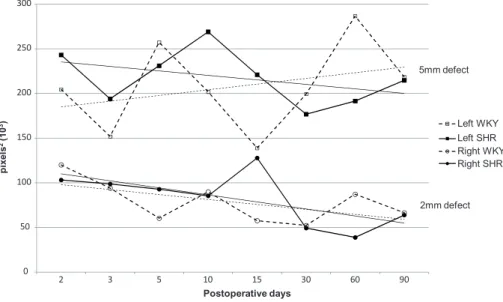
ble 1 and postoperative progression of the defect can be seen in Figure 4. Two-way analysis of variance and Tukey multiple comparison tests revealed sig-niicant differences only on the left side:
• in the WKY group, the defect area was smaller on the 15th POD than on the 60th POD (p = 0.0042); • between strains, the defect area on the 60th POD
was larger in the WKY group than in the SHR group (p = 0.0491).
Discussion
In similar conditions, dogs and rats with induced renal hypertension display an immature trabecular pattern during alveolar bone repair after tooth ex-traction, suggesting some interference in the
min-eralization phase.18,19 In monocortical defects on
rat femur, SHR presented faster granulation tissue growth and bone healing than did normotensive rats, although bone matrix production was re-duced at later periods because osteoblasts showed low cellular activity.20 Recently, it has been found
that untreated male SHR show alveolar bone with a high expression of RANKL (receptor activator of nuclear factor kappa-B ligand, a protein involved in osteoclast activation), a high ratio of RANKL/OPG (osteoprotegerin, a decoy receptor for RANKL), a high number of positive tartrate resistant acid phos-phatase cells (an enzyme highly expressed by oste-oclasts), greater bone loss, and reduced bone den-sity.21
Figure 4 - Progression of the defect area across the postoperative days. The tendency lines of the 2 mm defect show similar bone closure behavior between the two strains. On the other hand, the 5 mm defect of the WKY strain seems to increase, but its final value is similar to that of the SHR strain.
Postoperative day
Side
Left Right
WKY SHR WKY SHR
2 204.43 (100.0) 243.06 (100.0) 120.02 (100.0) 103.16 (100.0) 3 151.79 (74.2) 193.90 (79.8) 94.04 (78.4) 98.72 (95.7) 5 257.07 (125.7) 231.00 (95.0) 60.34 (50.3) 92.82 (90.0) 10 201.82 (98.7) 268.95 (110.7) 89.92 (74.9) 85.39 (82.8) 15 138.79a (67.9) 220.87 (90.9) 57.65 (48) 127.79 (12.9)
30 199.30 (97.5) 176.82 (72.7) 52.25 (43.5) 49.29 (47.8) 60 286.47a.b (140.1) 191.52b (78.8) 87.20 (72.7) 38.86 (37.7)
90 218.36 (106.8) 214.71 (88.3) 66.42 (55.3) 63.91 (62.0)
* Same letters indicate significant differences (p < 0.05, ANOVA) between values.
Table 1 - Defect area (×103 pixels2) and percentage (%) in relation to the initial value.
5mm defect
2mm defect
0 50 100 150 200 250 300
pi
xe
ls
2(1
0
3)
Postoperative days
A critical bone defect is the smallest defect that cannot heal spontaneously during the whole life of an animal; in rats, it was determined that the mini-mum diameter of such a defect on the mandibular angle is 4 mm. Thus produced, the defect is well-de-limited by the ramus and lower border of the mandi-ble, with 1 mm of safety margin.22-23 Although SHR
are small animals, we chose to perform defects with 5 mm, not only because most investigations with Wistar rats perform a 5 mm defect, but also because SHR show fast angiogenic proliferation, thus posing a greater risk of early closure of the defect. Indeed, these defects did show incomplete closure, as shown by the similar defect area values observed along the length of the study, and by the severe mandibular angle deformation, especially from the 30th POD on,
which could be explained by bone remodelling ow-ing to functional adaptation. In spite of the statisti-cal differences observed, the variation in defect area across the POP and between strains was unpredicta-ble. The remaining defect area on the 90th POD was
practically the same original size, suggesting a simi-lar inability of both animal groups to appose and sustain newly formed bone on the defect margins.
Thus, if any diameter smaller than 4 mm has the potential to close spontaneously, healing of the 2 mm defect should have been observed, but this did not occur. The unexpected result was that none of them had closed completely on the 90th POD,
sug-gesting impairment of the bone healing. Several hy-potheses were raised to explain this inding:
• simultaneous defects on either side of the man-dible could inluence the repair process on the opposite side;
• mandibular angle and ramus have scarce
cancel-lous bone, therefore the number of osteogenic cells available is small and self-limited, and de-fects of any diameter would not close in this re-gion;
• although the WKY strain is often used as a con-trol, because the SHR strain descended from it and any genetic differences would be limited to mechanisms of blood pressure elevation, the for-mer would not be an appropriate control for the latter, owing to the higher incidence of sponta-neous hypertension in the WKY strain than that
observed in Wistar rats; and, inally,
• a period of time longer than 90 days would be necessary to complete bone closure, because in both strains there was a tendency towards bone closure as indicated by the 40%–45% closure rate. Future investigations are needed to shed light on the factors involved in this process.
The results of the histological analysis are quite similar to the macroscopical indings, because no signiicant differences were found in bone repair be-tween the study groups. The amount of angiogen-esis was similar at the early sacriice time points, although some studies report that microvascular rarefaction in SHR could delay the formation of granulation tissue.24 At the later time points, the
rate of bone remodelling was also similar between strains, irrespective of the size of the defect. The progression of bone healing was more coordinated on the right side for both strains, maybe because the reduced size of the defect on that side (2 mm) al-lowed an enhanced response to the same functional pressure exerted on both sides.
Comparing our results to those of other authors is dificult because there are few studies available on bone repair in hypertensive animals, and they have been conducted either with monocortical de-fects in SHR rat femur,20 or with tooth extraction in
dogs and rats with induced renal hypertension.18,25
Although changes in cellular activity have been described in the bone metabolism of SHRs, these changes did not seem to adversely affect bone repair when the hypertensive strain was compared to the WKY strain.
Some aspects of bone healing and hypertension should be addressed in future investigations, name-ly:
• the use of another strain as a control instead of the Wistar or WKY strains;26
• the fact that smoking, hypertensive women and male rats exposed to passive smoking have shown a signiicant reduction in BMD;16,27 • the observation that ovariectomy has induced
• the observation that the addition of inhibitors of angiotensin-converting enzyme in cocultures of bone cells inhibits the resorptive activity,28 even
though there are no reports of an anti-hyperten-sive drug protocol for SHR and the use of any medication must be conirmed by investigations on blood pressure control; and, inally,
• the activity of OPG and osteopontin, both bone metabolism biomarkers, because there is evi-dence that their elevated levels are associated to inlammation and arterial hypertension.29
Conclusions
Within the limits of this investigation that com-pared SHR with control WKY rats, after a critical-size defect 5 mm in diameter was created on the left
side of the mandible, and another defect 2 mm in diameter was created on its right side, it could be concluded that there was no statistically signiicant difference in terms of bone healing between strains or among the evaluated postoperative periods.
Acknowledgement
To the Fundação de Amparo à Pesquisa do
Esta-do de São Paulo (FAPESP, São Paulo Research Foun-dation), for research grant no. 05/55009-6; to the Laboratory of Oral Pathology, School of Dentistry,
Universidade de São Paulo (USP, University of São Paulo); and to veterinary pathologists Luciana Torres Neves, MSc, and Daniel Soares Sanches, MSc, School of Veterinary Medicine and Zootechny, Universidade de São Paulo (USP, University of São Paulo).
References
1. Kearney PM, Whelton M, Reynolds K, Muntner P, Whelton PK, He J. Global burden of hypertension: analysis of world-wide data. Lancet. 2005 Jan 15-21;365(9455):217-23. 2. World Health Organization. World health statistics 2012.
Geneva: WHO Press; 2012. 176 p.
3. Pérez-Castrillón JL, Justo I, Silva J, Sanz A, Igea R, Escu-dero P, et al. Bone mass and bone modelling markers in hy-pertensive postmenopausal women. J Hum Hypertens. 2003 Feb;17(2):107-10.
4. Gotoh M, Mizuno K, Ono Y, Takahashi M. High blood pres-sure, bone-mineral loss and insulin resistance in women. Hy-pertens Res. 2005 Jul;28(7):565-70.
5. Tsuda K, Nishio I, Masuyama Y. Bone mineral density in women with essential hypertension. Am J Hypertens. 2001 Jul;14(7 Pt 1):704-7.
6. Jankowska EA, Susanne C, Rogucka E, Medras M. The in-verse relationship between bone status and blood pressure among Polish men. Ann Hum Biol. 2002 Jan-Feb;29(1):63-73. 7. Larijani B, Bekheirnia MR, Soltani A, Khalili-Far A, Adibi H,
Jalili RB. Bone mineral density is related to blood pressure in men. Am J Hum Biol. 2004 Mar-Apr;16(2):168-71.
8. Taylor EN, Mount DB, Forman JP, Curhan GC. Association of prevalent hypertension with 24-hour urinary excretion of calcium, citrate, and other factors. Am J Kidney Dis. 2006 May;47(5):780-9.
9. Masugata H, Senda S, Inukai M, Murao K, Hosomi N, Iwado Y, et al. Association between bone mineral density and arterial stiffness in hypertensive patients. Tohoku J Exp Med. 2011 Feb;223(2):85-90.
10. DeMoss DL, Wright GL. Sex and strain differences in whole skeletal development in the rat. Calcif Tissue Int. 1998 Feb;62(2):153-7.
11. Wang TM, Hsu JF, Jee WS, Matthews JL. Evidence for re-duced cancellous bone mass in the spontaneously hypertensive rat. Bone Miner. 1993 Mar;20(3):251-64.
12. DeMoss DL, Wright GL. Analysis of whole skeleton 3H-tetracycline loss as a measure of bone resorption in maturing rats. Calcif Tissue Int. 1997 Nov;61(5):412-7.
13. Wright GL, DeMoss D. Evidence for dramatically increased bone turnover in spontaneously hypertensive rats. Metabo-lism. 2000 Sep;49(9):1130-3.
14. McCarron DA, Yung NN, Ugoretz BA, Krutzik S. Disturbanc-es of calcium metabolism in the spontaneously hypertensive rat. Hypertension. 1981 May-Jun;3(3 Pt 2):I162-7.
15. Lucas PA, Brown RC, Drüeke T, Lacour B, Metz JA, McCar-ron DA. Abnormal vitamin D metabolism, intestinal calcium transport, and bone calcium status in the spontaneously hy-pertensive rat compared with its genetic control. J Clin Invest. 1986 Jul;78(1):221-7.
16. Cappuccio FP, Meilahn E, Zmuda JM, Cauley JA. High blood pressure and bone-mineral loss in elderly white women: a prospective study. Lancet. 1999 Sep 18;354(9183):971-5. 17. AVMA Panel on Euthanasia. American Veterinary Medical
Association. 2000 Report of the AVMA panel on euthanasia. J Am Vet Med Assoc. 2001 Mar 1;218(5):669-96.
19. Murata M, Itoi S, Nonoguchi T, Ota T, Yokota M. [Histologi-cal study on the healing processes of extraction sockets in the experimental hypertensive dogs]. Kyoto Daigaku Kokukagaku Kiyo. 1967;7(2):122-39. Japanese.
20. Pereira AC, Fernandes RG, Carvalho YR, Balducci I, Faig-Leite H. Bone healing in drill hole defects in spontaneously hypertensive male and female rats’ femurs. A histological and histometric study. Arq Bras Cardiol. 2007 Jan;88(1):104-9. 21. Bastos MF, Brilhante FV, Gonçalves TE, Pires AG, Napimoga
MH, Marques MR, et al. Hypertension may affect tooth-supporting alveolar bone quality: a study in rats. J Periodontol. 2010 Jul;81(7):1075-83.
22. Kaban LB, Glowacki J, Murray JE. Repair of experimen-tal mandibular bony defects in rats. Surg Forum. 1979 Oct;30:519-21.
23. Struijker Boudier HA. Arteriolar and capillary remodelling in hypertension. Drugs. 1999;59 Spec No:37-40.
24. Kaban LB, Glowacki J. Induced osteogenesis in the repair of experimental mandibular defects in rats. J Dent Res. 1981 Jul;60(7):1356-64.
25. Liang H, Ma Y, Pun S, Stimpel M, Jee WS. Aging- and ovariec-tomy-related skeletal changes in spontaneously hypertensive rats. Anat Rec. 1997 Oct;249(2):173-80.
26. Louis WJ, Howes LG. Genealogy of the spontaneously hy-pertensive rat and Wistar-Kyoto rat strains: implications for studies of inherited hypertension. J Cardiovasc Pharmacol. 1990;16 Suppl 7:S1-5.
27. Ajiro Y, Tokuhashi Y, Matsuzaki H, Nakajima S, Ogawa T. Impact of passive smoking on the bones of rats. Orthopedics. 2010 Feb;33(2):90-5.
28. Hatton R, Stimpel M, Chambers TJ. Angiotensin II is generat-ed from angiotensin I by bone cells and stimulates osteoclastic bone resorption in vitro. J Endocrinol. 1997 Jan;152(1):5-10. 29. Stępień E, Wypasek E, Stopyra K, Konieczyńska M, Przybyło