Biodegradation of cypermethrin by immobilized cells of
Micrococcus
sp.
strain CPN 1
Preeti N. Tallur, Sikandar I. Mulla, Veena B. Megadi, Manjunatha P. Talwar,
Harichandra Z. Ninnekar
Department of Biochemistry, Karnatak University, Karnataka, India.
Submitted: May 24, 2013; Approved: November 28, 2014.
Abstract
Pyrethroid pesticide cypermethrin is a environmental pollutant because of its widespread use, toxic-ity and persistence. Biodegradation of such chemicals by microorganisms may provide an cost-effective method for their detoxification. We have investigated the degradation of cypermethrin by immobilized cells ofMicrococcussp. strain CPN 1 in various matrices such as, polyurethane foam (PUF), polyacrylamide, sodium alginate and agar. The optimum temperature and pH for the degrada-tion of cypermethrin by immobilized cells ofMicrococcussp. were found to be 30 °C and 7.0, respec-tively. The rate of degradation of 10 and 20 mM of cypermethrin by freely suspended cells were compared with that of immobilized cells in batches and semi-continuous with shaken cultures. PUF-immobilized cells showed higher degradation of cypermethrin (10 mM and 20 mM) than freely suspended cells and cells immobilized in other matrices. The PUF-immobilized cells ofMicrococcus sp. strain CPN 1 were retain their degradation capacity. Thus, they can be reused for more than 32 cy-cles, without losing their degradation capacity. Hence, the PUF-immobilized cells ofMicrococcus sp. could potentially be used in the bioremediation of cypermethrin contaminated water.
Key words:degradation, immobilization, cypermethrin, polyurethane foam,Micrococcussp. strain CPN 1.
Introduction
Cypermethrin is a synthetic pyrethroid pesticide widely used to control pests in cotton, fruits, and vegetable crops, (Tulluret al., 2008; Chen et al., 2012). In recent years, the use of cypermethrin has been increased sharply in the agricultural field for crop protection (Weston et al., 2009). As a result, cypermethrin residues were found in most of the tested samples (sediment) from urban creek (Riedereret al., 2010; Westonet al., 2009, 2011). Hence, the presence of cypermethrin in the environment is of global concern. Cypermethrin has been shown to be geno-toxic, neurogeno-toxic, immunotoxic and carcinogenic to mam-mals, including humans (Ansari et al., 2011; Jin et al., 2011; McKinlayet al., 2008; Wanget al., 2011; Wolansky and Harrill, 2008; Zhanget al., 2010). There are reports of degradation of cypermethrin by the free cells of microor-ganisms (Roberts and Standen, 1981; Jilani and Khan,
2006; Talluret al., 2008; Zhanget al., 2010; Lin et al., 2011; Chenet al., 2012). In addition, degradation of cyper-methrin by physico-chemical methods such as oxidation with ozone, photolysis, ultrasonic degradation, Fenton deg-radation, incineration and adsorption has also been investi-gated (Segal-Rosenheimer and Dubowski, 2007; Xieet al., 2011). However, these methods were found to be more ex-pensive and less-effective than biological systems used for the remediation of toxic pollutants (Yanget al., 2011). In nature, cypermethrin may be degraded through several ways, including hydrolysis, volatilization, photolysis, and aerobic degradation by microorganisms. There is a report on the enhanced degradation of cypermethrin by mixed mi-crobial culture (Chenet al., 2012). The use of freely sus-pended cells for the degradation of various toxic/hazardous compounds for industrial applications has a number of dis-advantages. It is mostly because of low mechanical strength, low density of cell population and the difficulty in
DOI: http://dx.doi.org/10.1590/S1517-838246320130557
Send correspondence to H.Z. Ninnekar. Department of Biochemistry, Karnatak University, Dharwad 580 003, Karnataka, India. E-mail: [email protected].
biomass effluent separation (Massalhaet al., 2007; Wang and Hu, 2007). Immobilization techniques have now been well established to overcome these problems (Cassidyet al., 1996). Immobilized microbial cells have more advan-tages than freely suspended cells as well as enzymes immo-bilized in various matrices (Zhenget al., 2009). Moreover, the immobilizing materials like polyurethane foam (PUF), agar and sodium alginate are inert, non toxic to cells, inex-pensive and practical (Mullaet al., 2012). Use of immobi-lized cells permit the operation of bioreactors at flow rates that are independent of the microorganisms, tolerate higher concentrations of toxic compounds than do their non im-mobilized counter parts (Westmeieret al., 1987; Zhenget al., 2009). The calcium alginate beads act like a slow re-lease delivery system, where the substrate is slowly released from culture medium to the cells for microbial mineralization without a significant impact on the sur-rounding environment. There are several reports on the po-tential use of immobilized bacterial cells in different matrices for the degradation of numerous toxic/hazardous chemicals (Chenet al., 2002; Talluret al., 2009; Ullahet al., 2010; Mullaet al., 2012; Aliet al., 2013; Mullaet al., 2013; Hoskeriet al., 2014). However, less information is available on biodegradation of cypermethrin by immobi-lized cells of microorganisms
Previously, we have reported the degradative path-way of cypermethrin in Micrococcus sp. strain CPN 1 (Talluret al., 2008). In this paper, we describe the enhanced degradation of cypermethrin by the cells ofMicrococcus sp. strain CPN 1 immobilized in sodium alginate (SA), agar, polyacrylamide and polyurethane foam (PUF). The rate of degradation of cypermethrin by the cells immobi-lized in various matrices were compared with that of freely suspended cells ofMicrococcussp. strain CPN 1 in batches and semi-continuous degradation.
Materials and Methods
Chemicals
Cypermethrin with 98% purity was purchased from Sigma-Aldrich. Sodium alginate, acrylamide, bis-acryl-amide, ammonium persulphate with 99% purity were pur-chased from Himedia, India. Polyurethane foam (PUF) was obtained from local suppliers. All other chemicals used in this study were of analytical grade.
Organism
Micrococcussp. strain CPN 1 previously isolated and identified in our laboratory by cypermethrin enrichment culture technique was used in this study (Tallur et al., 2008). The organism was maintained on the slants of cyper-methrin-mineral salts medium solidified with 2% agar (wt/vol).
Medium
Two different media were used in this study. The me-dium used for precultivation ofMicrococcussp. strain CPN 1 was a mineral salts medium (MM 1) containing (g L-1) K2HPO4, 6.30; KH2PO4, 1.82; NH4NO3, 1.00; MgSO4.7H2O, 0.20; CaCl2.2H2O, 0.10; Na2MoO4.2H2O, 0.06; MnSO4.H2O, 0.06 and FeSO4.7H2O, 0.10 (Tallur et
al., 2008). The pH of the medium was adjusted to 7.0. One hundred mL aliquots of this medium were transferred into 500 mL Erlenmeyer flask and sterilized by autoclaving at 121 °C for 15 min. Cypermethrin (10 mM) dissolved in ethyl acetate (solvent) was sterilized by membrane filtra-tion, added to the medium and kept on a rotary shaker for solvent evaporation. After two days, the organism was in-oculated into the sterilized medium containing cyper-methrin (10 mM) and this process was followed for all experiments.
The medium (MM 2) used for cypermethrin degrada-tion studies contained (gL-1) K2HPO4, 6.30; MgSO4.7H2O, 0.20; CaCl2.2H2O, 0.20; NH4NO3, 1.0 and FeCl3, 0.05 (Talluret al., 2009). The pH of the medium was adjusted to 7.0 and sterilized by autoclaving. Cypermethrin (10 mM and 20 mM) dissolved in ethyl acetate was added after ster-ilization of the medium. The cultures were incubated on a rotary shaker (150 rpm) at 30 °C. The bacterial cell concen-trations were measured by the plate-count method (Mullaet al., 2013).
Immobilization of whole cells in various matrices
The cypermethrin-degrading organism (Micrococcus sp. strain CPN 1) was harvested during the mid-logarithmic growth phase from 4 L of culture medium. The cell suspen-sion (3 x 10¹²cfu/mL) was obtained by centrifugation at 8,000 x g for 10 min at 4 °C and washed thrice with 50 mM phosphate buffer pH 7.0. The washed cells were immobi-lized in different matrices namely; Polyurethane foam (PUF), polyacrylamide, sodium alginate (SA) and agar (Mullaet al., 2013).
Preparation of PUF-entrapment: The PUF was cut into approximately 5 mm cubes, washed thrice with sterile double distilled water and dried. 100 mL of bacterial cell suspensions (3 x 10¹²cfu/mL) were added to 500 mL coni-cal flasks containing sterilized foam cubes (5 g). The con-tent of the flasks were mixed by stirring on magnetic stirrer for 2 h and then the flasks were kept on a rotary shaker for 1 h at 150 rpm. The flasks were then allowed to stand undis-turbed for additional 4 h. The medium was removed and foam cubes containing the immobilized bacteria were washed with saline. The decanted bacterial suspension and the saline wash were combined and the bacterial population in the mixture was counted by the plate-count method.
was added to 200 mL sterilized sodium alginate solution (4%, wt/vol) and mixed by stirring on a magnetic stirrer. This sodium alginate cell mixture was extruded drop by drop cold, sterile CaCl2(0.2 M) solution. Gel beads of ap-proximately 4 mm diameter were obtained. The beads were hardened by resuspending in a fresh CaCl2solution for 7 h with gentle agitation and then frozen at -18 °C for 24 h. Finally, these beads were washed several times with sterile double distilled water and stored at 4 °C for further investi-gations.
Preparation of polyacrylamide entrapment: About 12 g wet cells were suspended in 10 mL distilled water and chilled in ice. To 10 mL of 0.2 M potassium phosphate buffer, (pH 7.0), 2.85 g acrylamide, 0.15 g bisacrylamide and 10 mg ammonium persulphate were added this buffer solution was mixed with the chilled cell suspension fol-lowed by the addition of 10mL of TEMED and poured into 2 or 3 glass petri dishes. It was then allowed for polymer-ization for 1 h. The sieved gels were suspended in 100 mL of 0.2 M potassium phosphate buffer pH 7.0 and allowed to settle.
Preparation of agar entrapment: 100 mg agar was dis-solved in 4.5 mL of 0.9% (wt/vol) sodium chloride by heat-ing at 100 °C and then cooled to 40 °C. Cell slurry was suspended in 0.9% (wt/vol) sodium chloride solution. 0.5 mL of the cell slurry was added to 4.5 mL of the agar so-lution and mixed. Immediately, the mixture was poured on nylon net placed on a glass plate and cooled to 5 °C. The membrane was stored in 0.1 M phosphate buffer, pH 7.0.
Degradation conditions
Batch degradation experiments
The batch degradation experiments were performed to evaluate the degradation of cypermethrin by both freely suspended cells and immobilized cells in various matrices.
For freely suspended cell cultures, 10 mL of exponen-tially growing cells were inoculated into 90 mL of MM 2 medium in 500 mL Erlenmeyer flasks along with the same amount of heat-killed cells as controls. The cell concentra-tion was adjusted (3 x 10¹²cfu/mL) and different amounts of cypermethrin (10 and 20 mM) were added. For immobi-lized cells, 12 g wet beads/foam cubes of the various matri-ces were added to a 500 mL Erlenmeyer flask containing 100 mL of mineral salts medium (MM 2) with 10 and 20 mM of cypermethrin. The cell counts in the immobilized matrices of the PUF, SA, polyacrylamide and agar were found to be 1.7 x 10¹²cfu/g foam cubes, 1.6 x 10¹²cfu/g, 1.8 x 10¹²cfu/g and 1.6 x 10¹²cfu/g beads, respectively. Both the freely suspended cell culture and the immobilized cells ofMicrococcussp. strain CPN 1 in various matrices were incubated at 30 °C on a rotary shaker (150 rpm) under iden-tical conditions along with controls. The samples from the culture broth were withdrawn under sterile conditions at different incubation periods and analyzed for residual
cypermethrin by HPLC (Metwallyet al., 1997). The rate of degradation of cypermethrin by freely suspended and PUF-immobilized cells ofMicrococcussp. strain CPN 1 at different pH (4.0-10.0) and temperature (25-45 °C) were measured after 96 h of incubation. The storage stability of both freely suspended cells and PUF immobilized cells were tested up to 60 days at 4 °C.
Semi-continuous degradation
For establishing the longevity of degrading activity of immobilized cells in various matrices, repeated batch deg-radations were performed. After each cycle of incubation (96 h/cycle), the spent medium was decanted and beads/foam cubes were washed with sterile water and transferred into fresh MM2 containing cypermethrin. The degradation process was performed under identical condi-tions as described above and the residual cypermethrin in the spent medium was analyzed (Metwallyet al., 1997).
Analytical methods
Cypermethrin concentration in the spent medium was determined by High Performance Liquid Chromatography (HPLC) as described in Metwallyet al.(1997). At regular intervals, 5 mL samples were withdrawn and centrifuged at 8,000 x g for 10 min. The supernatants were extracted with ethyl acetate and the residue obtained after solvent evapo-ration was dissolved in methanol and used for HPLC analy-sis. 10 mL of each residual sample of cypermethrin was analyzed by HPLC (Shimadzu, Japan) equipped with SPD-10AVP UV-Detector using shim-pack CLC-C8 col-umn (4.6 x 150 mm) of particle size (5mm) (Phenomenex) and methanol-water (90:10, vol/vol) as mobile phase at the flow rate of 1 mL min-1.
Statistical analysis
All Experiments were carried out in triplicate and their results are presented as mean± standard deviations (SD).
Results
Degradation of cypermethrin of free and immobilized cells ofMicrococcussp. strain CPN 1 in batch cultures
decreased, whereas immobilized cells degraded the same concentration within 120 h (Figure 1B). These results sug-gest that higher concentration of cypermethrin was better tolerated and more rapidly degraded by immobilized cells than freely suspend cells.
Semi-continuous degradation of cypermethrin by immobilized cells of strain CPN 1
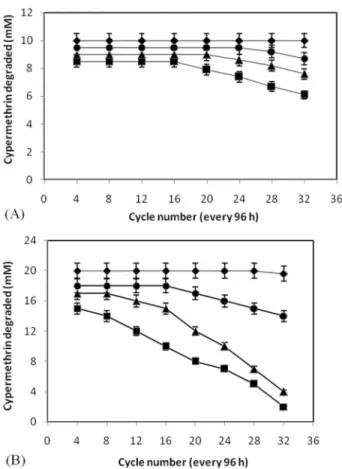
The results of the semi-continuous degradation of 10 and 20 mM cypermethrin by cells ofMicrococcussp. strain CPN 1 immobilized in PUF, alginate, polyacrylamide and agar are shown in Figure 2A and B. The PUF-immobilized cells can be reused for up to 32 cycles without losing their ability to degrade cypermethrin at the initial concentration of 10 and 20 mM. In contrast, agar, sodium alginate and polyacrylamide immobilized cells could be reused for 16, 20 and 24 cycles, respectively (Figure 2A). However, when the initial concentration of cypermethrin was increased to 20 mM, these immobilized cells could be reused with a de-creased rate of degradation of cypermethrin (Figure 2B). These observations suggest that lower concentration of cypermethrin (10 mM) could be fed at much higher fre-quency than higher concentration of cypermethrin (20 mM).
Effect of pH, temperature and storage stability on degradation capacity of PUF-immobilized cells of
Micrococcussp. strain CPN 1
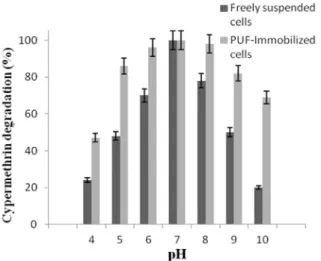
The effect of pH on the degradation of cypermethrin by freely suspended cells and PUF immobilized cells shows that variations of the initial pH between 5.0 and 9.0 (Figure 3) had no effect on cypermethrin degradation (Fig-ure 3). In contrast, the freely suspended cells were able to degrade cypermethrin at narrow range pH between 6.5 to 7.5. The effect of temperatures on the degradation of cyper-methrin by PUF-immobilized cells showed higher activity at the temperature between 25 and 40 °C (Figure 4). Whereas the freely suspended cells showed activity at the temperature between 30 and 35 °C (Figure 4). However, the optimal pH and temperature were found to be 7.0 and 30 °C both for PUF-immobilized cells and freely suspended cells in culture medium. The PUF-immobilized cells can be stored for 60 days at 4 °C without loss of its degradation ca-pacity while the freely suspended cells lost their degrading capacity after 60 days at 4 °C (Figure 5).
Figure 1- Degradation of cypermethrin at 10 mM (A) and 20 mM (B) in batch cultures by cells ofMicrococcussp. strain CPN 1 immobilized on PUF (-t-), polyacrylamide (-l-), sodium alginate (-p-), agar (-n-), freely suspended cells (-+-) and uninoculated control (-x-). Data values represent means of triplicate and error bars indicate 95% confidence inter-vals.
Discussion
The degradation of cypermethrin by immobilized cells ofMicrococcussp. strain CPN 1 in various matrices such as PUF, sodium alginate, polyacrylamide and agar were compared with that of freely suspended cells in batches and semi-continuous shaken cultures. The results obtained from cells immobilized in various matrices with batch cultures suggested that the rate of degradation of cypermethrin, even at a higher concentration (20 mM), was much higher than that with freely suspended cells. The en-hanced degradation of cypertmethrin by immobilized cells may be due to availability of a high density of cells in or on immobilized matrices. Immobilization of cells may also lead to a stabilization of membrane permeability and pro-tect against the toxicity of high substrate concentration, thus leading to enhanced degradation rate (Cassidyet al., 1996).
The results of semi-continuous degradation suggests that the PUF and polyacrylamide immobilized cells re-tained the cypermethrin degradation capacity for a longer period and they could be reused for 32 and 24 cycles, re-spectively. When the initial concentration of cypermethrin (10 mM) was increased to 20 mM, the PUF immobilized cells could be reused without losing their degrading capac-ity. The immobilized cells in other matrices could also be reused but with decreased rate of degradation at higher con-centration (20 mM). The storage stability and activity of cells entrapped in PUF were better than those cells en-trapped in other matrices. The alginate and agar-immo-bilized cells showed lower degradability of cypermethrin with increased cycle numbers. The mechanical instability and gradual cell leakage from these beads decreased the degradation rate with an increasing cycle number (Trevors et al., 1992; Tallur et al., 2009; Mulla et al., 2012). The PUF-immobilized cells showed more tolerance to pH and temperature changes than freely suspended cells. The ad-vantages of PUF in chemical and physical properties com-pared to other matrices are its high porosity, mechanical strength, stability and adsorbing capacity. PUF is an ideal support of cell growth (Romaskevicet al., 2006). The cells immobilized in PUF showed a better and faster degradation rate even at higher initial concentration of substrate. These immobilized cells could be stored for longer periods with-out losing their degradation ability. Furthermore, the lon-gevity of cells immobilized in PUF and their operational stability is better than those of other matrices determined.
The present study have revealed that the more effec-tive degradation of cypermethrin at higher concentration could be achieved by immobilized cells ofMicrococcussp. strain CPN 1 than freely suspend cells. The immobilized microbial system has an advantage of enhanced rate of deg-radation, tolerance to higher substrate concentrations and their reuseability. Thus, the immobilized microbial tech-nology provides a highly versatile and cost-effective
ap-Figure 3- Effect of pH on the degradation of cypermethrin (10 mM) by freely suspended cells and PUF-immobilized cells ofMicrococcussp. strain CPN 1. Data values represent means of triplicate and error bars indi-cate 95% confidence intervals.
Figure 4- Effect of Temperature on the degradation of cypermethrin (10 mM) by freely suspended cells and PUF-immobilized cells of Micrococcussp. strain CPN 1. Data values represent averages of three rep-licate determinations.
proach that can be used for degradation of pesticide contaminated wastewater.
References
Ali O, Namane A, Hellal A (2013) Use and recycling of Ca-alginate biocatalyst for removal of phenol from wastewater. J Ind Eng Chem 19:1384-1390.
Ansari AR, Rahman S, Kaur Met al.(2011) Invivocytogenetic and oxidative stress-inducing effects of cypermethrin in freshwater fish, Channa punctata Bloch. Ecotoxicol Environ Saf 74:150-156.
Cassidy MB, Lee H, Trevors JT (1996) Environmental applica-tions of immobilized microbial cells: a review. J Ind Micro-biol 16:79-101.
Chen KC, Lin YH, Chen WHet al.(2002) Degradation of phenol by immobilized Candida tropicalis. Enzyme Microbiol Technol 31:490-497.
Chen S, Luo J, Hu Met al.(2012) Enhancement of cypermethrin degradation by a coculture of Bacillus cereus ZH-3 and
Streptomyces aureus HP-S-01. Bioresource Technology 110:97-104.
Hall DO, Rao KK (1989) Immobilized photosynthetic membranes and cells for the production of fuels and chemicals. Chemi-caoggi 1:41-47.
Hoskeri RS, Mulla SI, Ninnekar HZ (2014) Biodegradation of chloroaromatic pollutants by bacterial consortium immobi-lized in polyurethene foam and other matrices. Biocatal Agric Biotechnol 3 (4): 390-396 http://dx.doi.org/10.1016/j.bcab.2014.03.001i.
Jilani S, Khan A (2006) Biodegradation of Cypermethrin by Pseu-domonasin a batch activated sludge process. Int J Environ Sci Tech 3:371-380. Bottom of Form
Jin YX, Zheng SS, Fu ZW (2011) Embryonic exposure to cyper-methrin induces apoptosis and immunotoxicity in zebrafish (Danio rerio). Fish Shellfish Immunol 30:1049-1054. Lin QS, Chen SH, Hu MYet al.(2011) Biodegradation of
cyper-methrin by a newly isolated actinomycetes HU-S-01from wastewater sludge. Int J Environ Sci Technol 8:45-56. McKinlay R, Plant JA, Bell JNet al.(2008) Endocrine disrupting
pesticides: implications for risk assessment. Environ Int 34:168-183.
Massalha N, Basheer S, Sabbah I (2007). Effect of adsorption and bead size of immobilized biomass on the rate of biodegra-dation of phenol at high concentration levels. Ind Eng Chem Res 46:6820-6824.
Metwally ME-S, Osman MS, Al-Rushaid R (1997) A high-perfor-mance liquid chromatographic method for the determination of cypermethrin in vegetables and its application to kinetic studies after greenhouse treatment. Food Chemistry 59:283-290.
Mulla SI, Talwar MP, Hoskeri RSet al.(2012) Enhanced Degra-dation of 3-Nitrobenzoate by Immobilized Cells ofBacillus flexusstrain XJU-4. Biotech Bioprocess Eng 17:1294-1299. Mulla SI, Talwar MP, Bagewadi ZKet al.(2013) Enhanced
deg-radation of 2-nitrotoluene by immobilized cells of
Micrococcus sp. strain SMN-1. Chemosphere 90:1920-1924.
Romaskevic T, Budriene S, Pielichowski Ket al.(2006) Applica-tion of polyurethane-based materials for immobilizaApplica-tion of enzymes and cells: A review. CHEMIJA 17:74-89. Riederer AM, Hunter RE, Hayden SWet al.(2010) Pyrethroid
and organophosphorus pesticides in composite diet samples from Atlanta, USA adults. Environ Sci Technol 44:483-490. Roberts TR, Standen ME (1981) Further studies of the
degrada-tion of the pyrethroid insecticide cypermethrin in soils. Pest Science 12:285-296.
Segal-Rosenheimer M, Dubowski Y (2007) Heterogeneous ozo-nolysis of cypermethrin using real-time monitoring FTIR techniques. J Phys Chem C 111:11682-11691.
Tallur PN, Megadi VB, Ninnekar HZ (2008) Biodegradation of cypermethrin by Micrococcussp. strain CPN1. Biodegra-dation 19:77-82.
Tallur PN, Megadi VB, Ninnekar HZ (2009) Biodegradation of
p-cresol by immobilized cells ofBacillussp. strain PHN 1. Biodegradation 20:79-83.
Trevors JT, VanElsa JD, Lee Het al.(1992) Use of alginate and other carriers for encapsulation of microbial cells for use in soil. Microb Release 1:61-69.
Ullah H, Shah AA, Hasan Fet al.(2010) Biodegradation of trini-trotoluene by immobilized Bacillus sp. YRE1. Pak J Bot 42:3357-3367.
Wang BE, Hu YY (2007) Comparison of four supports for adsorp-tion of reactive dyes by immobilizedAspergillus fumigates
beads. J Environ Sci 19:451-457.
Wang H, Wang SF, Ning Het al.(2011) Maternal cypermethrin exposure during lactation impairs testicular development and spermatogenesis in male mouse offspring. Inc Environ Toxicol 26:382-394.
Westmeier F, Rehm HJ (1987) Degradation of 4-chlorophenol in municipal wastewater by adsorptive immobilized
Alcaligenessp. A7-2. Appl Microbiol Biotechnol 26:78-83. Weston DP, Holmes RW, Lydy MJ (2009) Residential runoff as a
source of pyrethroid pesticides to urban creeks. Environ Pollut 157:287-294.
Weston DP, Asbell AM, Hecht SAet al.(2011) Pyrethroid insec-ticides in urban salmon streams of the Pacific Northwest. Environ Pollut 159:3051-3056.
Wolansky MJ, Harrill JA (2008) Neurobehavioral toxicology of pyrethroid insecticides in adult animals: a critical review. Neurotoxicol Teratol 30:55-78.
Xie JM, Wang PL, Liu Jet al.(2011) Photodegradation of lamb-da-cyhalothrin and cypermethrin in aqueous solution as af-fected by humic acid and/or copper: intermediates and deg-radation pathways. Environ Toxicol Chem 30:2440-2448. Yang L, Chen SH, Hu MYet al.(2011) Biodegradation of
car-bofuran byPichia anomalastrain HQ-C-01 and its applica-tion for bioremediaapplica-tion of contaminated soils. Biol Fertil Soils 47:917-923.
Zhang C, Jia L, Wang Set al.(2010) Biodegradation ofBeta -cypermethrin by twoSerratiaspp. with different cell surface hydrophobicity. Bioresour Technol 101:3423-3429. Zheng C, Zhou J, Wang Jet al.(2009) Aerobic degradation of
nitrobenzene by immobilized ofRhodotorula mucilaginosa
in polyurethane foam. J Haz Mat 168:298-303.
Associate Editor: Rodrigo da Silva Costa