Characterization of mannitol-fermenting methicillin-resistant
staphylococci isolated from pigs in Nigeria
Clifford C. Ugwu
1, Elena Gomez-Sanz
2, Ifeoma C. Agbo
3,
Carmen Torres
2, Kennedy F. Chah
31
Department of Animal Science and Technology, Federal University of Technology, Owerri, Nigeria. 2
Biochemistry and Molecular Biology Laboratory, Department of Food and Agriculture, University of La Rioja, Logrono, Spain.
3
Department of Veterinary Pathology and Microbiology, University of Nigeria, Nsukka, Nigeria.
Submitted: July 29, 2014; Approved: February 2, 2015.
Abstract
This study was conducted to determine the species distribution, antimicrobial resistance pheno- and genotypes and virulence traits of mannitol-positive methicillin-resistant staphylococci (MRS) iso-lated from pigs in Nsukka agricultural zone, Nigeria. Twenty mannitol-positive methicillin-resistant coagulase-negative staphylococcal (MRCoNS) strains harboring the mecA gene were detected among the 64Staphylococcusisolates from 291 pigs. A total of 4 species were identified among the MRCoNS isolates, namely, Staphylococcus sciuri(10 strains), Staphylococcus lentus(6 strains), Staphylococcus cohnii(3 strains) andStaphylococcus haemolyticus(one strain). All MRCoNS iso-lates were multidrug-resistant. In addition to b-lactams, the strains were resistant to fusidic acid (85%), tetracycline (75%), streptomycin (65%), ciprofloxacin (65%), and trimethoprim/sulpha-methoxazole (60%). In addition to themecAandblaZgenes, other antimicrobial resistance genes de-tected weretet(K),tet(M),tet(L),erm(B),erm(C),aacA-aphD,aphA3,str,dfrK,dfrG,catpC221, and catpC223. Thirteen isolates were found to be ciprofloxacin-resistant, and all harbored a Ser84Leu mu-tation within the QRDR of the GyrA protein, with 3 isolates showing 2 extra substitutions, Ser98Ile and Arg100Lys (one strain) and Glu88Asp and Asp96Thr (2 strains). A phylogenetic tree of the QRDR nucleotide sequences in thegyrAgene revealed a high nucleotide diversity, with several ma-jor clusters not associated with the bacterial species. Our study highlights the possibility of transfer of mecAand other antimicrobial resistance genes from MRCoNS to pathogenic bacteria, which is a seri-ous public health and veterinary concern.
Key words:methicillin-resistant, mannitol-fermenting, staphylococci, quinolone resistance, pigs.
Introduction
Staphylococci are Gram-positive bacteria, and they are classified into two groups, coagulase-positive (CoPS) and coagulase-negative (CoNS), based on their ability to produce the enzyme coagulase (Bergeron et al., 2011). Staphylococcus aureus and Staphylococcus pseudintermedius are the most important species in the CoPS group as they are major pathogens for both humans and animals, especially S. aureus. Although CoNS are saprophytic and rarely pathogenic (Kloos and Bannerman,
1994), multidrug-resistant (MDR) strains have been associated with severe cases of difficult to treat infections, especially in immunocompromised individuals (Zellet al., 2008).
Methicillin-resistant staphylococci (MRS) are among the most important bacteria in both human and veterinary medicine and of major clinical, public health and economic concern (Kolaret al., 2010). The problem is aggravated by the fact that MRS, in addition tob-lactam antibiotics, are commonly resistant to other classes of antimicrobial agents
Send correspondence to K.F. Chah. Department of Veterinary Pathology and Microbiology, University of Nigeria, Nsukka, Nigeria. E-mail: [email protected].
including aminoglycosides, macrolides, phenicols, tetra-cyclines and fluoroquinolones (Lee, 2003; Khannaet al., 2008). Methicillin resistance is conferred by themecAgene which encodes an altered penicillin-binding protein (PBP2a or PBP2’) with a low affinity forb-lactam anti-microbials (Weese, 2010).
Methicillin-resistantS. aureus(MRSA) colonization in pigs was first reported in the Netherlands in 2005 (Voss et al., 2005). Since then, MRSA, particularly strains of lin-eage ST398, have been isolated from livestock, especially pigs, in several countries in Europe, America and Asia (Khannaet al., 2008; Deniset al., 2009; Wagenaaret al., 2009; Babaet al., 2010; Goldinget al., 2010; Gomez-Sanz et al., 2010; Gravelandet al., 2011; Linet al., 2011; Larsen et al., 2012; Oppligeret al., 2012). Recently, Chahet al. (2014) characterized methicillin-resistant CoNS from dogs in Nsukka, Nigeria. There are, however, no documented reports on the characterization of methicillin-resistant staphylococci from pigs in Nigeria. Thus, this study was conducted to gain insight into the species distribution, anti-microbial resistance pheno- and genotypes and virulence traits of mannitol-positive MRS from intensively reared pigs in the Nsukka agricultural zone, Nigeria.
Materials and Methods
Bacterial strains
Sixty-four staphylococcal strains isolated from nasal and ear swabs of 291 pigs from 16 farms in the Nsukka agri-cultural zone, Enugu State, Nigeria, were used in the study. Informed consent of each pig owner was obtained prior to sample collection. Stocked cultures of the isolates were sub-cultured on nutrient agar and confirmed as staphylo-cocci based on their microscopic and biochemical charac-teristics (Gram-positive cocci in bunches and catalase-posi-tive). Each confirmedStaphylococcusisolate was cultured on oxacillin resistance screening agar base (ORSAB) (Oxoid) supplemented with 2mg/mL oxacillin (Oxoid) and incubated at 37 °C for 24-48 hours. Blue colonies (manni-tol-positive isolates) were picked from ORSAB and sub-cultured on brain heart infusion (BHI) agar (Oxoid). Cul-tures on BHI agar were tested for coagulase and DNAse ac-tivity. Oxacillin/methicillin-resistant mannitol-positive isolates were identified to the species level by PCR amplifi-cation and sequencing of thesodAand 16S rRNA genes (Mellmannet al., 2006). Detection of themecAgene was carried out by PCR using specific primers (Al-Talibet al., 2009).
Pheno- and genotype of the mannitol-positive methicillin-resistant staphylococci
Mannitol-positive methicillin-resistant isolates were tested for susceptibility to 16 antimicrobial agents using the
disk diffusion method, and the interpretive criteria were as specified by the Clinical and Laboratory Standards Institute (CLSI, 2014) guidelines. The antimicrobial agents tested were penicillin (P), oxacillin (OX), cefoxitin (FOX), erythromycin (E), clindamycin (CC), gentamicin (GM), kanamycin (K), streptomycin (S), tobramycin (NN), tetra-cycline (T), trimethoprim/sulphamethoxazole (SXT), chlo-ramphenicol (C), ciprofloxacin (CIP), mupirocin (MUP), fusidic acid (FUS), and linezolid (LIN). The breakpoints for fusidic acid/mupirocin and streptomycin were as rec-ommended by EUCAST (http://www.eucast.org) and the Societé Francaise de Microbiologie (www.sfm.asso.fr), re-spectively. A double-disk diffusion test (D-test) was per-formed on the isolates to detect inducible clindamycin resistance. Detection of antimicrobial resistance genes (with the exception of that for fusidic acid) was performed by specific PCRs (Gomez-Sanzet al., 2010). Positive and negative controls from the collection of the University of La Rioja were used in each reaction.
Molecular basis for quinolone resistance
Ciprofloxacin-resistant isolates were evaluated by amplification and sequencing of the quinolone resistance-determining region (QRDR) of the DNA gyrase A subunit gene gyrA between positions equivalent to Ala-68 and Gln-107 (Takahata et al., 1997), using primers
gyrA_157-fw (5’-TTAAATGAACAAGGTATGAC-3’)
and gyrA_539-fw (5’-GCCATACCTACCGCGATACC-3’) (Takahataet al., 1997). The phylogenetic relationships between the QRDR nucleotide sequences (nt 202-321 of gyrA) of all ciprofloxacin-resistant isolates were investi-gated by constructing a maximum likelihood phylogenetic tree using the SeaView program version 4.4.0. The QRDR nucleotide sequences of representative strains of quino-lone-susceptible S. aureus (Genbank accession no. CP000253),S. pseudintermedius (Genbank accession no. AM262968),Staphylococcus epidermidis(Genbank acces-sion no. AF127634), and Staphylococcus haemolyticus (Genbank accession no. AY341071) were included in the analysis for comparison purposes. The sequences were aligned using MUSCLE, and the trees were constructed with PhyML using the general time reversible (GTR) model.
Detection of virulence genes
Results
Methicillin-resistantStaphylococcusspecies
Out of the 64Staphylococcusstrains, 20 were able to grow on ORSAB supplemented with oxacillin and formed blue colonies, thus indicating mannitol fermentation. All 20 strains were negative in the coagulase and DNAse tests and harbored the mecA gene. Thus, the strains were all methicillin-resistant coagulase-negative staphylococci (MRCoNS). These mannitol-positive MRCoNS belonged to 4 species, namely, S. sciuri (10 strains), S. lentus (6 strains), S. cohnii (3 strains) and S. haemolyticus (one strain) (Figure 1).
Antimicrobial resistance phenotypes of the MRCoNS strains
Seventeen (85%) of the 20 MRCoNS strains were re-sistant to fusidic acid, while resistance to tetracycline, streptomycin and ciprofloxacin was shown by 15 (75%), 13 (65%) and 13 (65%) strains, respectively (Table 1). Five (25%) of the isolates expressed inducible clindamycin re-sistance as revealed by the typical D-shaped halo around a clindamycin disc, while the rest exhibited constitutive re-sistance to clindamycin. None of the isolates was resistant to mupirocin or linezolid. Sixteen different resistance pat-terns were found among the 20 MRCoNS strains, with P-OX-FOX-E-CCind-S-T-SXT-CIP-FUS being the pre-dominant pattern (4/20). All the isolates were MDR as they displayed resistance to at least 3 classes of antimicrobial agents (Table 2).
Antimicrobial resistance and virulence genes detected
The antimicrobial resistance genes detected in the MRCoNS strains are presented in Table 2. ThemecAand blaZgenes mediatingb-lactam resistance were detected in all 20 and 4 MRCoNS strains, respectively. Tetracycline
resistance was found to be mediated mainly bytet(K) alone (3 strains) or in combination with tet(M), ortet(M) and tet(L) (3 strains each). Two tetracycline-resistant strains lacked any of the genes encoding tetracycline resistance. Various combinations of the aacA-aphD, aphA3 and str genes were detected among the aminoglycoside-resistant MRCoNS strains. Thecatp221orcatp223genes were detected in the chloramphenicol-resistant strains. Of the 12 sulphamethoxazole/trimethoprim-resistant strains, 9 were positive fordfrG while the remaining 3 harbored thedfrK gene. These latter strains (2 strains of S. lentusand one strain of S. cohnii) also carried thetet(L) gene linked to dfrK, as determined by specific PCR using primers tet(L)-fw (5’-CATTTGGTCTTATTGGATCG-3’) and dfrK-rv (5’-CAAGAAGCTTTTCGCTCATAAA-3’) and by sequencing of a 1,732-bp fragment. All the MRCoNS strains were negative for the genes mediating exfoliative toxin and biofilm formation.
Analysis of the QRDR of quinolone-resistant strains
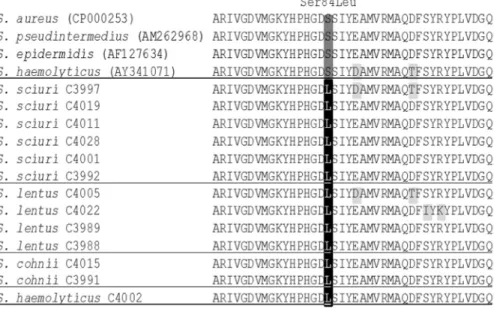
All 13 ciprofloxacin-resistant strains (6 strains ofS. sciuri, 4 strains ofS. lentus, 2 strains ofS. cohniiand one strain ofS. haemolyticus) harbored a Ser84Leu mutation within the QRDR of the GyrA protein at the position identi-cal to that involved in quinolone resistance inS. aureus,S. pseudintermedius, S. epidermidis and S. haemolyticus (Sreedharanet al., 1991; Yonezawaet al., 1996; Gómez-Sanzet al., 2013) (Figure 2A). In addition to this, 3 isolates Figure 1- Percentage distribution of mannitol-positive MRCoNS species
from pigs in Nsukka agricultural zone, Nigeria.
Table 1- Antimicrobial resistance profile of mannitol-positive MRCoNS from pigs in Nsukka Agricultural Zone, Nigeria (n = 20).
Antimicrobial agent (potency) No. (%) of resistant isolates
Oxacillin (1mg) 20 (100)
Cefoxitin (30mg) 20 (100)
Penicillin (10 units) 20 (100)
Fusidic acid (10mg) 17 (85)
Tetracycline (30mg) 15 (75)
Streptomycin (10mg) 13 (65)
Ciprofloxacin (5mg) 13 (65)
Trimethoprim/Sulphamethoxazole (25mg)
12 (60)
Clindamycin (2mg) 10 (50)
Erythromycin (15mg) 10 (50)
Gentamicin (10mg) 9 (45)
Kanamycin (30mg) 9 (45)
Tobramycin (10mg) 4 (20)
Chloramphenicol (30mg) 3 (12.5)
Mupirocin (200mg) 0 (0.0)
showed two extra substitutions, Ser98Ile and Arg100Lys in S. lentusstrain C4022 and Glu88Asp and Asp96Thr inS. sciuriC3997 andS. lentusC4005, with the latter also pres-ent in the representative quinolone-susceptible S. haemolyticusstrain (Figure 2A). The phylogenetic tree of the QRDR nucleotide sequences in thegyrAgene revealed a high nucleotide diversity, with several major clusters not
associated with the bacterial species. The quinolone-susceptible S. pseudintermedius representative strain showed the most divergent QRDR (Figure 2B).
Discussion
In this study, the species distribution, antimicrobial resistance pheno- and genotypes and virulence traits of
mannitol-fermenting MRS isolated from intensively reared pigs in the Nsukka agricultural zone, Nigeria, were investi-gated. The study provides the first report on MRS in pigs in Nigeria. MRCoPS, particularly MRSA, have been reported from pigs in several European, American and Asian coun-tries (Khannaet al., 2008; Deniset al., 2009; Wagenaaret al., 2009; Babaet al., 2010; Goldinget al., 2010; Gomez-Sanzet al., 2010; Gravelandet al., 2011; Linet al., 2011; Larsenet al., 2012; Oppliger et al., 2012). Surprisingly, none of the 20 strains in the present study was MRSA, de-spite the fact that they formed blue colonies on ORSAB. Oxacillin resistance screening agar base is a modification of mannitol-salt agar supplemented with 2mg/mL of oxa-cillin, on which mannitol-fermenting isolates turn intensely blue due to the presence of aniline. Although ORSAB is in-tended for detection of MRSA (Simoret al., 2001), the re-sults of the present study as well as those of previous work (Beckeret al., 2002; Dzenet al., 2007) have shown that col-onies of mannitol-positive CoNS on this medium are simi-lar to those of MRSA. These findings, therefore, emphasize the need for accurate identification of mannitol-fermenting methicillin-resistant staphylococci.
Three of the fourStaphylococcusspecies reported in the present study have recently been reported in dogs in the same study area (Chahet al., 2014).S. sciuriwas the pre-dominant MRCoNS species found among the pig Staphylo-coccusisolates in this study. In Switzerland,S. sciurihas been identified as the major MRCoNS species isolated from various animal sources, including pigs (Huberet al., 2011).S. sciuriwas also reported as the major MRCoNS species in the bovine population in Belgium (Vanderhae-ghenet al., 2013). Although the degree of importance of CoNS in veterinary medicine is not clearly understood, they are increasingly found to be implicated in cases of bo-vine mastitis (Inegol and Turkyilmaz, 2012; Kaynarca and Turkyilmaz, 2010) and canine pyoderma (Lima et al., 2012).S. sciurihas been reported to cause fatal exudative epidermitis in piglets in China (Chenet al., 2007). This spe-cies has also been associated with endocarditis (Walletet al., 2000), urinary tract infections (Stepanovicet al., 2003) and wound infections (Shiyuuet al., 2004; Coimbraet al., 2011) in humans.
In addition to resistance tob-lactam antibiotics, the MRCoNS in this study also demonstrated high rates of re-Table 2- Species and antimicrobial resistant pheno- and genotypes of mannitol-positive methicillin-resistant coagulase-negative staphylococci (MRCoNS) isolated from pigs in Nsukka, Nigeria.
Strain No. Staphylococcusspecies Resistance phenotypea Resistance genes detected
C4019 S. sciuri P-OX-FOX-E-CCindb-S-T-SXT-CIP-FUS mecA,erm(C),str,tet(M),dfrG
C4017 S. lentus P-OX-FOX-S-T-SXT mecA, str, dfrG
C4020 S. sciuri P-OX-FOX-SXT-CCi-C-FUS mecA,dfr(G),catpC221
C3985 S. sciuri P-OX-FOX-E-CC-GM-K-S-T-SXT-FUS mecA,erm(C),aacA/aphD,str,tet(K),tet(M)dfrG
C3986 S. lentus P-OX-FOX-S-T-SXT-FUS mecA,str,dfrG
C4011 S. sciuri P-OX-FOX-E-CCind-S-T-SXT-CIP-FUS mecA,erm(C),str,tet(M),dfrG
C4012 S. cohnii P-OX-FOX-E-CCind-GM-K-S-T-FUS mecA,blaZ,erm(C),aacA/aphD, aphA3, str, tet(K)
C3988 S. lentus P-OX-FOX-E-CC-GM-NN-K-S-T-SXT-CIP-FUS mecA,erm(B),aacA/aphD, str, tet(K),tet(M), [tet(L)-dfrK]c C3989 S. lentus P-OX-FOX-E-CC-GM-NN-K-S-T-SXT-CIP-FUS mecA,erm(B),aacA/aphD, str, tet(K),tet(M), [tet(L)-dfrK]c
C3991 S. cohnii P-OX-FOX-CCind-CIP-FUS mecA
C3992 S. sciuri P-OX-FOX-GM-NN-K-CIP-FUS mecA,blaZ, aacA/aphD
C4015 S. cohnii P-OX-FOX-E-CC-GM-K-S-T-SXT-CIP-FUS mecA,erm(B),aacA/aphD,str,tet(K),tet(M), [tet(L)-dfrK]c
C4024 S. sciuri P-OX-FOX-T-FUS mecA,tet(K)
C4001 S. sciuri P-OX-FOX-E-CCind-S-T-SXT-CIP-FUS mecA,erm(C),str,tet(M),dfrG
C4002 S. haemolyticus P-OX-FOX-E-CCind-S-T-SXT-CIP-FUS mecA,erm(C),str,tet(M),dfrG
C4005 S. lentus P-OX-FOX-GM-K-C-CIP-SXT mecA,blaZ,aacA/aphD, aphA3, dfrG,catpC223
C3997 S. sciuri P-OX-FOX-GM-K-C-CIP mecA, blaZ, aacA/aphD, aphA3, catpC223
C4022 S. lentus P-OX-FOX-S-T-CIP-FUS mecA,str,tet(K),tet(M)
C3998 S. sciuri P-OX-FOX-T-FUS mecA,tet(K)
C4028 S. sciuri P-OX-FOX-E-CC-GM-NN-K-S-T-CIP-FUS mecA,erm(B),aacA/aphD, aphA3, str, tet(K),tet(M)
a
OX, oxacillin; FOX, cefoxitin; P, penicillin; FUS, fusidic acid; T, tetracycline; S, streptomycin; CC, clindamycin; CIP, ciprofloxacin; SXT, sulphamethoxazole-trimethoprin; E, erythromycin; K, kanamycin; GM, gentamycin; NN, tobramycin; C, chloramphenicol; VAN, vancomycin; LIN, linezolid; MUP, mupirocin.
b
sistance to other classes of antimicrobial agents, particu-larly tetracycline, aminoglycosides, fluoroquinolones and macrolides. Similar findings (except fluoroquinolones) have been reported for CoNS from dogs in Nsukka (Chahet al., 2014). As has been pointed out by Aslantas et al. (2013), MRCoNS could pose a major therapeutic challenge for veterinarians due to a limited choice of antimicrobial agents in the case of infection. A high diversity of anti-microbial resistance profiles was observed in this study, for the 20 MRCoNS strains exhibited 16 resistance patterns. This finding suggests the involvement of antimicrobial se-lective pressure in the pig farms.
Antimicrobial resistance in these MDR MRCoNS was mediated by multiple antimicrobial resistance genes. This observation is similar to that reported for MRCoNS isolated from dogs in Nsukka, Nigeria (Chahet al., 2014) and Hatay, Turkey (Aslantaset al., 2013). Although the de-gree of importance of MDR MRCoNS in veterinary medi-cine is not clearly understood, they may represent a reser-voir of resistance genes which can be spread to pathogenic bacteria within and across species and genera. These MDR staphylococci, therefore, represent a public health risk as they may transfer their resistance genes to human patho-gens such asS. aureus. The presence of these MDR bacteria in pigs may be due to the indiscriminate use of antimicro-bial agents in pig production in Nigeria. The fact that the MRS strains harbor several resistance genes against the same antimicrobial agent indicates that the strains are capa-ble of acquiring and maintaining multiple resistance genes at the same time. A possible adaptive advantage of carrying these redundant genes is unknown yet.
Detection of the resistance gene clustertet(L)-dfrKin S. lentusandS. cohniiis a novel observation. A first de-scription of the trimethoprim resistance genedfrKlocated next to the tetracycline resistance genetet(L) in plasmid pKKS2187 from a MRSA ST398 isolate of pig origin was reported in Germany (Kadlec and Schwarz, 2009). The presence of this gene cluster in MRCoNS isolates from swine in Nigeria indicates a broad geographic distribution of both resistance determinants. The use of tetracyclines and trimethoprim in pig farming in Nigeria may favor the spread and maintenance of their resistance genes.
All 13 quinolone-resistant MRCoNS strains harbored the Ser84Leu substitution in the GyrA protein. To our knowledge, this is first report of this mutation inS. sciuri,S. lentusandS. cohnii, suggesting that quinolone resistance in these bacterial species is commonly associated with this mutation. Until now, this type of mutation has been most frequently found in S. aureus, S. pseudintermedius, S. epidermidisandS. haemolyticus(Sreedharanet al., 1991; Yonezawaet al., 1996; Takahataet al., 1997; Gómez-Sanz et al., 2013). The majority of the strains carried a single amino acid substitution in the same region in the
represen-tative quinolone-susceptible S. aureus, S. pseudintermediusandS. epidermidisstrains, while the rep-resentativeS. haemolyticusstrain exhibited two additional substitutions. Interestingly, analysis of the QRDR nucleo-tide sequences revealed relatively high intra-species diver-gence in this region, with S. pseudintermedius clustered farthest away from the others. These results broaden the current knowledge on the quinolone resistance mechanisms among different CoNS species.
This study demonstrated the presence of mannitol-positive MRCoNS in intensively reared pigs in the Nsukka agricultural zone, Nigeria, withS sciuribeing the predomi-nant species. This is the first report on MRS in pigs in Nige-ria. The study highlighted the fact that the CoNS strains were MDR and, therefore, could serve as a pool of resis-tance genes for pathogenic bacteria. Methicillin-resistantS. aureuswhich is frequently reported in pigs in other coun-tries was not detected in this study. Our study provides a new insight into bacterial resistance mechanisms in MRCoNS from pigs, with special attention to quinolone re-sistance.
Acknowledgments
The molecular analysis was financially supported by the grant awarded to Ugwu, Chidozie Clifford by Uni-versidad de La Rioja, Logroño, Spain. This work was par-tially supported by Project SAF2012-35474 from the Ministerio de Economía y Competitividad of Spain and the Fondo Europeo de Desarrollo Regional (FEDER).
References
Al-Talib H, Yean CY, Al-Khateeb CYet al.(2009) A pentaplex PCR assay for the rapid detection of methicillin-resistant Staphylococcus aureus and Panton-Valentine Leucocidin. BMC Microbiol 9:113.
Aslantas O, Turkyilmaz S, Yilmaz MAet al.(2013) Prevalence of methicillin-resistant staphylococci in dogs. Kafkas Univ Vet Fak Derg 19:37-42.
Baba K, Ishihara K, Ozawa Met al.(2010) Isolation of methi-cillin-resistantStaphylococcus aureus(MRSA) from swine in Japan. Int J Antimicrob Agents 36:352-354.
Becker A, Forster DH, Kneiehl E (2002) Oxacillin resistance screening agar base for detection of methicillin-resistant Staphylococcus aureus. J Clin Microbiol 40:4400-4401. Bergeron M, Dauwalder O, Gouy Met al.(2011) Species
identifi-cation of staphylococci by amplifiidentifi-cation and sequencing of thetufgene compared to thegapgene and by matrix-assisted laser desorption time-of-flight mass spectrometry. Eur J Clin Microbiol Infect Dis 30:343-354.
Chah KF, Gómez-Sanz E, Nwanta JAet al.(2013) Methicillin-resistant coagulase-negative staphylococci from healthy dogs in Nsukka, Nigeria. Braz J Microbiol 45:215-220. Chen S, Wang Y, Chen Fet al.(2007) A highly pathogenic strain
Clinical and Laboratory Standards Institute (CLSI) (2014) Perfor-mance standards for antimicrobial susceptibility testing: Twenty-first informational supplement. CLSI Document 34:M100-S24.
Coimbra DG, Almeida AGCS, Junior JBOet al.(2011) Wound infection by multiresistantStaphylococcus sciuriidentified by molecular methods. New Microbiol 34:425-427. Cucarella C, Solano C, Valle Jet al.(2001)Bap, aStaphylococcus
aureus surface protein involved in biofilm formation. J Bacteriol 183:2888-2896.
Denis O, Suetens C, Hallin Met al.(2009) Methicillin resistant Staphylococcus aureusST398 in swine farm personnel, Bel-gium. Emerg Infect Dis 15:1098-1101.
Dzen SM, Santoso S, Santosaningsih Det al.(2007) Evaluation of latex agglutination test and oxacillin resistant screening agar base (ORSAB) medium for the detection oxacillin resistant coagulase negative staphylococci (ORCoNS) (Preliminary study). Med J Indones 16:228-232.
European Committee on Antimicrobial Susceptibility Testing (EUCAST) (2014) Breakpoint tables for interpretation of MICs and zone diameters. Version 4.0, 2014. http://www.eucast.org.
Graveland H, Duim B, van Duijkeren Eet al.(2011) Livestock-Associated methicillin resistantStaphylococcus aureus in animals and humans. Int J Med Microbiol 301:630-634. Golding GR, Bryden L, Levett PNet al.(2010)
Livestock-Asso-ciated methicillin resistantStaphylococcus aureusSequence Type 398 in humans, Canada. Emerg Infect Dis 16:587-594. Gomez-Sanz E, Torres C, Lozano Cet al.(2010) Detection,
Mo-lecular Characterization and Clonal Diversity of Methi-cillin-ResistantStaphylococcus aureusCC398 and CC97 in Spanish slaughter pigs of different age groups. Foodborne Path Dis 7:1269-1277.
Gómez-Sanz E, Torres C, Lozano Cet al.(2013) High diversity of Staphylococcus aureus and Staphylococcus pseudintermedius lineages and toxigenic traits in healthy pet-owning household members. Underestimating normal household contact? Comp Immun Microbiol Infect Dis 36:83-94.
Huber H, Ziegler D, Pfluger Vet al.(2011) Prevalence and char-acteristics of methicillin-resistant coagulase-negative staph-ylococci from livestock, chicken carcasses, bulk tank milk, minced meat, and contact persons. BMC Vet Res 7:6. www.biomedcentral.com/1746-6148/7/6.
Inegol E, Turkyilmaz S (2012) Determination ofSCCmectypes in methicillin resistant staphylococci isolated from cows and farm workers. Ankara Univ Vet Fak Derg 59:89-93. Kadlec K, Schwarz S (2009) Identification of a novel
trime-thoprim resistance gene, dfrK, in a methicillin-resistant Staphylococcus aureusST398 strain and its physical linkage to the tetracycline resistance genetet(L). Antimicrob Agents Chemother 53:776-778.
Kaynarca S, Turkyilmaz S (2010) Methicillin resistance and slime positivity of staphylococci isolated from bovine mastitis. Kafkas Univ Vet Fak Derg 16:567-572.
Khanna T, Friendship R, Dewey Cet al.(2008) Methicillin resis-tant Staphylococcus aureus colonization in pigs and pig farmers. Vet Microbiol 128:298-303.
Kloos WE, Bannerman TL (1994) Update on clinical significance of coagulase negative staphylococci. Clin Microbiol Rev 7:117-140.
Kolar M, Bardon J, Hanulik Vet al.(2010) Resistance to methi-cillin in coagulase negative staphylococci and its detection. ACTA BRNO 79:261-267.
Larsen J, Imanishi M, Hinjoy Set al.(2012) Methicillin-resistant Staphylococcus aureusST9 in pigs in Thailand. PLoS One 7:e31245.
Lee H (2003) Methicillin- (oxacillin) resistantStaphylococcus aureusstrains isolated from major food animals and their potential transmission to humans. Appl Environm Microbiol 69:6489-6494.
Lima LF, Lira AC, Coutinho HDMet al.(2012) Antimicrobial re-sistance in staphylococci isolated from canine pyoderma. Comunicata Scientiae 3:181-185.
Lin Y, Barker E, Kislow Jet al.(2011) Evidence of Multiple Viru-lence Subtypes in Nosocomial and Community-Associated MRSA Genotypes in Companion Animals from the Upper Midwestern and Northeastern United States. Clin Med Res l 9:7-16.
Mellmann A, Becker K, von Eiff Cet al. (2006) Sequencing and staphylococci identification. Emerg Infect Dis 12:333-336. Oppliger A, Moreillon P, Charriere Net al.(2012) Antimicrobial
resistance ofStaphylococcus aureusacquired by pig farmers from pigs. Appl Environm Microbiol 78:8010-8014. Simor A, Goodfellow J, Loiue Let al.(2001) Evaluation of a new
medium, oxacillin resistance screening agar base, for the de-tection of methicillin-resistantStaphylococcus aureusfrom clinical specimens. J Clin Microbiol 39:3422.
Sreedharan S, Peterson LR, Fisher LM (1991) Ciprofloxacin re-sistance in coagulase-positive and -negative staphylococci: role of mutations at serine 84 in the DNA gyrase A protein of Staphylococcus aureus and Staphylococcus epidermidis. Antimicrob Agents Chemother 35:2151-2154.
Stepanovic S, Jezek P, Vukovic Det al.(2003) Isolation of mem-bers of theStaphylococcus sciurigroup from urine and their relationship to urinary tract infections. J Clin Microbiol 41:5262-5264.
Takahata M, Yonezawa M, Matsubara Net al.(1997) Antibacte-rial activity of quinolones against coagulase-negative staph-ylococci and the quinolone resistant-determining region of thegyrAgenes from six species. J Antimicrob Chemother 40:383-386.
Vanderhaeghen W, Vandendriessche S, Crombe Fet al.(2013) Characterization of methicillin-resistant non- Staphylococ-cus aureusstaphylococci carriage isolates from different bo-vine populations. J Antimicrob Chemother 68:300-307. Voss A, Loeffen F, Bakker Jet al.(2005) Methicillin resistant
Staphylococcus aureus in pig farming. Emerg Infect Dis 11:1965-1966.
Wagenaar JA, Yue H, Pritchard Jet al.(2009) Unexpected se-quence types in livestock associated Methicillin resistantS. aureus(MRSA): MRSA ST9 and a single locus variant of ST9 in pig farming in China. Vet Microbiol 139:405-409. Wallet F, Stuit L, Boulanger Eet al.(2000) Peritonitis due to
Staphylococcus sciuriin a patient on continuous ambulatory peritoneal dialysis. Scand J Infect Dis. 32:697-698. Weese JS (2010) Methicillin resistantStaphylococcus aureusin
animals. Inst Lab Anim Res J 51:233-244.
Zell C, Resch M, Rosenstein Ret al.(2008) Characterization of toxin production of coagulase-negative staphylococci iso-lated from food and starter cultures. Int J Food Microbiol 127:246-251.
ZiebuhrW, Krimmer V, Rachid Set al.(1999) A novel mecha-nism of phase variation of virulence in Staphylococcus epidermidis: evidence for control of the polysaccharide
intercellular adhesin synthesis by alternating insertion and excision of the insertion sequence element IS256. Mol Microbiol 32:345-356.
Associate Editor: Nilton Erbet Lincopan Huenuman