A search for homologues of plant photoreceptor genes and their signaling partners in
the sugarcane expressed sequence tag (Sucest) database
Roberto V. Santelli* and Fábio Siviero
Abstract
A search in the sugarcane expressed sequence tag (SUCEST) database for homologues of plant genes involved in photo-sensory mechanisms was carried out using the basic local alignment tool (BLAST). Our results shown that known elements (phytochromes, cryptochromes and phototoprin) present inArabidopsisand other higher plants were detected with low e-values. We also searched for proteins interacting with photoreceptors in primary or downstream signaling events. One putative homologue for a protein postulated to be a primary element in phytochrome signaling pathways was identified, as were other candidates for downstream interacting factors.
INTRODUCTION
Extensive reviews are available focusing on all as-pects of photoreception in plants (Nagyet al., 2000; Quail, 2000; Hudson, 2000). However as the field is broad, we will present basic information for a better evaluation of our results.
The molecules engaged in the perception of light are specialized ones and are classified based upon the quality of the light absorb,i.e.phytochromes absorb in the red and far-red, and the cryptochromes and phototropin absorb UV-A and blue light.
InArabidopsisthe photoreceptors are present as two groups: the first group being the phytochrome gene family, which has five members (phytochromes A, B, C, D and E) and the other group consisting of two cryptochromes (cry1 and cry2) and one phototropin (nph1).
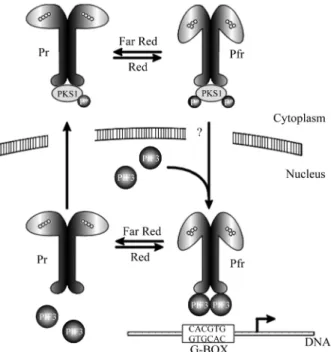
Phytochromes are photochromic pigments that exert their regulatory activity by switching between two forms: an active Pfr form by absorbing red light and an inactive Pr form by absorbing far-red light (Figure 1). Phytochromes are localized in the cytosol in both etiolated seedlings and in plants adapted to growth in the dark. Subsequent nuclear residence of phytochromes depends on quality and quantity of light (Nagyet al., 2000; Nagyet al., 2001).
Three groups of researchers, utilizing the yeast two-hybrid system, were able to locate candidates for pri-mary phytochrome action.
One primary phytochrome action candidate is phyto-chrome Interacting Factor 3 (PIF3) which was isolated by Peter Quail’s group using as bait the portion of phyto-chrome B COOH-terminal domain which is not involved in chromophore binding response. Interestingly the re-con-version of phyB to its non-reactive form caused dissocia-tion of PIF3. This result was the firstin vitrodemonstration
of a photo-reversible binding between a phytochrome and its putative signaling partner (Niet al., 1999). According to Zhuet al.(2000) the apparent affinity of PIF3 is higher for phyB than for phytocheome A (phyA) PIF3 has a bipartite signature with a nucleus localization signal (NLS) and a ba-sic helix-loop-lelix (bHLH) motif of this super-family of transcription factors, common in theArabidopsisgenome. The target DNA is a palindrome, CACGTG, of the G-box sequence motif, present in various light-regulated gene pro-moters (Martinez-Garcia, 2000). The nuclear localization of PIF3 and its binding properties indicate that after trans-location to the nucleus the photoactive form of phyA or/and B, interacts with PIF3; this being a primary stage in light-induction gene activation. The overall situation is thus a positive regulation of phytochrome action.
A second primary phytochrome action candidate was isolated using the C terminal domain of PHYA as bait by Joanne Chory’s group who isolated a protein with different properties, phytochrome kinase substrate 1 (PKS1) (Fankhauser et al., 1999) present in the cytoplasm. The N-terminal of this protein can be phosphorylated on its serine and threonine residues by preparations of recombi-nant oat phyA extracted from yeast, in Pr and Pfr condi-tions, but not with the protein obtained from dark grown controls. It thus appears that phyA function as a protein-ki-nase. This data supports the proposition that PKS1 is a can-didate for a primary partner in phytochrome signal transduction initiation. A scheme for the putative interac-tions of phytochromes, PKS1 and PIF3 is shown in Figure 1
The third possible primary phytochrome action can-didate, isolated by Choiet al.(1999) is nucleoside diphos-phate kinase 2 (NDPK2). However NDKP2 is known to participate in several other developmental processes in
other organisms and the present data in plants is far from conclusive.
Several other transcription factors are shown to act downstream in photoreceptor transduction pathways,e.g.
the bZIP (basic Zipper) circadian clock associated 1 (CCA1) (Wang et al. 1998), the nuclear protein GI (GIGANTEA) (Huqet al., 2000), the bHLH protein, long hypocotyl in far-red (HFR1) (which binds PIF3 by a possi-ble mechanism of in vivo heterodimerization (Fairchildet al., 2000) and COP1 (constitutive photomorphogenic 1), a negative regulator of CRY1 (McNelliset al.1994) (Yanget al., 2001).
Three blue light photoreceptors, cryptochrome1 (cry1), cryptochrome 2 (cry2) and phototropin (nph1) were identified inArabidopsis. The main regulatory events for this class of photoreceptors are, hypocotyl inhibition, flow-ering time and phototropism, while other functions include stimulation of cotyledon expansion and circadian changes in response to light.
Phototropism appears to be exclusive of nph1 regula-tion (Christieet al., 1998; Liscum and Stowe-Evans, 2000) but the possibility is not excluded of other photoreceptors acting in the range of high intensity blue light. Recently it has been observed inArabidopsisthat a NPH1 homologue, the protein NPL1 seems to be functionally linked to the
chloroplast high-light avoidance response (Kagawaet al., 2001; Jarilloet al., 2001). Unlike the position with phyA and phyB, little is known for downstream regulation for the blue receptors. In the case of phototropin (nph1), a candi-date protein NPH3 (Moutchoulski and Liscum, 1999), with potential protein-protein interaction motifs was isolated and characterized by Moutchoulski and Liscum (1999).
Finally, although being proteins which reside in the nucleus (or are nuclear bound), interactions (cross-talk), collectively referred to as co-action, between phytochro-mes and cryptochrophytochro-mes, has been suggested by Guoet al.
(2001), as is the case for the Ca2+binding protein SUB1.
MATERIAL AND METHODS
All sequences analyzed were from the SUCEST data-base. Descriptions of the libraries that generated the Ests clones as well as protocols for sequencing and the general strategies used in the SUCEST project can be found at http://sucest.lbi.dcc.unicamp.br. Sequence analysis was performed using the BLAST facility and the `search by keyword’ service, both available on the SUCEST site, and the clustalX 1.8 program (Thompson et al., 1997) on a workstation running under Linux (Debian 3.0) with the ToolKit 6.1 (NCBI), Vibrant 6.1 (NCBI) packages in-stalled.
The BLAST program used was tblastn, using as query sequences proteins mainly fromArabidopsis thalianaand
Oryza sativagenomes. The search by keyword service on the SUCEST site uses as database the Blastx and Blastn of the SUCEST sequences in NCBI Blast site response. The results were filtered restricting the hits to an E value 1E-15. The phylogenetic dendrogram was constructed using ClustalX 1.8.
RESULTS
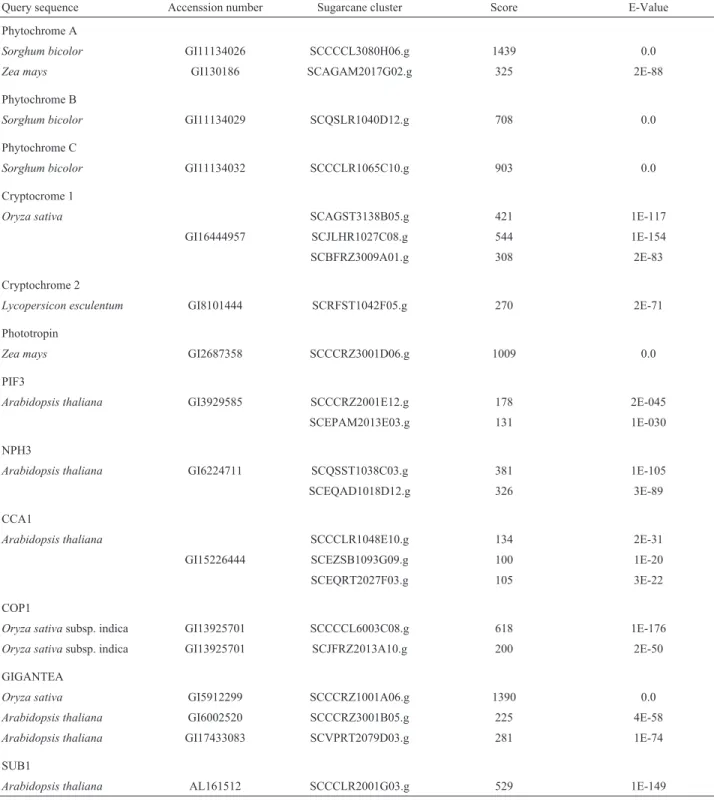
Our search for homologues of genes involved in pho-toreception was focused on three main groups: 1) phyto-chromes, 2) cryptochromes and phototropin and 3) primary targets and downstream putative regulators. The Table1 is constructed in relation to the best score and lowest e-value.
PHYLOGENETIC RELATIONSHIPS
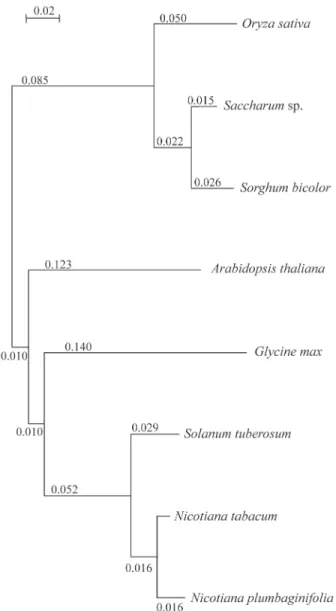
The grass family (POACEAE) has recently been sub-mitted to extensive phylogenetic analysis of phytochrome B (PHYB) nuclear DNA sequences using a 1.2 kilobase (kb) region of thePHYBgene first exon that encompasses the chromophore binding site (Mathewset al., 2000). Un-fortunately, the complete sequence of this gene is not in the Sucest database. Nevertheless we applied the clustralX alignment program using the existent sugarcanePHYB se-quence, against several complete sequences from current databases. The results are presented in the dendrogram (Figure 2).
Figure 1- The scheme (modified from Smith, 1999) is based on the data from Quail’s and Chory’s groups on PIF3 and PKS1. Phytochromes are represented by their dimeric form. They oscillate between aninactive
DISCUSSION
The sequencing of the genome of the weed Arabi-dopsis thalianaduring the Arabidopsis Genome Initiative reveal novel information about genomic organization, plant physiology and evolutionary relationships. One aspect with implications for some general conserved mechanisms
be-tween plants was the high degree of gene redundancy for several proteins of known and unknown function.
This peculiar aspect of the Arabidopsis genome seems to be represented in the small family of phytochro-mes (A to E) known to be present in this plant. Mutant forms of phyA and phyB are frequent (see the review by Table I- Results of a Basic local alignment search tool (Blast) for groups of genes involved in photoreception. The sugarcane expressed sequence tag (Sucest) was used for the search. Clusters were made with the sugarcane expressed sequence tag (SUCEST) database and using the CAP3 (Contig
Assembly Program, version 3).
Query sequence Accenssion number Sugarcane cluster Score E-Value
Phytochrome A
Sorghum bicolor GI11134026 SCCCCL3080H06.g 1439 0.0
Zea mays GI130186 SCAGAM2017G02.g 325 2E-88
Phytochrome B
Sorghum bicolor GI11134029 SCQSLR1040D12.g 708 0.0
Phytochrome C
Sorghum bicolor GI11134032 SCCCLR1065C10.g 903 0.0
Cryptocrome 1
Oryza sativa SCAGST3138B05.g 421 1E-117
GI16444957 SCJLHR1027C08.g 544 1E-154
SCBFRZ3009A01.g 308 2E-83
Cryptochrome 2
Lycopersicon esculentum GI8101444 SCRFST1042F05.g 270 2E-71
Phototropin
Zea mays GI2687358 SCCCRZ3001D06.g 1009 0.0
PIF3
Arabidopsis thaliana GI3929585 SCCCRZ2001E12.g 178 2E-045
SCEPAM2013E03.g 131 1E-030
NPH3
Arabidopsis thaliana GI6224711 SCQSST1038C03.g 381 1E-105
SCEQAD1018D12.g 326 3E-89
CCA1
Arabidopsis thaliana SCCCLR1048E10.g 134 2E-31
GI15226444 SCEZSB1093G09.g 100 1E-20
SCEQRT2027F03.g 105 3E-22
COP1
Oryza sativasubsp. indica GI13925701 SCCCCL6003C08.g 618 1E-176
Oryza sativasubsp. indica GI13925701 SCJFRZ2013A10.g 200 2E-50
GIGANTEA
Oryza sativa GI5912299 SCCCRZ1001A06.g 1390 0.0
Arabidopsis thaliana GI6002520 SCCCRZ3001B05.g 225 4E-58
Arabidopsis thaliana GI17433083 SCVPRT2079D03.g 281 1E-74
SUB1
Hudson, 2000), but phyC and phy E mutants remain elu-sive. Only one natural null mutant of phy D has been ob-served which indicates a minor role for this phytochrome. Why then are phyD and phyE maintained if most of their functions are noticeable only in aphyA/phyB double-mu-tant background? Hudson has suggested that “the redun-dancy that they provide may be the key for their retention, rather than any specific response for which they are re-quired in wild typeArabidopsis”.
We are able to detect phyA, phyB and phyC homo-logues in the SUCEST database. This is the same situation observed in rice. In this monocotyledon it was possible to demonstrate that thePHYA,PHYBandPHYCgenes are all located on chromosome 3, and of conserved synteny with these same genes in linkage group C fromSorghum(Basu
et al., 2000).
This redundancy or high gene density seems to be a recurrent model in small and large grass genomes (wheat, barley and rice) as is the case for theLrkgenes that encode receptor-like kinases (Feuillet and Keller, 1999).
The present identification (by sequence homology) of at least three members of the phytochrome family in sugar-cane, as well as homologues to cryptochromes and photo-tropin will open the possibility of interesting comparisons at a genomic level to other monocotyledons. In this sense it is noteworthy that, as observed for maize, no NPL1 (photo-tropin homologue) was found in the SUCEST database.
With the exception of PKS1, not found in the SUCEST database we found homologues to genes being postulated to act in the primary photoreceptor response, mainly PIF3. However in the case of NDPK2, several other putative sequences for NDPKs were present which may suggest a more general role for this protein. Because of this, this element was not included in our table. In this context the conclusive presence of a PIF3 homologue reinforces the possible implication of this protein in primary phytochro-me signaling in plants.
The situation is also very interesting for other mem-bers described previously as important elements in photo-transduction. High scores were found for CCA1 and GIGANTEA, with Table I giving a complete list of ele-ments. The FHY1 protein, a recent identified phytochrome A-specific signal transducer was not found (Desnoset al.
2001).
Although incomplete, the dendrogram showed in Fig-ure 2 alignedSaccharumwithSorghum bicolorbut distant fromOryza sativa. The sequence available fromZea mays
is incomplete and in a region not comparable to that from
Saccharum. The information for maize is limited and we suggest that the completion of the phytochrome B sequence from either sugarcane or maize will furnish interesting phylogenetic relationships in relation to the position of these plants in the grass family (Mattewset al., 2000).
Our studies have revealed basic evolutionary infor-mation and open the opportunity to apply to sugarcane the same approach that revealed essential information about light transduction signaling in other plants. Taken together, these results contribute valuable information to what is known about light transduction signaling in monocotyle-dons.
RESUMO
A partir dos dados do projeto de sequenciamento de Ests da Cana de Açúcar (Sucest/FAPESP) e utilizando BLAST (tblastn) como ferramenta, foi realizada uma busca de genes homólogos aos elementos envolvidos nos proces-sos de foto-recepção e já descritos para outras plantas, principalmenteArabidopsis. Foram obtidas altas identida-des para os fitocromos A, B e C assim como para os criptocromos 1, 2 e a fototropina. Diversos elementos iden-tificados como reguladores primários ou secundários na Figure 2- Partial phylogenetic comparisons between thePHYBsequence
transdução de sinal de foto-receptores também foram iden-tificados com baixos valores de E-value.
ACKNOWLEDGEMENTS
We thank FAPESP for the support of the Sucest pro-ject and to Dr. Brian Bandy for valuable suggestions. F. Siviero is a doctoral student with support from CAPES.
REFERENCES
Basu D, Dehesh K., Schneider-Poetsch H.J., Harrington S.E., McCounch, S.R.,andQuail P.H. (2000). Rice PHYC gene: structure, expression, map position and evolution. Plant Mol. Biol. 44(1): 27-42.
Chantao, L.(2000). Plant blue-light receptors.Trends in Plant Sciences 5: 337-342.
Choi, G., Yi H., Lee, J. Kuon, Y.K., Soh, M.S., Shin, B.. Luka, Z., Hahn, T.R.andSong P.S.(1999). Phytochrome signal-ling is mediated through nucleotide diphosphate kinase 2. Nature 401: 610-613.
Christie, J.M., Reymond, P., Powell, G.K., Bernasconi, P., Raibekas, A.A.,Liscum, E.andBriggs W.R.(1998) Arabi-dopsisNPH1: a flavoprotein with the properties of a photo-receptor for phototropism.Science 282: 1698-1701.
Desnos, T., Puente, P., Whitelam, G.C. and Harberd, N.P.
(2001) FHY1: a phytochrome A-specific signal transducer. Genes & Dev. 15: 2980-2990.
Fairchild, C.D., Schumaker, M.A.,and Quail, P.H., (2000). HFR1 encodes an atypical bHLH protein that acts in phyto-chrome A signal tranduction. Genes & Development 14: 2377-2391.
Fankhauser, C., Yeh, K.C., Lagarias, J.C., Zhang, Elich, T.D.
andChory, J.(1999). PKS1, a substrate phosphorylated by phytochrome that modulates light signalling inArabidopsis. Science 284: 1539-1541.
Feuillet, C., Keller, B.(1999). High gene density is conserved at syntenic loci of small and large grass genomes.Proc. Natl. Acad. Sci U.S.A. 96: 8265-8270.
Guo, H., Mockler, T., Duong, C.andLin, C.(2001). SUB1, an ArabidopsisCa2+Binding Protein Involved in Cryptochro-me and PhytochroCryptochro-me Coaction.Science 291: 487-490.
Huq E., Tepperman, J.M.andQuail, P.H.(2000) GIGANTEA is a nuclear protein involved in phytochrome signaling in Arabidopsis. Proc. Natl. Acad. Sci. USA 97 (17): 9789-9794.
Hudson, M.E.(2000) The genetics of phytochrome signalling in Arabidopsis.Semin Cell & Dev Biol. 11: 475-483.
Jarillo, J.A., Gabrys, H., Capel, J., Alonso, J.M., Ecker, J.R.
and Cashmore, A.R. (2001). Phototropin-related NPL1 controls chloroplast relocation induced by blue light.Nature 410: 952-954.
Kagawa, T.,Sakai, T., Suetsugu, N., Oikawa, S. Kato, T., Tabata, S, Okada, K, Wada, M. (2001) Arabidopsis
NPL1: a phototropin homolog controlling the chloroplast high-light avoidance response.Science 291: 2138-2140.
Liscum, E., Stowe-Evans, E.L.(2000). Phototropism: a “simple” physiological response modulated by multiple interacting photosensory-response pathways.Photochem Photobiol 72 (3): 273-282.
Martinez-Garcia, J.F., Huq, E.andQuail, P.H.(2000). Direct targeting of light signals to a promoter element-bound tran-scription factor.Science 288(5467): 859-63.
Mattews, S., Tsai, R.andKellogg, E.A. (2000). Phylogenetic structure in the grass family (POACEAE): evidence from the nuclear gene Phytochrome B. Am. Jour. Bot. 87 (1): 96-107.
McNellis, T.W., Torii, K.U.andDeng, X.W. (1994). Over-ex-pression ofArabidopsis COP1results in partial suppression of light mediated development and evidence for a light inactivable suppressor of photomorphogenesis.Plant Cells 6: 1391-1400.
Moutchoulski, A.andLiscum, E(1999).ArabidopsisNPH3: A NPH1 Photoreceptor-interacing protein essential for photo-tropism.Science 286: 961-964.
Nagy, F., Kircher, S.and Schäfer, E., (2000). Nucleo-cyto-plasmic partitioning of the plant photoreceptors phyto-chromes.Semin Cell & Dev Biol. 11: 505-510.
Nagy, F., Kircher, S.,andSchäfer, E.(2001). Intracellular traf-ficking of photoreceptors during light-induced signal trans-duction in plants.J. Cell Sci. 114: 475-480.
Ni, M., Tepperman, J.M.andQuail, P.H.(1999). Binding of phytochrome B to its nuclear signaling partner PIF3 is re-versibly induced by light.Nature 19(400): 781-784.
Quail, P.H.,(2000). Phytochrome-interacting factors.Semin Cell & Dev Biol.11: 457-466.
Smith, H.(1999). Tripping the light fantastic.Nature 19(400): 710-711.
Thompson JD, Gibson TJ, Plewniak F, Jeanmougin F, Hig-gins DG. (1997). The CLUSTAL_X windows interface: flexible strategies for multiple sequence alignment aided by quality analysis tools.Nucleic Acids Res Dec 15; 25(24): 4876-82.
Yang, H.Q., Tang, R.H.andCashmore, A.R. (2001) The signal-ing Mechanism of Arabidopsis CRY1 involves direct inter-action with COP1.Plant Cell 13: 2573-2587.
Zhu, Y., Tepperman, J.M., Fairchild, C.D., Quail, P.H.(2000). Phytochrome B binds with greater apparent affinity than phytochrome A to the basic helix-loop-helix factor PIF3 in a reaction requiring the PAS domain of PIF3. Proc. Natl. Acad. Sci,USA 97: 13419-13424.