Amendments to the Law on Value Added Tax in Kosovo
LL. M. Simeana Beshi
University College “FAMA”
Dr. Sc. Safet Krasniqi
University of Prizren “Ukshin Hoti” University College “FAMA”
Abstract
Main purpose of this paper is to explore and analyze the objectives and effects of amendments in the Law on Value Added Tax (VAT) as part of the new fiscal package in Kosovo. This paper is based on a quantitative analysis. Some of the methods used in this paperwork are: historical-, descriptive-historical-, and comparative method. It relies on facts and researches conducted by international organizations, based on productive forces and on the development of economic capacities in general, also a comparative overview of the fiscal policies applied in different states. This paper presents also the challenges of Kosovo, towards EU, by harmonizing tax legislation, fiscal policy and combating tax evasion.
Keywords: Fiscal Policy, Value Added Tax, Tax Rates.
Introduction
This paper aims to give an overview of the tax administration which is closely related to Kosovo’s future, since this plan will depend on the social-, and economic development and its perspective. The discussion of fiscal policy is focused in the role of taxes in attracting FDI and a competitive and flexible tax system. Kosovo has imposed the obligation of payment of taxes to the citizens, regulated not only by the Constitution of Kosovo, but also the specific laws on the fiscal policy.
With the implementation of the new law on VAT, on one hand is intended the facilitation of the economic situation of citizens and businesses, while on the other hand additional budget revenues and combating tax evasion is foreseen.
The new legislation on VAT
Integral part of the new Fiscal Package, which started to be implemented from 1.9.2015, is the new Law on Value Added Tax. This package brought many changes, but the biggest change is precisely that of VAT. In essence, these changes are based on estimates which aim to bring certain effects in the economic and social life of Kosovo. Some of the main innovations of the new Law on Value Added Tax are:
· The new law on VAT lowered the threshold for VAT registration from • 50,000 to • 30,000. The law has determined to unsubscribe from VAT taxable, only if the taxpayer has a turnover under • 30,000 in recent year. According to recent changes in the framework of the law on VAT there is a standard VAT rate of 18% (16% in the previous law) and a reduced rate of VAT of 8%.
· One of the amendments to the Law on VAT is the exemption for certain activities of public interest. The law stipulates exemption from VAT for:
o Hospital services and medical care (not exempted from VAT the provision of rental facilities for these services);
o Education services;
o Welfare and social security services, (...).
· The law has defined other exemptions from VAT, such as:
o VAT exemption when importing raw;
o Exemption from VAT when importing machinery for production; o VAT exemption when importing information technology equipment; o Exemptions on exportation of information technology equipment; o Exemptions related to international transport.
These changes are expected to offer fiscal incentives to businesses in terms of new investments. Government tax changes expected to yield direct results and side effects, which will take time to assess.
According to the indications from the International Monetary Fund (IMF) and World Bank about the reform on VAT in Kosovo, a risk decline in revenues has been identified, because of the entry into force of the Stabilization and Association Agreement (SAA) where imports have no customs duties. 70% of revenues are collected from Kosovo’s border countries.
In order to increase the budget expenditures with revenues, the IMF suggested to the Government of Kosovo, on the ongoing increase of different excise also to see opportunities for increasing of Tax Value Added Tax (VAT) which will bring a substantial increase in budget revenues. (International Monetary Fund, 2015) Kosovo previously had a standard VAT rate of 16%. According to a study of Open Data Albania (ODA), Kosovo in relation to the countries of the region had the lowest standard rate 16%, with 1% difference from Bosnia and Herzegovina, which has the standard rate of 17%. Croatia leads with the standard rate of VAT at 25%. With the new law on VAT Kosovo goes before Bosnia and Herzegovina Kosova again with a difference of 1%. (Open Data Albania, 2013)
Changes made to the Law on VAT, aimed at sustainable economic growth with relatively high employment without generating inflation without increasing public debt and a satisfactory balance of payments.
The economic effects of the new Law on VAT
With the new law, VAT the range of raw materials and essential products was reduced in order to reduce the financial burden on the poor. From 1.9.2015, all essential products have a measure Value Added Tax (VAT) of 8% in comparison to 16%. Public services such as water (not packaged), electricity and heating have a rate of 8% VAT. In the list of essential commodities medications also are taxed at 8%, since they have a direct effect on the standard of life.
According to the findings regarding the effects of economic and fiscal laws mentioned above, small businesses will be adversely affected by the decrease of VAT, while the abolition of VAT on machinery and raw materials will lower the cost of production and potentially increase investment in productive sectors. (Institute for Advanced Studies, 2015, 2-4)
Increasing the VAT for the majority of products from 16 to 18%, while keeping other factors isolated, is expected to lead to increased prices in the consumer basket and budget revenues.
It is noteworthy that for the first time since the declaration of independence in 2008, VAT escalated progressively, following an increase from 16% to 18%. This increase will bring a raise in citizen’s cost of life and in general prices will rise by 1%.
According to GAP Institute, the number of businesses that have paid VAT in 2014 is 14.560, while by lowering the VAT threshold to 30,000, this will increase the number to 1,800 more businesses (GAP, 2015, 2).
Table 11
Kosovo Budget will benefit from the lowering of the threshold for VAT because a higher number of businesses will be forced to pay VAT, but on the other hand fiscal policy will weigh on the new businesses that need fiscal alleviations which potentially create new jobs (GAP, 2015, 3).
Another change which is expected to have the opposite effect to that of lowering the threshold for payment of VAT is the exemption from VAT of these categories of products:
· production lines and machinery for the use in the production process; · raw material used for the production process;
· equipment of informative technology.
improve the liquidity of the business. Unlike the old law where the VAT rate was 16% for most products, the new VAT rate is expected to increase at 18%, which is an increase of 13%. An equally important amendment in the new Law was made to determine the rate of VAT reduced to 8% for some categories of products, such as: a) food (rice, flour, white bread, milk, eggs, etc.);
b) supplies of public utilities (electricity, garbage collection, heating, etc.); c) supply with medications and medical instruments, etc... (GAP, 2015, 3). The reduced rate of VAT of 8% should have a positive impact on the reduction of essential items, if correctly calculated the price of the item, as well as exemptions for raw materials, production line. This rate will have a positive impact on local producers. While the increase in the standard rate of VAT at 18% would give its own contra effect, this will lessen fiscal facilities. As a result of amendments of tax rates of VAT, we can say that there is a very small number of products that have been decreased, while it is a large number of products that are expensive.
The law changes are focused in two directions: social and human sustainability and the economic – strategic impact. The effects on social and human sustainability are supposed to be achieved by the fact that, in Kosovo, there is a high level of extreme poverty and unemployment through these tax changes that are intended to fill more essential consumer basket. 2014 was considered as a year of economic failure, which means that we enter in the New Year with a minus budget, due to obligations contingency. These fiscal policies will help Kosovo’s European integration processes, at all levels, either as civil society or government.
Many foreign companies have expressed willingness to invest in Kosovo but the inability of exemption from VAT, the import of machinery and raw materials has caused for them many problems and consequently it came to a product with a much higher cost than imports, therefore, we can say that these three points are the main points of the new fiscal package.
These fiscal policies, if taken in its entirety, are positive, but they must be analyzed in each segment to see in which of these segments have been created alleviations and which other segments are not favorable for the businesses and the consumers. Some of the main points that affect businesses are:
- Exemption from customs of the production lines;
burden is borne by the final consumer, and that this burden affects the pocket of the customer, its standard, financial power or potential and this impacts also on consumer demand and finally in his preference for products or basic living needs and those of luxury.
In this regard, positive dominances consist of an increasing of total revenue of Tax Administration of Kosovo (TAK), while these companies had no negative impact on their finances, however, this did not affect their offer. On the other hand, the demand by the customer, according to the theory is growing, however, according to current practice; day by day it suffers from the negative impact and reducing demand as a result of the reduction of their potential buyers. All these happens as a result of increasing prices, unemployment, purchasing power, demand, offer, incomes per head of population, etc. all of which are causing a non-stability of Kosovo’s economy and slow economic growth.
Through fiscal policy, the state first of all has the ability to stimulate or slow down economic growth in a country.
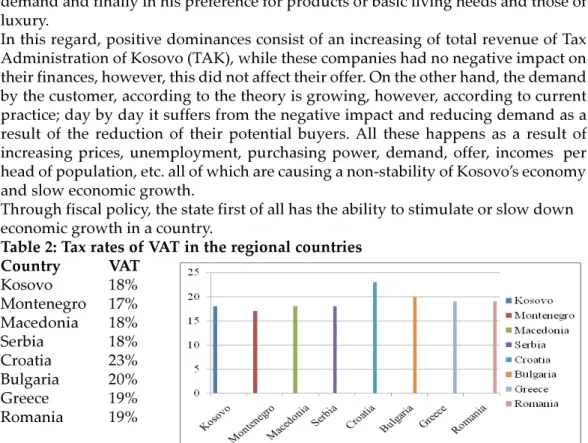
Table 2: Tax rates of VAT in the regional countries
Country VAT
Kosovo 18%
Montenegro 17% Macedonia 18%
Serbia 18%
Croatia 23% Bulgaria 20%
Greece 19%
Romania 19%
The degree of the amount of tax in the Republic of Kosovo is among the lowest of these countries, especially the member countries of the EU and it is in accordance with the standard and economic development of the country. It is known that Kosovo is behind the EU countries in terms of stability and economic development. Countries in the region that are members of the EU also have a higher rate than Kosovo (Haliti, 2015, 6-7).
Harmonization of legislation with EU countries must be done in order to have a unification of these legal specifications but the economic development level and the standard of living should always be taken into consideration, because a citizen cannot be charged with a high tax while receiving low income and precisely for this reason, Kosovo must follow the trends of local economic development.
Conclusions
taxing between the luxury products and existential products. This will improve the standard of living of the population, which is one of the social intentions of the changes made in the fiscal policy.
The increase of VAT from 16% to 18% will certainly satisfy in the initial stage, the gap of customs revenue as a result of the entry into force of the SAA.
Kosovo still needs a lot of work to secure greater revenues from taxes in the country, in order to provide its own budget, as a country aspiring to European integration.
References
Dabrowski, M. & Radziwill, A. (2005). International Public Goods for Economic Development:
The Case of Postcommunist Transition. Poland: Center for Social and Economic Research.
Haliti, B. “n.d.” Fiscal Policy in Kosovo and their harmonization with Regional and the EU. Retrieved February 10, 2016, from http://www.academia.edu/.
Institute for Advanced Studies GAP. (2015). Economic and budgetary effects of fiscal reforms 2015.
Retrieved December 12, 2015, from http://www.institutigap. org/documents/ 5675_Economic%20and%20budgetary%20effects%20of%20fiscal%20reforms%202015_final.pdf. International Monetary Fund. (2015). Kosovo: Concluding Statement of the 2015 Article IV Mission.
Retrieved January 22, 2016, from http://www.imf.org/external/np/ ms/2015/033015.htm. Kosovarisch- Deutsche Wierschaftsvereinigung KDWV. (2015, October 2). Krasniqi:Segmente të pakos fiskale, të pafavorshme për biznesin e qytetarin. Retrieved February 5, from http://oegjk.eu/ krasniqi-segmente-te-pakos-fiskale-te-pafavorshme-per-biznesin-e-qytetarin/.
Law on Value Added Tax, Nr. 05/L-037. (2015). Retrieved from http://www.atk-ks.org/ wpcontent/uploads/2015/09/LAW_NO._05_L037_ON_VALUE_ADDED_TAX___ANNEX.pdf. OEK, ATK dhe Doganat: Efektet afatgjate të pakos fiskale do të jenë pozitive. (4 Shtator 2015).
KOHAnet. Retrieved from http://koha.net/?id=27&l=73613.
Tatimi mbi të Ardhurat Personale, Tap në Shqipëri dhe rajon 2013/2014. “n.d”. Open Data
Albania. Retrieved from