INFLUENCE OF HATCHING EGGS STORAGE PERIOD UPON THE INCUBATION
PARAMETERS IN JAPANESE QUAILS
ВЛИЯНИЕ НА СРОКА НА СЪХРАНЕНИЕ НА РАЗПЛОДНИТЕ ЯЙЦА ВЪРХУ
ИНКУБАЦИОННИТЕ ПОКАЗАТЕЛИ ПРИ ЯПОНСКИ ПЪДПЪДЪЦИ
Atanas GENCHEV
Trakia University, Faculty of Agriculture, Department of Poultry Science, 6000 Stara Zagora, Bulgaria, e-mail: [email protected]
ABSTRACT
The purpose of the present study was to establish the effect of the prolonged storage of Japanese quail hatching eggs upon the incubation performance and the quality of hatched quail chicks.
The duration of egg storage prior to their incubation had a weak negative effect on the weight loss from incubation day 0 to day 15. Eggs stored for 1-3 days exhibited a statistically signifi cantly higher weight loss than eggs stored for 8-11 days prior to incubation (P<0.001).
Eggs stored for up to 8 days showed a tendency towards statistically signifi cant (P<0.05) longer period of incubation. The relationship between incubation period length and egg storage term was moderate, curvilinear and the effect of egg storage term was estimated at 14.3% оf the total dispersion of the trait.
Despite the egg storage term prior to incubation, quails with high relative weight had a statistically signifi cant shorter period of incubation. The analysis of the combined effects of egg storage term and relative weight at hatching on incubation length showed that both factors complemented each other and even enhanced their effects upon the determination of the studied trait. The strength of these factors’ effects was estimated at 13.1% of the total dispersion of the incubation period length (P<0.001), with a leading role of the factor relative weight of hatched quail chicks. Key words: Japanese quail, egg storage period, incubation parameters, length of incubation period.
РЕЗЮМЕ
Целта на настоящото проучване е да провери влиянието на продължителното съхранение на разплодните яйца от Японски пъдпъдъци върху резултатите от инкубацията и качеството на излюпените пъдпъдъци.
Продължителността на съхранение на яйцата преди инкубацията оказва слаб, отрицателен ефект върху загубата на маса през инкубационния период от 0 до 15 дни. Загубата на маса при яйцата, съхранявани 1-3 дни е достоверно по-висока от тази при яйцата, съхранявани 8-11 дни преди инкубацията (P<0.001).
При яйцата, съхранявани до 8 дни се наблюдава тенденция към достоверно удължаване на инкубационния период (P<0.05). Зависимостта между продължителността на инкубационния период и срока на съхранение на яйцата е умерена, криволинейна, а силата на влияние на срока на съхранение на яйцата се оценя на 14,3% от общата дисперсия на признака.
Независимо от срока на съхранение на яйцата преди инкубация, пъдпъдъците с висока относителна маса при излюпването са имали доказано по-къс инкубационен период. Анализът на съвместното влияние на срока на съхранение на яйцата и относителна маса при излюпването върху продължителността на инкубационния период показва, че двата фактора взаимно се допълват и усилват своето влияние върху детерминацията на проучвания признак. Силата на влияние на изследваните фактори се оценя на 13,1% от общата дисперсия на продължителността на инкубационния период (P<0.001), като водещо е влиянието на фактора относителна маса на излюпените пъдпъдъци.
РАЗШИРЕНО РЕЗЮМЕ
Често в отраслите с нисък относителен дял в стопанската практика, съществува проблем с числеността на родителските стада, което препятства нормалното провеждане на възпроизводителния процес. Оттук възникват трудности, защото продължителността на събиране на яйцата често надхвърля препоръчваните срокове от 7 дни, а това влошава люпимостта и може да повлияе върху качеството на излюпените птици. В литературата са изказани много хипотези за причините, влияещи върху люпимостта, но основните се свързват със “стареенето на яйцето”, предизвиквано от загубата на CO2 и вода.
Целта на настоящото проучване е да провери влиянието на продължителното съхранение на разплодните яйца от Японски пъдпъдъци върху резултатите от инкубацията и качеството на излюпените пъдпъдъци. Проучването е проведено с яйца, получени от родителско стадо на 91-102-дневна възраст, произхождащо от месодайната порода Фараон. Яйцата бяха събирани в продължение на 11 дни и съхранявани при температура 8-10оС. Преди зареждане в инкубатора яйцата бяха аклиматизирани за 12 h при температура 20оС. Яйцата бяха инкубирани в лабораторен инкубатор при стандартни условия: температура 37,7оС, относителна влажност 55-60% и обръщане 24 пъти в денонощие. Яйцата бяха претеглени с точност до 0,1 g при зареждането в инкубатора и на 15-я ден от инкубацията, а по разликата беше отчетена загубата на маса (%). След излюпването, изсъхналите пъдпъдъци бяха теглени и беше изчислена относителната маса (%). Продължителността на инкубационния период беше отчитан през 6-часови интервали от 402-я до 462-я h. Като излюпени и готови за изваждане се записваха пъдпъдъците със заздравял пъпен отвор и изсъхнали глава и шия.
Получените резултати бяха обработени вариационно-статистически чрез използване на класическите методи за провеждане на статистически анализ в средата на MS Excel 2003. За установяване на влиянието на изпитвания фактор върху признаците, характеризиращи качеството на излюпените пъдпъдъци беше приложен дисперсионен анализ на получените резултати.
От изследването се установи, че продължителността на съхранение на яйцата преди инкубацията оказва слаб, отрицателен ефект върху загубата на маса през инкубационния период от 0 до 15 дни. Загубата на маса при яйцата, съхранявани 1-3 дни е достоверно по-висока от тази при яйцата, съхранявани 8-11 дни
преди инкубацията (P<0.001).
Продължителността на съхранение на яйцата не оказва влияние върху относителната маса на излюпените пъдпъдъци, но влияе върху продължителността на инкубационния период. При яйцата, съхранявани до 8 дни се наблюдава тенденция към достоверно удължаване на инкубационния период (P<0.05). Зависимостта между продължителността на инкубационния период и срока на съхранение на яйцата е умерена, криволинейна, а силата на влияние на фактора срок на съхранение на яйцата се оценя на 14,3% от общата дисперсия на признака.
Независимо от срока на съхранение на яйцата преди инкубация, пъдпъдъците с висока относителна маса при излюпването са имали доказано по-къс инкубационен период. Анализът на съвместното влияние на срока на съхранение на яйцата и относителна маса при излюпването върху продължителността на инкубационния период показва, че двата фактора взаимно се допълват и усилват своето влияние върху детерминацията на проучвания признак. Силата на влияние на изследваните фактори се оценя на 13,1% от общата дисперсия на продължителността на инкубационния период (P<0.001), като водещо е влиянието на фактора относителна маса на излюпените пъдпъдъци.
INTRODUCTION
Quite often, the small size of parent fl ocks is a problem in animal husbandry practices with a relatively smaller business share. Hence, problems with reproduction are emerging, because the terms of egg collection often exceeds the recommended 7-day period and thus, hatchability of eggs becomes worse [13] and the quality of hatched chickens could be altered [22]. In cases when the breeder fl ock is older, troubles could become even more serious. The prolonged storage of eggs laid down by old layers resulted in lower hatchability as compared to eggs obtained from a young breeder fl ock [16]. Such problems are often encountered in Japanese quail husbandry practices.
There are numerous hypotheses about the factors infl uencing the hatchability, but the primary ones are connected to “egg ageing” cause by the loss of carbon dioxide and water.
opinion of [2], the nuclear plasmatic ratio in embryonic cells is disturbed under these conditions and causes their death.
Another factor that has an effect upon hatchability is the loss of water that should be interpreted from two aspects. On one part, the loss of water during storage is a trait of “egg aging”. It depends on eggs’ storage conditions and duration [24], аs well as on the changes in the thickness and porosity of eggshell related to breeder fl ock age [7]. On the other, the loss of weight during incubation is a main parameter of biological control providing information for the development of the embryo [17]. This trait is dependent on the physical conditions in the incubator, the thickness and porosity of shells, but also on the intensity of embryonic metabolism.
The optimum water loss during incubation is essential for the normal embryonic development and the problem-free hatching of chicks ranges between 13-15% of the initial egg weight [4]. In the view of [6] there is a statistically signifi cant linear correlation between storage duration and weight loss of eggs during incubation. The conclusions of [3] are however on the contrary opinion, having found no correlation between both traits. The mathematical modeling of incubation development from the setting of eggs to the 18th day showed that weight loss should follow a linear pattern. During the fi rst 3 days of the embryogenesis, weight loss has a defi nite non-linear character, explained by [18] by the intensive transfer of water from the albumen to the yolk.
One of the quality parameters for evaluation of embryos and one-day-old chicks is their body weight. In the opinion of some authors, the intensity of growth, especially in broilers, is largely infl uenced by the relative weight of chicks that should be not less than 65% of the initial egg weight [12]. Another factor infl uencing the hatching weight is the duration of incubation. The prolonged storage of eggs prior to incubation (14 days) extends incubation period with about 13.5 h [13]. In the opinion of [8], eggs having lost less than 9% and more than 15% of their weight, had longer incubation times. According to [1] late-hatched chicks are heavier by about 3.2% compared to normally hatched and by about 4.2% than early hatched ones. There is a statistically signifi cant difference with regard to incubation duration between genders, and in the view of [5], the hatching masse in both genders was of a similar duration - 16 h (500-516 h in males and 496-513 h in females). During this stage in the author’s opinion, about 80% of all chicks are hatched. This presumes that early hatched chickens lose part of their weight during their stay in the incubator, estimated by [15] to be about 6-6.5% for 24 h and approximately 10-10.5% for 48 h.
The purpose of the present study was to establish the effect of the prolonged storage of Japanese quail breeder eggs upon the incubation performance and the quality of hatched quail chicks.
MATERIAL AND METHODS
The investigation was carried out in January 2009 with eggs from a breeder fl ock (45 females and 18 males birds) of Japanese quails at the age of 91-102 days from the meat-type Pharaoh breed. Eggs were collected for 11 days and stored at a temperature of 8-10оС. Prior to setting eggs in the incubator, they were numbered, weighed with a precision of 0.1 g and their major and minor axis were measured. At each storage day, about 8% from daily setting eggs were randomly selected for egg content quality evaluation – height (h) and diameters (D and d) of albumen and yolk, shell thickness and shell weight. The hatching eggs were arranged in incubation trays depending on the term of their storage, and then placed for 12 h at 20оС for acclimatization. The eggs were incubated in laboratory incubator with capacity of 780 setting eggs under standard conditions: temperature of 37.7оС, relative humidity 55-60% and turned 24 times per day. On the 10th incubation day, eggs were candled, infertile eggs and those with dead embryo were removed. On the 15th day, the remaining eggs were weighed with a precision of 0.1 g, then placed into incubation trays with option for individual isolation of each egg.
Eggs were evaluated also according to shape index (Si) by the formula: Si=d/D*100, where d is the minor axis, D – the major axis of the egg [20]. The egg area and volume were calculated as followed [23]: shell area (cm2): S=d*D*γ, where: d was the minor axis; D – the major axis of the egg. The value of γ was obtained according to the equation:
.
The egg volume (cm3) was determined as:
.
considered hatched and ready to be removed.
The results were processed by routine methods of statistical analysis included in the MS Excel 2003 package. The effect of the studied factor on quality traits of newly hatched quails was evaluated by means of dispersion analysis [14].
RESULTS AND DISCUSSION
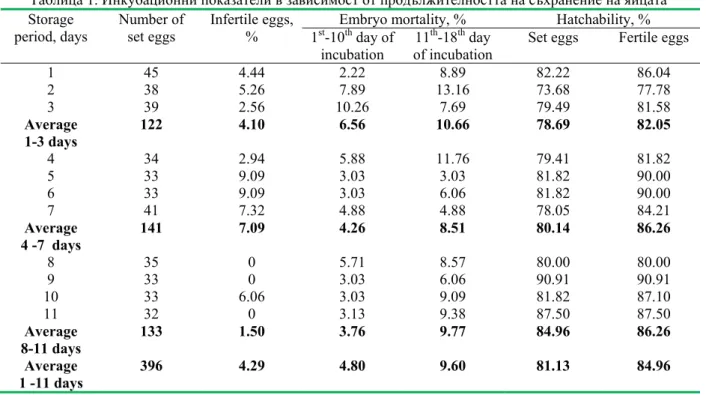
The incubation technology is largely dependent on the main characteristics of hatching eggs and the detailed knowledge of the features of embryonic development. The eggs used in this experiment have the following characteristics: weight – 15.29±0.03 g; shape index – 76.43±0.14%; shell area – 29.42±0.04 cm2; shell thickness 0.23±0.001mm; volume – 30.40±0.07 cm3. One cm2 of shell area corresponded to 42.6±0.23 mg shell weight and 1.03±0.001 cm3 of egg content, whereas 1.99±0.002 cm3 of egg volume weighed 1 g. The thick albumen height was 5.06±0.07 mm and albumen index – 0.118±0.002. The yolk index was 0.469±0.003. The results from incubation in this experiment did not allow drawing any conclusions related to egg storage terms (Table 1). The hatchability of set eggs as well as of fertile eggs was high which is proper for Japanese quails in this stage of the productive cycle (end of the second productive month). The data obtained at each day
of egg storage period, with the exception of the 2ndndnd day, did not show large variations. The higher difference in the hatchability of eggs stored for 2 days was statistically insignifi cant. The average data outline the lower hatchability of newest eggs (up to 3 days), thus opposing to conclusions and recommendations of [10], that quails eggs should not be stored for more than 4 days in order to preserve a higher hatchability. The lower hatchability in our experiment could be related to the intensity of albumen changes occurring within the fi rst 24 hours of fresh egg incubation [3]. According to these authors, the albumen of fresh eggs loses more rapidly its viscosity and increased more quickly its pH. This, in the view of [9] impairs the gas excange and embryo feeding during the fi rst hours of incubation. Depending to the degree of embryonic development, these changes could be fatal for some embryos [19].
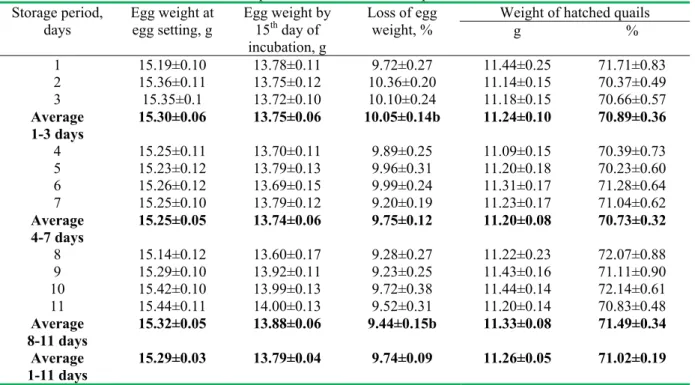
The weight loss between incubation days 0 and 15 in the Pharaoh breed ranged between 9-10.5% of initial egg weight (Table 2). Our results showed a slight effect of egg storage period on weight loss during the incubation. The average values for storage term of 4 to 7 days were by 3% lower compared to older eggs. The difference of weight lost by fresh and old eggs was statistically signifi cant (P<0.01). In this connection, our results differ from the assumption of [3] that weight loss during incubation was not infl uenced by egg storage period. Table 1. Incubation parameters depending on egg storage period
������� 1. ������������ ���������� � ���������� �� ����������������� �� ���������� �� ������ Storage
period, days Number of set eggs Infertile eggs, % 1st-10Embryo mortality, % th day of Hatchability, %
incubation 11
th-18th day
of incubation Set eggs Fertile eggs
1 45 4.44 2.22 8.89 82.22 86.04
2 38 5.26 7.89 13.16 73.68 77.78
3 39 2.56 10.26 7.69 79.49 81.58
Average
1-3 days 122 4.10 6.56 10.66 78.69 82.05
4 34 2.94 5.88 11.76 79.41 81.82
5 33 9.09 3.03 3.03 81.82 90.00
6 33 9.09 3.03 6.06 81.82 90.00
7 41 7.32 4.88 4.88 78.05 84.21
Average
4 -7 days 141 7.09 4.26 8.51 80.14 86.26
8 35 0 5.71 8.57 80.00 80.00
9 33 0 3.03 6.06 90.91 90.91
10 33 6.06 3.03 9.09 81.82 87.10
11 32 0 3.13 9.38 87.50 87.50
Average
8-11 days 133 1.50 3.76 9.77 84.96 86.26
Average
Table 2. Eggs weight (g), loss of egg weight (%), and relative weight (%) of the hatched quails depending on egg storage period
������� 2. ���� �� ������(g), ������ �� ���� (%) � ����������� ���� (%) �� ���������� ��������� � ���������� �� ����������������� �� ���������� �� ������
Storage period,
days Egg weight at egg setting, g Egg weight by 15th day of
incubation, g
Loss of egg
weight, % Weight of hatched quails g %
1 15.19±0.10 13.78±0.11 9.72±0.27 11.44±0.25 71.71±0.83 2 15.36±0.11 13.75±0.12 10.36±0.20 11.14±0.15 70.37±0.49 3 15.35±0.1 13.72±0.10 10.10±0.24 11.18±0.15 70.66±0.57 Average
1-3 days 15.30±0.06 13.75±0.06 10.05±0.14b 11.24±0.10 70.89±0.36 4 15.25±0.11 13.70±0.11 9.89±0.25 11.09±0.15 70.39±0.73 5 15.23±0.12 13.79±0.13 9.96±0.31 11.20±0.18 70.23±0.60 6 15.26±0.12 13.69±0.15 9.99±0.24 11.31±0.17 71.28±0.64 7 15.25±0.10 13.79±0.12 9.20±0.19 11.23±0.17 71.04±0.62 Average
4-7 days 15.25±0.05 13.74±0.06 9.75±0.12 11.20±0.08 70.73±0.32 8 15.14±0.12 13.60±0.17 9.28±0.27 11.22±0.23 72.07±0.88 9 15.29±0.10 13.92±0.11 9.23±0.25 11.43±0.16 71.11±0.90 10 15.42±0.10 13.99±0.13 9.72±0.38 11.44±0.14 72.14±0.61 11 15.44±0.11 14.00±0.13 9.52±0.31 11.20±0.14 70.83±0.48 Average
8-11 days 15.32±0.05 13.88±0.06 9.44±0.15b 11.33±0.08 71.49±0.34 Average
1-11 days 15.29±0.03 13.79±0.04 9.74±0.09 11.26±0.05 71.02±0.19
Note: b-b; Values within columns with common letters differ significantly P<0.01.
Our data for egg weight loss were however lower that data of [21] and previous data of ours (unpublished data) performed with eggs from a breeder fl ock at the same age of the Manchurian Golden breed. A possible reason for this difference could be the various egg shell quality between Pharaoh and Manchurian Golden quails at this age. The eggshell in Pharaoh breed was thicker by 9.6% (P<0.001), and its density – by 4.5% higher (P<0.001) compared to Manchurian Golden quail breed. These facts are a sound reason for reduction of the shell permeability to water vapours during the fi rst 10 days of incubation, when weight loss of Japanese quail eggs was the highest [21].
The observed tendency towards weight loss up to the 15th day had not a serious effect on the relative weight of hatched quail chicks. The relative weight of birds hatched from eggs stored for 1-3 and 4-7 days was practically equal, and the highest difference within this period was 2.1%. The relative weight of quails hatched from old eggs (stored for more than 8 days) was higher compared to the other two terms. The difference however was lower than 0.5%, that does not allow us to assume specifi c reasons for this. The relative weight of hatched quails in this study varied between 70.2-72.1% of initial
egg weight, corresponding to earlier results of [5] in broiler chickens. The relative weight of hatched chicks in this study was on the average by 8% higher than data of [21] obtained in Japanese quails. These data (about 65.4%) were probably due to the longer stay of hatched birds in the incubator prior to being weighed [15]. The detailed investigation of the relationship by means of dispersion analysis showed that the correlation was linear, weak and negative (r= -0.253). This supports the assumptions of [6] about the type of relationship between egg storage terms and egg weight loss during incubation. The strength of the factor egg weight loss up to the 15th day in the determination of the relative weight of hatched quail chicks in this investigation is estimated at 15.9% from the total dispersion of the trait.
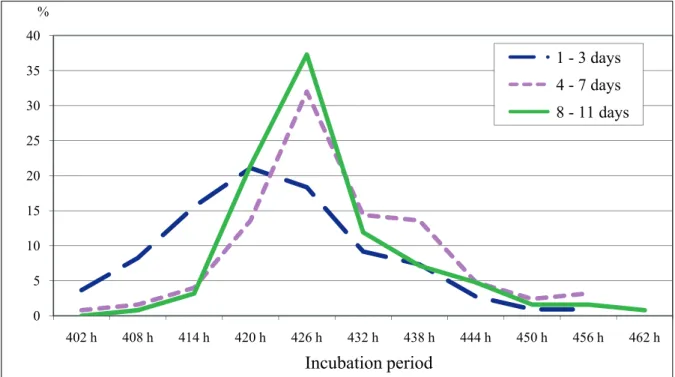
incubation. The period when most eggs hatched at a time, was between the 420th and the 432ndndnd hour of incubation. The shorter incubation period for fresh eggs shifts this stage within the interval of hours 414−426. The study of the link between incubation duration and egg storage term showed a curvilinear relationship with a coeffi cient of curvilinearity L=0.095±0.03 (P<0.01). The correlation was moderate with η=0.378, and the effect of the factor egg storage term upon the determination of incubation length in this experiment was estimated at 14.3% of the total dispersion of the sign.
The grouping of data related to incubation duration in a manner such as to perceive not only the egg storage terms but also the relative weight of hatched quails, showed another stable relationship with statistically signifi cant differences (Table 3). Despite the egg storage
term prior to incubation, quails with high relative weight had a statistically signifi cant shorter period of incubation. This correlation is particularly valid for fresh eggs. The opposite relationship was observed in quails hatched from older eggs and with lower relative weight, whose incubation period was the longest. The difference between these variants was more than 24 hours.
Under optimal conditions, the relative weight of hatched birds could serve as a criterion in the evaluation of the intensity and effi cacy of embryos’ metabolism during the incubation. Thus, the relationship between the relative weight of hatched birds and incubation length is logical as during the last days of incubation, a series of specifi cally successive processes, closely dependent on embryos’ metabolism did occur and without them, the hatching is impossible [17]. Thus, the relative weight could be
��ble 3. Duration of incubation for quails with different relative weight
������� 3. ��������������� �� ����������� � ���������� �� ������������� ���� �� ���������� ���������
Storage
period, days Low Relative weight, %
68.85±0.30 *** 72.33±0.09 *** Middle 74.86±0.18 *** High 72.27±0.20Average 1-3 433.85±3.90 (1) 427.26±2.24 (2) 418.29±2.95 (3) 426.39±1.85 (4) 4-7 439.76±3.39 (5) 431.57±2.08 (6) 426.40±2.38 (7) 432.10±1.57 (8) 8-11 444.00±3.53 (9) 429.00±1.63 (10) 426.00±2.29 (11) 430.34±1.48 (12)
Note: The order of presenting statistical significance is from left to right and from the top to the bottom. Statistical significance * - P<0.05; ** - P<0.01; *** - P< 0.001; 1-3**; 3-7*; 3-11*; 4-8*; 5-6*; 5-7**; 9-10***; 9-11***
Figure 1. Average length of incubation period depending on egg storage period
0 5 10 15 20 25 30 35 40
402 h 408 h 414 h 420 h 426 h 432 h 438 h 444 h 450 h 456 h 462 h %
Incubation period
1 - 3 days 4 - 7 days 8 - 11 days
Figure 2. Relative share of hatched quails during the control period, %
Фигура 2. Относителен дял на излюпените пъдпъдъци през контролния период, %.
regarded not only as a trait characterizing the quality of hatched quail chicks, but also as a factor determining at some extent the incubation length. The analysis by means of the dispersion method showed that this hypothesis is completely possible. Moreover, both factors – egg storage term and relative weight at hatching, complement each other and even enhance their effects upon the determination of the trait incubation length. Evaluating the strength of these factors’ effects, it was established that it was 13.1% of the total dispersion of the studied trait (P<0.001), with a leading role of the factor relative weight of hatched quail chicks.
CONCLUSIONS
The duration of egg storage prior to their incubation had a weak negative effect on the weight loss from incubation day 0 to day 15. Eggs stored for 1-3 days exhibited a statistically signifi cantly higher weight loss than eggs stored for 8-11 days prior to incubation (P<0.001). The duration of egg storage had no effect on relative weight of hatched quail chicks, but infl uences the incubation length. Eggs stored for up to 8 days showed a tendency towards statistically signifi cant (P<0.05) longer period of incubation. The relationship between incubation period length and egg storage term was moderate, curvilinear and the effect of egg storage term was estimated at 14.3%
оf the total dispersion of the trait.
Despite the egg storage term prior to incubation, quails with high relative weight had a statistically signifi cant shorter period of incubation. The analysis of the combined effects of egg storage term and relative weight at hatching on incubation length showed that both factors complemented each other and even enhanced their effects upon the determination of the studied trait. The strength of these factors’ effects was estimated at 13.1% of the total dispersion of the incubation period length (P<0.001), with a leading role of the factor relative weight of hatched quail chicks.
REFERENCES
[1] Ates C., Elibol O. and Brake J., The effect of storage period of eggs on hatching time and broiler performance, in: CD-Rom Abstr. and Proc. of XXII World’s Poult. Congr., Istanbul, Turkеy (2004) N 350.
[2] Belcheva S.Y. and Peltser S.O., Infl uence of egg storage temperature on the development of a chicken embryo during the embryogenesis. Agric. Biol. (1984) 4: 28-30.
[4] Brake J., Relationship of time of feeding and strain to egg shell quality and hatchability in broiler breeders, Poult. Sci. (1988) 67: 538-543.
[5] Burke W., Sex differences in incubation length and hatching weight of broiler chicks, Poult. Sci. (1992) 71: 1933-1938.
[6] Fasenko G.M., Robinson F.E., Hardin R.T. and Wilson J.L., Variability in preincubation embryonic development in domestic fowl. 2. Effect of duration of egg storage period, Poult. Sci. (1992) 71: 2129-2132.
[7] Genchev A., Study of dynamic of growing and respiration of meat type chicken embryos. Thesis for PhD, Trakia University, Stara Zagora, (1997) 186 pp.
[8] Genchev A. and Zelyazkov G., Factors, infl uencing incubation duration in hen embryos. J. Anim. Sci. (1997) (Suppl.), 258-261.
[9] Hurnik G.I., Reinhart B.S. and Hurnik J.F., Relationship between albumen quality and hatchability in fresh and stored eggs, Poult. Sci. (1978) 57: 854-857.
[10] Kara H.and Ipek A., The effect of ultraviolet light application on hatchability parameters of Japanese quail eggs (Coturnix coturnix japonica), in: CD-Rom Abstr. and Proc. of XII Europ. Poul. Conf., Verona, Italy, (2006) N 10191.
[11] Lapao C., Gama L.T. and Chaviero Soares M., Effects of broiler breeder age and length of egg storage on albumen characteristics and hatchability, Poult. Sci. (1999) 78: 640-645.
[12] Lukyanov V., Fortuna V. and Bontar V., Relationship between eggs weight and chickens weight, Poult. (1990) 2: 28-29.
[13] Mather C.M. and Laughlin K.F., Storage of hatching eggs: the effect of total incubation period, Br. Poult. Sci. (1976) 17: 471-479.
[14] Merkurieva E.K., Biometrics in selection and genetics of agricultural animals. Moskow, “Kolos”, 1970, pp. 270-328.
[15] Nir J. and Levanon M., Effect of posthatch holding time on performance and residual yolk and liver composition, Poult. Sci. (1993) 72: 1994-1997.
[16] Okan E., Turkoglu1 M. and Brake J., Optimum turning of broiler hatching eggs during storage and incubation, in: CD-Rom Abstr. and Proc. of XXII World’s Poult. Congr., Istanbul, Turkеy (2004) N 346.
[17] Orlov M.V., The biological control in incubation process, Moskow “Rosselhozizdat”, 3th edition, 1987, p. 222.
[18] Phillips L., Brake J. and Ellner S., Examination of dynamics of weight loss during incubation using a mathematical model, Poult. Sci. (1992) 71, 1(Suppl.):125 (Abstr.).
[19] Reijrink I.A.M., Meijerhof R., Kemp B. and Van Den Brand H., The chicken embryo and its micro environment during egg storage and early incubation, Word’s Poult. Sci. J. (2008) 64, 4: 581-598.
[20] Romanoff, A.L. and Romanoff, D.J., The avian egg. Moskow, “Pishtepromizdat”, 1959, pp. 57-85.
[21] Soliman F.N.K, Rizk, R.E. and Brake, J., Relationship between shell porosity, shell thickness, egg weight loss and development in Japanese quail eggs. Poult. Sci. (1994) 73:1607-1611.
[22] Tona K., Bamelis F., De Katelaere B., Bruggeman V., Moreas V.M.B., Buyse J., Onagbesan O. and Dequypere E., Effects of egg storage time on spread of hatch, chick quality and chick juvenile growth, Poult. Sci. (2003) 82: 736-741.
[23] Ushakov V., Fandeev E., Rud A. and Trishechkin P., Defi nitions of geometrical parameters of an egg, Pticevod. (1996) 5: 22-23.