Bull Pan Am Health Organ 16(i), 1982.
ERADICATION
OF
AEDES AEGYPTZON CAYMAN
BRAC AND
LITTLE
CAYMAN,
WEST INDIES,
WITH ABATE (TEMEPHOS)
IN 1970-197ll
M. B. Nathan2 and M.E.C. Gigliol?
In 1970-1971 an intmive campaign against Aedes aegypti adults and larvae resulted in eradication of this mosquitofrom the Lesser Cayman Islanak. This account of problems encountered and the measures taken to overcome them
provides useful information for those comerned with aegypti eradication.
Introduction
Recent History
In 1948 Giglioli reported an abundance of
Aedes aegypt; on Grand Cayman, the largest of the three Cayman Islands, and recommended control by intradomiciliary residual treatment with DDT (I). These recommendations led to implementation of a yearly cycle of DDT spraying between 1950 and 1954, supple- mented by use of larvivorous fish (Gambusia puncticulata) and kerosene oil in cisterns and water containers (2). In retrospect, it can be seen that eradication of A. aegypti from Grand Cayman was achieved sometime between 1950 and 1953, because surveys conducted in the latter year were negative (3). Larval surveys made in 1966, 1967, and 1968 were also negative (a), indicating its continued eradication; and it appears that the mosquito remained eradicated until 1973, when Grand Cayman suffered a temporary reinfestation (5).
The DDT campaign was not extended to Cayman Brat or Little Cayman despite the presence of A. aeDpti (6). Infestation of these islands was confirmed in 1967 by Giglioli and Ward (7), a finding that led to establishment
lAlso appearing in Spanish in the Bob& de la Oficcina
Sanitaria Panamericana 92(1):18-32, 1982.
2Entomologist, Unite2 ‘Kingdom Medical Research Council.
3Director, Mosquito Research and Control Unit, Cayman Islands Government.
of a port disinsection service on Grand Cayman and initiation of an eradication cam- paign on Cayman Brat and Little Cayman. This article describes the behavior of A. aeapti
on these islands and its successful eradication with Abate@ (Temephos) insecticide in 1970-
1971.
Geography
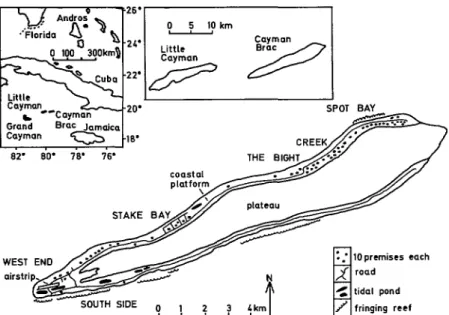
The Cayman Islands consist of three small corraline islands in the northwestern Carib- bean that are more or less equidistant from Cuba and Jamaica (Figure 1). Cayman Brat, with an area of 38 km2 , is 7.6 km east of Little Cayman, which covers 29 km2. The latter, in turn, is situated 109 km northeast of the capi- tal island, Grand Cayman, which has a con- siderably larger area (198 km2).
The two smaller islands are both elongate, but Little Cayman is extensively covered by mangrove swamps, whereas Cayman Brat is dominated by an arid, central, wedge-shaped plateau largely covered by xerophytic vegeta- tion. The plateau, which rises to 43 meters at its eastern end, is almost completely encircled by a low, narrow, inhabited coastal platform.
According to the 1970 census, the Cayman Islands’ total population of 10,249 was distrib- uted as follows: 8,932 on Grand Cayman, 1,297 on Cayman Brat, and 20 on Little Cayman.
A seasonally variable tropical climate pre- vails. The rainy season, from May to October, is characterized by occasional low-pressure
Nathan and Giglioli l A. AEGYPTI ERADICATION ON CAYMAN ISLANDS 29
Figure 1. Maps of the Cayman Islands. The map of Cayman Brat shows the “ribbon development” pattern of premises along the single road of the
coastal platform and the location of the six main communities on the island.
SPOT BAY -2p+
82’ 80’ 78’ 76’ THE RIGHT
caastal
Z;-.C”-;OUTH SIDE o , 2 3 Lkm
I . I 1 J iii] fringing reef
weather systems that provide a major portion of the total rainfall. The mean annual rainfall for Cayman Brat during the years 1970-1973 was 1,083 mm. The annual mean monthly maximum andminimum temperatures ranged from 29 to 33% and from 20 to 25’C, respec- tively, in this period.
The dwindling resident community of Little Cayman lives in semiretirement near the west end of the island. This population is supple- mented by a small dry-season tourist influx that also attracts temporary labor from Cayman Brat. The native population of Cay- man Brat lives in a ribbon development along the north coast (see Figure l), and a small seasonal tourist community exists on the south coast. Employment has traditionally been found in the fishing industry and merchant marine.
Modern houses on the islands are of con- crete block construction, but the older homes are wooden. Most houses on Cayman Brat have electricity, but neither island has a com- munity garbage disposal or water supply sys- tem. Drinking water is collected by roof catch-
ment and is typically stored in 208 liter (55 U.S. gallon) steel drums or concrete cisterns. Well water of varying quality supplements the roof catchment supplies in many homes.
Materials and Methods
General Approach
The policy adopted against aegypt; was that of making a strong logistical buildup and launching an all-out attack. This was done in order to reduce repeated cycles of treatment, to shorten the campaign, and thereby to mini- mize public complaint and opposition. The value of this policy and its results have been discussed in detail elsewhere (5).
30 PAHO BULLETIN l vol. 16, no. 1, 1982
penses amounted to US$21,935 in 1970 and US$10,996 in 1971, the years spanning the full duration of the attack phase.
Mapping
Before the campaign, all premises on the two islands were mapped and sequentially numbered. The 49 premises on Little Cay- man were considered as one area, while the 575 premises on Cayman Brat were divided into six areas on the basis of community or topographic divisions. The resulting maps were updated during each survey and treat- ment cycle.
Survey Techniques and Definitions
Except in the initial survey on Cayman Brat, when alternately numbered premises were searched, A. aegypti abundance was determined by regular Iarval surveys of all ac- cessible premises. All potential breeding foci on the premises, both indoors and out, were methodically examined for the presence of mosquito larvae and pupae.
During the initial survey a count was made of all containers that provided potential sites for breeding foci. The general type of such containers, as well as the presence or absence of water in them, was also noted. After this survey, in which specimens were collected from all foci, trained inspectors only took samples when Aedes-like larvae or pupae were present or the larvae were too small for clear ia
situ examination. Representative specimens from all sampled foci were stored in 70 per cent alcohol for microscopic laboratory exami- nation.
Three standard larval indexes were measured. These were as follows:
1) the premises index (also referred to as the house or Aedes aegypti index), which is the percentage of premises infested;
2) the Breteau index, which is the number of positive containers per 100 premises in- spected; and
3) the container index, which is the percent- age of water-filled containers infested.
During the latter stages of the campaign a weekly ovitrap (8) survey was conducted on Cayman Brat. Positive paddles were im- mersed in water containing a little baker’s yeast to induce hatching, and the larvae were reared to the third or fourth instar for identifi- cation.
Insecticide Application
The susceptibility df wild-caught Aedes ae- gypti to Abate (Temephos) was demonstrated (LD,, = 0.005 ppm) before the campaign (9) and was later checked by Tinker (unpublished data) using insects reared from eggs collected in the field.
As a consequence, and to simplify provision of supplies, Abate was the only insecticide used in the campaign. Both inside and outside walls were given a residual treatment. Painted indoor walls were treated with a 1.5 per cent emulsion of Abate 500E, whilst outdoor walls, unpainted surfaces, and perifocal areas around outdoor water containers were treated with 50 per cent Abate in wettable powder used as a 1.5 per cent suspension. Formula- tions were mixed in the field using available supplies of fresh water from storage vessels or wells on the premises and were applied with Hudson X-Pert pressure sprayers fitted with fan nozzles (Tee Jet J.S.S. 8002) delivering approximately 800 cc per minute and depos- iting 1.6 g of active ingredient per square meter of target.
Nathan and Giglioli l A. AEGYPTZ ERADICATION ON CAYMAN ISLANDS 31
holders, who objected to the taste of Abate in potable water and were apt to blame over- treatment.
Initially, all premises were treated. How- ever, only premises within 100 meters of an infestation were included in subsequent re- treatments.
Results
Types of Breeding Sites
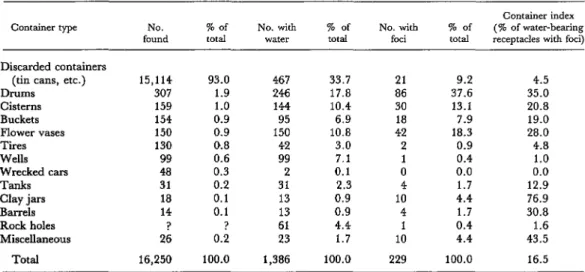
The initial larval survey was conducted in the dry season between January and April 1970. All 49 premises on Little Cayman and 240 (41.7 per cent) of those on Cayman Brat were surveyed. Table 1 shows the relative abundance of all types of potential breeding containers with and without water that were detected and their observed frequency of in- festation with A. aeQpti. Discarded containers (tin cans, glass jars, bottles, plastic containers, and so forth) were plentiful, accounting for 93 .O per cent of all potential breeding sites and 33.7 per cent of all sites containing water. However, they generally offered unfavorable breeding places, their container index being only 4.5 per cent. Drums for holding rain- water were the second most common type of
receptacle, accounting for 1.9 per cent of all the potential breeding sites and 17.8 per cent of the receptacles containing water. In con- trast to the discarded containers, however, their level of infestation was high, the re- corded container index being 35.0 per cent. High container indexes were also recorded for flower vases (28.0 per cent) and rainwater cisterns (20.8 per cent), but these types of con- tainers were less plentiful. Clay jars used for storing drinking water were uncommon (only 18 were found and only 13 contained water). However, these appeared to provide by far the most favorable breeding receptacles, the con- tainer index of infestation being 76.9 per cent. Well-water used for domestic purposes varied considerably in quality; in some areas where this water had low salinity it was used for drinking purposes. In one such well a breeding focus was discovered 3 meters below ground in water with a salinity of 1.2 grams per liter of Cl-. The well was located within 15 meters of a house. Adult A. aeapti were seen resting on the walls of a nearby well, but no other foci were found in any of 97 other wells examined.
The sparsely-soiled substrate of the coastal platform on Cayman Brat, composed of con- solidated coral-sand and limestone deposits,
Table 1. Relative abundance of container types and Aedes ae@ti container indexes at 289 premises on Cayman Brat and Little Cayman before application of insecticide.
Container type
Discarded containers (tin cans, etc.) Drums
Cisterns Buckets Flower vases Tires Wells Wrecked cars Tanks Clay jars Barrels Rock holes Miscellaneous
Total
NO. found
15,114 307 159 154 150 130 99 48 31 18 14 2;
16,250
% of No. with % of No. with % of
total water total foci total
93.0 467 33.7 21 9.2
1.9 246 17.8 86 37.6
1.0 144 10.4 30 13.1
0.9 95 6.9 18 7.9
0.9 150 10.8 42 18.3
0.8 42 3.0 2 0.9
0.6 99 7.1 1 0.4
0.3 2 0.1 0 0.0
0.2 31 2.3 4 1.7
0.1 13 0.9 10 4.4
0.1 13 0.9 4 1.7
? 61 4.4 1 0.4
0.2 23 1.7 10 4.4
100.0 1,386 100.0 229 100.0
Container index (% of water-bearing receptacles with foci)
32 PAHO BULLETIN l vol. 16, no. 1, 1982
provided innumerable rocky depressions and holes capable of holding rainwater. At the time of the initial survey (in the dry season) only 61 were seen to contain water, and only one active focus was found among them. However, during subsequent surveys addi- tional breeding sites in rock holes were dis- covered. Tree-hole breeding, noted else- where in the Caribbean (12, 13), was not en- countered.
Three infested roof-catchment cattle cisterns on Cayman Brat’s plateau were especially in- teresting sites. Their isolation probably pre- cluded unaided colonization, since all were over 400 meters from the nearest habitation and were separated from it by a sheer, wind- swept cliff rising 42 meters high. Therefore, these foci most likely resulted from farmers carrying eggs or larvae to the cisterns in buckets used for transferring water into drink- ing troughs. Since the cisterns were only visited briefly and occasionally by the farmers, adult mosquitoes presumably fed on cattle or other vertebrates near the breeding sites.
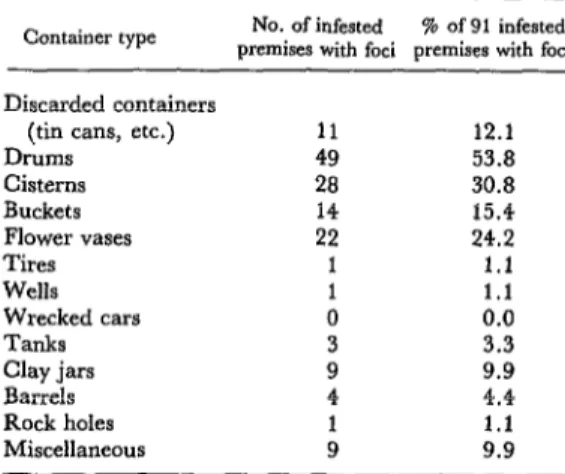
Table 2 shows the relative abundance of foci by container type at the 91 infested premises included in the initial survey. Water-contain- ing drums harbored a large share of the foci contributing to the premises index, infested drums being present at 53.8 per cent of the in-
Table 2. Relative abundances of foci in different containers at 91 infested premises on Cayman Brat and Little Cayman before application of insecticide.
Container type premises with foci Dremises with foci No. of infested ‘70 of 91 infested
Discarded containers (tin cans, etc.) Drums
Cisterns Buckets Flower vases Tires Wells Wrecked cars Tanks Clay jars Barrels Rock holes Miscellaneous
11 12.1
49 53.8
28 30.8
14 15.4
22 24.2
1 1.1
1 1.1
0 0.0
3 3.3
9 9.9
4 4.4
1 1.1
9 9.9
fested premises. Infested cisterns and flower vases (present, respectively, at 30.8 per cent and 24.2 per cent of the infested premises) were next in importance; other foci-bearing containers were of relatively minor signifi- cance .
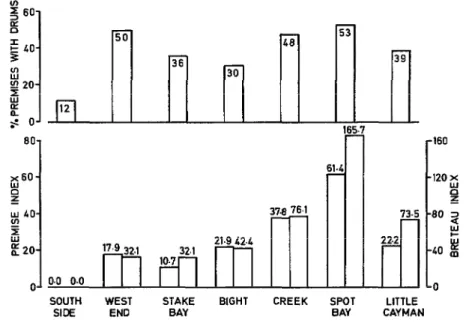
Geographic Distribution of Breeding Sites The initial premises and Breteau indexes obtained for each of the seven aforementioned areas are shown in Figure 2. As may be seen, the indexes varied considerably from one area to another. South Side was the only locality where the indexes were at zero. In the remain- ing areas, the premises index ranged from 10.7 per cent (at Stake Bay) to 61.4 per cent (at Spot Bay); the corresponding Breteau in- dexes were 32.1 and 165.7.
These variations may possibly have been due to differences in the availability of pre- ferred breeding habitats. In particular, dif- ferences in infestation indexes show a correla- tion with the extent to which drums were used for storing rainwater. At one extreme, in the South Side area, drums were only used at 12 per cent of the premises and the premises index was zero. At the other, in the Spot Bay area, 53 per cent of the premises had drums and the premises index was 61.4 per cent. Eradication Chronology
The initial premises index of 31.5 per cent (see Table 3) was based on data obtained from January to May during the dry season of
Nathan and Giglioli l A. AEGYPTZ ERADICATION ON CAYMAN ISLANDS 33
Figure 2. Differences in the premises and Breteau indexes at different localities on Cayman Brat and Little Cayman before applica- tion of insecticide and the relative abundance of
drums used for rainwater storage.
53
1
165.7~60
B w LO 9 3
g20
,160
61
r
SOUTH WEST
SIDE END
STAKE BAY
BIGHT CREEK SPOT LITTLE
BAY CAYMAN
Table 3. Progress of the A&s mgypti eradication campaign on Cayman Brat and Little Cayman, January 1970-April 1972.
Activity Date NO.
inspected
No. with Premises index NO. foci (74 with foci) treated
Initial survey and treatment 1st verification
and treatment 2nd verification and treatment 3rd verification
and treatment 4th verification
and treatment 5th verification
January-June 1970 June-August
1970 September-December
1970 January-February
1971 February-March
1971 June-July
1971 September
1971 November-January
1972 March-April
1972
289 626
627
91 31.5 624
16 2.6 198
39 6.2 151
16 2.5 96
1 0.2 7
0 0.0 0
0 0.0 0
0 0.0 0
0 0.0 0
628
641
641
648
635
654
34 PAHO BULLETIN 9 vd. 16, no. 1, 1982
70 per cent, whereas during the initial survey all the tires had been dry. The onset of the rains also greatly facilitated the location and treatment of previously dry rock holes.
As indicated by the first verification survey (Table 3), the initial treatment reduced the overall premises index from 3 1.5 to 2.6 per cent. However, the second verification survey (begun in September 1970) indicated that the index had risen again to 6.2 per cent. This lat- ter increase probably arose in part from the initial inexperience of new staff members combined with a maximum availability of breeding containers at the end of the rainy season in September and October. One focus, discovered in a previously cleared area, was found to have been started by A. aeg@ti eggs imported from Jamaica in a glazed clay flower vase that had been shipped with a crate of per- sonal effects one month before. At the time of discovery four other containers besides the vase had become infested, but the focus had not spread to adjoining premises.
Treatment of several detected foci was deferred from the second verification and re- treatment cycle to the third because of a delay in the arrival of insecticide supplies, This delay accounted for a significant proportion of the infestations producing the premises index of 2.5 per cent that was recorded by the third verification survey.
The last known focus of A. aegypti was detected during the fom-th verification survey in February-March 1971, 15 months after the campaign began. Four more surveys con- ducted over the next 12 months yielded only negative results.
Treatment of Breeding Places
Even though tin cans, bottles, and other small discarded containers greatly outnum- bered all other potential breeding containers, they harbored only 9.2 per cent of the A. aegypti foci detected by the initial survey. As the campaign progressed, however, it became evident that foci in these small containers (and in rock holes) would be harder to eliminate
than other foci, because such breeding sites were easily overlooked during inspection and treatment procedures.
On the second verification survey a need for cutlasses-used to uncover scattered cans and bottles hidden in thick undergrowth on the periphery of many properties-illustrated the magnitude of the problem. This physical clearing effort led to detection of 19 foci-24.7 per cent of all foci found during the survey.
The difficulty of treating these areas and large piles of garbage with back-pack sprayers was overcome by using a small trailer- mounted power sprayer with a fifteen-meter hose and rod. Operated at a working pressure of 7 kg per cm2, and with an output of 8 liters per minute, this apparatus effectively pene- trated dense foliage and garbage heaps, and in this manner these persistent foci were success- fully eliminated in one treatment. While un- doubtedly overtreating these foci, the method proved both very efficient and economical; and in hindsight one can see that it would have been far more beneficial had it been used at the start of the campaign.
Nine rock-hole foci were detected during the second verification survey. All of these were in shady areas located within 6 meters of buildings. As a result of this finding, during dry weather the spraying of rocky depressions in the yards of re-treated premises was supple- mented by broadcasting a granular formula- tion of the insecticide (in sparing quantities) on likely water settlement areas near build- ings. In this way the granules were scattered into holes and crevices that might otherwise have been missed by the spraymen.
Nathan and Giglioli l A. AEGYPTI ERADICATION ON CAYMAN ISLANDS 35
(owing to a hardened coating of black tar). These two features, which have been corre- lated with attractiveness to Aedes aegypti (14), appeared to favor colonization.
In the case of flower vases used for house- hold decoration, frequent changes of water minimized the effectiveness of treatment. The problem was further aggravated by temporary storage of some of these containers at the time of spraying, thus enabling larval development to take place at a later date when viable eggs were flooded.
Other Mosquito Species
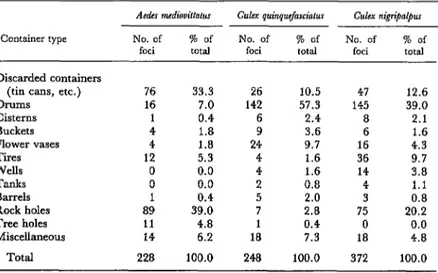
Aedes mediovittatus was the only aedine species with a habitat overlapping that of A. aegypti. A total of 228 foci colonized by this species were found during the campaign, eight in association with A. aegypti foci (Table 4). Rock holes and tin cans were the most com- mon types of refuges, respectively harboring 39.0 and 33.3 per cent of the foci. Eleven breeding places in tree holes were also noted. Details of Culex breeding were recorded on the first and eighth verification surveys. The species most commonly found were Culex nigri- palpus and C. quinquefasciatus. Massive breed-
ing concentrations of the latter were often found in septic tanks; but because A. aegypti does not normally breed in water with such a high organic content, details of these foci were not recorded. With the exception of clay jars, both species were found in all types of con- tainers occupied by A. aeg@ti (see Table 4). Drum breeding sites accounted, respectively, for 57.3 and 39.0 per cent of the observed C. quinquefasciatus and C, nigripalpus foci. The lat- ter species was also commonly found in rock holes.
Other species occasionally encountered were Anopheles grabhamii, Aedes tortilis, Psoropho- ra pygmaea, Psorophom columbiae, Culex sphinx(?),4 and Culex bahamensis. In most instances these species were found in tem- porary ground pools close to a habitation. With the exception of A. tortilis, none are regarded as container breeders.
Ovitrap Surveillance
Following the first negative larval survey in July 1971 (the fifth verification survey), 23 ovitraps were set out at previously infested
4Tentative identification; species not confirmed.
Table 4. Breeding of other mosquito species besides ae&ti around human settlements. (The data for Aedes mediovittatus are from all the larval surveys,
while those for the C&x species are from the first and eighth verification surveys.)
container type No. of 70 of No. of % of No. of % of
foci total foci total foci total
Discarded containers Dtiiscans, etc.) Cisterns Buckets Flower vases Tires Wells Tanks Barrels Rock holes Tree holes Miscellaneous
76 33.3 26 10.5 47 12.6
16 7.0 142 57.3 145 39.0
1 0.4 6 2.4 8 2.1
4 1.8 9 3.6 6 1.6
4 1.8 24 9.7 16 4.3
12 5.3 4 1.6 36 9.7
0 0.0 4 1.6 14 3.8
0 0.0 2 0.8 4 1.1
1 0.4 5 2.0 3 0.8
89 39.0 7 2.8 75 20.2
11 4.8 1 0.4 0 0.0
14 6.2 18 7.3 18 4.8
36 PAHO BULLETIN l vol. 16, no. I, 1982
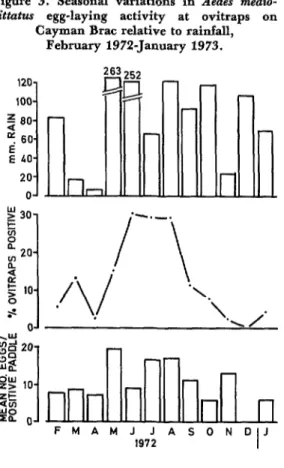
premises along the north coast of Cayman Brat. No A. aegypt; eggs were recovered during 10 weeks of trapping, but a consider- able proportion of the traps were positive for A. mediovittutus, the weekly maximum being 43 per cent.
In February 1972, ovitraps were again set out at 22 houses and were serviced weekly for a year. Again, no A. ae.pti eggs were col- lected, but the program provided an opportu- nity to study the seasonal abundance of A. mediovittatus, a species poorly represented in CDC miniature light trap collections on the island (Nathan, unpublished data). As Figure 3 shows, the monthly percentage of positive ovitraps varied from zero to 30.5 per cent and was generally related to rainfall. Low positivi- ty during the initial months of trapping was associated with dry-season conditions, while increased egg-laying activity in June, July,
Figure 3. Seasonal variations in Aedes medio-
vittutus egg-laying activity at ovitraps on
Cayman Brat relative to rainfall, February 1972-January 1973.
120- 100- 2 ao- ? 60. ii 40. 20- o-
5% .- 10 $5 YP 0 I
FMAMJJASONDJ 1972
and August was preceded by heavy May rains. The reason for the rapid decline in egg- laying toward the end of the year, during the latter part of the wet season (September to November), is unknown. The mean number of eggs per paddle did not vary widely from month to month, there being only a small average increase during the wetter months.
Discussion
A policy of “total” treatment (perifocal, ex- tradomiciliary, and intradomiciliary treatment of all premises) was adopted because it was felt that eradication would be achieved quickly, thereby avoiding the expense of a protracted campaign with extensive re-treatment, high labor costs, declining public cooperation, and possible failure to eliminate A. aepypti. In retrospect, the success of the campaign justi- fied this decision. The increasing reluctance of householders to have their houses re-treated (even though none received more than two treatments) made it imperative to achieve eradication quickly before public opinion turned strongly negative.
This negative change of attitude stemmed partly from public concern about the insecti- cide, despite concerted efforts through public meetings to assure people of its safety. Also, many people objected to the smell in their homes after intradomiciliary spraying and to the taste of treated water. Indeed, some people claimed insecticide-induced digestive and respiratory ailments, although these were not substantiated medically. The decision to treat potable water by volume rather than by con-
tainer capacity helped to minimize the discon- tent, because a consistent treatment concen- tration of 1 ppm was obtained; and it is the authors’ opinion that the taste of the insecti- cide at this low concentration provided no basis for serious complaint.
Nathan and G$ioli . A. AEGYPTI ERADICATION ON CAYMAN ISLANDS 37
hour exposure to plywood panels coated with 2 g of active ingredient per square meter was shown to produce an effective kill for up to 10 weeks (19). Also, field trials in Jamaica showed Abate to give good control when ap- plied as a perifocal or intradomiciliary treat- ment (Tinker, personal communication). This evidence, together with our successful eradica- tion of A. aeu,bti from the lesser Cayman Islands using only Abate at 1.6 g/m* or 1 ppm, has adequately demonstrated the com- pound’s efficacy as an adulticide.
In areas such as Djakarta (20), where in- door breeding predominates, the seasonal tim- ing of anti-aegypti measures probably matters little, since there is little seasonal variation in aegypti’s abundance. However, in areas such as Puerto Rico, where most breeding occurs outdoors (21), perifocal treatment may be more difficult in the dry season than in the wet season because it is harder to locate certain potential foci when they are dry. The failure to control aeg#ti in some parts of Puerto Rico has been attributed to the presence of hidden and inaccessible rock-hole breeding places (22). On Cayman Brat the importance of rock-hole foci, and the difficulty of locating them when dry, was not fully appreciated un- til the onset of the rains mid-way through the first spraying cycle. For this reason, in hind-
sight, it would have been more effective to have commenced treatment during the wet season.
The importance of maintaining a surveil- lance program after eradication was demon- strated on two occasions, once during the lat- ter part of the campaign and once shortly thereafter. The first instance, already dis- cussed, involved importation of viable A. aegypti eggs to Cayman Brat in a crate of household articles. The second occurred on Grand Cayman in early 1973, when that island became reinfested (apparently for the first time in 20 years) despite establishment of an active port disinsection program in 1968 (5). By the time aegypti’s presence was noticed, during a routine six-monthly vigilance survey in June 1973, the mosquito had spread to most areas of Georgetown, the capital. A 16.5 per cent premises index was recorded in the harbor area, and the overall distribution of foci was highly suggestive of reintroduction via this port. Foci were confined to the capital, and their elimination entailed initial treat- ment of 1,073 premises using the methodology adopted on the lesser islands. Only two recur- rent foci, which required the re-treatment of 58 premises, were found on the next verifica- tion survey.
ACKNOWLEDGMENTS
We gratefully acknowledge the technical Mr. Floyd Banks and other staff members of assistance provided by the Pan American the Cayman Islands Mosquito Research and Health Organization and, in particular, the Control Unit for their contribution to the suc- advice and support given by Dr. M. Tinker cess of the campaign.
and Mr. A. Benitez. We also wish to thank
SUMMARY
38 PAHO BULLETIN l ml. 16, no. 1, 1982
A dry-season, pretreatment premises index of 31.5 per cent was recorded. The most common lar- val habitats were steel drums used for rainwater storage, and an association was found between the abundance of these drums and the premises index in different areas. Other important habitats in- cluded cisterns, tires, and rock holes.
Painted indoor walls were treated with a 1.5 per cent emulsion of Abate 500E, while unpainted sur- faces, outdoor walls, and perifocal areas around outdoor water containers were treated with Abate wettable powder used as a 1.5 per cent suspension. All potable water collections from roof catchments or wells were treated with Abate (1 per cent sand
granules) to yield a concentration of 1 ppm. Observation of breeding sites made while the first treatment was being completed (in May and June 1970) revealed a considerable increase in foci with the arrival of wet weather. However, the initial treatment reduced the overall premises index from 31.5 to 2.6 per cent; and although this index later rose again to 6.2 per cent, repeated surveys and re- treatments eliminated all foci in 15 months. Certain types of potential habitats-notably small discarded containers hidden by undergrowth, heaps of con- tainer-bearing garbage, rock holes, rainwater drums, and flower vases-posed special problems.
REFERENCES
(1) Giglioli, G. The Mosquito Problem of Grand Cayman Island in Relation to Recent Advances in Mosquito Control Technique. Mimeographed report to His Majesty’s Colonial Office. 1948, 31 PP.
(2) Ebanks, S. 0. The Health Officer’s Report for 1952: Mosquito Control. Typewritten report to the Cayman Islands Government. 1952, 3 pp.
(3) Rausch, D. Quoted on p. 5 of Report on the Health Conditions of the Cayman Islands during 1953. Chief Medical Officer’s annual report (type- written document). 1953, 6 pp.
(4) Giglioli, M.E.C., E. Garcia, A. Benitez, and M. Nathan. Aedes ae@ti Campaign in the Cayman Islands: Final Verification of Eradication. Mimeo- graphed document. 1972, 28 pp.
(5) Giglioli, M.E.C. Aedes ae..pti Programs in the Caribbean and Emergency Measures against the Dengue Pandemic of 1977-1978: A Critical Review. In Dengue in the Caribbean, 1977. PAHO Scientific Publication No. 375. Pan American Health Organization, Washington, D.C., 1979.
(6) Ebanks, S. 0. Personal communication, 1970.
(7) Giglioli, M.E.C., and R. D. Ward. Unpub- lished data, 1967.
(8) Thaggard, C. W., and D. A. Eliason. Field evaluation of components for an Aedes aellypti (L.) ov,iposition trap. Mosquito News 29:608-612, 1969. (9) Armstrong, J. A. Insecticide studies at the Mosquito Research and Control Unit, Grand Cay- man, B.W.I. Mosquito News 31:1-11, 1971.
(10) World Health Organization. Vector Control in International Health. Geneva, 1972.
(11) Tinker, M. Unpublished data; personal
communication, 1970.
(12) Kellett, F. R., and T. A. Omardeen. Tree hole breeding of Aedes aegypti (Linn.) in Arima, Trinidad, B.W.I. West Indian Med J 6(3):179-188,
1957.
(13) Haber, W. A., and C. G. Moore. Aedes aegypti in the Puerto Rican rain forest: Results of a one-year survey. Mosquito News 33:576-578, 1973.
(14) Bond, H. A., and R. W. Fay. Factors in- fluencing Aedes aegypti occurrence in containers. Mosquito News 29:113-116, 1969.
(15) Brooks, G. D., H. F. Schoof, and E. A. Smith. Effectiveness of various insecticides against Aedes aegypti infestations in water storage drums in U.S. Virgin Islands. Mosquito News 25:423-427, 1965.
(16) Brooks, G. D., H. F. Schoof, and E. A. Smith. Evaluation of five formulations of Abate against Aedes aeapti in Savannah, Georgia, 1965. Mosquito News 26:580-582, 1966.
(17) World Health Organization. Insecticide Resistance and Vector Control: Seventeenth Repoti of the WHO Expert Committee on Insecticides. WHO Techni- cal Report Series No. 443. Geneva, 1970.
(18) Gould, D. J., G. A. Mount, J. E. Scanlon, M. F. Sullivan, and P. E. Winter. Dengue control on an island in the gulf of Thailand: I. Results of an Aedes aegypti control program. Am J Trap Med Hyg
20:705-714, 1971,
(19) Schoof, H. F. Insecticides for use against Aedes aegypti. Bull WHO 36:618-622, 1967.
Nathan and Giplioli l A. AEGYPTI ERADICATION ON CAYh4AN ISLANDS 39
(21) Lee, D., and C. G. Moore. Mosquito (22) Fox, I., A. H. Boike, Jr., and I. Garcia- studies during an inter-epidemic outbreak of Mall. Notes on rock hole breeding and resistance of dengue in Puerto Rico. Mosquito News 33:506-509, Aedes aegypti in Puerto Rico. Am J Trap Med
1973. 9:425-429, 1960.
1981 MEASLES EPIDEMIC IN TRINIDAD AND TOBAGO As of 30 June 1981, the National Surveillance Unit of the Ministry of Health received reports of approximately 3,000 cases of measles (rubeola). Although the number of sources from which communicable disease mor- bidity data is collected increased in 1981, compared to 1980, it is known that a measles epidemic did occur.
Greatest morbidity was observed between weeks 8 through 22, with peak activity (204 cases reported) in weeks 10 and 11. Cumulative data obtained from 13 sentinel physicians showed a trend quite similar to that observed in the data from all sources.
Between weeks 15 through 26,54 per cent (166/309) of the reported mea- sles cases from sentinel physicians had occurred in children between one and four years of age, while 34 per cent (105/309) were in the age group of five to nine years.