Dr. Jo& Manuel Borgofio, ’ Dr. Rosa Greiber,3 E. Heras, B. Carrillo,4 G. Solari, and F. Concha 4
An account is given of five experiments carried out on Chilean children with a view to evaluating the combined effect of measles vaccine and smallpox vaccine by observing the clinical and skin reactions and serologic response to the combination as compared with the same vaccines administered separately.
Introduction
Virological and immunological research on vaccines against measles has produced new and more attenuated live vaccines which cause fewer clinical reactions while maintaining excellent immunogenic power. Simultaneously, significant advances have been made in com- bining these vaccines with the smallpox vaccine. These achievements are of considerable practical interest for the Chilean health services, which have to conduct vaccination programs against both diseases to cope with the country’s epidemiological situation.
A study was made of the clinical reactions produced by the combination Attenuvax- smallpox vaccine; the results were compared with the reactions produced by each vaccine administered separately, and note was taken of the frequency of the different types of skin reaction to the smallpox vaccine component in susceptible children and in children previously vaccinated with smallpox vaccine and showing the scar. The frequency and type of skin reactions was also noted when revaccination was carried out with smallpox vaccine by the multipuncture method in children who had been given the combined vaccine two months before. At the same time the serologic response
lPublished in Spanish in Boletin de Za Uficina Sanitaria Panamericana, Vol. LXX, No. 3 (March 1971), pp. 219-225.
*Chief, Epidemiology Section of the National Health Service (SNS) of Chile; Professor of Preventive Medicine, University of Chile.
3Epidemiologist, Epidemiology Section, SNS. 4Nurse, Epidemiology Section, SNS.
produced by the combined vaccine and by each of the vaccines administered separately was studied by observing the hemagglutination inhibition reaction.
Material Used
The experiment was based on the combined freeze-dried and preblended Attenuvax-small- pox vaccine (Merck Laboratories, batch 285) and the freeze-dried smallpox “Dryvax” vaccine (Wyeth Laboratories, batch 286106). The smallpox vaccine administered intradermally by jet injector is less potent than that used in the multipuncture technique; the vaccine virus con- tent of the combined vaccine is 105.6 PFU. The children vaccinated were between 1 and 5 years of age (average 1.6 years) and they were kept under supervision in the maternal and child consultation center of the National Health Service (SNS), Santiago.
Procedure
The combined vaccine was administered by means of a jet injector fitted with a nozzle leaving a space of 4 mm between the skin and the orifice of the injector. It injects 0.5 ml at a time, 0.1 ml being deposited intradermally to form a blister, and 0.4 ml penetrating more deeply. The measles vaccine was administered subcutaneously only. The smallpox vaccine was inoculated exclusively by the multipuncture technique. Both were diluted in distilled water immediately before use.
16 BOLETIN DE LA OFICINA SANITARIA PANAMERICANA
All the children vaccinated were observed daily for 15 days in their homes by nurses from the University who checked the course of the smallpox vaccine “take” and the general and local reactions to the measles vaccine. They also took the rectal temperature each day. The study was divided into five experiments in accordance with the different objectives laid down (see Annex I).
For the serologic study, blood samples were taken before and 30 days after vaccination. The principles on which the smallpox vaccine take was classified were as follows:
1) Primary vaccination reaction: growth of the vaccinal lesion for eight to 14 days with extensive erythema 2.5 to 5 cm in diameter forming blisters and pustules for 10 to 12 days and developing a scab.
2) Vaccinoid reaction: this reaches its peak 5-6 days following vaccination and is accom- panied by blistering. Erythema is less extensive than in the case of the primary vaccination take, and it subsides rapidly from the sixth day onward.
3) Immunity reaction: occurs between the first and third day following vaccination in the form of a small reddened or indurated area which appears at the site of the vaccination and disappears rapidly.
Findings
Experiment A
The combined vaccine was administered by jet injector to 161 children with negative
histories of measles, measles vaccine, and small- pox vaccine. Of these, 44 were revaccinated two months later with smallpox vaccine alone, by the multipuncture method.
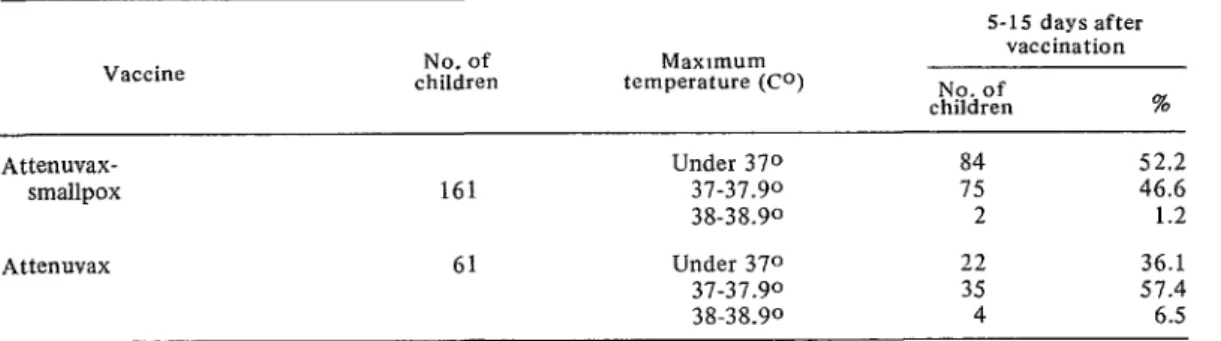
The clinical reactions show that the majority of the children vaccinated with Attenuvax- smallpox vaccine had no fever; 47.8 per cent showed a feverish rise in temperature, only 1.2 per cent of the cases exceeding 38OC. When the Attenuvax vaccine was used alone, similar results were obtained (Table 1).
Analysis of the clinical symptoms reveals no appreciable difference between the effects on the children who received the combined vaccine and those inoculated with the Attenuvax vac- cine only, though the one case of pneumonia attributable to a vaccine reaction occurred in the group of children vaccinated with the combined vaccine (Table 2).
The serologic results showed a conversion rate for the vaccine virus of 97.1 per cent in the 139 initially susceptible children, and for the measles virus 97.2 per cent in the 141 such children (Table 3).
A positive skin reaction was noted in 96.9 per cent (156 children); there were 154 primary vaccination takes; and two children showed immunity reaction (Table 4).
The hemagglutination inhibition titers ranged between l/32 and l/64 in most of the children for the vaccine virus and between l/64 and l/128 for measles, the geometric mean for those vaccinated being 33.0 and 53.6, respec- tively. Two months later, 44 of the children were revaccinated with smallpox vaccine by
TABLE l-Maximum rectal temperatures observed in 161 children vaccinated with Attenuvax-smallpox vaccine and 61 vaccinated with Attenuvax alone, Santiago, Chile, 1969.
5-15 days after Vaccine children No. of temperature (Co) Maxlmum
vaccination No. of
children %
?
t
A’
Attenuvax- Under 370 84 52.2
smallpox 161 37-37.90 75 46.6
38-38.90 2 1.2
Attenuvax 61 Under 370 22 36.1
37-37.90 35 57.4
38-38.90 4 6.5
TABLE 2-Clinical reactions observed in 161 children given the combined vaccine and 61 given Attenuvax, Santiago, Chile, 1969.
Vaccine Respiratory symptoms No. %
Pneumonia Conjunctivitis
No. % No. %
Gastrointestinal symptoms
No. %
Eruption No. %
Total
Attenuvax- smallpox Attenuvax
33 20.5 1 0.62 1 0.6 4 2.5 10 6.2 161
11 18.0 - - 1 1.6 - - 1 1.6 61
multipuncture. The skin reactions were positive in 88.6 per cent (Table 5). The two primary vaccination reactions involved children in whom the combined vaccine had failed to take two months previously.
Experiment B
Subcutaneous inoculation with Attenuvax, by syringe, was performed on 62 children with negative histories of measles and measles vac- cination. The clinical and febrile reactions are summarized in Tables 1 and 2, where they are compared with the reactions caused by the combined vaccine. The serologic response of the 5 1 initially seronegative children was 100 per cent (Table 3). The titer most frequently observed-in 68 per cent of the cases-was l/64, and the geometric mean of the antibody titer was 69.4.
Experiment C
Sixty children with no history of smallpox vaccination were inoculated by multipuncture with dried smallpox vaccine. The serologic response of the 54 initially susceptible children
was positive in 92.6 per cent of the cases (Table 3). All those vaccinated showed skin reactions; 58 per cent had primary vaccination. reactions, and two showed vaccinoid reactions. In other words the takes were 100 per cent (Table 4). The smallpox vaccination was repeated on 41 of the children two months later, again by multipuncture, the following skin reactions being observed: in 39 there was immunity reaction, and in two there was a primary vaccination reaction. These two had a primary vaccination reaction and serum conversion when originally vaccinated (Table 5).
Experiment D
Fifty-nine children with smallpox vaccina- tion scars were inoculated with the combined vaccine, and the fever and skin reactions were observed. Two out of the 59 had primary vaccination reactions, 36 had vaccinoid reac- tions, and 21 immunity reactions. In other words, 100 per cent showed positive reactions. Only 6.8 per cent had a temperature exceeding 37.1°C and the fever never rose as high as 38.1OC.
In 20 of these children with initial positive
TABLE 3-Serum conversion rates in susceptible children 30 days after administration of combined vaccine, Attenuvax and smallpox vaccine, Santiago, Chide, 1969.
Type of vaccine No. of
children
Conversion
No. %
Combined a) Measles 141 137 97.2
vaccine b) Vaccine virus 139 135 97.1
Attenuvax 51 51 100.0
18 BOLETIN DE LA OFICINA SANITARIA PANAMERICANA
TABLE 4-Skin reaction produced by the combined vaccine and by smallpox vaccine alone, Santiago, Chile, 1969.
Vaccine children No. of
Primary vaccination
reaction Vaccinoid reaction Immunity reactlon reaction No
Positive reactions % Attenuvax-
smallpox Smallpox
161 154 0 2 5 96.9
60 58 2 0 0 100.0
serologic reactions to both the smallpox and As already stated, of the 44 children in the measles vaccine, the geometric mean of the group A and the 41 in group C vaccinated by hemagglutination inhibition reaction titers was multipuncture two months after inoculation calculated before and after administration of with the combined vaccine, a large proportion the combined vaccine with a view to deter- showed immunity skin reactions (88.6 per cent mining the serologic booster response. The of the children in group A and 100 per cent of
results were as follows: those in group C).
Geometric mean
Before After
vaccination vaccination Vaccine virus 11.7 21.1 Measles virus 50.2 55.7
Clearly, all have the booster dose effect it was hoped they would have.
Summary
Experiment E
Thirty children with no history of smallpox vaccination were inoculated with smallpox vaccine by the multipuncture technique, and the skin reaction was compared with the reactions of those revaccinated against smallpox during the same period. All the 30 children vaccinated (100 per cent) reacted positively: 28 showed primary vaccination reactions, and two showed vaccinoid reactions.
The article describes the results of a series of five experiments carried out, under the auspices of the National Health Service in Chile, on a group of children 1 to 5 years of age. The purpose was to compare the clinical reactions to a combination of an attenuated measles vaccine and a smallpox vaccine, both freeze- dried, with the reactions to each of the vaccines administered separately. The combined vaccine was jet injected, the measles vaccine was admin- istered subcutaneously, and the smallpox vac- cine by multipuncture.
The new preblended and combmed Attenu- vax-smallpox vaccine administered by jet injec- tion produces general clinical reactions similar to or milder than those caused by each vaccine administered separately. Takes were recorded in 96.9 per cent of the children inoculated with the combined vaccine, which is excellent.
To judge from the rise in the serologic
TABLE 5-Skin reactions in 44 children revaccinated with smallpox vaccine two months after receiving the combined vaccine and in 41 children two months after receiving smallpox vaccine, Santiago, Chile, 1969.
Effects of smallpox revaccination Initial
vaccination
Primary vaccination
reaction
Vaccinoid Immunity No
reaction reaction take
Positive reactions
%
No. of children
Attenuvax- smallpox Smallpox
2 5 32 5 88.6 44
reaction titers for both viruses in the vaccines, there was no evidence of interference between the antigens. The conversion rate for each component closely resembled that obtained when the vaccines were administered sepa- rately, and the geometric mean of the hemag- glutindtion inhibition titers was also very similar in either case.
Revaccination against smallpox of children inoculated two months earlier with the com- bined vaccine produced immunity or vaccinoid
skin reactions consistent with the previous presence of antibodies; similar skin reactions were noted in children revaccinated with small- pox vaccine two months after primary vaccina- tion with the same vaccine. The experiments indicated that the combined Attenuvax-small- pox vaccine can be administered by jet injec- tion without risk, producing minimum clinical reactions and an excellent serologic response, while the administrative advantages are con- siderable. 0
ANNEX I
Summary of the experiments carried out to evaluate the combination Attenuvax-smallpox vaccine, Santiago, Chile, 1969.
Experiment children No. of 0 days O-15 days 28 days 56 days
A No history of measles or vaccina- tion against measles or smallpox
B No history of measles or vaccination against measles
C No history of vaccination against smallpox
D Previously vaccinated against smallpox (showing scar)
E No history of smallpox vaccination 161 62 60 59 30 Take blood sample 12 cc. Jet-inject 0.5 cc Attenuvax-smallpox vaccine (batch 285)
Take blood sample 12 cc. Administer 0.5 cc of Attenuvax (batch 283 A) by synnge
Take blood sample 12 cc. Administer smallpox vaccine (Dryvax) by multipuncture
Take blood sample 12 cc. Jet-inject 0.5 cc of Attenuvax- smallpox vaccine (batch 285)
Observe local lesion and general reaction Observe general reaction Observe local lesion
Observe Take
local lesion blood and general sample reaction 12 cc
Take blood sample 12 cc Take blood sample 12 cc Take blood sample 12 cc
Revaccinate 44 children with smallpox vaccine by multipuncture
Revaccinate 4 1 children with smallpox vaccine by multipuncture
20 BOLETIN DE LA OFICINA SANITARIA PANAMERICANA
REFERENCES Kalabus, F. el al. “Standardization and mass applica-
tion of combined live measles-smallpox vaccine in Upper Volta.” Amer J Epidem 86(l), 1966. Ristori, C. et al. “Vacunacibn combinada contra
sarampi6n y viruela.” Bol Ofic Sanit Panamer 67(4):322-327, 1969.
Ristori, C. et al. “Estudios clinicos y serol6gicos con vacuna antisarampionosa viva mis atenuada
(Moraten) en Chile.” Revista Mkdica de Chile (en prensa) .
Weibel, R. E. et al. “Clinical-laboratory experiences with combined dried live measles-smallpox vac- cine.” Pediatrics 37.913-920, 1966.
Weibel, R. E. et al. “Climcal-laboratory experiences with a more attenuated Ender’s measles virus vaccine (Moraten) combined with smallpox vac- cine.” Pediatrics 43(4), 1969.