*e-mail: [email protected]; [email protected]
Giant Reversible Magnetocaloric Effect in Flower-like
β
-Co(OH)
2Hierarchical
Superstructures Self-assembled by Nanosheets
Xianguo Liua*, Chao Fenga, Feng Xiaoa, Siu Wing Orb, Yuping Sunc, Chuangui Jina, Ailin Xiaa
aAnhui Key Laboratory of Metal Materials and Processing, School of Materials Science and
Engineering, Anhui University of Technology, Ma’anshan 243002, PR China bDepartment of Electrical Engineering, The Hong Kong Polytechnic University,
Hung Hom, Kowloon, Hong Kong
cCenter for Engineering practice and Innovation Education, Anhui University of Technology,
Ma’anshan 243002, PR China
Received: February 15, 2013; Revised: September 4, 2013
A facile hydrothermal strategy is proposed to synthesize lower-like β-Co(OH)2 hierarchical microspherical superstructures with a diameter of 0.5-1.5 µm, which are self-assembled by β-Co(OH)2 nanosheets with the average thickness ranging between 20 and 40 nm. The magnetocaloric effect associated with magnetic phase transitions in Co(OH)2 superstructures has been investigated. A sign change in the magnetocaloric effect is induced by a magnetic ield, which is related to a iled-induced transition from the antiferromagnetic to the ferromagnetic state below the Néel temperature. The large reversible magnetic-entropy change –∆Sm (13.4 J/kg K at 15 K for a ield change of 5 T) indicates that lower-like Co(OH)2 superstructures is a potential candidate for application in magnetic refrigeration in the low-temperature range.
Keywords: magnetic materials, nanocomposites, nanoparticles
1. Introduction
Currently, there is a great deal of interest in utilizing the magnetocaloric effect (MCE) as an alternate technology for refrigeration, replacing the common gas-compression expansion technology, due to higher efficiency and environmental concerns1-11. An ideal material for magnetic
refrigeration should be composed of relatively inexpensive raw materials, have a high MCE demonstrated by a high change in magnetic entropy (∆SM) and a high adiabatic temperature change, and have little or no thermal/magnetic hysteresis1,8. The giant MCE, closely associated with the
irst-order magnetic transition (FOMT), has been observed in different systems1. Unfortunately, the FOMT usually
leads to considerable thermal and magnetic irreversibility which is disadvantageous for application. Therefore, much attention has been recently focused on inding new materials with a large MCE and a small thermal/magnetic hysteresis. A giant MCE has been observed in antiferromagnetic (AFM) systems, originating from a ield-induced transition from a collinear AFM to a triangular AFM [(or ferromagnetic (FM)] state1,11.Furthermore, as the thermal/ magnetic hysteresis is
quite small for AFM systems, compared with giant-MCE ferromagnetic (FM) materials, they may be more suitable for application on the aspect of refrigerant efficiency and energy conservation. In the past decade, there has been a growing interest in the investigation of superstructures self-assembled by nanosheets due to the interesting properties they possess, owing to their high anisotropy and thinness7,12.
A few investigations have been focused on the preparation
and magnetic properties of cobalt hydroxide β-Co(OH)2[1,7].
In this work, we synthesize the flower-like Co(OH)2 hierarchical superstructures self-assembled by nanosheets and study the magnetic and magnetocaloric properties of the superstructures at low temperatures. A giant negative magnetic-entropy change is found together with a ield-induced MCE conversion (the MCE changes its sign in the applied magnetic ield).
2. Experimental Section
Analytically pure reagents were used in this experiment. A mixture was prepared by mixing water, ethanol and glycol amine in 20:1:10 volume ration, and then 0.2 mmol Co(NO3)2·6H2O was dissolved in the 40 mL above mixture under stirring. This solution was stirred for 30 min, after which it was transferred into a 50-mL Telfon-lined stainless tell autoclave. The autoclave was sealed and maintained at 180 °C for 12 h and then cooled to room temperature naturally. The products obtained after hydrothermall treatment were centrifuged, washed with distilled water and ethanol several times and inally dried in vacuum at 60 °C for 4h. The as-prepared sample was characterized by x-ray diffraction (XRD, Bruker D8) and scanning electron microscopy (SEM, JEOL-6300 F) and transmission electron microscopy (TEM, JEOL JEM-2010). The magnetization measurements were carried out using a superconducting quantum interference device (SQUID, Quantum Design MPMS XL-7). The MCE is characterized by the isothermal magnetic-entropy change. By using the Maxwell relation
Materials Research. 2014; 17(1): 186-189 © 2014
OI:
Giant Reversible Magnetocaloric Effect in Flower-like Β-Co(Oh)2 Hierarchical Superstructures Self-assembled by Nanosheets
∂ ∂ = ∂ ∂
( S/ B)T ( M/ T)B, the magnetic-entropy change can be represented as
∂ ∂
∆ = − = =
∂ ∂
∫0 ∫0
( , ) ( , ) ( , 0) B M B
M M M
B T
S M
S T B S T B S T dB dB
B B (1)
3. Results and Discussion
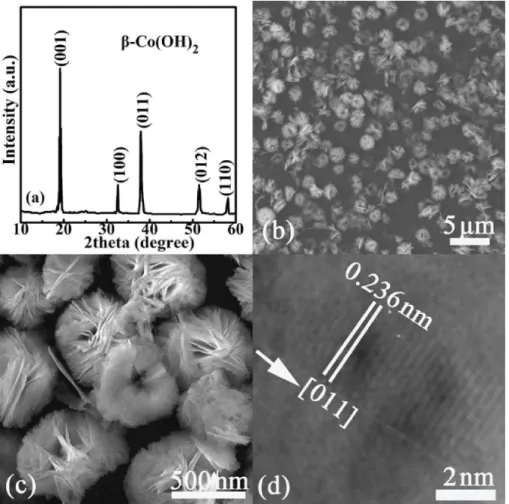
The XRD pattern of the as-synthesized lower-like Co(OH)2 hierarchical supersturcutures is illustrated in Figure 1a. Five obvious diffraction peaks can be easily identified for the (001), (100), (011), (012) and (110) planes of the hexagonal β-Co(OH)2 crystalline structure, respectively. No peaks of any other phases or impurities are detected, suggesting high purity of the as-prepared pink Co(OH)2 sample. Figure 1b, c demonstrate the SEM images of the Co(OH)2 samples with different magniications. The as-synthesized Co(OH)2 sample presents a uniform lower-like microspheres with a diameter of 0.5-1.5µm , as seen from Figure 1b. Furthermore, the magniied SEM images (Figure 1c) demonstrate that three-dimensional lower-like microspheres are self-assembled by lots of Co(OH)2 nanosheets building blocks with the average thickness ranging between 20 and 40 nm. It is worthwhile noting that the as-obtained lower-like Co(OH)2 superstructures
cannot be destroyed and broken into the individual Co(OH)2 nanosheets even after subjecting long-time ultrasonication. In addition, the TEM image in Figure 1d clearly shows that the d-spacing of 0.236 nm corresponds to the lattice plane {011} of β-Co(OH)2.
The temperature dependences of the magnetic susceptibility and the inverse magnetic susceptibility in a magnetic ield of 0.01 T are shown in Figure 2a. A sign of AFM transition at Néel temperature TN≈ 10 K can be found from the 1/χ-T curve, which is lower than the previously reported values of 11 and 12.3 K in References1,8,
respectively. A decrease in TN is observed in many nanosized AFM systems as the grain size decreased1,7.The magnetic
hysteresis loop at 5 K in an applied ield of 5 T is shown in Figure 2b. It can be noticed that the coercivity of 0.014 T is extremely small and the remanent magnetization is close to zero. Furthermore, there is nearly zero magnetic hysteresis in the transition ield. Gd5(Ge1-xSix)4 as a typical giant-MCE material has the magnetic hysteresis of about 1 T near the magnetic-transition temperature10. The small magnetic
hysteresis of β-Co(OH)2 is advantageous for application. In addition, it should be noted that the M-H loop shows step-type line (ield-induced AFM to FM behavior) at 5 K[7].
Figure 2c shows the isothermal magnetization curves of the β-Co(OH)2 superstructures , which are plotted as
Figure 1. (a) XRD pattern, (b) and (c) SEM images with different magniications for the lower-like Co(OH)2 superstructures, and (d) TEM
image of Co(OH)2 nanosheets.
Liu et al.
a function of the applied magnetic ield (ranging from
B = 0 to 5 T) between 4 and 28 K with ∆T = 2 K. Below TN, the magnetization increases gradually with the applied ield in the low-ield range and then jumps at a critical ield but remains unsaturated at 5 T. The step in the magnetization curves indicates a clear ield-induced AFM to FM phase transition1.
A large MCE is expected around TN where the magnetization rapidly changes with varying temperature. The isothermal entropy change is derived from the magnetization data in Figure 2c according to Equation 1. The curves of –∆Sm versus T are given in Figure 2d. It can be seen that, for small magnetic-ield changes, –∆Sm is negative below TN, whereas it changes to small positive values with increasing temperature1. Usually, the inverse
MCE is observed in irst-order magnetic transitions such as AFM/FI, AFM/FM, or collinear AFM/triangular AFM1,11.
The inverse MCE has also been reported in AFM/PM transition systems, in which the applied ield results in a further spin-disordered state near the transition temperature, which increases the conigurational entropy1,13,14.The inset in
Figure 2d presents -∆Sm versus ∆B at 9 K, where a minimum value of –1.62 J/kg K of –∆Sm is found for ∆B=1.7 T. The applied ield destroys the antiparallel alignment of the spin moments, and the spin disorder will result in a negative –∆Sm, becoming more negative with increasing applied ield. However, the value of –∆Sm increases with further increasing magnetic ield due to the ield-induced transition
from the AFM to the FM state and becomes positive at 2.7 T. The ield-induced AFM to FM transition is responsible for the conversion from the inverse to the conventional MCE in β-Co(OH)2. The maximum of –∆Σm of 13.4 J/kg K at K for ∆B = 5T, which is comparable with giant MCE reported for La-Fe-Si, MnAs and Mn-Fe-P based alloy15. The
slope of the curve in Figure 2d is relatively small, and the smooth variation in –∆Sm with temperature is more useful than a sharp one, which is another property that makes it a promising magnetic refrigerant.
4. Conclusions
In summary, we propose an eficient synthetic strategy to synthesize the flower-like Co(OH)2 hierarchical superstructures, which are self-assembled by Co(OH)2 nanosheets. This material displays a large magnetic entropy change of 13.4 J/kg K almost without hysteresis at 15 K in a magnetic ield change of 5 T, thereby indicating the suitability of this material for use in magnetic refrigeration.
Acknowledgements
This study has been supported partly by the National Natural Science Foundation of China (Grant Nos. 51201002, 11204003 and 21071003), by the Research Grants Council of the HKSAR Government (PolyU 5236/12E), and by The Hong Kong Polytechnic University (G-YK59 and 4-ZZ7L). Figure 2. (a) Temperature dependence of the magnetic susceptibility and the inverse magnetic susceptibility of Co(OH)2 measured at an
applied magnetic ield of 0.01 T. (b) Magnetic hysteresis loop of at 5 K in applied ields up to 5 T. Inset: the hysteresis loop at 5 K in low
ields. (c) Magnetic isotherms of Co(OH)2 measured between 4 and 28 K with a temperature step of 2 K. (d) Negative magnetic-entropy
change –∆Sm verse temperature T curves for different magnetic ield changes (∆B). Inset: –∆Sm as a function of ∆B at 9 K.
Giant Reversible Magnetocaloric Effect in Flower-like Β-Co(Oh)2 Hierarchical Superstructures Self-assembled by Nanosheets
References
1. Liu XH, Liu W, Hu WJ, Guo S, Lv XK and Cui WB.
Giant reversible magnetocaloric effect in cobalt hydroxide
nanoparticles. Applied Physics Letters. 2008; 93(20):202502. http://dx.doi.org/10.1063/1.3028337
2. Liu XG, Geng DY, Du J, Ma S, Li B, Shang PJ et al. The
large cryogenic magnetocaloric effect of TbAl2 nanocapsules.
Scripta Materilia. 2008; 59(3):340-343. http://dx.doi. org/10.1016/j.scriptamat.2008.04.005
3. Liu XG, Geng DY, Zhang Q, Jiang JJ, Liu W and Zhang ZD.
Microstructure and magnetic properties of graphite-coated Gd
nanocapsules. Applied Physics Letters. 2009; 94(10):103104. http://dx.doi.org/10.1063/1.3100618
4. Liu XG, Or SW, Li B, Ou ZQ, Zhang L, Zhang Q et al. Magnetic
properties of Dy nanoparticles and Al2O3-coated Dy nanocapsules. Journal of Nanoparticle Research. 2011; 13(3):1163-1174. http://dx.doi.org/10.1007/s11051-010-0108-y
5. Liu XG, Geng DY, Jiang JJ, Li B, Ma S, Li D et al. Magnetic
properties and large cryogenic low-iled magnetocaloric effect
of HoCo2 nanoparticles without core/shell structure. Journal of Nanoparticle Research. 2010; 12(4): 1167-1172. http://dx.doi. org/10.1007/s11051-009-9717-8
6. Liu XG, Li B, Geng DY, Shi CX, Yang F, Kang DJ et al.
Formation and large cryogenic magnetocaloric effect of HoAl2/Al2O3 nanocapsules. Journal of Physics D: Applied Physics. 2009; 42(4):045008. http://dx.doi.org/10.1088/0022-3727/42/4/045008
7. Shamba P, Zeng R, Wang JQ and Dou SX. A sign of
ield-induced irst order magnetic state transition and giant reversible
magnetocaloric effect in cobalt hydroxide nanosheets. Journal of Applied Physics. 2010; 107(9):09A919.
8. Takada T, Bando Y, Kiyama M and Miyamoto H. The
magnetic property of β-Co(OH)2. Journal of Physical Society of Japan. 1966; 21(2):2726-2727. http://dx.doi.org/10.1143/ JPSJ.21.2726
9. Samanta T, Das I and Banerjee S. Giant magnetocaloric
effect in antiferromagnetic ErRu2Si2 compound. Applied Physics Letters. 2007; 91(15):152506. http://dx.doi. org/10.1063/1.2798594
10. Pecharsky VK and Gschneidner KA Jr. Giant magetocaloric effect
in Gd5(Si2Ge2). Physial Review Letters. 1997;
78(23):4494-4497. http://dx.doi.org/10.1103/PhysRevLett.78.4494
11. Du J, Cui WB, Zhang Q, Ma S, Xiong DK and Zhang ZD. Giant
magnetocaloric effect in ε-(Mn0.83Fe0.17)3.25Ge antiferromagnet. Applied Physics Letters. 2007; 90(4):042510. http://dx.doi. org/10.1063/1.2432274
12. Hu JQ, Bando Y, Zhan JH, Li YB and Sekiguchi T.
Two-diemnsional micrometer-sized single-crystalline ZnO thin
nanosheets. Applied Physics Letters. 2003; 83(21):4414-4416. http://dx.doi.org/10.1063/1.1629788
13. Hu WJ, Du J, Li B, Zhang Q and Zhang ZD. Giant anomalous
magnetocaloric effect in DySb Ising antiferromagnet.
Applied Physics Letters. 2008; 92(19):192505. http://dx.doi. org/10.1063/1.2928233
14. Krenke T, Duman E, Acet M and Wassermann EF. Inverse magnetocaloric effect in ferromagnetic Ni-Mn-Sn alloys.
Nature Materials. 2005; 4: 450-454. http://dx.doi.org/10.1038/ nmat1395
15. Sandeman KG. Magnetocaloric materials: The search for
new systems. Scripta Materialia. 2012; 67(6):566-571. http:// dx.doi.org/10.1016/j.scriptamat.2012.02.045