Page 1 of 18
© The Author 2017. Published by Oxford University Press on behalf of the Maryland Psychiatric Research Center. All rights reserved. For permissions, please email: [email protected]
Prevalence of Catatonia and Its Moderators in Clinical Samples: Results from a
Meta-analysis and Meta-regression Analysis
Marco Solmi*,1,2, G. Giorgio Pigato3, Beatrice Roiter1, Argentina Guaglianone1, Luca Martini1, Michele Fornaro4, Francesco Monaco2, Andrè F. Carvalho2,5, Brendon Stubbs2,6,7, Nicola Veronese2,8, and Christoph U. Correll2,9,10
1Psychiatry Unit, Neuroscience Department, University of Padua, Padua, Italy; 2Institute for Clinical Research and Education in
Medicine, Padua, Italy; 3Psychiatry Unit, Azienda Ospedaliera di Padova, Padua Hospital, Padua, Italy; 4Section of Psychiatry, Department of Neuroscience, Reproductive Sciences and Odontostomatology, Federico II University, Naples, Italy; 5Translational Psychiatry Research Group and Department of Clinical Medicine, Faculty of Medicine, Federal University of Ceará, Fortaleza, Brazil; 6Physiotherapy Department, South London and Maudsley NHS Foundation Trust, London, UK; 7Health Service and Population
Research Department, Institute of Psychiatry, Psychology and Neuroscience, King’s College London, London, UK; 8National Research Council, Ageing Branch, Padua, Italy; 9Department of Psychiatry Research, The Zucker Hillside Hospital, Northwell Health, Glen Oaks, NY; 10Department of Psychiatry and Molecular Medicine, Hofstra Northwell School of Medicine, Hempstead, NY
The Behavioral Neurogenetics Center, The Edmond and Lily Safra Children’s Hospital, Sheba Medical Center, Tel Hashomer 52621, Israel; tel: 972-3-530-2663; fax: 972-77-349-8317, e-mail: [email protected]
*To whom correspondence should be addressed; Psychiatry Unit, Neuroscience Department, University of Padua, via Giustiniani 2, Padua, Italy 35124; tel: +39-0498213831, fax: +39-0498218256, e-mail: [email protected]
Catatonia is an independent syndrome that co-occurs with several mental and medical conditions. We performed a sys-tematic literature review in PubMed/Scopus until February 2017 and meta-analyzed studies reporting catatonia preva-lence. Across 74 studies (cross-sectional = 32, longitudi-nal = 26, retrospective = 16) providing data collected from 1935 to 2017 across all continents, mean catatonia preva-lence was 9.0% (k = 80, n = 110 764; 95% CI = 6.9–11.7, I2 = 98%, publication bias P < .01), decreasing to 7.8% (k = 19, n = 7612, 95% CI = 7–8.7, I2 = 38.9%) in a sub-group with low heterogeneity. Catatonia prevalence was 23.9% (k = 8, n = 1168, 95% CI = 10–46.9, I2 = 96%) in patients undergoing ECT/having elevated creatinine phos-phokinase. Excluding ECT samples, the catatonia preva-lence was 8.1% (k = 72, n = 109 606, 95% CI = 6.1–10.5, I2 = 98%, publication bias P < .01), with sensitivity analy-ses demonstrating that country of study origin (P < .001), treatment setting (P = .003), main underlying condition (P < .001), and sample size (P < .001)moderated catato-nia prevalence, being highest in Uganda (48.5%, k = 1) and lowest in Mexico (1.9%, 95% CI = 0.4–8.8, I2 = 67%, k = 2), highest in nonpsychiatric out- or inpatient services (15.8%, 95% CI = 8.1–28.4, I2 = 97%, k = 15)and lowest in psychiatric outpatients services (3.2%, 95% CI = 1.7– 6.1, I2 = 50%, k = 3), highest in presence of medical or neurological illness with no comorbid psychiatric condition (20.6%, 95% CI = 11.5–34.2, I2 = 95%, k = 10)and low-est in mixed psychiatric samples (5.7%, 95% CI = 4.2–7.7,
I2 =98%, k = 43), highest in studies with sample sizes <100 (20.7%, 95% CI = 12.8–31.6, I2 = 90%, k = 17) and lowest in studies with sample sizes >1000 (2.3%, 95% CI = 1.3–3.9, I2 = 99%, k = 16). Meta-regression showed that smaller sample size (P < .01) and less major depressive disorder (P = .02) moderated higher catatonia prevalence. Year of data collection did not significantly moderate the results. Results from this first meta-analysis of catatonia frequencies across time and disorders suggest that catato-nia is an epidemiologically and clinically relevant condition that occurs throughout several mental and medical condi-tions, whose prevalence has not decreased over time and does not seem to depend on different rating scales/criteria. However, results were highly heterogeneous, calling for a cautious interpretation.
Key words: catatonia/meta-analysis/DSM5/severe
mental illness/prevalence Introduction
Catatonia is a complex psychopathological and clinical condition.1 The difficulties in the clinical diagnosis, con-ceptualization, and management of catatonia have been described as “the catatonic dilemma.”2,3 Clinical manifesta-tions of catatonia are extremely heterogeneous and at least 40 separate signs of catatonia have been described,4 mak-ing recognition challengmak-ing with frequent misdiagnoses.5
Downloaded from https://academic.oup.com/schizophreniabulletin/advance-article-abstract/doi/10.1093/schbul/sbx157/4626666 by Universidade Federal do Cear� user
Page 2 of 18 M. Solmi et al
The nosological conceptualization of catatonia ranges from the original concept catatonia as an independent syndrome as per Kahlbaum and Heckers, to the inclusion of catatonia into Kraepelin’s nomenclature of demen-tia praecox (although he acknowledged Kahlbaum’s theory, but coming to different nosology though), which influenced various diagnostic classifications to include a catatonia subtype of schizophrenia.6 Despite Bleuler’s assimilation of catatonia as a feature of schizophrenia, and despite DSM-III and -IV including the subtype of catatonic schizophrenia, which each ignored Taylor and Abrams’s reports describing a high frequency of cata-tonia in bipolar disorder (BD) rather than schizophre-nia, the literature as well as DSM-5 gradually, but only partially,6,7 acknowledged Kahlbaum’s and Hecker’s original categorization of catatonia as an independent syndrome.8,9
In recent years, catatonia has accrued renewed inter-est in clinical research, as shown by an exponentially growing number of published studies (from a total of 1660 hits with “catatonia” search in PubMed from data-base inception until 2000, 546 from 2000 to 2010, and 738 just between 2010 and May 2017). Some authors10–15 proposed refined criteria to identify catatonia as a self-standing syndrome with its core clinical features that can be addressed by effective therapies, such as benzodiaz-epines (BDZs) and electroconvulsive treatment (ECT).1 However, international classification systems of psychi-atric diseases have only partially accepted these propos-als. In 2013, the Diagnostic and Statistical Manual of Psychiatric Disorders (DSM5)16 classified catatonia not as separate syndrome but as a “specifier,” which may occur among virtually all psychiatric disorders (mainly neurodevelopmental, psychotic, and mood disorders) as well as medical conditions and which may be associated to drug treatments (mainly antipsychotics). However, a change toward catatonia as an independent syndrome has been considered, but not made yet.9
Due to the fact that theoretical frameworks, noso-logical concepts, and rating scales/criteria used to diagnose catatonia have changed across time, and since pharmacological treatments for a wide range of nonpsychotic conditions shifted from mainly first-gen-eration antipsychotics (FGAs) to second-genfirst-gen-eration antipsychotics (SGAs) that are associated with less extrapyramidal symptoms (with EPS being a risk fac-tor for catatonia),17,18 it may be expected and has been described that the epidemiology of catatonia may have decreased over time.19,20
However, data on time trends are scarce and isolated and the prevalence of catatonia likely varies based on several factors, including the specific population and sampling frame, underlying diagnoses, definition of cata-tonia, country/continent of study origin, and time of the study, which may also be related to differences in specific medication and dosing patterns of antipsychotics.
Recent studies have reported that the prevalence of catatonia rates is around 10% among acute psychiatric inpatients,10,21 with apparently different prevalence ranges according to the underlying or comorbid condition, ie, 4%–67% for schizophrenia, 14%–71% for mood disor-ders, and 4%–46% for medical conditions.
As an additional complication, however, is that cata-tonia definitions vary according to the number, dura-tion, definidura-tion, and severity of signs and symptoms, with different criteria having been used in different stud-ies. Moreover, there are several different rating scales or catatonia criteria definitions that have been proposed to detect and measure catatonic symptomatology. A recent narrative review of different catatonia scales which have been used/developed in the last 3 decades22 identified the following: Modified Rogers Scale (MRS) in 1991,23,24 Rogers Catatonia Scale revised (RCS) in 1996,25 Bush– Francis Catatonia Rating Scale (BFCRS) in 1996,4 Northoff Catatonia Rating Scale (NCRS) in 1999,26 and the Catatonia Rating Scales in 2000.27 In addition, Carrol also proposed the Kanner Scale in 2000.28 Furthermore, frequencies of catatonia measured with these different rating scales may differ substantially (range: 3.4% to 10.3%).29 Despite the heterogeneous nature and theo-retical background of the above-mentioned rating scales, which could raise the concern about the validity of the measured clinical syndrome, they have all shown high sensitivity/specificity.
Moreover, some studies have reported changes in rates of catatonic schizophrenia during different time periods at single sites,19,30 suggesting that at least catatonic schizo-phrenia may have become less common during the course of the 20th century. However, this supposedly decreased incidence may be influenced by several factors, including the selection of the type and dose regimen of FGAs or SGAs, to rating scales/criteria used to diagnose catatonia, or likelihood of misdiagnoses (secondary to neuroleptic malignant syndrome or rapid BDZ/anti-parkinsonian agent discontinuation), which has not been systematically and quantitatively assessed.13,31
Since the epidemiology of catatonia remains poorly investigated and has not been systematically evaluated, we conducted a systematic review and meta-analysis plus moderator analysis of the prevalence of catatonia and of potential moderators.
Methods
Search Strategy and Study Selection
This systematic review adhered to the MOOSE guide-lines32 and PRISMA statement.33
Four authors divided into two pairs (GP, AG, BR, LM) independently searched PubMed, and Scopus from database inception until February 11, 2017, using the following search terms: (“catatonia” [MeSH Terms] OR “catatonia” [All Fields]) OR (“catatonia” [MeSH Terms]
Downloaded from https://academic.oup.com/schizophreniabulletin/advance-article-abstract/doi/10.1093/schbul/sbx157/4626666 by Universidade Federal do Cear� user
Page 3 of 18 OR “catatonia” [All Fields] OR “catatonic” [All Fields]).
We also checked the reference list of included articles and of relevant reviews. Studies were deemed eligible if they reported the prevalence of catatonia, or data allowing to compute it, in a psychiatric or medical clinical sample, with data gathered after 1935.
Data Extraction
Four authors divided into two pairs (GP, AG, BR, LM) independently extracted data, using a predetermined extraction form, including: catatonia prevalence (or vari-ables needed to compute it), author, year of publication, year of data collection, country/continent of data collec-tion, study design, setting, demographic characteristics, underlying main condition, employed catatonia rating scale used to diagnose catatonia, and percentage of sub-jects diagnosed with schizophrenia, major depressive disorder (MDD), BD, or other primary diagnoses, and prescription of FGAs or SGAs.
Quality Assessment
Two authors (BR, MS) independently assessed the qual-ity of included studies with the Newcastle-Ottawa Scale (NOS), with a score of ≤5 (out of 9) indicating high risk of bias.34
Meta-analysis
Due to the anticipated heterogeneity, we utilized a random effects meta-analysis and calculated pooled prevalence and 95% confidence intervals (CIs) with comprehen-sive meta-analysis (CMA, version 3). Heterogeneity was assessed with the Cochrane Q and I2 statistics for each analysis.35 We conducted meta-regression analyses with CMA for outcomes with high heterogeneity (I2 > 50% and/or P < .05) and reported by ≥4 studies to investigate potential moderators of the observed catatonia preva-lence. We conducted sensitivity analyses according to country, continent, rating scale/criteria used to define catatonia, treatment setting (nonpsychiatric out- or inpatient units, psychiatric inpatient units or psychiat-ric outpatients services), period of data collection, main underlying/co-morbid clinical condition (specific psychi-atric diagnosis, or absence of any psychipsychi-atric condition, ie, medical/neurological condition) and quality of the study (post hoc, using the NOS score >5 as the thresh-old for high quality studies). We also investigated the fol-lowing moderators: sample size, year of data collection, mean age, percentage of males, percent of subjects with schizophrenia, with mood disorders, with MDD, with BD, taking antipsychotics (FGAs and/or SGAs).
Publication bias was assessed via visual inspection of funnel plots and with the Begg–Mazumdar Kendall’s tau36 and Egger bias test.37 In case that publication bias was suspected, we calculated the trim and fill adjusted
analysis38 to remove the most extreme small studies from the positive side of the funnel plot, and recalculated the effect size at each iteration until the funnel plot was sym-metric around the (new/adjusted) effect size.
Whenever studies reported more than one prevalence result, providing frequencies for different catatonia crite-ria/rating scales, we averaged the frequencies to yield one single prevalence result for these studies and avoid double counting of subjects in the main analyses.
Given the fact that studies restricted to patients under-going ECT or those with elevated levels of creatinine phosphokinase (CPK) inherently contain a selection bias toward higher catatonia prevalence in these enriched samples, we reported outcomes separately in these stud-ies and the remaining ones not restricting their samples in this way. Thereafter, we conducted a comprehensive series of subgroup analyses or sensitivity analyses, adding also treatment setting (nonpsychiatric in- or outpatient services and psychiatric in- and outpatient units or ser-vices) and subgroups of studies with ascending numbers of included patients (as we found that sample size had a significant effect on the catatonia prevalence (ie, n ≥ 100,
n ≥ 200, n ≥ 300, n ≥ 500, n ≥ 750, n ≥ 1000) in order to find possible explanations of the high observed heterogeneity. Finally, we trimmed down the same number of studies on both sides of the catatonia point prevalence of the studies not focusing on ECT/elevated CPK samples in an ascend-ing fashion until we had a final study sample without sig-nificant heterogeneity, reporting this post hoc exploratory result in comparison to the overall prevalence to provide a benchmark of a nonheterogeneous catatonia preva-lence estimate not influenced by outliers with overly high or low results, assessing the range and robustness of our primary findings.
Results
Search Results
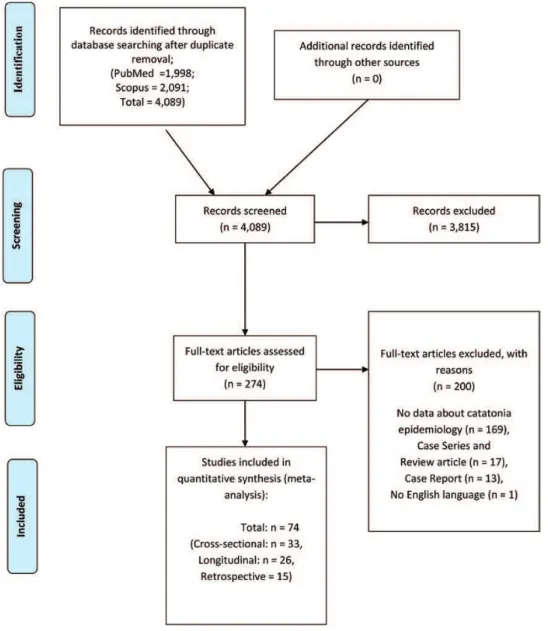
Out of initial 4089 hits in PubMed and Scopus after duplicate removal, 3813 studies were excluded after title/ abstract reading. Full text articles of 276 studies were assessed, with further exclusion of 201 studies due to several reasons specified in figure 1. Finally, we included 73 studies that provided data about the prevalence of catatonia.20,21,26,29,39–107
Characteristics of Included Studies
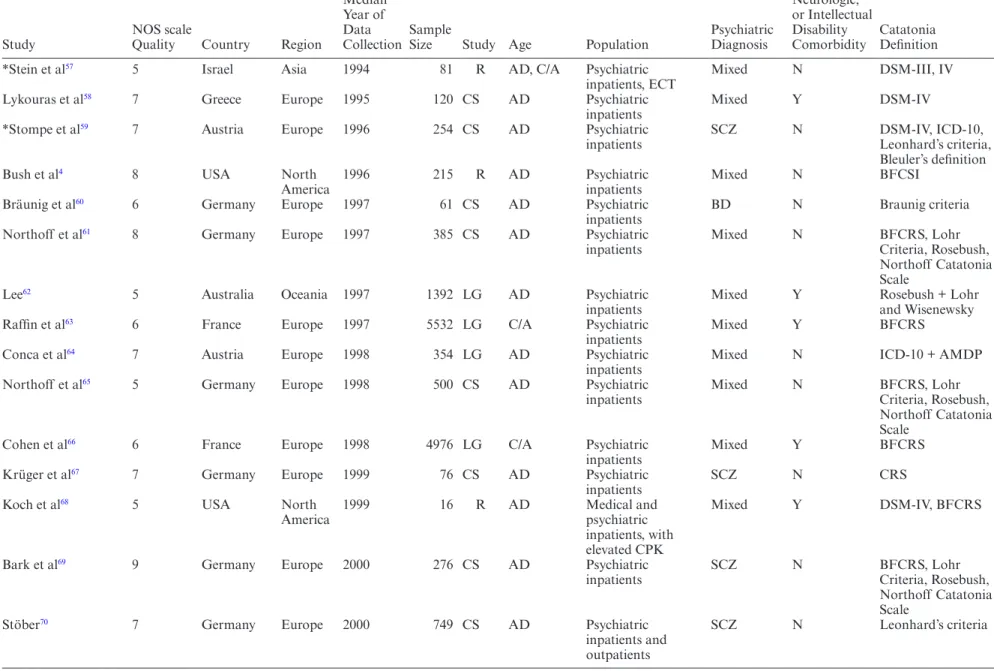
All included studies’ main features are reported in table 1. We included 73 studies with a total population of 110 559 subjects from 99 individual samples. Studies were conducted across all continents, with median year of data collection ranging from 1935 to 2017. The majority of studies, 55, included psychiatric inpatients, 7 described patients undergoing ECT, 4 studies provided data from psychiatric consultation services, 4 involved outpatients,
Downloaded from https://academic.oup.com/schizophreniabulletin/advance-article-abstract/doi/10.1093/schbul/sbx157/4626666 by Universidade Federal do Cear� user
Page 4 of 18 M. Solmi et al
while 3 studies included medical inpatients. The popula-tions included subjects with several psychiatric condipopula-tions in 36 studies, while the sample was limited to patients diagnosed with schizophrenia in 26 studies, BD in 4 stud-ies, autism in 2 studstud-ies, and postpartum psychosis in a single study. A comorbid medical or neurological con-dition was present in 26 studies. Catatonia was defined according to Bush-Francis scales (k = 25), DSM-any version (k = 24), ICD-any version (k = 11), Lohr’s crite-ria (k = 7), Rosebush’s criteria (k = 7), Catatonia Rating Scales (k = 4), Leonhard’s criteria (k = 4), Northoff ’s cri-teria (k = 3), Modified Rogers Scale (k = 3), Catatonia Scale Instrument (k = 2), Fink and Taylor’s criteria (k = 2), Bleuler’s criteria (k = 2), or Carrol’s criteria (k = 1), while no validated tool was used in 11 studies. Europe was the most represented continent (k = 40), fol-lowed by Asia (k = 19), North America (k = 7), Africa (k = 3), Oceania (k = 2), and South America (k = 2).
The design of the study was cross-sectional (k = 32), lon-gitudinal prospective (k = 26), or retrospective (k = 15). The mean Newcastle-Ottawa scale quality score across all studies was 5.6 ± 1.5 (out of a range from 1–9), indicating medium risk of bias.
Meta-analysis of Catatonia Prevalence, Publication Bias, Heterogeneity in the Whole Sample
Results of meta-analysis are reported in detail in table 2. The overall pooled catatonia prevalence across 80 samples from 74 studies (some studies reported results from samples in different countries or time periods) and 110 774 individuals was 9.0% (95% CI = 6.9– 11.7, I2 = 98%). Heterogeneity was high (I2 = 98%,
P < .0001). Publication bias was present according to Egger’s test (5.18, P < .01) and visual funnel plot inspection (figure 2), and results increased to 12.6% Fig. 1. PRISMA flowchart.
Downloaded from https://academic.oup.com/schizophreniabulletin/advance-article-abstract/doi/10.1093/schbul/sbx157/4626666 by Universidade Federal do Cear� user
P
a
ge 5 of
18
Catatonia Pr
ev
alence Meta-analysis
Table 1. Study, Sample and Catatonia Definition Characteristics of Included Studies (Organized by Median Year of Data Collection)
Study
NOS scale
Quality Country Region
Median Year of Data Collection
Sample
Size Study Age Population
Psychiatric Diagnosis
Medical, Neurologic, or Intellectual Disability Comorbidity
Catatonia Definition
Baran et al39 3 Hungary Europe 1935 23 LG AD Psychiatric
inpatients, ECT
Mixed N ICD-10
Flekkoy40 4 Norway Europe 1956 72 CS AD Psychiatric
inpatients
SCZ N Study-defined criteria
*Guggenheim and Babigian41
6 USA North
America
1963 39475 CS AD Psychiatric
inpatients
Mixed, SCZ N Study-defined criteria
Kimura et al42 4 Japan Asia 1967 173 LG C/A Psychiatric
outpatients
SCZ N Study-defined criteria
Kleinhaus et al43 8 Israel Asia 1970 568 LG AD Psychiatric
inpatients
SCZ N ICD-10
Petho et al44 8 Hungary Europe 1971 276 LG AD Psychiatric
inpatients
Mixed N Leonhard’s criteria
Bland45 4 USA North
America
1972 1556 CS AD Psychiatric
inpatients
SCZ N ICD-8
Scharfetter46 6 Switzerland Europe 1973 140 LG AD Psychiatric
inpatients
SCZ N ICD
Serban47 6 USA North
America
1975 641 CS AD Psychiatric
inpatients
SCZ N DSM-II
Tsoi48 4 Singapore Asia 1975 423 CS AD Psychiatric
inpatients
SCZ N ICD-9 + Bleuler
Strian and Klicpera49 6 Germany Europe 1976 225 LG AD Psychiatric
inpatients
SCZ N ICD
Ihezue and
Kumaraswamy50
7 Nigeria Africa 1978 204 LG AD Psychiatric
inpatients
SCZ N Study-defined criteria
Beckmann et al51 6 Germany Europe 1992 749 CS AD Psychiatric
inpatients and outpatients
SCZ N Leonhard’s criteria
Northoff et al52 6 Germany Europe 1992 1143 CS AD Psychiatric
inpatients
Mixed Y Rosebush + Lohr
and Wiesniwski
Beratis et al53 5 Greece Europe 1993 374 R AD Psychiatric
inpatients
SCZ N DSM-III
Wing and Shah54 6 UK Europe 1994 506 CS AD Psychiatric
inpatients and outpatients
Autism N Study-defined criteria
Northoff et al26 9 Germany Europe 1994 1259 CS AD Psychiatric
inpatients
Mixed N Rosebush + Lohr
and Wiesniwski
Peralta et al55 8 Spain Europe 1994 272 CS AD Psychiatric
inpatients
Mixed N DSM-III + AMDP
Lee56 6 Australia Oceania 1994 802 R AD Psychiatric
inpatients
Mixed Y Rosebush + Lohr
P
a
ge 6 of
18
M. Solmi et al
Study
NOS scale
Quality Country Region
Median Year of Data Collection
Sample
Size Study Age Population
Psychiatric Diagnosis
Medical, Neurologic, or Intellectual Disability Comorbidity
Catatonia Definition
*Stein et al57 5 Israel Asia 1994 81 R AD, C/A Psychiatric
inpatients, ECT
Mixed N DSM-III, IV
Lykouras et al58 7 Greece Europe 1995 120 CS AD Psychiatric
inpatients
Mixed Y DSM-IV
*Stompe et al59 7 Austria Europe 1996 254 CS AD Psychiatric
inpatients
SCZ N DSM-IV, ICD-10,
Leonhard’s criteria, Bleuler’s definition
Bush et al4 8 USA North
America
1996 215 R AD Psychiatric
inpatients
Mixed N BFCSI
Bräunig et al60 6 Germany Europe 1997 61 CS AD Psychiatric
inpatients
BD N Braunig criteria
Northoff et al61 8 Germany Europe 1997 385 CS AD Psychiatric
inpatients
Mixed N BFCRS, Lohr
Criteria, Rosebush, Northoff Catatonia Scale
Lee62 5 Australia Oceania 1997 1392 LG AD Psychiatric
inpatients
Mixed Y Rosebush + Lohr
and Wisenewsky
Raffin et al63 6 France Europe 1997 5532 LG C/A Psychiatric
inpatients
Mixed Y BFCRS
Conca et al64 7 Austria Europe 1998 354 LG AD Psychiatric
inpatients
Mixed N ICD-10 + AMDP
Northoff et al65 5 Germany Europe 1998 500 CS AD Psychiatric
inpatients
Mixed N BFCRS, Lohr
Criteria, Rosebush, Northoff Catatonia Scale
Cohen et al66 6 France Europe 1998 4976 LG C/A Psychiatric
inpatients
Mixed Y BFCRS
Krüger et al67 7 Germany Europe 1999 76 CS AD Psychiatric
inpatients
SCZ N CRS
Koch et al68 5 USA North
America
1999 16 R AD Medical and
psychiatric inpatients, with elevated CPK
Mixed Y DSM-IV, BFCRS
Bark et al69 9 Germany Europe 2000 276 CS AD Psychiatric
inpatients
SCZ N BFCRS, Lohr
Criteria, Rosebush, Northoff Catatonia Scale
Stöber70 7 Germany Europe 2000 749 CS AD Psychiatric
inpatients and outpatients
SCZ N Leonhard’s criteria
Table 1. Continued
Downloaded from https://academic.oup.com/schizophreniabulletin/advance-article-abstract/doi/10.1093/schbul/sbx157/4626666
by Universidade Federal do Cear� user
P
a
ge 7 of
18
Catatonia Pr
ev
alence Meta-analysis
Study
NOS scale
Quality Country Region
Median Year of Data Collection
Sample
Size Study Age Population
Psychiatric Diagnosis
Medical, Neurologic, or Intellectual Disability Comorbidity
Catatonia Definition
Tuerlings et al71 1 Netherlands Europe 2000 285 R AD Psychiatric
inpatients, ECT
Mixed Y DSM-IV
Peralta and Cuesta72 6 Spain Europe 2001 187 CS AD Psychiatric
inpatients
SCZ N Modified Rogers
Scale
Consoli et al73 6 France Europe 2001 5532 LG C/A Psychiatric
inpatients
Mixed N BFCRS
Gazdag et al74 6 Hungary Europe 2001 43 R AD Psychiatric
inpatients, ECT
SCZ N Study-defined criteria
Krüger et al75 5 Germany Europe 2002 99 CS AD Psychiatric
inpatients
BD N CRS
Ungvari et al76 8 China Asia 2003 225 CS AD Psychiatric
inpatients
SCZ N BFCRS
Suzuki et al77 6 Japan Asia 2004 51 LG AD Psychiatric
inpatients
SCZ N DSM IV
Benarous et al78 9 France Europe 2004 6463 LG C/A Psychiatric
inpatients
Mixed Y PCRS (from
BFCRS) Narayanaswamy
et al79
6 India Asia 2005 7474 LG AD Psychiatric
inpatients
Mixed N DSM-IV
Grover et al80 5 India Asia 2005 25 R C/A Psychiatric
inpatients, receiving ECT
Mixed Y BFCRS
Cavanna et al81 5 UK Europe 2005 55 CS AD Medical outpatients None Y BFCRS, BFCSI
*Chalasani et al82 6 UK, India North
America, Asia
2006 208 CS AD Psychiatric
inpatients
Mixed Y DSM-IV, CSI,
Morrison
Dutt et al83 5 India Asia 2006 1056 LG AD Psychiatric
inpatients
Mixed Y BFCRS
Ghaziuddin et al84 2 USA North
America
2006 101 R C/A Psychiatric
inpatients
Mixed Y Study-defined criteria
Sayegh and Reid85 5 UK Europe 2007 453 LG AD Psychiatric
inpatients
Mixed Y Modified Rogers
scale
Cottencin et al86 5 France Europe 2007 656 LG AD Medical inpatients,
consultation
Mixed Y Carrol
Mustafa et al87 5 Kuwait Asia 2008 729 R AD Psychiatric
inpatients
Mixed N ICD-10
Kruse et al88 4 USA North
America
2008 32 R AD Medical and
psychiatric inpatients
Mixed Y Study-defined criteria
Yoshimura et al89 5 Japan Asia 2009 450 R AD Psychiatric
inpatients
SCZ N DSM-IV, BFCRS
Peralta et al90 4 Spain Europe 2009 200 LG AD Psychiatric
inpatients
SCZ N DSM-IV
Peralta et al91 6 Spain Europe 2009 200 LG AD Psychiatric
inpatients
SCZ N Modified Rogers
scale
P
a
ge 8 of
18
M. Solmi et al
Study
NOS scale
Quality Country Region
Median Year of Data Collection
Sample
Size Study Age Population
Psychiatric Diagnosis
Medical, Neurologic, or Intellectual Disability Comorbidity
Catatonia Definition
Benzoni et al92 6 Italy Europe 2009 264 LG AD Psychiatric
inpatients, ECT
Mixed Y DSM-IV
Zahid and Ohaeri93 4 Kuwait Asia 2009 130 CS AD Psychiatric
outpatients
SCZ N ICD-10
Guinchat et al94 4 France Europe 2010 58 R C/A Psychiatric
inpatients
Autism Y Study-defined criteria
Menard et al95 6 France Europe 2010 15 LG C/A Psychiatric
inpatients
Mixed N BFCRS
Grover et al21 4 India Asia 2011 201 LG AD Psychiatric
inpatients
Mixed N BFCSI
Medda et al96 6 Italy Europe 2011 447 CS AD Psychiatric
inpatients, ECT
BD N DSM-V
Takahashi et al97 5 Japan,
Korea, Taiwan
Asia 2011 324 LG AD Psychiatric
outpatients
SCZ N DSM-IV
*Grover et al98 5 India Asia 2012 205 CS AD Medical inpatients,
consultation
None Y DSM5, BFCSI,
BFCRS, Fink and Taylor
*Jaimes-Albornoz et al99
4 Spain Europe 2012 348 CS AD, E Medical inpatients,
consultation
None Y DSM-IV, BFCSI,
Fink and Taylor’s criteria
Nahar et al100 6 India Asia 2013 200 R AD Psychiatric
inpatients, postpartum psychosis
Postpartum psychosis
N BFCRS
*Sarkar et al29 5 France Europe 2013 87 CS AD Psychiatric
inpatients
Mixed N DSM-5, ICD-10,
BFCRS, BFCSI, CRS.
Ishida et al101 6 Japan Asia 2013 911 R AD Psychiatric
inpatients, involuntarily admitted
Mixed Y BFCSI
Kakooza et al102 6 Uganda Africa 2013 33 CS C/A Medical inpatients None Y BFCRS
Valencia et al103 5 Mexico South
America
2014 168 CS AD Psychiatric
inpatients
SCZ N DSM-IV
Espinola-Nadurille et al104
9 Mexico South
America
2014 2044 LG AD Medical and
psychiatric inpatients
Mixed Y DSM-5, BFCRS,
BFCSI
Rajkumar105 6 India Asia 2016 66 CS AD Psychiatric
inpatients
BD N Study-defined
criteria.
*Kaelle et al106 5 Australia Oceania 2014 108 CS E Medical inpatients,
consultation
Mixed Y BFCSI, BFCRS
Table 1. Continued
Downloaded from https://academic.oup.com/schizophreniabulletin/advance-article-abstract/doi/10.1093/schbul/sbx157/4626666
by Universidade Federal do Cear� user
P
a
ge 9 of
18
Catatonia Pr
ev
alence Meta-analysis
Study
NOS scale
Quality Country Region
Median Year of Data Collection
Sample
Size Study Age Population
Psychiatric Diagnosis
Medical, Neurologic, or Intellectual Disability Comorbidity
Catatonia Definition
*Usman et al107 5 Nigeria Africa 1984,
2004
13968 LG AD Psychiatric
inpatients
Mixed N DSM-IV, BFCSI
*Van der Heijden et al20
5 Netherlands Europe 1985,
1995, 1998, 2002
2805 R AD Psychiatric
inpatients
SCZ N DSM-III
Total: 74 studies Mean 5.7
(1.5)
40 Europe, 19 Asia, 8 North America, 3 Africa, 2 Oceania, 2 South America
From 1935 to 2016
110,774 32 CS, 26 LG, 16R
63 adults, 11 children/ adolescents, 2 elderly
55 psychiatric inpatients, 4 psychiatric
consultation, 7 ECT treated patients,1 elevated CPK, 4 outpatients, 3 medical inpatients
37 mixed, 26 SCZ, 4 BD, 2 autism, 4 none, 1 postpartum psychosis
48 no, 26 yes 25 Bush-Francis scales, 24 DSM, 11 ICD, 11 no validated tool, 7 Lohr, 7 Rosebush, 4 CRS, 4 Leonhard’s criteria, 3 Northoff, 3 Modified Rogers Scale, 2 CSI, 2 Fink and Taylor, 2 Bleuler, 1 Carrol
Note: AD, adults, BD, bipolar disorder; BFCRS: Bush-Francis catatonia rating scale; BFCSI: Bush-Francis catatonia screening instrument; C/A, children/adolescents; CPK, creatinine phosphokinase; CRS, catatonia rating scale; CS, cross-sectional; DSM, Diagnostic and statistical manual; E, elderly; ECT, electroconvulsive therapy; ICD, International classification of diseases; LG, longitudinal; PCRS, pediatric catatonia rating scale; R, retrospective; SCZ, schizophrenia. Asterisk indicates more than one sample in the study, or catatonia defined according to more than one definition.
Page 10 of 18 M. Solmi et al
Table 2. Meta-analysis of Prevalence of Catatonia in Psychiatric and Medical Patients
Subgroup/Moderator
Number of Samples
Number of
Participants Prevalence (%)
95% Confidence Interval (CI)
I2 (%)
Lower 95% CI Upper 95% CI
Catatonia (main analysis) 80 110 774 9.0 6.9 11.7 98
Catatonia (low heterogeneity subgroup) 19 7612 7.8 7.0 8.7 39
Catatonia (ECT/elevated CPK subgroup)
8 1168 23.9 10.0 46.9 96
Catatonia (no ECT/elevated CPK subgroup)
72 109 606 8.1 6.1 10.5 98
Sensitivity analyses excluding patients undergoing ECT (based on 92 of 100 samples, from 72 of 80 studies)
Continent (between continent P value = .30)
North America 8 50 130 11.1 5.0 22.7 99
Asia 22 14 113 10.0 6.3 15.4 98
Europe 52 37 303 8.3 6.0 11.2 97
Oceania 4 2410 7.1 5.8 8.8 32
Africa 4 28 173 5.9 0.1 31.7 99
South America 2 2212 1.9 0.4 8.8 67
Countrya (between country P value P < .001)
Uganda 1 33 48.5 NA NA NA
China 1 225 32.0 NA NA NA
Switzerland 1 140 27.1 NA NA NA
UK 6 1326 19.9 8.8 38.9 96
Hungary 1 276 19.6 15.3 24.7 NA
Singapore 1 423 16.8 NA NA NA
Austria 5 1370 12.1 8.1 17.6 86
India 12 10 129 11.2 5.2 22.6 98
USA 8 50 130 11.1 5.0 22.7 99
Spain 9 1631 10.7 8.2 13.8 69
Germany 11 5522 8.2 4.5 14.5 97
Israel 1 568 7.6 5.7 10.1 NA
Japan 5 1909 7.6 4.5 12.6 87
Australia 4 2410 7.1 5.8 8.8 32
Netherlands 4 2805 6.9 3.0 15.0 96
Norway 1 72 5.6 NA NA NA
Kuwait 2 859 4.9 3.2 7.6 22
Greece 2 494 3.9 2.5 6. NA
France 12 23 667 3.6 2.1 6.2 95
Nigeria 3 28 140 2.5 0.3 17.7 99
Mexico 2 2212 1.9 0.4 8.8 67
Rating scale/criteria used to diagnose catatonia (between group P value = .13)
Other 23 9430 11.9 8.7 16.1 96
ICD 10 4466 10.6 7.6 14.5 92
Study-defined 10 48 781 10.2 5.0 19.6 99
BFCSI 8 1968 9,7 7.0 13.3 77
BFCRS 16 25 648 7.4 3.2 16.1 99
DSM 25 44 048 5.4 3.3 8.6 98
Period of study conduct (between group P value = .13)
Before 1970 5 48 382 5.4 2.0 13.6 99
1970–1980 7 3465 13.6 9.2 19.6 93
1980–1990 2 14 880 2.4 0.2 21.7 99
1990–2000 26 22 537 6.9 4.6 10.3 98
2001–2010 29 39 087 10.4 6.3 16.7 98
After 2010 23 5990 9.0 5.9 13.3 95
Age group (between group P value = .38)
Adults (>18 years old) 78 106 006 9.0 7.0 11.4 98
Elderly (>65 years old) 5 552 8.5 6.4 11. 0
Children/adolescents 9 22 883 4.9 2.1 11.0 98
Risk of bias (between group P value = .85)
NOS ≤ 5 45 42 202 8.6 5.9 12.3 98
NOS > 5 47 92 139 8.2 6.0 11.2 99
Downloaded from https://academic.oup.com/schizophreniabulletin/advance-article-abstract/doi/10.1093/schbul/sbx157/4626666 by Universidade Federal do Cear� user
Page 11 of 18 (95% CI = 9.1–17.4) after employing the trim and fill
procedure and trimming 12 studies.
Meta-analysis of Catatonia Prevalence, Publication Bias, Heterogeneity, and Categorical Sensitivity
Analysis Without Studies Selecting Patients Undergoing ECT or With Elevated CPK Levels
After exclusion of patients undergoing ECT/having elevated CPK, across 72 samples and 109 606 sub-jects the pooled catatonia prevalence was 8.1% (95%
CI = 6.1–10.5). Heterogeneity was high (I2 = 98%). Publication bias was evident according to Egger’s test (intercept 4.8, P < .01) and visual funnel plot inspection (supplementary figure 1), and the adjusted point estimate increased after trim and fill analysis (11 studies trimmed) to a catatonia prevalence of 11.3% (95% CI = 8.2–15.3).
In subgroup and sensitivity analyses of studies with-out ECT/elevated CPK samples the following signifi-cant moderators of catatonia prevalence were identified: country (P < .001), ranging from Mexico (1.9%, 95% CI = 0.4–8.8, I2 = 67%, k = 2) to Uganda (48.5%, 95%
Subgroup/Moderator
Number of Samples
Number of
Participants Prevalence (%)
95% Confidence Interval (CI)
I2 (%)
Lower 95% CI Upper 95% CI
Main conditiona (between group P value < .001)
Medical or neurological illness 10 1480 20.6 11.5 34.2 95
Bipolar disorder 3 226 20.1 9.6 37.3 94
Postpartum psychosis 1 200 20.0 NA NA NA
Autism 2 564 11.1 3.0 33.5 93
Schizophrenia 33 20 276 9.8 8.0 12.0 95
Mixed 43 111 595 5.7 4.2 7.7 98
Treatment settinga (between group P value = .003) Nonpsychiatric out- or inpatient
units
15 4412 15.8 8.1 28.4 97
Psychiatric inpatients units 74 129 302 7.7 6.0 9.9 99
Psychiatric outpatients services 3 627 3.2 1.7 6.1 50
Sample sizea (between group P value < .001)
<100 17 1069 20.7 12.8 31.6 90
≥100 19 2324 10.9 8.2 14.3 80
≥200 21 4766 12.9 9.7 17 93
≥300 4 1437 4.4 1.3 13.7 95
≥400 3 1326 11.1 7.0 17.3 88
≥500 12 8424 6.1 4.2 9.0 96
≥1000 16 114 995 2.3 1.3 3.9 99
Note: Bold values indicates maini analyses.
aCountry, treatment setting, main underlying condition, and sample size influenced results.
Table 2. Continued
Fig. 2. Funnel plot of meta-analysis of catatonia prevalence in whole included clinical populations (80 samples from 74 studies).
Downloaded from https://academic.oup.com/schizophreniabulletin/advance-article-abstract/doi/10.1093/schbul/sbx157/4626666 by Universidade Federal do Cear� user
Page 12 of 18 M. Solmi et al
CI = NA, I2 = NA, k = 1); main underlying condition (P < .001), ranging from mixed psychiatric samples (5.7%, 95% CI = 4.2–7.7, I2 = 98%, k = 43) to medical or neurological illness with no comorbid psychiatric con-dition (20.6%, 95% CI = 11.5–34.2, I2 = 95%, k = 10); treatment setting (P = .003), ranging from psychiatric outpatient services (3.2%, 95% CI = 1.7–6.1, I2 = 50%,
k = 3) to nonpsychiatric/medical out- or inpatient services (15.8%, 95% CI = 8.1–28.4, I2 = 97%, k = 15); sample size (P < .001), ranging from studies with sample sizes >1000 (2.3%, 95% CI = 1.3–3.9, I2 = 99%, k = 16) to sample sizes <100 (20.7%, 95% CI = 12.8–31.6, I2 = 90%, k = 17).
In contrast, the following variables did not significantly moderate catatonia prevalence: continent (P = .30), ranging from South America (1.9%, 95% CI = 0.4–8.8,
I2 = 67%, k = 2) to North America (11.1%, 95% CI = 5.0– 22.7, I2 = 99%, k = 8); rating scale/criteria (P = .13), rang-ing from DSM criteria (5.4%, 95% CI = 3.3–8.6, I2 = 98%,
k = 25) to studies using other than ICD, DSM, BFCSI, BFCRS, or study defined diagnostic criteria (11.9%, 95% CI = 8.7–16.1, I2 = 96%, k = 23); time of data collec-tion (P = .13), ranging from 1980 to 1990 (2.4%, 95% CI = 0.2–21.7, I2 = 99%, k = 2) to 1970–1980 (13.6%, 95% CI = 9.2–19.6, I2 = 93%, k = 7); age group (P = .38), ranging from children/adolescents (4.9%, 95% CI = 2.1– 11, I2 = 98%, k = 9) to adults (9.0%, 95% CI = 7.0–11.4,
I2 = 98%, k = 78).
Meta-regression Analysis of Potential Continuous Variable Moderators, in Samples Without Patients Undergoing ECT/Elevated CPK
The only significant continuous moderator variables of greater catatonia prevalence in the entire sample were smaller sample size (P < .001), and lower percentage of patients with MDD (P = .02) (table 3) Moreover, in the subgroup of studies including patients with conditions other than schizophrenia (k = 65), smaller sample size moderated higher prevalence (P < .001).
Meta-analysis of Catatonia Prevalence, Publication Bias, Heterogeneity in Studies Selecting Patients Undergoing ECT or with Elevated CPK Levels
The overall pooled catatonia prevalence across 8 sam-ples and 1168 subjects was 23.9% (95% CI = 10–46.9,
I2 = 96%). Heterogeneity was high (I2 = 96%, P < .0001). Publication bias was not evident according to Egger’s test (intercept 7.2, P = .18) or visual funnel plot inspection (supplementary figure 2).
Meta-analysis of Catatonia Prevalence in a Restricted Sample of Studies to Yield Low Heterogeneity
After visual inspection of funnel plot of non-ECT sub-group meta-analysis, we progressively excluded outlying studies with highest and lowest values until the pooled
catatonia prevalence estimate had low heterogeneity with an I2 < 50%. Across 19 studies and 7612 subjects, the nonheterogeneous pooled catatonia prevalence was 7.8% (95% CI = 7–8.7, I2 = 39%) (figure 3).
Discussion
This comprehensive meta-analysis, including 74 studies and 107 304 individuals from 99 independent samples across all continents, showed that the overall pooled, mean prevalence of catatonia was 9.2% among subjects diagnosed with a variety of psychiatric or medical con-ditions. Meta-regression results indicated that a lower sample size and a lower proportion of patients diagnosed with MDD significantly moderated higher catatonia prevalence in the entire sample. Finally, despite sub-stantial heterogeneity, catatonia prevalence was not sig-nificantly affected by year of study conduct throughout a long-time span ranging from 1935 to 2017, as well as a number of varying patient, system, diagnostic, illness, and treatment variables.
Our results confirm that the catatonia syndrome is not rare among both people with severe mental illnesses and medical conditions. In fact, our findings suggest that catatonia may even be more frequent in patients with a medical condition, progressively decreasing through BD, to autism, schizophrenia, and mixed psy-chiatric illness, with MDD moderating lower catatonia prevalence. Prior studies suggested that comorbid med-ical conditions in patients with psychiatric disorders,73 delirium108 and in medically ill samples, especially the presence of encephalitis and seizure disorder, repre-sented risk factors for catatonia.109 Our finding that the catatonia prevalence was higher in BD, even more than in schizophrenia or MDD, is consistent with the prior literature,21,82 with experts underlining the difference between schizophrenia and catatonia as 2 entities,8,110 and the trans-diagnostic nature across mental and psy-chiatric conditions.111 Moreover, although MDD has long been considered one of the conditions related to catatonia the most,21,108,112 our meta-regression findings suggested MDD as a moderator of lower prevalence of catatonia. However, this result should be interpreted with caution and in light of the absence of “pure” MDD samples precluding isolated sensitivity analysis for this diagnostic subgroup. Furthermore, one potential expla-nation for the relatively lower catatonia prevalence in samples with more MDD patients may be that with the advent of SGAs for the adjunctive treatment of MDD, doses used for this indication have become much lower than previously when used for psychotic depression or when using FGAs, and the catatonia prevalence in MDD samples may be lowered via a reduced risk for extrapyramidal side effects with low-dose SGA treat-ment, compared with higher SGA doses when used to treat BD or schizophrenia.
Downloaded from https://academic.oup.com/schizophreniabulletin/advance-article-abstract/doi/10.1093/schbul/sbx157/4626666 by Universidade Federal do Cear� user
Page 13 of 18 Fig. 3. Forest plot of catatonia prevalence in a subgroup of 19 studies with reduced heterogeneity (I2 < 50%).
Table 3. Mixed Effect Meta-regression of Moderators of Catatonia Prevalence across All Diagnoses, in Schizophrenia, and in Patients With Other Disorders than Schizophrenia (Excluding 8 Studies Restricted to Patients Undergoing Electroconvulsive Treatment or Having Elevated Creatine Phosphokinase)
Moderator Variable Number of Comparisons β 95% CI Pvalue
All diagnoses Sample size 92 −0.000 −0.000 −0.000 .00009
Year of data collection 92 0.000 −0.009 0.027 .36
Mean age 92 0.006 −0.011 0.024 .48
% male 92 0.007 −0.009 0.023 .38
% schizophrenia 92 −0.006 −0.013 0.000 .06
% mood disorders 92 −0.005 −0.016 0.005 .36
% SGA 15 −0.004 −0.022 0.013 .66
% FGA 12 0.006 −0.001 0.020 .59
%MDD 74 −0.023 −0.045 −0.002 .02
%BD 74 0.000 −0.011 0.017 .65
Schizophrenia only Sample size 33 −0.000 −0.000 0.000 .87
Year of data collection 33 −0.000 −0.022 0.021 .93
Mean age 33 0.000 −0.045 0.045 .99
% male 33 −0.004 −0.034 0.026 .79
%FGA 5 −0.003 −0.014 0.008 .58
%SGA 10 −0.017 −0.038 0.002 .09
Other disorders than schizophrenia Sample size 59 −0.000 −0.000 −0.000 .00023
Year of data collection 59 0.031 −0.001 0.064 .06
Mean age 59 0.008 −0.013 0.029 .46
% male 59 0.009 −0.010 0.029 .35
% mood disorders 59 −0.006 −0.021 0.009 .43
%FGA 8 0.010 −0.007 0.028 .25
%SGA 6 0.012 −0.001 0.025 .07
Note: BD, bipolar disorder; FGA, first-generation antipsychotic; MDD, major depressive disorder; SGA, second-generation antipsychotic; SMI, severe mental illness. Bold P-values: P < .05. Bold values indicates significant moderators.
Downloaded from https://academic.oup.com/schizophreniabulletin/advance-article-abstract/doi/10.1093/schbul/sbx157/4626666 by Universidade Federal do Cear� user
Page 14 of 18 M. Solmi et al
Several limitations of the present meta-analysis need to be considered. These include the limitations of the meta-analyzed sample, such as high heterogeneity of studies, populations, and treatments, as well as assessment and diagnostic strategies for catatonia. Nevertheless, the cata-tonia prevalence did not seem to be significantly affected by these factors in our meta-regression or sensitivity analyses. Additional limitations that need to be consid-ered when interpreting the results include the presence of publication bias, yet results remained similar after sta-tistical correction for this effect. Furthermore, there was a lack of more specific longitudinal medication-related information, which would have been needed to better disentangle the relationship between antipsychotic and/ or other psychotropic medication treatment and cata-tonia. Moreover, since it may be sometimes difficult to differentiate catatonia from severe EPS or malignant neu-roleptic syndrome,113 we cannot exclude some diagnostic imprecision. However, since all of these biases relate to all studies to a large degree and seem relatively indepen-dent of when and where the data were collected, the lack of a time trend difference in the frequency of catatonia seems to be a robust finding, withstanding the heteroge-neity and potential biases inherent in the meta-analyzed database. Nevertheless, the fact that smaller sample sizes were related to higher catatonia prevalence indicates the potential of a selection bias in smaller sized studies that focused on more enriched samples for the risk and occurrence of catatonia. Thus, the prevalence estimates may be lower in population based samples, even when including patient subgroups with the diagnoses that have been associated with higher frequencies of catatonia. To address this shortcoming, large studies of represen-tative samples are needed in order to further inform the prevalence range and moderator variables of catatonia. Additionally, under-represented countries with extreme prevalence values may have skewed our results. Moreover, no “pure” sample including only patients with MDD were available, precluding any sensitivity analysis for this pure diagnostic subgroup, and relatively few samples including BD patients, rendering the results in patients with affec-tive disorders potentially less robust. Furthermore, the meta-analyzed data rely on published data, and unpub-lished results could alter the results. Hence, authors should include information on catatonia prevalence when describing their samples.6 Moreover, we included popu-lations affected by potentially severe comorbid condi-tions, such as those with underlying medical disorders, or psychiatric inpatients, or neurological conditions, such as Tourette’s syndrome, or nodding syndrome, with fre-quent comorbid catatonic symptoms.81,88,102 Moreover, severity of catatonia was rarely reported. Thus, our catatonia prevalence estimate in clinical population may not be representative of patients affected by milder con-ditions. Nevertheless, we attempted to investigate this possibility by comparing catatonia prevalence estimates
in psychiatric outpatient samples (ie, a potential proxy marker of milder illness) with those in inpatient and non-psychiatric samples, finding that non-psychiatric outpatients had lower rates of catatonia, of 3.2%, ie, almost one third of the pooled overall catatonia prevalence, but only 3 small studies (n = 667) were available capturing such populations. Finally, we only used cross-sectional data in our analyses, thus, any causal relationship between cata-tonia prevalence and investigated moderators remains to be investigated in prospective studies.
Despite these limitations, this is the first comprehensive meta-analysis of the frequency and correlates of catato-nia across diverse psychiatric and medical conditions that indicates that catatonia is not a disappearing clinical con-dition, as had been suggested before.19,20 Overall, our data seem to confirm Kahlbaum’s introduction of the concept of catatonia, around 150 years after he conceptualized it as a syndrome occurring in different psychiatric and medi-cal conditions.8 Since catatonia has been associated with greater illness severity in BD60 and MDD,25 may recur,114 has been associated with an increased risk of suicide,43 and may be life-threatening,115 it deserves ongoing clinical attention. Moreover, when treated appropriately and not co-occurring with or misdiagnosed as schizophrenia,111 eg, when managed with BDZs and/or ECT, catatonia generally has a good outcome.116 In particular, instead of continuing antipsychotics treatment, quick relief from BDZs can actu-ally confirm a diagnosis of catatonia and should encour-age an escalation to higher doses of BDZs with a positive response in up to 80% of patients, while nonresponders should prompt referral to undergo ECT to maximize response rates.110 In order not to miss cases with catato-nia, sufficiently sensitive and specific rating scales exist.16–23 In fact, at least according to our sensitivity analyses, the catatonia prevalences were not significantly different across rating scales used to diagnose catatonia. Thus, clinicians might feel free chose the scale/criteria they are more used to or that they find most practical. The clinical attention and regular screening for catatonia in patients with sug-gestive symptoms and signs is particularly relevant, as several authors have suggested that catatonia may remain under-recognized due to lack of awareness or symptomatic overlap with core motor/behavioral symptoms of autism, stuporous, negativistic, or melancholic depression, or nega-tive and disorganized symptoms of schizophrenia.20,117,118
Taken together, our results suggest that beyond specific study settings, time of data collection, rating scales/crite-ria used to diagnose catatonia or continent, encompass-ing data from a wide and comprehensive range of settencompass-ings and clinical conditions, catatonia is a clinically relevant condition that has remained relatively frequent as a fea-ture of medical and psychiatric disorders, whose preva-lence (different to some opinions) does not seem to have decreased over a long period of time. Risk factors appear to include underlying medical or neurological condi-tions. Additional, prospective cohort studies or detailed
Downloaded from https://academic.oup.com/schizophreniabulletin/advance-article-abstract/doi/10.1093/schbul/sbx157/4626666 by Universidade Federal do Cear� user
Page 15 of 18 database and register studies are needed to better
under-stand the current prevalence and risk factors for catato-nia. Moreover, additional studies are needed to describe the outcome in specific patient subgroups in response to immediate or delayed identification of catatonia as well as to different interventions.
Supplementary Material
Supplementary data are available at Schizophrenia
Bulletin online.
Acknowledgments
Dr Solmi, Dr stubbs, Dr Fornaro, Dr Monaco, Dr Veronese, Dr Carvalho, Dr Pigato, Dr Roiter, Dr Guaglianone, and Dr Martini have no conflict of inter-est. Dr Correll has been a consultant and/or advisor to or has received honoraria from: Alkermes, Allergan, Bristol-Myers Squibb, Gerson Lehrman Group, IntraCellular Therapies, Janssen/J&J, LB Pharma, Lundbeck, Medavante, Medscape, Neurocrine, Otsuka, Pfizer, Sunovion, Takeda, and Teva. He has provided expert testimony for Bristol-Myers Squibb, Janssen, and Otsuka. He served on a Data Safety Monitoring Board for Lundbeck and Pfizer. Dr Correll received grant sup-port from Takeda.
References
1. Fornaro M. Catatonia: a narrative review. Cent Nerv Syst Agents Med Chem. 2011;11:73–79.
2. Brenner I, Rheuban WJ. The catatonic dilemma. Am J
Psychiatry. 1978;135:1242–1243.
3. Penland HR, Weder N, Tampi RR. The catatonic dilemma expanded. Ann Gen Psychiatry. 2006;5:14.
4. Bush G, Fink M, Petrides G, Dowling F, Francis A. Catatonia. I. Rating scale and standardized examination. Acta Psychiatr Scand. 1996;93:129–136.
5. Fink M, Taylor MA. The many varieties of catatonia. Eur Arch Psychiatry Clin Neurosci. 2001;251(suppl 1):I8–I13. 6. Francis A, Fink M, Appiani F, et al. Catatonia in diagnostic
and statistical manual of mental disorders, Fifth edition. J ECT. 2010;26:246–247.
7. Heckers S, Tandon R, Bustillo J. Catatonia in the DSM— shall we move or not? Schizophr Bull. 2010;36:205–207. 8. Fink M, Shorter E, Taylor MA. Catatonia is not
schizophre-nia: Kraepelin’s error and the need to recognize catatonia as an independent syndrome in medical nomenclature. Schizophr Bull. 2010;36:314–320.
9. Tandon R, Heckers S, Bustillo J, et al. Catatonia in DSM-5.
Schizophr Res. 2013;150:26–30.
10. Fink MTM. Catatonia. A Clinician’s Guide to Diagnosis and Treatment. UK: Cambridge University Press. 2003.
11. Fink M, Taylor MA. The catatonia syndrome: forgotten but not gone. Arch Gen Psychiatry. 2009;66:1173–1177.
12. Fink M. Catatonia: a syndrome appears, disappears, and is rediscovered. Can J Psychiatry. 2009;54:437–445.
13. Caroff SN MS, Campbell EC, Sullivan KA. Catatonia:
From Psychopathology to Neurobiology. USA: American Psychiatric Publishing. 2004.
14. Rasmussen SA, Mazurek MF, Rosebush PI. Catatonia: our current understanding of its diagnosis, treatment and patho-physiology. World J Psychiatry. 2016;6:391–398.
15. Ungvari GS, Goggins W, Leung SK, Lee E, Gerevich J. Schizophrenia with prominent catatonic features (‘catatonic schizophrenia’) III. Latent class analysis of the catatonic
syndrome. Prog Neuropsychopharmacol Biol Psychiatry.
2009;33:81–85.
16. American Psychiatric Association. Diagnostic and Statistical Manual of Mental Disorders. 5th ed. Washington, DC: American Psychiatric Association; 2013.
17. Caroff SN, Hurford I, Lybrand J, Campbell EC. Movement disorders induced by antipsychotic drugs: implications of the CATIE schizophrenia trial. Neurol Clin. 2011;29:127–148, viii.
18. Solmi M, Murru A, Pacchiarotti I, et al. Safety, tolerability, and risks associated with first- and second-generation antip-sychotics: a state-of-the-art clinical review. Ther Clin Risk Manag. 2017;13:757–777.
19. Stompe T, Ortwein-Swoboda G, Ritter K, Schanda H, Friedmann A. Are we witnessing the disappearance of cata-tonic schizophrenia? Compr Psychiatry. 2002;43:167–174. 20. van der Heijden FM, Tuinier S, Arts NJ, Hoogendoorn ML,
Kahn RS, Verhoeven WM. Catatonia: disappeared or under-diagnosed? Psychopathology. 2005;38:3–8.
21. Grover S, Chakrabarti S, Ghormode D, Agarwal M, Sharma A, Avasthi A. Catatonia in inpatients with psychiatric dis-orders: a comparison of schizophrenia and mood disorders.
Psychiatry Res. 2015;229:919–925.
22. Sienaert P, Rooseleer J, De Fruyt J. Measuring catatonia: a sys-tematic review of rating scales. J Affect Disord. 2011;135:1–9. 23. McKenna PJ, Lund CE, Mortimer AM, Biggins CA. Motor,
volitional and behavioural disorders in schizophrenia. 2: The ‘conflict of paradigms’ hypothesis. Br J Psychiatry. 1991;158:328–336.
24. Lund CE, Mortimer AM, Rogers D, McKenna PJ. Motor, volitional and behavioural disorders in schizophrenia. 1: Assessment using the Modified Rogers Scale. Br J Psychiatry. 1991;158:323–327, 333.
25. Starkstein SE, Petracca G, Tesón A, et al. Catatonia in depression: prevalence, clinical correlates, and validation of a scale. J Neurol Neurosurg Psychiatry. 1996;60:326–332. 26. Northoff G, Koch A, Wenke J, et al. Catatonia as a
psycho-motor syndrome: a rating scale and extrapyramidal psycho-motor symptoms. Mov Disord. 1999;14:404–416.
27. Bräunig P, Krüger S, Shugar G, Höffler J, Börner I. The cata-tonia rating scale I—development, reliability, and use. Compr Psychiatry. 2000;41:147–158.
28. Carroll BT, Kirkhart R, Ahuja N, et al. Katatonia: a new con-ceptual understanding of catatonia and a new rating scale.
Psychiatry (Edgmont). 2008;5:42–50.
29. Sarkar S, Sakey S, Mathan K, Bharadwaj B, Kattimani S, Rajkumar RP. Assessing catatonia using four different instru-ments: inter-rater reliability and prevalence in inpatient clini-cal population. Asian J Psychiatr. 2016;23:27–31.
30. Morrison JR. Catatonia: prediction of outcome. Compr
Psychiatry. 1974;15:317–324.
31. Stübner S, Rustenbeck E, Grohmann R, et al. Severe and uncommon involuntary movement disorders due to psycho-tropic drugs. Pharmacopsychiatry. 2004;37(suppl 1):S54–S64.
Downloaded from https://academic.oup.com/schizophreniabulletin/advance-article-abstract/doi/10.1093/schbul/sbx157/4626666 by Universidade Federal do Cear� user
Page 16 of 18 M. Solmi et al
32. Stroup DF, Berlin JA, Morton SC, et al. Meta-analysis of observational studies in epidemiology: a proposal for report-ing. Meta-analysis of Observational Studies in Epidemiology
(MOOSE) group. JAMA. 2000;283:2008–2012.
33. Moher D, Liberati A, Tetzlaff J, Altman DG; PRISMA Group. Preferred reporting items for systematic reviews
and meta-analyses: the PRISMA statement. Int J Surg.
2010;8:336–341.
34. Wells GASB, O’Connell D, Peterson J, Welch V, Losos M, Tugwell P: The Newcastle-Ottawa Scale (NOS) for Assessing the Quality of Nonrandomised Studies in Meta-analyses. http:// www.ohri.ca/programs/clinical_epidemiology/oxford.asp2017. Accessed July 1, 2017.
35. Higgins JP, Thompson SG, Deeks JJ, Altman DG. Measuring inconsistency in meta-analyses. BMJ. 2003;327:557–560. 36. Begg CB, Mazumdar M. Operating characteristics of
a rank correlation test for publication bias. Biometrics. 1994;50:1088–1101.
37. Egger M, Davey Smith G, Schneider M, Minder C. Bias in meta-analysis detected by a simple, graphical test. BMJ. 1997;315:629–634.
38. Duval S, Tweedie R. Trim and fill: a simple funnel-plot-based method of testing and adjusting for publication bias in meta-analysis. Biometrics. 2000;56:455–463.
39. Baran B, Bitter I, Ungvari GS, Gazdag G. The birth of con-vulsive therapy revisited: a reappraisal of László Meduna’s first cohort of patients. J Affect Disord. 2012;136:1179–1182. 40. Flekkoy K. Changes of associative performance in hospi-talized schizophrenics: a 16-year follow-up. Acta Psychiatr Scand. 1975;52:330–335.
41. Guggenheim FG, Babigian HM. Catatonic schizophrenia: epidemiology and clinical course. A 7-year register study of 798 cases. J Nerv Ment Dis. 1974;158:291–305.
42. Kimura S, Asai S, Wakeno M, Aoki N. On early and mid-adolescent schizophrenia. Part 1: phenomenological aspects.
Folia Psychiatr Neurol Jpn. 1978;32:41–56.
43. Kleinhaus K, Harlap S, Perrin MC, et al. Catatonic
schiz-ophrenia: a cohort prospective study. Schizophr Bull.
2012;38:331–337.
44. Petho B, Tolna J, Tusnády G, et al. The predictive validity of the Leonhardean classification of endogenous psychoses: a 21–33-year follow-up of a prospective study (“BUDAPEST 2000”). Eur Arch Psychiatry Clin Neurosci. 2008;258:324–334. 45. Bland RC. Demographic aspects of functional psychoses in
Canada. Acta Psychiatr Scand. 1977;55:369–380.
46. Scharfetter C. Schizophrenia’s classical subtypes. A
fam-ily heredity study. Arch Psychiatr Nervenkr (1970).
1982;231:443–447.
47. Serban G. Stress in schizophrenics and normals. Br J
Psychiatry. 1975;126:397–407.
48. Tsoi WF. First admission schizophrenia: clinical manifesta-tion and subtypes. Singapore Med J. 1993;34:399–402. 49. Strian F, Klicpera C. Anxiety in schizophrenic psychoses.
Arch Psychiatr Nervenkr (1970). 1983;233:347–357.
50. Ihezue UH, Kumaraswamy N. A psychosocial study of schiz-ophrenic patients treated at a Nigerian psychiatric hospital. J Natl Med Assoc. 1984;76:617–621.
51. Beckmann H, Franzek E, Stöber G. Genetic heterogeneity in catatonic schizophrenia: a family study. Am J Med Genet. 1996;67:289–300.
52. Northoff G, Wenke J, Demisch L, Eckert J, Gille B, Pflug B. Catatonia: short-term response to lorazepam and
dopaminergic metabolism. Psychopharmacology (Berl).
1995;122:182–186.
53. Beratis S, Gabriel J, Hoidas S. Gender differences in the fre-quency of schizophrenic subtypes in unselected hospitalized patients. Schizophr Res. 1997;23:239–244.
54. Wing L, Shah A. Catatonia in autistic spectrum disorders. Br J Psychiatry. 2000;176:357–362.
55. Peralta V, Cuesta MJ, Mata I, Serrano JF, Perez-Nievas F, Natividad MC. Serum iron in catatonic and noncatatonic psychotic patients. Biol Psychiatry. 1999;45:788–790.
56. Lee JW. Serum iron in catatonia and neuroleptic malignant syndrome. Biol Psychiatry. 1998;44:499–507.
57. Stein D, Kurtsman L, Stier S, Remnik Y, Meged S, Weizman A. Electroconvulsive therapy in adolescent and adult psychi-atric inpatients—a retrospective chart design. J Affect Disord. 2004;82:335–342.
58. Lykouras L, Oulis P, Daskalopoulou E, Psarros K, Christodoulou GN. Clinical subtypes of schizophrenic disor-ders: a cluster analytic study. Psychopathology. 2001;34:23–28. 59. Stompe T, Ortwein-Swoboda G, Ritter K, Marquart
B, Schanda H. The impact of diagnostic criteria on the prevalence of schizophrenic subtypes. Compr Psychiatry. 2005;46:433–439.
60. Bräunig P, Krüger S, Shugar G. Prevalence and clinical sig-nificance of catatonic symptoms in mania. Compr Psychiatry. 1998;39:35–46.
61. Northoff G, Pfennig A, Krug M, et al. Delayed onset of late movement-related cortical potentials and abnormal response to lorazepam in catatonia. Schizophr Res. 2000;44:193–211.
62. Lee JWY. Neuroleptic-induced catatonia. J Clin
Psychopharmacol. 2010;30:3–10.
63. Raffin M, Zugaj-Bensaou L, Bodeau N, et al. Treatment use in a prospective naturalistic cohort of children and adolescents with catatonia. Eur Child Adolesc Psychiatry. 2015;24:441–449.
64. Conca A, Bertsch E, Küng A, et al. Zuclopenthixol-acetate treatment in catatonic patients: the implication of iron metabolism. Eur Psychiatry. 2003;18:28–31.
65. Northoff G, Nagel D, Danos P, Leschinger A, Lerche J, Bogerts B. Impairment in visual-spatial function in cata-tonia: a neuropsychological investigation. Schizophr Res. 1999;37:133–147.
66. Cohen D, Nicolas JD, Flament MF, et al. Clinical relevance of chronic catatonic schizophrenia in children and adolescents: evidence from a prospective naturalistic study. Schizophr Res. 2005;76:301–308.
67. Krüger S, Bräunig P, Höffler J, Shugar G, Börner I, Langkrär J. Prevalence of obsessive-compulsive disorder in schizophre-nia and significance of motor symptoms. J Neuropsychiatry Clin Neurosci. 2000;12:16–24.
68. Koch M, Chandragiri S, Rizvi S, Petrides G, Francis A. Catatonic signs in neuroleptic malignant syndrome. Compr Psychiatry. 2000;41:73–75.
69. Bark R, Dieckmann S, Bogerts B, Northoff G. Deficit in deci-sion making in catatonic schizophrenia: an exploratory study.
Psychiatry Res. 2005;134:131–141.
70. Stöber G. Genetic predisposition and environmental causes in periodic and systematic catatonia. Eur Arch Psychiatry Clin Neurosci. 2001;251(suppl 1):I21–I24.
71. Tuerlings JH, van Waarde JA, Verwey B. A retrospective study of 34 catatonic patients: analysis of clinical care and treatment. Gen Hosp Psychiatry. 2010;32:631–635.
Downloaded from https://academic.oup.com/schizophreniabulletin/advance-article-abstract/doi/10.1093/schbul/sbx157/4626666 by Universidade Federal do Cear� user