A Work Project, presented as part of the requirements for the Award of a Masters Degree in Finance from the Faculdade de Economia da Universidade Nova de Lisboa.
A Project carried out on the 2872_MAS-1516_FLL course, with the supervision of: Prof. dr. Mariana Abrantes de Sousa
8/01/2016
To toll or not to toll
The road charging case in Belgium
Student - Elien Paula Maureen Hendrickx
Table of Contents
Case description ... 3
Problem statement ... 3
Research question and methodology ... 3
Why does Belgium want to change from a time-based to a distance-based road charging scheme? ... 4
Why did Belgium decide to use a PPP? Why don’t they ‘do it themselves’? ... 6
How is the Belgian road charging PPP contract structured and managed? ... 9
Contract structure ... 9
Roles of the stakeholders ... 9
Payment mechanism ... 12
Project risks ... 14
Financial attractiveness of the contract ... 18
Contract Management ... 23
Conclusion ... 24
Case description
Problem statement
During the crisis, an idea was born in the Flemish region of Belgium to change the way in which the government charged trucks to use their roads. They wanted to move away from the time-based Eurovignette (used since 1994), and towards a national distance-based payment mechanism for vehicles weighing more than 3.5 tons. However there were of course a few practical problems. Firstly, all three Belgian regions would have to agree to and cooperate with the plan if they wanted to change the road payment mechanism for the whole country. Secondly the solution had to be created in such a way that the change of the payment mechanism would be executed in a budget-neutral manner. (Theirssen, 2015a; Vierth & Schleussner, 2012: 8)
Research question and methodology
From this problem statement we can derive three research questions:
1. Why does Belgium want to change the payment mechanism of their road charging from a time-based mechanism to a distance-based one?
2. Why would they want to use a PPP to do this instead of ‘doing itthemselves’? 3. How did they structure the PPP contract and how will they manage it?
considerable amount of support from the Flemish PPP Knowledge Center and the interregional regulator Viapass.
Why does Belgium want to change from a time-based to a distance-based
road charging scheme?
Simply put road charging schemes are used by governments to internalize the external costs of driving (such as pavement wear-and-tear, congestion, air pollution, etc.) into the behavior of drivers. If these costs would not be included, the true price of travelling would be underestimated by the drivers which in turn leads to excessive travel which is what governments are hoping to avoid. (Litman, 1999; Litman, 2009; Erdmenger et al., 2010) Preferably this internalization should be carried out to an as high degree as possible and it must also be fairly distributed amongst the users. So in other words the costs caused by drivers should be paid by drivers, not society as a whole; and those that generate the most costs should pay the most for them. While time-based charges do influence the yes-no decision of whether or not to use tolled roads, they do not distribute the external costs of the use of these roads fairly amongst its users because the charge is not marginal. (Litman, 1999: 2; Erdmenger et al., 2010: 5-6) Distance-based charges on the other hand depend on the number of kilometers driven.1 Therefore this type of charge is marginal and able to distribute the burden of the use of the roads (including the environmental costs) fairly amongst users according to their use of this same network. The government would also gain a traffic management tool because this type of charge can be actively differentiated in terms of time and location, with modern toll collection mechanisms. (Booz & Company, 2012: 4 & 14; Robinson, 2008: 12;
Erdmenger et al., 2010: 6) A distance-based charge is however much more complex to implement, operate, enforce and expand in comparison to a time-based charge and therefore detracts more of the revenue gathering due to the complex nature of the system. (Booz & Company, 2012: 4 & 14; Erdmenger et al., 2010: 6; Robinson, 2008: 12) Therefore there is trade-off between a well-executed distribution of external costs amongst users and the costs of the toll collection system.
In April 2016, the three Belgian regions are going to change the payment mechanismof their road charging system for vehicles weighing more than 3.5 tons from the time-based Eurovignette to a national distance-time-based system, called the kilometer levy or Viapass system, with the new levy depending on four factors: the weight of the truck, its Euro emission class, the type of road used and of course the number of kilometers driven. Because road charges for vehicles weighing less than 3.5 tons were not included in the government agreements of the Wallonia region, such charges will not be introduced at this time. (Claessens, 2015)
As it happens, the Belgian road charging case ticks all the boxes of the arguments for a distance-based payment mechanism. The cabinet of the Flemish minister of Transport Ben Weyts and that of the Brussels minister of Transport Pascal Smet, both mention the
‘user pays’ principle. The Flemish minister seems to be concerned with the transit traffic and the foreign trucks who should contribute their share to the road infrastructure
that they’re using. Furthermore he points out that neighboring countries are installing
When it comes to the traffic management tool we see that the number of tolled roads will be extended from 3,740 km under the Eurovignette system approximately to 6,866 km under the new system. The most remarkable extension will happen in the Brussels region for reasons of improving traffic management. They will charge levies on all their roads and higher ones in the inner city. They do this to deter pollution and to discourage traffic of heavy goods vehicles not making deliveries from entering the city unnecessarily. It should improve the quality of life in this way. (Smet, 2015) Conversely the new payment mechanism will not be able to serve as an instrument to combat congestion. Firstly the charge will not be determined by the time of day and will not differentiate between peak and off-peak hours. Secondly the charge will only apply to vehicles weighing more than 3.5 tons and not to all the traffic driving through the roads. Therefore even if a time-variable would be included in the calculation of the tolls, it still would not help congestion as the share of heavy traffic in total traffic (20% of total traffic) is too limited to make a difference. (Devoldere, 2015) However the system is scalable towards both possible time-variables and an inclusion of other traffic should a political agreement be reached for these things. (Claessens, 2015; Devoldere, 2015) Because the payment mechanism is a complicated one, the technology of its system is inherently more complex as well. Both in-vehicle (OBUs) and roadside infrastructure (ANPR cameras for enforcement) is needed. (Claessens, 2015; Robinson, 2008: 12)
Why did Belgium decide to use a PPP? Why don’t they ‘do it themselves’?
account of the public authority who takes over the operations. (Vlaams Kenniscentrum PPS, 2009: 10; Martens, 2006: 32) With the alternative public-private partnership, the private partner will be engaged in a long-term contract, including design, construction and operation. (Investopedia, 2015) The key to PPP is that the public contracting entity delegates or creates a concession to the private partner which takes over the responsibility of providing the public infrastructure or public service to the users for the duration of the contact. (Martens, 2006: 32) The decision to choose one or the other should not be generalized but taken on a case-by-case basis. Using long term PPP contracts should not be seen as a goal in and of itself but rather as a means or a tool for creating added value for society. (Vlaams Kenniscentrum PPS, 2009: 7) Therefore the proposed PPP project should be compared with its version using the public works method (and the option of doing nothing), to evaluate the value for money and the fulfillment of public interests in the Public Sector Comparator. (Hall, 2014: 38; PSIRU, 2014: 3; Deloitte, 2009: 4; Vlaams Kenniscentrum PPS, 2012: 4-5 & 8)
at the end of 2010, public debt was € 160 billion but its external debt was € 405 billion.
(Abrantes de Sousa, 2011:9) Now we see that external debt is considered by the credit rating agencies when evaluating the sovereign credit rating of the respective governments and the Eurostat rules have tightened. (The EPEC PPP Guide, 2015a). Due to these new rules, a great number of PPP projects will no longer be allowed to be recorded off-budget which has substantial budgetary consequences. (Vereeck, 2015) The three Belgian regions complied with the Eurostat rules and shifted risks (construction and the availability risk) to the private partner. As the private operator receives availability payments from the three regions, the demand risk lied with the public partners. The new Eurostat rules were followed and the investment could be booked off-budget for at least for 90%. (Theirssen, 2015a; Reflex Databanken, 2015; Schoups, 2015)
The budgetary concerns were not the only reason behind the use of a PPP however. Instead the main reason behind the choice for the PPP method was the desire to engage in an output-based contract. PPP contracts are often characterized as “incomplete”, they are useful in situations where a government knows clearly its public service needs, but is not entirely sure on how that service should be delivered. Of course this makes PPP contracts automatically more complex and uncertain which in turn has the very real possibility of making the contract structuring and management into a bit of a nightmare
and often leaves the door open to renegotiations. Suffice to say that PPPs “require more,
value to society was preserved because of concerns for the quality of the project and the feasibility of its execution plan. (Theirssen, 2015b)
How is the Belgian road charging PPP contract structured and managed?
This section will concentrate on describing and analyzing the contract structure and contract management of the Belgian road charging PPP case.
Contract structure
Roles of the stakeholders
The major shareholder of the SPV of the kilometer levy project is T-Systems (a business unit of Deutsche Telekom). It provides 76% of the SPVs’€ 10 million capital. (T-Systems, 2014; Viapass, 2015; Amadeus database, 2015) The other 24% are owned by the Austrian construction company Strabag whose brand EFKON was contracted in the Belgian road charging PPP to provide the enforcement infrastructure and software. (MarketLine, 2013; EFKON, 2015; Viapass, 2015c; Amadeus database, 2015)
Figure 1 Contractual diagram of the Belgian road charging PPP
The public partner is represented by the governments of the three Belgian regions; Flanders, Brussels and Wallonia who received the responsibilities of public works and transport in a series of state reforms. Therefore if they wanted to change the road charging system for the whole of Belgium, all three regions had to agree to and cooperate with the plan. (Theirssen, 2015a) To solve this problem the three regions made a political agreement in 2011, to change the payment mechanism together. This new mechanism would be called the kilometer levy. Flanders and Brussels would implement the measure as a levy and Wallonia would call it a toll2 (on which VAT still has to be paid). (Claessens, 2015; Viapass, 2015a; Viapass, 2015c)
To facilitate the cooperation between these three regions and the regulation of the kilometer levy system, the three regions made an interregional cooperation agreement on the 31st of January 2014 which defined the scope and the duties of a new interregional entity in which they would all equally take part (for 1/3rd of the shares). (Viapass, 2014) This entity (called Viapass) selected the preferred private partner, closed the DBFMO contract with this partner and signed it together with representatives of the regions on the 25th of July 2014. (Claessens, 2015; Schoups, 2015) The responsibilities of Viapass include the coordination of the enforcement of the system (not the enforcement itself), the coherence of the kilometer levy project amongst the three tolling regions and the communication for the three regions. (Claessens, 2015) Very little public information is known about the identity of the creditors of the SPV. According to the financial records of 2014 of the Amadeus database (Amadeus database, 2015), they represent 86% (€ 59 million) of the total assets; € 14 million is
2 This is because the Walloonian government has given some of its highways (1200 km) and some of its
registered as long-term debt (originated from banks) and the other € 45 million comes from suppliers. We know that the major shareholder in the SPV, T-Systems, doubles as a supplier of the SPV but they are not alone. The other shareholder Strabag is another as well as 20-25 others. Together these parties supply the SPV with software, cameras, GSM communication, OBUs, etc. (Amadeus database, 2015; Schoups, 2015)
The SPV (named Satellic) was born in 2014 when the selected consortium closed a DBFMO contract with the interregional regulator and the three regions. It then started to build and implement the system. For this system to work, each truck will need to be equipped with an OBU (on-board unit). This OBU will then calculate the levy due every day on the basis of the four characteristics of the toll. The OBU will transmit this calculated number to the back office. These amounts and the number of driven kilometers will be registered with the three regions. Once the registration is done, the amounts will be collected into invoices which will be sent to the transportation companies to which the truck belongs and the SPV has 45 days to collect these amounts before it has to deliver them to the regions. The amounts that it could not collect will need to be paid from the SPVs own pocket. This is called the toll income warranty. (Claessens, 2015; Schoups, 2015) Of course a system can only come into operation if
it’s also enforced. This enforcement will largely happen with the help of Automatic
and then wired directly to that region. In return the three regions will contribute to annual availability payments which will be made for 12 years (from April 2016 until April 2027 although the contract runs until April 2028). Perhaps even longer as the contract allows for three possible extensions of one year. (Claessens, 2015; Schoups, 2015)
Payment mechanism
(The EPEC PPP Guide, 2015b; European PPP Expertise Center, 2014; Abrantes de Sousa, 2015; Schoups, 2015; Febetra, 2014)
Availability deductions are related to the availability of the service which the public partner is paying for. In this case for example if for some reason the system is interrupted for a certain amount of time, the private partner will be penalized heavily with deductions according to the contract. The performance deductions relate to the conditions by which the service must be delivered according to the contract (measured with the performance measures or KPI’s). An example of our case would be the accuracy with which the number of driven kilometers are measured. We don’t know the
specific KPI’s for the DBFMO contract though we do know that they apply to the areas of concern discussed earlier, and that they are extensive, covering 30 pages of the contract. (Schoups, 2015) Of course in some cases the private partner might also be awarded bonuses if they over-perform on their performance expectations. If on the other hand the underperformance is persistent, the problems are not resolved and deductions continue to be awarded, warnings should be given and the contract may even be terminated. After all, even though the performance of the service may temporarily be transferred to a private partner by means of a DBFMO contract, the responsibility remains ultimately with the government. Therefore it is possible that if the public partner feels that ultimately it would be best to take over from the private partner and perform the service themselves, they might decide to terminate the contract. (Abrantes de Sousa, 2015)
we will apply three different scenarios in the financial analysis of the SPV in the Financial attractiveness of the contract section.
1. A base scenario where no bonus or penalty will be applied (or if they were applied they would balance each other out and the end-result would be the same) and the
milestone compensation of € 166 million will be awarded once the system is operational.
2. A pessimistic scenario where the SPV is forced to pay 45 days of kilometer levies to the government themselves in the form of availability deductions. We will assume that this interruption happens in the first year of operation as it seems more likely due to possible bugs and child diseases in the software.
3. An optimistic scenario where 5 years from now the SPV will be implementing different GPS technology with a greater accuracy and it will therefore obtain a performance bonus of 3% of the gross availability fee.
These scenarios are not necessarily based in reality, but they are used in this case to demonstrate the effect that they would have on the financial analysis.
Project risks
An argument for using PPPs states that it creates value because of the risk distribution amongst the parties of the contract. It is thought that some tasks and risks are better off
when left to the private sector who is more capable at handling them. So let’s look at the
most important risks of the Belgian road charging case. First and foremost we must mention that this discussion is not exhaustive, we will simply be discussing the risks which seem most relevant to us. More detail (along with a risk matrix) can be found in the appendix. (Government of the Netherlands, 2015; PPPIRC, 2015)
used; they get paid the same amount either way. (Iossa, Spagnolo & Vellez, 2007: 7) The three regions also carry the price risk because they are responsible for determining the kilometer levy rates. This price is however regulated by the European Union; they determine the way to calculate it and have to approve the price before it can be charged. The tariff that will be asked in Belgium is 70% under the maximum that can be asked and very similar to the German one so it is not expected to cause problems. (Schoups, 2015) These two risks combined is where the gravity point of the risks lies for the public partner.
For the private partner, the most important risks are centered on the performance, supply, equipment and collection risks. All of these risks are related to situations in which a truck might drive through Belgium without ending up paying kilometer levies. We must remember that the levy is being charged by the government with the understanding that everyone will be equal before the law. The system has to be able to treat everyone the same way and provide for everyone the same way. If a truck can drive through Belgium without paying kilometer levies, it would mean that it has an advantage on others and is therefore not equally treated. These situations can be subdivided into four categories. First of all there is the performance risk which is relevant because if the system stops working for any reason for a certain amount of time, the kilometer levy cannot be collected and the private partner will lose revenue due to the way the DBFMO contract was written. (Schoups, 2015)
which would cause it to stop calculating the kilometer levies. There might even be something wrong with the transmission of the calculated kilometer levies to the back office. All these things would mean that even though the truck driver complied with the rules and installed an OBU in his or her truck, the system would still fail. The fault lies with the SPV in these cases and therefore the equipment risk lies with the SPV as well (and its contractors). Some of this equipment however might still need to be delivered
and hasn’t proven itself yet. This constitutes the supply risk. As this is so crucial to the
case the suppliers have signed agreements with the SPV to alleviate some of the risk this way. We should also remember that these suppliers provide 65.65% of the total liabilities and equity of the SPV and therefore maintaining good relationships with these suppliers is especially important. (Amadeus database, 2015
It is however also possible that a truck driver did not comply with the rules and if the enforcement activities are found lacking, he or she might not be detected and punished. This might occur because there is something wrong with the enforcement infrastructure. There might also simply not be enough cameras and enforcement officers which would give trucks the opportunity to slip between the cracks. These first set of problems are the responsibility of the SPV as they have been tasked with providing this infrastructure for the three regions. The actual enforcement activities however will be carried out by tax officers of these three regions so that part of the enforcement risk lies with them. (Claessens, 2015; Schoups, 2015)
transportation organizations for whatever reason, the SPV will have to pay the amounts missing after the 45 days after the registration of the kilometers, themselves. Due to the toll income warranty clause of the DBFMO contract every driven, measured and registered kilometer becomes a paid kilometer for the government. Therefore we can safely say that the collection risk lies entirely with the SPV. Because of the magnitude
of the amounts of the kilometer levy, it is in the SPV’s best interest to collect as much of these levies as it can. (Schoups, 2015)
have when it comes to collecting money that they are due from their customers. Like regular companies, the SPV might employ tactics to collect as much of this money as possible. They might for example employ a collection agency to help them with this. (Wikipedia, 2015) With regards to the enforcement for example we can say that while the enforcement activities and infrastructure themselves seem rather limited (40 fixed ANPR cameras, 22 mobile ones and 40 cars driven by tax officers) this might be mitigated by the magnitude of the deterrence power of the fines.3 (Claessens, 2015)
Let’s also not forget that these truck drivers will be using this system in the day-to-day activities of their profession. They are therefore not very likely to risk time delays and such heavy fines to circumvent the system. (Schoups, 2015) We must also consider that external parties such as the creditors might have forced them to provide certain measures or take action because those creditors will also not like to see their money threatened. And if after all of this the SPV would still fail we must also remember that while the responsibilities of the kilometer levy project were temporarily transferred to the SPV for a period of 12 years, the final responsibility lies with the three regions and if the situation becomes truly dire they might decide to step in, terminate the contract and take over themselves.
Financial attractiveness of the contract
Before a contract is signed both parties (public and private) must ensure that this contract is financially advantageous for them. Therefore it is a good point for analysis to verify whether this is the case for the kilometer levy project. In this section we will discuss the results of an NPV & IRR analysis conducted for the project for both parties. We will not however discuss how this analysis was constructed, what the different
3€ 1,000 if they are found to be non-compliant and € 1,000 again if they are found to be non-compliant
elements are and why these elements were included. These questions as well as the division of the results amongst the three regional governments and the different scenarios of the payment mechanism have been delegated to the appendix where they are answered extensively. We will also stress again that this analysis is entirely based on public information as the private partner declined to cooperate with this work project. As such this analysis may not entirely represent the reality.
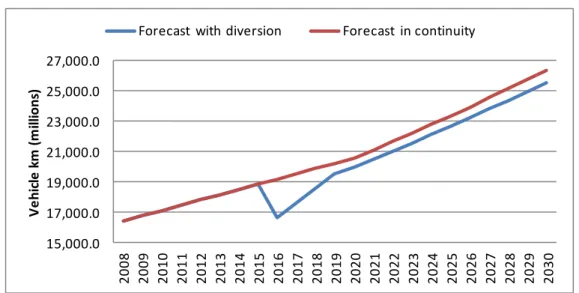
Figure 2 Traffic forecast with and without diversion
15,000.0 17,000.0 19,000.0 21,000.0 23,000.0 25,000.0 27,000.0
2008 2009 2010 2011 2012 2013 2014 2015 2016 2017 2018 2019 2020 2021 2022 2023 2024 2025 2026 2027 2028 2029 2030
V
e
hi
cl
e
k
m
(m
il
li
on
s)
Forecast with diversion Forecast in continuity
Source: Blauwens et al., 2011; FOD Mobiliteit en Vervoer, 2013; Federaal Planbureau, 2012; Renshaw & Brauer, 2010; De Jong et al., 2010; De Ceuster et al., 2009; FOD Economie, K.M.O., Middenstand en Energie, 2015; Viapass, 2015b; Yperman et al., 2012 and own calculations
Since the private partner will not provide their services for free, we must make the deduction of the gross availability fees and the milestone compensation to arrive at the free cash flows. We must also deduct the Eurovignette revenues to find the true value of the project since the government can no longer charge those (Vierth & Schleussner, 2012: 9). The same applies to the foregone revenues of the reduction of the traffic tax (an accompanying measure) and the share of the kilometer levies generated by the Belgian trucks since these levies are 100% deductable from the corporation tax. We are left with the Net Net Free Cash Flows which will be discounted at the appropriate rate which should be a rate that reflects the opportunity cost of capital for the entire Belgian society. Such a discount rate is called the social discount rate and it can be estimated by the social rate of time preference approach. This approach finds “the rate at which the society is willing to postpone a unit of current consumption in exchange of more future
consumption” (Florio & Sirtori, 2013: 5). Florio & Sirtori (2013: 12) estimated this rate to be 2.05% for Belgium. We will be using this estimation in our analysis. If we sum
those discounted cash flows we find an NPV of € 16.56 billion. As this NPV is positive
we can conclude that the kilometer levy project is financially attractive to the public partner. We have chosen not to calculate the IRR because the government does not need to make an initial investment to start the project and therefore the IRR would not provide us with relevant information.
It is remarkable that several sources state an annual expected revenue of the income tax
of € 700 - 800 million4 whereas this preliminary analysis shows that in 2016 the
revenues are expected to be around € 1,500 million. There are several possible reasons
for that. Firstly this analysis is made up from publicly available information and
4
assumptions based on that information. It is reasonable to assume that the data used by the government to make their expectations would be more exact. Political reasons could also play a part however. After all when we look at the revenues we see that the kilometer levy entails a rather significant increase with comparison to the Eurovignette.
We estimated that in 2015 the three regions will receive € 67.18 million from the
Eurovignette and in the next year they will receive € 1,523.72 million from the kilometer levy. That is a considerable increase of revenues and therefore it is possible that the government may wish to downplay the scale of these expected revenues so as not to anger the transport sector who will have to pay them.
When we look at the free cash flows generated by the kilometer levy project and their scale we can try to put this in perspective. According to data obtained from the National Bank of Belgium (2015) and calculations made with them, the Belgian GDP will
amount to € 408.81 billion in 2016. This means that the free cash flows of the project in
the same year will be equal to 0.23% of that GDP. When we look at the NPV of the project (which has been calculated for April 2014) we see that it is equal to 4.16% of the GDP (of 2014). This is not bad when we know that the EU Treaty requires the budget deficit of a country to stay below 3%. (European Commission, 2015) This might again
be a reason for choosing the ‘upgrade’ that the kilometer levy provides.
extremely dire (perhaps unrealistically so) before the project becomes unattractive for the government.
The complete NPV & IRR analysis of the private partner in the base scenario, as well as the optimistic and the pessimistic scenarios, can be found in the appendix. We will not discuss the individual elements of the analysis in this section but refer to the appendix instead. The only thing we will mention here is that these free cash flows were discounted with the Weighted Average Cost of Capital estimated for the SPV. This rate was found to be 3.07%. Despite the negative free cash flows of 2014 and 2015, we see
that the NPV for the private operator is positive at € 167.48 million in the base scenario,
€ 169.98 million in the optimistic scenario and € 50.76 million in the pessimistic one. The IRR of these scenarios is 10.04%, 10.13% and 4.89% respectively. This means that the project is financially attractive to the private partner.
What is remarkable about the pessimistic scenario is that the amount of kilometer levies associated with the grace period of 45 days is greater than the gross availability fee that the SPV can earn for a whole year. In 2016 for example this amount of 45 days of
kilometer levies is € 187.86 million whereas the gross availability fee is € 140.5 million.
It seems clear from this analysis that such a mistake is very heavily punished and therefore to be avoided at all costs. Indeed when this scenario is applied, the NPV and
Contract Management
We mentioned earlier that the interregional regulator Viapass was created to facilitate the cooperation and coordination between the governments of the three regions. This is why they co-signed the DBFMO contract along with representatives of these three regions and why they were formally made responsible for the contract management of this DBFMO contract. (Schoups, 2015) In this section we will give examples of how the contract management responsibilities were or will be fulfilled.
Proper contract management institutions with the necessary resources should be created, in this case this would be Viapass itself. An example of how a healthy communication channel will be maintained between both parties, are the weekly meetings which are organized between Viapass and the SPV to facilitate these contract management and monitoring activities. These meetings are also used to evaluate the performance of the SPV and to see whether or not penalties or bonuses should be applied. When it comes to renegotiations we were told that the DBFMO contract does not allow for that. There are however some variable elements (such as the number of clients, the number of active OBUs and the amount of collected levies) which can be revised if necessary. The KPIs themselves are fixed and cannot evolve over time, however they were intelligently written. Therefore if the SPV were to start using a new and better GPS technology which improves the measuring accuracy for example, than it would be allowed to do so and it would most likely receive a performance bonus for it. (Schoups, 2015; PPP Knowledge Lab, 2015)
government institution would. Viapass is also required to check whether the payment flows are equal, whether each region is receiving what it should, whether each driven, measured and registered kilometer is invoiced and paid and whether everything runs correctly. Finally, the continuity of the contract management activities is secured because Viapass will continue to exist so long as the kilometer levy exists. This should answer our question of who will handle possible contract termination or handover. (Schoups, 2015; PPP Knowledge Lab, 2015)
Conclusion
Now that we’ve come to the end of the work project, let’s look back and see what we’ve
attractiveness however we noticed something that makes us double back to the first research question. While it is undoubtedly true that a distance-based charging mechanism internalizes external costs in a better way than its time-based alternative would, we cannot simply speak of switching one out for the other. Due to the rather substantial increase in annual government revenue (€ 67.18 million to € 1,523.72 million going from 2015 to 2016) we should instead speak about an intentional increase in user-based revenues.
So before we wrap up we should ask ourselves; is this fair? Is this fair towards the truck drivers who will see their costs rise even with the fact that they can deduct it from their corporation tax? Is it fair towards the truck drivers who come from peripheral countries such as Portugal, whose countries have barely any transit traffic and therefore cannot implement a similar system with a similar success? Some will say yes. After all similar
systems have been used in other European countries, so why shouldn’t Belgium get to
do the same? And our literature study has clearly demonstrated that while it is the most expensive payment mechanism to implement, it is the better option for internalizing all sorts of external costs. Others will undoubtedly disagree by pointing to the burden which it will put on a sector who is already struggling and who will most likely hand the hot potato over to their own customers and therefore society. (Febetra, 2015) So in the
end what would the Belgian society be gaining? And let’s not forget that this might be
References
Abrantes de Sousa, Mariana. 2011. “Managing
PPPs for budget sustainability.” Association for European Transport: 1-16.
Abrantes de Sousa, Mariana. 2015. “Availability
payments.” PowerPoint slides from Project Finance Course.
Amadeus database. 2015. Bureau Van Dijck.
https://fesrvsd.fe.unl.pt:2136/version-20151112/Export.Download.serv?_CID=429&conte xt=3AWU9EPYSQNR4YI&DisplayFileName=Ama deus_Satellic&FileName=2138b50625284c209b97d 8e5f680bd9d.xlsx&WriteAsAttachment=1 (accessed November 20, 2015).
Blauwens, Gust, Hilde Meersman, Christa Sys, Eddy Van De Voorde and Thierry Vanelslander.
2011. “Kilometerheffing in Vlaanderen – De impact
op havenconcurrentie en logistiek.” Steunpunt Goederenstromen: 1-54.
Booz & Company. 2012. “Study on Impacts of Application of the Vignette Systems to Private
Vehicles.” Final report prepared for Directorate-General for Mobility and Transport - European Commission: 1-61.
Claessens, Edward. 2015. “The role of Viapass in
the kilometer levy project.” Interview with Strategic
Communications Advisor of Viapass.
De Ceuster, G., Yperman I., Heyndrickx C., Vanhove F., Vanherle K. & Proost S. 2009.
“Eindrapport - Effecten van een kilometerheffing
voor vrachtwagens.” Transport & Mobility Leuven Report for Steunpunt Fiscaliteit en Begroting: 1-111. De Jong, Gerard, Arno Schroten, Huib Van
Essen, Matthijs Otten, & Pietro Bucci. 2010.
“Price Sensitivity of European road freight transport –towards a better understanding of existing results.”
A report for Transport & Environment: 1-136. Deloitte. 2009. “Benchmark PPS in Vlaanderen -
Wat kunnen we leren uit het buitenland?.”Report for Kenniscentrum Publiek – Private samenwerking van de Vlaamse overheid: 1-48.
Devoldere, Michaël. 2015. “Thesis about the kilometer levy in Belgium: Opinion of Minister
Weyts.” Interview with Communication counselor
for the Cabinet of the Flemish minister of Mobility, Public Works, Flemish suburbs, Tourism and Animal welfare, 1/09/2015.
EFKON. 2015. EFKON AG.
http://www.efkon.com/en/news/ETC_Belgium.php (Accessed December 5, 2015).
Erdmenger, Christoph, Caroline Hoffmann, Kilian Frey, Martin Lambrecht and Wojciech Wlodarski. 2010. “Road Pricing for Cars in Germany? An evaluation from an environmental and
transport policy perspective.” Umweltbundesamt
European Commission. 2015. European Commission.
http://ec.europa.eu/economy_finance/economic_gove rnance/sgp/index_en.htm (Accessed December 11, 2015).
European PPP Expertise Center. 2014. “Managing
PPPs during their contract life.” Report written by the European PPP Expertise Center: 1-60.
Eurostat Press Office. 2015. European Commission. http://ec.europa.eu/eurostat/en/web/products-press-releases/-/2-11022004-AP (Accessed November 5, 2015).
Febetra. 2014. “Invoering van de Kilometerheffing
in België.” Report written by Febetra: 1-15.
Febetra. 2015. Febetra.
http://febetra.be/2015/06/kilometerheffing-de-belgische-wegvervoerders-in-gevaar/ (Accessed on December 15, 2015).
Federaal Planbureau. 2012. “Bestemming 2030: chaos op de autowegen of alternatieve trajecten? –
Data.” Data provided by Federaal Planbureau. Florio, Massimo. & Emanuela Sirtori. 2013. “The
Social Cost Of Capital: Recent Estimates For The EU
Countries.” Centre for industrial studies Working Paper 03/2013.
FOD Economie, K.M.O., Middenstand en Energie. 2015. “Consumptieprijsindex vanaf 1920 en gezondheidsindex vanaf 1994 – Data.” Data provided by FOD Economie, K.M.O., Middenstand en Energie.
FOD Mobiliteit en Vervoer. 2013. “In miljoen voertuig-kilometers - Data.” Data provided by FOD Mobiliteit en Vervoer.
Government of the Netherlands. 2015.
Government of the Netherlands
https://www.government.nl/topics/public-private-
partnership-ppp-in-central- government/contents/difference-between-ppp-and-traditional-procurement (Accessed on November 6, 2015).
Hall, David. 2014. “Why Public-Private Partnerships
Don’t Work.” Report commissioned by Public Services International Research Unit: 1-56.
Investopedia. 2015. Investopedia. http://www.investopedia.com/terms/p/public-private-partnerships.asp#ixzz3pxabj87U (Accessed on November 10, 2015).
Iossa, Elisabetta, Giancarlo Spagnolo & Mercedes Vellez. 2007. “Best Practices on Contract Design in Public-Private Partnerships.” Report written for the World Bank: 1-67.
Litman, Todd A. 1999. “Distance-Based Charges; A Practical Strategy for More Optimal Vehicle
Litman, Todd A. 2009. Transportation Cost and Benefit Analysis Techniques, Estimates and Implications. Victoria: Victoria Transport Policy Institute.
MarketLine.2013. “Company Profile - Strabag SE.”
Report written by MarketLine: 1-29.
Martens, Patrick. 2006. “Lonken naar de
privésector.” Knack. April 5, 32-35.
National Bank of Belgium. 2015. National Bank of Belgium.
http://stat.nbb.be/Index.aspx?ThemeTreeId=7&lang= nl (Accessed on December 16, 2015).
PPP Knowledge Lab. (2015). The World Bank Group. https://pppknowledgelab.org/ppp-cycle/contract-management (Accessed on December 17, 2015).
PPPIRC. 2015. World Bank Group.
http://ppp.worldbank.org/public-private-partnership/overview/ppp-objectives (Accessed on November 10, 2015).
PSIRU. 2014. “Exposing the myths around Public
-Private Partnerships.” Report written for EPSU: 1-10. Reflex databanken. 2015. “Moniteur Belge –
10.08.2015 – Belgisch Staatsblad.” Report for the Raad Van State: 1-3.
Renshaw, Nina and Henryk Brauer. 2010.
“Understanding the effects of introducing lorry charging in Europe.” Report written forTransport & Environment: 1-8.
Robinson, Ferrol O. 2008. “Heavy Vehicle Tolling in Germany: Performance, Outcomes and Lessons Learned for Future Pricing Efforts in Minnesota and
the U.S.” Report prepared for State and Local Policy
Program, Hubert Humphrey Institute for Public Affairs & University of Minnesota: 1- 21.
Schoups, Johan. 2015. “Contract design and
management.” Interview with administrator-general of the interregional regulator Viapass, 3/12/2015. Smet, Pascal. 2015. “Opinion of Minister Smet on
the impact of the kilometer levy in Belgium.” Interview with Minister of Mobility, Public Works, Culture, Youth, Sports and Urban Policy of the Brussels Capital Region, 13/10/2015.
Sofico. 2015. Sofico. http://www.sofico.org/fr/qui-sommes-nous/missions-et-financement (Accessed December 20, 2015).
The EPEC PPP Guide. 2015. European Investment Bank. http://www.eib.org/epec/g2g/i-project-identification/12/125/index.htm (Accessed November 2, 2015).
The EPEC PPP Guide. 2015. European Investment Bank. http://www.eib.org/epec/g2g/annex/6-payment/index.htm(Accessed November 2, 2015). Theirsen, Marc. 2015. “The role of the Flemish
Knowledge Center PPS in the kilometer levy
project.” Interview with Legal expert of the Vlaams
Theirssen, Marc. 2015. “The decision of using PPP in the kilometer levy project.” Interview with Legal expert of the Flemish Knowledge Center PPP, 5/11/2015, Flemish Knowledge Center PPS.
T-Systems. 2014. T-Systems. http://www.t-
systems.be/pressanalysts/detail-page-press-release/1286476 (Accessed on December 2, 2015).
Vereeck. 2015. Lode Vereeck.
http://www.vereeck.be/nl/standpunten/d/detail/europ a-geeft-federale-regering-tot-einde-maart-2015 (Accessed on November 30, 2015).
Viapass. 2014. “Samenwerkingsakkoord.” Modified
cooperation agreement published on the Viapass website: 1-45.
Viapass. 2015. “Het Viapass project – het systeem en de implementatie.” PowerPoint presentation of Viapass: 1 – 18.
Viapass. 2015. “Kilometerheffing voor +3,5 ton
vrachtwagens: € / km.” Kilometer levy rates published on the Viapass website: 1.
Viapass. 2015. “Kilometerheffing voor vrachtwagens in België (+3,5 ton)” Slides of presentation given on March 24, 2015, Wijnegem. Vierth, Inge and Heike Schleussner. 2012.
“Impacts of different environmentally differentiated
truck charges on mileage, fleet composition and
emissions in Germany and Sweden.” CTS Working Paper, 222012:22.
Vlaams Kenniscentrum PPS. 2009.
“Gebiedsontwikkeling met behulp van PPS.” Report written by Vlaams Kenniscentrum PPS: 1-48. Vlaams Kenniscentrum PPS. 2012. Samen Publiek
Privaat. Brussels: Diensten voor het Algemeen Regeringsbeleid - Kenniscentrum Publiek-Private Samenwerking.
Yperman, I., Vanhove, F., Delhaye, E., Scheltjens, T., Hens, D., Voogt, M. and den Boeft, K. 2012.
“Haalbaarheidsstudie voor invoering en beheer van lage emissiezone(s) in de stad Antwerpen.” Report written by Transport & Mobility Leuven: 1-237.
Wikipedia. 2015. Wikipedia.