UNIVERSIDADE DE LISBOA
FACULDADE DE CIÊNCIAS
DEPARTAMENTO DE BIOLOGIA ANIMAL
Conservation of the Macaronesian endemic species:
patterns among archipelagos and taxonomic groups based
on IUCN lists
Joana Mendes Casimiro
Mestrado em Biologia da Conservação
Versão Provisória
Dissertação orientada por:
Professora Doutora Maria Manuel Romeiras
Professora Doutora Maria Filomena de Magalhães
Agradecimentos
A realização desta dissertação de mestrado contou com apoios indispensáveis aos quais estarei eternamente grata e sem os quais nada teria sido possível.
Às minhas orientadoras, Professora Doutora Maria Manuel Romeiras e Professora Doutora Maria Filomena Magalhães, pelo incansável apoio, disponibilidade, opiniões e críticas, pelo conhecimento e segurança que transmitiram e, principalmente, pela verdadeira orientação ao longo de todo o trabalho.
Ao Professor Doutor Paulo Borges pela disponibilidade e pela contribuição de dados dos artrópodes dos Açores que se mostraram essenciais para enriquecer este trabalho.
À Doutora Sílvia Catarino pela disponibilização de informação sobre a biodiversidade de Cabo Verde.
Finalmente, aos meus pais, Elizabete e Carlos, e à minha irmã, Rita, por não me deixarem desistir mesmo quando tudo parecia desmoronar-se e por acreditarem nas minhas capacidades, por vezes mais do que eu própria acredito, o que me levou a querer alcançar mais uma etapa.
Abstract
Earth is facing one irreversible and concerning global environmental change: the loss of biodiversity. Several studies have been done in recent years in order to protect biodiversity but it is still necessary to improve global understanding on this theme. This is a very concerning situation, especially when it comes to oceanic islands, which account for only about 5% of the Earth’s surface but contain 20% of the world's biodiversity and are centers of endemism. Moreover, island biodiversity has become one of the most threatened in the world, mostly because island endemics often have globally small population sizes and limited geographical distribution ranges.
This study focuses on the Macaronesian archipelagos (i.e. Azores, Madeira, Selvagens, Canary Islands and Cape Verde) which belong to the Mediterranean Basin biodiversity hotspot, the second largest hotspot in the world. In order to identify major conservation gaps within this hotspot area, the most recent species checklists available for each archipelago were compared against the available data in the IUCN Red List of Threatened Species. With the analysis of endemic species, it was possible to identify considerable differences between species diversity and conservation threat patterns across islands and taxonomic groups. More specifically we found that (1) the number of species added to the Red List, since 1996 until present days, has increased for all archipelagos, especially since 2010 for the Azores, Madeira, Selvagens and Canaries archipelagos and since 2012 for Cape Verde; (2) currently, the conservation efforts across all Macaronesian archipelagos are equivalent, though the proportion of species included in the Red List decreases slightly with the increasing number of endemic species of the archipelagos; (4) the Canary Islands, is the most biodiverse archipelago of the Macaronesian Region, however with the major gap between the number of species in the Red List and the number of species available in checklists, while the Azores presents the lowest gap, which may be related to recent conservation efforts in this archipelago, but also to the low number of the endemic species in this archipelago relative to the Canary Islands; (5) only 5,6% of the endemic species of arthropods, the most diverse taxonomic group under analysis, are classified in the Red List, making this the less represented group in the Red List, while Mammals are represented only by 3 endemic species, all of which classified in the Red List; (6) the Madeira and Selvagens archipelagos present the highest percentage of protected area (67%), while Cape Verde has the lowest proportion of protected area (15%). It is concluded that efforts have been made in recent years to improve the proportion of endemic species assessed in the Red List, as well as, to promote several initiatives to reverse biodiversity and habitat losses in the Macaronesian Region, namely the establishment of the Key Biodiversity Areas and the Important Plant Areas, or the implementation of the Habitats Directive in the EU's archipelagos. Nevertheless, additional studies to revise some taxonomic groups and effective efforts to implement these international initiatives are still needed to preserve the biodiversity of these North-eastern Atlantic archipelagos.
Resumo alargado
A região da Macaronésia compreende os arquipélagos dos Açores, Madeira, Selvagens, Canárias e Cabo Verde e constitui um dos mais importantes hotspots de biodiversidade, na Região Mediterrânica, pelo que se torna imperativo a proteção e conservação da fauna e flora selvagens. Contudo as consequências das perturbações antrópicas são particularmente relevantes nestes ecossistemas insulares, uma vez que a região da Macaronésia possui uma grande riqueza de espécies endémicas, mas que na maioria dos casos ocorrem em pequenas populações e em áreas geográficas muito restritas. Assim, torna-se urgente o conhecimento e inventário da biodiversidade ameaçada, para que se torne efetiva a proteção de espécies únicas e para garantir a conservação dos seus habitats naturais.
A União Internacional para Conservação da Natureza (IUCN - International Union for Conservation of Nature), fundada em 1948, é uma organização dedicada à conservação da natureza. A IUCN promove uma série de iniciativas, destacando-se a promoção de uma rede mundial de áreas protegidas e a publicação de inventários sobre o estado de conservação de espécies, conhecida como Lista Vermelha da IUCN (Red List). A Lista Vermelha disponibiliza informação sobre espécies, atribuindo-lhes um estatuto de conservação que permite compreender a situação atual da espécie e a evolução do seu estado de conservação ao longo do tempo. De acordo com os critérios estabelecidos pela IUCN, relacionados principalmente com o tamanho e efetivo populacional e a área de distribuição, as espécies são distribuídas por várias categorias de conservação, sendo Vulnerável (Vulnerable -VU), Ameaçada (Endangered - EN) e Criticamente Ameaçada (Critically Endangered - CR), as categorias de ameaça. Refira-se, a título de exemplo, que é com base na proporção de espécies ameaçadas que é possível o estabelecimento de Key Biodiversity Areas (KBA), que representam áreas prioritárias de conservação da biodiversidade. Isto representa um exemplo prático da utilidade da Lista Vermelha para a conservação da natureza e manutenção da biodiversidade global.
Apesar de nos últimos anos se verificar um aumento do esforço no sentido de proteger o ambiente e uma crescente preocupação em preservar os recursos naturais da região da Macaronésia, há ainda um enorme trabalho pela frente e um longo caminho a percorrer. Uma das formas de avaliar o estado atual do conhecimento, passa por comparar os números de espécies endémicas existentes em cada arquipélago e disponíveis em checklists, com o número de espécies endémicas já classificadas e que integram a Lista Vermelha da IUCN. Estes dados permitirão perceber para cada um dos arquipélagos da Macaronésia, quais os grupos taxonómicos já avaliados segundo os critérios da IUCN e quais as espécies ameaçadas, o que fornecerá informação necessária para futuras propostas de medidas de proteção que assegurem a conservação da biodiversidade insular.
O objetivo geral deste estudo foi contribuir para o conhecimento do estado atual de conservação da biodiversidade terrestre das ilhas da Macaronésia, usando, para tal, a informação disponível na Lista Vermelha da IUCN. Os objetivos específicos foram:
(1) Analisar a evolução do número de espécies avaliadas segundo os critérios da IUCN, desde 1996 até ao presente;
(2) Comparar a distribuição da riqueza específica endémica, entre os arquipélagos e diferentes grupos taxonómicos;
(3) Catalogar as espécies endémicas da Macaronésia incluídas na Lista Vermelha da IUCN; (4) Avaliar a distribuição das espécies listadas pelas diferentes categorias de ameaça, para
determinar o risco de ameaça a que pode estar sujeito cada arquipélago;
(5) Relacionar o número de espécies nas categorias de ameaça com as áreas protegidas estabelecidas para cada arquipélago.
Este estudo teve por base a consulta de checklists e de outras fontes bibliográficas para a obtenção de dados sobre as espécies dos diferentes grupos taxonómicos terrestres endémicos e para cada arquipélago da Macaronésia. Posteriormente, foi utilizada a informação disponível no site da Lista Vermelha da IUCN (www.iucnredlist.org) para identificar as espécies endémicas já classificadas para cada um dos arquipélagos e para os diferentes grupos taxonómicos, e o respetivo ano de publicação. A partir desta informação, foram determinados o número de espécies endémicas terrestres (excluindo as extintas) disponíveis nas checklists, na Lista Vermelha da IUCN e em cada categoria de ameaça, para cada grupo taxonómico, em cada arquipélago.
Os dados obtidos foram analisados de modo a identificar 1) os padrões temporais de classificação de espécies, obtidos com base na variação do número de espécies endémicas incluídas na Lista Vermelha de 1996 até 2017, em cada arquipélago; 2) lacunas na classificação dos diversos grupos taxonómicos em cada arquipélago, com base na comparação entre os números de espécies endémicas nas checklists e na Lista Vermelha; 3) os padrões de distribuição das espécies pelas categorias da IUCN, através de análise de classificação hierárquica, UPGMA (Unweighted Pair Group Method using Arithmetic averages) e de Análise de Componentes Principais (ACP); 4) as relações entre o número de espécies ameaçadas, a área total de cada arquipélago e a respetiva proporção de área protegida por lei, com base em regressão linear. Os resultados obtidos revelaram que (1) a avaliação de espécies endémicas segundo os critérios da IUCN, sofreu um aumento significativo em 2010 no caso dos arquipélagos Europeus da Macaronésia, independentemente do grupo taxonómico a que pertencem, (2) atualmente, os esforços de conservação entre os arquipélagos da Macaronésia são, de certo modo, equivalentes, ainda que a proporção de espécies incluídas na Lista Vermelha tenda a ser ligeiramente menor quanto maior for o número de espécies endémicas no arquipélago; (3) o arquipélago das Canárias apresenta a maior lacuna entre o número de espécies na Lista Vermelha e o número de espécies na checklist, salientando a necessidade de mais esforços de conservação neste arquipélago espanhol, enquanto os Açores apresentam a maior contribuição para a inclusão de espécies na Lista Vermelha da
IUCN, refletindo as preocupações ambientais e os esforços de conservação realizados a última década; (4) apenas 5,6% das espécies endémicas de artrópodes, o grupo taxonómico mais diversificado em análise, estão classificadas, sendo este o grupo com menor representatividade na Lista Vermelha, enquanto que para os mamíferos a totalidade das espécies endémicas estão classificadas, muito embora sejam apenas três espécies, o que não é comparável com a diversidade de outros grupos taxonómicos como os artrópodes; (5) os arquipélagos da Madeira e das Selvagens apresentam a maior percentagem de área protegida (67%), enquanto Cabo Verde apresenta a menor percentagem de área protegida (15%).
Os resultados obtidos neste estudo permitiram identificar diferentes lacunas ao nível dos instrumentos de conservação disponíveis, como são as Listas Vermelhas das espécies ameaçadas, embora seja evidente o esforço de conservação feito nos últimos anos de modo a contornar a perda da biodiversidade global e a perda de habitats na região da Macaronésia. Com base nas evidencias obtidas é possível formular diversas sugestões que visam facilitar e melhorar os estudos e trabalhos futuros no âmbito dos padrões de biodiversidade e necessidade de conservação desta região, nomeadamente: (1) os resultados de pesquisa no site da Lista Vermelha da IUCN deveriam mostrar as listas de subespécies, tornando mais fácil a obtenção de informação neste nível taxonómico, o que é essencial quando se realizam estudos em ilhas; (2) foram consultados alguns artigos recentes para atualizar os número de espécies endémicas dos arquipélagos, demonstrando a necessidade de uma atualização das checklists de modo a que a informação acerca da biodiversidade dos arquipélagos da Macaronésia esteja completa e atualizada; (3) por fim, conclui-se que os grupos taxonómicos acedidos estão muito dependentes dos trabalhos dos grupos de investigação, pelo que seria mais conveniente que os esforços de classificação fossem de caráter mais abrangente pelos diferentes grupos taxonómicos, o que implicaria maior financiamento nesse sentido.
Atualmente, a sobre-exploração dos recursos naturais da Terra e consequentes alterações climáticas levam a muitos impactos ambientais como, por exemplo, a acidificação dos oceanos, expansão de espécies invasoras e incidência de pragas e doenças que contribuem para o desaparecimento de espécies endémicas importantes para a persistência dos ecossistemas. Nesse sentido, estudos que permitam identificar os grupos taxonómicos e regiões que se encontram ameaçados, são particularmente importantes para reforçar as medidas de conservação da biodiversidade e preservação dos ecossistemas naturais únicos como as ilhas.
Palavras chave:
Table of contents
Agradecimentos ... II Abstract ... III Resumo alargado ... IV Table of contents ...VII Index of acronyms and abbreviations ... IX Index of Figures ... X Index of Tables ...XII
1. Introduction ... 1
1.1. Macaronesian Region: A Biodiversity Hotspot ... 1
1.2. Worldwide initiatives for the conservation of nature ... 4
1.2.1. The International Union for Conservation of Nature ... 4
1.2.2. Key Biodiversity Areas ... 5
1.2.3. Other initiatives and organizations ... 6
1.3. Aims of the study ... 8
2. Materials and methods ... 9
2.1. Study area ... 9
2.2. Data collection ... 12
2.2.1. Biodiversity checklists ... 12
2.2.2. The IUCN Red List of Threatened Species ... 14
2.3. Data analysis ... 14
3. Results ... 16
3.1. Temporal patterns in species classification efforts ... 16
3.2. Variation in classification of endemic species ... 17
3.3. Characterization of the threat status in Macaronesian archipelagos ... 22
3.3.1 Patterns in species classification in IUCN threat categories ... 23
3.4. Species in threatened categories and the protected areas ... 27
4. Discussion ... 29
4.1. Temporal patterns in species classification efforts ... 29
4.2. IUCN classification patterns for Macaronesia: revealing Red Listed species ... 30
4.3. Distribution of Red Listed species among Macaronesian archipelagos ... 31
5. Final remarks and perspectives ... 33
6. References ... 35
6.2. Websites ... 40 Supporting information ... 41
Index of acronyms and abbreviations
CBD - Convention on Biological Diversity
CEPF - Critical Ecosystem Partnership Fund
CR - Critically Endangered
DD - Data Deficient
DRA - Direção Regional do Ambiente
EN - Endangered
EW - Extinct in the Wild
EX - Extinct
GPAP - Global Protected Areas Programme
HCA - Hierarchical Clustering Analysis
IPA – Important Plant Areas
IUCN - International Union for Conservation of Nature
KBA - Key Biodiversity Area
LC - Least Concern
N2K - Nature 2000 Network
NE - Not Evaluated
PCA - Principal Component Analysis
SSC - Species Survival Commission
UPGMA - Unweighted Pair Group Method with Arithmetic Mean
VU - Vulnerable
WCPA - World Commission on Protected Areas
WCS - Wild Conservation Society
Index of Figures
Figure 1.1: Geographical context of the Macaronesian region among (A) the world´s
Biodiversity Hotspots and (B) the Mediterranean Basin biodiversity hotspot; (C) Detail of the
Macaronesian archipelagos………. 3
Figure 1.2: Categories of the IUCN Red List of Threatened Species. Adapted from Rodrigues
et al. (2006)……… 5
Figure 2.1: Macaronesian archipelagos. Adapted from Rando et al. (2014)………... 9
Figure 3.1: Variation in the cumulative number of endemic species classified in Red List, for
Canaries, Madeira & Selvagens, Azores and Cape Verde archipelagos between 1996 and
2017……… 16
Figure 3.2: Symbols used to represent taxonomic groups under analysis in this study………... 18
Figure 3.3: Number of endemic species reported for the Macaronesian archipelagos and
included in the Red List. The size of the pie charts is proportional to the total number of endemic species. Lighter colours indicate endemic species listed in Red List, while the dark colours indicate the endemic species that still not assessed.……… 18
Figure 3.4: Detailed description of the number of endemic species of each taxonomic group
in each archipelago of Macaronesia, as well as the number of endemic species listed in Red
List and their proportion……… 19
Figure 3.5:Relations between the number of endemic species in checklists and the (A) number of endemic species in Red List for each taxonomic group in each Macaronesian archipelago, (B) proportion of endemic species in Red List for each taxonomic group and (C) proportion of endemic species in Red List for each Macaronesian archipelago. The red circles indicate the groups that deviate the most from the perceived trends, which are the arthropods of Canaries and Madeira & Selvagens... 21
Figure 3.6: Number of species classified into each Red List Category for each taxonomic
group considered (Gastropods, Arthropods, Birds, Mammals, Reptiles, Non Vascular Plants and Vascular Plants) in each Macaronesian archipelago. The differences in the scales of the x-axis (the largest differences in the scales are surrounded by a red line) occur due to the huge discrepancy between the totals of endemic species in each taxonomic group………. 22
Figure 3.7: Dendrogram of the hierarchical cluster analysis considering total of endemic species in each Red List Category, excluding extinct species for each taxonomic group in each archipelago. Acronyms: AZ: Azores; MD: Madeira & Selvagens; CAN: Canary Islands; CV:
Cape Verde………. 23
Figure 3.8: Ordination diagram of Principal Component Analysis of the total number of
endemic species in each Red List category... 24
Figure 3.9: Dendrograms of hierarchical cluster analysis considering percentage of endemic
Coefficient. Acronyms: AZ: Azores; MD: Madeira & Selvagens; CAN: Canary Islands; CV: Cape Verde..……….. ………
25
Figure 3.10: Ordination diagram of Principal Component Analysis of the percentages of
species in each Red List category……… 26
Figure 3.11: Relationships between the number of species classified in threatened categories
(VU, EN and CR) and the (A) total land area (Km2) of each archipelago, as well as with the
Index of Tables
Table 2.1: Physico-geographical features and percentage of land area that is protected by law
in the Macaronesian archipelagos. Adapted from Caujapé-Castells et al. (2010) for Azores, Madeira & Selvagens and Canary Islands. The information for Cape Verde is from the official law decree “I SÉRIE — NO 17 SUP «B. O.» DA REPÚBLICA DE CABO VERDE — 17 DE MARÇO DE 2016”……….. 11
Table 2.2: Checklists consulted to assess the number of species endemic to each
Macaronesian archipelago……… 13
Table 3.1: Classes that are represented in the IUCN Red List of Threatened Species with one
or more species endemic to the Macaronesian archipelagos……… 17
Table 3.2: Proportion of endemic species classified in the IUCN Red List of Threatened
Species, for each taxonomic group across all Macaronesian archipelagos……… 20
Table 3.3: Loadings of each Red List category in the ordination axis derived from the
Principal Component Analysis of the total number of endemic species in each Red List
Category. Loadings over 0.4 are highlighted in bold……… 24
Table 3.4: Loadings of each Red List category in the ordination axis derived from the
Principal Component Analysis of the percentage of endemic species in each Red List Category. Loadings over 0.4 are highlighted in bold………. 26
1. Introduction
1.1. Macaronesian Region: A Biodiversity Hotspot
Conservation of endemic and threatened species in natural ecosystems is widely recognized as a fundamental requirement for the maintenance of worldwide biodiversity (Lindenmayer, 2015). However, the Earth's ecosystems are increasingly transformed by anthropogenic threats such as habitat loss, biological invasion and climate change (Tershy et al., 2015). Over the last two decades, there was an urgent need to identify the sectors of the greatest biodiversity that are also the most endangered ones - the Biodiversity Hotspots. The proposal of establishing hotspot regions as “Earth’s most biologically rich and threatened areas” was first published by Myers (1988; 1990) and Myers and colleagues (2000), and greatly revised and expanded by Mittermeier et al. (2005). According to these seminal studies, 34/35 biodiversity hotspots are presently recognized worldwide (Fig. 1.1A). Due to their high endemicity and high degree of threat, these regions have become international priorities for conservation, with important efforts allocated to their preservation. Presently, the biodiversity hotspots support nearly 60% of the world's plant, bird, mammal, reptile, and amphibian species, with a very high share of those species as endemics (Myers et al., 2000).
Among biodiversity hotspot regions, several are islands groups (e.g. Caribbean Islands; Madagascar and the Indian Ocean Islands; Polynesia-Micronesia), which have been classified because of their exceptionally diverse terrestrial and marine ecosystems. Islands account for only about 5% of the land surface of the Earth, yet they contain 20% of the world's biodiversity and are centers of endemism (Bellard et al., 2014). However, island biodiversity has become one of the most threatened in the world (Lagabrielle et al., 2009), mostly because island endemics often have globally small population sizes and limited geographical distribution ranges, driven by limited habitat availability and unique traits resulting from prolonged evolutionary isolation (e.g. Whittaker and Fernández-Palacios, 2007). It has been estimated that 5 to 10% of the insular endemics worldwide could be highly threatened and that 3 to 4% could be in critical danger of extinction (Caujapé-Castells et al., 2010).
Macaronesian Islands (Fig. 1.1C), which comprises the North-eastern Atlantic archipelagos of Azores, Madeira, Selvagens, Canary Islands and Cape Verde, belong to the Mediterranean Basin biodiversity hotspot (Fig. 1.1B). This is the second largest hotspot in the world and covers more than 2 million Km2 and stretches west to east from Portugal to Jordan and north to south from northern Italy to
Cape Verde (Fig. 1). The Mediterranean Basin is particularly noted for the diversity of its plants, with ca. 25,000 native species, half of which are endemic (Mittermeier et al., 2004), but it is also one of the world’s richest places in terms of terrestrial and marine fauna. A high proportion of Mediterranean
animals are unique to the region, with 2 out of 3 amphibian species being endemic, as well as half of the crabs and crayfish, 48% of the reptiles, 25% of mammals, 14% of dragonflies, 6% of sharks and rays, 3% of the birds, and a total of 253 endemic freshwater fish (Cuttelod et al., 2009). Current regional assessments have confirmed the high diversity and endemism of Mediterranean plants and animals, but also underline the severe threats that these species face (Cuttelod et al., 2009); nine species groups have been comprehensively assessed to date (amphibians, birds, cartilaginous fishes, cetaceans, crabs and crayfish, endemic freshwater fishes, mammals, dragonflies and reptiles) and almost a fifth of these species are threatened with extinction, with 5% Critically Endangered (CR), 7% Endangered (EN) and 7% Vulnerable (VU) (Cuttelod et al., 2009).
Within the Mediterranean Basin biodiversity hotspot, the Macaronesian region (Fig. 1.1C) is characterized by a high level of endemism. In general, terrestrial Macaronesian endemic lineages are characterized by their occurrence in different habitats, striking morphological differences among species and frequent rarity, being restricted to a few, small populations (Crawford and Stuessy, 2016). The conservation of this huge diversity is a complex, multifaceted topic, and little is known about the extent to which endemics in each archipelago are protected and about taxonomic groups still requiring protection. This information is critical to guide the strategic expansion of the network of protected areas and the effective allocation of conservation resources to maximize the persistence of biodiversity in the Macaronesian hotspot area.
Figure 1.1: Geographical context of the Macaronesian region among (A) the world's Biodiversity Hotspots and (B) the
1.2. Worldwide initiatives for the conservation of nature
The baseline for develop a legal framework for biodiversity conservation was establish in 1992 during the “Convention on Biological Diversity (CBD)” at the Rio Summit (see for more details: https://www.cbd.int/). The CBD is the legally binding agreement on the use and conservation of biological diversity, and since then a series of global and regional, as well as species and ecosystem specific conventions concerning the protection of nature and wildlife have been adopted.
1.2.1. The International Union for Conservation of Nature
Only a small percentage of the total land area within biodiversity hotspots is now protected (Churchyard et al., 2016). However, several international organizations are working in many ways to conserve biodiversity hotspots (Wilson et al., 2006). One of the most important environmental networks working to protect world’s biodiversity is the “International Union for Conservation of Nature - IUCN”, which has been founded in October 1948, includes government and civil society organizations, and implements a large portfolio of conservation projects worldwide, working to restore ecosystems and reverse habitat loss (Brouder, 2009). It provides organizations with the knowledge and tools that enable nature conservation and the sustainable use of natural resources, contributing to the human progress and economic development (see for more details: www.iucn.org).
The IUCN implements several initiatives on global species conservation, such as projects to assess the status of the species for “The IUCN Red List of Threatened Species™” (henceforth “Red List”), which provides information on threats, ecological requirements, habitats and conservation actions that can be taken, acting like an indicator of the health of world’s biodiversity (Rodrigues et al. 2006). The IUCN Species Programme supports the activities of the IUCN Species Survival Commission (IUCN SSC), which is a science-based network that provides scientific advice and information on biodiversity conservation and supports the implementation of environmental agreements, exposing the information in the Red List, where the conservation status of species is assessed (Baillie et al. 2004).
The Red List is a global list of threatened species, each of which are assessed is allocate into different categories, according to criteria matchings (Rodrigues et al., 2006), as shown in Fig. 1.2. It has been widely recognized as an important tool to identify and prioritize actions for species and habitat protection, and to inform natural resource policy and management more broadly (Bennun et al., 2017). However, previous studies have shown that the application of IUCN Red List criteria to oceanic islands
may cluster most endemic species in top threat categories, and that additional information is needed to enhance the contribution of Red List assessments to prioritize conservation action (e.g. Martin 2009; Romeiras et al. 2016a).
Figure 1.2: Categories of the IUCN Red List of Threatened Species. Adapted from Rodrigues et al. (2006).
1.2.2. Key Biodiversity Areas
An example of the importance of the data provided in the Red List is its use in the identification of “Key Biodiversity Areas” (KBA) (Bennun et al., 2017). These are ‘sites that contribute to the global persistence of biodiversity’, including terrestrial, freshwater and marine ecosystems, that are identified through the consistent application of quantitative criteria developed through several consultation exercises (Langhammer et al., 2007). The IUCN WCPA-SSC Joint Task Force on Biodiversity and Protected Areas developed “A Global Standard for the Identification of Key Biodiversity Areas”, which describes globally criteria for the identification of KBA’s. In this case, funding to protect an area can only be obtained if information on endemic species is available in the Red List (see for more information: www.keybiodiversityareas.org/what-are-kbas).
An area/region can be classified as a KBA if it meets one or more of eleven criteria presented in Appendix I. The most important of which is the proportion of endemic species listed in threatened categories in Red List. These criteria can be applied to species and ecosystems in all environments and
across all taxonomic groups (except microorganisms), resulting in a highly inclusive, consultative and bottom-up process (Eken et al., 2004). To propose a site to qualify as a KBA, consultation with stakeholders with appropriate scientific data at the national level is required, independent scientific review is needed, and the data must be sufficiently recent and updated. There is a minimum set of information required to enable peer review of the data (Appendix II), and KBA proposals that do not include all the information listed are returned to the proposers for completion, before the nomination can progress (Foster et al., 2012).
The Macaronesian KBA Geoportal provides the necessary information for the involvement of stakeholders in the definition of Key Biodiversity Areas in the Azores, Madeira & Selvagens and Canary Islands. This includes georeferenced information on the occurrence of endemic species that have been classified in threatened categories (CR, EN or VU) in the Red List. There are 44 KBAs in Azores, 18 in Madeira & Selvagens and 132 in Canary Islands. According to the criteria for biological prioritization of KBA’s, based on Langhammer et al. (2007), the three sites with highest KBA prioritization are the (1) Desertas Islands in Madeira, (2) Great Crater of Faial in Azores and (3) Jandía Peninsula in Canary Islands, all with extreme species-based vulnerability and extreme irreplaceability (for more details see http://servicos-sraa.azores.gov.pt/best_iii_macaronesia/).
For Cape Verde archipelago, the KBA’s are not established yet, but the “Important Plant Areas” (IPA) were recently published (Gomes et al. (2017); see for more details: http://www.cepf.net/SiteCollectionDocuments/madagascar/IPA-Cabo-Verde-report-Portuguese.pdf).
1.2.3. Other initiatives and organizations
Nowadays several other initiatives and organizations carry out conservation work such as practical field projects, scientific research, advising of local and national governments on environmental policy, promoting environmental education, and raising awareness of environmental issues. Among other global initiatives carry out by several worldwide organizations, which aims to halt and reverse the destruction of our natural environment, is highlighted:
a) World Wide Fund for Nature (WWF): one of the world's largest conservation organizations that has as its main objective the protection of endangered species, maintenance of productive and resilient ecosystems, integrity of forests and freshwater ecosystems, sustainable food systems and reduce carbon emissions, always including all the benefits to human well-being (see for more details: wwf.panda.org);
b) Wildlife Conservation Society (WCS): the main goal is to save wildlife and to conserve the world’s largest wildlands to ensure the future of threatened species (see for more details: www.wcs.org).
More specifically for Europe:
c) Natura 2000 Network (N2K): implemented by the Habitats Directive on the conservation of natural habitats and wild fauna and flora and the Birds Directive on the conservation of wild birds, whose expansion contributes to achieve the goals of the Convention on Biological Diversity Aichi Biodiversity Targets, which is a set of measures that encourage sustainable use of natural resources and halt species loss, contributing to the human well-being (Popescu et al., 2014);
1.3. Aims of the study
Within conservation science, it is increasingly acknowledged that there are biases in our understanding of species ecology and threat status and that knowledge gaps can fundamentally impede our ability to establish priority settings and ultimately conserve biodiversity (Churchyard et al., 2016). Several recent studies caution against taxonomic and geographical biases in conservation tools and increasingly recommend evaluations of the data available, so that the robustness of the results can be assessed, and knowledge deficits resolved.
This study is focused on the Macaronesian endemic terrestrial biodiversity and the main goal is to identify which of the groups are best and worst represented and where, and thereby explore the question “Are we able to protect the Macaronesian biodiversity based on current conservation data?”. We will a) compare data on species records for each archipelago available in biodiversity checklists with species in the Red List; b) evaluate patterns in the proportion of threat status of the different taxonomic groups through multivariate analysis; c) identify gaps that may exist in Red List, available for different taxonomic groups within the region, when applied to small oceanic islands.
The tasks developed in the study included the analysis of the (1) evolution of the number of species added to the Red List since 1996, to identify temporal patterns in species classification efforts; (2) distribution of endemic species richness in checklists among archipelagos and taxonomic groups, to evaluate biodiversity patterns in the Macaronesian Islands, (3) the proportions of species included in the Red List, to determine gaps in this conservation tool; (4) distribution of listed species among threatened categories, to determine the risk of extinction that may be derived for this biodiversity hotspot, and finally (5) relationships between the number of species in threatened categories with the area that is protected by law in each archipelago, to explore the effectiveness of current protected areas.
2. Materials and methods
2.1. Study area
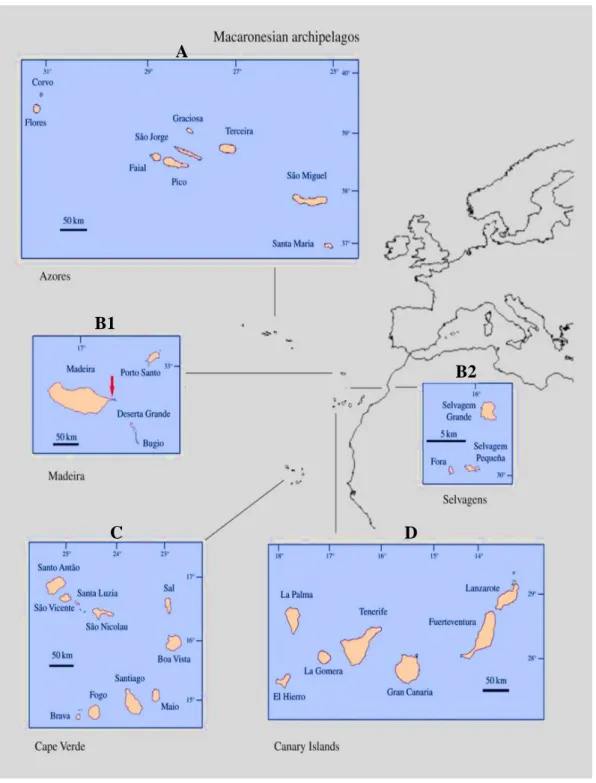
The study area is the Macaronesia Region, which comprises the archipelagos of Azores, Madeira, Selvagens, Canary Islands and Cape Verde (Fig. 2.1). All these archipelagos of volcanic origin are among the most relevant islands biodiversity hotspots worldwide (Romeiras et al., 2016b).
Figure 2.1: Macaronesian archipelagos. Adapted from Rando et al. (2014).
A
B2
C
D
The Azores archipelago (Fig. 2.1A) is located in the North Atlantic, and consists of nine main islands and some islets, categorized into Western Group (Corvo and Flores), Central Group (Faial, Pico, Graciosa, São Jorge and Terceira) and Eastern Group (São Miguel and Santa Maria). The minimum distance between Azores and the mainland is about 1584 Km from the Cabo da Roca (Portugal), which is the westernmost point in the European continent. The archipelago is characterized by an oceanic moist temperate climate, which is mild, with small fluctuations in temperature, precipitation and high relative atmospheric humidity. The influence of the Gulf’s hot current is very important because it allows sea-level temperatures to be quite similar across islands (Borges et al., 2010).
The Madeira archipelago (Fig. 2.1B1) also locates in the North Atlantic, in the southwest of the Iberian Peninsula, and the distance to the closest point in Europe, that is the Ponta de Sagres (Portugal), is about 1000 Km, while the distance to the northwest African coast is about 600 Km. The archipelago consists of two inhabited islands: the island of Madeira and the island of Porto Santo. Due to its location, orography and natural vegetation, the island of Madeira is characterized by a great variety of microclimates, but mostly includes Mediterranean and temperate climates, whereas the Porto Santo climate is more homogeneous and predominantly arid. The Desertas are located in the southeast of Madeira, and consists of several islets and three small islands: Ilhéu Chão, Deserta Grande and Bugio. The Selvagens (Fig. 2.1B2) are located approximately at 300 Km south of the Madeira and 180 Km north of Canaries, and its maximum altitude is found in the Selvagem Grande, at Pico da Atalaia (153 m) (Borges et al., 2008). The Madeira & Selvagens islands will henceforth be considered together in this study.
The Canary Islands (Fig. 2.1C) are the largest Macaronesian archipelago and the closest to the mainland (95 Km west of the North Africa) (Valido and Olesen, 2010). It includes seven main islands, divided into Eastern Group (Lanzarote and Fuerteventura) and Western Group (Gran Canaria, Tenerife, La Gomera, La Palma and El Hierro) (Reyes-Betancort et al., 2008). The Canarian archipelago is characterized mainly by a semi-arid climate, with Lanzarote and Fuerteventura being the driest islands. However, except for these islands, the archipelago is much wetter than usual for its latitude (from 27°37′ to 29°25′N and from 18°10′ to 13°20′W), (García-Herrera et al., 2003).
Cape Verde (Fig. 2.1D) is the southernmost archipelago of Macaronesia and locates 1350 Km
southwest of Canary Islands and 560 Km west of the African mainland coast. The archipelago consists of ten islands distributed in three groups: Northern Group (Santo Antão, São Vicente, Santa Luzia and São Nicolau), Southern Group (Santiago, Fogo and Brava) and Eastern Group (Sal, Boavista and Maio) which are the oldest islands, with also have the lowest elevation (Duarte and Romeiras, 2009). This archipelago is characterized by a tropical dry climate and the northeast trade winds are important factors
Although all the archipelagos are of volcanic origin, they present a great variation in several physical characteristics. The Canaries are the archipelago with the largest area (7545 Km2), followed by
Cape Verde, Azores and finally Madeira with only 794 Km2. The archipelago of Canaries is the closest
to mainland, followed by Cape Verde, Madeira & Selvagens and Azores, the most isolated one. The maximum altitude is found in the Canaries archipelago in Pico do Teide (3718 m) followed by Pico do Fogo in Fogo Island, Cape Verde (2890 m), whereas the Madeira archipelago is the one with lower altitude (1861 m) (Caujapé-Castells et al., 2010).
The Madeira archipelago has the largest proportion of protected area (67%) while Cape Verde has only 0.2% of protected area (Table 2.1). However, a recent law decree from 2016, indicates that the total protected area in the archipelago includes 616,65 Km2 of land / coastal area, representing 15.29%
of the land area of the country (for more information see “I SÉRIE — NO 17 SUP «B. O.» DA REPÚBLICA DE CABO VERDE — 17 DE MARÇO DE 2016”).
Table 2.1: Physico-geographical features and percentage of land area that is protected by law in the Macaronesian archipelagos.
Adapted from Caujapé-Castells et al. (2010) for Azores, Madeira & Selvagens and Canary Islands. The information for Cape Verde is from the official law decree “I SÉRIE — NO 17 SUP «B. O.» DA REPÚBLICA DE CABO VERDE — 17 DE MARÇO DE 2016”. Archipelagos Number of main islands Minimum distance to the mainland (Km) Total land area (Km2) Percentage of land area protected by law Total land area protected by law (Km2) Maximum height (m) Azores 9 1343 2332 20 466,4 2531 Madeira & Selvagens 2 630 794 67 531,98 1861 Canary Islands 7 95 7545 40 3018 3718 Cape Verde 9 576 4033 15,29 616,65 2829
2.2. Data collection
The collection of data included primarily the compilation of the information available in the most recent species checklists for the Macaronesian archipelagos (for more details see Table 2.2), and of the IUCN Red List of Threatened Species website (www.iucnredlist.org).
2.2.1. Biodiversity checklists
The checklists for Azores, Madeira, Selvagens, Canaries and Cape Verde were used to determine the number of species in different taxonomic groups endemic to each archipelago (see Table 2.2). We also included some updates of recent information for some taxonomic groups from Cape Verde: Vasconcelos et al. (2013) for reptiles, as well as Gardère (2015) and Romeiras et al. (2016b) for vascular plants. This information was used to build a database of terrestrial endemic species in the Macaronesian archipelagos.
Table 2.2: Checklists consulted to assess the number of species endemic to each Macaronesian archipelago.
Archipelago Description Checklist
Azores
Native and endemic species
of Azores
Borges, P.A.V., Costa, A., Cunha, R., Gabriel, R., Gonçalves, V., Martins, A.F., Melo, I., Parente, M., Raposeiro, P., Rodrigues, P., Santos, R.S., Silva, L., Vieira, P. & Vieira, V. (eds.) (2010). A list of the terrestrial and marine biota from the
Azores. Princípia, Cascais. 432 pp.
Madeira & Selvagens Native and endemic species of Madeira and Selvagens
Borges, P.A.V., Abreu, C., Aguiar, A.M.F., Carvalho, P., Fontinha, S., Jardim, R., Melo, I., Oliveira, P., Sequeira, M.M., Sérgio, C., Serrano, A.R.M., Sim-Sim, M. & Vieira, P. (2008). "Terrestrial and freshwater biodiversity of the Madeira and Selvagens archipelagos". In P.A.V. Borges, C. Abreu, A.M.F. Aguiar, P. Carvalho, R. Jardim, I. Melo, P. Oliveira, C. Sérgio, A.R.M Serrano & P. Vieira (eds.). «A list
of the terrestrial fungi, flora and fauna of Madeira and Selvagens archipelagos».
Funchal and Angra do Heroísmo, Direcção Regional do Ambiente da Madeira and Universidade dos Açores: pp. 13-25.
Canaries Native and
endemic species of Canaries
Arechavaleta, M., Rodríguez, S., Zurita, N., & García, A. (eds.) (2010). Lista de
especies silvestres de Canarias. Hongos, plantas y animales terrestres. 2009.
Gobierno de Canarias. 579 pp.
Cape Verde
Native and endemic species
of Cape Verde
Arechavaleta, M., N. Zurita, M. C. Marrero & J. L. Martín (eds.) 2005. Lista
preliminar de especies silvestres de Cabo Verde (hongos, plantas y animales terrestres). 2005. Consejería de Medio Ambiente y Ordenación Territorial,
Gobierno de Canarias. 155 pp.
Updates to the biodiversity
checklist
Reptiles:
Vasconcelos, R., Brito, J. C., Carranza, S., & Harris, D. J. (2013). Review of the distribution and conservation status of the terrestrial reptiles of the Cape Verde Islands. Oryx, 47(1), pp. 77-87.
Vascular Plants:
Gardère, M. L. (2015). Two new species of Campanula (Campanulaceae) from the island of Santo Antão, Cabo Verde archipelago. Phytotaxa, 197(2), pp. 104-114. Romeiras, M. M., Catarino, S., Gomes, I., Fernandes, C., Costa, J. C., Caujapé‐ Castells, J., & Duarte, M. C. (2016b). IUCN Red List assessment of the Cape Verde endemic flora: towards a Global Strategy for Plant Conservation in Macaronesia.
2.2.2. The IUCN Red List of Threatened Species
From October 2016 to May 2017, the IUCN Red List of Threatened Species website (www.iucnredlist.org) was assessed to identify the number of species endemic to Macaronesian archipelagos in different taxonomic groups that have been assessed and their respective threat categories. The filtering procedure used to gather the required information involved several sequential steps, as follows:
1) Selection of “Other Search Options”;
2) Selection of the archipelagos of Azores, Madeira, Canary Islands and Cape Verde, in the “Location” section, one at the time;
3) Selection of “Native” species, for each archipelago, excluding “Marine” species;
4) Individual analysis of each native species included in the resultant list, in order to identify the ones that were endemic to the selected archipelago;
5) Recording of the Red List category for each endemic species and of the criteria used in the classification, as well as the year of publication;
6) Collection of additional data for each endemic species listed, including species authority and, taxonomy (kingdom, phylum, class, order and family), and on habitat, ecological traits, main threats, conservation actions and population trends.
This information Red List in addition to that from the checklists was organized in a database for the Macaronesian terrestrial endemics.
2.3. Data analysis
Data analysis was focused on detecting variation in conservation patterns among the endemic terrestrial species from Macaronesia, as assessed from checklists and the Red List. Primary focus was on assessing patterns in species threat among archipelagos and taxonomic groups, and additionally we analysed temporal variation in species inclusion in the Red List, to evaluate the evolution of classification efforts for each archipelago.
Because the study aimed to detect variations that may affect the establishment of conservation priorities, endemic species listed as “Extinct” and “Extinct in the Wild” were excluded from analysis. Thereby, the main data matrix used in this study included the number of extant terrestrial endemic species included in Checklists and in the Red List, and the number of species in each threat category, for each taxonomic group in each archipelago.
Temporal patterns in species classification were derived based on variation among archipelagos in the cumulative number of endemic species included in the Red List from 1996 to 2017, irrespective of taxonomic group.
Gaps in information for each archipelago, were derived from plots of the number of species in each taxonomic group included in the Red List against that in updated checklists.
Patterns in species threat among archipelagos and taxonomic groups were derived based on: 1) Hierarchical agglomerative clustering, performed using a dissimilarity coefficient
based on Pearson’s correlation (1-r Pearson) and the Unweighted Pair Group Method with Arithmetic Mean (UPGMA) for linkage. This analysis was used to identify homogeneous groups, with similar distribution of species among IUCN threat categories (see Johnson, 1967);
2) Principal Component Analysis (PCA), to describe and summarize dominant gradients in the matrix of species distribution among IUCN threat categories (see Abdi and Williams, 2010);
3) The combination of clustering and ordination analyses was then used to determine the adequacy and mutual consistency of both data representations. Prior to analysis, data were transformed as log10(x+1), to dampen the influence of exceptionally large species
numbers.
Finally, simple linear regression was used to highlight the relationships between total number of threatened species and the total land area and the proportion of land area that is protected by law in each Macaronesian archipelago.
3. Results
3.1. Temporal patterns in species classification efforts
The number of endemic Macaronesian species included in the Red List has increased over time (Fig. 3.1). The greater efforts to assess species in IUCN have been conducted since 2010, mostly in the Canaries and Madeira archipelagos but, in the last years, there has been a decay in the species evaluation, especially in the Madeira archipelago. Conversely, there has been a recent high contribution of data for the Azores, mainly corresponding to the assessments of arthropods endemic in these islands. For Cape Verde, increase in classification efforts was only verified in the last six years, with two main efforts in 2013 for reptiles and in 2017 for vascular plants.
Figure 3.1: Variation in the cumulative number of endemic species classified in the Red List, for the Canaries, Madeira &
3.2. Variation in classification of endemic species
In total, 15 Classes including terrestrial and freshwater species endemic to the Macaronesian archipelagos are represented in the Red List, as shown in Table 3.1.
Table 3.1: Classes that are represented in the IUCN Red List of Threatened Species with one or more species endemic to the
Macaronesian archipelagos.
Class Lecanoromycetes, which belongs to the Phylum Ascomycota, is very badly represented in the Red List. This Phylum is the only one with less than three species endemic to the Macaronesian archipelagos (Anzia centrifuga and Ramalina erosa, both from Madeira & Selvagens) and, for that reason, the Class Lecanoromycetes, the only one belonging to this Phylum, was not included in the data analysis.
The species information per class was hereafter reorganized into more clarified groups (Fig. 3.2) as:
> Gastropods (all non-marine species of the Class Gastropoda);
> Arthropods (Class Insecta and Class Arachnida);
> Birds (Class Aves);
> Mammals (Class Mammalia);
> Reptiles (Class Reptilia);
> Non Vascular Plants (Classes Bryopsida, Jungermanniopsida and Marchantiopsida);
Phylum Class Arthropoda Arachnida Insecta Chordata Aves Mammalia Reptilia Mollusca Gastropoda Ascomycota Lecanoromycetes Bryophyta Bryopsida Marchantiophyta Jungermanniopsida Marchantiopsida Tracheophyta Isoetopsida Liliopsida Magnoliopsida Pinopsida Polypodiopsida
> Vascular Plants (Classes Liliopsida, Magnoliopsida, Isoetopsida, Pinopsida and Polypodiopsida).
Figure 3.2: Symbols used to represent taxonomic groups under analysis in this study.
The Canary archipelago presents the highest number of endemic terrestrial species recorded (with 3273 species), followed by Madeira and Selvagens (with 1049 assessed species), Cape Verde (with 463 assessed species) and finally Azores (with 191 assessed species) However, a great percentage of species are still not listed in Red List for all archipelagos (Fig. 3.3).
Figure 3.3: Number of endemic species reported for the Macaronesian archipelagos and included in the Red List. The size of
the pie charts is proportional to the total number of endemic species. Lighter colours indicate endemic species listed in Red List, while the dark colours indicate the endemic species that still not assessed.
When analysing the number of endemic species in detail for each taxonomic group (Fig. 3.4), arthropods are the most diverse group across all archipelagos, followed by vascular plants for all but Madeira and Selvagens, whose second most diverse group are gastropods. According to the checklists consulted, no endemic reptiles are found in Azores and endemic mammals are not present in Madeira & Selvagens neither in Cape Verde. Mammals are represented only by three species (Plecotus teneriffae and Crocidura canariensis, both from Canaries, and Nyctalus azoreum from Azores).
Figure 3.4: Detailed description of the number of endemic species of each taxonomic group in each archipelago of
Arthropods are the group with the biggest gap between what is listed in Red List and what is described in checklists amongst all archipelagos (115 non-classified arthropods in Azores, 908 in Madeira and Selvagens, 2783 in Canaries and 435 in Cape Verde), with only 5,6% of species classified in the Red List (Table 3.2). On the other side, mammals, represented only by three endemic species across all Macaronesian archipelagos, have 100% of the species classified in the Red List.
Table 3.2: Proportion of endemic species classified in the IUCN Red List of Threatened Species, for each taxonomic group
across all Macaronesian archipelagos.
Taxonomic Groups Proportion of Endemic Species in Red List (%)
Mammals 100,00%
Gastropods 74,51%
Birds 66,67%
Reptiles 61,54%
Vascular Plants 30,39%
Non Vascular Plants 23,33%
Arthropods 5,61%
Some groups of endemic species are not represented at all in Red List, such as birds of Azores, reptiles of Madeira & Selvagens, non vascular plants of Canaries and gastropods and arthropods of Cape Verde (Fig. 3.4.)
In general, the greater the number of endemic species in checklists, the greater the number of endemic species listed in the Red List, except for the arthropods of Canaries and Madeira & Selvagens, which have great number of endemic species but only include a small number of those in Red List (Fig. 3.5A). The proportion of species listed in the Red List was largely independent of the number of species in the checklists, with apparent negative trends resulting from the low listing records for the arthropods of Canaries and Madeira & Selvagens (Fig. 3.5B; Fig.3.5C).
Figure 3.5: Relations between the number of endemic species in checklists and the (A) number of endemic species in Red List
for each taxonomic group in each Macaronesian archipelago, (B) proportion of endemic species in Red List for each taxonomic group and (C) proportion of endemic species in Red List for each Macaronesian archipelago. The red circles indicate the groups that deviate the most from the perceived trends, which are the arthropods of Canaries and Madeira & Selvagens.
A
C
B
3.3. Characterization of the threat status in Macaronesian archipelagos
The distribution of endemic species in Red List among IUCN threat categories for each taxonomic group and for each archipelago is shown in Figure 3.6. The Azores has the highest proportion of endemic species in threatened categories (29,4%) relative to the total number of endemic species in checklists, followed by Cape Verde (9,9%), Madeira and Selvagens (7,5%) and finally Canaries (5,1%). As to the proportion of endemic species in threatened categories relative to the total number of endemic species in Red List, the order remains the same and Azores still have the highest value (62,7%), followed by Cape Verde (60,4%), Madeira and Selvagens (49,5%) and finally Canaries (44,9%). All taxonomic groups of all archipelagos seem to have similar proportion of endemic species in threatened categories, except birds of Canaries and Madeira & Selvagens (Fig. 3.6).
Figure 3.6: Number of species classified into each Red List Category for each taxonomic group considered (Gastropods,
Arthropods, Birds, Mammals, Reptiles, Non Vascular Plants and Vascular Plants) in each Macaronesian archipelago. The differences in the scales of the x-axis (the largest differences in the scales are surrounded by a red line) occur due to the huge discrepancy between the totals of endemic species in each taxonomic group.
3.3.1 Patterns in species classification in IUCN threat categories
The hierarchical agglomerative analysis of the number of endemic species in each Red List category resulted in the dendrogram exposed in Figure 3.7 and it revealed three major clusters of taxonomic groups and archipelagos (A, B and C).
Figure 3.7: Dendrogram of the hierarchical cluster analysis considering total of endemic species in each Red List Category,
excluding extinct species for each taxonomic group in each archipelago. Acronyms: AZ: Azores; MD: Madeira & Selvagens;
CAN: Canary Islands; CV: Cape Verde.
Cluster A, composed of vascular plants and mammals of Canaries, vascular plants and mammals of Azores and non vascular plants of Madeira & Selvagens, represents taxonomic groups with high number of species listed as Endangered.
Cluster B, composed of birds, gastropods and arthropods of Canaries, non vascular plants and gastropods of Azores, gastropods and birds of Madeira & Selvagens and reptiles of Cape Verde, is, somewhat, a heterogeneous cluster, but taxonomic groups and regions with high number of species listed as Data Deficient.
Cluster C, composed of vascular plants and birds of Cape Verde, vascular plants and arthropods of Madeira & Selvagens, reptiles of Canaries and arthropods of Azores, represents the groups in which there is greater conservation efforts and, therefore, have a higher number of species classified in Red List.
The first two ordination axis extracted from the PCA of the number of endemic species in each Red List category, explained 88.7% of the variation in the data (Fig. 3.8). The PC1 axis, accounting from 77.4% of the variation, highlighted a gradient in the number of endemic species included in the Red List, while PC2 axis identified a gradient between species in Endangered and Data Deficient categories.
Figure 3.8: Ordination diagram of Principal Component Analysis of the number of endemic species in each Red List
category.
Table 3.3: Loadings of each Red List category in the ordination axis derived from the Principal Component Analysis of the
total number of endemic species in each Red List Category. Loadings over 0.4 are highlighted in bold.
lgLC lgNT lgV lgEN lgCR lgDD PC1 -0.895 -0.849 -0.918 -0.878 -0.914 -0.82 PC2 -0.338 -0.249 0.205 0.425 0.324 -0.42 EN: 0 .4 3 V: -0.92 CR: -0.91 LC: -0.90 EN: -0.88 NT: -0.85 DD: -0.82 DD: -0 .4 2
The hierarchical clustering analysis of the percentage of endemic species per taxonomic group and archipelago in each Red List categories resulted in the dendrogram exposed in Fig. 3.9 and it revealed three major clusters:
Figure 3.9: Dendrograms of hierarchical cluster analysis considering percentage of endemic species in each Red List Category,
excluding extinct species, using Pearson Correlation Coefficient. Acronyms: AZ: Azores; MD: Madeira & Selvagens; CAN: Canary Islands; CV: Cape Verde.
Cluster A F which is equivalent to the cluster A in Figure 3.9, is characterized by taxonomic groups with high proportion of endangered endemic species, as indicated before.
Cluster B, composed of non vascular plants of Azores, reptiles and birds of Canaries and birds of Cape Verde and Madeira & Selvagens, is clearly a “Near Threatened” cluster.
Cluster C, composed of gastropods, vascular plants and arthropods of Madeira & Selvagens, gastropods and arthropods of Azores, vascular plants and reptiles of Cape Verde and gastropods and arthropods of Canary Islands, is characterized by taxonomic groups and archipelagos with high proportion of Data Deficient endemic species.
The first two ordination axis extracted from the PCA of the percentage of endemic species in each Red List category explained 58.1% of the variation in the data (Fig. 3.10). The PC1 axis, accounting
from 34.4% of the variation, highlighted a gradient in the degree of threat, with taxonomic groups per archipelago on the right side being more threatened than the other on the left side, while PC2 axis identified a gradient between species in the Data Deficient and Near Threatened categories.
Figure 3.10: Ordination diagram of Principal Component Analysis of the percentages of species in each Red List category.
Table 3.4: Loadings of each Red List category in the ordination axis derived from the Principal Component Analysis of the
percentage of endemic species in each Red List Category. Loadings over 0.4 are highlighted in bold.
lgLC lgNT lgV lgEN lgCR lgDD PC1 -0.166 -0.923 -0.319 0.837 0.609 -0.099 PC2 0.538 0.09 0.583 0.099 0.564 0.677 DD: 0. 6 8 V: 0. 58 CR: 0. 5 6 LC : 0 .54
3.4. Species in threatened categories and the protected areas
There was a significant relationship between the number of endemic species in threatened categories and the total land area that is protected by law for each archipelago (p<0.05). The Canaries, the archipelago with biggest number of endemic species classified in threatened categories in the Red List, is also the one showing the largest protected area, while on the other side, Cape Verde, with the lowest number of endemic species classified into threatened categories, has the smallest protected area (Fig. 3.11B).
Conversely, there was no significant association between the number of endemic species in threatened categories and the total area of each archipelago (Fig. 3.11A).
Figure 3.11: Relationships between the number of species classified in threatened categories (VU, EN and CR) and the (A)
total land area (Km2) of each archipelago, as well as with the (B) total land area (Km2) that is protected by law in each
archipelago. A B y = 0,014x + 60,172 R2 = 0,4893 F (1,2) = 1,916 p-value = 0,301 y = 0,0414x + 69,864 R2 = 0,9479 F (1,2) = 36,395 p-value = 0,026
4. Discussion
During the this study, much of the research was based on data available on the International Union for Conservation of Nature - IUCN, which works across a wide range of themes related to conservation, environmental and ecological issues (www.iucn.org). It is clear that scientific research on conservation is essential for the maintenance of the proper functioning of the ecosystems and to revert the biodiversity loss scenario that we are facing in current days, since they concretely allow the formulation and application of conservation goals and management actions. Although several
worldwide initiatives [e.g. Natura 2000 Network (N2K)
(www.ec.europa.eu/environment/nature/natura2000/); World Wide Fund for Nature (WWF) (wwf.panda.org); Wildlife Conservation Society (WCS) (www.wcs.org/)]are providing important data to increase our knowledge of the current status of the habitat and the species losses, the IUCN is the world’s largest and most diverse environmental network. IUCN implements several initiatives on global species conservation, such as biodiversity assessment projects to assess the status of the species worldwide for the IUCN Red List of Threatened Species.
The discussion and conclusions developed through this chapter are thus based on the biodiversity data that this organization provides, and specifically for one of the most diverse regions of the world: the Macaronesian Islands that are included in the Mediterranean Hotspot region.
4.1. Temporal patterns in species classification efforts
The results obtained in this study highlight that the number of species added to the Red List since 1996 was greater for the Canaries archipelago, followed by Madeira & Selvagens, Azores and finally Cape Verde. For the three EU archipelagos, there has been a marked increase in the number of species classified since 2010, while for the Cape Verde archipelago the rise was only observed since 2013. This emphasizes the fact that, probably, some important European initiatives, such as the Natura 2000 network of protected areas, may have an important role in promoting conservation initiatives within European Macaronesian archipelagos (Popescu et al., 2014). Nevertheless, it is also possible to notice a recent effort in species classification for the IUCN Red List due to the works of Borges et al. (in prep.) for the arthropods of the Azores, and the contributions of Vasconcelos et al. (2013) for the reptiles and of Romeiras et al. (2016b) for the vascular plants contributions of, while for arthropods there is still lack of knowledge for this archipelago.
4.2. IUCN classification patterns for Macaronesia: revealing Red Listed species
Diversity patterns in the Macaronesian endemic species are, in general, much higher in Canary Islands, with some exceptions such as the reptiles endemic to Cape Verde. Among several studies on the biodiversity patterns in islands, the seminal studies started in the 1960’s by MacArthur and Wilson (1967), which already proposed that the number of species found in an island is determined by immigration and extinction, and islands that are more isolated are less likely to receive immigrants than islands that are less isolated, as Canary Islands. Also, this archipelago is larger than the others, including larger habitat area and habitat heterogeneity, which also favour the increase in the number of species that will be successful after immigration (MacArthur and Wilson, 1967).
However, our study revealed that the conservation efforts were not proportional to the number of endemic species across all archipelagos and the Canary Islands have a smaller proportion of assessed species in Red List (11,56%). In fact, if conservation efforts were equivalent across all archipelagos it would be expected that when there was a larger amount of species at a site, it becomes more difficult to assess them all, and so, the smaller the number of endemic species in a location, the bigger is the probability of evaluate and assess a higher proportion of them. These results lead us to believe that, currently, the conservation effort across all Macaronesian archipelagos are likely somewhat equivalent. However, this indicates that Canary Islands are the archipelago with the major gap between the number of species in the Red List and the number of species available in checklists, highlighting the need for more conservation efforts in this Spanish archipelago, so a bigger proportion of endemic species can be assessed and protected if necessary.
On the other side, the Azores archipelago presents the lowest gap between the number of species in the Red List and the number of species available in checklists, with more than 46% of endemic species assessed in the Red List. This reflects the environmental concerns and the conservation efforts that have been done in this archipelago, with strong research groups on conservation biology as revealed by several studies (e.g. Borges and Gabriel 2009). Also, Environment Regional Directorate (DRA: Direção Regional do Ambiente) promotes and implements several programs and campaigns that aim the environmental awareness of the Azorean population and the tourists that visit the archipelago (see for more information: www.azores.gov.pt/Portal/pt/entidades/sreat-dra/).
Among all the taxonomic groups analysed (i.e. gastropods, arthropods, birds, mammals, reptiles, non-vascular plants and vascular plants), arthropods are from far the most diverse group across all Macaronesian archipelagos, with ca. 4490 terrestrial endemic species, according to the checklists consulted (Table 2.2). In the terrestrial habitats, arthropods are generally the most abundant group (Borges et al., 2009) and in Macaronesian Islands they are found in a wide variety of niches and microhabitats, enhancing their speciation and increasing the level of endemicity in this group