Rita Isabel Assis da Costa
The Chechen Conflict and the Russian War on
Terror: an IN-OUT shaping of foreign policy.
Universidade do Minho
Escola de Economia e Gestão
Rit
a Isabel Assis da Cost
a
The Chechen Conflict and t
he R
ussian W
ar on
T
error
: an IN-OUT shaping of foreign policy
.
1
Rita Isabel Assis da Costa
The Chechen Conflict and the Russian War on
Terror: an IN-OUT shaping of foreign policy.
Universidade do Minho
Escola de Economia e Gestão
Dissertação de Mestrado
Mestrado em Relações Internacionais
Trabalho efetuado sob a orientação da
Acknowledgements
I would like to thank Professor Sandra Dias Fernandes for her expert advice and for believing in my capabilities, even when I thought I could not; for giving me the space to address my doubts and for taking them seriously, even though some might have seemed foolish.
To parents, especially my mother, who despite not being fully able to understand what I was talking about nor appreciating Russia, did let me express my craziest thoughts and theories and proudly said: “hum, that makes perfect sense!”.
To my grandmother for always reminding me the importance of time.
To Luís, who read the list of contents and told me: “very interesting”. Thank you for not letting me be swallowed by this dissertation and for reminding me about the importance of life outside work and for the moments we have shared during the last six years. It might seem cheesy, but you are my rock, or my pain in the neck.
To Daniel Moreira who has been a really good friend for the past few years. I know I can count on you always and forever; we are “amigos para sempre”!
To Andreia who during her dissertation has inspired and bored me to death with her biology talk and with her beautiful pink fungus.
To Daniel Correia, my partner in crime. Despite from being far away he has always managed a way to be present and to make me laugh. Daniel, if being researchers does not work for us, we can always invest in our small but brilliant duet.
Last but not least, to my fellows Anna and Diana. We have known each other for almost six years, but the last two we have shared something special: no, it was not the drama of our dissertations, nor the beginning of our path as researchers; it was something way bigger, a major security threat: the Chinese people in the Russian Far East!! Thank you so much for your friendship, even when I was driving you insane after countless hours of complaining and despair.
Abstract
After the end of Cold War new security challenges became more prominent to the international security agenda such as terrorism. This phenomenon is not new, but its international component is, i.e., terrorism was first used for ethno-nationalist purposes (domestic terrorism). The terrorist threat after the Cold War is perpetrated by terrorist organisations outside the country, or by organisations linked to foreign terrorist organisations, most of them with “religious” claims. International Terrorism became prominent in Security Studies after the terrorist attacks in the United States (US), in September 2001. Our analysis focuses on how terrorism affects the Russian foreign policy, namely the Kremlin’s anti-terrorism policy, by taking into consideration the Russian domestic context of the North Caucasus. We stress that terrorism is, at the same time, an internal and external threat to the state. The Russian Federation has this premise very much present as it has been dealing with international terrorism inside its borders since 1998 officially. The Chechen secessionist movement that began as a secular movement has found inspiration in Islamist teachings and has radicalised. After the end of the First Chechen War (1996) the influence of foreign fighters was palpable not only in Chechnya, but throughout the North Caucasus region. In 2007, a terrorist organisation — the Caucasus Emirate (CE) — was created in Dagestan. Last year, it pledged its allegiance to the Islamic State of Syria and Levant (ISIL). The latter has declared jihad against Russia. Having territorial integrity and sovereignty as the Russia main national interests, this dissertation stresses the link between the Chechen separatist movement and the Russian anti-terrorism policy, namely how the “securitisation” of the Chechen separatism as an internal-external (IN-OUT) threat and the Russian intervention in Syria are related. In other words, this work emphasises the interconnection between the domestic and foreign policies in the face of an IN-OUT security challenge called terrorism.
Resumo Analítico
Após o fim da Guerra Fria, novos desafios de securitários tornaram-se mais proeminentes para a a agenda internacional de segurança, como o terrorismo. Este fenómeno não é novo, mas a sua componente internacional sim, isto é, o terrorismo foi primeiramente utilizado com propósitos étnico-nacionalistas (terrorismo interno). A ameaça terrorista no pós-Guerra fria é perpetrada por organizações terroristas fora do país, ou então por organizações ligadas a organizações terroristas estrangeiras, a maioria delas com reivindicações “religiosas”. O terrorismo internacional popularizou-se nos Estudos de Segurança após os ataques terroristas nos Estados Unidos, em setembro de 2001. Este estudo foca-se em como o terrorismo afeta a política externa Russa, nomeadamente a política contra-terrorista do Kremlin, tendo em consideração o contexto doméstico do Cáucaso do Norte. É nosso argumento que o terrorismo é, simultaneamente, uma ameaça interna e externa ao Estado. A Federação Russa tem esta premissa bastante presente, pois tem vindo a lidar com o terrorismo internacional dentro das suas fronteiras desde 1998 (oficialmente). O movimento secessionista checheno, que começou secular, encontrou inspiração nos ensinamentos Islamistas e radicalizou-se. Depois do fim da Primeira Guerra da Chechénia (1996), a influência dos combatentes estrangeiros era palpável não apenas na Chechénia, mas na região do Cáucaso do Norte. Em 2007 foi criada, no Daguestão, uma organização terrorista — o Emirado do Cáucaso — que recentemente (2016) se aliou ao Estado Islâmico da Síria e do Levante. O último declarou jihad à Rússia. Tendo a integridade territorial e a soberania como os principais interesses nacionais russos, esta dissertação estabelece a ligação entre o movimento separatista checheno e a política contra-terrorista russa, nomeadamente como é que a “securitização” do movimento separatista checheno como uma ameaça interna-externa e a intervenção russa na Síria estão relacionadas. Por outras palavras, este trabalho enfatiza a conexão entre as políticas doméstica e internacional face a uma ameaça interna-externa chamada terrorismo.
Palavras-chave: Federação Russa; Chechénia; Síria; terrorismo; Securitização; Nexo de segurança interno-externo.
List of Contents
Acknowledgements ... iii
Resumo Analítico ... vii
List of Contents ... ix
List of Figures/Tables ... xi
Abbreviations ... xii
Introduction ... 1
Chapter 1. Securitisation and the phenomenon of terrorism ... 13
1.1. Security in a post-Cold War international order ... 15
1.2. The Copenhagen School and the Theory of Securitisation ... 17
1.3. Terrorism: an IN-OUT security threat ... 22
1.3.1. The IN-OUT Security Nexus ... 23
1.3.2. International Terrorism ... 25
Chapter 2. Religion, independence and Chechnya: from resistance to radicalism ... 31
2.1. The North Caucasus: an ethnic and cultural mosaic ... 33
2.2. The role of Islam in the North Caucasus resistance ... 36
2.2.1. Sufism versus Salafism ... 38
2.3. The Caucasus Emirate: An Islamic Caliphate inside the Russian Federation... 43
2.3.1. The “Afghanisation” of the North Caucasus ... 43
2.3.2. The Caucasus Emirate ... 46
Chapter 3. The Russian response to the North Caucasus insurgency ... 53
3.1. The Boris Yeltsin’s Presidencies ... 55
3.1.1. The First Chechen War ... 58
3.1.2. The lessons from the first Chechen War: a definition of terrorism for Russia... 62
3.2. The inter-war period: a failed test for state-building in form of radicalism ... 64
3.3. The Vladimir Putin’s Presidencies ... 65
3.3.1. The Second Chechen War: not war but counter-terrorism ... 65
3.2.2. "Chechenisation": a political solution for the North Caucasus? ... 75
Chapter 4. The Russo-Syrian coalition against terrorism ... 81
4.1. Russia’s international fight against terrorism ... 83
4.1.1 The US-Russian strategic partnership after 9/11 ... 85
4.1.2.2. From a civil War to a War against terrorism ... 91
4.2. Syria, the North Caucasus, and the Russian territorial integrity ... 98
Conclusion ... 101
Appendixes ... 111
Appendix 1: The main foreign policy goals of the Russian Federation in overview ... 113
Appendix 2:
Chechen rebel leaders throughout Russian Presidents
... 113Appendix 3: Contrasting the two Chechen Wars ... 117
Annexes ... 119
Annex 1: The Republic of Dagestan ... 121
Annex 2: The Region of Stavropol ... 123
Annex 3: The Republic of Chechnya ... 125
Annex 4: The Republic of Kabardino-Balkaria ... 127
Annex 5: The Republic of Ingushetia ... 129
Annex 6: The Republic of Karachai-Cherkessia ... 131
Annex 7: The Republic of North Ossetia ... 133
Annex 8: Victims of terrorism in the North Caucasus from 2010-2015 ... 135
Annex 9: Firearm incidents and explosions and terror acts in the North Caucasus ... 137
References ... 139
Primary Sources ... 141
List of Figures/Tables
Table 1. An ideal type of securitization ... 20
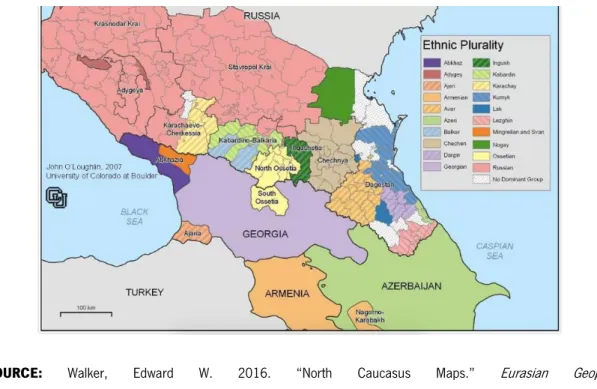
Figure 1. The Ethnic diversity of the North Caucasus ... 34
Table 2. Salafism and Sufism in the North Caucasus ... 40
Figure 2. Planning the Caucasus Emirate ... 50
Figure 3. Chechnya in Putin’s System of Power ... 71
Figure 4. The War-Terrorism Interplay in Chechnya ... 72
Abbreviations
CE Caucasus Emirate
ChRI Chechen Republic of Ichkeria
CTO Counterterrorism Operation
EU European Union
ISIL Islamic State of Syria and Levant
NATO North Atlantic Treaty Organisation
R2P Responsibility to Protect
SC Security Council
US United States
Introduction
Traditionally, a threat to the state’s security was identified as only being perpetrated by another state (Brandão, 2010; Tomé, 2014). Since the 2001 Al-Qaeda’s terrorist attacks in New York and Washington DC (9/11) the whole world acknowledged the existence of other types of security challenges — soft security threats1 — namely the ones posed by jihadist groupings with transnational ramifications (Hafez & Mullins, 2015). As a consequence, the Westphalian order, in which states are perceived as the epicentre of the security paradigm (Terrif, Craft, James & Morgan, 1999; Morgan, 2007; Caldwell & Williams, 2012), saw its foundations shaken. International Relations are entering a new era that challenges the traditional Westphalian model as new security menaces are emerging and Eriksson & Rhinard (2009:244) suggest that scholars should “turn their attention to the ‘nexus’, or critical connections, between the internal and external security domains and assess how those connections condition government responses”. To put it in other words, in order to be able to react to that sort of threats, states must be able to understand and to adapt to this new reality.
As a result of the broadening of the concept of security and of the spectrum of security challenges, new theories have emerged on the field of security (Silva, 2014). The Theory of Securitisation was one of them. Securitisation is part of the Copenhagen School and claims that any subject can be securitised through discourse (Buzan, Waever & Wilde, 1998; Huysmans, 1998; Stritzel, 2007). In other words, the two main contributors to the development of this theory — Barry Buzan and Ole Waever (2003) — consider the “speech act” to be the corollary of securitisation, since it is through discourse that the securitising actor, most of the times the state, tries to convince the audience that a particular issue is an existential threat to security. Hence, it is necessary to take extraordinary measures to eradicate the threat. Securitising an issue is, however, an intersubjective process, since each one may have a different interpretation of what a threat to security is. Eriksson stresses that
[A]nyone who classifies an issue as a ‘security problem’ makes a political rather than an analytical decision. Therefore, the role of the analyst cannot be to observe threats, but to determine how, by whom, under what circumstances, and with what consequences some issues are classified as existential threats but not others"(Eriksson, 1999:315).
1 The soft security threats are more flexible and referent to a specific object (Buzan, Waever & Wild, 1998). These new menaces are, among others, the
international terrorism. As Brandão (2010:9) argues:“[d]uring the Cold War the threat was identified (political-military, intentional, state’s source and target) and the conflict was predominantly interstate. In the post-Cold War, the threat and risks were diffuse, indirect, multisectoral, originated by and targeting a
The 9/11 terrorist events, later replicated in Madrid (2004) and London (2005), have raised awareness to the emergence of new (and transnational) actors who have been acquiring a prominent position in the international security agenda, showing evidence that states no longer hold the monopoly of violence and/or security. Terrorism is hardly a new phenomenon. In the 1970s, terrorism was already a threat to several European countries (Staab, 2011:142) — Northern Ireland (Irish Republic Army), Germany (Booder-Meinhof) and Italy (Red Brigades). During this period, terrorist aggressions were mainly ethno-nationalist in nature (Rees, 2008) and were often diminished by other states since they were considered to be a subject of national security 2 (Zimmermann, 2006:123).
Globalisation as a consequence of the spread of the capitalist model and the development of the world economy allowed new dangers to arise (Russian Federation Foreign Policy Concept, 2000). Terrorism whose character was essentially ethno-nationalist (domestic terrorism) gained another component: the international one. In this research, our aim is to understand how terrorism has materialised into an internal-external (IN-OUT) security threat to the Russian Federation.
International terrorist organisations such as Al-Qaeda became, in the years of 2000, the source of instability and insecurity, leading the United States (US) President, George W. Bush, to head a “global war on terror” and the European Union (EU) to launch several reports and strategies regarding the threat of radicalism and terrorism. In fact, the EU considered that preventing radicalism was crucial to the EU’s counter-terrorism strategy, since radicalisation provides the opportunity for terrorist cells to manipulate and recruit people to join its crusade (Council of the EU, 2005). The Russian Federation has, however, stated terrorism to be a threat before the 2001 turmoil.
Russia declared war on terrorism in 1998 (Oldberg, 2006) due to the radicalisation of the North Caucasus insurgency and its connections to the Global Jihad. The Russian President, Boris Yeltsin, signed the first Russian legal framework on terrorism, entitled On the Fight Against Terrorism, after two major terrorist attacks in the North Caucasus region. The first occurred in 1995 in Budyonnovsk (Stavropol krai), and the second in 1996 in Kizlyar-Pervomayskoye (Dagestan). These two hostage-taking situations aimed at forcing the Kremlin into negotiations with the Chechen rebels who aspired to Chechnya’s independence (Oldberg, 2006). Later in 2000, Russia claimed that fighting terrorism was a priority, since terrorism threatens not only the stability of a single state, but also of entire regions. The Kremlin has identified terrorism as “a serious threat to Russian national security. International terrorism has
2 Notwithstanding, the European Commission established, in 1976, an intergovernmental group entitled to fight terrorism called TREVI: Terrorisme,
Radicalisme, Extremisme, Violence Internationale (Kaunert & Zwolski, 2013; Staab, 2011; Rees, 2008; Nilsson, 2007; Zimmermann, 2006; Lavenex & Wallace, 2005). The TREVI group worked outside EU’s legal framework and as a forum where the foreign ministers of the member states shared information (Staab, 2011 Rees, 2008) regarding counter-terrorism cooperation (Zimmermann, 2006).
unleashed the overt campaign aimed at destabilizing the situation in Russia” (Russian Federation Foreign Policy Concept, 2000)3.
The desire for Chechnya’s independence came as a result of several independence movements that spread throughout the Soviet territory after the end of the Cold War4 (Freire, 2011). Boris Yeltsin, however, inherited not only economic problems, but also the new country’s identity problems. Hence, during his first mandate Yeltsin’s main goal was to keep the Russian Federation’s integrity (Fernandes, 2006). Regardless, that integrity was being threatened by the nationalist movements whose intention was to be freed from Moscow’s sphere of influence (Fernandes, 2006).
Despite Moscow’s military superiority, its aspirations were frustrated by the Chechen ambition of getting free of the Russian rule. In order to revert their unfavourable situation, the Chechen side relied on unconventional tactics, namely staging a guerrilla warfare against the Russian military (Arquilla & Karasik, 1999). In addition, the Chechen movement for independence was reinforced by the Muslim foreign fighters5, who identified with the cause of their fellow Muslims who arrived to Chechnya, many of them with connections to Al-Qaeda (Hahn, 2012). They wanted to impose their interpretation of Islam even though not all Chechens were inclined to accept the radical ideologies of the foreign fighters6. Islam, which was once the glue of a disperse society, started to frighten those who did not relate to Salafi interpretations of Islam (Campana, 2006). In other words, Islam ended up being instrumentalised as a catalyst of radicalism and violence (Garner, 2013), culminating on the use of terrorism by the Chechen rebels (Snetkov, 2011; 2012).
The 1995 and 1996 hostage-takings in Budyonnovsk and Kizlyar-Pervomayskoye, respectively, and the influx of foreign fighters from Arab countries preaching their radical teatchings (Hahn, 2012) — Salafism7 — have contributed to the radicalisation of the Chechnya secular insurgent movement. These
3 “Russia regards as its most important foreign policy task to combat international terrorism which is capable of destabilizing the situation not only in individual
states, but in entire regions.
The Russian Federation calls for the further measures to intensify cooperation among states in this area. It is the direct duty of every state to protect its citizens against terrorist encroachments, to prevent any activity on its territory aimed at organizing such acts against citizens and interests of other countries, and not to provide asylum to terrorists” (Russian Federation Foreign Policy Concept, 2000:np.).
4 The aftermath of the Cold War brought significant changes in world geopolitics, one of such changes being the fall of what current Russian Federation
President Vladimir Putin considers the major catastrophe of the XX century: “we should acknowledge that the collapse of the Soviet Union was a major geopolitical disaster of the century. As for the Russian nation, it became a genuine drama. Tens of millions of our co-citizens and compatriots found themselves outside Russian territory. Moreover, the epidemic of disintegration infected Russia itself. Individual savings were depreciated, and old ideals destroyed” (Putin, 2005: np).
5 We consider necessary to note that the majority of the North Caucasus population was Muslim, which has emphasised the divergences between both sides,
and that Russia feared the growing of the Islamic radicalism inside its borders (Freire, 2013).
6 Radical Islamists were able to manipulate young Chechens’ minds by exploiting their lack of confidence in government institutions to do the necessary
changes in order to promote de development of the region. In other words, “the young population who were deprived of opportunities for career growth or quality” were more easily conducted towards radicalisation because “of a lack of any exact social, economic, or political development of the North Caucasus” (Markedonov, 2010:5).
7 The concept of Salafism will be developed in the second chapter, when analysing the role of Islam in the insurgent movement in the North Caucasus. In
terrorist attacks and the fact that Yeltsin was worried with his reelection (Dannreuther & March, 2008) paved the way for the end of the Russo-Chechen conflict. Both sides entered negotiations — the Khassavyurt Accords — in which Chechnya acquired a special status with more autonomy (Atrokhov, 1999:383-384) and, in January 1997, held elections choosing Aslan Mashkadov8 as its new leader. Regardless, the fear that the Chechen separatism could spread through the North Caucasus region, namely into Dagestan, Ingushetia and Kabardino-Balkaria (Snetkov, 2011; Matveeva, Oliphant, Russel & Sagramoso, 2012; Garner, 2013) and jeopardise Moscow’s influence (Calzini, 2005) remained9.
The 1999 incursion of two Chechen rebel leaders into Dagestan — Shamil Basayev and Amir al-Khattb — followed by a series of bombings in the Russian cities of Buinaksk, Moscow and Volgodonsk (Reynolds, 2013), demanded the Russian authorities to show assertiveness and strength towards the rebel movement. Hence, Prime Minister Vladimir Putin initiated a second military campaign in Chechnya in September of the same year, labelled by the Kremlin as a counter-terrorism operation (CTO). A few months before being elected President of the Russian Federation, Putin declared that the North Caucasus was a decisive matter in Russia’s domestic policy, since it could represent a “threat of disintegration, the perceived penetration and subversion by foreign forces, the weakening of state structures as a result of criminality and terror, and Russia’s basic inability to stand up for itself and secure its core national objectives” (Dannreuther & March, 2008:99). Therefore, when he first came to power, Putin started to re-centralise the Russian state through a firm administrative control (Baev, 2006:5) in order to avoid Russia’s sovereignty erosion (“vertical power”).
Putin was worried with the possible consequences if the Chechen unrest spread towards the entire region. In order to prevent the “Yugoslavisation” of Russia (Putin, 2000 in Radoman, 2008:22) and to enable Russia to emerge as a “strong state”, Chechnya had to be defeated (Radoman, 2008:22). The CTO10 aimed at that. By claiming there was terrorism in Chechnya, the Kremlin settled a new moment on the Russian-Chechen conflict. The first moment began in 1991, when Dudaev declared the independence of Chechnya and created the Chechen Republic of Ichkeria as its successor. Yeltsin reacted in order to protect the territorial integrity and the sovereignty of the new Russian state. During the first war, the conflict was mostly about the Chechen aspiration for freedom and the Russian attempt
8 Aslan Mashkadov was a former Soviet military who obtained some support from the Kremlin for being a relatively moderate separatist (Melvin, 2007), unlike
the foreign fighters that arrived at Chechnya.
9 In fact, Dagestan became known as “Little Chechnya” (Wiktorowicz, 2001:25) after groupings of Salafis who fought in Chechnya returned home, in 1996,
to create an Islamic State in Dagestan.
10 It had three military stages aimed at circumscribing and destroying the terrorists but, it also had a more political component based on the principles of
recentralisation and “vertical power”. So, in addition to the military component, the CTO comprised the securitisation of media, the coordination of governmental structures, and a strategy called Chechenisation (Kim & Blank, 2013). All these new measures reinforced the role of the President and his centrality on the Russian politics. In 2009, President Medvedev considered the situation in Chechnya controlled, mostly due to the success of the "Chechenisation" policy (Calzini, 2005; Campana, 2006; Dunlop & Mennon, 2006; Melvin, 2007; Dannreuther & March, 2008; Predmore, 2011; Ware, 2011) and Ramzan Kadyrov’s strong leadership (Ware, 2011), so he declared the end of the CTO in Chechnya.
to avoid losing more territories after the disintegration of the USSR. The second moment began when foreign fighters associated with international terrorist organisations, namely Al-Qaeda, arrived at the North Caucasus and commenced imposing their Salafi ideologies. The Chechen association with the global jihad was instrumental for Moscow to show evidence that there was terrorism in Chechnya and that it was a threat to the Russian Federation. In other words, the internal sphere of the Russian state collided with the external one, once the threats posed by regional separatism (internal) and terrorism (international) (Russian Federation National Concept, 1997) were combined in Chechnya. So, fighting international terrorism was a priority to the Russian Federation, as it has impact inside the country’s borders.
The terrorist topic is still a priority to the Russian politics. Despite the end of the CTO in 2009 and the fact that violence ratings have been decreasing over the past few years, the Kremlin did not fully eradicate radicalism from the North Caucasus. The “Chechenisation model” could not be replicated on the other republics and the hub of extremism and radicalism moved from Chechnya to Dagestan, where the headquarters of the North Caucasus’ terrorist organisation — the Caucasus Emirate (CE) — are located. The CE emerged as the successor of the Chechen Republic of Ichkeria (Hahn, 2011; 2012; Soliyev, 2014; Falkowski, 2014) and shares the same ideals of the Islamic State of Syria and Levant (ISIL), to whom it pledged allegiance in 2016 (Hahn, 2016). According to the Caucasian Knot (2016), from 2010 to 2015, 6 074 people have become victims of terrorism in the North Caucasus. The International Crisis Group estimated, in March 2016, that five thousand Russian people have left the country to join ISIL and fight in Syria, and the Kremlin has already expressed its concerns regarding this data (Putin, 2015a).
Under the rhetoric of an advocate of multilateralism and promotor of the “democratisation of international relations based on the principle of multilateralism and respect for international law” (Legvold, 2009:21), Russia has been shaping its foreign policy, namely by pursuing a multipolar world order (Rowe & Torjesen, 2009). Multilateralism is, thus, considered the legitimate basis to address peace and security problems (Legvold, 2009), and it also is a way for Russia to stress its value as an actor. The Russian intervention in Syria is an example of that. The Syrian conflict that began in 2011 as a civil war has turned into a battle against extremism and terrorism (Hahn, 2015). The Kremlin considers supporting Bashar al-Assad the lesser evil option, so Russia has accepted his request to fight terrorism in Syria (Putin in Rose, 2015b). Fighting the expansion of terrorist organisations whose aim is the creation of a pan-Islamic global caliphate connecting all Muslims in the world, such as ISIL and its associates, Boku
Haram and CE, is a priority to Russia. These terrorist organisations use the name of Allah11 to perpetrate their acts and spread fear. Russia, who has been dealing with terrorism for a long time, has assumed itself as an actor on the global fight against international terrorism (Rowe & Torjesen, 2008; Legvold, 2008). International terrorism is a threat both at the international and domestic levels and because of that awareness, the Kremlin has been active in the fight against international terrorism, more recently by intervening in Syria.
In this dissertation, we intend to analyse not the secessionist movement per se, but how it has affected the Russian politics over the years. We aim at understanding how the Russian anti-terrorist foreign policy has been influenced by the domestic context of Chechnya’s struggle for independence, i.e., in which way the North Caucasus secular movement turned into a religion-oriented one has affected the way the Kremlin has been guiding its domestic and foreign policies. So, our guiding question is: How does the domestic context affect the foreign policy?
In order to explore the main research question, we raise two hypotheses, both related to the IN-OUT security nexus. The narrative of the IN-OUT security nexus was developed under the European Studies and has been applied, most of the times, to the EU’s reality. According to the EU, there is a general understanding that after the Cold War the internal and external aspects of security became intrinsically linked (Council of the EU, 2003; European Commission, 2005). That being said, our first hypothesis is that terrorism is, simultaneously, an internal and external security threat; and the second hypothesis is that, unlike what classical thinkers stated, there is a connection between the domestic and international realms of a state, i.e., the domestic policy has an impact on the foreign policy and vice-versa.
Separatism, ethnic conflicts, extremism and terrorism are considered a threat to the Russian Federation since Yeltsin and, ever since, they have been present in several Russian official documents (see the National Security Concepts of 1997; 2009; 2015; and the Russian Federation Foreign Policy Concept 2000; 2008; 2013; 2016). So, in this research we intend to understand how the Kremlin has been dealing with the Chechen separatism internally. Has the Kremlin been able to securitise the Chechen secessionist movement? Was it able to successfully portray the separatism in Chechnya as an IN-OUT security threat to the integrity of the Russian Federation?
As above-mentioned, the North Caucasus has been a complex challenge for Russia that wants to keep it as part of its territory. The Kremlin has claimed to be dealing with an international threat — international
11 We must note that Russia is not against religious diversity, nor Islam in particular. In fact, according to the 1993 Russian Constitution, the Russian
Federation is committed to respect religious diversity and that has to do not only with the democratic aspect Russia wants the world to see, but also with the development of a practical model of Russian-Muslim relations. This is particularly evident during the Putin-Medvedev tandem where Moscow used a top-down approach (Braginskaia, 2012:614) to Islam, i.e., the “Putin-Medvedev period have closely followed the semi-authoritarian principal of vertical distribution of power”, meaning that even though Islam was not portrayed as a threat, the Kremlin only supported religious organisations willing to respect the federal government and to be loyal to Russia (Filatov, 2007:42 in Braginskaia, 2012:604).
terrorism — in that specific republic, which led to the declaration of a second intervention in Chechnya, i.e., the Russian government was forced to intervene in order to prevent the Chechen radicalism from spreading to the other republics. Ramzan Kadyrov — Chechnya’s president since 2007 — has been crucial to the stabilisation of the Chechen republic (Falkowski, 2014; 2015). Kadyrov has proclaimed his loyalty to the Kremlin, particularly to Vladimir Putin. His authoritarian style of leadership allowed him to gain all the support needed to take the measures he considered necessary to a new status quo to the rebellious republic. We wonder, however, if the “normalisation” of Chechnya, after Kadyrov, has changed the IN-OUT security nexus. Violence ratings in Chechnya decreased, but has the terrorist threat ceased to exist in the North Caucasus?
The jihadist fighters who settled in the North Caucasus after the first and the second Chechen wars (McFaul, 1995; Henkin, 2006; Snetkov, 2011) and the preaching of their radical view of Islam has materialised in a linkage between the North Caucasus insurgent movement and the global jihadist movement, first through Al-Qaeda and more recently through ISIL (Hahn, 2012; 2015; 2016). Exploring the North Caucasus connection to other Islamic terrorist organisations, and how that connection influences the Russian foreign policy is another goal of this dissertation, namely by trying to understand the reasons why Russia has accepted Assad’s request for help, despite the Russian principle of non-intervention in the domestic matters of a state. The civil war in Syria, in which several jihadi groups have been exploiting the vulnerabilities of the country, has become a war against terrorism. So, another secondary question of this dissertation is: Is the Russian intervention in Syria linked to the domestic situation of the North Caucasus?
As we have argued before, in the traditional Westphalian world order, states are the main actors in the International System, meaning than only states could harm the security of other states (Terrif et al., 1999; Morgan, 2007; Brandão, 2010; Tomé, 2014). Terrorism, however, has proven this premise to no longer be entirely true. Terrorism has been gradually acquiring a more prominent position in the international security agenda. In this dissertation, we address the role terrorism has been playing in Russian politics. We argue that terrorism is an IN-OUT threat, as it threatens not only the state in which the terrorist event occurs, but also threatens the international peace and stability (Russian Federation Foreign Policy Concept, 2000; 2008; 2013; 2016). So, the goal of this dissertation is to understand how the IN-OUT security nexus applies to the Russian case, namely by exploring how the Chechen domestic context has shaped the Russian foreign policy.
Our research will be delimited by the study of the 1991-2016 period. The year of 1991 is fundamental to this research since it is the year the USSR finally collapsed being succeeded by the Russian Federation,
way smaller after the independence of fourteen Soviet Socialist Republics, and the year that Dzhokar Dudaev has, unilaterally, declared Chechnya’s independence; and 2016 is the year ISIL has formally threatened the Russian territorial integrity both by accepting the CE’s allegiance and by declaring jihad against the Russian state. In this research we will focus on the Chechen struggle for independence, because Chechnya is the most paradigmatic republic — it was the first republic to rebel against Russia, and the only republic in which a CTO was declared—, even though we may mention other North Caucasus’ republics, especially Dagestan, when we consider appropriate.
Studying Russia is always challenging as Russia is “a riddle, wrapped in a mystery, inside an enigma” (Churchill, 1939 in Cowell, 2008:np). Understanding Russia is not a linear process, which makes it a very compelling case study. In addition to the relevance of the Russian Federation as an actor, we address a recurrent topic to the Security Studies’ agenda: the terrorist threat12. A lot has been said about the Russian war on terrorism and on the Russian motives to intervene in Syria, but we have found a research gap. Most of the literature on the Russian war on terrorism focuses exclusively on one of the two realms of the state, i.e., either authors access the North Caucasus separatist movement, and most of the times taking into consideration the rebel motives; or they address the Russian strategic partnerships with other states and/or international organisations. This dissertation aims at adding value by addressing the Russian point of view regarding the Chechen struggle for independence, and by acknowledging the IN-OUT security threat it represents to the Russian Federation. Also, this dissertation gives a new perspective on how the Russian anti-terrorism policy is the result of the connection of the domestic context and the foreign policy.
This dissertation produces an analysis of how the Russian anti-terrorist policy has been influenced by the domestic conflict in the North Caucasus, and how both realms of the state — the internal and the external— are linked. Regarding the methodology framework, in this research we assume a deductive posture, as we begin with the attempt to apply the theoretical framework (Marsh & Furlong, 2002) and then make considerations — the theoretical framework is the Theory of “Securitisation” that will be complemented by the IN-OUT security nexus. We also assume a post-modernist ontology, since the Theory of “Securitisation” is a derivative of Constructivism. All these postures condition not only our epistemology but also our methodology. As such, this investigation understands that concepts socially constructed are subjective and susceptible to the personal interpretations of the researcher, hence the impossibility of a totally impartial conclusion by the person investigating (Snape & Spencer 2003). In
12 The growing narrative of ISIL as the newest great international security threat and its expansion in Syria amplify the research value of this dissertation, as
other words, the interpretative epistemology in addition to a post-modernist ontology offer a broader interpretation of the concepts that are socially constructed (Tadjkshkh & Chenoy, 2007), as it is the case of terrorism.
Taking into consideration that we are assuming a Constructivist lens, we must acknowledge the characteristics of the North Caucasus in order to understand what motivates the North Caucasus’ people to rebel against the Russian government, and how that is related to the phenomenon of terrorism. The roots of the insurgent movement will help us to analyse how the Kremlin has been building its narrative regarding the Chechen struggle for independence and the Russian fight against terrorism. This evolution of the Chechen movement puts in evidence that the factors involved in this dissertation are not always linear, but subjective. Security is a social construct and depends on each one’s interpretation of it (Eriksson, 1999), meaning that the social life process is not frozen, but changes over time.
The complexity of the North Caucasus character and evolution makes it a compelling case study. Yet, we acknowledge that a generalisation or a replication might not be possible, since the qualitative research does not rely on numerical or statistics figures (King, Keohane & Verba, 1994). In other words, we have chosen a single case study — the Russian anti-terrorist foreign policy — and our intention is to study how the evolution of this particular movement affects the internal and external decisions of the Kremlin, namely by studying how the Russian intervention in Syria is an example of terrorism as an IN-OUT security threat to Russia.
As we assume an interpretative posture, hence a more subjective research, we must also assume that our methodology — the methods and techniques — are essentially qualitative. Consulting primary sources is crucial for a more accurate interpretation of the Russian point of view on the subject in study. As for the primary sources we will analyse strategic documents, such as the Russian Constitution; the Foreign Policy Concepts of 2000, 2008, 2013 and 2016; the Concepts of National Security of 1997; 2000, 2009, and 2015; the Russian Federation Federal Law No. 130-FZ: On the fight against terrorism; as well as some discourses of the Presidents of the Russian Federation: Boris Yeltsin, Vladimir Putin and Dmitri Medvedev. The use of primary sources will help us understand the Russian narrative, but it is important to balance them with secondary sources, otherwise we may take the plunge of loosing focus. The structure of this dissertation has been built in order to provide an answer to our guiding question and it will be divided into four parts. The first chapter, entitled Securitisation and the phenomenon of terrorism, will address the new reality the International System is facing, namely by acknowledging the need for a broader concept of security that includes not only the military threats, or hard security threats, but also threats posed by other actors besides the state, in this particularly case terrorism. In this chapter
we will also explore the Theory of “Securitisation” in order to understand how and when a menace can be securitised; i.e., how an actor can construct the narrative of an existential threat to its security. In this first chapter, we also access the literature on IN-OUT security nexus and how terrorism is an example of an IN-OUT threat affecting both realms of the state.
In the second chapter, entitled The North Caucasus struggle for independence: understanding the conflict, we address the historical and sociological contexts leading to two major confrontations between the Russian and the Chechen sides. We explore the religious and cultural factors that brought the North Caucasus together and how Islam has been an instrument to unite the resistance and how the foreign fighters have contributed to the radicalisation of the Chechen secular movement seeking for independence.
The third chapter, The Russian response to the North Caucasus insurgency, will focus on the internal measures taken by the Russian government to control the insurgents. This chapter addresses the presidencies of Boris Yeltsin, from his first election and then declaration of war in Chechnya, until his resignation in 1999. We also analyse Vladimir Putin’s first two mandates (2000-2008) and his re-centralisation policies and the strategy of "Chechenisation". We deliberately excluded a section dedicated to the presidency of Dmitri Medvedev (2008-2012) because we considered he did not have the same internal relevance as Yeltsin — who declared the first Chechen War and created a legal framework on terrorism — or as Putin — who ordered another intervention on the grounds of an anti-terrorism campaign and initiated a policy of re-centralisation of power — did. Instead, Medvedev declared the end of the counter-terrorism operation in Chechnya less than a year after assuming the Russian leadership and ten years after Putin’s continuous efforts to circumscribe the insurgency. We understand that Medvedev’s presidency had more impact on the foreign policy of the Russian Federation, at least when compared to the internal measures taken to stabilise the North Caucasus. In other words, he played a more significant part in re-engaging a cordial relationship with the US and Barack Obama; and then in expressing the Russian support over Assad in the Syrian crisis, and for that reason we will enhance his importance during the fourth chapter.
The support of Bashar al-Assad’s regime and the subsequent election of Vladimir Putin in 2012 have contributed to another worsening of the Russia-US relations, as we sought to mirror in the fourth and last chapter, called The Russo-Syrian coalition against terrorism. The last chapter is about the Russian intervention in Syria. It is not our aim to comment on whether the support over Assad’s government and the military intervention had been efficient or not, but what has motivated Russia to go against its policy of non-intervention on the internal affairs of a sovereign state and to answer the Syrian leader’s call for
help. It is in this chapter that we establish the connection between the Russian territorial integrity (in) and the Syrian crisis (out). We will explore the North Caucasus linkage to ISIL and the Kremlin’s concern regarding the Russian and neighbouring citizens who left their countries to fight in Syria for ISIL and their return home with a more radicalised perspective. In other words, if in the third chapter we address the IN on the IN-OUT security nexus, namely by analysing the consequences of the Chechen separatist movement at home, in this last chapter we will address the OUT of the IN-OUT security nexus, since we will explore the motives leading Russia to fight against terrorism in Syria.
1.1. Security in a post-Cold War international order
Similar to several Social Sciences core concepts — power, justice, freedom, or equality (Gallie, 1962); “security” is also an “essentially contested concept”. Barry Buzan considers that in addition to contested, the concept of security is also underdeveloped and relative (Buzan, 1983:2;18). The first debates concerning a definition for security consider it an absolute value (Hobbes in Ullman, 2011:12) and, until the decade of 1980, national security was dominated by two main approaches: (1) the Realist in which power is contemplated as the ultimate goal, i.e., if an actor acquires enough power its security is assured; and (2) the Idealist which, contrary to the Realist one, identifies peace as the priority of an actor who aspires for security (Buzan, 1983). Ullman (2011:11) stresses that we, traditionally, think of national security in terms of military threats arising from outside of our borders. To this author,
[A] threat to national security is an action or a sequence of events that (1) threaten drastically and over a relatively brief span of time to degrade the quality of life for the inhabitants of state, or, (2) threaten significantly to narrow the range of policy choices available to governments of a state or to, nongovernmental entities (persons, groups, corporations) within the state.
Buzan (1983:18), in his turn, reflects that the concept of security must combine ideas of both Realist and Idealist approaches since “security”:
[T]ends to be either seen as a derivative of power, in the sense that an actor with enough power to reach a dominating position will acquire security as a result, or as a consequence of peace, in the sense that a lasting peace would provide security for all (…) We shall argue that security is more usefully viewed as a companion to, rather than a derivative of, power, and that is more usefully viewed as a prior condition of peace than a consequence of it.
Some events such as the Peloponnesian War (5th century BC), the Thirty Years’ War (1618-1648) and the First World War (1914-1918) help to understand why the Realist approach has been prevailing a preferred International Relations theory to explain the phenomena related to international (in)security. As noted by Lene Hansen (2012:96): “[r]ealism is the foundational school of thought about international politics around which all others are oriented”. To put it in other words, since the end of the Thirty Years’ War and the Peace of Westphalia in 1648, states are considered the primary actor of the International System portraying, simultaneously, the source of reliability and fear. The Realist School understands that interests and the struggle for power are continuous on the daily basis life of states. Additionally, those are the main causes of conflict between States. Traditional thinkers argue that only states can pose a
security paradigm should only focus on states, as they are the provenience of both peace and insecurity (Terrif et al., 1999; Morgan, 2007; Caldwell & Williams, 2012).
The Hobbesian tradition explains that the most important obstacle to security is the human nature: “[t]he security dilemma arose, ironically, from humans themselves as intelligent, creative, rational bipeds seeking to survive and thrive in eliciting the cooperation of others on their own egoistic terms” (Kolodziej, 2005:53). The combination of egoistic feelings, continued competition and the struggle for survival — described by Thomas Hobbes as state of nature — hinders cooperation once relationships between people are essentially perceived as negative, following the Realist premise that the gain of the one is the lost of the other — zero sum game. So, when living in a state of nature, the suspicion level is elevated and everybody fear for their lives and, in order to secure them, each person is willing to enter into a social contract, alienating part of their sovereignty to a major authority that is the Leviathan — representation of the Modern State. Anarchy also plays an important role in the International System. Despite the fact that anarchy characterises the dynamics between states (Clausewitz, 1976) and that human nature condition is transferred to international relations, the same proceeding cannot be applied to states’ interactions, since the Westphalian order evinces that there are major actors than the states and they obey anyone but themselves which can trigger extreme conflict between these actors (Clausewitz, 1976).
The Cold War, however, sets the beginning of the transformation of the security paradigm as it acknowledges the emergence of new transnational actors and threats (Terrif et al., 1999). Globalisation has had great impact on how these new challenges to the Westphalian order still guided by traditional aspects — sovereignty, boundaries, armed forces, national interest — affect the states’ security behaviour. Despite its benefits, globalisation left states more susceptible to new and distant threats, such as terrorism, drug trafficking, immigration, and so on (Aldis & Herd, 2005). The traditional thinking that only states can harm states is obsolete, leading to the debate of whether expand or not the concept of security. Authors, such as Stephen Walt (1991:212-213), have shown some reluctance in widening the concept of security since he believes that Security Studies must focus on the study of war. Encompassing other matters such as poverty, the environment or economics could “destroy its intellectual coherence and make it more difficult to devise solutions to any of these problems”. Despite that, one cannot ignore the fact that traditional security paradigm based on the military component fails to respond to the threats of today. With globalisation states became interconnected and no state, alone, can absolutely guarantee its protection nor interests. Since the Cold War we have been experiencing a gradual decentralisation of the
state as the unitary13 actor in the International System. Hard security threats have become less frequent while soft security threats, in which terrorism is included, have been acquiring more significance14.
There is no consensus on security as a concept. In fact, that it is a social construct (Sheehan, 2005) in which “there are no objective threats, only attempts to saddle issues with ‘security’ implications” (Eriksson, 1999:315) implies that security is a concept susceptible to one’s understanding.
In addition, “[d]anger is not an objective condition. It is not a thing which exists independently of those to whom it may become a threat (…) Danger is an effect of interpretation” (Campbell, 1992:1-2 in. Müller, [2009]:14). This means that security as a concept must be malleable and flexible (Aldis & Herd, 2005: 182), once by focusing solely in military issues — for instance war — we are ignoring must of the new security challenges appearing in a globalised era. Despite the difficulty [and even impossibility] of reaching a consensus regarding the definition of security, since it is a social construct (Sheehan, 2005) susceptible to plenty of interpretations. Buzan, Wæver and Wilde (1998) identify five sectors of security that one must pay attention to in order to fully understand “security”: (1) military; (2) political; (3) economic; (4) societal; and (5) environment15.
1.2. The Copenhagen School and the Theory of Securitisation
The Copenhagen School came into being in the 1980s, when scholars from the Centre for Peace and Conflict Research, now known as Conflict and Peace Research Institute, struggled to move beyond a restrictive security agenda (Huysmans, 1998) based exclusively on military issues. This school of thought advocates a broader concept for security in order to exploit the gap filled with neglected and marginalised issues left during Cold War (Panic, 2009). The Copenhagen scholars, with particular focus on the work of Barry Buzan and Ole Wæver, back a greater attention on the “social identity” (McSweeney,1996:81).
13 This does not mean that states are no longer the main actors in the International System. Even though Buzan opens up the debate for new security units,
units being “actors composed of various groups, organisations, communities, and many individuals and sufficiently cohesive and independent to be differentiated from others and to have standing at the higher levels (e.g., states, nations, transnational firms)” (Buzan et al., 1998:6); he considers that the state-centred paradigm is still very much present on the study of security.
14 “Hard security in which military force (“hard power”) was deployed by militaries against combatants for territorial gains or defence is increasingly perceived
to be superseded by soft security — non-military threats that could be managed through recourse to the military, but more appropriately non-military instruments, such as diplomatic, economic, financial, and intelligence strategies or policies, instruments which formed the mainstay of ‘soft power’” (Aldis & Herd, 2005:182).
15 In short, “the military security concerns the two-level interplay of the armed offensive and defensive capabilities of states, and states’ perceptions of each
other’s intentions. Political security concerns the organizational stability of states, systems of government and the ideologies that give them legitimacy. Economic security concerns access to resources, finance, markets necessary to sustain acceptable levels of welfare and state power. Societal security concerns the sustainability, within acceptable conditions for evolution, of traditional patterns of language, culture and religious and national identity and custom. Environmental security concerns the maintenance of the local and the planetary biosphere as the essential support system on which all other human
The Copenhagen School is also innovative as it the result of a collective dynamic that conjures both elements of neorealism and social constructivism (Huysmans, 1998), instead of Realism exclusively.
The theory of securitisation is one of the most evident contributions of the Copenhagen School and, by recognising that any issue can be subject of securitisation through discourse (Buzan et al.,1998; Huysmans, 1998; Stritzel, 2007; Panic, 2009; Silva, 2014) allows different interpretations of security16.
In other words, the Copenhagen School finds in the “speech act”17 (Wæver,1995:55) a way to perform a security action with potential to structure social practices (Stritzel, 2007:360). Discourse has gain major importance on security analysis (Balzacq, 2005). Post-structuralists assign the same importance to power as realists do, though they have different referents of power: while realists assume power as the subjugation of the other, post-structuralists consider language to be power (Hansen, 2012). Jurgen Habermas has developed a theory known as Communicative Action, made known in the field of International Relations by Thomas Risse, in which he considers knowledge not to be the fundamental factor of rationality but language instead (Habermas in Stanford Encyclopaedia of Philosophy, [2014]). It is through discourse that actions are oriented — we may understand discourse as a road map of actions — and Communicative Action is a process of argumentation, deliberation and persuasion in which actors (must) engage in a truth-seeking discourse (Risse, 2000). This way, discourse can be seen as a tool for securitisation as for the Copenhagen School it is through discourse that the securitiser actor points out the presence of an existential threat (Buzan et al., 1998). Buzan & Wæver (2003:491) identify the “speech act” as the core assumption of the theory of securitisation and, for that reason, discourse plays an important part on the process of securitisation, yet it is not the only requirement18. It also calls for an emergency measure that will legitimise that sense of emergency and that threat as an existential threat19. This means that the securitising process can be seen as legitimate by one particular political community and as a paranoia by another (Buzan et al.,1998).
In other words, the securitisation process, according to Buzan et al. (1998) is a speech act through which the securitiser actor constructs the threat, enabling it with power to break the rules in the name
16“Security is no longer perceived only as military security of the state. Different reference objects, economy, environmental protection, or military relations,
can be subjects to the securitisation process in which socially and politically effective linguistic act of denoting an issue as security moves such issue away from the area of daily politics and identifies it as an existential threat that requires and justifies special measures” (Panic, 2009:31).
17“The process of securitization is what in language theory is called a speech act (…) By saying the words, something is done (…) It is important to note that
the security speech is not defined by uttering the word security. What is essential is the designation of an existential threat requiring emergency action or special measures and the acceptance of that designation by a significance audience” (Buzan et al., 1998: 26-27).
18“A discourse that takes the form of presenting something as an existential threat to a referent object does not by itself create securitization — this is a
securitizing move, but the issue is securitized only if and when the audience accepts it as such. (Accept does not necessarily mean in civilized, dominance-free discussion; it only means that an order always rests on coercion as well as on consent” (Buzan et al. 1998:25).
19 “[A]n emergency measure has to be adopted, only that the existential has to argued and just gain enough resonance for a platform to be made from which
it is possible to legitimize emergency measures or other steps that would not have been possible had the discourse not taken the form of existential threats, point of no return, and necessity” (Buzan et al. 1998:25).
of security20 (Bright, 2012), but only if legitimised by an audience. The Copenhagen School splits the actor, most of the times the state, in two parts: the securitising one who performs the emergency speech act, and the audience accepting, or not, the securitising move21. Whether the audience accepts it or not, that depends on its interpretation and on the negotiation between the securitiser and the relevant audience (Strietzel, 2007).
The Copenhagen School and the theory of securitisation provide “an innovative, sophisticated, and productive research strategy within contemporary security studies” (Williams, 2003:528) but by focusing on security as a speech act they [the Copenhagen School and securitisation theorists] are narrowing the context in which securitisation happens. The fact that securitisation is a subjective22 phenomenon allows a panoply of interpretations of it. For instance, Rita Floyd (2011:428) argues that a moral rightness of securitisation must obey to three criteria: (1) the existence of an objective existential threat that endangers the survival of an actor; (2) the referent object of security must be morally legitimate (and concerned with the human needs); and (3) an appropriate response to the threat that takes into consideration (a) the capability of the aggressor and (b) the sincere intentions of the securitising actor.
Thierry Balzacq (2011) stresses that a “sociological” approach to securitisation is preferable to the “philosophical” based on the speech act suggested by the Copenhagen School. Balzacq (2011:1-2) believes securitisation “is better understood as a strategic (pragmatic) process that occurs within, as part of, a configuration of circumstances, including the context, the psycho-cultural disposition of the audience, and the power that both speaker and listener bring to the interaction”.
20 “[S]ecurity is about survival. It is when an issue is presented as posing an existential threat to designated referent object (traditionally, but no necessarily
the state, incorporating government, territory, and society). The special nature of security threats justifies the use of extraordinary measures to handle them. The invocation of security has been the key to legitimizing the use of force, but more generally it has opened the way for the state to mobilize, or to take special powers, to handle existential threats” (Buzan et al.,1998:21).
21“The concept of a securitizing move can thus be employed as an empirically observable indication of an initiation of a threat construction performed by a
decision-maker. In terms of operationalization, a securitizing move is here defined as the public framing of an issue as a national threat, accompanied by a strategy for action. If a decision-maker has publicly declared that an issue is a threat to national security, and presents an action plan to handle this threat, a securitizing move has been initiated. If the issue is presented in more general terms or lacks a concrete strategy, there is no move. This operationalization serves to separate the securitizing move from other statements by a decision-making unit which can be employed as indications of internalization” (Sjöstedt, 2013:146).
22 Buzan et al. (1998) establish a distinction between subjective and objective, recognising securitisation as being a subjective process that can seen as legit
by one particular political community and as a paranoia by other. So, the authors define securitisation as “intersubjective and socially constructed: Does a referent object hold general legitimacy as something that should survive, which entails that actors can make reference to it, point to something as a threat, and thereby get others to follow or at least tolerate actions not otherwise legitimate? (…) Successful securitization is not decided by the securitizer but by the
Notwithstanding, Balzacq understands that circumstances may vary in form and content. In order to make securitisation more manageable, he narrows it to three factors23 and considers pertinent to recast securitisation as an ideal type24 (see the table below).
TABLE 1. AN IDEAL TYPE OF SECURITIZATION
• Threats are social facts whose status depends on an intersubjective commitment between an audience and a securitizing actor
• Securitizing moves and context are co-dependent
• The drivers of securitizing moves are knowledge claims about an existential threat to a referent object
• Power relations among stakeholders structure both the processes and outcomes of securitizong moves
• Securitizing moves are engraved in social mechanisms (persuasion, propaganda, leaning, socialization, practices, etc.)
• Securitization instantiates policy changes — for example, ‘deontic powers’ (rights, obligations, derogations exceptional or otherwise, etc.)
• Securitization ascribes responsibility.
SOURCE: Balzacq, Thierry. 2014. “The ‘Essence’ of Securitization: Theory, Ideal Type, and a Sociological Science of Security.” In Forum: What Kind of Theory - If Any - Is Securitization?, edited by Thierry Balzaq, Stefano Guzzini, Michael C. Williams, Ole Waever, and Heikki PatomäkI, 14.
So, Balzacq’s definition of securitisation is:
an articulated assemblage of practices whereby heuristic artefacts (metaphors, policy tools, image repertoires, analogies, stereotypes, emotions, etc.) are contextually mobilized by a securitizing actor, who works to prompt an audience to build a coherent network of implications (feelings, sensations, thoughts, and institutions), about the critical vulnerability of a referent object, that concurs with the
23“However, in order to make the analysis of securitization more tractable, I have narrowed down their number by arguing, in substance, that the conditions
underlying the effectuation of securitization fall into at least three sets of factors — audience, context and securitizing agent. In short, the first of these has three components — (i) audience’s frame of reference; (ii) its readiness to be convinced, which depends on whether it perceives the securitizing actor as knowing the issue and as trustworthy; and (iii) its ability to grant or deny a formal mandate to public officials. The second set of factors concerns contextual effects on the audience’s responsiveness to the securitizing actor’s arguments — relevant aspects of the Zeitgeist that influence the listener, and the impact of the immediate situation on the way the securitizing author’s sentences are interpreted by the listener. The third set involves the capacity of the securitizing actor to use appropriate words and cogent frames of reference in a given context, in order to win the support of the target audience for political purposes” (Balzacq, 2005:192).
24 “[A]n ideal type is formed by the one-side exaggeration … of one or several points of view and by the synthesis of great many diffusely and discretely existing
component phenomena … which are sometimes more and sometimes less present and occasionally absent, which are in accordance with those one-sidedly emphasized viewpoints, and which are arranged into an internally consistent … thought-image” (Weber in Balzacq et al., 2014:9).
securitizing actor’s reasons for choices and actions, by investing the referent subject with such an aura of unprecedented threatening complexion that a customized policy must be undertaken immediately to block its development25(Balzacq, 2011:3).
Thierry Balzacq agrees that the “speech act” is important to a successful securitisation, but he goes beyond the founding fathers of the Theory of “Securitisation” by claiming that context matters when the main goal is to convince the audience of an existential threat. Playing with analogies, emotions and metaphors help the audience to engage on the securitising move and to legitimate it. In other words, through context the securitising actor can manipulate the audience’s fears and led it to accept the referent object as an actual threat to security and to agree on taking special and customised measures to strike down the menace.
The Copenhagen School has, thus, played an important role in the defence of a widened26 concept of security by considering that any issue can move from non-politicised to securitised27. Apart from that, securitisation as envisioned by the Copenhagen School might be limited, as the scholars conceptualise security solely as a speech act discrediting the importance of the context in which securitisation occurs (Wilkinson, 2011:94). Mark B. Salter (2011:116-117) stresses that securitisation does not depend exclusively on discourse, otherwise faults in the grammatical structure would jeopardise the whole process. Instead, he advocates that securitisation is more than a manifest in language, it is political and sociological process in which different securitising moves require different dynamics28. To that extent, securitisation cannot be seen as a linear nor an objective process — threats to national security can differ from a national decision-maker to another, and even over time and space (Sjöstedt, 2013).
25 Emphasis of the author.
26 “In the post-Cold War, debate about security leading to conceptual, theoretical and empirical pluralism became widespread, resulting in its broader
re-conceptualization. No longer at the centre of the realistic approach, security is conceived as a multi-sector phenomenon because it is not restricted to the traditional political and military sectors, and as a multi-level one, because it is not limited to the provider and object of state reference. In short, four central themes in the debate can be identified. First, the critical contributions of the threat’s realistic setting warned of the complexity of the post-Cold War environment, characterized by multiple threats including non-state ones. Politically, the discourse about the "changing context", diffuse and unpredictable, became widespread. A second front of the debate focused on the referencing object of security, deconstructing the realistic equation — 'state security’ equals 'security of people’? from the question, 'whose security?' One of the answers favoured the people-centred approach in the context of the 'humanizing' discourse of the nineties, also present in the field of development. The diversity both in terms of threat and object (of security) justified a third axis of the reformulation applied to the security provider: besides the state, historically enshrined as the actor of security, other actors contribute to the security of persons, ranging from supra-state organizations to nongovernmental organizations. The academic and political trend towards a holistic approach (comprehensive approach) to security is reinforced by the fourth axis of the debate: the security nexuses” (Brandão, 2015:4). The nexuses narrative will be further developed above in this chapter.
27 Buzan et al. (1998:23-24) consider securitisation an extreme version of politicisation so, “[i]n theory, any issue can be located on the spectrum ranging
from nonpoliticized (meaning the state does not deal with it and it is not in any way other made an issue of public debate and decision) through politicized (meaning the issue is part of public policy, requiring government decision and resource allocations or, more rarely, some other form of communal governance) to securitized (meaning the issue is presented as an existential threat, requiring emergency measures and justifying actions outside the normal bounds of political procedure”.
28 “Securitization is a sociological and political process — manifest in language, but a complex effect of power, interest, inter-subjectivity, bureaucratic position,