D evelopment,
health-industrial complex and
industrial policy
ABSTRACT
This paper puts health questions within the context of national development and industrial policy. It follows the idea of structuralist, Marxist and Schumpeterian approaches, in which industry and innovations form determining factors for the dynamism in capitalist economies and relative positions within the world economy. All countries that have developed and started to compete under better conditions with advanced countries have had an association between strong industry and an endogenous knowledge, learning and innovation base. However, in the field of health, this vision presents problems because business interests move according to the economic logic of profit rather than to meet health needs. The notion of the health-industrial complex is an attempt to provide a theoretical reference that enables linkage between two distinct types of logic: health and economic development. This study has sought to show, on the basis of foreign trade data, how disregard for the logic of health policy development has led to a situation of economic vulnerability in this sector, which may limit the objectives of universality, equality and comprehensiveness. Within this context, a cognitive and political break with these antagonistic visions that put health needs on one side and industrial needs on the other is proposed. A country that aims to reach a condition of development and independence requires strong innovative industries and an inclusive and universal health system, at the same time.
KEYW O RD S: Industry, economics. Industries, trends. H ealth care sector. Technological development. H ealth sciences, technology and innovation management. N ational science, technology and innovation policy. Carlos Augusto Grabois Gadelha
Departamento de Administração e Planejamento em Saúde. Escola Nacional de Saúde Pública. Fundação Oswaldo Cruz. Rio de Janeiro, RJ, Brasil
Correspondence:
Carlos Augusto Grabois Gadelha Departamento de Administração e Planeja-mento em Saúde (DAPS)
Escola Nacional de Saúde Pública (ENSP), Fundação Oswaldo Cruz
Rua Leopoldo Bulhões, 1480 7o andar
Manguinhos
21041-210, Rio de Janeiro, RJ, Brasil E-mail: [email protected]
INTRODUCTION
This paper puts health questions within the context of national development and industrial policy. It fol-lows the idea of structuralist, Marxist and Schum-peterian approaches, in which industry and innova-tions form determining factors for the dynamism in capitalist economies and relative positions within the world economy. All countries that have developed and started to compete under better conditions with advanced countries have had an association between strong industry and an endogenous base of knowl-edge, learning and innovation.
However, in the health field, this vision presents prob-lems because business interests move according to the economic logic of profit rather than to meet health needs. The notion of the health-industrial complex is an attempt to provide a theoretical reference that ena-bles linkage between two distinct types of logic: health and economic development. This arises be-cause health is simultaneously a right within citizen-ship and a strategic front for development and inno-vation within the knowledge society.
The objective of the present study was to show, on the basis of data on innovation potential in Brazil and foreign trade data, how disregard for the logic of health policy development has led to a situation of economic vulnerability in this sector, which may limit the objec-tives of universality, equity and comprehensiveness.
D EVELO PM EN T AN D IN D U STRIAL PO LICY: TH E STRU CTU RALIST TRAD ITIO N IN TH E KN O W LED GE SO CIETY
The question of development and industrial policy always permeates the debate around the role of the State in overcoming the backwardness in underde-veloped countries. In Brazil, this debate guided the contributions of the “classical development econom-ics” to overcoming dependence and underdevelop-ment . Several authors can be cited, such as: Prebisch,19
Furtado,10 Tavares,22 Cardoso & Faletto4 and Cardoso
de Mello,5 among many others within the ECLAC
tradition (Economic Commission for Latin America and the Caribbean),* who were always against the idea that* natural market forces would lead to a con-vergence in per capita income and individuals’ stand-ard of living. The development strategy and changes would require ruptures in the economic structure and political and institutional order.
It is within this theoretical context that developmen-tal policies were pursued in various Latin American
countries over the period from 1930 to 1980. Indus-try was taken as the central core of the strategies of these countries that craved to overcome their situa-tion of dependence and their locasitua-tion on the periph-ery of the economic system.
Industrialization would simultaneously allow the pro-duction of goods with greater added value, endoge-nization of the generation of technical progress, and improvement in international position – or in the lan-guage of ECLAC, there would be exchange between primary and industrial goods. This would progres-sively lead to development and a reduction in the dependence on developed countries. In short, the struggle for development was the struggle for indus-trialization. At a political level, industry would also allow a new alliance between the industrial bourgeoi-sie and the workers, to the detriment of the “back-ward” primary exporting segments. Thus, this would enable a more inclusive and egalitarian pattern of development, in conjunction with other policies such as agrarian reform.
According to Tavares22 (1979), the industrialization
process was not natural and would involve qualita-tive leaps and ruptures in the producqualita-tive structure. In its first phase, the process would involve the installa-tion of “light” industries with lower capital and tech-nological requirements, so that in a subsequent phase, heavy industries with inputs of basic raw materials and capital goods would come in. In this second phase, the role of the State would be seen to be cen-tral, allowing the financing of the capital accumula-tion and coordinaaccumula-tion of the complementary invest-ments, including investments in economic infrastruc-ture. The instruments utilized would go from reserv-ing a market for the national and foreign private seg-ment to setting up large-sized state companies.
For the purposes of the present article, it is not appropri-ate to make a more in-depth critique of this vision, but only to extract some of the more important ideas for the case of Brazil, from authors who at that time shared the developmental and ECLAC tradition. In brief, although the national problem was treated in depth, the ques-tions of the development model, inequality and exclu-sion were incorporated according to a simplistic view of the relationship between the State and society. The internal class interests associated with international capi-tal were not considered adequately and perpetuated the dependence and incorporation of the bottom segments in the social pyramid (Cardoso & Faletto,4 1979). In
fact, the endogenous reality of the development of capi-talist forces in Brazil, within a national development picture that was late in the historical context of the
vanced (or oligopolistic) phase of world capitalism and the past of slavery and colonialism, was disregarded. In other words, the question of development was largely reduced to the relationship between the center and the periphery, without considering the internal capitalistic, economic, political and social dynamics of a backward and dependent country (Cardoso de Mello,5 1982).
From the point of view of more recent theories, which started from the studies by Schumpeter21 on
develop-ment centered on the process of innovation, it can be said that the typical model from ECLAC did not dis-tinguish between production capacity incorporated in machines and equipment, and technological ca-pacity. In other words, in more present-day terms, the knowledge and learning base form the most promi-nent dynamic factors in company and national com-petitiveness. The systemic nature of innovation, with industry as the dynamic core of the generation and dissemination of technical progress was little con-sidered. Consequently, there was little emphasis on the competencies required for a continuous learning process and for setting up an endogenous basis for innovation that would allow the introduction of con-tinual improvements in goods, services and produc-tion processes, thereby also raising the capacity for prospecting and absorbing technology from the in-ternational frontier. In other words, today it is clearly perceived that for economic development, it is not enough to have productive capacity but it is also essential to have a systemic and industrial base that is capacitated for generating knowledge and innova-tion (Kim & Nelson,16 2005).
Independent of the criticisms and the fact that, in certain situations like the Brazilian one, the concrete process of expansion of peripheral capitalism has been extremely excluding and unequal, the growth and diversification of the manufacturing sector and industrial policy have been at the root of overcoming the dependence and changing the international divi-sion of labor. This is a point of unity among all the authors cited, who have focused their concerns on the development process, taking the basis of its role as the motor for technical progress and dissemina-tion of innovadissemina-tions to the whole system, including to agriculture and services. The structuralist ECLAC perception formed a very strong reference that guided the development path pursued by Brazil between 1950 and 1980. Even as an excluding and concen-trating model, particularly during the years of au-thoritarianism, this vision of development was be-hind a vigorous process of economic growth (an
av-erage of more than 8% per year), accompanied by strong changes in the production structure.
The neoliberal revolution took place at the end of the 1970s and during the 1980s, and the ideas from this are still very present in current public policies. This revolution incisively attacked the development strat-egy adopted, a model that was labeled as “import sub-stitution”. In these ideas, the State’s role of induction and coordination was rejected and the policies adopted were accused of being inefficient and ineffective. In-ternational agencies like the InIn-ternational Monetary Fund (IMF) and the World Bank (IBRD) adopted a view in their norms and policies that the essential role of the State should be to create the foundations for a market economy to function well (by following a “mar-keting conforming approach”). This was emphasized in reference documents containing critiques and pro-posals for a new model (BIRD,1,2 1993, 1997).
The successful experience of East Asian countries was also (re) read in a distorted and fallacious manner, as successful cases of development without selective in-terventionism from the State in the economic structure, thus going against all the historical evidence. In this process, the principal targets of the attack were devel-opmental policies and industrial policy, in particular (Gadelha,11 2001). Along these lines, and as a
counter-part to the successful cases, the Brazilian experience was presented as an emblematic example of the failure of the import substitution mode. It was disregarded that the material basis for a more developed form of capital-ism had in fact been established between the years 1950 and 1980, despite the problems of inequality, exclusion and precarious basis for innovations that have already been mentioned. The result from this attack and the effective exhaustion of the previous model, in the face of the new challenges brought about by asym-metrical globalization and the third technological revolution, was more than two decades of macroeco-nomic stagnation and involution of the industrial structure implemented (Coutinho,8 2005).
Within the health field, in the opposite direction to this restricted view of the State’s role, the founda-tions for the National Health System (SUS) were launched precisely at the end of the 1980s and be-ginning of the 1990s. SUS was delineated by the guidelines of the Eighth National Health Conference of 1986 and was to a large extent instituted in the Brazilian Constitution of 1988 and in the Health System Law (Law 8,080 of September 19, 1990). It can be noted that the latter was approved by the
tional Congress, during the full force of the Collor government, which, in turn and contradictorily, rep-resented the victory of the neoliberal paradigm in the national strategy that has been permeating succes-sive economic policies implemented since then.
Thus, in general terms, the health sector has devel-oped out of step with liberalizing reforms, and has been seated within a vigorous social and political movement (the health movement or “party”), thereby engendering one of the most important forms of federative alliances and participation by civil soci-ety in national public policies (Cordeiro,7 2001). In
conceptual terms, the perception promoted by the health movement and in academia that health could not be treated sectorally (i.e. just as the fighting of diseases) was also important. Health was seen as re-lated to general living conditions and implying the need for integrated multisectoral treatment, involv-ing the question of health promotion (Buss,3 2000)
and, even more comprehensively, the national devel-opment pattern itself.
However, this integral view of health and its relation-ship with development has never dealt with its rela-tionship with the strategies for industrial activity and for generating and disseminating health innovations, except within the tradition of research and the ac-tions relating to technological evaluation for health. This is from a perspective principally relating to the regulation of the process of incorporating technolo-gies into the health system, by means of a variety of lines of economic analysis of cost-benefit type.
Although strategic for the rationale of the system and for meeting health needs, this traditional way of deal-ing with the question of technology and innovation in the health field does not cover health in one other dimension. That is, health as an important front for innovation, income and employment generation and development, within a context of excluding and asymmetrical globalization (Lastres et al,17 2005), in
which economic dependence appears in a variety of forms, including, importantly, in the production of health-related goods and services.
The recent literature on development shows that the health field constitutes an important front for activi-ties relating to science and technology, innovation, employment and income generation and, therefore, economic development. It is invariably one of the leading fields in national innovation systems, together with the military-industrial complex (Rosemberg et al,20 1995). According to the internal logic of
capital-ist competition (on an oligopolcapital-istic basis), company production within health also constitutes a source of intense generation of asymmetry, private appropri-ability of the fruits of technical progress and exclu-sion of people, regions and countries. Dependence and underdevelopment therefore also leave a signifi-cant structural mark on the health field, thereby re-stricting the evolution of healthcare and the construc-tion of a universal, equitable and comprehensive sys-tem.* This makes it a challenge for less developed countries to bring in new technological paradigms, by means of forming an endogenous basis for health innovation and setting up competitive industry.
In short, the development pattern in the knowledge society cannot be dealt with on one side and the health system on the other, as if they were two independent dimensions. Separate treatment solely following de-fensive logic aimed at protecting the interests of in-dustry, and the pressure from industry for absorbing new products and processes in the system, has meant that social forces, which historically have struggled for a wide-ranging and inclusive health system in Brazil, have ended up acting in the same direction as the neoliberal model. In turn, this model has sought to veto the endogenous processes of development, industrialization and overcoming dependence in less developed countries, by means of denying active and selective policies for the production structure in the sectors with greatest dynamism, such as health.
Thus, a double and contradictory attack on health in-novation linked to development of the productive forces of the industrial sectors can be seen. On the one hand, it comes from a neoliberal line that simply dis-cards the role of the State in industrial policy. On the other hand, it comes from a line associated with the field of critical thought among health policymakers that has always defended the expansion of the role of the State for forming a fair and universal system, but which has hardly ever taken health to be a vital field for national development on a company basis.
The question that is posed is complex, notably in the political field, but it absolutely necessary to face up to it. Added to the usual agenda for research and health policy, there is the need for a new agenda focusing on drawing up policies for developing production activi-ties. It should involve science, technology and, funda-mentally, industrial and innovation policies for the different sectors, including for the field of services.
To this end, it becomes necessary to incorporate the topics connected with the development of economic
activities and industrial policy. However, this requires updating to adapt to a society in which the competitive basis is increasingly founded on knowledge and innovation (Cassiolato,6 1999). Among these topics of
analytical and normative nature, the follow-ing can be highlighted:
1. Study of industrial and innovation dynamics in the health industries, and how they connect with the healthcare system; 2. analysis of how to form an endogenous knowledge base in strategic sections of the health production system, following the premise that learning takes place on the basis of local, tacit and systemic capacitation, and is thus distinguished from the simple process of access to and acquisition of information;
3. formation of technical-productive networks involving a wide combination of production, research, funding and regulation organizations; 4. analysis and promotion of locally interlinked
activities that form local productive arrangements within health;
5. continual prospecting for technologies that lead to the future;
6. studies for setting up non-traditional regulatory systems in the health field, such as those connected with intellectual property;
7. efforts towards introducing institutional changes in the production sector and in support institutions, particularly within the sphere of funding and in the research and technology organizations, thus involving a major transformation of the State itself, through the flexibility, new requirements and challenges of the third industrial revolution.
TH E H EALTH -IN D U STRIAL CO M PLEX: IN SEARCH O F AN IN TEGRATED VISIO N
It is within this historical, economic and political context that the concept of the health-industrial com-plex has been developed (Gadelha,*,12 2002, 2003).
It has been sought to capture the health and economic dimensions simultaneously, within a perspective of thinking out the interactions between health and de-velopment, insofar as possible. This relationship goes beyond the concept of a system for adequate care. It ultimately relates to its place within a development strategy that simultaneously emphasizes dynamism and attenuation of the economic dependence in stra-tegic sectors, within the present historical context, as
exemplified by electronic equipment, biotechnology and new materials. The big challenge is to build a model that allows restructuring of the national pro-ductive base towards economic dynamism and over-coming the backwardness in critical areas, in order to attenuate the inequality and social exclusion, as seen in all segments that form part of the health complex.
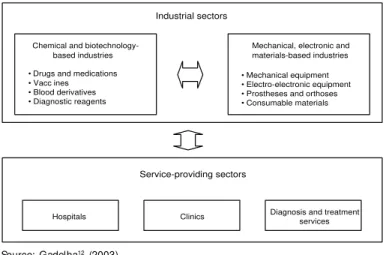
The notion of the health-industrial complex is simul-taneously a cognitive, analytical and political ap-proach. As Figure 1 shows, it forms “... a selected set of productive activities that maintain intersectoral relationships of buying and selling goods and serv-ices (such that they are picked up, for example, in the input-product matrices in the national accounts) and/ or knowledge and technologies...” (Gadelha,12 2003
p. 523). These productive activities are within a very particular political and institutional context that in-volves the provision of services and the economic space to which all the health production flows. Thus, this activity is completely within the complex, both because it is increasingly organized on a company basis** and because it configures the health market as a political and institutional construction. This con-fers an organic nature on the complex, thereby allow-ing connections within the same context, between the production of services and goods that are as dif-ferent as medications, equipment and diverse materi-als or products for diagnostic purposes.
The perspective is systemic and therefore related to the concept of the national innovation system within health (Rosemberg et al,20 1995). The concept of the
health-industrial complex gives emphasis to produc-tive activity as a critical element of this system,
con-*Gadelha CAG. Health complex. Unpublished data forming part of the research report on the Project for Studying Competitiveness using Integrated Chains, from the Industrial Economy and Technology Group of the Institute of Economics, coordinated by Coutinho LG, Laplane, MF, Kupfer D, Farina E. (Accords between FECAMP/MDIC/MCT/FINEP). Campinas; 2002.
**Here, the Marxist perspective would have to be returned to, in which the development of the productive capitalist forces and their expansion across the world would tend to disseminate industrial logic to all sectors of activity, including agriculture and services.
Figure 1 - Health-industrial complex: general characterization. Source: Gadelha12 (2003)
Chemical and biotechnology-based industries
• Drugs and medications • Vacc ines • Blood derivatives • Diagnostic reagents
Mechanical, electronic and materials-based industries
• Mechanical equipment • Electro-electronic equipment • Prostheses and orthoses • Consumable materials
Hospitals Clinics Diagnosis and treatment
services
sidering that the core of the country’s economic vul-nerability in the health field is the fragility of the Brazilian industrial and company system. The coun-try’s innovation capacity is determined by the poten-tial for transforming knowledge into new goods and services, or ones that have been improved in their quality or production process. In Brazil, this capac-ity is detached from the national scientific and tech-nological base and from the needs of the health sys-tem, especially because of the low capacitation among companies for carrying out research and development activities (Gadelha,13 2005). From this perspective, it
can be stated that the complex constitutes an effort towards restoring the structuralist perspective, thus emphasizing the questions of development, depend-ence, industrial policy and innovation in the health field, within the historical context of asymmetrical globalization and the technological-industrial revo-lution that is in progress.
Taking this theoretical reference to the health-indus-trial complex in the context of the national develop-ment pattern, and focusing on its potential for innova-tion and the profile of activities that are carried out in this country, this now has to be situated with respect to the historical question of dependence and development.
The most recent data on the company capacity for innovation were gathered by the Pesquisa Industrial
de Inovação Tecnológica 2003 (PINTEC - Industrial
Survey on Technological Innovation), (IBGE,15
2005). This recent and highly relevant initiative dem-onstrates the low intensity of innovation within health industry companies, with specific data for the phar-maceutical industry (“manufacture of pharmaceuti-cal products”) and the medipharmaceuti-cal-hospital equipment industry, although in this latter category other prod-ucts unrelated to health (precision and optical equip-ment, industrial automation, chronometers and clocks) were included.* The specific data are reveal-ing, even considering that, in relation to the mean for such industrial companies, these activities are well positioned. In general terms, the innovation rate seems to be high: 50.4% of the pharmaceutical companies and 45.4% of the equipment companies had intro-duced some product or process innovation between 2001 and 2003. Nevertheless, the more scattered data show that these activities were largely concentrated on the acquisition of equipment for improving proc-esses and on new products and procproc-esses for compa-nies, but not for the national market. Only 0.53% of net income was spent on internal research and
devel-opment activities in the “innovative” pharmaceuti-cal companies, and 1.22% in the equipment compa-nies that introduced some innovation into the mar-ket. Other data, for which the detailing is outside of the scope of the present article, also show the low importance of relationships with science and tech-nology institutions for carrying out research and de-velopment activities, the low level of cooperation and alliances for the development of innovations, and the low impact of government programs. Only 16% of innovative companies received any support from the State in these two sectors, and the economic mar-ket risk (“marmar-ket conditions” and “economic risks”) were the most critical factor that limited or even blocked the more intense innovation strategies.
Behind these indicators, there is a need to “open up” the health complex through its segments, thereby seek-ing to capture the profile of productive activities car-ried out in Brazil. For this, the best indicators are those related to the trade balance, since they mirror the seg-ments in which this country is capacitated or depend-ent on imports. Since the notion of the industrial com-plex fundamentally relates to the productive base ex-isting in this country, this indicator is much more rel-evant than others relating to scientific publications and even to patents. In Brazil, these last two indicators reflect much more the capacitation in applied research and not necessarily the potential for innovation, which should always be correlated with the company base.
SITUATIO N O F D EPEN D EN CE O N FO REIGN TRAD E
On the basis of this theoretical reference, the situa-tion of dependence was characterized by means of gathering and systematizing the foreign trade data for the health complex as a whole and for each of its segments. The information utilized was the data avail-able in the databases of the Secretaria de Comércio Exterior do Ministério de Desenvolvimento, Indústria
e Comérico Exterior (SECEX, Alice network -
Secre-tariat of Foreign Trade of the Ministry of Develop-ment, Industry and Foreign Trade).
Along general lines, the following methodological procedures were adopted, in accordance with Gadelha** (2002).
• Primary database. This database was concentrated
on the period from 1997 to 2001, since in 1997 there was a significant change in the classification of commercialized products resulting from the
*These categories were included in ‘equipment’, thus serving only as an approximation.
replacement of the Nomenclatura Brasileira de
Mercadorias (NBM - Brazilian Nomenclature for
Merchandise ) by the Nomenclatura Comum do
Mercosul (NCM - Common Nomenclature for
Mercosul).* To capture what occurred during the 1990s, the basis taken was the sectoral studies available, which have been shown to be adequate and sufficient for the intended objectives (Negri & Giovanni,18 2001). There were difficulties in the
NCM database regarding identification of the in-dustrial segments for health, consisting of identification problems for products when they were within broader categories undefined categories such as “other items”, or when the use of the product is not specific to the health field. Despite these difficulties, it was possible to work with this more homogenous primary database without losing sight of the dynamics of these segments during the initial period of commercial liberalization.
• Pharmaceutical segment. The usual procedure of
separating medications (formulated products) and drugs (active agents) was adopted. In the medi-cations industry, the items shown in Chapter 30 of the NCM (the chapter where pharmaceutical products are concentrated) were utilized. Medica-tions presented in the form of doses or packs for separate sale, extracts, human or animal substances prepared for therapeutic or prophylactic purposes and medications that are not presented as doses were included. Human blood, animal blood, antise-rums, other blood fractions, immunological pro-ducts, vaccines, toxins and other products included in the specific analysis of the vaccine, reagent, blood derivative, serum and toxin segments were not taken into consideration because of the specific purposes of this study.
• Drugs. The breakdown of subitems in the chapter
on organic chemical products (Chapter 29 of the NCM). This breakdown considers the drugs and the intermediate items utilized in their production. Because these intermediate items and the drugs can be used in other industries, and also because some codes may involve non-pharmaceutical subs-tances, it is possible to obtain some overestimated values. These products can be used in the food and cosmetics industries, clinical analyses and even in the plastics industry (additives for rubber and plastics, and coloring agents). However, the risk of underestimating some values is also present be-cause the inorganic chemical products utilized in the pharmaceutical industry and some organic products remained outside of the analysis. In any event, despite these problems that are inherent to
the classification standard adopted by the NCM, the aggregated values form a good indicator for the overall performance of the segment.
• Equipment and materials. According to the
methodology of Furtado & Souza9 (2001),
complemented with the breakdown utilized by the sectoral association (Associação Brasileira da
In-dústria Médico-Odontológica - ABIMO - Brazilian
Association for the Medical-Dental Industry), the subitems of the NCM are classified in four groups, namely: Group 1: medical-hospital instruments; Group 2: medical, dental and laboratory electrical apparatus and equipment; Group 3: prostheses and orthoses; Group 4: consumable materials.
Support diagnostic/laboratory reagents and reagents for determining blood groups and factors were ex-cluded from the group of consumable materials (Group 4), since these two items were included in the diag-nostic reagents segment. Despite the inclusions and exclusions made, which were because of the specific needs of the study and the analytical approach adopted, the values are very close to and comparable with those presented in the literature and by the busi-ness association.
• Blood derivatives. Blood fractions and modified
immunological products, among others related to blood and its derivatives, were aggregated.
• Reagents for diagnosing. The assessment over the
recent period unfortunately did not allow the level of breakdown recommended for an evaluation of the competitiveness of different products, since it incorporates distinctly different technological bases. Nevertheless, the methodological approach sought to make a selection of the products, item by item, in the different chapters and positions of the NCM, including reagents for diagnosing microbe origins, reagents for determining blood factors and groups, culturing media and support diagnosis reagents.
• Vaccines. The basis taken for the analysis was
vaccines for human medicine, which unfortuna-tely is not broken down in the same way as in the National Immunization Program (NIP). However, it incorporates both finished goods and imported supplies, and attendance for the public and private markets.
• Serums and toxins. In this case, the approach was
imperfect because of the diversity of use. Anti-ophidic serum, anti-tetanus serum, polyvalent antiserums, toxins, antitoxins of microbial origin and other products were included, which allows an overview of the evolution of this sector.
On the basis of this methodology for dealing with the trade balance within health, the information was gath-ered in dollars (FOB - Free On Board) for the complex and for its segments, for the period from 1997 to 2004. The figures were monetarily corrected to the year 2004 on the basis of the United States Consumer Price Index (CPI), in order to have real values as backing for the analysis.
In general terms, analyzing the period as a whole, as shown in Table 1, it appears that there was an im-provement in the external conditions of the complex with regard to the trade balance. The year 1998 pre-sented the worst performance regarding the trade defi-cit, reaching a real value of US$3.8 billion, and also presented the greatest figure for imports effected by the industrial complex (US$4.48 billion). In 2003, these values reached a lower level than at the end of the 1990s, such that the deficit declined to less than US$2.5 billion for the first time in the eight years analyzed, because of reductions in imports.
Nonetheless, this picture of the trade balance for the complex is not very encouraging when factors of a macroeconomic nature are taken into account and a more broken down analysis by products and groups of countries is made. From a macroeconomic point of view, there was a clear impact on the performance of the sector coming from the evolution of the exchange rate, which was a stronger impact than in the evalua-tion made in an earlier study (Gadelha,12 2003). Since
there is a certain delayed reaction between the evolu-tion of the exchange rate and its result in imports and exports, it can be inferred that the high level of im-ports up to 2001 partly resulted from the excessive valuation of the exchange rate up to 1999, which made imports within the complex competitive (i.e. cheaper) in relation to the local offer. In the years 2002 and 2003, the deficit reduced markedly, to reach its lowest value in 2003, as the resultant effect (with a time de-lay) from the large exchange rate devaluation that oc-curred in 1999. In 2004, imports grew again, by almost 20%, and this may have been related to the increase in the exchange rate associated with the macroeconomic
adjustment carried out on the basis of high interest rates. This picture was very attractive for the entry of capital, thereby leading to upward valuation of the exchange rate starting at the beginning of 2003.
Here, a first source of economic vulnerability in the health-industrial complex already appears: its high dependence on external conditions and macroeco-nomic policy. Any movement in the exchange rate may lead to an explosion in health expenditure or on im-ports. Under a certain economic situation, exchange rate devaluation may, at least initially, before generat-ing its effects of reduction of external acquisitions and increase of exports, lead to pressure on health expendi-ture (imports becoming more expensive in Brazilian currency) that is incompatible with budget availabil-ity.* Under another macroeconomic situation, upward valuation of the exchange rate, as seen today, may lead to an explosion of imports and increased demand for foreign exchange to cover health needs.
In both situations, what is clear is that the economic model for external and internal adjustments interferes directly in health actions, thereby limiting their de-gree of freedom and therefore precisely the social poli-cies relating to access and inclusion. The relationship between development pattern, industrial policy and health conditions is evident, thus showing the risk of excessive external dependence with regard to making health policies and their objectives viable.
However, there are also structural questions that can be shown by the data analysis, and these are even more relevant from a long-term development perspective. Table 2 shows, in terms of product lines, that the de-pendence on imports is concentrated on the products involving higher technology and knowledge. Analy-sis of the origins and destinations by economic blocks confirms this indication that the dependence is con-centrated in the most dynamic segments. Brazilian exports relating to health are mostly destined for less developed blocks, such that Mercosul and the “Rest of the World“ accounted for 61% of external sales in 2004. On the other hand, 73% of the imports came Table 1 - Evolution of the trade balance in the health complex. Brazil, 1997-2004.
Year Exports Imports Trade balance
1997 612,787,671 3,869,714,328 -3,256,926,657
1998 695,854,820 4,475,195,426 -3,779,340,606
1999 669,882,828 4,402,954,388 -3,733,071,560
2000 602,594,655 4,036,686,657 -3,434,092,002
2001 590,239,217 4,289,482,785 -3,699,243,568
2002 586,202,367 3,307,215,557 -2,721,013,190
2003 668,661,566 3,113,349,015 -2,444,687,449
2004 822,166,127 3,694,107,603 -2,871,941,476
Source: Compiled by the author from data gathered from SECEX/MDIC – Alice network.
Note: Figures have been monetarily corrected to 2004 using the United States Consumer Price Index and are in United States dollars, free on board
from the more developed countries of the European Union and the North American Free Trade Agreement area (NAFTA, United States and Canada, especially).
There is therefore clear asymmetry in Brazilian inter-national relations, thus demonstrating the technologi-cal dependence relating to more intensively knowl-edge-based products coming from the more devel-oped countries. For such cases, there is little sensitiv-ity in external purchases in relation to the price and exchange rate. To accomplish health actions, Brazil has ended up having to import high-technology prod-ucts from the more developed countries at any cost. This is why, following the upward leap in the trade deficit at the end of the 1980s, a time when it is esti-mated on the basis of the existing literature that it was US$700 million (Negri & Giovanni,18 2001), the
level of imports into this country has never been less than US$3 billion. On the other hand, in the segments
and markets that are sensitive to price and therefore to the exchange rate, local competitiveness is con-nected with products and processes of lower techno-logical level, as also shown in the data from IBGE15
(PINTEC 2003) that were analyzed earlier.
Figures 2 to 8 illustrate the evolution of the segments of the complex over the analysis period. In the phar-maceutical industry (Figures 2 and 3), in addition to the weak performance of exports, both of drugs and of medications, what is seen first is the degree of de-pendence that exists. Putting the two segments to-gether, pharmaceutical care has depended very heav-ily and riskheav-ily on imports, and the summed value has never been less than US$2 billion in real terms. Even when the drug segment has appeared to be evolving favorably through reducing imports, this movement has at least partially been compensated by increases in the imports of medications. This indicates a
situa-Segments N AFTA European U nion
Exports Imports Bal ance Exports Imports Bal ance
Equip,/ Materials 76,372,236 313,602,771 -237,230,535 37,772,286 267,258,249 -229,485,963 N on-electronic apparatus 24,158 776,057 -751,899 30,916 741,929 -711,013 Electronic apparatus 15,688,525 183,234,508 -167,545,983 18,761,552 157,009,740 -138,248,188 Prostheses/ orthoses 1,895,217 27,771,629 -25,876,412 3,398,650 37,750,432 -34,351,782 Consumable material 58,764,336 101,820,577 -43,056,241 15,581,168 71,756,148 -56,174,980
Vaccines 1,199 5,953,270 -5,952,270 899,185 135,296,534 -134,397,349
D iagnostic reagents 1,242,700 108,509,801 -107,267,101 1,996,202 88,834,671 -86,838,469 Blood derivatives 37,402 65,802,704 -65,765,302 2,496,369 139,928,033 -137,431,664 M edications 43,429,789 311,569,827 -268,140,038 18,263,678 420,236,431 -401,972,753 D rugs 48,491,798 279,151,186 -230,659,388 84,851,575 441,701,522 -356,849,947 Other products* 1,841 12,559,816 -12,597,975 2,261,866 29,938,619 -27,676,753
Total 169,576,965 1,097,149,375 -927,612,609 148,541,161 1,523,194,059 -1,374,652,898
Segments M ercosul Rest of the World
Exports Imports Bal ance Exports Imports Bal ance
Equip,/ Materials 31,289,573 21,730,647 9,558,926 143,927,638 182,740,712 -38,813,074 N on-electronic apparatus 16,949 1,018 15,931 94,070 4,969,580 -4,875,510 Electronic apparatus 6,436,789 1,695,762 4,741,027 89,762,171 98,546,280 -8,784,109 Prostheses/ orthoses 1,207,362 7,373 1,199,989 8,785,783 9,759,282 -973,499 Consumable material 23,628,473 20,026,494 3,601,979 45,285,614 69,465,570 -24,179,956
Vaccines 521,950 0 521,950 16,291,344 2,588,973 13,702,371
D iagnostic reagents 492,470 6,833,068 -6,340,598 623,650 10,153,832 -9,530,182 Blood derivatives 615,718 7,434,775 -6,819,057 1,293,837 56,900,366 -55,606,529 M edications 64,631,339 47,365,933 17,265,406 107,037,130 363,149,943 -256,112,813 D rugs 12,967,354 4,193,547 8,773,807 123,924,556 364,390,100 -240,465,544
Other products* 295,390 5,301,800 -5,006,410 136,052 940,473 -804,421
Total 110,813,794 92,859,770 17,954,024 393,234,207 980,864,399 -587,630,192
Segments Total
Exports Imports Bal ance Equip./ Materials 289,361,733 785,332,379 -495,970,646
N on-electronic apparatus 166,093 6,488,584 -6,322,491 Electronic apparatus 130,649,037 440,486,290 -309,837,253 Prostheses/ orthoses 15,287,012 75,288,716 -60,001,704 Consumable material 143,259,591 263,068,789 -119,809,198 Vaccines 17,713,678 143,838,777 -126,125,099 D iagnostic reagents 4,355,022 214,331,372 -209,976,350 Blood derivatives 4,443,326 270,065,878 -265,622,552 M edications 233,361,936 1,142,322,134 -908,960,198 D rugs 270,235,283 1,089,436,355 -819,201,072 Other products* 2,695,149 48,780,708 -46,085,559
Total 822,166,127 3,694,107,603 -2,871,941,476
NAFTA: North American Free Trade Agreement
Source: Compiled by the author from data gathered from SECEX/MDIC - Alice network.
Note: Figures have been monetarily corrected to 2004 using the United States Consumer Price Index and are in United States dollars, free on board.
*Serums and toxins
tion that is even more unfavorable, in which instead of imports being concentrated on the active
agents (as occurred during the 1980s), Bra-zil has also started to depend on finished products that were formulated abroad.
In the field of equipment and materials (Fig-ure 4), which was the segment that most re-duced its imports over the course of the pe-riod, the dependence is concentrated on elec-tronic equipment, which certainly constitutes the goods of greatest complexity and inno-vation potential. There is a significant in-dustry in this country that has produced good responses in relation to local demand, but in the context of the microelectronic revolu-tion and the exchange rate condirevolu-tions, its competitive capacity for the future clearly may be under threat.
Within the field of technologies based on biotech-nology (blood derivatives, diverse products for
diag-nostic purposes, vaccines, serums and tox-ins), all companies are increasing their im-ports, and in some cases very significantly. In the case of blood derivatives (Figure 5), the situation is explosive, with imports al-ready reaching almost US$300 million, thus tripling in real terms over the analysis pe-riod. Unless urgent action is implemented regarding industrial development and pro-duction,* Brazil may come to have serious difficulties in its successful policy for ac-cess to these products.
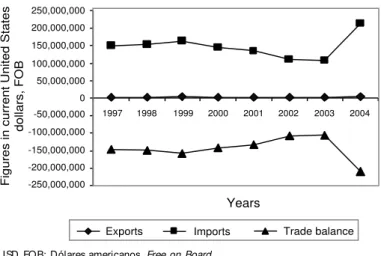
In the case of reagents for diagnostic pur-poses (Figure 6), even though the data are very concentrated, the def icit remained chronic and there was a very large increase in the last
year of the analysis period. This situation reflects a loss of opportunity to enter a technological segment that is promising in terms of its capacity for interac-tion between the science and technology system and the industry, considering that the technologi-cal leap between laboratory activities and industrial activities is relatively small in re-lation to other sectors.
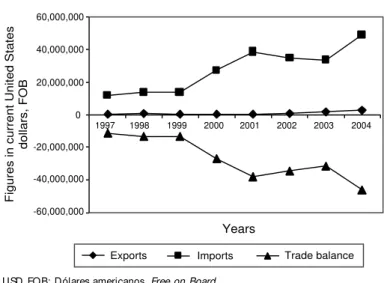
Finally, in the fields of vaccines (Figure 7) and serums and toxins (Figure 8), there was a clear worsening in the commercial situation, with large growth in imports and trade deficit. This process may partly be the result from strat-egies adopted by the main national producers (Bio-Manguinhos/Fiocruz and Butantan) to establish technology transfer agreements with the major world leaders of the industry, through import commitments during the pe-riod of absorbing the technology. However, there is the risk inherent to this type of
agree--1,500,000,000 -1,000,000,000 -500,000,000 0 500,000,000 1,000,000,000 1,500,000,000
1
Years
Figures in current United States
dollars, FOB
Exports Imports Trade balance
1997 1998 1999 2000 2001 2002 2003 2004
Figure 2 - Evolution of the foreign trade in medications. Brazil, 1997-2004. USD FOB: Dólares americanos, Free on Board
Figure 3 - Evolution of the trade balance in drugs. Brazil, 1997-2004. USD FOB: Dólares americanos, Free on Board
-2,000,000,000 -1,500,000,000 -1,000,000,000 -500,000,000 0 500,000,000 1,000,000,000 1,500,000,000 2,000,000,000
1 2 3 4 5 6 7 8
Years
Exports Imports Trade balance
Figures in current United States
dollars, FOB
Figure 4 - Evolution of the foreign trade in equipment and materials. Brazil, 1997-2004.
USD FOB: Dólares americanos, Free on Board
-1,500,000,000 -1,000,000,000 -500,000,000 0 500,000,000 1,000,000,000 1,500,000,000
1
1997 1998 1999 2000 2001 2002 2003 2004
Years
Figures in current United States
dollars, FOB
Exports Imports Trade balance
ment that the technological frontier may shift by the end of this period, thereby bringing back the question of dependence.
In summary, the analysis of the trade balance of the health-industrial complex reflects how the national pattern of development has in-duced precarious specialization in the produc-tion base and internaproduc-tional posiproduc-tioning that is strongly asymmetrical, thereby making the health system vulnerable and dependent.
FINAL CO N SID ERATIO N S AN D PERSPECTIVES
The results allow it to be demonstrated that there is a need to think of health in the general con-text of Brazil’s strategy for development and
depend-ence reduction, which should be a natural conse-quence of a broad-based conception of health (and not a sectoral approach). The concept of the health-industrial complex has been shown to useful
within this context, in that it precisely re-lates the need to join health care logic to economic development logic within the health field. Study of this, with emphasis on the questions of innovation and this coun-try’s specialization pattern within the world context, has demonstrated the analytical and normative disregard for the economic dy-namics of the sector. This brings the conse-quence of extreme vulnerability for the na-tional health policies, and may imply risks to the objectives of universality, equity and comprehensiveness.
As a political consequence, this analysis
places the question of joining together industrial policy and health policy at the center of a strategy for developing the complex, with the backdrop of the debating of and pros-pects for a new development model for the country. This model should simultaneously give emphasis to the dynamics of innova-tion and development of the industry and to social inclusion, thereby again taking the structuralist perspective put forward follow-ing Furtado10 (1961), within a
contempora-neous rereading.
Recently, some important steps have been taken, albeit insufficient. Within the field of industrial policy, the Industrial, Technologi-cal and Foreign Trade Policy (PITCE) that was launched in November 2004 incorpo-rated key segments of the health-industrial complex. Taking a broad view of the phar-maceutical industry, including medications, drugs, blood derivatives and vaccines, this segment was selected as one of the four strategic options relat-ing to fields of high dynamism and intensity of knowl-Figure 5 - Evolution of the foreign trade in blood derivatives. Brazil, 1997-2004.
USD FOB: Dólares americanos, Free on Board
-300,000,000 -200,000,000 -100,000,000 0 100,000,000 200,000,000 300,000,000
1997 1998 1999 2000 2001 2002 2003 2004
Years
Figures in current United States
dollars, FOB
Exports Imports Trade balance
USD FOB: Dólares americanos, Free on Board
Figure 6 - Evolution of the foreign trade in diagnostic reagents. Brazil, 1997-2004.
-250,000,000 -200,000,000 -150,000,000 -100,000,000 -50,000,000 0 50,000,000 100,000,000 150,000,000 200,000,000 250,000,000
1997 1998 1999 2000 2001 2002 2003 2004
Years
Figures in current United States
dollars, FOB
Exports Imports Trade balance
Figure 7 - Evolution of the foreign trade in vaccines. Brazil, 1997-2004. USD FOB: Dólares americanos, Free on Board
-200,000,000 -150,000,000 -100,000,000 -50,000,000 0 50,000,000 100,000,000 150,000,000 200,000,000
1997 1998 1999 2000 2001 2002 2003 2004
Years
Figures in current United States
dollars, FOB
edge. This policy then implied the mobilization of significant funding instruments (such as the Devel-opment Support Program for the Pharmaceutical Pro-ductive Chain, Profarma, from the National Bank for Economic and Social Development, BNDES) and other initiatives related to public investments in medi-cations and blood derivatives. In addition to this, one of the other strategic options is capital goods, with linkage to prioritize medical equipment within the scope of this policy, by means of interventions by the recently created Agência Brasileira de
Desenvol-vimento Industrial (ABDI - Brazilian Agency for
In-dustrial Development).
Moreover, some generic measures for improving the institutional environment have been facilitating and adding flexibility to the relationships between re-search institutions and the private productive sector (Law 10,973 of December 2, 2004, the “Innovation Law”). The conceding of fiscal incentives to compa-nies, including investments in technology (Law 1,196 of November 21, 2005, formerly known as the Provi-sional Measure for tax concessions), is also acting towards creating an environment that is favorable for innovation and investments in the health industry.
Within the field of health policies, it can be stated that the question of the health-industrial complex has started to form part of large numbers of policy documents (in the form of the “Health-Productive Complex”). Directives have been established, includ-ing in the current National Health Plan, and also a set
of sectoral policies, such as for generic, stra-tegic, exceptional and AIDS medications. Furthermore, within the Ministry of Health’s own structure, the National Secretariat for Science, Technology and Strategic Supplies has been created, and thus there is now a spe-cific locus focusing on scientific, techno-logical and industrial development within health. In this way, the industrial question is no longer being dealt with independently from the question of knowledge generation.
In summary, the present context can be seen to be much more favorable than it was in the past. Nonetheless, there is a long way to go towards a cognitive and political break with the antagonistic visions that still separate health needs and the country’s needs for in-dustrial development into two hermetically sealed camps. Failure to utilize the purchasing power asso-ciated with health policies for technological and in-dustrial development in real practice is a promi-nent example of how the dichotomy between the two types of logic still persists. In this respect, there is an essential need to overcome this dichotomy. A coun-try that aims to reach a condition of development and independence requires strong and innovative industries and an inclusive and egalitarian health system, simultaneously. This is perhaps one of the most important strategic challenges within the Bra-zilian Health System.
ACKN O W LED GEM EN TS
To Carmen N. P. Romero Casas of the Escola Nacional de Saúde Pública - Fiocruz, for their support in gath-ering and systematizing the foreign trade data and organizing the information; to Militze Bortoloto Cajazeira, of the Department of Planning and Devel-opment (Depla) of the Secretariat of Foreign Trade (Secex) of the Ministry of Development, Industry and Foreign Trade (MDIC), for guidance in obtaining data from the Federal Government (Alice network); to Jorge Luís, of the Foreign Trade Group of the Secretariat of Foreign Trade (Secex) in Rio de Janeiro, for sending the codes for the items that form part of the Mercosul Common Nomenclature, with updated changes for all items within the health-industrial complex; and to Henrique Chaves for support in the final organiz-ing of the figures and tables.
Figure 8 - Evolution of the foreign trade in serums and toxins. Brazil, 1997-2004.
USD FOB: Dólares americanos, Free on Board
-60,000,000 -40,000,000 -20,000,000 0 20,000,000 40,000,000 60,000,000
1997 1998 1999 2000 2001 2002 2003 2004
Years
Figures in current United States
dollars, FOB
REFEREN CES
1. BIRD. The East Asian miracle: economic growth and public policy. New York: Oxford University Press; 1993.
2. BIRD. World Development Report: the state in a changing world. New York: Oxford University Press, 1997.
3. Buss PM. Promoção da saúde e qualidade de vida, 2000. Ciênc Saúde Coletiva. 2000;5:163-77. 4. Cardoso FH, Faletto E. Dependência e
desenvolvi-mento na América Latina: um ensaio de interpretação sociológica. 5a ed. Rio de Janeiro: Zahar; 1979.
5. Cardoso de Mello JM. O capitalismo tardio. Rio de Janeiro: Brasiliense; 1982.
6. Cassiolato JE. A economia do conhecimento e as novas políticas industriais e tecnológicas. In: Lastres H M M , Albagli S. Informação e globalização na era do conhecimento. Rio de Janeiro: Campus; 1999. p. 164-90.
7. Cordeiro H . D escentralização, universalidade e equidade nas reformas da saúde, 2001. Ciênc Saúde Coletiva. 2001;6:319-28.
8. Coutinho, LG. Regimes macroeconômicos e estratégi-as de negócios: uma política industrial alternativa para o Brasil no século XXI. In: Lastres HMM, Cassiolato JE, Arroio A, organizadores. Conhecimento, sistemas de inovação e desenvolvimento. Rio de Janeiro: Contraponto; 2005. p. 429-48.
9. Furtado AT, Souza JH. Evolução do setor de insumos e equipamentos médico-hospitalares, laboratoriais e odontológicos no Brasil: a década de 1990. In: Negri B, Giovanni G. Brasil: radiografia da saúde. Campi-nas: Unicamp; 2001. p. 63-91.
10. Furtado C. Desenvolvimento e subdesenvolvimento. Rio de Janeiro: Fundo de Cultura; 1961.
11. Gadelha CAG. Política industrial: uma visão Neo-Schumpeteriana sistêmica e estrutural. Rev Econ Pol. 2001;21(4):149-71.
12. Gadelha CAG. O complexo industrial da saúde e a necessidade de um enfoque dinâmico na economia da saúde, 2003. Ciênc Saúde Coletiva. 2003;2:521-35. 13. Gadelha CAG. O complexo industrial da saúde:
desafios para uma política de inovação e desenvolvi-mento. In: Buss PM, Temporão JG, Carvalheiro JR. Vacinas, soros e imunizações no Brasil. Rio de Janeiro: Fiocruz; 2005.
14. Goldenstein L. Repensando a dependência. Rio de Janeiro/ São Paulo: Paz & Terra; 1994.
15. Instituto Brasileiro de Geografia e Estatística - IBGE. Pesquisa Industrial de Inovação Tecnológica. Rio de Janeiro; 2005.
16. Kim L, Nelson RR, organizadores. Tecnologia, aprendizado e inovação: as experiências das economias de industrialização recente. Campinas: Editora da Unicamp; 2005.
17. Lastres HMM, Cassiolato JE, Arroio A. Sistemas de inovação e desenvolvimento: mitos e realidade da economia do conhecimento global. In: Lastres HMM, Cassiolato JE, Arroio A, organizadores. Conhecimento, sistemas de inovação e desenvolvimento. Rio de Janeiro: Contraponto; 2005. p 17-50.
18. Negri B, Giovanni G, organizadores. Brasil: radiogra-fia da saúde. Campinas: Unicamp; 2001.
19. Prebisch, R. O desenvolvimento econômico da América Latina e seus principais problemas, 1949. Rev Bras Economia. 1949;3(3):47-112.
20. Rosemberg N, Gelijns AC, Dawkins H. Sources of medical technology: universities and industry. Washington (DC): National Academy Press; 1995. 21. Schumpeter J. Capitalismo, socialismo e democracia.
Rio de Janeiro: Zahar; 1985.