COMUNICACIÓN Y SOCIEDAD
ISSN 0214-0039 © 2013 Communication&Society/Comunicación y Sociedad, 26, 4 (2013) 175-193 175 © 2013 Communication&Society/Comunicación y Sociedad ISSN 0214-0039
E ISSN 2174-0895
www.unav.es/fcom/comunicacionysociedad/en/ www.comunicacionysociedad.com
COMMUNICATION&SOCIETY/ COMUNICACIÓN Y SOCIEDAD Vol. XXVI • N.4 • 2013 • pp. 175-193
Online forums, audience participation and modes of political
discussion: readers’ comments on the Brazilian presidential election as
a case study
Foros en línea, participación del público y modos de la discusión política:
comentarios de los lectores sobre las elecciones presidenciales de Brasil,
un caso de estudio
MARISA TORRES DA SILVA
Marisa Torres da SILVA. Post-Doctoral Researcher. New University of Lisbon (UNL). Social and Human Sciences Faculty (FCSH). 1069-061 Lisboa.
Submitted: March 20, 2013 Approved: June 3, 2013
ABSTRACT: The Internet has created new “dialogical spaces”1 where issues of common concern can be discussed, serving to democratize the public sphere. However, some scholars express doubts about the quality of the debates that occur in the online environment, pointing out the fragmentation, the incivility or even the
1
Cfr. OBLAK, Tanja, “The lack of interactivity and hypertextuality in online media”, International Communication Gazette, vol. 67, nº 1, 2005, pp. 87-106.
How to cite this article:
SILVA, M.T. Da, “Online forums, audience participation and modes of political discussion: readers’ comments on the Brazilian presidential election as a case study”,
ISSN 0214-0039 © 2013 Communication&Society/Comunicación y Sociedad, 26, 4 (2013) 175-193 176 anonymity as major problems that may undermine the expansion of the online public sphere.
As a potential deliberative section and a civic forum, readers’ comments in newspapers’ websites constitute a locus for public debate and ideas exchange provided by the mainstream media. As a case study, this article intends to assess the quality of audience participation in online news sites, by analysing the readers’ comments in the news about the Brazilian presidential campaign (September-November 2010) in the online versions of two Portuguese newspapers.
RESUMEN: Internet ha creado nuevos "espacios dialógicos" donde se discuten temas
de interés común, que sirven para democratizar la esfera pública. Sin embargo, algunos expertos dudan sobre la calidad de los debates que se producen en el entorno en línea, señalando la fragmentación, la falta de civismo o incluso el anonimato como los principales problemas que pueden menoscabar la expansión de la esfera pública en línea.
Como parte deliberativa potencial y un foro cívico, los comentarios en los periódicos de los lectores de páginas web constituyen un lugar para el debate público y el intercambio de ideas aportadas por los principales medios de comunicación. Como estudio de caso, este artículo tiene la intención de evaluar la calidad de la participación del público en los sitios de noticias en línea, mediante el análisis de los comentarios de los lectores en las noticias sobre la campaña presidencial de Brasil (septiembre-noviembre de 2010) en las versiones en línea de los dos diarios portugueses.
Keywords: Internet, deliberative democracy, readers’ comments, audience participation
Palabras clave: Internet, democracia deliberativa, comentarios de los lectores, la participación del público.
1. Introduction: the Internet and the public sphere
The mass media and, more recently, the new interactive media provide communicative spaces that allow the circulation of information and ideas and, also, have the potential to facilitate links between citizens and the power holders of society2. In modern societies, the Internet encloses various possibilities of public communication and debate, by creating new spaces for political expression and participation. Citizens have therefore the opportunity for a more active involvement in deliberation processes within a very different interaction framework from the one that is provided by conventional media3.
2
Cfr. DAHLGREN, Peter, “The Internet, public spheres, and political communication: dispersion and deliberation”, Political Communication, vol. 22, 2005, p. 148.
3 Cfr. SCHULTZ, Tanjev, “Mass media and the concept of interactivity: an exploratory study of online
forums and reader email”, Media, Culture & Society, vol. 22, 2002, pp. 205-221; CHADWICK, Andrew,
ISSN 0214-0039 © 2013 Communication&Society/Comunicación y Sociedad, 26, 4 (2013) 175-193 177 Due to its interactive and communicative possibilities, Internet has introduced changes in the ways by which information is produced and consumed and it also has contributed to blur the traditional distinction between sender and receiver4. Compared to traditional mass media, the Internet as a communication environment offers a wider range of possibilities for debates on public issues5, creating new “dialogical spaces” where participants are allowed to discuss issues of common concern6. Being a public space, it thus provides a forum for political deliberation7.
In this sense, the majority of deliberative democracy’s proponents see Internet as a space that promotes rational debate, from which deliberation is generated8. Offering means for civic expression, Internet can act as a “sounding board” likely to affect political agents and other citizens9.
Deliberation denotes a broad class of public communication, which is characterized by the attempt to provide some kind of justification of evidence, some kind of argumentative or evidential support for statements or judgments, explanations or proposals, some kind of anticipation of doubt, openness for questions and objections, recognition of fallibility10.
The more optimistic views about the Internet claim that access to its environment is universal and non-hierarchical, and it provides a non-coercive communication, helping to generate opinion within discussion processes. Kees Brants, when describing the views of the “e-optimists”, states that, in this perspective, “the Internet would make a thousand flowers bloom: instant and ubiquitous access to government information, political proposals, and policy options”11.
Several studies argue that the Internet might serve to democratize the public sphere, although doubts remain about the extent to which these new forms of participation lead to a fruitful public debate or whether they actually offer more opportunities to citizens to question and challenge the power holders12. Moreover, scholars like Peter Dahlgren also refer that the use of Internet for political purposes is minor when compared to other
redes e tecnologias de informação e comunicação”, in PIRES, E. B. (ed.), Espaços públicos, poder e comunicação, Edições Afrontamento, Porto, 2007, pp. 209-224.
4 Cfr. SCOTT, Ben, “A contemporary story of digital journalism”, Television & New Media, vol. 6, nº1,
2005, pp. 92; BRANTS, Kees and DE HAAN, Yael, “Taking the public seriously: three models of responsiveness in media and journalism”, Media Culture & Society, vol. 32, nº 3, 2010, p. 412.
5
Cfr. DAHLBERG, Lincoln, “Computer-mediated communication and the public sphere: a critical analysis”, Journal of Computer-Mediated Communication, vol. 7, nº 1, 2001, p. 1.
6 Cfr. OBLAK, Tanja, op. cit.
7
Cfr. PAPACHARISSI, Zizi, “The virtual sphere 2.0: the internet, the public sphere and beyond”, in CHADWICK, A. and HOWARD, P. (eds.), Handbook of Internet Politics, Routledge, London, 2009, p. 11.
8 Cfr. FERREIRA, Gil, “Internet e deliberação. A discussão política em fóruns online”, Media &
Jornalismo, vol. 16, nº1, 2010, p. 103.
9 Cfr. FERREIRA, Gil, op. cit., p. 105.
10 PETERS apud GIMMLER, Antje, “Deliberative democracy, the public sphere and the internet”,
Philosophy & Social Criticism, vol. 27, nº4, 2011, p. 29-30.
11 BRANTS, Kees, “Guest Editor’s Introduction: The Internet and the public sphere”, Political
Communication, vol. 22, nº 2, 2005, p. 143.
12 Cfr. PAPACHARISSI, Zizi, op. cit.; COLEMAN, Stephen and BLUMLER, Jay G., The Internet and
ISSN 0214-0039 © 2013 Communication&Society/Comunicación y Sociedad, 26, 4 (2013) 175-193 178 activities13, such as entertainment, consumerism, online chat and non-political networking14.
Nevertheless, it is undeniable that the Internet provides additional spaces for political debate, fostering greater participation –yet, are these online discussions promoting a democratic exchange of ideas and opinions? More generally speaking, is this new media environment changing the public sphere– and in what ways?
The work of Jürgen Habermas and his theories of public sphere and rational communication15 have been receiving growing attention with the introduction of Internet-based bottom-up communication tools16. Normative conditions such as the equality of opportunity for participants and openness in general, for instance, can serve as “maxims for the institutional protection of a communicative structure within which guidelines for securing certain basic elements can be developed”17.
Indeed, Lincoln Dahlberg draws upon Habermas’ normative conditions of the public sphere to question whether online discourse is in fact extending the public sphere of rational-critical deliberation18. Therefore, rationality and justification, ideal role-taking
(to understand the argument from the other’s perspective), reflexivity (to critically reflect upon and change one’s position when faced by “the better argument”), sincerity
(effort to make known all the relevant information, as well as intentions and interests) or
discursive equality and inclusion (open access to the debate) are mentioned as
requirements that can be used to evaluate the Internet’s potential in stimulating public communication19.
The potential for the Internet to enhance democracy by increasing public engagement is still a subject of much discussion20. New technologies cannot unilaterally transform the nature of the political sphere –Internet has managed to improve citizen involvement, but only to a certain extent21. Indeed, Robert Goodin argues that posting a comment on the Internet is not in itself deliberative: “There must also be uptake and engagement –other people must hear or read, internalize and respond for that public sphere activity to count as remotely deliberative”22.
13 Cfr. DAHLGREN, Peter, “The Internet, public spheres, and political communication: dispersion and
deliberation”, Political Communication, vol. 22, 2005, p. 151; DAHLGREN, Peter, “Parameters of online participation: conceptualising civic contingencies”, Communication Management Quarterly, vol. 21, 2011b, p. 91.
14 Cfr. REDDEN, Joanna and WITSCHGE, Tamara, “A new news order? Online news content
examined”, in FENTON, N. (ed.), New Media, Old News. Journalism and Democracy in the Digital Age, Sage, London, 2010, p. 182.
15 Cfr. HABERMAS, Jurgen, The structural transformation of the public sphere: an inquiry into a
category of bourgeois society, The MIT Press, Cambridge, Massachussetts, 1994; HABERMAS, Jurgen,
Facticidad e validez: sobre el derecho y el Estado democrático de derecho en término de teoria del discurso, Trotta, Madrid, 2001.
16 Cfr. KEYSER, Jeroen de and RAEYMAECKERS, Karin, “Bottom-up or going down? The journalistic
value of open online feedback opportunities”, Paper presented in the IAMCR Convention, Braga, Portugal, 2010.
17
GIMMLER, Antje, “Deliberative democracy, the public sphere and the internet”, Philosophy & Social Criticism, vol. 27, nº4, 2011, pp. 26-27.
18 Cfr. DAHLBERG, Lincoln, op. cit., pp. 1-2. 19
Cfr. DAHLBERG, Lincoln, op. cit., pp. 3-15; KEYSER, Jeroen de and RAEYMAECKERS, Karin, op. cit., pp. 2-4.
20
Cfr. REDDEN, Joanna and WITSCHGE, Tamara, op. cit., p. 182.
21 Cfr. PAPACHARISSI, Zizi, “The virtual sphere: the internet as a public sphere”, New Media &
Society, vol. 4, nº 1, 2002, p. 20.
22
ISSN 0214-0039 © 2013 Communication&Society/Comunicación y Sociedad, 26, 4 (2013) 175-193 179 Furthermore, we can argue that there are a number of factors undermining the expansion of the public sphere online23. Some scholars point out that online political discussions are fragmented, dominated by a few (a sort of an extension of the existent inequalities in offline political debates), and too specific to live up to the Habermasian ideal of rational accord24. Despite the potential of the Internet offering an inclusive space for debate, it is increasingly segmented due to the prevalence of special interest groups.
Plus, greater participation does not automatically mean the generation of a discussion that promotes democratic ideals –online communication is often about venting emotion and expressing “hasty opinions”, rather than rational discourse25. Interactions such as “flaming” (abusive posting) or “trolling” (postings aimed to misinform, deceive, provoke or trivialize the debate) make online deliberations particularly vulnerable to disruption –and, at the same time, undermine normative requirements like tolerance and sincerity26.
The anonymity of those responding online also introduces concerns of verification, accountability and accuracy27, which may affect the deliberative nature of online posting28. While some argue that anonymity and the use of nicknames foster a more open debate, since the participants feel freer to express their opinions online29, which can encourage the expression of parts of the self repressed in offline interactions30 and remove the fear of being personally banned31, others refer the opportunity for conscious deception of identity, which may undermine the trust within online groups and lead to misinformation and inaccuracy32, as well as the increasing number of verbal attacks (injury, humiliation), among other forms of incivility33, concept that can be defined as “gratuitous asides that show a lack of respect and/or frustration with the opposition”34. Beyond anonymity, other problems are also referred: posts and comments are often focused on personal points of view and do not reflect the confrontation with other arguments nor respond to other participants35; the pressure to reply quickly can limit the likelihood of the participants to carefully consider and re-develop their positions36; and lead to the monopolization of attention by particular individuals or groups37. In other words:
23
Cfr. DAHLBERG, Lincoln, op. cit., p. 1.
24 Cfr. PAPACHARISSI, Zizi, “The virtual sphere 2.0: the internet…”, op. cit., p. 10; DAHLGREN,
Peter, “The Internet, public spheres, and political communication: dispersion and deliberation”, Political Communication, vol. 22, 2005, p. 152.
25 Cfr. PAPACHARISSI, Zizi, “The virtual sphere: the internet as a public sphere”, New Media &
Society, vol. 4, nº 1, 2002, p. 16.
26 Cfr. DAHLBERG, Lincoln, op. cit., p. 7-10.
27 Cfr. FENTON, Natalie, New Media, Old News. Journalism and Democracy in the Digital Age, Sage,
London, 2010, p. 10.
28 Cfr. CRAWFORD, Ewan, op. cit., p. 458.
29 Cfr. WALLACE apud FERREIRA, Gil, “Internet e deliberação. A discussão política em fóruns
online”, Media & Jornalismo, vol. 16, nº 1, 2010, pp. 110.
30
Cfr. DANET apud DAHLBERG, Lincoln, op. cit., p. 10.
31 Cfr. KEYSER, Jeroen de and RAEYMAECKERS, Karin, op. cit., p. 9. 32 Cfr. DAHLBERG, Lincoln, op. cit., p. 10-11.
33
Cfr. FERREIRA, Gil, op. cit., p. 110.
34 MUTZ & REEVES apud SOBIERAJ, Sarah and BERRY, Jeffrey M., “From incivility to outrage:
political discourse in blogs, talk radio, and cable news”, Political Communication, vol. 28, nº 1, 2011, p. 20.
35 Cfr. FERREIRA, Gil, op. cit., p. 111; WILHEM apud DAHLBERG, Lincoln, op. cit., p. 3. 36
Cfr. DAHLBERG, Lincoln, op. cit., p. 6.
ISSN 0214-0039 © 2013 Communication&Society/Comunicación y Sociedad, 26, 4 (2013) 175-193 180 The online discussion fora may increase the quantity of participation, but that doesn’t necessarily mean increasing the diversity of participation –because the participants are often the ‘usual suspects’. The virtual public sphere is structured in a way that is similar to the structure of traditional politics and, thus, the online political debate is dominated, quantitative and qualitatively by individuals that transfer to the virtual sphere the dominance that they have in the offline world38.
2. The media and readers’ comments. Research design and scope of the study
“A consideration of the media, viewed as both an ongoing problem and possibility for democracy, is central to a consideration of the public sphere”39. The media can be seen as a forum for debate where arguments can be made on the basis of equality40 and, in fact, the incorporation of the Internet in the conventional media may have helped to create several spaces for public discussion and deliberation.
Moreover, mainstream news sites do indeed provide an opportunity for readers to post comments on articles. Email addresses, discussion fora, virtual communities or blogs are also other examples of the diversity of participation modes that audiences nowadays have in the online versions of traditional media41, that have been developing considerable efforts in the creation of feedback tools, so that their publics can have the possibility to add information, to provide alternative angles or to correct mistakes42. Readers’ comments in newspapers’ websites are the “the most widespread in online news sites and usually the most popular in quantitative terms”43. As a potential deliberative section, readers’ comments are therefore one of the most compelling ways that citizens have to express their opinions on a particular subject, reacting specifically to a news piece and discussing it along with other readers. Readers’ comments can thus be understood as civic forums, where citizens exchange ideas and where civic talk can take place –these kinds of civic forums are often seen as the paradigmatic model of the online public sphere44.
Although the media constitute the most effective channel correlating the public with powerful agents45, we must into account that
38 FERREIRA, Gil, Novos media e vida cívica. Estudos sobre deliberação, internet e jornalismo, Livros
LabCom, Covilhã, 2012, p. 69.
39
MCLAUGHLIN, Lisa, “Feminism, the public sphere, media and democracy”, Media, Culture & Society, vol. 15, 1993, p. 617.
40 Cfr. CRAWFORD, Ewan, op. cit., p. 468. 41
Cfr. DOMINGO, David, “Interactivity in the daily routines of online newsrooms: dealing with an uncomfortable myth”, Journal of Computer-Mediated Communication, vol. 13, 2008, pp. 687-694; RASMUSSEN, Terje, “The Internet and Differentiation in the Political Public Sphere”, Nordicom Review, vol. 29, nº 2, 2008, p. 76.
42 Cfr. KEYSER, Jeroen de and RAEYMAECKERS, Karin, op. cit., p. 4.
43
RUIZ, Carles; NOCI, Javier D.; MASIP, Pere; MICÓ, Josep L.; DOMINGO, David and MESO, Koldo, “Public Sphere 2.0? The democratic qualities of citizen debates in online newspapers”, The International Journal of Press/Politics, vol. 16, 2011a, p. 464.
44
Cfr. DAHLGREN, Peter, Media and Political Engagement. Citizens, Communication and Democracy, Cambridge University Press, Cambridge, 2009, p. 168.
45 Cfr. SPLICHAL, Slavo, “In search of a strong European public sphere: some critical observations on
ISSN 0214-0039 © 2013 Communication&Society/Comunicación y Sociedad, 26, 4 (2013) 175-193 181 participation in the media does not mean that the voices of participants will automatically and intensely impact on all other societal spheres (…). In this sense the expectation that participation in the media is a privileged channel to allow for participation in society can only be considered a naïve fantasy that ignores the complexity of the polis46.
This article intends to present a case study to assess the quality of audience participation in online news sites, by analysing the readers’ comments in the news about the Brazilian presidential campaign (September-November 2010)47 in the online versions of two Portuguese newspapers, Público (a daily newspaper) and Expresso (a weekly newspaper), taking mainly into account the research of Tsaliki48 and other theoretical/empirical proposals that incorporate Habermas’ ethics of discourse in the analysis of online political forums49. Additionally, we aim to introduce new dimensions for both theoretical and empirical researches on this matter, in order to seek for complementary academic approaches that go beyond habermasian ideals of deliberative democracy.
The Brazilian presidential campaign gained substantial journalistic coverage in Portugal (71 articles in Público online; and 60 news stories in Expresso online), due to the cultural proximity news value. We have focused only on the articles (six) that received the greatest number of comments in both websites; we have analysed 303 readers’ comments (139 in Público and 164 in Expresso), using Nvivo, a qualitative and quantitative data analysis software. The unit analysis chosen for coding was the paragraph; each one was coded into one or more categories/subcategories.
Prior to the analysis of the readers’ comments itselves, it is important to understand the strategies that mainstream media use to manage readers’ contributions –and their
46
CARPENTIER, Nico, Media and Participation. A site of ideological-democratic struggle, Intellect, Bristol, 2011, p. 355.
47
The Brazilian presidential election was held in 2010 with two rounds of balloting. The first round was held on October 3rd, with three candidates: Dilma Roussef, Lula's former Chief of Staff, of the ruling centre-left democratic socialist/social democratic Workers' Party (PT); José Serra, São Paulo State former governor, from the centre-right opposition coalition formed mainly by the Social Democratic Party (PSDB), and the right-wing Democrats (DEM); and Marina Silva, Lula's former Minister of Environment and candidate for the Green Party (PV), which she joined on late 2009 after leaving the PT. As no presidential candidate polled 50 percent of the vote on October 3rd, a runoff was held on October 31st between Dilma Rousseff and José Serra. Rousseff won with 56% of the second round vote. The election determined the successor to President Luiz Inácio Lula da Silva, of the Workers' Party. (Information retrieved from http://en.wikipedia.org/wiki/Brazilian_presidential_election,_2010,
http://www.bbc.co.uk/news/world-latin-america-11662623 and
http://www.guardian.co.uk/world/2010/nov/01/dilma-rousseff-wins-brazil-president, accessed on July 3rd
2013).
48 Cfr. TSALIKI, Lisa, “Online foruns and the enlargement of public space: research findings from a
European Project”, Javnost-The Public, vol. 9, nº 2, 2002, pp. 95-112.
49 See mainly: GRAHAM, Todd and WITSCHGE, Tamara, “In search of online deliberation: towards a
new method for examining the quality of online discussions”, Communications vol. 28, 2003, pp. 173-204; RUIZ, Carlos; MASIP, Pere; MICÓ, Josep L.; NOCI, Javier D. and DOMINGO, David, “Conversación 2.0 y democracia. Análisis de los comentarios de los lectores en la prensa digital catalana”, Comunicación y Sociedad, vol. 23, nº2, 2010, pp.7-39; GRAHAM, Todd, “Needles in a haystack: a new approach for identifying and assessing political talk in non-political discussion fóruns”,
ISSN 0214-0039 © 2013 Communication&Society/Comunicación y Sociedad, 26, 4 (2013) 175-193 182 possible effects on the quality of the debate. Javier Diaz Noci and other authors claim that there are two main strategies that news organisations use to deal with readers’ comments: 1) an “interventionist” one, based on pre-moderation (prior to publication) – this strategy implies more responsibility for journalists on the quality of the contributions, as they read and evaluate comments, and only publish comments that respect civility and respect norms; 2) a looser one, based on post-moderation50 –the comment is automatically published but if its content is considered to be abusive other readers can denounce it, so that journalists can evaluate if the comment “crosses the line” and, eventually, remove it from the website.
Pre-moderation by journalists may help to promote the quality of online deliberations, avoiding its “natural tendency towards incivility, which is a regrettable reality even on traditional media websites”51 –even if this implies a substantial decrease on “visible” (that is to say, published) comments and may discourage readers to send a comment, as the publication is not immediate. We can thus say that pre-moderation privileges quality over quantity, but entails a costly investment in human resources52 and more work for journalists53.
Post-moderation (with or without registration) is the most open strategy, generating a greater volume of participation and relying on the audience to warn about abusive comments54. Some websites use software filtering keywords, but doubts remain about its effectiveness, “as many contributions are offensive without using obscenity”55. Besides that, even if a reader denounces an abusive comment, it can stay “on air” for a long time, which may affect the debate quality. “A libertarian ‘free speech’ ethos permeates cyberculture to such an extent that the acceptable behaviour norms of online fora often permit dominant posters, moderate hostility, and even harassment”56.
Both Público and Expresso used a strategy of readers’ comments management based on post-moderation, although somehow differently.
The online version of Público required registration (name, password and email) but the user had the possibility to write down false personal data or use nicknames –although the requirement of email was aimed to send the user a link so that he/she could activate his/her account. The user also had the option to comment as “anonymous”. The website exposed what made a comment “unacceptable”: “criminal accusations, insults, rude or discriminatory language, comments that prompt hate or violence, and offense to human rights”. Público also determined that “as long as readers’ comments do not respect the established criteria, the comment will be removed”.
However, this newspaper changed its moderation strategy on March 2011 –due to several complaints and even recommendations issued by the newspaper’s ombudsman, it decided to create a team of journalists dedicated to evaluate comments prior to
50 Cfr. NOCI, Javier D.; DOMINGO, David; MASIP, Pere; MICÓ, Josep L. and RUIZ, Carles,
“Comments in News, Democracy Booster or Journalistic Nightmare: Assessing the Quality and Dynamics of Citizen Debates in Catalan Online Newspapers”, Paper presented to the International Symposium on Online Journalism, Austin, Texas, 2010, p. 3.
51 KEYSER, Jeroen de and RAEYMAECKERS, Karin, op. cit., p. 5.
52 Cfr. NOCI, Javier D., et al., op. cit., p. 8; THURMAN, Neil, “Forums for citizen journalists? Adoption
of user generated content initiatives by online news media”, New Media & Society, vol. 10, nº1, 2008, p. 147.
53
Cfr. CHUNG, Deborah S., “Profits and perils: online news producers’ perceptions of interactivity and uses of interactive features”, Convergence, vol. 13, nº 1, 2007, p. 57.
54 Cfr. NOCI, Javier D., et al., op. cit., p. 10. 55
Cfr. NOCI, Javier D., et al., op. cit.,p. 7.
ISSN 0214-0039 © 2013 Communication&Society/Comunicación y Sociedad, 26, 4 (2013) 175-193 183 publication (pre-moderation), in order to increase the quality of the online discussions and, also, to decrease the chances of having abusive or disrespectful comments. In November 2012, Público decided to introduce a prestige system, in which each registered user has more or less power of moderating other comments, according to his/her quality of participation, however keeping pre-moderation. Our analysis of readers’ comments about the Brazilian presidential elections is prior to these changes. Demanding registration (such as Público), Expresso used a post-moderation management strategy based on a prestige system that is similar to what is was introduced by Público in 2012, but without pre-moderation –the users moderate each others’ posts; each reader gets “karma points” for a post, reflecting how prominent a comment can be57, a system very much alike the one used by YouTube or Slashdot. The more “karma points” the user got (minimum of five), the more chances he/she had to moderate other readers’ comments58, qualifying them as “fun”, “interesting” or “well written”. This aims to stimulate the quality of the debate, since in order to gain “prestige points” they have to express themselves in a certain way, at least not disrespectful to other readers. Yet, the user didn’t have to have positive “karma points” to report an abusive comment.
Since the moderation strategies used by both websites were very similar in its attitude (post-moderation), at the time of our research, we can now address the fundamental questions of this article: what forms of communication occur in readers’ comments’ sections? To what extent can we talk about the normative requirements for public discourse that we mentioned earlier? And what possible effects can the post-moderation model have in the quality of the debate?
3. Discussion: audience participation and deliberativeness. A case study
As a case study integrated in a larger project about the possibility of a “female” public sphere59, we analysed readers’ comments on the Brazilian presidential elections within variables designed to define the discursive mode of the messages exchanged:
-Rationality of argumentation. This variable can be linked to rational-critical debate,
which requires that participants provide justified and reasoned validity claims60, and is assessed in our study in four different categories: justification (presentation of reasons that support an idea/opinion), complexity (subcategories: presence of different ideas, expressing ideas in a different/more elaborate way), civility (subcategories: respect for democracy, respect for other social groups and respect for other view points) and politeness (subcategories: cooperation and avoidance of disagreement).
-Non-rationality of argumentation. In the cooperative search for truth, it important to
verify if the participants respect each other in the debate61; in this sense, the presence of insults or attacks may show the absence of mutual recognition and respect, and thus may indicate a rational level of the argumentation legitimacy. Categories:
57
Cfr. THURMAN, Neil, op. cit., p. 152.
58 For instance, if the reader received five “prestige points”, he earned the right to moderate five
comments.
59 “Female Online Participation: redefining the public sphere”, sponsored by the Science and Technology
Foundation (Portugal).
60
Cfr. GRAHAM, Todd and WITSCHGE, Tamara, op. cit., p. 184.
ISSN 0214-0039 © 2013 Communication&Society/Comunicación y Sociedad, 26, 4 (2013) 175-193 184 civility (subcategories: threats to democracy and threats to social groups and/or individuals) and politeness (subcategories: personal attacks, defamation, non-cooperation and other behaviours such as sarcasm or use of all-caps).
-Rational-critical opinion. Reflexivity can be assessed by observing the comments in
terms of the ability to provide counterarguments to other’s positions62. Plus, a comment can provide a reflexive argument when, for instance, a participant considers possible challenges to his position63. Categories: critique of the other and self-criticism.
-Degree of rational legitimacy. This variable intends to verify the critical-rational
dimension of the online comments and whether the participants contribute to the debate in a rational way64. Categories: valid (the readers offer reasons and arguments for the stance they take) and non-valid (subcategories: the readers offer neither reasons nor arguments for the stance taken; arbitrary comments; fallacies).
-Utterance position. Todd Graham and Tamara Witschge say that reciprocity represents
the first level to the process of understanding, requiring a giving and taking of claims and arguments by participants65 –however, as the authors argue, reciprocity should not be viewed as the mere act of reading each other’s claims or responding to other participants. Plus, in the search of the “better argument”, the quoting of sources/information/ideas that complement or try to enrich the debate66 can also be seen as an indicator of reciprocity. Therefore, we divided the “utterance position” into categories that tried to incorporate several elements in the assessment of the reciprocity level: to start a discussion; to search for information (in the form of direct questions, for instance); to complement the arguments of other readers with further information and ideas external to the debate; and to reply to another comment (conversational response). While the two first categories try to examine if the participants seek and provide information, the second last focus on the extent to which the debates that occur in online comments are indeed interactive67.
-Degree of solidarity for a person, ideology or argument. As Tsaliki argues, in-group
homogeneity or favouritism can be defined as the extent to which postings show a certain political affiliation, by supporting a person, an argument, an ideology or issue68. Categories: affiliation, neutral posts (comments that do not show any solidarity) and disaffiliation (messages that show negativity or opposition towards a person, ideology or argument).
-Elements of plurality. Iris Mary Young sustains a model of deliberative democracy
based in a plural communicative perspective, which entails taking into account multiple discursive styles, thus proposing three formal elements of communication that a broader conception of communicative democracy requires, in addition to critical argument69: storytelling, rhetoric and greeting. We adopted these formal elements as categories for this variable, viewing greeting as the recognition by the participants of each other’s particularities (which include forms of speech and expressions of deference and flattery, for instance), rhetoric as the position of the participant regarding the traits of his/her
62 Cfr. GRAHAM, Todd and WITSCHGE, Tamara, op. cit., p. 186. 63
Cfr. GRAHAM, Todd, op. cit., p. 30.
64 Cfr. TSALIKI, Lisa, op. cit., p. 98.
65 Cfr. GRAHAM, Todd and WITSCHGE, Tamara, op. cit., p. 185. 66
Cfr. RUIZ et al., op. cit., p. 34.
67
Cfr. TSALIKI, Lisa, op. cit., p. 99.
68 Cfr. TSALIKI, Lisa, op. cit., p. 98.
69
ISSN 0214-0039 © 2013 Communication&Society/Comunicación y Sociedad, 26, 4 (2013) 175-193 185 particular audience and trying to persuade it (using rhetorical devices, such as metaphors and evocation, for instance), and storytelling as the transmission of subjective experience of the participant, so that the other interlocutors better understand the premises underlying a particular argument (telling personal narratives and subjective experiences).
-Free nodes. Categories: off-topic and the use of irony. The category “off-topic” was
used to assess the level of coherence within the discussion thread70, that is to say, if the comments are focused in the subject that is being debated –therefore, we tried to grasp whether there are comments that are not consistent to the issue under discussion, in this particular case, the Brazilian presidential elections. On the other hand, we created the category of irony in order to seek for “alternative” aspects of online discourse71 in the online comments analysed, including jokes or funny statements.
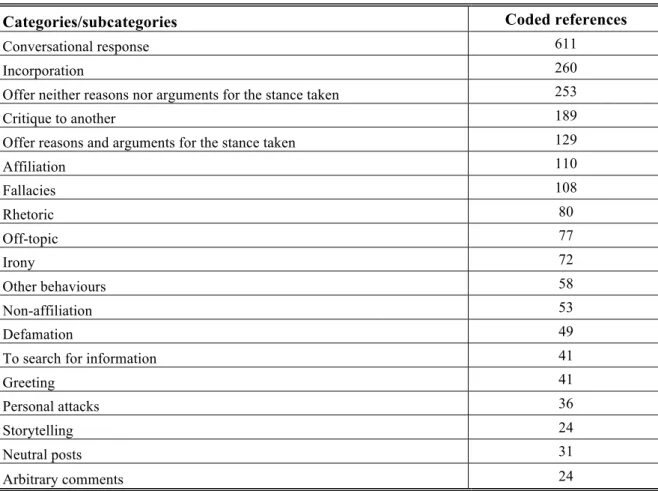
We hereby present and discuss the most coded categories/subcategories.
Table 1. Categories/subcategories and coded references: overall results
Categories/subcategories Coded references
Conversational response 611
Incorporation 260
Offer neither reasons nor arguments for the stance taken 253
Critique to another 189
Offer reasons and arguments for the stance taken 129
Affiliation 110
Fallacies 108
Rhetoric 80
Off-topic 77
Irony 72
Other behaviours 58
Non-affiliation 53
Defamation 49
To search for information 41
Greeting 41
Personal attacks 36
Storytelling 24
Neutral posts 31
Arbitrary comments 24
The most frequently coded category within the overall categories/subcategories was
conversational response (611 references), that is to say, replies to other posts. This may
show the interactivity that readers’ comments as a vehicle for participation may entail – and at the same time, contradicts the idea that comments often do not reflect the
70
Cfr. GRAHAM, Todd and WITSCHGE, Tamara, op. cit., p. 185.
ISSN 0214-0039 © 2013 Communication&Society/Comunicación y Sociedad, 26, 4 (2013) 175-193 186 confrontation with other arguments nor respond to other participants72. Although this is a case study without representativeness ambitions, we can say that readers’ comments are a dynamic space of ideas and arguments exchange.
The level of incorporation or the attempt to complement the arguments of other readers with further information and ideas external to the debate (news pieces consulted in other websites, opinion articles, specialists information, etc.) is also very high, coming in 2nd place in the context of the frequencies obtained (260 references). This somewhat meets the definitions of readers’ comments as not only a space for ideas exchange, but also for information exchange. However, our case study also shows a possibility that the comments strongly diverge from the initial thread topic –users often were not discussing the presidential campaign itself, but were making off-topic contributions (77 references), talking about their personal lives or other issues not concerned with the initial discussion topic.
Many comments offer neither reasons nor arguments for the stance taken (253 references), standing at 3rd within the total of categories –the rational legitimacy of comments is frequently non-valid, and among these, we found a considerable amount of
fallacies (108 references) and arbitrary comments (24 references)73. Yet, many users
also do offer reasons and arguments for the stance they take (129 references). This is perhaps the most contradictory aspect of the selected corpus –there is sort of an oscillation between readers that take dogmatically asserted positions (not open to discussion) and readers that make an effort to provide their positions with reasons and thus are open to critique74.
In spite of the rather high level of rational legitimacy of comments, we found a considerable amount of non-politeness in comments –which includes defamation (49 references), personal attacks to other users (36 references) and other behaviours such as the use of All-Caps or sarcasm (58 references).
Even if comments didn’t contain swear-words, some of them were way beyond the politeness that should be required to these sorts of participatory spaces. The concept of politeness entails a commitment to a conversational contract that intends to minimize conflicts and dissent75. Therefore, and even if the websites include norms that aim to regulate the debates occurring in readers’ comments, the persistence of a considerable amount of insults and libel can be perhaps linked to the absence of a pre-moderation that could avoid the presence of non-polite language and disrespectful behaviours. Perhaps not surprisingly, the critique to another (user or, for instance, a politician) ranked as the 4th most coded category (189 references), which suggests a very “aggressive” exchange of ideas in what respects the debate around the Brazilian presidential elections. But the discussion sometimes diverged from the electoral dispute in itself and was focused instead in the characteristics of the candidates and, also, the partisan differences between users and comparisons between Brazil and Portugal. In fact, the category affiliation (to a person, ideology or argument) was amongst the most coded, ranking in 6th (110 references), due to the nature of the debate that was being established (high level of solidarity to a candidate or ideology), which may indicate a
72
Cfr. FERREIRA, Gil, “Internet e deliberação. A discussão...”, op. cit., p. 111; WILHEM apud
DAHLBERG, Lincoln, op. cit., p. 3.
73
Examples: “Who voted for Marina, didn’t want the same as Lula and therefore will vote for me. I mean it”; “Tirica for President. What does a President do? I don’t know, but vote for me (…)”.
74 Cfr. DAHLBERG, Lincoln, op. cit., p. 2. 75
ISSN 0214-0039 © 2013 Communication&Society/Comunicación y Sociedad, 26, 4 (2013) 175-193 187 connection through ideological commonalities within the participants of the discussion, although the category disafilliation was rather present in the discussions (53 references). If we take a look at the word frequency, the most frequent words counted in comments are the following: “Dilma” (193), “Brazil” (188) and “Lula” (162), but also “Serra” (71), “Portugal” (69), “Brazilian” (53), “people” (53), “Marina” (46), “power” (43), “president” (42), “poverty” (30), “government” (29) and “party” (26). It is interesting to notice that “Lula” and “Dilma” had a very similar amount of word frequency, perhaps due to the fact that the former president and the president-to-be were seen as “one” candidate; José Serra and Marina Silva were much less mentioned in comments.
In his study about an online forum (talk.abortion), Schneider76 showed the way by which some participants were able to have their voices more heard than others and he concluded that more than 80% of posts were sent by less than 5% of participants. In his analysis of the discussion boards of De Standaard Online during six months, Hans Beyers revealed that 957 unique posters contributed to a total of 10.201 messages, which amounts to 10.7 comments per poster, noting that “forum discussions degenerate into a tug-of-war between a few very dominant participants on a regular basis”77. Similarly, Lincoln Dahlberg underlines that, although theoretically all subscribers to a group have equal opportunity to post, in many groups a small number of participants are responsible for most posts, which leads to the monopolization of attention within online discourse by particular individuals and groups78, posing questions about discursive equality and inclusion.
In our case study, we verified that the 303 comments were posted by 104 unique participants, which amounts to an average of 2.9 comments per poster. The dominance of certain participants was even more evident in Expresso, where the 164 comments were posted by 35 users (average of 4.7 comments per poster). Some users showed a peculiar regularity on their posting (in Público, a single user posted 31 comments; and
in Expresso, several users posted more than 10 comments each). These indicators show
a striking similarity to empirical studies around other participation vehicles such as letters-to-the-editor in press79, which also demonstrates the presence of regular readers in the letter writing activity. While we can say that identity can be fluid in the online environment, it is not certain that power relations disappear completely in that space80. Besides the issues related to discursive inequalities, the normative requirement of sincerity can also be challenged by the use of anonymity and nicknames. Although we can not affirm that the use of false identities or the suppression of personal data can automatically lead to a more disrespectful debate, the fact is that most users didn’t provide a credible name and/or identification, preferring to use nicknames or to remain anonymous. Among the 104 users that posted comments, only 31 provided a name or
76
SCHNEIDER, Steven M., “Expanding the Public sphere through Computer-Mediated Communication: Political discussion about abortion in a Usenet newsgroup”, PhD Thesis, Massachussetts, MIT, 1997, p. 85.
77 BEYERS, Hans, “Interactivity and online newspapers: a case study on discussion boards”,
Convergence, vol. 10, 2004, pp. 13-14.
78
Cfr. DAHLBERG, Lincoln, op. cit., p. 13.
79 Cfr. RAEYMAECKERS, Karin, “Letters to the editor: a feedback opportunity turned into a marketing
tool”, European Journal of Communication, vol. 20, nº 2, 2005, pp. 199-221; SILVA, Marisa Torres da, “As cartas dos leitores na imprensa portuguesa: uma forma de comunicação e debate do público”, PhD Thesis, New University of Lisbon, 2009.
80
ISSN 0214-0039 © 2013 Communication&Society/Comunicación y Sociedad, 26, 4 (2013) 175-193 188 surname and location and only 12 provided their name, surname and location –although it’s nearly impossible to verify the authenticity of these data.
4. Concluding remarks: moving beyond Habermas?
Our case study shows that readers’ comments constitute a discursive space that might not meet the rational-critical deliberation criteria exposed by Habermas and other scholars. In fact, the categories of justification, complexity (namely the presence of different or contrasting ideas), civility (a respectful attitude towards democracy, other social groups and perspectives) and politeness (cooperation, expression of agreement, avoid disagreements) were among the least coded. The absence of coded “civil” behaviours and the low level of agreement can be linked to the reasonable amount of libelous and abusive posting. Tolerance and ideal role-taking can be defined as pre-conditions for deliberation as an attitude towards others’ reasons and perspectives81 –in that sense, we argue that a great majority of readers’ comments on the Brazilian presidential election fail short to meet these requirements.
So the question remains: did the existence of the commentary section lead to a fruitful discussion? We could say yes, to a certain extent. Interactivity between users was a key feature in the analyzed comments, as well as the exchange of information and ideas. However, the presence of uncivil behavior (and the absence of pre-moderation by journalists) somehow affected the quality of the debate around this election.
The participation of audiences introduces a new moral subject that alters the concept of responsibility in communication and affects the communicative undertaking. If, up until now, responsibility was centered on the content that the company itself emitted, now the company also has a moral responsibility for user generated contents82.
We believe that mainstream media should make a serious effort to increase the quality of the debates that occur in their space. The absence of basic deliberative standards, such as the respect for good argument, can “undermine not only deliberation, but also democracy as well”83.
However, we should also ask whether the Internet should be evaluated on the basis of similarity with the traditional public sphere in the habermasian sense (rational accord and consensus) and whether we should limit the studies on this subject to normative conditions of deliberation, such as rational-critical debate or reflexivity in online forums84, or whether we should look for new models of assessment that may go beyond Habermas.
Recent research has demonstrated that online discussions do not follow the high ideals set for deliberative democracy, although they “are useful and necessary to define
81 Cfr. BOHMAN, James, “Reflexive public deliberation: democracy and the limits of pluralism”,
Philosophy and social criticism, vol. 29, nº 1, 2003, p. 93; DAHLBERG, Lincoln, op. cit.
82 RUIZ, Carles; NOCI, Javier D.; MASIP, Pere; MICÓ, Josep L.; DOMINGO, David and MESO, Koldo,
“Online news comments: a sense of community from an ethical and legal perspective”, in Diversity of Journalisms. Conference proceedings (ECREA + CICOM), 2011b, p. 312.
83 DAHLGREN, Peter, Media and Political Engagement. Citizens, Communication and Democracy,
Cambridge University Press, Cambridge, 2009, p. 92.
ISSN 0214-0039 © 2013 Communication&Society/Comunicación y Sociedad, 26, 4 (2013) 175-193 189 directions, even if we realize that reality often falls short of the ideals”85 –the communicative character of the political discussion does not always promote the civic ideal; much of it is isolated, unpleasant, which might mean that its contributions to democratic will formation cannot always be assumed86. “Speech is not always so rational, tolerance toward those who hold opposing views is at times wanting, and the forms of interaction are not always so civil”87.
Plus, what Peter Dahlgren calls as “the rationalist bias” tends to marginalize a wide array of communicative modes that important for democracy, “including the affective, the poetic, the humorous, the ironic, and so forth”88; the dominant theories of democracy thus put a strong emphasis on rationality but tend to ignore anything that relates to the passionate, emotional or affective89.
Similarly, when referring to commercially public spaces such as YouTube, Zizi Papacharissi argues that they
may not render a public sphere, but they provide spaces where individuals can engage in healthy democratic practices, including keeping a check on politicians, engaging in political satire, and expressing/circulating political opinions. These spaces are essential in maintaining a politically active consciousness90.
Moreover, the online environment can also stimulate the circulation of other discursive forms beyond rational-critical argumentation, giving shape to a heterogeneous public space, either in terms of language and expression or in terms of subjects discussed91. Indeed, the Internet is even likely to establish a different concept of “public” from the habermasian perspective (which is based in strict normative dichotomies such as public/private, universal/particular or reason/emotion), where we can see “the Public” as a work in progress, with more flexible frontiers with “the private” and, consequently, more open to new problems and issues that otherwise would not be acknowledged92. Actually, in what respects discursive forms and styles, our research shows not only the significant presence of irony in online comments about the Brazilian presidential elections (72 references), which may indicate that humoristic elements can be a rather important feature in online political discussions, but also the use of modes of communication in which the participants seek to establish trust and empathy among each others –such as greeting93 (41 references)–, to stimulate the understanding of a certain point of view through personal experiences and storytelling94 (24 references), and, especially, to persuade the potential audience, using elements of rhetoric95 (80
85 DAHLGREN, Peter, “The Internet, public spheres...”, op. cit., p. 156. 86
Cfr. WILHELM apud DAHLGREN, Peter, “The Internet, public spheres...”, op. cit., p. 151.
87 Cfr. WILHELM apud DAHLGREN, Peter, “The Internet, public spheres...”, op. cit., p. 156. 88Ibíd.
89 Cfr. DAHLGREN, Peter, Media and Political Engagement…, op. cit., p. 83. 90
PAPACHARISSI, Zizi, “The virtual sphere 2.0: the internet…”, op. cit., p. 23.
91 Cfr. ESTEVES, João Pissarra, Espaço público e democracia, Edições Colibri, Lisboa, 2003, p. 203. 92 Cfr. ESTEVES, João Pissarra, op. cit., pp. 204-205.
93
Examples: “Congratulations on your comment”; “You’re right and what you’ve said is very interesting”.
94
Example: “From what I’ve heard from my university friends and in the streets, the voters for Marina [da Silva] used the tactics of voting in [José] Serra so that Dilma couldn’t win.”
95 Example: “In Brazil they start by eliminating poverty, in Portugal they start by creating poverty!”;
ISSN 0214-0039 © 2013 Communication&Society/Comunicación y Sociedad, 26, 4 (2013) 175-193 190 references).
Taking into account that basic civility is not always as it should be in online forums, particularly in readers’ comments to the news, and considering the presence of a plurality of communicative modes that go beyond normative criteria of deliberation, we should reflect upon Peter Dahlgren’s proposal of acknowledging the importance of
sociality in stimulating and maintaining participatory activities in the online
environment96. Dahlgren suggests four angles through which the actual practices of sociality could be analysed, looking at how they contribute to:
functionality, i.e., what is perceived as basic, bedrock correct behaviour towards the other; affinity, which involves looking at degrees to which caring and identification with others is expressed; trust, which has to do with the willingness to take risks with others whom one does not know really well; and not least responsibility, which has to do with a sense of obligation towards others97.
These categories, among other aspects to be developed, could serve as a starting and turning point for a somewhat distinctive analysis of the online public sphere, one that preserves the basic sets of deliberative democracy, but at the same time acknowledges the changes in the current deliberative practices and the existence of diverse modes of public discussion within the online environment, thus recognizing the plurality of participation modes, instead of relying exclusively on the habermasian rational-critical deliberation criteria.
96 Cfr. DAHLGREN, Peter, “Parameters of online participation: conceptualising civic contingencies”,
Communication Management Quarterly, vol. 21, 2011b, p. 97.
97
ISSN 0214-0039 © 2013 Communication&Society/Comunicación y Sociedad, 26, 4 (2013) 175-193 191
References
BEYERS, Hans, “Interactivity and online newspapers: a case study on discussion boards”, Convergence, vol. 10, 2004, pp. 11-20.
BOHMAN, James, “Reflexive public deliberation: democracy and the limits of pluralism”, Philosophy and social criticism, vol. 29, nº 1, 2003, pp. 85-105.
BRANTS, Kees, “Guest Editor’s Introduction: The Internet and the public sphere”, Political Communication, vol. 22, nº 2. 2005, pp. 143-146.
BRANTS, Kees and DE HAAN, Yael, “Taking the public seriously: three models of responsiveness in media and journalism”, Media Culture & Society, vol. 32, nº 3, 2010, pp. 411-428.
CARPENTIER, Nico, Media and Participation. A site of ideological-democratic struggle, Intellect, Bristol, 2011.
CHADWICK, Andrew, Internet politics: states, citizens, and new communication technologies, Oxford University Press, New York, 2006.
CHUNG, Deborah S., “Profits and perils: online news producers’ perceptions of interactivity and uses of interactive features”, Convergence, vol. 13, nº 1, 2007, pp. 43-61.
COLEMAN, Stephen and BLUMLER, Jay G., The Internet and democratic citizenship. Theory, practice and policy, Cambridge University Press, Cambridge, 2009.
CRAWFORD, Ewan, “A new sort of democracy?: The opinion pages in the Scottish daily quality press”, Journalism, vol. 10, nº 4, 2009, pp. 451-472.
DAHLBERG, Lincoln, “Computer-mediated communication and the public sphere: a critical analysis”, Journal of Computer-Mediated Communication, vol. 7, nº 1, 2001.
DAHLGREN, Peter, “As culturas cívicas e a Internet: para uma contextualização da participação política”, Media & Jornalismo, vol. 18, 2011a, pp. 11-30.
DAHLGREN, Peter, “Parameters of online participation: conceptualising civic contingencies”, Communication Management Quarterly, vol. 21, 2011b, pp. 87-110.
DAHLGREN, Peter, Media and Political Engagement. Citizens, Communication and Democracy, Cambridge University Press, Cambridge, 2009.
DAHLGREN, Peter, “The Internet, public spheres, and political communication: dispersion and deliberation”, Political Communication, vol. 22, 2005, pp. 147-162.
DOMINGO, David, “Interactivity in the daily routines of online newsrooms: dealing with an uncomfortable myth”, Journal of Computer-Mediated Communication, vol. 13, 2008, pp. 680-704.
ESTEVES, João Pissarra, “Os novos media na perspectiva da democracia deliberativa: sobre redes e tecnologias de informação e comunicação”, in PIRES, E. B. (ed.), Espaços públicos, poder e comunicação, Edições Afrontamento, Porto, 2007, pp. 209-224. ESTEVES, João Pissarra, Espaço público e democracia, Edições Colibri, Lisboa, 2003.
FENTON, Natalie, New Media, Old News. Journalism and Democracy in the Digital Age, Sage, London, 2010.
FERREIRA, Gil, Novos media e vida cívica. Estudos sobre deliberação, internet e jornalismo, Livros LabCom, Covilhã, 2012.
FERREIRA, Gil, “Internet e deliberação. A discussão política em fóruns online”, Media & Jornalismo, vol. 16, nº 1, 2010, pp. 99-114.
GIMMLER, Antje, “Deliberative democracy, the public sphere and the internet”, Philosophy & Social Criticism, vol. 27, nº 4, 2011, pp. 21-39.
GRAHAM, Todd, “Needles in a haystack: a new approach for identifying and assessing political talk in non-political discussion fóruns”, Javnost-The Public, vol. 15, nº 2, 2008, pp. 17-36.
ISSN 0214-0039 © 2013 Communication&Society/Comunicación y Sociedad, 26, 4 (2013) 175-193 192 HABERMAS, Jurgen, Facticidad e validez: sobre el derecho y el Estado democrático de
derecho en término de teoria del discurso, Trotta, Madrid, 2001.
HABERMAS, Jurgen, The structural transformation of the public sphere: an inquiry into a category of bourgeois society, The MIT Press, Cambridge, Massachussetts, 1994. KEYSER, Jeroen de and RAEYMAECKERS, Karin, “Bottom-up or going down? The
journalistic value of open online feedback opportunities”, Paper presented in the IAMCR Convention, Braga, Portugal, 2010.
MCLAUGHLIN, Lisa, “Feminism, the public sphere, media and democracy”, Media, Culture & Society, vol. 15, 1993, pp. 599-620.
NOCI, Javier D., DOMINGO, David, MASIP, Pere, MICÓ, Josep L. and RUIZ, Carles, “Comments in News, Democracy Booster or Journalistic Nightmare: Assessing the Quality and Dynamics of Citizen Debates in Catalan Online Newspapers”, Paper presented to the International Symposium on Online Journalism, Austin, Texas, 2010. OBLAK, Tanja, “The lack of interactivity and hypertextuality in online media”, International
Communication Gazette, vol. 67, nº 1, 2005, pp. 87-106.
PAPACHARISSI, Zizi, “The virtual sphere 2.0: the internet, the public sphere and beyond”, in CHADWICK, A. and HOWARD, P. (eds.), Handbook of Internet Politics, Routledge, London, 2009.
PAPACHARISSI, Zizi, “Democracy online: Civility, politeness, and the democratic potential of online political discussion groups”, New Media & Society, vol. 6, nº 2, 2004, pp. 259-283.
PAPACHARISSI, Zizi, “The virtual sphere: the internet as a public sphere”, New Media & Society, vol. 4, nº 1, 2002, pp. 9-27.
RASMUSSEN, Terje, “The Internet and Differentiation in the Political Public Sphere”, Nordicom Review, vol. 29, nº 2, 2008, pp. 73-83.
RAEYMAECKERS, Karin, “Letters to the editor: a feedback opportunity turned into a marketing tool”, European Journal of Communication vol. 20, nº 2, 2005, pp. 199-221. REDDEN, Joanna and WITSCHGE, Tamara, “A new news order? Online news content
examined”, in FENTON, N. (ed.), New Media, Old News. Journalism and Democracy in the Digital Age, Sage, London, 2010.
RUIZ, Carles, NOCI, Javier D., MASIP, Pere, MICÓ, Josep L., DOMINGO, David and MESO, Koldo, “Public Sphere 2.0? The democratic qualities of citizen debates in online newspapers”, The International Journal of Press/Politics, vol. 16, 2011a, pp. 463-487. RUIZ, Carles, NOCI, Javier D., MASIP, Pere, MICÓ, Josep L., DOMINGO, David and MESO,
Koldo, “Online news comments: a sense of community from an ethical and legal perspective”, in Diversity of Journalisms. Conference proceedings (ECREA + CICOM), 2011b, pp. 299-313.
RUIZ, Carlos, MASIP, Pere, MICÓ, Josep L., NOCI, Javier D. and DOMINGO, David, “Conversación 2.0 y democracia. Análisis de los comentarios de los lectores en la prensa digital catalana”, Comunicación y Sociedad, vol. 23, nº 2, 2010, pp.7-39.
SCHNEIDER, Steven M., “Expanding the Public sphere through Computer-Mediated Communication: Political discussion about abortion in a Usenet newsgroup”, PhD Thesis, Massachussetts, MIT, 1997.
SCHULTZ, Tanjev, “Mass media and the concept of interactivity: an exploratory study of online forums and reader email”, Media, Culture & Society, vol. 22, 2002, pp. 205-221. SCOTT, Ben, “A contemporary story of digital journalism”, Television & New Media, vol. 6, nº
1, 2005, pp. 89-126.
SILVA, Marisa Torres da, “As cartas dos leitores na imprensa portuguesa: uma forma de comunicação e debate do público”, PhD Thesis, New University of Lisbon, 2009. SILVEIRINHA, Maria João, Identidades, media e política: o espaço comunicacional nas
ISSN 0214-0039 © 2013 Communication&Society/Comunicación y Sociedad, 26, 4 (2013) 175-193 193 SOBIERAJ, Sarah and BERRY, Jeffrey M., “From incivility to outrage: political discourse in blogs, talk radio, and cable news”, Political Communication, vol. 28, nº 1, 2011, pp. 19-41.
SPLICHAL, Slavo, “In search of a strong European public sphere: some critical observations on conceptualizations of publicness and the (European) public sphere”, Media Culture & Society, vol. 28, 2006, pp. 695-714.
THURMAN, Neil, “Forums for citizen journalists? Adoption of user generated content initiatives by online news media”, New Media & Society, vol. 10, nº 1, 2008, pp. 139-157.
TSALIKI, Lisa, “Online foruns and the enlargement of public space: research findings from a European Project”, Javnost-The Public, vol. 9, nº 2, 2002, pp. 95-112.
WINKLER, Roman, “Deliberation on the Internet. Talkboard Discussions on the UK Parliamentarian Elections 2001”, Medienjournal, vol. 4, 2002, pp. 1-20.