331 Marta da Felicidade Mateus Frazão
PhD Candidate - CHAIA - Centro de História da Arte e Investigação Artística, Évora University [email protected]
SPEAKER
Design as a key for understanding, a pretext for action, a synthesis
of knowledge
Abstract:
This paper considers the current investigation under the context of a PhD thesis. The research theme focuses on exploring possible strategies to promote and empower the Rural Territory, through the historical and cultural use of springs with therapeutic properties, in Baixo Alentejo region of Mértola, where we observe a significant concentration of bathing places, which are nowadays in a declining process.
This research explores and considers the connection and complementarity between theoretical and operational field, the narrative and design, the thinking process and possible action. The main purpose of this paper is to identify some of the mechanisms and working methods that have been adopted, with special focus on the ‘diagram’, understood as an essential design tool and therefore a graphic instrument that organises information, activates thinking and stimulates unexpected possibilities for action.
Keywords: Rural Territory. Spring waters. Bathing places . Mértola . Diagram . Design process.
Introduction
Assuming that new research methods are desirable and necessary in the context of a larger and increasingly complex nature of the researched topics (in architecture), this text essentially covers the interdependence between a specific problem, and the understanding of the tools and mechanisms within the discipline of architecture, in which “design process” is observed as a potential method of investigation.
The Design Process has met along history several mutations both from the point of view of mechanisms and tools that integrates and also from its meaning and relevance in the speech of architecture itself.
Generally the evolution of its definition includes the gradual shift of the practice sense to a broader definition in which the sole act of designing welcomes paths of interpretation and reflection that go beyond the purpose of building, constituting itself as a means to production of knowledge.
Therefore the fundamental procedures and techniques that integrate the design project have been gradually moving from traditional drawing to other forms of representation and presentation, from which stands the Diagram as an important device of thought in contemporary architecture.
Therefore, within this idea, it’s important to retain some assumptions that generally frame and question the "design process" into the rigorous scope of scientific investigation.
The project as a key for understanding
The first feature is based on the awareness that research in architecture necessarily involves other areas of knowledge, such as the social and human sciences and the natural and territorial sciences. This results in the emergence of design as a "synthesis”, and architecture as a field of multidisciplinary alliance, capable of producing their own knowledge through a specific point of view, of interpretative and transformative genesis.
Subjects such as archaeology, geography, geology, anthropology, sociology, landscape theory among others, are commonly assembled for the construction of theoretical, scientific and practical knowledge, decoded out of a specific process of observation, analysis and proposition, which are featured in architecture. Thus, even before becoming the expression of an intention or practical motivation, the “design process” primarily constitutes itself as an analytical, interpretive and deductive key of the vast and complex disciplinary contributions that intersect architecture.
333
The project as a pretext for action
The second feature concerns the prospective and propositional nature inherent to the “design process” and architecture itself.
The act of designing involves imagination that implies the argument of a sensitive and visible transformation, an ambition to invent the future through structure. All these aspects form a program of action, which is in the epistemological root of architecture.
Basis and foundation of professional practice, pre-vocational test in schools of architecture and the “design process”, regardless of its interpretative variants, always had a core value in training and construction of architectural thought and architecture itself.
Why then has it been so difficult to integrate the “design process” in the rigorous scientific challenge of an architectural study?
Apart from many other possible reflections on the subject, it is important to consider that:
- The (yet) classic and strict understanding of the design project as an instru-mental means of producing technical drawings with the purpose of construction, mainly assuming the practice side, has inhibited the perception of designing as "cosa mentale" (Providência, Moniz, 2013, p.13); and, therefore as something capable of integrating theoretical and scientific knowledge.
(It is important to emphasise, however, that the adjustment of architecture programs to the Bologna process has promoted an important discussion about the role of the “design process” in research.)
And that, on the other hand:
- Investigations on "research by design", being a pioneer and innovating process in Portugal, are faced with the difficulty of showing how the “design process” assures itself as a research methodology, ensuring meticulously the disciplinary matter of architecture.
For now it matters to retain the fundamental idea that design, beyond being able to structure complex problems and formulate working hypotheses, is probably the ultimate mechanism which enables the articulation between theory and practice, combining accuracy and invention and thereby linking a theoretical issue with an action plan.
The project as a synthesis of knowledge
The validation of scientific knowledge is invariably associated with the accuracy of the research method used.
Though, design unfolds itself into a continuum of steps and phases that systematically intersect themselves. It has its own mechanisms to analyse, read and perceive: introduces a question, challenges and creates working hypotheses, configures possible solutions and finally tests and experiments several possibilities, validating or rejecting one or more options.
To some extent, we can identify connections from the act of designing to methods used in other fields, which means that design, through its own architectural instruments, offers the ability to produce a specific and unique knowledge, building its own territory for critical review and reflection.
Although, within the scope of an investigation there has to be a special methodological care in the development of the design, it is primarily the ability to discuss the implied sensibility, systematising, hierarchizing, rehearsing, deducting and reflecting, which can outlook the design process as a mean of generating knowledge for its approach of continuous questioning, adjustment and revision of the raised question.
Further it will be discussed the importance and relevance of the diagrams in this case study, as a simultaneous decryption, analysis, interpretation, re-description and action mechanisms.
For now, after this brief framework on design process and its potential role in the production of knowledge in the specific field of research, we will continue into the current research, which theme focuses on the regeneration of Rural Territory, as a test of this possibility.
I. The Nature of Investigation Itself – The Subject is Already an Appeal to
Design
The "Rural Territory", epicentre of a confirmed, profound and accelerated desertification process and widespread loss of identity and collective, social, economic and cultural value is the basis and foundation of the current investigation.
Starting from the idea that there must be a certain abandonment so that "a state of high probability" (Clément, 2012, p.16), arises, it is this research’s objective to build the fundamental bases - theoretical and purposeful - of an evaluative strategy of the ‘genius loci’, from the own natural and specific characteristics of a particular territory.
335 The purpose of this research, focusing on the dynamics of informal appropriation of waters with recognised therapeutic properties, from which was established the practice of the common bath1, becomes the "trigger" of a process that experiences the possibility of renewal and reinvention of landscape2.
FIG. 1 Identification of springs and corresponding bath places in Baixo Alentejo, Mértola - the study area. (our elaboration)
The research contemplates the evident concentration of hydro mineral occurrences, generally springs, located in the East territory of Beja region, in the surroundings of Guadiana River, with particular focus on Mértola municipality where the practice of common bath constitutes itself as a historical, anthropological and cultural "phenomenon" of prominently incidence and local specificity.
1
It is adopted the term "common bath” (also designated, under anthropology, by popular or illegal Hydrotherapy) to name the cultural phenomenon of spontaneous use and appropriation of water sources and springs with reported therapeutic vocation in predominantly rural locations. Although it is chosen the first terminology, since Hydrotherapy, as proposed by the legislation regulating the thermal activity in Portugal definition, refers to the set of therapeutic activities within a resort setting, medically regulated and whose therapeutic agent is the water with different physicochemical properties from the ordinary water.
2
Meant landscape "as an open process, and even that it can be pictorially and literary represented, it is a socially cognitive reality, is an eidetic process, in other words, it is more than a quantifiable object, is an idea , is a cultural form of looking, or rather to relate to the space around us." (Carapinha, 2005)
This research aims the construction of a model that will advocate an evaluative action program for the case study area, by mapping solutions and strategies for the creation of a network of bathing places, (now perceived as dispersed locations) allowing to inquire about the contemporary use of those waters and simultaneously to reflect on the design of the rural landscape and its possible processes of revitalization.
In fact, it would be possible to presume a cause-effect relationship between the topic covered and the research methods that should be involved in a process that aims beyond the full exercise of analysis and physical, environmental, historical, anthropological, cultural and social recognition, looking for a program of action, able to constitute itself as a matter of innovation and originality.
II. The Challenge of Multidisciplinarity
"The more complex becomes the set of necessary knowledge for the formation of the architect, the more sense has this non specialised and comprehensive conception of their training. It is in the ability to cross disciplinary knowledge related to different disciplinary areas that lies the uniqueness of the architect’s education and his ability to develop research by design (…)." (Fernandes, 2013, p.230)
From geology to hydrogeology, from physical to human geography, from anthropology to sociology, from general history of Hydrotherapy to the particular history of the sites, from agrarian sciences to Landscape Theory, all these areas are involved in the research of Rural Territory and its landscape and, therefore, deeply committed to the current investigation.
Consequently, we must ask the question:
How is this knowledge articulated, managed, processed and interpreted in the context of this research?
Assessing a possible answer through a gradual approach to what Alves Costa calls "Work of Territory’s Science" (Costa, 2013) which comprises the systemic and detailed recognition of natural, symbolic, cultural, social and relational functions modelled on it. This progressive path towards a "Territory’s Knowledge", which incorporates part of the ambition of the design, will make possible to decode, re-describe, re-appoint and finally to understand and propose.
Therefore, this "Territory’s Knowledge" implies:
A work that considers the Landscape as a place of settlement for memory, culture and local identity, in addition to their physical, natural and environmental dimension, that are here summarised in the following steps:
337
From Geography to Territory’s geology and hydrology:
I) Recognition of the interdependencies between geological grounding and the mineralisation of the waters;
II) Identification of the causes for the appearance of water on the surface (springs); III) Crossing between the springs’ location and the terrain’s proximity;
IV) Identification of the similarity factors between springs. Recognition of a common pattern of springs location;
From general History of Hydrotherapy to particular History of the popular
baths:
V) Deduction on anthropological, symbolic, cultural, and community value that water always promoted throughout the history of civilization;
VI) Understanding on the development of thermal history in Portugal through the identification of various types of structures accommodating the thermal circulation; VII) The distinction between Concessional Hydrotherapy and Common Baths;
From region and country’s Historical Evolution to the particular history of bath
places (social and economic history)
VIII) Recognition of the historical process of land occupation in the region of Beja and in particular in the county of Mértola;
IX) Particular evolution of the social and economic history of springs’ places;
From Landscape to Agrarian Sciences
X) Identification of landscape features - crop type, ecosystem type, soil type, agrarian structure type;
XI) Evolution of land tenure and property division, in order to assess the relationship between the natural characteristics and the type of activities that have been progressively developed in it;
From Anthropology to Ethnography of Places
XIII) Characterization of bathers’ community in order to deduce about the kind of range and influence this practice and culture of "redemption by the waters" induces on a local and regional level;
XIV) Identification of the time and manner of stay in these places;
XV) Identification of the type of synergies between local people and bathers;
XVI) Identification of the performing rituals - what steps do configure the bath ritual and which using programs and functions are linked to this practice;
The challenge of researching by design
Briefly, the work described before should finally converge in the integrated and shared exercise between analysis and invention, between speech and action, where the design emerges as a synthesis for new knowledge.
Thus, the landscape design should be the expression of a clear understanding of the characteristics and natural, cultural and social systems of the place, as well as a revelation of the potential complementarities and interdependencies of uses and functions that the set of springs offer, now read as scattered and unrelated places. It is also an ambition of this research to inquire about an innovative and desirably inventive program associated with the use of the waters and the established practice of the popular baths, offering itself as an ideal pretext for:
- Reflect about the complexity of the individual/social life while debating the possible mechanisms of action about a place;
- Inquire about the "support structure " that accommodates rituals of movement and residence based on water and its appropriation;
- Introduce some "innovation" to a program of uses and functions.
Further, it will try to understand how the design and in particular the diagram (one of the many possibilities of the drawing) constitutes a fundamental and instrumental mechanism for territory’s science and how it gains critical relevance within the on course investigation.
III. The Diagram as a Design’s Fundamental Device
"The diagram is a graphic representation of a dynamic process synthesised through compression, abstraction and simulating.
(...) It is precisely in this economic - synthetic-property that their true expressive and operative value resides. Their being almost instantaneous reproductions of complex
339 factors renders capable Them - Despite Their high degree of reduction - of (re) producing and expressing the "suggestion of the whole."
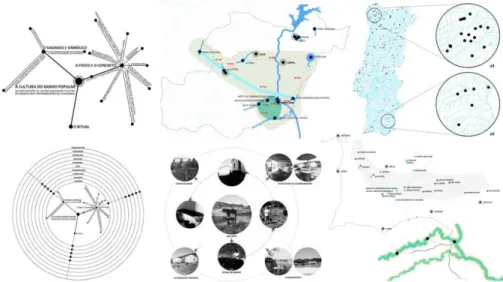
As a medium, the diagram plays a dual role. It is a Manner of notation (of analysis, of recognition and of reflection) but Also a machine of action (generative, synthetic and productive). Diagnosis and response. Map and trajectory." (Gausa, 2003, p.164) Drawing, redrawing the landscape from its decipherment, involves disassembling the various components that comprise it. Thus, the diagram works as a capable decomposition mechanism of a complex reality (by layers), while acting as a mechanism for interpretation and exploration of relationships between things. Also, it is a graphic tool that organises information, activates thinking and stimulates and provokes unexpected possibilities for action.
The categorisation of diagrams has been matter of thought by many authors such as Laseau, Porter, Fraser & Henmi. Also numerous architects, in the book Activity Diagrams (KIM, 2006) defend the diagram as an essential graphic mechanism to design.
But in here it is proposed a free adjustment of the diagram types, to be developed according to the steps identified above.
Analytical Diagram - Territory’s scale:
Include disassembly in layers of different thicknesses that integrate the studied fields, decomposing the landscape on its integrated components:
- The geology as part of first level understanding on issues related to the mineralization of the water and its consequent spontaneous emergence to the surface;
- The morphology and topography of the land, especially crossed with water lines as a way of identifying a common denominator for the location of the springs;
- The identification of landscape units that characterise the set of springs, demonstrating the relationship between the location of springs with the river line ecosystems;
- The evolution of land occupation and ownership associated with the bath locations in order to perceive the evolution of their occupation, deducting the social, cultural and symbolic history of these places;
Functional Diagrams - on the scale of the Bath Places (springs):
Comprising the construction of an array of recognition inherent in the practice of the bath, through the comparative exercise between places, less over a common denominator of occupation and ritual.
- Definition of possible linking itineraries and routes between places of Bath;
- Decomposition of the bath rituals identifying their steps - capture, water heating, water transport, the bath and its duration.
Prospective diagrams – on the scale of the Bathing Place (springs):
It integrates the test of the main lines of action, through the interpretation of the contemporary Bath Ritual:
- Mapping of structures designed for the practice of bathing in its many inventive possibilities of relationship between body and water (collective/individual bath, outdoor/indoor bath, immersion/steam bath etc.);
- Proposing uses and auxiliary and complementary functions to the bath practice – social structures for conviviality and temporary accommodations;
- Exploration and testing of structures/spaces’ designed to the practice of bathing and other complementary programs;
341
Operating diagrams – on the scale of the Territory, on the scale of the Bathing
Places (springs), on the scale of the building:
It concentrates and summarises the possible design orientations and the main intervention strategies.
- The river ecosystems as the pillar for reading and understanding all the bath places (springs), through which equates the idea of “Places Network”;
- Construction of the assumptions for creating that network of places, decoding the physical and human structures of continuity and complementarity between those places;
- Identification of infrastructural systems (low-tech and easy maintenance) for driving, retaining, treating and reusing the water, in order to guarantee the implementation of the thermal locations network;
- Mapping of possible micro-interventions;
It is the mixture of analysis and invention implied in the construction of a diagram that may shed light on an idea of landscape transformation (applying the Territory Knowledge), approaching the main aim of the research.
Conclusion
This progressive path towards a "Territory Knowledge" presupposes a work of deciphering a reality that is not static but rather systemic and in continuous process of transformation, to which is added the ambition to imagine the future, that naturally implies questioning the instruments and mechanisms of architecture itself and mainly the design process.
The limitation that the technical drawing and even the model implies on the construction of a theoretical and propositional thinking (by assuming the strict commitment to the building object) precipitates us naturally to search for other ways of thinking the design and especially of thinking the design integrated within an academic research.
The understanding of design as a cosa mentale capable of being simultaneously key to understanding, action pretext and synthesis of knowledge, incorporates a more expanded notion not only of their instruments of analysis and conception (as exemplified by the active exploitation of the diagram at the expense of traditional design in architecture), as it is as the closest link between theory and practice, between thought and action, between rigor and invention.
knowledge) in this investigation because it focus itself not only on the potential for analysis, interpretation and deduction on a complex reality (where they mix natural, symbolic, cultural, social and anthropological functions), but also it allows the exercise of imagination, invention and design of a future landscape.
The diagram works here as a tool for analysing and understanding the various scales - territory, place and space - as a tool for a multidisciplinary link, as an induction tool for reflection before the questioning that instigates, as an instrument to stimulate the action and finally as an open and non-deterministic instrument, from which it is always possible the exercise of correction, review and evolution.
In summary, considering that the nature of the subject provides a fruitful and vigorous "field of opportunity" in building a perspective and a prospective by the "will for the future", and digressive in the search of strategies to improve their stimulation, enhancement and redesign. The resource to design as a research method inevitably arises as an indispensable tool and also as a means of undisputed appreciation of architectural critical discourse itself.
343
References
Carapinha, A. (2005) “Escrita na Paisagem”, Catálogo Escrita na Paisagem, Festival de performance e Artes da Terra. Évora: Colecção B, Minesis, pp.9-10.
Clément, G. (2012) El jardín en movimento. (Translated by Susana Bossut), Barcelona: Gustavo Gili, SL. (original work published 2007)
Costa, A. (2013) “Lugares praticados versus Lugares de memória”, poster 04: Transformação: capital urbano e cultural. Braga: Ordem dos Arquitectos Secção Regional do Norte.
Fernandes, E. (2013) “The architectis instituendis: A investigação pelo desenho depois de Bolonha”, Joelho 04, Teaching through design. Porto: FCTUC, Architecture Department, pp. 229-236.
Fraser, I. (1994) Envisioning Architecture: An analysis of Drawing. New York: John Wiley & Sons.
Gausa, M., Guallart, V., Muller, W., Soriano, F., Porras, F. and Morales, J. (2003) The metapolis dictionary of advanced architecture: city, technology and society in the information age. Barcelona: Actar Editions.
Kim, J. (2008) Activity Diagrams. Korea: DAMDI
Laseau, P. (1989) Graphic thinking for architects and designers. New York: John Wiley & Sons.
Providência, P., Moniz, G. (2013) “Teaching through design”, Joelho 04, Teaching through design. Porto: FCTUC, Architecture Department, pp. 11-19.
Porter, T. (1997) The Architects Eye: Visualization and depiction of space in architecture. London: Chapman & Hall.