(Annals of the Brazilian Academy of Sciences)
Printed version ISSN 0001-3765 / Online version ISSN 1678-2690 www.scielo.br/aabc
http://dx.doi.org/10.1590/0001-3765201520150084
Correlation between radiation dose and p53 protein expression levels in human lymphocytes
MARIANA B. CAVALCANTI1, THIAGO S. FERNANDES1,2, EDVANE B. SILVA1,3 and ADEMIR AMARAL1
1
Laboratório de Modelagem e Biodosimetria Aplicada (LAMBDA), Departamento de Energia Nuclear, Universidade Federal de Pernambuco, Avenida Professor Luiz Freire, 1000, Cidade Universitária, 50740-540 Recife, PE, Brasil
2Departamento de Biofísica e Radiobiologia, Universidade Federal de Pernambuco,
Avenida Moraes Rego, 1235, Cidade Universitária, 50670-901 Recife, PE, Brasil
3
Centro Acadêmico de Vitória, Universidade Federal de Pernambuco, Rua Alto do Reservatório, s/n, 55608-680 Vitória de Santo Antão, PE, Brasil
Manuscript received on February 5, 2015; accepted for publication on April 29, 2015
ABSTRACT
The aim of this research was to evaluate the relationship between p53 protein levels and absorbed doses from in vitro irradiated human lymphocytes. For this, samples of blood from 23 donors were irradiated with 0.5; 1; 2; and 4 Gy from a Cobalt-60 source, and the percentages of lymphocytes expressing p53 were scored using Flow Cytometry. The subjects were divided into 3 groups, in accordance with the p53 levels expressed per radiation dose: low (Group I), high (Group II), and excessive levels (Group III). For all groups, the analyses showed that the p53 expression levels increase with the absorbed dose. Particularly for groups I and II, the correlation between this protein expression and the dose follows the linear-quadratic model, such as for radioinduced chromosomal aberrations. In conclusion, our findings indicate possible applications of this approach in evaluating individual radiosensitivity prior to radiotherapeutical procedures as well as in medical surveillance of occupationally exposed workers. Furthermore, due to the rapidity of flow-cytometric analyses, the methodology here employed would play an important role in emergency responses to a large-scale radiation incident where many people may have been exposed.
Key words: Biological Dosimetry, cellular radiobiology, Flow Cytometry, p53 protein, radiosensitivity.
Correspondence to: Mariana B.C. Freire Bezerra E-mail: [email protected]
INTRODUCTION
Ionizing radiation (IR) is a physical agent used in
many fields, such as in medicine for diagnosis and
treatment of diseases, and for industrial purposes. Due to the adverse health effects of this agent, the evaluation of the risks associated to individual
exposure to IR is a very important issue. This assessment can be done by measuring biomarkers,
which are modifications of biological parameters
induced by the interaction of this type of radiation with the living tissue (Amaral et al. 2008, Lemos-Pinto et al. 2010).
whether individuals have been considerably exposed to IR, and, sometimes, to determine what level of absorbed dose they have been exposed to. The frequency of dicentric chromosomes in peripheral blood lymphocytes is the most widely used biomarker for estimating the individual absorbed dose. Despite being the “gold standard” in biodosimetry, the dicentric scoring-based methodology is too laborious and time consuming, which would be of great concern in cases of radiation emergencies, where quick responses are crucial for an early and better management of cases associated to acute radiation syndrome (Amaral et al. 2008, Fernandes et al. 2008). Furthermore, it is well known that not all people respond equally to the same level of exposure to IR, some of them presenting overreactions (Orient 2014).
The search for innovative biological methods of screening an irradiated population is nowadays motivated by the advent of new technologies that enable better studies of gene and protein expressions (Guipaud and Benderitte 2009). This is especially important in, for example, a mass casualty event such as the recent nuclear incident of Fukushima in Japan (Lee et al. 2012, Chen et al. 2014).
The two main radiation-induced DNA damages, single strand breaks (SSB) or double strand breaks (DSB), can be misrepaired so as to generate abnormal dicentric chromosomes (Sweigert et al. 1989, Olive 1998, Pojoga et al. 2013). When the DNA is injured, the protein p53, so-called the “Guardian of the Genome”, is expressed. This protein acts by coordinating the response to DNA injuries in a transcription-dependent and independent manner (Riley et al. 2008, Rashi-Elkeles et al. 2014). One of the multiple roles played by p53 after radiation is to act as a transcription
factor by binding to specific DNA sequences and
consequently inducing activation or even repression of pivotal genes enrolled in cell-cycle arrest, DNA repair and apoptosis (Speidel 2010).
From in vitro irradiated human lymphocytes, it was demonstrated elsewhere that the p53
protein expression increases with the radiation levels (Cavalcanti et al. 2008, 2011). Hence, it is evident that there is proportionality between absorbed dose and biomarkers of radiation exposures, such as the formation of dicentric chromosomes, the p53 protein expression, and the
γH2AX phosphorylation, all of these as a result of DNA double strand breaks (Redon et al. 2009, Rothkamm and Horn 2009).
In order to investigate the potential of p53 as a candidate for biomarker of individual exposure to IR, the aim of this research was to measure the relationship between p53 protein levels and absorbed doses in human lymphocytes from in vitro irradiated peripheral blood.
MATERIALS AND METHODS
STUDIED POPULATION AND ETHICAL ASPECTS
This research was performed with 23 healthy volunteers, being 10 females (aged 19 to 42 years) and 13 males (aged 22 to 36 years). All individuals involved in this research signed a written informed consent before blood collection, following recommendations of the ethics committee of the Fundação de Hematologia e Hemoterapia de Pernambuco (HEMOPE/Brazil) (Number 046/06).
IRRADIATION AND PROCESSING OF SAMPLES
For each donor, 50-mL samples of peripheral
blood were divided into five equal aliquots. From
ISOLATION OF PERIPHERAL BLOOD MONONUCLEAR CELLS After irradiation, blood was diluted (1:1) with phosphate-buffered saline (PBS, pH 7.2) and deposited onto the Ficoll-Paque PLUS density (1.077 g/mL) gradient (GE Healthcare, USA). After centrifugation, peripheral blood mononuclear cells (PBMC) were individually removed, washed twice with PBS and resuspended in RPMI-1640 medium (Cultilab, Brazil) supplemented with 10% fetal bovine serum (Cultilab, Brazil) at density of 2 × 10⁶ cells/mL. The cell viability was evaluated using trypan blue dye 0.4% (Sigma-Aldrich, USA), in accordance to the methodology described elsewhere (Cavalcanti et al. 2011). Only samples with more than 80% of viable cells were cultured.
LYMPHOCYTE CULTURE
The methodology for cell cultures was adapted from De Freitas e Silva et al. (2014). In short: cells were plated in 96-well bottom plates (TPP, Switzerland) at density of 2 x 10⁵cells/well and cultured at a
final concentration of phytohemagglutinin (PHA) of 10 µg/mL. Plates were incubated in a humidified
atmosphere of 5% CO2 at 37 °C for 72 h.
CELL LABELING WITH ANTIBODIES
All methods employed in this work for cell labeling were previously tested and established (Cavalcanti et al. 2008, 2011). After cell culture, cells were harvested and washed with RPMI-1640 medium supplemented with 10% fetal bovine serum. For permeabilization, cells were resuspended in solution containing 1 mL of FACS lysing solution (BD Pharmigen, USA) diluted in water (1/10) and 9 mL of 4% paraformaldehyde in PBS, and incubated for 10 min at room temperature. After this, cells were washed with PBS 0.05% Tween 20 (Merck, Germany) at 400 x g for 5 min. Cell
pellet was resuspended in 200 μL of PBS 0.05%
Tween 20 and stained with phycoerithrin (PE)-conjugated anti-p53 antibody (clone G59-12) (BD Pharmigen, USA) for 20 min at room temperature.
PE-conjugated mouse IgG1 (clone MOPC-21) (BD Pharmigen, USA) was used as isotype control antibody. Then, cells were washed twice in PBS
0.05% Tween 20 and fixed with 500 μL of 1%
paraformaldehyde in PBS.
FLOW CYTOMETRY
The percentage of lymphocytes expressing p53 was scored using Flow Cytometry (FC). The
analyses were performed on a FACScalibur flow
cytometer (Becton Dickinson, USA), equipped with a 15 mW argon-ion laser (wavelength 488 nm), using Cell Quest pro software (Becton Dickinson Immunocytometry Systems, USA). Based on scatter parameters, cells were graphically settled according to its size and granularity, and from this visualization, lymphocyte population was electronically selected with a gate tool (lymphogate). For each analysis, 50,000 events
were scored and the p53 final levels were calculated
by subtraction of isotype control (less than 1%) from p53 expression value.
STATISTICAL ANALYSES
For evaluating whether the data followed a Normal distribution, the Shapiro-Wilk test was used. To compare biological response differences among absorbed doses, ANOVA and Post-hoc Tukey were applied. Lastly, the t-student test was employed
to determine the interval of confidence of the
percentage of p53 protein expression (p<0.05).
RESULTS
per dose, and were considered as outliers. In the
classification of these groups, age or sex of the
subjects was not considered.
Table I presents the interval of confidence of
p53 protein expression level for different absorbed doses in the case of groups I and II.
TABLE I
Interval of confidence of p53 protein expression level for different absorbed doses and control (non-irradiated).
p53 EXPRESSION LEVEL (%) Radiation Dose (Gy)
GROUPS Control 0.5 1.0 2.0 4.0
I 0.08 – 0.44 0.00 – 0.60 0.12 – 0.78 0.34 – 2.33 2.94 – 6.11 II 1.07 – 1.75 1.05 – 3.01 1.36 – 4.24 3.84 – 9.67 10.97 – 16.30
TABLE II
p53 protein expression levels in lymphocytes from subjects S1 and S2, for non-irradiated (Control) and
irradiated (0.5; 1; 2; 4 Gy) samples.
p53 EXPRESSION LEVEL (%) Radiation Dose (Gy)
Samples Control 0.5 1.0 2.0 4.0
S1 1.00 48.57 37.72 40.95 52.18
S2 0.41 4.56 48.49 22.73 60.87
From Table I, it can be noticed that the p53 expression levels of Group I, responded less intensely (from 0.08% to 6.11%) to the absorbed doses. When compared to the p53 expression levels shown by the Group II (1.07% to 16.30%), the “lower responders”
given by the first group, may be an indicator that
those former subjects are more resistant in terms of radiation-induced cell death.
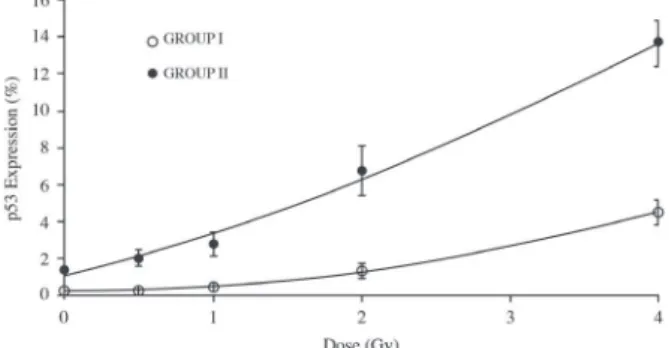
Figure 1 presents the means of p53 expression levels in lymphocytes after in vitro irradiation with absorbed doses of 0.5; 1; 2; and 4 Gy, including the background (non-irradiated sample), from 72-hour cell cultures in the presence of phytohaemaglutinin (PHA) in the beginning of cell culture in order to induce mitosis.
Table II shows the p53 protein expression level from samples of the two subjects considered as outliers in terms of pattern in response to ionizing Figure 1 - Mean percentage of the p53 protein expression levels in non-irradiated (0 Gy) and irradiated (0.5; 1; 2; 4 Gy) lymphocytes for Groups I and II.
radiation. Those donors, coded as S1 and S2, form Group III and their cells expressed much higher p53 protein expression levels than the ones of the other studied individuals, with a different tendency as the dose increased. For these two subjects, statistically
significant differences among control and absorbed
doses of 0.5; 1; 2; and 4 Gy (p<0.05), was observed.
DISCUSSION
The discovery of new, quicker biomarkers of individual exposure to ionizing radiation would
be of great significance for a faster identification
of absorbed dose to which the person has been exposed to (Heslet et al 2012). However, it should be kept in mind that the range is generally too wide for estimating the real absorbed dose, serving only for screening the more highly-exposed subjects who require urgent medical intervention. In addition, some laboratorial tests can be performed, such as the leucogram and the counting of platelets. The depletion of these cells from the peripheral blood is commonly related to the severe, moderate and tolerant level of irradiation. For a faster screening, micronuclei assay have been proposed,
but this is also not specific to radiation and can
be caused by chemical agents (Voisin 1997, Voisin et al. 2001, 2002, Luzhna et al. 2013.). It
is worth emphasizing that the identification of
persons exposed to absorbed doses higher than 1 Gy would help the medical team in therapeutical planning in order to avoid the symptoms of acute radiation syndrome (Mettler 2012). For doses less than 1 Gy, the health staff would be able to advise the irradiated persons about the risks of stochastic and long term effects.
The gamma-H2AX expression has also been proposed as a biomarker of individual exposure to ionizing radiation. However, this histone subunit
undergoes very quick modifications as an immediate
radiation response. Then, the lapse of time after an individual exposure is a limiting factor for applying this method in cases of radiation emergencies, unless the blood samples could be sent to analysis
within the first hours after irradiation (Sak and
Stuschke 2010, Moroni et al. 2013).
The importance of the p53 protein, as a guardian of genome integrity is due to its role in regulating biological processes such as DNA repair, cell cycle arrest and apoptosis (Vousden and Lane 2007, Liu et al. 2014). Those cellular mechanisms are directly related to the cell response to the in vitro or in vivo physico-chemical stresses. Thus, knowledge about how the expression levels of this protein correlate with the absorbed dose would successfully
introduce a new biomarker of individual exposure to ionizing radiation (Cavalcanti et al. 2008, Fei and El-Deiry 2003).
Blood-based assays with stimulated cells, mainly lymphocytes, have been used in the most advanced investigations concerning protein expressions under radioactive stress. As human lymphocytes are well distributed in the human body, staying typically in resting phase (G0), they can reenter the cell cycle if appropriately stimulated to mitosis, maintaining therefore the memory of damage until the cell culture (Lloyd and Dolphin 1977, De Freitas e Silva et al. 2014).
In this context, the measure of p53 protein expression by Flow Cytometry would be a rapid screening method in order to spot those who were actually exposed to ionizing radiation. Once the
exposed person has been identified, a more reliable
method for estimating the absorbed dose would be the gold-standard dicentric assay (IAEA 2011).
Regarding Figure 1, Group I presents the mean of p53 protein expression levels for 8 subjects. For this group, it is possible to verify a statistically
significant difference between the control (0 Gy)
and the absorbed dose of 4 Gy.
Group II presents the results for expression of p53 protein of another 13 subjects. For this group,
statistically significant differences of p53 protein
expression levels were observed among control (0 Gy), 2 and 4 Gy.
presenting a quadratic response (Lemos-Pinto et al. 2010, IAEA 2011). In the present study, the same pattern of dose response was observed for p53 protein expression, reinforcing the idea that there is a close relationship between increase of radioinduced DNA damage and the increase of the this protein expression levels.
Comparing each p53 protein expression level of Group I with the respective result of Group II,
for each condition (control, 0.5 to 4 Gy), significant
differences (p<0.05) were observed.
The results pertaining to the subjects S1 and S2 are summarized in Table II, and show considerably higher p53 protein expressions than any other individual belonging to the previous groups. Thus, for S1 and S2 subjects, one can expect overreactions in terms of cell death and mitotic delay, in comparison to the others.
In radiotherapy, the capacity of predicting
the individual radiosensitivity would significantly
improve the treatment of cancer (Barnett et al. 2009, Prasanna et al. 2014). Although cellular radiosensitivity is directly correlated with the mechanisms of DNA repair, this parameter in normal tissues is not investigated prior to treatment. Generally, depending on the treatment approach, the dose delivered to the tumor is 2 Gy a day fractions, with a smaller dose to the surrounding tissue. This is responsible for the side effects associated with damages to normal tissues (Hall and Giaccia 2006).
Our preliminary results suggest that the
definition of a “normality interval” for p53 protein expression levels may provide a patient-specific
protocol. This would be very important so that
radiation sensitive patients could be identified
before they undergo therapy. Obviously, further studies with a greater number of subjects are needed to support this hypothesis.
On the other hand, in terms of radioprotection
management, the identification of individual less
sensitive to radiation would be of great interest
for those who need to be occupationally exposed, such as professionals in Nuclear Power Plants, Hospitals, Industries, Research, Aircraft Pilots or Astronauts, in the goal of avoiding or mitigating the risks associated to the exposure to ionizing radiation (Byrne et al. 2014).
CONCLUSIONS
The response of p53 protein expression induced by ionizing radiation presents a dose-dependent pattern correspondent to the amount of DNA breaks induced per unit dose. This could be reinforced by the evidence that for some samples the dose-effect follows the linear-quadratic model. Nevertheless, one mind considerer the radiation sensitivity, because for some subjects the dose response follows no patterns, due to the high p53 levels even for lower doses. Thus, even though further studies are needed, the use of the methodology presented in this research would be helpful in the assessment of individual sensitivity to ionizing radiation.
Considering the rapidity of flow-cytometric
analyses, this work also opens the possibility of applying this methodology in a fast screening of a large number of people suspected of having received an overdose of radiation in the case of accidents or radiotherapy, but also for occupational personnel working on nuclear plants or jet pilots, who are systematically exposed to chronic low radiation doses.
ACKNOWLEDGMENTS
The authors would like to thank the Centro de Pesquisas Aggeu Magalhães (Fiocruz-CPqAM-Brazil) for providing laboratory facilities, and
Conselho Nacional de Desenvolvimento Científico e Tecnológico (CNPq-Brazil), for financial support.
RESUMO
de sangue de 23 doadores foram irradiadas com 0,5; 1; 2; e 4 Gy a partir de uma fonte de cobalto-60, e as porcentagens de linfócitos expressando p53 foram quantificadas por Citometria de Fluxo. Os indivíduos foram divididos em três grupos, de acordo com os níveis da p53 expressos por dose de radiação: baixo (Grupo I), elevado (Grupo II), e níveis excessivos (Grupo III). Para todos os grupos, as análises mostraram que os níveis de expressão da p53 aumentam com a dose absorvida. Particularmente para os grupos I e II, a correlação entre a expressão desta proteína e a dose segue o modelo linear-quadrático, como para as aberrações cromossômicas radioinduzidas. Em conclusão, nossos achados indicam possíveis aplicações desta metodologia na avaliação radiossensibilidade individual antes de procedimentos radioterapêuticos, bem como na monitoração médica de trabalhadores ocupacionalmente expostos. Além disso, devido à rapidez das análises por Citometria de Fluxo, a metodologia aqui empregada poderá desempenhar um papel importante nas ações emergenciais em incidentes radioativos de larga escala, onde muitas pessoas podem ter sido expostas.
Palavras-chaves: Dosimetria Biológica, radiobiologia celular, Citometria de Fluxo, proteína p53, radiossensibilidade.
REFERENCES
AMARAL A, FERNANDES TS AND CAVALCANTI MB. 2008. Bioindicators in radiation protection. Braz Arch Biol Technol 51: 91-96.
BARNETT GC, WEST M, DUNNING AM, ELLIOTT RM, COLES CE, PHAROAH PD AND BURNET NG. 2009. Normal tissue reactions to radiotherapy: towards tailoring treatment dose by genotype. Nat Rev Cancer 9: 134-142.
BYRNE RT ET AL. 2014. Evolution of extreme resistance to ionizing radiation via genetic adaptation of DNA repair. eLife 3: 1-18.
CAVALCANTI MB, AMARAL A, FERNANDES TS, MELO JA AND MACHADO CGF. 2008. p53 protein expression levels as bioindicator of individual exposure to ionizing radiation
by flow cytometry. Mol Cell Biochem 308: 127-131.
CAVALCANTI MB, SILVA APG, SILVA RF AND AMARAL A. 2011. p53 protein expression and cell viability in irradiated peripheral blood mononuclear cells as bioindicators of radiosensitivity. J Biophys Chem 2: 63-67.
CHEN Y, ZHOU PK, ZHANG XQ, WANG ZD, WANG Y AND DARROUDI F. 2014. Cytogenetic studies for a group of people living in Japan 1 year after the Fukushima nuclear accident. Radiat Prot Dosimetry 159: 20-25.
DE FREITAS E SILVA R, DOS SANTOS NFG, PEREIRA V AND AMARAL A. 2014. Simultaneous analysis of p53 protein expression and cell proliferation in irradiated human
lymphocytes by flow cytometry. Dose Response 12: 110-120.
FEI P AND EL-DEIRY WS. 2003. P53 and radiation responses. Oncogene 22: 5774-5783.
FERNANDES TS, LLOYD DC AND AMARAL A. 2008. A comparison of different cytological stains for biological dosimetry. Int J Radiat Biol 84: 703-711.
GUIPAUD O AND BENDERITTE M. 2009. Protein biomarkers for radiation exposure: towards a proteomic approach as a new investigation tool. Ann Inst Super Sanitá 45: 278-286. HALL EJ AND GIACCIA AJ. 2006. Radiosensitivity and cell age
in the mitotic cycle. In: Hall EJ and Giaccia AJ (Eds), Radiobiology for the radiologist, 6th ed., Philadelphia:
Lippincott Williams &Wilkins, p 47-59.
HESLET L, BAY C AND NEPPER-CHRISTENSEN S. 2012. Acute radiation syndrome (ARS) – treatment of the reduced host defense. Int J Gen Med 5: 105-115.
IAEA - INTERNATIONAL ATOMIC ENERGY AGENCY. 2011. Cytogenetic dosimetry: applications in preparedness for
and response to radiation emergencies. Vienna: Scientific
and Technical.
LEE JK, HAN EA, LEE SS, HA WH, BARQUINERO JF, LEE HR AND CHO MS. 2012. Cytogenetic biodosimetry for Fukushima travelers after the nuclear power plant accident: no evidence of enhanced yield of dicentrics. J Radiat Res 53: 876-881.
LEMOS-PINTO MM, SANTOS NF AND AMARAL A. 2010. Current status of biodosimetry based on standard cytogenetic methods. Radiat Environ Biophys 49: 567-581.
LIU B, BHATT D, OLTVAI1 ZN, GREENBERGER JS AND BAHAR I. 2014. Significance of p53 dynamics in regulating apoptosis in response to ionizing radiation, and polypharmacological
strategies. Scientific Reports 4: 6245.
LLOYD DC AND DOLPHIN GW. 1977. Radiation-induced chromosome damage in human lymphocytes. Br J Ind Med 34: 261-273.
LUZHNA L, KATHIRIA P AND KOVALCHUK O. 2013. Micronuclei in genotoxicity assessment: from genetics to epigenetics and beyond. Front Genet 4: 131.
METTLER FA. 2012. Medical effects and risks of exposure to ionizing radiation. J Radiol Prot 32: 9-13.
MORONI M, MAEDA D, WHITNALL MH, BONNER WM AND REDON CE. 2013. Evaluation of the Gamma-H2AX Assay for Radiation Biodosimetry in a Swine Model. Int J Mol Sci 14: 14119-14135.
OLIVE PL. 1998. The role of DNA single- and double-strand breaks in cell killing by ionizing radiation. Radiat Res 150: S42-51.
POJOGA M, MANAILA E, CONSTANTIN N, DUTA CG, CIMPONERIU D AND SIMON-GRUITA A. 2013. Chromosome aberrations, telomere and telomerase dysfunction after beta irradiation in human lymphocytes. Rom Biotech Lett 18: 8603-8612. PRASANNA PGS, AHMED MM, STONE HB, VIKRAM B, MEATA
MP AND COLEMAN CN. 2014. Radition-induced brasin damage, impact of Michael Robbins´work and the need for predictive biomarkers. Int J Radiat Biol 90: 742-752. RASHI-ELKELES S ET AL. 2014. Parallel profiling of the
transcriptome, cistrome, and epigenome in the cellular response to ionizing radiation. Sci Signal 7(325): rs3. REDON CE, DICKEY JS, BONNER WM AND SEDELNIKOVA OA.
2009. γ-H2AX as a biomarker of DNA damage induced by
ionizing radiation in human peripheral blood lymphocytes
and artificial skin. Adv Space Res 43: 1171-1178.
RILEY T, SONTAG E, CHEN P AND LEVINE A. 2008. Transcriptional control of human p53-regulated genes. Nat Rev Mol cell Biol 9: 402-412.
ROTHKAMM K AND HORN S. 2009. γ-H2AX as protein biomarker for radiation exposure. Ann Ist Super Sanita 45: 265-271.
SAK A AND STUSCHKE M. 2010. Use of γH2AX and other biomarkers of double-strand breaks during radiotherapy. Seimin Radiat Oncol 20: 223-231.
SPEIDEL D. 2010. Transcription-independent p53 apoptosis: an alternative route to death. Trends Cell Biol 20: 14-24. SWEIGERT SE, EGUCHI-KASAI K, WARTERS RL AND
DETHLEFSEN LA. 1989. Repair of DNA single- and double-strand breaks in proliferating and quiescent murine tumor cells. Int J Radiat Biol 56: 253-264.
VOISIN P. 1997. Chromosome lesions as short and medium term biological indictor of acute irradiation. In: Court L and Lallemand A (Eds), l'Homme Blessé. Edf, Paris, p. 139-150.
VOISIN P ET AL. 2002. Towards a standardization of biological dosimetry by cytogenetics. Cell Mol Biol 48: 501-504. VOISIN P, BENDERITTER M, CLARAZ M, CHAMBRETTE V,
SOROKINE-DURM I, DELBOS M, DURAND V, LEROY A AND PAILLOLE N. 2001. The cytogenetic dosimetry of recent accidental overexposure. Cell Mol Biol 47: 557-564. VOUSDEN KH AND LANE DP. 2007. p53 in health and disease.