Ciência Rural, v.45, n.1, jan, 2015.
β-mannanase and mannan oligosaccharides in broiler chicken feed
β-mananase e mananoligossacarídeo em rações de frangos de corte
Victor Ramos Sales Mendes de BarrosI Geraldo Roberto Quintão LanaI*
Sandra Roselí Valerio LanaI Ângela Maria Quintão LanaII Fabio Sales Albuquerque CunhaIII João Virgínio Emerenciano NetoII
ISSN 0103-8478
Received 11.19.13 Approved 06.03.14 Returned by the author 09.01.14 ABSTRACT
The study aimed to evaluate the use of β-mannanase
and mannan oligosaccharides (MOS) to replace growth promoters in broiler diets. Four hundred male Cobb broiler chicks were used, with initial weight of 45±1g, distributed in a completely randomized
design with fi ve treatments and eight repetitions of ten birds. The
treatments were: basal feed; basal feed without growth promoter;
basal feed without growth promoter + β-mannanase; basal feed
without growth promoter + MOS; and basal feed without growth
promoter + β-mannanase + MOS. The feed intake of the birds
increased in response to dietary treatments compared to basal diet during the period 1-21 days of age. A higher weight gain and improved feed conversion was found at 42 days of age among birds that had received the basal diet without growth promoter + MOS. The absolute weight at slaughter, relative carcass and prime cuts except breast weights improved in response to dietary treatments compared to the basal diet at 42 days of age. No difference was
observed in relative weight of the liver, while signifi cant differences
were found in the weight of heart, gizzard, and abdominal fat. It
was concluded that β-mannanase and MOS can replace the growth
promoters in broiler diets without compromising production and economic performance. However, the association of these products into the feed may cause negative interaction that reduces the broiler chickens’ performance.
Key words: broiler chickens, economic effi ciency, exogenous
enzymes.
RESUMO
O experimento teve como objetivo avaliar a utilização
de β-mananase e mananoligossacarídeos em substituição aos
promotores de crescimento nas rações para frangos de corte. Foram utilizados 400 pintos de corte machos da marca Cobb, com peso inicial de 45±1g, distribuídos em delineamento inteiramente ao acaso, com cinco tratamentos e oito repetições de 10 aves.
Os tratamentos foram: ração basal; ração basal sem promotor de crescimento; ração basal sem promotor de crescimento +
β-mananase; ração basal sem promotor de crescimento + MOS; e ração basal sem promotor de crescimento + β-mananase +
MOS. O consumo de ração das aves aumentou em resposta aos tratamentos dietéticos, quando comparados à ração basal no período de 1 a 21 dias de idade. Observou-se maior ganho de peso e melhora na conversão alimentar das aves aos 42 dias de idade que receberam a dieta basal sem promotor de crescimento + MOS. Os pesos absolutos ao abate e relativos de carcaça e de cortes nobres, com exceção de peito, melhoraram em resposta aos tratamentos dietéticos, quando comparados à ração basal aos 42 dias de idade. Não houve diferença sobre o peso relativo de fígado, enquanto os pesos de coração, moela e gordura abdominal foram
infl uenciados pelos tratamentos. Concluiu-se que a β-mananase e
o MOS podem substituir os promotores de crescimento em rações de frangos de corte sem comprometer o desempenho produtivo e econômico, no entanto, a associação destes produtos à ração pode causar interação, reduzindo o desempenho das aves.
Palavras-chave: aves, efi ciência econômica, enzimas exógenas.
INTRODUCTION
Advances in poultry production in the past few years, mainly in broiler production, are mainly due to the adjustments arising from a series of research studies developed in various segments including genetics, adaptations in facilities, equipment automation, health, and nutrition.
About 80% of the birds’ diets are made up of ingredients of plant origin (corn and soy meal), containing non-starch polysaccharides (NSPs) that
IPrograma de Pós-graduação em Zootecnia, Universidade Federal de Alagoas (UFAL), Campus Delza Gitaí, 57100-000, Rio Largo, AL,
Brasil. E-mail: [email protected]. *Corresponding author.
IIPrograma de Pós-graduação em Zootecnia, Universidade Federal de Minas Gerais (UFMG), Belo Horizonte, MG, Brasil. IIIUniversidade Estadual de Alagoas (UNEAL), Santana do Ipanema, AL, Brasil.
form the cell wall in plants, where a large portion of this group is present in the hemicellulose fraction. The NSPs have the characteristic of increasing gastrointestinal viscosity, which results in a reduction in the diffusion rate of digestive enzymes and substrates, preventing their interactions on the surface of the intestinal mucosa, leading to impaired digestion and absorption of nutrients. Endogenous enzymes produced by poultry and swine cannot hydrolyze the NSPs contained in cereals (OPALINSKI et al., 2010). In poultry, only the amylase enzyme produced by the pancreas can hydrolyze starch into smaller units that can be absorbed; therefore, the presence of exogenous enzymes is needed (O’NEILL et al., 2014).
The enzyme β-mannanase is responsible for the hydrolysis of β-mannans, thus reducing intestinal
viscosity, promoting better nutrient digestibility, and acting on pathogens after hydrolysis. However, since the exact effect of the enzyme interaction is unknown,
and there is a diffi culty in determining the amount
of NSPs present in foods, the results may often be controversial (ALBINO et al., 2006).
Mannan oligosaccharides (MOS) derived from the yeast cell wall have high binding
affi nity, providing a competitive binding site for oligosaccharide-specifi c bacteria. The benefi ts of
MOS are based on properties that include changes
in the intestinal fl ora, a reduction in mucosa turnover
rate, and the modulation of the immune system in the intestinal lumen (SIMS et al., 2004). Therefore, this
study aimed to evaluate the use of β-mannanase and
mannan oligosaccharides (MOS) to replace growth promoters in broiler diets.
MATERIAL AND METHODS
The trial was carried out in the Aviculture Sector of the Center for Agrarian Sciences at the Federal University of Alagoas, in the city of Maceio, Brazil, during the months of August and September 2011. Four hundred one-day-old broiler chicks of the Cobb 500® breed were used, selected according to
the initial weight of 45±1g, randomly distributed in a shed with reused sugarcane bagasse bedding, raised according to the breed manual.
The broiler chickens were allocated to a brick shed, with 40 experimental units, built on the east-west axis with a ceiling height of 3.5m and natural ventilation. The climate variables were monitored daily at 9:00 AM and 4:00 PM with maximum-minimum, dry- and wet-bulb thermometers, and a black globe thermometer. The average air temperature over the trial period was 25.4°C (maximum and minimum
temperatures of 23.2 and 27.6°C, respectively) and 78.0% average relative air humidity. The value of 77.6 found for the black globe temperature and humidity index (BGHI) was calculated according to BUFFINGTON et al. (1981).
Feed and water were provided ad libitum in tubular feeders and hanging fountains throughout the trial. The thermal control of the animals was done
with artifi cial heating in each box until the 14th day
with 100-watt incandescent light bulbs. Artifi cial illumination was provided by 60-watt fl uorescent
light bulbs in a continuous light regimen.
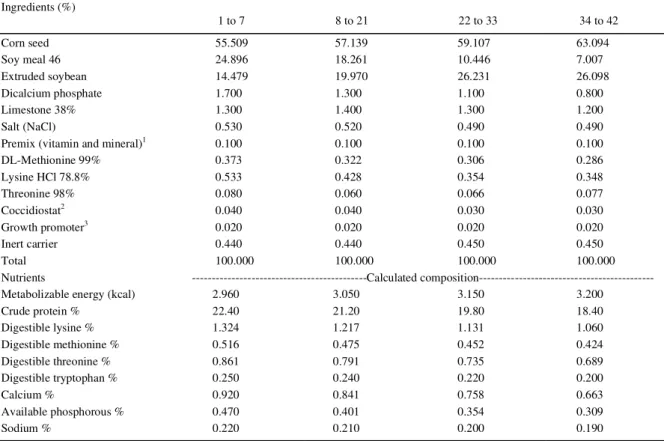
The isonutritive and isoenergetic experimental diets based on soy meal and corn (Table 1) were formulated according to the nutritional needs of high-performance male broilers indicated by ROSTAGNO et al. (2011). Diets were subdivided into four periods: 1 to 7; 8 to 21; 22 to 33; and 34 to 42 days. The treatments were: T1 - Basal diet (Positive Control); T2 - Basal diet without growth promoter (Negative Control); T3 - Basal diet
without growth promoter + β-mannanase; T4 - Basal
diet without growth promoter + MOS; T5 - Basal
diet without growth promoter + β-mannanase + MOS. β-mannanase and MOS were added to the
treatments replacing the inert carrier, according to the manufacturers’ recommendations, i.e., 0.500kg
ton-1 β-mannanase in all raising periods and 1.500,
1.000, and 0.500 kg ton-1 MOS for the periods of 1 to
21; 22 to 33, and 34 to 42 days of age, respectively. The trial design was completely
randomized with fi ve treatments, eight repetitions,
and ten broiler chickens per experimental unit. The statistical analyses of the assessed variables were carried out with the software SAEG version 9.0, and the averages were compared by Duncan’s test
at a 5% signifi cance level. At the end of each trial
period, the broiler chickens, the feeds, and the feed leftovers of each repetition were weighed to evaluate the productive performance of the broilers subjected to different treatments. At the end of the trial period, all broiler chickens were individually weighed and two birds of average weight from each trial unit
were identifi ed, individually weighed, slaughtered,
plucked, and eviscerated after eight hours of fasting for analysis of the characteristics found in the carcass and cuts. The abdominal fat was composed of the fatty tissue around the cloaca and bursa of Fabricius.
relative weight (%) was calculated in relation to the slaughter weight (after eight hours in fasting); the yields of prime cuts, edible offal, and abdominal fat were calculated in relation to the carcass weight.
The economic analysis was carried out as a function of the live weight, feed intake, and feed cost during the treatments employed. The economic analysis is inherent to the production and feed component, since the labor and other farming expenses were the same for all treatments. The value of the live broilers was based on the value earned by the market (USD1.46 kg-1) and the value of the raw
materials used for calculating the cost of the feeds was based on the values in effect on September 27th
2011 according to the company Ave Sui Consultoria Técnica Comércio e Representações, Brazil.
In order to obtain the variables used in the economic analysis, the following parameters were considered: gross revenue (GR), which is the
amount earned as a function of the live weight versus broiler price; gross margin (GM), which represents the difference between the gross income and the feeding cost; relative gross margin (RGM), which is the quotient between the gross margin of the other treatments in relation to treatment 1 (basal diet);
average profi tability (AP), which represents the
quotient between the gross margin and the feeding
cost, indicating the profi tability over the investment in feed; and relative profi tability index (RPI),
which represents the quotient between the average
profi tability of the various treatments and treatment 1.
The value of 100 was assigned to the relative margin
and to the relative profi tability index of treatment 1.
RESULTS AND DISCUSSION
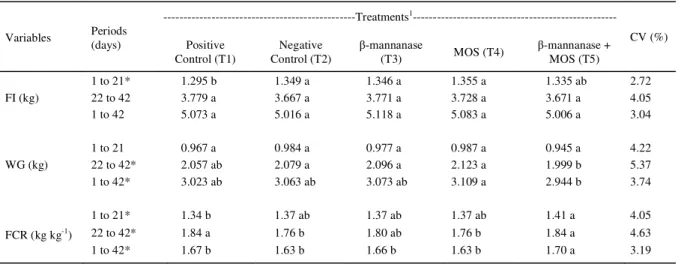
From the results in table 2, it can be seen that the broilers’ feed intake at the phase of 1 to 21 days of Table 1 - Composition of basal diets used in the trial periods.
---Periods---Ingredients (%)
1 to 7 8 to 21 22 to 33 34 to 42
Corn seed 55.509 57.139 59.107 63.094
Soy meal 46 24.896 18.261 10.446 7.007
Extruded soybean 14.479 19.970 26.231 26.098
Dicalcium phosphate 1.700 1.300 1.100 0.800
Limestone 38% 1.300 1.400 1.300 1.200
Salt (NaCl) 0.530 0.520 0.490 0.490
Premix (vitamin and mineral)1 0.100 0.100 0.100 0.100
DL-Methionine 99% 0.373 0.322 0.306 0.286
Lysine HCl 78.8% 0.533 0.428 0.354 0.348
Threonine 98% 0.080 0.060 0.066 0.077
Coccidiostat2 0.040 0.040 0.030 0.030
Growth promoter3 0.020 0.020 0.020 0.020
Inert carrier 0.440 0.440 0.450 0.450
Total 100.000 100.000 100.000 100.000
Nutrients ---Calculated
composition---Metabolizable energy (kcal) 2.960 3.050 3.150 3.200
Crude protein % 22.40 21.20 19.80 18.40
Digestible lysine % 1.324 1.217 1.131 1.060
Digestible methionine % 0.516 0.475 0.452 0.424
Digestible threonine % 0.861 0.791 0.735 0.689
Digestible tryptophan % 0.250 0.240 0.220 0.200
Calcium % 0.920 0.841 0.758 0.663
Available phosphorous % 0.470 0.401 0.354 0.309
Sodium % 0.220 0.210 0.200 0.190
1premix kg-1: Vit. A 13,440,000UI; Vit. D 3,200,000UI; Vit. E 28,000mg kg-1; Vit. K 2,880mg kg-1; Thiamine 3,500mg kg-1; Riboflavin
9,600mg kg-1; Pyridoxine 5,000mg kg-1; Cyanocobalamin 19,200mcg kg-1; Folic acid 1,600mg kg-1; Pantothenic acid 25,000mg kg-1; Niacin
67,200mg kg-1; Biotin 80,000mcg kg-1; Selenium 600ppm; Antioxidant 0.40g kg-1; 40mg N-TAN L-1; Mg 150,000ppm; Zn 140,000ppm; Fe 100,000ppm; Cu 16,000ppm; IodoI 1,500ppm.
2
Coccidiostat: from 1 to 21 days, Nicarbazin 25%; from 22 to 42 days, Monenzin 20%.
age was signifi cantly higher (P<0.05) for the birds fed
with basal feed without growth promoter + MOS (T4) compared to those fed with basal feed. Similar results were obtained by CARAMORI JR et al. (2008) when using antibiotics and MOS-based prebiotics in diets for broilers from 1 to 21 days old. On the other hand, ALBINO et al. (2006), LORENÇON et al. (2007) and ROCHA et al. (2010) observed that feed intake of the
broiler chickens showed no signifi cant differences
when using antibiotics and MOS in diets for broilers. From 22 to 42 days of age and in the whole
period, feed intake was not (P>0.05) infl uenced by
any treatments. Similarly, SIMS et al. (2004), GODOI et al. (2008) and SOUZA et al. (2008) reported no difference in broilers’ feed intake at 42 days of age attributed to the use of MOS or antibiotics. However, ESONU et al. (2004), while studying the inclusion of cellulose enzyme in poultry feed over the period of 28 and 35 days of age, saw an increase in feed intake and decrease in weight gain due to the inclusion of the enzyme. Similarly, OPALINSKI et al. (2010) found higher feed intake of broilers fed with a diet including
an enzymatic complex containing β-mannanase. No signifi cant difference (P>0.05) was seen
for the broilers’ weight gain between 1 to 21 days of age among the assessed treatments. Similar results were obtained by ZOU et al. (2006) and OPALINSKI et al. (2010) while feeding broilers with diets with and without
β-mannanase over the period of 1 and 21 days of age.
At the phase of 22 to 42 days of age, the broilers that received the treatment with the basal diet
without growth promoter + MOS (T4) had a 3.10%
signifi cantly (P<0.05) higher weight gain compared to
the broilers that received the treatment with basal diet (2.057kg). The results suggest that the MOS used in the diets had positive effects on the intestinal mucosa and immune system, and reduced colonization by pathogenic bacteria. These results are in agreement with CARAMORI JR et al. (2008), GODOI et al. (2008) and ARRUDA et al. (2013) who reported that MOS can improve productive performance.
Over the whole rearing period, it was also seen that the birds fed with basal diet without growth
promoter + MOS (T4) had signifi cantly higher
(P<0.05) weight gain (3.109kg), followed by the
treatment containing only β-mannanase (3.073kg).
The better performance may be associated with the stimulus to the intestinal mucosa provided by the enzyme, since it reduces intestinal viscosity, allowing for higher nutrient absorption, consequently favoring higher weight gain. These results corroborate those obtained by ZOU et al. (2006) and ALBINO et al. (2006), CARAMORI JR et al. (2008) and GODOI et al. (2008), who tested antibiotics and MOS-based prebiotics in broiler diets and saw an improvement in the broilers’ weight gain. On the other hand, ESONU et al. (2004), while assessing diets with and without added cellulase enzyme, did not see an improvement
in the birds’ fi nal weight or feed conversion ratio.
In the period of 1 to 21 days of age, the broilers fed with basal feed had the best feed conversion ratio (P<0.05) compared to the others. Table 2 - Effect of -mannanase and mannan oligosaccharides on feed intake (FI), weight gain (WG), and feed conversion ratio (FCR) of
male broilers from 1 to 42 days of age.
---Treatments1
---Variables Periods
(days) Positive Control (T1)
Negative Control (T2)
β-mannanase
(T3) MOS (T4)
β-mannanase + MOS (T5)
CV (%)
1 to 21* 1.295 b 1.349 a 1.346 a 1.355 a 1.335 ab 2.72
22 to 42 3.779 a 3.667 a 3.771 a 3.728 a 3.671 a 4.05
FI (kg)
1 to 42 5.073 a 5.016 a 5.118 a 5.083 a 5.006 a 3.04
1 to 21 0.967 a 0.984 a 0.977 a 0.987 a 0.945 a 4.22
22 to 42* 2.057 ab 2.079 a 2.096 a 2.123 a 1.999 b 5.37
WG (kg)
1 to 42* 3.023 ab 3.063 ab 3.073 ab 3.109 a 2.944 b 3.74
1 to 21* 1.34 b 1.37 ab 1.37 ab 1.37 ab 1.41 a 4.05
22 to 42* 1.84 a 1.76 b 1.80 ab 1.76 b 1.84 a 4.63
FCR (kg kg-1)
1 to 42* 1.67 b 1.63 b 1.66 b 1.63 b 1.70 a 3.19
1T1 - basal feed (Positive Control); T2 - basal feed without growth promoter (Negative Control); T3 - basal feed without growth promoter +
β-mannanase; T4 - basal feed without growth promoter + MOS; T5 - basal feed without growth promoter + β-mannanase + MOS. *Significant (P<0.05), by F test.
Moreover, it was seen that the broilers fed with basal
feed without growth promoter + β-mannanase + MOS
(T5) had the worst feed conversion ratio index (1.41),
likely due to the interaction between β-mannanase
and MOS.
From 22 to 42 days of age, the feed
conversion ratio was infl uenced (P<0.05) by the
treatments. It can be seen that the treatments with basal feed without growth promoter (T2) and with basal feed without growth promoter + MOS (T4) had the best feed conversion ratio indices (1.76) compared to the other treatments. In the period of 1 to 42 days of age, the broilers fed with basal feed without growth
promoter + β-mannanase + MOS (T5) had the worst
feed conversion ratio index (1.70).
Within this context, it can be inferred
that the MOS and β-manananase enzyme may play
an important role in circumstances where the use of antibiotics is not desired. However, broilers
subjected to the β-manananase + MOS interaction
can worsen their performance, demonstrating a possible antagonism between substances or changes in villus in the absorptive portion of the chickens’ gastrointestinal tract (O’NEILL et al., 2014).
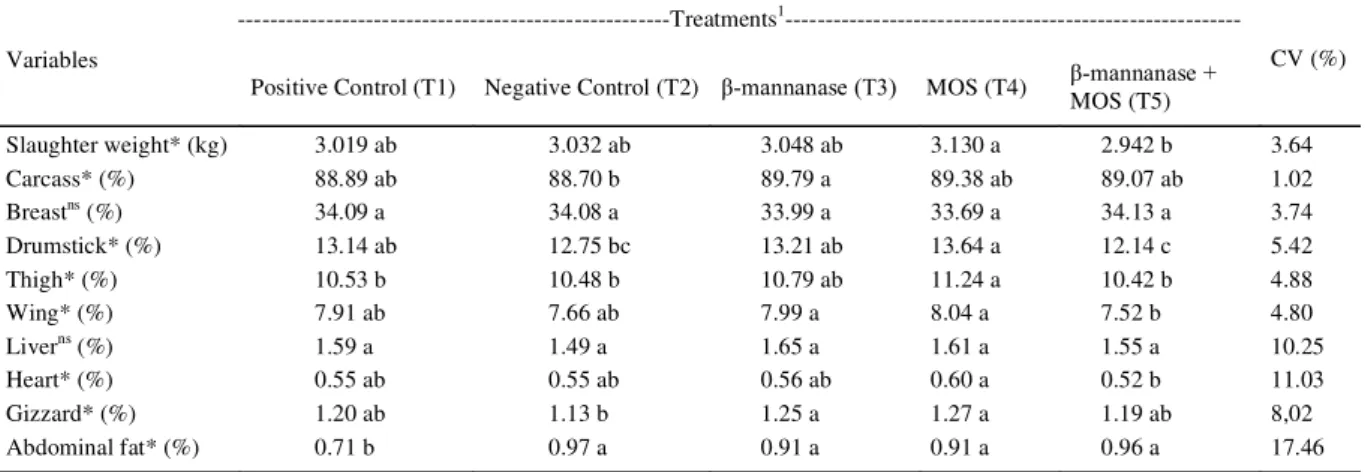
The results of weight at slaughter (kg) and relative weights (%) of the carcass, prime cuts, edible offal, and abdominal fat of broilers at 42 days of age
differed signifi cantly (P<0.05) among treatments,
except for the weight of breast and liver (Table 3). The broilers fed with basal diet without
growth promoter + β-mannanase + MOS (T5) had
the lowest absolute weight (2.942kg) at slaughter compared to the other birds. This result may be due
to the antagonism between β-mannanase and the
MOS or to the fact that MOS had positive effects on the intestinal mucosa and immune system, thus reducing the colonization of pathogenic bacteria and causing better productive performance and carcass yield. Similar results were obtained by WALDROUP et al. (2003), who tested MOS-based prebiotics in broiler diets and saw an improvement in the broilers’ performance.
The broilers subjected to treatment 3
(basal feed without growth promoter + β-mannanase)
had the best carcass yield (89.79%), while those with treatment 2 (basal feed without growth promoter) had the lowest carcass yield (88.70%). These results corroborate those obtained by ALBINO et al. (2006), who tested antibiotics and MOS-based prebiotics in broiler diets and observed better broiler carcass yield.
No signifi cant difference (P>0.05) was
observed among treatments evaluated for breast yield of the broilers. These results were similar to those obtained by SOUZA et al. (2008), who did
not fi nd a better breast yield in broiler chickens fed
with diets containing MOS and enzymatic complex. On the other hand, ALBINO et al. (2006), assessing the addition of MOS in broilers at 42 days of age,
found signifi cant differences in the breast yield of the
broilers.
Basal feed without growth promoter + MOS (T4) produced the best yield for drumsticks (13.64%),
Table 3 - Effect of -mannanase and mannan oligosaccharides on values of slaughter weight and relative weight of carcass, prime cuts, edible offal, and abdominal fat of broilers at 42 days of age.
---Treatments1
---Variables
Positive Control (T1) Negative Control (T2) β-mannanase (T3) MOS (T4) β-mannanase + MOS (T5)
CV (%)
Slaughter weight* (kg) 3.019 ab 3.032 ab 3.048 ab 3.130 a 2.942 b 3.64
Carcass* (%) 88.89 ab 88.70 b 89.79 a 89.38 ab 89.07 ab 1.02
Breastns (%) 34.09 a 34.08 a 33.99 a 33.69 a 34.13 a 3.74
Drumstick* (%) 13.14 ab 12.75 bc 13.21 ab 13.64 a 12.14 c 5.42
Thigh* (%) 10.53 b 10.48 b 10.79 ab 11.24 a 10.42 b 4.88
Wing* (%) 7.91 ab 7.66 ab 7.99 a 8.04 a 7.52 b 4.80
Liverns (%) 1.59 a 1.49 a 1.65 a 1.61 a 1.55 a 10.25
Heart* (%) 0.55 ab 0.55 ab 0.56 ab 0.60 a 0.52 b 11.03
Gizzard* (%) 1.20 ab 1.13 b 1.25 a 1.27 a 1.19 ab 8,02
Abdominal fat* (%) 0.71 b 0.97 a 0.91 a 0.91 a 0.96 a 17.46
1
T1 - basal feed (Positive Control); T2 - basal feed without growth promoter (Negative Control); T3 - basal feed without growth promoter + β-mannanase; T4 - basal feed without growth promoter + MOS; T5 - basal feed without growth promoter + β-mannanase + MOS. * Significant (P<0.05), by F test.
thighs (11.24%), and wings (8.08%), while treatment 5
(basal feed without growth promoter + β-mannanase +
MOS) had the lowest values, of 12.14%, 10.42%, and 7.52% for drumsticks, thighs, and wings, respectively. Similar results were obtained by ALBINO et al. (2006).
The relative weights for heart (0.60%) and gizzard (1.27%) were the highest for the broilers that received basal feed without growth promoter + MOS (T4) and the lowest for those that received basal feed
without growth promoter + β-mannanase + MOS (T5).
As for abdominal fat, the lowest index was seen in broilers that received the basal feed, and the highest content was found in broilers who consumed the basal diet without growth promoter +
β-mannanase + MOS (T5). These results corroborate
those reported by SOUZA et al. (2008), who found an increase in abdominal fat in broiler chickens fed with enzyme complex. Different results were reported by VARGAS JR. et al. (2000), who used two antibiotics and two types of probiotics and prebiotics in their broiler feed mixes and saw no increase in yield for commercial cuts and edible offal.
It is noteworthy that the MOS may improve growth performance and carcass yield of broiler chickens, because it has a positive effect on the intestinal mucosa and the immune system and reduces colonization of pathogenic bacteria (WALDROUP et al., 2003). However, there is a discrepancy in the results from that study, probably originating from the amount used in the feed, ingredients used in the formulation of feed, the sanitary conditions in which the birds are raised and by differences in experimental design, among other factors (OLIVEIRA et al., 2007).
The results of the economic analysis for the different treatments of broilers at 42 days of age can be seen in table 4. It was seen that the treatment containing basal diet without growth promoter + MOS (T4) was superior to the others as regards gross
revenue, average revenue, and profi tability index of the
broilers at 42 days of age, and no reduction in body weight was seen due to the replacement of growth promoters by MOS. However, treatment 5 (basal diet
without growth promoter + β-mannanase + MOS),
despite making a combination of enzyme and prebiotic available to the birds, did not cause any improvement in performance, being the treatment that had the lowest gross income and, consequently, the worst economic
effi ciency.
It is clear that the treatment with basal feed without growth promoter (T2) had the best feed
economic effi ciency. This low feeding cost resulted
in an excellent gross margin, relative gross margin,
gross revenue, and profi tability index, being inferior
only to treatment 4 (basal feed without growth promoter + MOS).
The use of prebiotics may be a very attractive alternative since they are more effective, leading to
higher profi tability, thus meeting the requirements of
the most demanding markets that disapprove the use of growth promoters in bird feed. In this respect, it is important to analyze the relative prices of poultry and
feed, as well as the fl uctuation in the dollar exchange rate so the appropriate replacement can be defi ned, promoting higher profi tability.
The relative gross margin of broilers at 42 days for the treatments containing MOS and
β-mannanase were 5.74% and 0.99%, respectively,
higher compared to the basal diet. However, the diet
containing an association of β-mannanase + MOS
produced a 5.45% lower relative gross revenue than the basal diet.
CONCLUSION
It was concluded that β-mannanase
and mannan oligosaccharides can replace growth
Table 4 - Effect of β-mannanase and mannan oligosaccharides on the economic traits of broilers at 42 days of age.
Treatment1 LW² (kg) FI² (kg) FP² (USD) FC²
(USD/bird)
GR²,³
(USD bird-1)
GM²,³
(USD bird-1)
RGM²,³
(%)
AP²,³
(%) RPI²
,³ (%)
1 3.064 5.073 0.466 2.364 4.473 2.109 100.00 89.21 100.00
2 3.104 5.016 0.466 2.337 4.531 2.194 104.03 93.88 105.23
3 3.114 5.118 0.472 2.416 4.546 2.130 100.99 88.16 98.82
4 3.150 5.083 0.466 2.369 4.599 2.230 105.74 94.13 105.52
5 2.984 5.006 0.472 2.363 4.357 1.994 94.55 84.38 94.59
1T1 - basal feed; T2 - basal feed without growth promoter; T3 - basal feed without growth promoter + β-mannanase; T4 - basal feed without
growth promoter + MOS; T5 - basal feed without growth promoter + β-mannanase + MOS.
2 LW - live weight; FI - feed intake; FP - feed cost; FC - feeding cost; GR - gross revenue; GM - gross margin; RGM - relative gross margin;
AP – average profitability; RPI - relative profitability index.
3
promoters in broiler diets without compromising the
productive performance and economic effi ciency.
However, the association of these products in the diet may cause negative interaction, reducing the performance of broilers.
REFERENCES
ALBINO, L.F.T. et al. Uso de prebióticos à base de mananoligossacarídeo em rações para frangos de corte. Revista Brasileira de Zootecnia, v.35, n.3, p.742-749, 2006. Available from: <http://www.scielo.br/pdf/rbz/v35n3/30064.pdf>. Accessed: nov 12, 2012. doi: 10.1590/S1516-35982006000300015.
ARRUDA, E.M.F. et al. Evaluation of diets with enzyme complex on broiler performance. In: PSA ANNUAL MEETING, 2013, San Diego, California, USA. Proceedings... Champaign, IL: Poultry Science Association, 2013. v.92, suppl.1. p.114.
BUFFINGTON, D.E. et al. Black globe humidity index (BGHI) as comfort equation for dairy cows. Transactions of the SAE, v.24, p.711-714, 1981.
CARAMORI JR., J.G. Efeito de simbiótico na ração inicial de frangos de corte sobre o desempenho, qualidade de carcaça e carne. Acta Scientiarum Animal Sciences, v.30, n.1, p.17-23, 2008. Available from: <http://periodicos.uem.br/ojs/index.php/ ActaSciAnimSci/article/view/3595>. Accessed: jan 19, 2013. doi: 10.4025/actascianimsci.v30i1.3595.
ESONU, B.O. et al. Effect of enzyme supplementation on the performance of broiler fi nisher fed Microdesmis puberula leaf meal. International Journal of Poultry Science, v.3, n.2 p.112-114, 2004. Available from: <http://www.pjbs.org/ijps/fi n132.pdf>. Accessed: nov 12, 2012. doi: 10.3923/ijps.2004.112.114.
GODOI, M.J.S. et al. Utilização de aditivos em rações formuladas com milho normal e de baixa qualidade para frangos de corte.
Revista Brasileira de Zootecnia, v.37, n.6, p.1005-1011, 2008. Available from: <http://www.scielo.br/pdf/rbz/v37n6/ v37n6a08.pdf>. Accessed: nov 12, 2012. doi: 10.1590/S1516-35982008000600008.
LORENÇON, L. et al. Utilização de promotores de crescimento para frangos de corte em rações fareladas e peletizadas. Acta Scientiarum Animal Sciences, v.29, n.2, p.151-158, 2007. Available from: <http:// periodicos.uem.br/ojs/index.php/ActaSciAnimSci/article/view/219>. Accessed: jan 19, 2013. doi: 10.4025/actascianimsci.v29i2.219.
OLIVEIRA, M.C. et al. Utilização de nutrientes de dietas contendo mananoligossacarídeo e/ou complexo enzimático para frangos de corte. Revista Brasileira de Zootecnia, v.36, n.4,
p.825-831, 2007. Available from: <http://www.scielo.br/pdf/rbz/ v36n4/11.pdf>. Accessed: nov 12, 2012. doi: 10.1590/S1516-35982007000400011.
O’NEILL, H.V.M. et al. Multicarbohydrase enzymes for non-ruminants. Asian-Australasian Journal of Animal Science, v.27, n.2, p.290-301, 2014. Available from: <http://www.ajas.info/ upload/pdf/ajas-27-2-290-17.pdf>. Accessed: feb 20, 2014. doi: 10.5713/ajas.2013.13261.
OPALINSKI, M. et al. Adição de complexo enzimático e da granulometria da soja integral desativada melhora desempenho de frangos de corte. Ciência Rural, v.40, n.3, p.628-632, 2010. Available from: <http://www.scielo.br/pdf/cr/v40n3/ a476cr962.pdf>. Accessed: feb 15, 2013. doi: 10.1590/S0103-84782010005000017.
ROCHA, A.P. et al. Prebióticos, ácidos orgânicos e probióticos em rações para frangos de corte. Revista Brasileira de Saúde e Produção Animal, v.11, n.3, p.793-801, 2010.
ROSTAGNO, H.S. et al. Tabelas brasileiras para aves e suínos - Composição de alimentos e exigências nutricionais. 3.ed. Viçosa, MG: Editora UFV, 2011. 252p.
SIMS, M.D. et al. Effects of dietary mannan oligosaccharide, bacitracin methylene disalicylate, or both on the live performance and intestinal microbiology of turkeys. Poultry Science, v.83, n.7, p.1148-1154, 2004. Available from: <http://ps.oxfordjournals.org/ content/83/7/1148.full.pdf+html>. Accessed: feb 15, 2013. doi: 10.1093/ps/83.7.1148.
SOUZA, R.M. et al. Efeitos da suplementação enzimática e da forma física da ração sobre o desempenho e as características de carcaça de frangos de corte. Ciência e Agrotecnologia, Lavras, v.32, n.2, p. 584-590, 2008. Available from: <http://www.scielo. br/pdf/cagro/v32n2/37.pdf>. Accessed: feb 15, 2013. doi: 10.1590/ S1413-70542008000200037.
VARGAS JR. et al. Uso de probióticos e prebióticos em rações de frangos de corte. Revista Brasileira de Ciência Avícola,Supl.2, p.31, 2000.
WALDROUP, P.W. et al. Utilization of Bio-Mos® mannan
oligosaccharide and Bioplex® copper in broiler diets. International
Journal of Poultry Science, v.2, n.1, p.44-52, 2003. Available from: <http://www.pjbs.org/ijps/fi n52.pdf>. Accessed: feb 15, 2013. doi: 10.3923/ijps.2003.44.52.