!
SCHOOL FOR THOUGHT
Creating a Social Enterprise
for the Children of Laos
Author:
Silvia Pitteri
Dissertation written under the supervision of professor Tommaso Ramus
Dissertation submitted in partial fulfillment of the requirements for the degree of
MSc in International Management at Católica-Lisbon School of Business &
Economics, 2016
! !
ABSTRACT
Title: SCHOOL FOR THOUGHT – Creating a Social Enterprise for the Children of Laos Author: Silvia Pitteri
This thesis presents the issue of financial sustainability for social enterprises through the example of School for Thought - SFT. This organization aims at offering an education service to the children of Laos but first needs to find the financial resources to begin the project. With a first question regarding the best business model that SFT can implement, my teaching case study focuses then on the available financial tools that the organization can implement. With my analysis I propose different financial tools that social enterprise can apply depending on their characteristics. This study can function as a guideline to social enterprises by offering them simple rules to overcome common challenges that they might face in their startup phase; they can find advice to shape their primary features, their business model and reach financial sustainability.
A presente tese visa estudar a sustentabilidade financeira de empresas de cariz social através da análise da empresa School for Thought - SFT . Esta organização procura oferecer serviços na área de educação a crianças desfavorecidas do Laos. Contudo, antes de por em prática a sua missão, esta necessita de encontrar os recursos financeiros necessários para lançar o seu projecto e sustentar a sua atividade.
Com o intuito de compreender qual o modelo de negócio mais adequado para a SFT, o case study desenvolvido apresenta uma lista de diversos recursos financeiros disponiveis para empresas de cariz social.
Esta análise procura propor diferentes métodos para angariação de fundos, consoante as especificidades de cada empresa de cariz social. Deste modo, este estudo poderá funcionar como guia, oferecendo a empresas de cariz social linhas orientadoras para a escolha dos seus métodos de financiancimento que as ajudarão ultrapassar as adversidades características da fase de implementação do seu negócio. Nesta tese poderão assim encontrar-se concelhos relativamente à delineação de atributos e à escolha de modelos de negócios e de sustentabilidade financeira.
! ""!
ACKNOWLEDGEMENTS
I would like to start by saying thank you to Professor Tommaso Ramus who first introduced me to the subject of social entrepreneurship in his class and then inspired and supported me through the last six months of elaboration of this thesis.
Second, I want to thank Dinko Barbalic who exposed to me his idea with his characteristic enthusiasm and joy; I hope that my work will help him in the development of his amazing project.
Third, with all my heart, I want to thank my parents, my sisters, my whole family and my fiancé who have always supported me in my decisions of studying abroad and start shaping my future. In particular, I would like to dedicate this thesis to my father, the greatest supporter I will ever have.
Lastly, a great thank you goes to my friends Chiara, Marco, Giorgio and Lorenzo who are spread all over the world but always there when I need them.
! !
Contents
1 INTRODUCTION!###########################################################################################################################################!$! 2 CASE STUDY!##################################################################################################################################################!%! 2.1 The initial idea!##########################################################################################################################################################!%! 2.2 Southeast Asia!###########################################################################################################################################################!&! 2.2.1 The LAO People’s Democratic Republic!###############################################################################################!'! 2.2.2 Educational System!########################################################################################################################################!(! 2.3 An encouraging example!#######################################################################################################################################!)! 2.3.1 The journey!#######################################################################################################################################################!*! 2.4 The ultimate idea!####################################################################################################################################################!$$! 2.4.1 The Business: Impact and financial sustainability!#############################################################################!$+! 2.4.2 The Team!#########################################################################################################################################################!$%! 2.4.3 Define a pathway!###########################################################################################################################################!$%! 2.5 Next Steps!#################################################################################################################################################################!$'! 3 LITERATURE REVIEW!############################################################################################################################!$(! 3.1 Introduction!##############################################################################################################################################################!$(! 3.2 Trials in the Start-up phase!#################################################################################################################################!$,! 3.2.1 Building a Pathway Towards the Business Model!#############################################################################!$)! 3.2.2 Common Governance Challenges!###########################################################################################################!$)! 3.2.3 Social Entrepreneuring Model!##################################################################################################################!$*! 3.3 Characteristics of Business Models for SE!####################################################################################################!+-! 3.3.1 Four Models of Social Business Hybrids!##############################################################################################!++! 3.4 Financial Sustainability!########################################################################################################################################!+%! 3.4.1 Types of Financing for SEs!#######################################################################################################################!+&! 3.5 Matching Business Model & Financial Sustainability!##############################################################################!+,! 4 TEACHING NOTE#######################################################################################################################################+* 4.1 Introduction!##############################################################################################################################################################!+*! 4.2 Learning Objectives!##############################################################################################################################################!+*! 4.3 Assignment Questions!##########################################################################################################################################!+*! 4.4 Class Discussions ###################################################################################################################################################%-4.4.1 Introduction!#####################################################################################################################################################!%-! 4.4.2 What are the key characteristics of the organization?!#######################################################################!%-!
! ".! 4.4.3 Which typology of business hybrid model best applies to this organization?!##########################!%+! 4.4.4 Which is the best tool to achieve financial sustainability?!##############################################################!%%! 4.4.5 Conclusions & Suggestions!#######################################################################################################################!%'! 5 CONCLUSIONS!############################################################################################################################################!%,! REFERENCES!###################################################################################################################################################!%)! 5.1 Case study References!#####################################################################################################################################!%)! 5.2 Literature Review Bibliography!##################################################################################################################!%*! APPENDICES!####################################################################################################################################################!&+! 5.3 Appendix 1!##########################################################################################################################################################!&+! 5.4 Appendix 2!##########################################################################################################################################################!&%! 5.5 Appendix 3!##########################################################################################################################################################!&%! 5.6 Appendix 4!##########################################################################################################################################################!&&! 5.7 Appendix 5!##########################################################################################################################################################!&&! ! ! ! ! ! !
!
! .!
LIST OF FIGURES
Figure 1 - Southeast Asia Map &!
Figure 2 -Key figures on the Lao PDR '!
Figure 3 – Children in Lao School (!
Figure 3 - Enrolment rate to grade 1 with pre-school experience ,!
Figure 5 - One of the school of GCAC in Laos! )!
Figure 6 - Dinko with children in Laos! *!
Figure 7 - Lao PDR regions $-!
Figure 8 - Steps towards the Business Model $)!
!
LIST OF TABLES
! ! ! ! ! ! !Table2 - Estimation of Costs 12
Table 3 - Typologies of Social Business Hybrids 23
Table 4 - Match of Business Hybrid Model with Types of Financing 28
Table 5 - Startup challenges and organization analysis 31
Table 6 - Dimensions of the Business Hybrid Model 32
Table 7 - Feasible financial Tools 34
! $!
1 INTRODUCTION
In this dissertation thesis I study a social enterprise called School for Thought to investigate how organizations can be financially sustainable while achieving a socially oriented mission. Since the beginning of the 1990s, social entrepreneurship studies have gained attention among scholars trying to develop a deeper understanding of the functioning of social enterprises, that is enterprises competition in the market with the aim to tackle complex social problems. . This dissertation intends to give a contribution to this literature, studying in particular the business model and financial sustainability strategies for social enterprises.
In order to propose my solution to School for Thought, I set to myself two main research questions: 1) What should be the structure of School for Thought business model? and 2)
Which is the best tool that the organization can use to achieve financial sustainability?
To begin my research, I spent much time talking with Dinko Barbalic, the founder of the organization, to understand well his project and his knowledge regarding the country of Laos. Then I had to study the educational system of Laos and collect data regarding the other organizations working in that region with a similar mission as the one of School for Thought. Of particular relevance, was the effort put in order to collect data of other organizations’ expenses in order to propose an estimation of the budget that School for Thought needs to begin its project.
Table 1 - Primary and Secondary data collected
Data collected
Interviews with School for Thoughts 5
Laos’ report analyzed 6
Other organizations analyzed 5
Other organizations’ expenses reports 13
This thesis is structured as follows: In the literature review I first set a definition for social enterprise to then find related studies that develop the issues of these organizations in their startup phase and how these issues can be overcome by defining an appropriate business model. Finally, my research was focused on the exploration of financial instruments that social enterprises can apply to become sustainable.
!
! +!
The teaching note is structured to function for a class discussion where students are invited to analyze the research questions and develop the elements of the business model to reach a conclusion where the best financial tool is identified.
Finally, in the conclusion I wanted to recap the key issue that we have observed throughout the case study and solutions available for School for Thought. Moreover, I suggest what further could be done by the organization to achieve its mission.
! %!
2 CASE STUDY
!
School for Thought is a project that took its first steps in the spring of 2015 from an idea of Dinko Barbalic, a project manager who decided to finally develop his managerial skills into a new challenge: to establish a social enterprise aimed at providing English and computer education to children in Laos.
Dinko was motivated by the willingness to give something back to humanity and to convey his skills into a project capable of actually making the difference in someone else’s life. What he didn’t know was how to achieve these goals.
Dinko is the founder of School for Thought (SFT); he was born in Yugoslavia and then received his university education in Italy where he started his career as a project manager in a manufacturing company to then progress throughout executive roles, until he took the crucial decisions to leave his job and to devote his capabilities to the creation of a personal project. His professional experiences provided him a strong managerial background regarding the for-profit business model of companies, although the subject of social entrepreneurship was still somehow a blur in his mind. It took him some efforts, and then the idea after a long process of reflection, readings and meetings eventually emerged.
The first point of attention that attracted Dinko towards the investigation of organizations with a social purpose was the concept of philanthropy: What motivates people to do it and what are the different practices of doing philanthropy? Why do people are willing to give out something without getting anything back? Soon enough he realized that to be altruist and to give something back to the society, it is not just a matter of donating money to poor people but what really matters is to give people the possibility to decide for their lives, to give them appropriate tools to make judicious choices. He believes that: “Education has the incredible power of being eternal: none can deprived you of it.”(School for Thought’s booklet); to be educated was the greatest gift he received in his life and he wanted to donate such thing to others that were not as fortunate as he had been.
2.1 The initial idea
It was a sunny morning in May 2015 when Dinko realized what he really wanted to give back to the world: to give children in less developed countries the opportunity to have access to a good education.
“Then I realized other thing such as the importance of education and how lucky I was to get the opportunity of being educated and create a better future for myself. From that, I wanted to
!
! &!
start working in some NGOs but it was not easy to get inside organizations and projects. So I took a decision to start my own project: I want to establish a school” (Dinko Barbalic, December 2015).
The problem of poor education is unfortunately well spread around the world: more than 25% of all children around the world have never been to primary school (World Inequality Database on Education, 2016).
Mr. Dinko had to choose where to focus his effort to make his idea as much realistic as possible; “Sometimes a feeling leads you to a logical decision; … How can you narrow down the world to one village? To do this logically would take time we don’t have.”(School for Thought’s booklet). He eventually decided to launch his project in Southeast Asia, which includes one of the poorest countries in the world with significant need for education combined with great opportunities of development (Nations Online, 2016). Dinko selected Laos: this region captured Dinko’s attention because of its potential despite the dramatic state of abandonment of children who do not receive the possibility of growing up in a protected environment.
2.2 Southeast Asia
Southeast Asia consists of Indochina and the Malay Archipelago. For what concerns the Indochinese peninsula in particular, it comprises the countries of Cambodia, Myanmar, Thailand, Vietnam, West Malaysia and Laos.
These countries are differentiated by many cultural factors; nevertheless, they face similar difficulties regarding the provision of a proper educational system. For example, in Cambodia only 3.09% of the nation's GDP was allotted to education (UNESCO, 2013). Fortunately, some governments of these countries have started to work, also in collaboration with foreign
Figure 4 - Southeast Asia Map http://merrytravelgroup.com
! '! non-governmental organizations, to improve the education system. In Vietnam the net enrollment in primary schools hit 97 percent in 2009, and almost 89 percent of children who enroll complete at least five years of education (United Nation 2013).
Although the majority of countries in Southeast Asia have been working towards the improvement of their education system, much still need to be accomplished. Laos, that is strongly trying to implement several reforms to allow new generations to access a higher quality of instruction, is a clear example of this.
2.2.1 The LAO People’s Democratic Republic
Characterized by a century of war, revolution and poverty, the territory of Laos became part of the French empire in 1893 and suffered continuing disputes between France and the Thais in the first half of the twentieth century.
The Lao People’ Democratic Republic (LPDR) is today still considered one of the poorest countries in the world.
!
The country is governed by the Communist regime, which imposes its domain with a strong military presence in the territory; however, starting from the 1990s’ a general evolution and opening process has been happening.
Lao PDR is governed by a recognized regime, deep cultural differences still exist among the population. Indeed, the country combines 49 different ethnic groups differentiated by cultural, religious and linguistic characteristics.
Figure 5 -Key figures on the Lao PDR UNESCO 2012 report
!
! (!
The recent economic development of the country has helped the population to improve their living conditions, yet the proportion of households leaving in conditions of poverty is still 23% (LECS 2013) and much need to be done. In a country with nearly 60% of the population of age below 25 years old (EFA 2015), a dominant issue that still needs to be addressed is the one of education (UNESCO, 2012).
2.2.2 Educational System
Key matter for operating in Laos, is the understanding of the real needs of the people, the socio-economic system, the way in which locals
interact with foreigners, how they treat them and how to get in contact with the community (Give Children a Choice, 2016).
Since 1975 important reforms and objectives have been implemented in Laos in order to align the existing education system to the modern universal benchmarks.
The Lao People's Democratic Republic (LPDR) government intended to improve the overall national level of literacy by establishing a
universal primary education system by 1985. In fact, remarkable attainments had been realized starting from the 1970s through the 1980s with a substantial increase in the number of enrolments in primary schools. However, the poor quality of the equipment, the low preparation of teachers, the difficulties in reaching isolated villages, are all factors that negatively affect the completion of a full education for children.
Nowadays, Lao PDR has made discreet progress towards the achievement of the social development objectives. Between 2006 and 2011 positive signs were registered for what concerns poverty reduction, mortality rate and economic growth (UNESCO Bankok 2012, UNESCO Country Programming Document (UCPD) for the Lao People’s Democratic Republic); unfortunately, the country is still off track from the program for several matters which include providing a proper education especially in the primary level of schooling.
As part of its goals in improving the educational sector, the Lao PDR has been focusing on the provision of pre-school programs (age 3-6) in order to avoid children to enter the job
1
Figure 6 - Children in Lao School SFT’s Booklet
! ,! market in a very young age by involving them early in the schooling environment (EFA, 2015). As showed in Figure 2, these efforts have led to some positive results.
!
Figure 7 - Enrolment rate to grade 1 with pre-school experience Lao EduInfo + EMIS 2013-14
Yet, the general education system in Lao PDR is still in need of support. Recent statistics1 reveal a dramatic situation in which the dropout rates during the first grade of schooling are 13%, with a survival rate to fifth grade of 67%. Among the many reasons behind these percentages, there is an issue correlated to the ethnic groups of children that do not speak Lao, the official language of instruction, and are therefore not able to follow lecturers. Furthermore, the general situation regarding infrastructures and learning equipment is still below an appropriate level for what concerns both the security of buildings and the availability of appropriate tools for both teachers and children (Ministry of Education, 2007).
Problems in the education system of LPDR are addressed by several NGOs and social enterprises that can exploit independent opportunities or choose to collaborate with UNESCO and its plan for educational development in the country. Indeed, ensuring early childhood care and education, universal primary education, assessing learning needs of all youth and adults, improving levels of adult literacy, assessing gender parity and equality in education, improve
!!!!!!!!!!!!!!!!!!!!!!!!!!!!!!!!!!!!!!!!!!!!!!!!!!!!!!!!
$Ministry of Education (April 2007), “Education Sector Development Framework 2009!2015”General
education in Lao PDR is facing several issues. According to the most recent statistics, the survival rate to grade 5 is 67% (2007) and the percentage of repeaters at primary level is 17% (2008) (UIS 2009). Dropout rates are 13% in grade 1 and 7% in grade 2 (Save the Children n.d.). At secondary level, the dropout rates are 14% for males and females in grade 6, and 15% for males and 12% for females in grade 9 (UNESCO 2008).
!
! )!
educational quality, are central topics that need to be treated in the immediate future (Ministry of Planning and Investment, 2009).
From this framework, Dinko confirmed his believes. The need of improving the education in the country of Laos is well recognized at both state and international level, which means a possibility of finding support from both sides. Citizens of the LPDR are already cooperating with foreign establishments and are willing to welcome additional aids from other reliable entities. This means that his idea of creating an educational environment where the children of the country could receive the instruction they deserve, would be appreciated first of all at the local level and perhaps supported by other international entities.
With different organizations already existing in the territory, it was essential for Dinko to analyze the work of these institutions in order to follow the successful examples and develop an efficient business.
2.3 An encouraging example
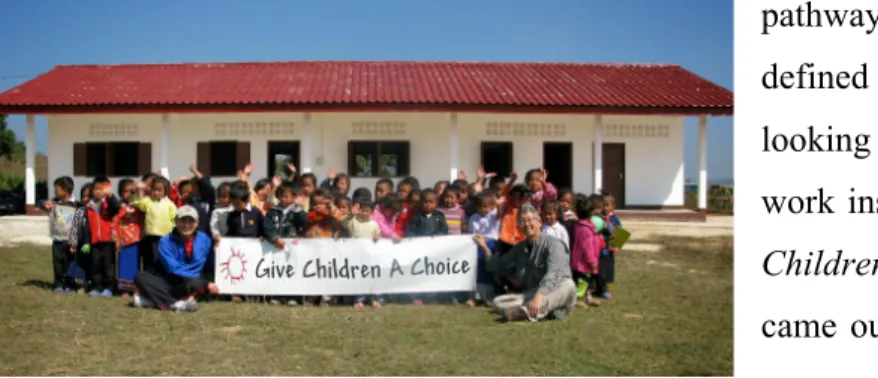
To understand how social enterprises carry out their objectives was the beginning of the pathway towards the shaping of a more defined project. While Dinko was looking to some of the organizations’ work inside Laos, the example of Give Children A Choice and its founder came out. This American NGO started its activities with the mission of creating new models of schooling to enable villagers to self-sustain their children’s future education. Since 2002 it has been able to build 35 schools in the region and to provide education to thousands of children (Give Children a Choice, 2016).
What was particularly inspiring in the eyes of Dinko was the ability of this organization to generate a significant impact in the community (Dinko Barbalic, December 2015).
The extraordinary case of Give Children a Choice, encouraged Dinko to finally follow his instinct to establish his social enterprise and to further define his dream: School For Thought (SFT) will start by building a first school in Laos to host about 100 children; a systematized instruction system will be implemented in order to allow the imparting of English and basic computer skills to teachers who will then teach these subjects to students.
Figure 5 - One of the school of GCAC in Laos www.paceworktravels.com
! *! At the vary base of the overall project, there is the first essential mission: to physically build the school with classrooms and appropriate learning equipment. But, how could Dinko define an appropriate budget for the project? What was the exact amount of money he needed? What are the local legislations for constructions? Were the materials available at the location for the school to be erected? Who would be working to build it?
To address all those questions, Dinko decided to visit Laos and get in contacts with local stakeholders. In this way, Dinko hoped to identify the real necessity of the community it intended to serve and o obtain the trust of the people that will allow the collaboration to happen and the desired social impact to be implemented. Dinko recalled
“To understand better the process of building schools I started travelling and creating a plan…. first objective was to reach out to arrive to Laos” (Dinko Barbalic, December 2015).
2.3.1 The journey
Reading guides about the Lao culture and the website of Give Children a Choice was not enough; in the summer of 2015Dinkobegan to move towards the realization of the project by starting a two months trip to Southeast Asia.
Once he reached Laos, the first impression was very positive; Dinko said: “The people in Laos are extraordinary! They leave in an amazing place and are the most peaceful people I ever met. Both the children and their parents welcomed us with their smiles.”(Dinko Barbalic, December 2015).
During this trip, Dinko had the opportunity to move across different regions and eventually decided that the best site to begin the development of SFT would be the province of Luang Parabang. Indeed, as he could see natural and historical sites with beautiful landscapes and temples fill this region of the country; however, the rural area is strongly characterized by poor infrastructures, low availability of markets and agricultural productivity. Similar to the overall situation of Laos, one of the major problems is also
the scarcity of school buildings in rural areas; in fact, 20% of communities do don’t have schools at all and only 45% of the schools in the country are able to provide education up to
Figure 6 - Dinko with children in Laos SFT’s Booklet
!
! $-!
third grade (Save the Children 2016). With half a million inhabitants (Word Bank data, 2014), this province represents a great opportunity for SFT to help children in peripheral areas where services are not sufficient.
Obtaining an overview of other organizations’ work was an important phase for the general understanding of how a social organization could operate in that area, however now that the preferred location was selected, a new stage had to begin in order to grasp more specific information: communicate with people, listen to real life stories and recognize the critical issues and challenges to face in the near future.
“I started to visit schools and to see what were really like the lives of children and people in Laos; I saw it was not an easy place to begin. I had to find someone to guide me inside the population and I met Dori.” (Dinko Barbalic, December 2015).
Dinko got in contact with Mr. Dori Shimoda, The founder of Give Children a Choice, a true example of a life changing experience of ‘giving back to society’. Mr Dori began his mission more than 15 years ago, starting from scratch, and becoming today a well-known member of the population; he was the perfect person to ask questions and to learn from him specific information regarding the local environment.
Dori gave to Dinko all the details of his own adventure in the establishment of his organization. The most important knowledge that Dinko gained from this meeting was essential to set up the basis for the collaborations with the local workers to build the first school and to find collaborators that will begin the educating organism.
Figure 7 - Lao PDR regions thumbs.dreamstime.com
! $$!
2.4 The ultimate idea
The trip brought an inconceivable amount of information and Dinko was ready to draw the final plan: in order to start with the building of the school’s infrastructure with three classrooms and lavatories, and to provide it with appropriate tools for learning, SFT needs an initial investment of 80,000 Euros.
By talking with the local communities, Dinko learned that the manufacturing of the school building would not take a large size of the costs since local resources will be involved; nevertheless, he would need to provide the school with appropriate furniture and excellent sanitary conditions aimed at lasting in time.
Moreover, to fully accomplish his project Dinko had to set up the whole frame of overhead costs to be covered both in Laos and in Italy, where the organization is meant be established. Thank to the information he gained from Dori Shimoda, he estimated that on average supporting one year of a children education in Laos, providing her with study materials, health care assistance and quality food, costs about !2502. Obviously, the children that the
school will host are not able to collect this sum to finance their studies; therefore, SFT must find a way to find external actors willing to pay for the education of these children.
Since the plan is to construct a three-classroom school, about 100 children will take part to the lectures; therefore, six local professors will be hired. Their monthly salary will correspond to !90, which compared to Lao national average salaries of teacher is considerably higher (Ministry of Education LPDR, 2010); this is done to stimulate the willingness of local citizens to participate in the project and to appropriately reward them for their work.
To ensure continuous communication and monitoring of the local activities, Dinko believes that two members of the staff of SFT should operate in the territory and assist teachers in the supervision of the school while the administration of the organization, will be carried out in Italy where the board members will specially focus on the management of the financials activities in order to provide sustainability of resources to the project.
!!!!!!!!!!!!!!!!!!!!!!!!!!!!!!!!!!!!!!!!!!!!!!!!!!!!!!!!
2 These costs have been estimated by looking at organizations operating a mission similar to the one of
SFT and present in the areas of Laos. In particular, the case of Give Children a Choice, Pencils for Promise and Adopt a Village brought a substantial amount of knowledge to this research. More details of costs estimation are reported in the appendix.
!
! $+!
According to Dinko’s forecast, the sum of the expected administration costs for the first year of operations rounds up to 94,000 Euros, which must be added to the startup cost of the school.
Finally, in order to improve one of the major problems in the Lao education system that is the dramatic drop out rate registered in the first years of schooling (UNESCO 2012), SFT must guarantee to provide its service to children for at least three years so that they can complete their first cycle of education. With this objective, the organization needs to raise financials of about 360,900 Euros.
!
Table2 - Estimation of Costs
At this stage, Dinko had to sit down and structure all the information in his posses to then continue in the development of the project. The agenda he was planning to implement comprised many tasks to be addressed like designing a structure to understand the business he was creating and who will actively participate to the project.
2.4.1 The Business: Impact and financial sustainability
With the definition of the final goal, Dinko had to think back to his managerial capability and reflect on the structure he wanted to implement for his business.
By providing a functioning school where teachers will be formed and then supplied with appropriate tools to teach English and basic computer skills to local children of Laos, SFT is creating a sensible value to the community. The social impact that this enterprise is willing to generate can be measured in terms of a gain for children who will be able to access an improved system of education and in the future to better implement the many economic possibilities that their country can exploit (School for Thought’s booklet).
! $%! Nevertheless, in order to create financial sustainability to the organization, the aspect of profit generation needs to be considered. School for Thought is meant to function as a private school, yet it is financed by external entities that do not directly benefit from the social value created by the organization. In this assessment, funders must be attracted to SFT driven by their willingness to help but also by a future potential, tangible gain.
2.4.2 The Team
In order to succeed in his purpose, Dinko knew he had to bring to School for Thought somebody that he could trust to help him. Without the possibility of offering any monetary rewards, he had to look thorough his network of friends and previous co-workers to find someone willing to embrace the project together with him.
An essential actor is Carlo, a long-time friend who was contacted by Dinko in order to support the mission by importing his knowledge in juridical matters to address the more bureaucratic issues of establishing a social enterprise in Italy. Moreover, thank to his working connections he was able to attract the first donor to SFT.
The third person collaborating with Dinko is his ex-colleague and friend Stuart, who began to work on this project by serving the organization with his past specialized experiences to develop an initial small marketing campaign to create the image of SFT with a website, a blog, and an explanatory booklet to sympathize the project; he is now also working on the improvement of social media channels and branding.
In the latest months of 2015, Suzana, a lifetime friend of the founder, joined the board of SFT; her 20 years of experience in an organization working in the humanitarian help area will allow the team to learn more about the topic of social aids and enlarge the network of people around the organization.
2.4.3 Define a pathway
With a more clear structure of the main actors inside the organization, the following move was to define the next months’ milestones to be reached.
i. Establishing the social enterprise. In order to operate on an international level, Dinko and Carlo had many discussions regarding how to coordinate the work of SFT in Laos with the administrative tasks carried out in Italy.
ii. Partnerships and collaborations. The meeting with Dori Shimoda during the trip in Laos was not only a way to gain more knowledge about the region and the organization’s work, but it also opened the possibility for creating collaborations
!
! $&!
between GCAC and SFT. This partnership could be beneficial for both actors in order to generate an effective network of education in Laos that possibly will last in the long term if the two associations are able to find a sustainable system of operations.
iii. Human capital. Since SFT aims at instructing Lao teachers with English language and computer skills, in this initial phase it must provide a defined number of people able to deliver this training. From the trip in the country, a local connection able to speak both local dialects and English has been found to start the process; however, in the view of a growth of the project, new volunteers need to be recruited.
Moreover, the current board members of the social enterprise are not fully devoted to it and still need to care about their primary jobs; indeed, Dinko might need to engage other collaborators for the administrative activities of SFT.
iv. Funding. To build a school only with good intentions is unfortunately not feasible yet; Dinko and his team must think at the project financial sustainability. As he defined at his return from Laos, an initial amount of 360,900 Euros is needed in order to build the infrastructure of the school, to furnish it with the appropriate equipment and to make sure that operations will run smoothly.
As Dinko learned at the beginning of his excursion into the social enterprises’ world, philanthropy is a strong tool that moves people awareness’s; but is it realistic to design up on it an entire organization?
The social impact the company aims at creating is clear and stated, the value to propose to its funders still need to be outlined.
Attracting financial resources appears to be a priority for SFT, but what are the most effective tools of financing that can be applied to this social enterprise?
! $'!
2.5 Next Steps
It is December 2015, Christmas’ holydays are just around the corner and the warm weather has left space to a snowy winter; Dinko’s bike ride is a rather distant memory but his motivation to create his first school in Laos is still strong and persistent.
The very priority in his mind is to find the initial amount of money to kick off with the process of building the infrastructure of the school and to set up the organization: 360,900 Euros to tangibly see his dream to take place. Still, this is not the only thought in his mind;
“After building the school and providing it with books, furniture, and all what is needed, the real challenge will begin. We need to create a sustainable system that will last in time: we need to financially support the school in Laos and the business back at home”.
What Dinko is worried about is to be able to provide the enterprise with sufficient means to perform in its mission, but also to elaborate a system able to stimulate people to work for SFT as in an authentic business reality. The central point of both these issues is to feed the organization up with consistent financial resources to enable it to perform at its best in both perspectives.
In the very short term, the goal is to begin with the development of building a satisfactory infrastructure where teachers and children will be able to study in a safe environment provided with apposite furniture and teaching materials of great quality. Since the organization recognizes the need of providing a good level of preparation to instructors, in this initial stage foreigners and local voluntaries in Laos will be recruited to start the process of training future teachers in the subjects of English and basic computer sciences. Together with this, a management team located in Italy will mainly focus on collecting financials and ensuring that SFT stays on track with its objectives.
!
! $(!
3 LITERATURE REVIEW
3.1 Introduction
Since the beginning of the 1990s, social entrepreneurship studies have been under great observation of scholars trying to identify a common knowledge of this subject in order to develop a solid definition of the topic itself and to structure valid managerial patterns around it. (Dacin et al., 2009).
A broad definition of social entrepreneurship sees it, as a process involving the innovative use and combination of resources to pursue opportunities to catalyze social change and/or address social needs (Mair&Martí, 2004). From this initial delineation many facets can be further analyzed and other, more specific definitions have been proposed; one of these is the related concept of Social Enterprise (SE):
“Social enterprise[s] [are] business[es] that trade for a social purpose. They combine innovation, entrepreneurship and social purpose and seek to be financially sustainable by generating revenue from trading. Their social mission prioritizes social benefit above financial profit, and if and when a surplus is made, this is used to further the social aims of the beneficiary group or community, and not distributed to those with a controlling interest in the enterprise.” (Haugh& Tracey, 2004)
One key concept introduced by this definition and frequently underlined by scholars, is that social enterprises aim at solving social problems through business ventures (Gonin, Besharov, Smith &Gachet, 2012). This implies that the vision and mission of a no-profit organization must be aligned with the efficiency and innovation characteristics of a for-profit enterprise (Battilana, Lee, Walker & Dorsey, 2012).
The task of combining the two opposite sides of the business model of a SE requires requires the capacity to overcome some significant challenges. To understand them, we should deepen the analysis of the concept of social enterprise. When looking at a social enterprise from a managerial perspective, the focus should not be on the word ‘social’ primary, but rather on the ‘enterprise’ composition of the title; this means that financial sustainability plays a key role in the creation of a social enterprise (Mair&Martì, 2004). Just as business entrepreneurship, also SE recognizes and act upon what other miss: opportunities to improve systems, create solutions, and invent new approaches (Mair 2004).
! $,! Certainly, SE and its aim for social impact must be addressed under a structured business model that guides the organization throughout its activities starting by setting strategic resources toward value creation (Mair & Schoen 2005). Certain aspects need to be empathized differently than for traditional for profit organizations, for instance SEs must always consider external stakeholders’ interest and maintain the balance between social and financial goals.
In this section I will cover some of the main challenges that social enterprises face in the start-up phase of their projects with critical attention to the delineation of a business model that focus on the social-value proposition while enhancing the fit among the key components of the framework, opportunity, people, capital and context (Austin, Stevenson & Wei-Skillern, 2006). Then I will present and evaluate different means of financials that can be applied to enterprises with a social purpose.
The final aim is to provide a satisfactory solution in order to help School for Thought in the shaping of a business model and consequently a sustainable scheme for financial sustainability.
3.2 Trials in the Start-up phase
To examine the main challenges that a social enterprise needs to address in initial steps of its project, we should first understand the origin of such issues.
Social entrepreneurship is a phenomenon able to combine two traditionally diverse spheres: the not-profits one, thought to be responsible for the creation of social value, and the for-profit one, with the aim of producing an economic value; the degree of alignment of these two areas represents the true talent of the social enterprise (Alter, 2008). If on one side the achieving the coordination between social interest and financial market is the greater ability of SEs, on the other hand it can be the lead to several trials that organizations need to be aware of.
In recent years, expectations of stakeholders on organizations declaring a social mission have been growing demanding advanced services, greater social impact and continuous results; this, escorted by the need of providing a sustainable flow of financial resources have become the crucial obstacle to overcome for social enterprises (Alter, 2008). The main difficulty lies on the fact that organizations might be tempted to focus on one side their activities putting aside the other one. Of course, letting to go the social mission would mean to become an organization that is just profit oriented, while getting distracted from the creation of an
!
! $)!
economic value could represent the inability of the organization to satisfy the social objectives.
Given the crucial importance of matching the creation of social impact with the realization of financial sustainability, social enterprises need to avoid a shift of their mission by building their business around a well defined pathway of activities, a clear idea regarding the actors involved and a solid underling strategy for the accomplishment of a long-lasting impact.
3.2.1 Building a Pathway Towards the Business Model
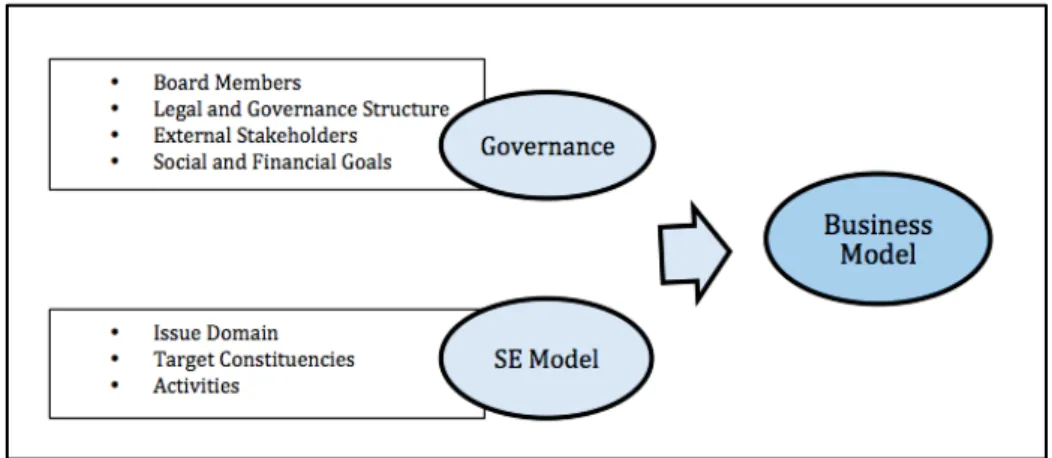
In order to ease the challenge of maintaining a double-sided mission perspective, at the beginning of its pathway a social enterprise needs to identify the main issues concerning the core structure of the organization itself and then try to classify the necessary targets to develop its business model.
We will first focus on key governance challenges that social enterprises commonly face at the beginning of their projects; these issue are the composition of the board members, the legal structure, the management of external stakeholders and the coordination between social and financial goals. Following this first framework, we will look at three aspects related to the core organization of the enterprise’s behaviors such as its issue domain, the target constituencies and its activities.
These two frameworks help us to set up the basis towards the understanding of the generation of a business model for a social enterprise.
�
Figure 8 - Steps towards the Business Model
3.2.2 Common Governance Challenges
Social enterprises commonly face several challenges related to their governance structure (Spear et al. 2009). To the pursue of this study, we will analyze the framework proposed by Spear et al. (2009) and focus on four main situations that SE need to examine in their start-up phase.
! $*! i. Recruiting board members; To find sufficiently experienced and skilled board
members is not an easy task, in particular because they need to have very disparate competencies, given the dual social and commercial objectives of a social enterprise. ii. Choosing an appropriate legal and governance structure; Managing money
exchanges in an efficient and transparent manner requires that from the beginning the SE establishes a legal structure that does not leave space for future missteps. To do so, it is essential to involve a legal advisor that institutes such a structure that remains as simple as possible and prevent the creation of a complex multi-level governance system.
iii. Managing external stakeholder interest; In the decision of serving a single or multiple stakeholders, the SE should pay attention on several aspects. Becoming involved in the serving of multiple stakeholders’ interests may produce an increased overall benefit for the social enterprise as a whole, but new costs will be incurred. By focusing on a single stakeholder’s benefit, especially in the start-up phase, the SE might be able to deliver a more specific and affined service to the community.
iv. Balancing social and financing goals; As we have seen at the beginning of this chapter, social enterprises are entities composed by the ‘social’ and the ‘entrepreneurial’ segments; the risk is that the organization can lose focus on the balance between the social and the financial goals (Pearce 2006). What is essential is to plan ahead the desired equilibrium that the social enterprise is willing to attribute to each segment.
3.2.3 Social Entrepreneuring Model
In order to generate a smoothed structure of governance and then develop a satisfactory business model, SEs need to parallel reason on basic aspects of their activities: what they do, how they do and why they do it (Mair, Battilana & Cardenas, 2012). To do so, SEs must be defined as configurations, i.e., ‘‘multidimensional constellations of conceptually distinct characteristics that commonly occur together’’ (Meyer et al. 1993, p. 1175).
When a social enterprise is designed, particular attention must be placed on three aspects: the issue domain in which the SE aims to make a difference, the target constituencies that it aspires to involve in the process, and the activities in which it will be engaged (Mair et al. 2012).
!
! +-!
i. The issue domain; a social enterprise commonly tries to address a social need that has been long ignored or not sufficiently served (Mair and Martì 2006). To tackle social problems, a SE needs to re-interpret and re-define them; this means that research, strategies and organizations must be outlined in new business models that best capture market opportunities by overcoming industry boundaries (Durand et al. 2007).
ii. The target constituencies; those involved into the initiatives of the organization. These actors may be beneficiaries, clients/funders, or players with important knowledge and resources useful to serve the mission. By setting a clear map of the target constituencies of a SE it allows to highlight the mechanisms of the social change in place.
iii. The activities; to specify the approach of involvement of the target constituencies, selected activities must be planned. Such activities can be measured in terms of their commercial or market functioning (Fowler 2000; Frumkin 2002), or by underlining their performance and impact created (Austin et al. 2006; Neck et al. 2009).
As we have seen in this first section, social enterprises in their start-up phase are required to overcome certain challenges related to governance issues to then focus on the initial setup of a model that will guide the organization throughout the achievement of its mission. The next milestone to conquer is the creation of a business model that, based on these two first categories, will eventually define the entire path of work of the enterprise.
3.3 Characteristics of Business Models for SE
Before focusing our attention on the structuring of a business model specific for social enterprises, it is worth opening a small parenthesis to recognize what a business model is. In general, “a business model can be understood to be a simplification of a planned or existing business” (Mair & Shoen, 2005). Furthermore, we can enhance that a business model is the exploitation of a business concept into practice and it shaped out of four main pillars: Customer Interface, Core Strategy, Strategic Resources and Value Network (Hamel 2000). From the study of Mair & Shoen (2005), we can learn that from these pillars also social enterprises can develop their organizations and structure their activities by creating a successful business model that allows them to achieve positive social and economic results.
! +$! By adopting the framework proposed by Santos et al. (2015), we will now execute an analysis of the different business models that a SE can adopt. The proposed scheme suggests that in order to understand the proper fit of model for a hybrid organization, two dimensions must be reviewed; these are contingent value spillovers and the overlap between clients/funder and beneficiaries.
• Contingent value spillovers, externalities, are the increase/decrease in value to economic agent outside a specific transaction. All businesses create some degree of value spillovers, positive and negative, and it is in the ability of the organization to capture the additional benefit coming out of these processes. In particular, business with a social purpose, tend to operate in activities that show stronger potential value spillovers beyond the community it intends to serve. Additionally, these externalities can be categorized as automatic results of commercial activities or contingent when are developed from the commercial activities; this second category is of particular relevance since it implies that additional activities such as training or mentoring must be implemented causing an increase in both costs and complexity.
• Overlap between clients and beneficiaries, is the degree to which those people who pay for the product or service and those who benefit from it are part of the same group (Santos et al. 2015). Commercial activities are characterized by their efficiency in the transactions with the customer who is able and willing to pay in order to receive something in return. However, these transactions can happen to fall short when the client is not able to pay, cannot access the offering or does not recognize the value of the offering. These three possibilities of missed interaction between the two parties can somehow easily be overcome by organizations if they are able to lower the costs or change the products to better fulfill customers’ needs. Yet, sometimes hybrid organizations are called to further innovate their business model and try to involve an additional category in the mission; indeed, when the beneficiary cannot afford to pay, someone else must play the client character. A possible solutions for example the creation of cross-segment subsidiaries where one segment of client willing to pay subsidize the other segment of non-paying clients; another example sees the involvement of some stakeholders who pay for the service and partially benefit form the general performance outcome (i.e. donors, foundations, government entities). As Santos et al. (2015) underline in their article, the greater is the gap between clients and beneficiaries, the
!
! ++!
harder is for the social enterprise to serves both parties; this implies a development of a more complex and harder to manage business model.
3.3.1 Four Models of Social Business Hybrids
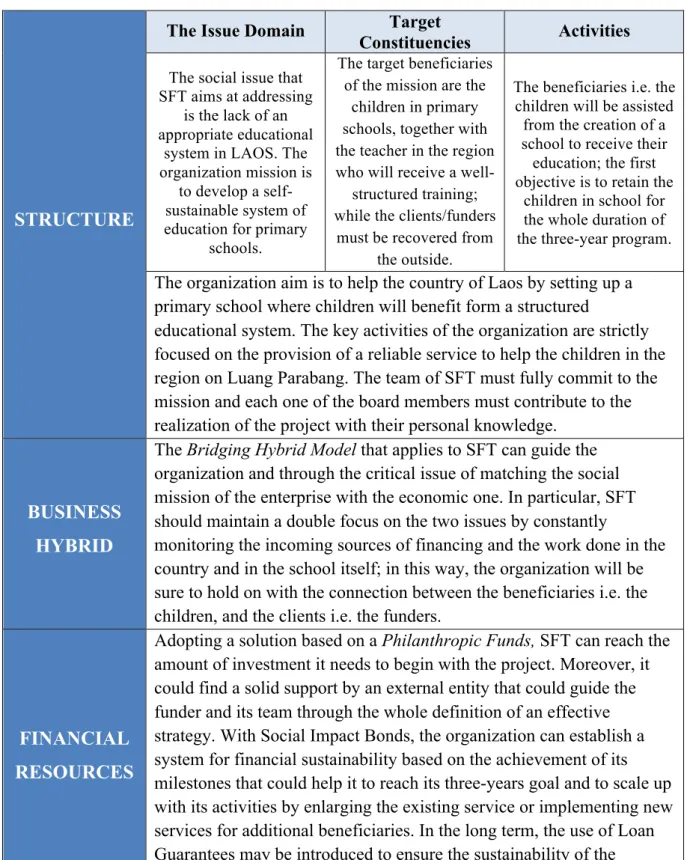
When we take these two dimensions of value spillover and the overlap between clients and beneficiaries together, they form a matrix that represents four possible types of business models for social enterprises. In this section, based on the definitions provided by Santos et al. (2015), an overview of the four models will be presented with particular attention on the aspects relative to their organizational structure and performance management.
1. Market Hybrid is able to offer to its beneficiaries, which are also clients, services or products that create automatic value spillovers; it adopts a social mission proving an offering at a lower cost that produces significant spillovers (i.e. water, health, energy). To ensure a smooth management process, board members able to manage business activities with a devotion to the social mission characterize Market Hybrids’ governance. The primary focus regarding performances is efficiency in operation and the maintenance of the equilibrium between the social and profit aims.
2. Blending Hybrid is capable of serving beneficiaries as clients, but it has a need of blending its commercial offering with additional activities in order to perform its social impact (contingency spillovers); this situation forces the organization to structure itself in a more complex and costly way that allows to have expertise in both the operational and the social impact activities.
The organization must implement a continuous monitoring of performances; KPIs of operations and impact must be aligned and balanced.
3. Bridging Hybrid serves clients and beneficiaries that do not belong in the same group; indeed, they must bridge the two segments. The goal of its business model is to have a complementary match of needs; the social mission must serve the needs of beneficiaries and of clients while the organization operates in a competitive market. Since commercial operation are the font of its social impact, Bridging Hybrid must keep under observation operational KPIs; moreover, it must monitor the composition of the two segments and provide them with the same quality services.
! +%! 4. Coupling Hybrid faces the greatest challenge of organizing itself in order to serve
clients and beneficiaries that are in different groups and it must develop contingent value spillovers. To smooth the problem of managing such entities, a solution is to establish a defined structural separation between commercial and impact operations. Members of the board must be differentiated in knowledge and be aware of the risk of mission drift (focus only on clients) by monitoring KPIs of both operational sides.
This overview to define different typologies of social business hybrids is useful to understand the characteristics that represent a social enterprise and to place it under a specific category. With this matrix organizations can immediately place themselves in the appropriate place and immediately set up their business model following the guideline.
Dimensions Clients = Beneficiaries Clients � Beneficiaries Automatic Value
Spillovers
Market Hybrid
Ex. Base of the pyramid initiatives for access to basic
services
Bridging Hybrid
Ex. Job matching for people with disabilities
Contingent Value Spillovers
Blending Hybrid
Ex. Microfinance support services
Coupling Hybrid
Ex. Work integration social enterprise
Table 3 - Typologies of Social Business Hybrids
3.4 Financial Sustainability
Certainly, to structure an organization under a well defined business model is an initial important step towards the alignment of its commercial and social entrepreneurship bulks; yet, this is just one side of the story. In fact, both components of the enterprise need to benefit from a sustainable flow of financing.
As Bugg-Levine, Kogut & Kulatilaka (2012) underline in their article, just like profit-oriented organizations, also SEs face the critical issue of generating revenue to cover their costs and fund their activities. However, when revenue stream is not sufficient, or inexistent, innovative tools of financing need to be implemented to attract investors.
Traditional financing tools include grants, loans, guarantees, bonds and equity; such instruments can be found also in the social investment domain (Brandstetter & Lehner, 2014).
!
! +&!
To be more precise, when we look at financing means addressed to organizations with a social impact, we are entering into the discussion of the issue of impact investing.
“Impact investing refers to funding that aims to generate a combination of financial and social return. To differentiate from more passive socially responsible investments, social impact investments must have a deliberate impact seeking strategy, aiming to generate measurable social impact” (EVPA, 2016).
To have a closer understanding of the concept of impact investing, we can refer to the report of the World Economic Forum, 2013, and observe this concept under a three-dimensional perspective. First of all impact investments reaches out across assets modules, and not just as a separate assets; thus, under this category we can find instruments from equity, quasi-equity, bonds and loans. Second, it is worth underling the investor’s standpoint; he will focus on both the financial result and particularly on the social impact result. In the third dimension, impact investments are continuously under measurement of both financial and social valuation. An important quality of the impact investing market is the offering of opportunities that are various and feasible and allow investors to reach social and environmental results while generating financial returns (Global Impact Investing Network, 2016). The creation of this two-sided result, is able to attract different actors to the impact investing market driven by different motivations; for example, banks or financial advisors can look out to new opportunities to provide investment opportunities to clients with an interest in social or environmental causes. On the other side, institutional and family foundations can benefit from the leveraging of greater assets to achieve their core social mission while increasing their potentials.
Impact investing challenges the long-standing idea that social enterprises are limited to relay only on philanthropic donations and that market investment are meant to focus exclusively on the achievement of financial results (GIIN, 2016). Indeed, innovative typologies of impact investment techniques can be implemented by social enterprises to smooth the alignment of social and economic value creation.
3.4.1 Types of Financing for SEs
With the possibility to relay on the existing literature and knowledge regarding the traditional financial market, in the most recent years, scholars of the topics of social enterprises have developed several innovative tools that can be implemented by such organizations.
! +'! In the following section, I will present an overview of some potential impact investment mechanisms that a social enterprise can implement in its strategy to attract new funds.
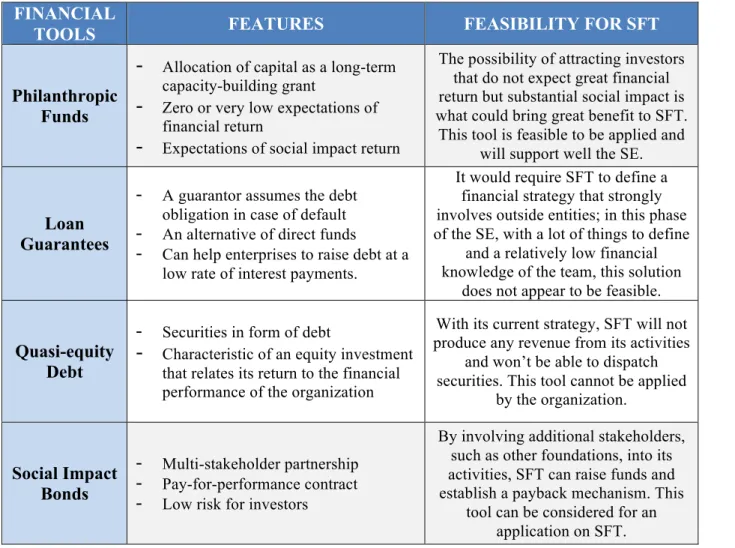
i. Philanthropic Funds
“The allocation of capital as a long-term capacity-building grant to a social enterprise, with zero or very low expectations of financial return but with a strong expectation of impact measurement and return” (Santos et al.,2015). For instance, “Venture Philanthropy” (VP) provides a combinations of funding and professional service to organizations with a social purpose to sustain their societal impact by implementing a long-term approach through core practices of tailored financing, organizational support and impact measurement and management (European Venture Philanthropy Association EVPA, 2016).
The EVPA is an example of an entity offering philanthropic funds services; it is a membership association of organizations interested or involved in venture philanthropy around Europe. Members of this association range from foundations to private equity firms that wish to provide both financial and non-financial support to increase societal impact. (EVPA, 2016).
ii. Loan Guarantees
“It is a promise by a guarantor to assume the debt obligation of a borrower in case of a default” (GIZ GmbH, 2014). These kinds of loans are an alternative of direct funds; they can help enterprises to raise debt at a low rate of interest payments.
An example of this mechanism is when an organization with a social purpose is supported with bank loan that are guaranteed by a third party which is played by an impact investor such as a Venture Philanthropic Organization; this third player takes some or all risk allowing the social organization to access to regular funding sources (EVPA, 2016). Indeed, loan guarantees are directly beneficial to social enterprises that can share risk with the impact investor and it can also stimulate the willingness of donors to invest in these organizations’ activities.
An example of organizations promoting such mechanisms are those based on microfinance like Grameen Bank which fosters commercial models to provide loans to the very poor population. This organization, established in 1976 in Bangladesh, started out its activities based on a rather small mechanism of loan guarantees financing that allowed 42 women to begin their own commercial activities in the region; indeed, by offering loans of just $27 at reasonable rates, Grameen Bank was able to institute a new, solid financing network to help several villages in Bangladesh to escape from their poverty trap (Mair et al., 2005).
!
! +(!
iii. Quasi-equity debt
“Usually structured as a debt where the financial returns are calculated as a percentage of the future revenue streams of the investee company.” (GIZ GmbH, 2014). This kind of financing tool is of particular relevance for legally structured non-profits that cannot obtain equity capital; they are securities in form of debt with a characteristic of an equity investment that relates its return to the financial performance of the organization (Bugg-Levine, Kogut&Kulatilaka, 2012). As Levine et al. (2012) underline in their article, the offering of quasi-equity debt to social investors allows the social enterprise to propose to profit-seeking lenders, such as banks, a competitive investment opportunity without reduction of ownership and control.
An example of the implementation of quasi-equity debts is the HCT Group, a social enterprise organization that operates in the UK offering services such as the London’s red busses, social service transport, school transport, community transport to education and training for people that cannot use public transport (HCT Group, 2016). This company relays on quasi-equity by sharing some of the business risk and gains with the Bridges Social Entrepreneurs Fund in exchange of a percentage on revenues. The direct connection between the loan and the revenue stream, gives a strong incentive to HCT to monitor its performance.
iv. Social Impact Bonds
“A Social Impact Bond (SIB) is a multi-stakeholder partnership in which a government contract for social services is structured as a pay-for-performance contract” (GIZ GmbH, 2014). This relatively new approach was introduced in the UK in 2010 and is especially helpful for governments that wish to fund infrastructure and services; these bonds are sold to private investors who receive a return only if the project succeeds (Bugg-Levine, Kogut&Kulatilaka, 2012). A great benefit from this source of financing is the low risk for government’s investment and the alignment of a set of stakeholders; on the other hand, the relative novelty of SIB characterize it with low feasibility of application.
A practical example of this mechanism comes from the Work Integration Social Enterprises (WISEs), which is a French organization that aim at helping unemployed people that are hired by the organization to generate products and services and sell them to the market; in this way, the previously unemployed people are able to learn new abilities and begin a pathway of personal growth. In order to perform in its activities, WISEs relays on the governmental subsidies in the form of social impact bonds (Santos et al., 2015).
! +,!
3.5 Matching Business Model & Financial Sustainability
After observing the different types of financing tools that social enterprises can apply in their organizations, it is now appropriate to look back to the previous section and to try to draw a solid match between the four models of social business hybrids and these financial sustainability strategies.
This match is fundamental in order to get back to the previously mentioned two-dimensional mission of social enterprises: societal and economic value creation. Indeed, as we have seen, organizations with a social mission must address this challenge by focusing first on the creation of a solid business model that drives their activities and then by implementing an effective financial mechanism that allows them to effectively realize such activities.
Moreover, this connection between business model and the financial tools can represent an important outline to help organizations to first identify themselves under a determined category and then directly understand which strategy to attract new funds would better fit them.
Taking again into consideration the study of Santos et al (2015), we can articulate the following suggestions:
Market Hybrid � Quasi-equity debt; having a strong alignment between clients and beneficiaries and no need of external activities to generate value spillovers, Market Hybrids can create capital gain with quasi-equity debt as form of financing. Multinational corporations that wish to engage in new business impact initiatives usually provide this financing, or impact investing funds that expect a return through dividends or royalties.
Blending Hybrid � Loan Guarantees; enterprises characterized by a low alignment between the commercial and social activities, due to the external activities needed to produce contingent value spillovers, are also those that mostly face the threat of deviating from the social mission to focus on the profit side. In order to avoid this shift, the best typology of financing for Blending Hybrids are loan guarantees; this would allow the organization to implement large capital investment with financing of fix-return interest.
Bridging Hybrids � Philanthropic Funds; social oriented organizations that need to serve a client who is not the direct beneficiary of their activities need to allocate major resources to the non-paying client; this represents a constraint in the generation of a surplus. To overcome this issue, the most appropriate answer for Bridging Hybrids is to employ philanthropic funds,