JOURNAL OF APPLIED INSTRUMENTATION AND CONTROL - V.06. N.1 30
Abstract — This article presents a wearable device capable of acquiring both facial EMG and EOG biopotentials. The circuit developed has amplification and filtering stages that eliminate higher frequency noises and low frequency biopotentials to use a band of frequency for acquisition of contractions from Frontalis muscle above the eyebrow and ocular movements on the vertical and horizontal axis. The output signal has an adjustment of gain and an offset that permits the application in embedded systems and digitally processing to eliminate 60 Hz noises. The wearable device is a mask with five electrodes allocated to make the acquisitions according to the positioning. The circuit is capable of acquiring both facial EMG and EOG simultaneously, but in this article they were acquired individually. Improvements in the whole system are being made and other ocular movements, like eye focus and involuntary movements for example, may be acquired in future works involving this system.
Index Terms—Biopotentials, Bioengineering, Signal Processing. I. INTRODUCTION
HE human body produces electrical signals, due to the activity of excitable cells in central nervous systems, called biopotentials or potentials bioelectric [1]. Among all biopotentials, electromyogram (EMG) and electrooculogram (EOG) are commonly used as input in human-machine interface systems [2], [3].
EMG is the electrical muscle signal, which is produced by muscular contractions from impulses of the central nervous system [4]. These signals are responses of stimulus from motor units, neurons responsible for muscle contractions. The signal from motor units presents amplitudes from 20 µV to 2000 µV and the time for the excitation process range between 3 ms to 15 ms [1]. There are two main approaches for EMG acquisition: intramuscular and superficial, being the last the most used. In
superficial EMG, the electrodes are allocated on the skin acquiring data from a sum of signals of motor units, besides; it is a non-invasive technique [5].
The human eye can be modeled as an electric dipole, which the corner represents the positive potential and the retina the negative potential. Based on this principle, the signal from EOG is acquired. The amplitude ranges from 0.05 mV to 3.5 mV and its frequency between 0 Hz to 100 Hz. These signals have linear behavior for angles from 50º in horizontal movements and 30º in vertical movements [6]. The acquisition techniques for EOG are similar to EMG and therefore the electrodes are placed near the eyes [7]. For acquisition from horizontal movements, the electrodes are positioned above and below one of the eyes, and for vertical movements, are positioned on the external side of both eyes. There are others ways for electrodes placement, however, they are less effective or are used for only one type of movement [8].
Biopotentials acquisition systems can be used both in diagnostic applications and in human-machine interfaces [7], [8]. Usually the circuits for acquisition of these two signals are allocated in wearable devices such as glasses and caps [9], [10]. Some of these applications use flexible circuits for better adaptation of the electrodes on the skin, other uses wireless caps for comfort improvement. These human-machine interfaces can aid in both locomotion systems and communication, improving the life quality of disabled people [11]–[13].
Therefore, this work presents a circuit able to acquire both EOG and facial EMG, which can monitor both facial muscle groups and eye movements simultaneously. Besides, the circuit provides an output with 2.5 V offset for use in embedded system.
II. RELATED WORKS
As the scope of the work deals with the development of a system for the acquisition of facial EOG and EMG signals, works that focused on this development as well are presented.
Several works present the development of systems for EOG and facial EMG acquisition, specially searching for wearable devices [7], [9]. These devices use different materials from commonly devices and present themselves as low cost devices [10]. Besides that, about the signal processing, others works searching the development of human-machine interfaces to control computer mice, improve the communication between
Felipe Garcia, José Jair Alves Mendes Júnior, Melissa La Banca Freitas and Sergio Luiz Stevan Jr.
____________________________________________________________________________
Wearable Device for EMG and EOG acquisition
T
____________________________________________________________ F. Garcia is with Graduate School of Electric Engineering in Federal University of Technology, Paraná, (UTFPR), 84016-210 Ponta Grossa, Brazil. (e-mail: [email protected]).
J. J. A. Mendes Jr. is with Graduate School of Electrical Engineering and Computer Science in Federal University of Technology, Paraná (UTFPR), 80230-901 Curitiba, Brazil (e-mail: [email protected]).
M. L. B. Freitas is with Graduate School of Electric Engineering in Federal University of Technology, Paraná, (UTFPR), 84016-210 Ponta Grossa, Brazil. (e-mail: [email protected]).
S. L. Stevan Jr. is with Graduated Program in Electrical Engineering in Federal University of Technology, Paraná (UTFPR), 84016-210, Ponta Grossa, Brazil.
JOURNAL OF APPLIED INSTRUMENTATION AND CONTROL - V.06. N.1 31 people, and facilitate the locomotion of individuals [6], [8],
[15]-[19].
Aiming at development an acquisition system for EOG and facial EMG to study the human emotions and use in interface control, reference [9] presents a device with six channels with a head cap. Reusable electrodes were embroidered with silver-coated wire in the device. The steps of acquisition, signal conditioning (such as amplification and filtering), and data transmission are presented, since the system was developed to be wireless.
Another work [7] presented the acquisition of EOG and facial EMG by a wearable device formed by a network containing 20 printed passive electrodes, these being fixed in a textile headband. This device was developed to control a mouse cursor and/or simulate functions of a keyboard. Thus, the signal processing steps were developed involving the conditioning of the signal, feature extraction, and calibration, to perform the cursor tests. The best control speed found for the mouse was 200 pixels/second. In addition, this work concluded that the number of electrodes should be decreased because of the proximity of the electrodes affected the control accuracy.
Differently from the other studies already presented, in reference [10] a device of acquisition of EOG signals is presented. By fixing electrodes in an adjustable eyewear frame, the authors sought to implement a wearable and low cost device. The data were acquired, analyzed, filtered and is made the blink and saccade detection. The results presented were referents to the waveforms obtained from the raw EOG and smoothed and truncated EOG data.
Due to skin irritation often caused by conventional Ag-AgCl electrodes, a wearable system has been developed using graphene coated tissue electrodes for the acquisition of EOG signals [14]. Thus, a comparison was made between the acquired signals of Ag-AgCl electrodes and the graphene electrodes of textile. As a result, textile graphene electrodes showed a high degree of flexibility and elasticity, making them suitable for various EOG applications such as development of wearable human-computer interfaces and monitoring of epileptic patients and driver drowsiness [14].
III. MATERIALS AND METHODS A. Methodology
Figure 1 shows the stages the signal passes through. The tests of the circuit started by the filtering stage using a wave generator of the DSO-X 2012A oscilloscope. The signal used for the tests was a tension of 20mV peak to peak and was used a logarithmic scale for the frequency acquisition, 50 points of frequency were used, most of the near the cut-off frequencies. This same signal was used to test the gain adjustment stage, but in this case, the frequency was fixed in 90 Hz.
Electrodes placement was based on previous works and in [8] and in [5]. The first acquisitions were made in the oscilloscope, but due to 60Hz noises later acquisitions were made using LabVIEWTM with DAQ USB-6212.
B. Circuit Design
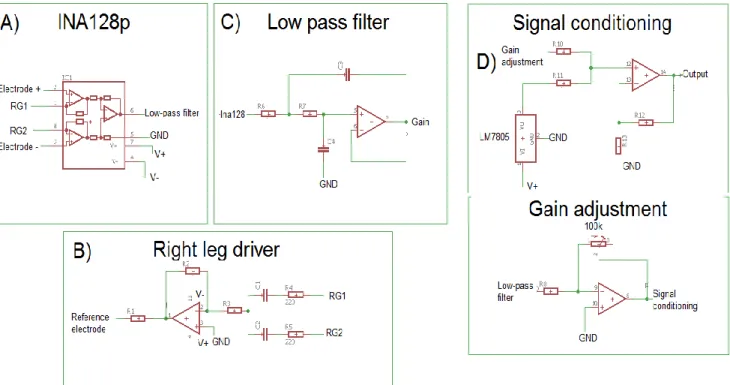
The acquisition system has the functions of acquiring and conditioning (amplification and filtering) the signals from electrodes on the skin. The stages which the signal passes through in the circuit are presented in Figure 2. The project was based on [20].
The first stage of the circuit is the amplification of signals collected from the skin, is presented in Figure 2a). An integrated circuit INA128 is used to amplify the signals; it has high input impedance and high common mode rejection ratio (CMRR). Two resistors of 220 Ω were used to adjust the gain for 114.63, according the equation (1):
50
1
k
G
Rg (1)
wherein G is the desired gain and Rg is the value of gain resistance, which is the sum of the two resistors [11].
A right leg driver is coupled to amplification stage. This circuit increases the CMRR (Common Mode Rejection Ratio), and it is used because in biopotentials acquisition systems the voltage in common mode of the body has to be minimized [5]. Figure 2b) presents the schematic for this circuit that redirect the common voltage through the reference electrode, reducing this interference [1]. Jointly with the right leg driver, two capacitors were used to build a high-pass filter with a cut-off frequency between 5 and 6 Hz. This filter is used to attenuate low frequencies signals like movements artifacts and others biopotentials.
Figure 2c) presents a low pass filter used to attenuate high frequency noises and its project was based on [22]. This filter has a 2nd order Butterworth approximation with cut-off
frequency of approximately 120 Hz. The gain of this filter is unitary.
The last two stages, Figure 2d), of the circuit have the function of gain adjustment and signal conditioning. The signal coming from the low-pass filter passes through an adjustment of gain with a variable resistance of 100 kΩ; the gain can be adjusted to a maximum of 13.19. The signal conditioner provides an offset of 2.5 V for uses in an embedded system. This last stage of the circuit is a voltage adder which adds the tension of the gain adjustment with the tension of a LM7805 that is a tension regulator. [23]. After all the stages, the output of the circuit is a signal from 0 to 5 V with a variable gain.
C. Mask Development
The system, as said before, was developed to acquire both facial EMG and EOG signals. For the acquisitions, five electrodes were allocated in a wearable mask; this helps the positioning and fixation as shown in the Figure 3. The mask is a
JOURNAL OF APPLIED INSTRUMENTATION AND CONTROL - V.06. N.1 32
device that can be connected to the circuit using a one-meter cable, approximately, and depending on the desired input, the user can choose, by the connector in the mask, which electrode will capture the signal.
Fig. 3. Mask design: a) Electrodes placement in the wearable mask. EMG are for Frontalis acquisition. EOGv+ and EOGv- are for vertical EOG acquisition. EOGh+ and EOGh- are for horizontal EOG acquisition. In b), position of the mask on the face.
The EMG signals are from contractions of the Frontalis muscle, it was acquired by two electrodes positioned above the eyebrow of the right eye. For EOG acquisitions four electrodes were used. Vertical movements were acquired by two electrodes, one of them above the eyebrow (EOGv+) and another below the eye (EOGv-). Horizontal movements were acquired by the other two electrodes, which are positioned on the external area of both eyes (EOGh+ and EOGh-).
The signals of EMG were acquired from contraction and relaxation of the muscle with a short interval of time. EOG signals were obtained with vertical and horizontal movements of the eye: up-middle and down-middle for vertical movements; left-middle and right-middle for horizontal movements. The
acquisition was performed in the own researcher and the circuits are in agreement with the ethical committee in Human Researches from UTFPR registered under the CAAE: 89638918.0.0000.5547.
IV. RESULTS
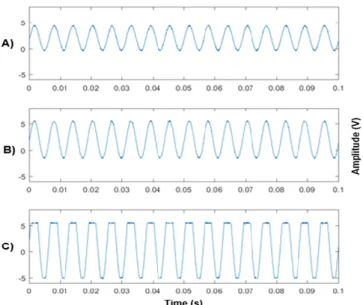
First results obtained are referring to circuit responses. It is possible to observe in Figure 4 the experimental frequency response and the operation of both filters pre-sent in the circuit; It was used a logarithmic scale and 50 points of frequency to test the filtering stages. Figure 5 demonstrates the performance of gain adjustment stage also obtained by experimentations. Both of these signals were acquired in the oscilloscope DSO-X 2012A using an input voltage of 20mV peak to peak and a frequency of 90 Hz approximately.
Fig. 4. Waveform referring to circuit responses, with a) the indication of high-pass cut-off frequency and b) the low-high-pass cut-off frequency.
By Figure 4 the performance of a bandpass filter is observed, with frequency values between 5 Hz and 120 Hz, approximately. This response is within what was fore-seen for the circuit operation, eliminating external noises of higher Fig. 2. Circuit schematics: a) Amplification; b) Right leg driver; c) Low pass Filter; and d) Signal Conditioning, and Gain adjustment.
JOURNAL OF APPLIED INSTRUMENTATION AND CONTROL - V.06. N.1 33 frequencies and interferences from biopotentials of lower
frequencies.
It is also important to note the response of the variable gain stage (Figure 2d); using values of 20 kΩ, 30 kΩ, and 70 kΩ respectively, according Figure 5. Using an input signal sine wave of 20 mV peak to peak (90 Hz), was adjusted to an output of 0 to 5 V using the gain stage and the offset of 2.5 V an increase can be noted of the output circuit signal’s peak to peak value until saturation point in values higher or equals to 70 kΩ. The signal of Figure 5 b) might seem saturated, but in this response, the input signal has an amplitude much higher than a biopotential, hence it can be disregarded.
Fig. 5. Performance of gain adjustment stage as the value of the variable resistance is changed to a) 20 kΩ, b) 30 kΩ, and c) 70 kΩ. The input signal sine wave of 20 mV peak to peak (90 Hz) was adjusted to an output of 0 to 5 V using the gain stage and the offset of 2.5 V.
During acquisitions realized with the mask, it was acquired signals of biopotentials separately. First, the facial EMG signals were obtained (from researcher) and then the signals from horizontal and vertical EOG. The EMG signals were collected from contractions of the Frontalis muscle using LabVIEWTM
with DAQ USB-6212 (isolated from mains supply) and it can be observed in Figure 6, where it represents a characteristic curve of this type of biopotential. In this case, the muscle group is smaller and that is why the potential of the contraction is smaller. The signals of EOG acquisitions are separated in vertical and horizontal movements. It is observed, by Figure 6, that every time there is an ocular movement, both vertically and horizontally, a peak of voltage occurs. This demonstrates the movement of a dipole formed by the eye. In this case, the electrodes are switched for vertical acquisitions; when there is a positive peak in vertical acquisition, means look to down, in horizontal acquisition look to left. Same thing goes for looks to down and to right. It is important to note that every time the eye comes back to central position, occurs a peak contrary to what has already happened, showing that the dipole came back to origin position.
V. DISCUSSION
The first case to be discussed is the system and the how the mask was developed. Noise processing is an important aspect in biopotential acquisitions, specially 60 Hz noises coming from electric and electronics devices nearby. As seen in Figure 3 the mask cables are not blinded, furthermore, the whole circuit is susceptible to these noises. Therefore, the acquisitions were made digitally using LabVIEWTM to eliminate all the possible
noises. Using the mask reduces undesirable movements from the electrodes as well, because of it the obtained signals have low incidence of artifact movements.
During the mounting of the circuit some problems related to gain and cut-off frequency were noticed. Initially there was no
JOURNAL OF APPLIED INSTRUMENTATION AND CONTROL - V.06. N.1 34 variation of gain and problems associated with saturation of the
signal often occurred, hence a gain adjustment stage was built on the circuit which can be altered according to the subject of testing. Thus, the EOG signals have a low frequency, and the acquisition of these signals depends on the cut-off frequency of high-pass filters, on the first project, the INA’s gain resistors had other values that precluded the EOG signal. After all necessary alterations were made, the final circuit, shown in Figure 2, was mounted.
Every time a ocular movement happens, a peak occurs in the signal, the peaks from horizontal movements have the same potential for both directions, right and left, but the peaks from vertical movements has a difference; for up-middle movements the peaks have less potential due to electrode positioning. Electrodes positioned above the eyebrow are farther than the other ones, but in terms of acquisition the signal can be processed in the same way.
VI. CONCLUSION
Although some problems were noticed during mounting and testing of the circuit and system, satisfactory results were obtained. All the acquisitions were as expected, and all the results were better than previous projects.
The next steps are to create more channels in a reduced circuit to start real applications using simultaneous acquisitions of these biopotentials. Besides, an embedded system will be made to process the signals digitally reducing noises from electronic devices nearby.
Some experimentation are being made with this system to acquire other ocular movements, like eye focus and involuntary movements during daily activities.
REFERENCES
[1] J. G. Webster e J. W. Clark, Orgs., Medical instrumentation: application and design, 4th ed. Hoboken, NJ: John Wiley & Sons, 2010. [2] J. J. V. Mayor, R. M. Costa, A. Frizera Neto, e T. F. Bastos, “Dexterous hand gestures recognition based on low-density sEMG signals for upper-limb forearm amputees”, Res. Biomed. Eng., vol. 33, no 3, p. 202–
217, set. 2017.
[3] J. Perdiz, G. Pires, e U. J. Nunes, “Emotional state detection based on EMG and EOG biosignals: A short survey”, in 2017 IEEE 5th Portuguese Meeting on Bioengineering (ENBENG), 2017, p. 1–4. [4] R. H. Chowdhury, M. B. I. Reaz, M. A. B. M. Ali, A. A. A. Bakar, K.
Chellappan, e T. G. Chang, “Surface Electromyography Signal Processing and Classification Techniques”, Sensors, vol. 13, no 9, p.
12431–12466, set. 2013.
[5] E. Criswell e J. R. Cram, Orgs., Cram’s introduction to surface electromyography, 2nd ed. Sudbury, MA: Jones and Bartlett, 2011. [6] E. Hortal, E. Iáñez, A. Úbeda, C. Perez-Vidal, e J. M. Azorín,
“Combining a Brain–Machine Interface and an Electrooculography Interface to perform pick and place tasks with a robotic arm”, Robot. Auton. Syst., vol. 72, p. 181–188, out. 2015.
[7] G. M. Paul, Fan Cao, R. Torah, Kai Yang, S. Beeby, e J. Tudor, “A Smart Textile Based Facial EMG and EOG Computer Interface”, IEEE Sens. J., vol. 14, no 2, p. 393–400, fev. 2014.
[8] H. Tamura, M. Yan, K. Sakurai, e K. Tanno, “EOG-sEMG Human Interface for Communication”, Comput. Intell. Neurosci., vol. 2016, p. 1–10, 2016.
[9] A. T. Vehkaoja, J. A. Verho, M. M. Puurtinen, N. M. Nojd, J. O. Lekkala, e J. A. Hyttinen, “Wireless Head Cap for EOG and Facial EMG Measurements”, 2005, p. 5865–5868.
[10] A. Chaudhuri, A. Dasgupta, S. Chakrborty, e A. Routray, “A low-cost, wearable, portable EOG recording system”, in 2016 International Conference on Systems in Medicine and Biology (ICSMB), Kharagpur, India, 2016, p. 102–105.
[11] J. Ju, Y. Shin, e E. Kim, “Vision based interface system for hands free control of an intelligent wheelchair”, J. NeuroEngineering Rehabil., vol. 6, no 1, p. 33, 2009.
[12] M. Zardoshti-Kermani, B. C. Wheeler, K. Badie, e R. M. Hashemi, “EMG feature evaluation for movement control of upper extremity prostheses”, IEEE Trans. Rehabil. Eng., vol. 3, no 4, p. 324–333, dez.
1995.
[13] A. Ubeda, E. Iañez, e J. M. Azorin, “Wireless and Portable EOG-Based Interface for Assisting Disabled People”, IEEEASME Trans. Mechatron., vol. 16, no 5, p. 870–873, out. 2011.
[14] A. J. Golparvar e M. Kaya Yapici, “Wearable graphene textile-enabled EOG sensing”, in 2017 IEEE SENSORS, Glasgow, 2017, p. 1–3. [15] N. Barbara, T. A. Camilleri, e K. P. Camilleri, “EOG-based eye
movement detection and gaze estimation for an asynchronous virtual keyboard”, Biomed. Signal Process. Control, vol. 47, p. 159–167, jan. 2019.
[16] R. Barea, L. Boquete, S. Ortega, E. López, e J. M. Rodríguez-Ascariz, “EOG-based eye movements codification for human computer interaction”, Expert Syst. Appl., vol. 39, no 3, p. 2677–2683, fev. 2012.
[17] Y. Bei, Y. Sichun, L. Mengke, e L. Xiangkun, “Gaze Estimation Method Based on EOG Signals”, in 2016 Sixth International Conference on Instrumentation & Measurement, Computer, Communication and Control (IMCCC), Harbin, China, 2016, p. 443– 446.
[18] A. Lopez, P. J. Arevalo, F. J. Ferrero, M. Valledor, e J. C. Campo, “EOG-based system for mouse control”, in IEEE SENSORS 2014 Proceedings, Valencia, Spain, 2014, p. 1264–1267.
[19] A. Bulling, J. A. Ward, H. Gellersen, e G. Tröster, “Eye Movement Analysis for Activity Recognition Using Electrooculography”, IEEE Trans. Pattern Anal. Mach. Intell., vol. 33, no 4, p. 741–753, abr. 2011.
[20] S. L. Stevan Jr, J. J. A. M. Jr, F. C. Janzen, E. A. Jr, e S. Okida, “Circuit Design for Surface Electromyography Data Acquisition”, IEEE Lat. Am. Trans., vol. 13, no 10, p. 3193–3200, out. 2015.
[21] “INA12x Precision, Low-Power Instrumentation Amplifiers”, Texas Instruments. .
[22] A. Pertence Junior, Amplificadores operacionais e filtros ativos: teoria, projetos, aplicacoes e laboratorio. Porto Alegre (RS): ARTMED, 2003.
[23] “MC7805: Linear Voltage Regulator, Positive, 5.0 V, 1.0 A”, ON Semiconductor. .
Received: October 10, 2018
Accepted: February 26, 2019
Published: February 28, 2019
© 2018 by the authors. Submitted for possible open access publication under the terms and conditions of the Creative
Commons Attribution (CC-BY) license
JOURNAL OF APPLIED INSTRUMENTATION AND CONTROL - V.06. N.1 35
Dispositivo vestível para aquisição de sinais
de EMG e EOG.
Resumo — Este artigo apresenta um dispositivo vestível capaz de adquirir biopotenciais faciais de EMG e EOG. O circuito desenvolvido possui estácios de amplificação e filtragem que eliminam ruídos de alta frequência e biopotenciais de baixa frequência para o uso de um abanda de frequência para aquisição de contrações do músculo Frontalis acima da sobrancelha e movimentos oculares nos eixos vertical e horizontal. O sinal de saída possui um ajuste de ganho e um offset que permite a aplicação em sistemas embarcados e processamento digital para eliminar ruídos de 60 Hz. O dispositivo vestível é uma máscara com cinco eletrodos alocados para realizar as aquisições de acordo com o posicionamento. O circuito é capaz de adquirir tanto o EMG facial quanto o EOG simultaneamente, mas neste artigo eles foram adquiridos individualmente. Melhorias em todo o sistema estão sendo feitas e outros movimentos oculares, como foco ocular e movimentos involuntários, por exemplo, podem ser adquiridos em trabalhos futuros envolvendo esse sistema.
Palavras-chave—Biopotenciais, Bioengenharia, Processamento de Sinais