CERN-PH-EP/2013-037 2015/09/07
CMS-HIG-13-006
Search for a Higgs boson decaying into a Z and a photon in
pp collisions at
√
s = 7 and 8 TeV
The CMS Collaboration
∗Abstract
A search for a Higgs boson decaying into a Z boson and a photon is described. The analysis is performed using proton-proton collision datasets recorded by the CMS de-tector at the LHC. Events were collected at center-of-mass energies of 7 TeV and 8 TeV, corresponding to integrated luminosities of 5.0 fb−1 and 19.6 fb−1, respectively. The selected events are required to have opposite-sign electron or muon pairs. No excess above standard model predictions has been found in the 120–160 GeV mass range and the first limits on the Higgs boson production cross section times the H→Zγ branch-ing fraction at the LHC have been derived. The observed limits are between about 4 and 25 times the standard model cross section times the branching fraction. The ob-served and expected limits for m``γ at 125 GeV are within one order of magnitude of the standard model prediction. Models predicting the Higgs boson production cross section times the H → Zγ branching fraction to be larger than one order of magni-tude of the standard model prediction are excluded for most of the 125–157 GeV mass range.
Published in Physics Letters B as doi:10.1016/j.physletb.2013.09.057.
c
2015 CERN for the benefit of the CMS Collaboration. CC-BY-3.0 license ∗See Appendix A for the list of collaboration members
1
Introduction
The observation of a new resonance decaying to two bosons and with decay modes and prop-erties consistent with those of the standard model (SM) Higgs boson has been reported by the ATLAS [1, 2] and CMS [3, 4] collaborations. Measurements of the basic properties of this resonance, such as the mass [5] and the coupling strength to vector bosons and fermions [1– 4, 6], have been reported. Within the SM, the partial width for the H → Zγ decay channel (ΓZγ) is rather small, resulting in a branching fraction between 0.11% and 0.25% in the 120–
160 GeV [7, 8] mass range. A measurement ofΓZγ provides important information on the
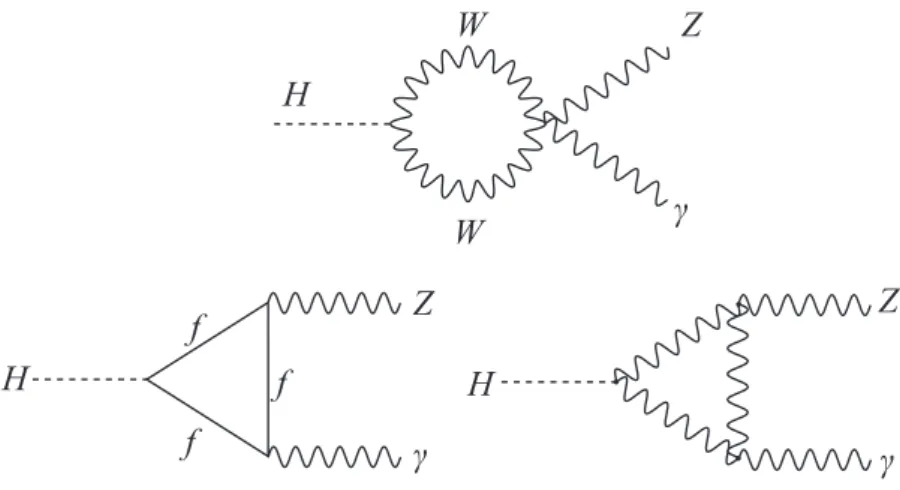
un-derlying dynamics of the Higgs sector because it is induced by loops of heavy charged particles, just as for the H → γγdecay channel. The contributing diagrams toΓZγ are shown in Fig. 1.
ΓZγis sensitive to physics beyond the SM, and could be substantially modified by new charged
particles without affecting the gluon-gluon fusion Higgs boson production cross section [9], such as derived from an extended Higgs sector [10], or by the presence of new scalars [11, 12].
γ Z W W H H Z γ γ Z f f f H
Figure 1: Diagrams contributing toΓZγ.
This paper describes the first search for a Higgs boson in the H → Zγ final state at the LHC in the 120–160 GeV mass range, with the Z boson decaying into an electron or a muon pair. This is a clean final-state topology with an effective mass peak resolution of about 1-3%. To improve the sensitivity of the search, the selected dilepton-plus-photon events are subdivided into classes according to their mass resolution and the signal-to-background ratio, for both the electron and muon channels. The dominant backgrounds consist of the irreducible contribution from the SM Zγ production, and the reducible backgrounds from final-state-radiation in Drell– Yan or Z decays, and Z plus jets, where a jet is misidentified as a photon. A previous search for H→Zγ has been performed at the Tevatron for masses above 140 GeV [13].
Results are based on data samples recorded by the CMS experiment corresponding to inte-grated luminosities of 5.0 fb−1at 7 TeV and 19.6 fb−1at 8 TeV in proton-proton collisions.
2
The CMS detector
A detailed description of the CMS detector can be found in Ref. [14]. The central feature of the CMS apparatus is a superconducting solenoid, 13 m in length and 6 m in diameter, which provides an axial magnetic field of 3.8 T. Within the field volume there are several particle detection systems. Charged-particle trajectories are measured by silicon pixel and strip track-ers, covering 0 ≤ φ ≤ 2π in azimuth and |η| < 2.5 in pseudorapidity, where η is defined
2 3 Event selection
as −ln[tan(θ/2)] and θ is the polar angle of the trajectory of the particle with respect to the
counterclockwise proton beam direction. A lead tungstate crystal electromagnetic calorimeter is distributed in a barrel region|η| <1.48 and two endcaps that extend up to|η| =3. A brass
and scintillator hadron calorimeter surround the tracking volume and cover the region|η| <3.
Iron forward calorimeters with quartz fibers, read out by photomultipliers, extend the calori-meter coverage up to|η| =5. They provide measurements of the energy of photons, electrons,
and hadron jets. A lead and silicon-strip preshower detector is located in front of the endcap electromagnetic calorimeter. Muons are identified and measured in gas-ionization detectors embedded in the steel return-yoke outside the solenoid. The detector is nearly hermetic, al-lowing energy balance measurements in the plane transverse to the beam direction. A two-tier trigger system selects proton-proton collision events of interest for use in physics analysis.
3
Event selection
Events with two opposite-sign, same-flavor leptons (e or µ) and a photon are selected: e+e−γ, µ+µ−γ. All particles must be isolated and have transverse momentum, pT, greater than 20
(10) GeV for the highest-pT (next to highest-pT) lepton and 15 GeV for the photon. The
elec-trons (muons) and the photon must have|η| < 2.5(2.4). Photons in the barrel-endcap
transi-tion region 1.44< |η| <1.57 of the electromagnetic calorimeter are excluded.
Events are required to pass at least one of the dielectron or dimuon triggers. The trigger effi-ciency for events containing two leptons satisfying the offline event selection requirements are measured to be between 60% and 98% for the eeγ channel depending on the electron transverse momenta and 91% for the µµγ channel.
Events are required to have at least one primary vertex, with the reconstructed longitudinal position (z) within 24 cm of the geometric center of the detector and the transverse position (x-y) within 2 cm of the beam interaction region. In the case of multiple reconstructed vertices associated with additional interactions (pileup), the one with the highest scalar sum of the p2T of its associated tracks is chosen as the primary vertex. The leptons are required to originate at the same primary vertex. Electron (muon) tracks are required to have the transverse and longitudinal impact parameters with respect to the primary vertex to be smaller than 2 (2) mm and 2 (5) mm, respectively.
The observables used in the photon selection are: isolation variables based on the particle-flow (PF) algorithm [15], the ratio of the energy in the hadron calorimeter towers behind the supercluster to the electromagnetic energy in the supercluster, the transverse width of the elec-tromagnetic shower, and a pixel tracker veto to avoid misidentifying an electron as a photon. In the barrel region, superclusters are formed from five crystal strips in η, centered on the most energetic crystal, and have a variable extension in φ [4, 16]. In the endcaps, where the crystals are arranged according to an x-y rather than an η-φ geometry, matrices of 5×5 crystals around the most energetic crystals are merged if they lie within a narrow φ road. The efficiency of the photon identification is measured from Z → ee data using a tag-and-probe technique [17] by treating the electrons as photons [4], and found to be 76% (88%) at a transverse energy of 15 (above 50) GeV. These efficiencies include the effects of the pixel tracker veto, estimated with Z→µµγdata, where the photon is produced via final-state radiation.
The electron selection criteria are optimized for background rejection using a multivariate ap-proach, while maintaining a combined identification and isolation efficiency of approximately 60% at low transverse momentum (10 GeV) and 90% at high transverse momentum (50 GeV) for electrons from W or Z boson decays as described in [18]. The training of the multivariate
elec-tron reconstruction is performed using simulated events, while the performance is validated using data. In addition, the electron energy resolution is improved by using a multivariate regression technique [5] resulting in improvements of 10% and 30% in the mass resolution for Z→ee events over the standard CMS electron reconstruction in the barrel and endcap, respec-tively, as described in [18].
Muon candidates are reconstructed with a global trajectory fit using hits in the tracker and the muon system. Muon combined identification and isolation efficiencies of better than 95% have been maintained [4, 5] after improving the pileup corrections with respect to those used in [19] for low luminosity data.
Electrons and muons from Z boson decays are expected to be isolated from other particles. A cone of size ∆R ≡ √(∆η)2+ (∆φ)2 = 0.4 is constructed around the momentum direction of
each considered lepton candidate [18, 19]. The relative isolation of the lepton is quantified by summing the transverse momentum of all photons, charged and neutral hadrons PF objects within this cone, excluding the lepton and charged particles associated with the pileup ver-tices, and then dividing by the lepton transverse momentum. The resulting quantity, corrected for additional underlying event activity due to pileup events [4], is required to be less than 0.4 for both Z → e+e−and Z → µ+µ−. This requirement rejects misidentified leptons and
back-ground arising from hadronic jets. Similarly, to reduce the backback-ground from misidentified jets in the photon reconstruction, photon clusters are required to be isolated from other particles within a cone size of∆R=0.3. Their absolute isolation from charged hadrons, neutral hadrons and photons is required to be smaller than 1.5 (1.2), 1.0 (1.5), and 0.7 (1.0) GeV, respectively, for photons in the barrel (endcap) region. These requirements are applied after correcting for pileup effects.
The `+`− pair invariant mass is required to be greater than 50 GeV. No upper dilepton mass condition is needed as the events are found to be dominated by processes containing a Z boson.
The minimum dilepton mass requirement rejects contributions from pp →γγ∗ and H→γγ∗
where an internal conversion of the photon produces a dilepton pair [20]. If two dilepton pairs are present, the one with the invariant mass closest to the Z boson mass is taken. The final set of requirements combines the information from the photon and the leptons: (i) the invariant mass of the`+`−γsystem, m``γ, is required to be between 100 and 190 GeV; (ii) the ratio of the photon transverse energy to m``γ must be greater than 15/110; this requirement suppresses backgrounds due to misidentification of photons without significant loss in signal sensitivity and without introducing a bias in the m``γspectrum; (iii) the∆R separation between each lep-ton and the pholep-ton must be greater than 0.4 in order to reject events with final-state radiation (Drell–Yan or Z decays); and (iv) the remaining final-state radiation events are rejected by re-quiring the sum of m``γand m``to be at least 185 GeV.
Jets used in the dijet-tagged event selection defined below are built by clustering the PF candi-dates with the anti-kT clustering algorithm [21] with distance parameter of 0.5. Jets with a
sig-nificant fraction of energy coming from pileup interactions or not associated with the primary vertex are rejected [4]. The pileup energy in jets is subtracted using the FASTJETtechnique [22–
24]. Calibrated and corrected jets [25] are required to have ET > 30 GeV, |η| < 4.7, and to
be separated by at least 0.5 in ∆R from leptons passing the selection requirements described above.
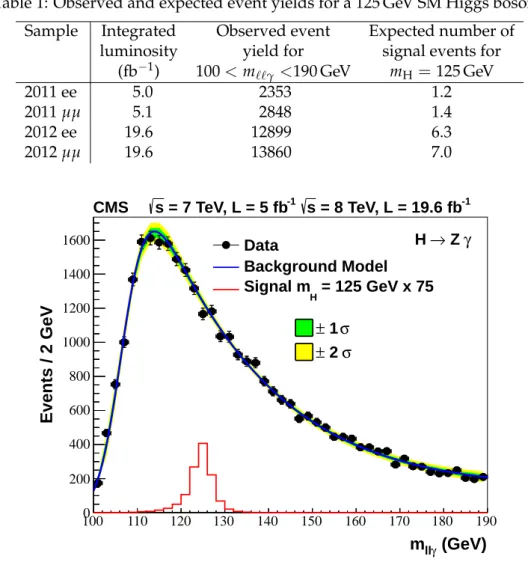
The observed yields for the basic event selection described above are listed in Table 1. The total yield for all channels combined is shown in Fig. 2.
4 4 Event classes
Table 1: Observed and expected event yields for a 125 GeV SM Higgs boson.
Sample Integrated Observed event Expected number of
luminosity yield for signal events for
(fb−1) 100<m ``γ <190 GeV mH=125 GeV 2011 ee 5.0 2353 1.2 2011 µµ 5.1 2848 1.4 2012 ee 19.6 12899 6.3 2012 µµ 19.6 13860 7.0 (GeV) γ ll m 100 110 120 130 140 150 160 170 180 190 Events / 2 GeV 0 200 400 600 800 1000 1200 1400 1600 -1 = 8 TeV, L = 19.6 fb s -1 = 7 TeV, L = 5 fb s γ Z → H CMS Data Background Model = 125 GeV x 75 H Signal m σ 1 ± σ 2 ±
Figure 2: The m``γ spectrum in the electron and the muon channels for the 7 and 8 TeV data combined, without weighting by the expected signal to background ratio of the individual data samples. Also shown is the expected signal due to a 125 GeV standard model Higgs boson, scaled by 75, and the sum of the individual fits made to the data for each channel and event class described in section 4. The uncertainty band reflects the statistical uncertainty from the fits to the data.
4
Event classes
The sensitivity of the search is enhanced by 20–40% by dividing the selected events into mutually-exclusive classes according to the expected mass resolution and the signal-to-background ratio, and then combining the results from each class.
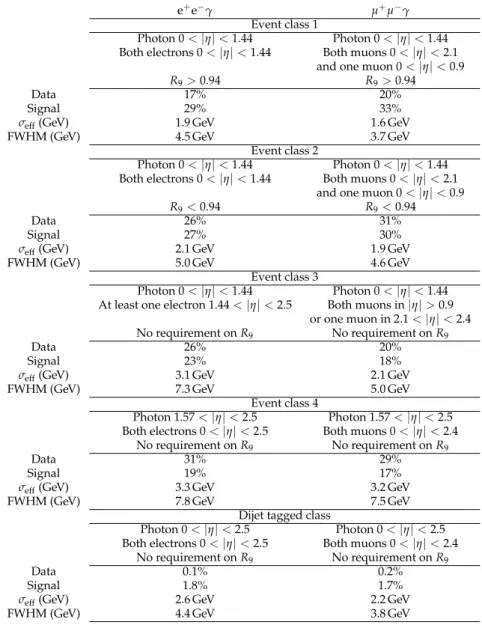
As shown in Table 2, a significant fraction of the signal events are expected to have both leptons and the photon in the barrel, while less than a fifth of the signal events are expected to have a photon in the endcap. This is in contrast with the background, where around one third of the events are expected to have a photon in the endcap. In addition, events where the photon does not convert into an e+e−pair have less background and better resolution in mH. For these
reasons, the events are classified according to the pseudorapidity of the leptons, the pseudo-rapidity of the photon and the shower shape of the photon for events with the two leptons in the barrel. The shower shape of the photon (R9) is characterized by the energy sum of 3×3
Table 2: Definition of the four untagged event classes and the dijet-tagged event class, the fraction of selected events for a signal with mH = 125 GeV produced by gluon-gluon fusion
at√s = 8 TeV, and data in a narrow region in the m``γ phase space centered at 125 GeV. The width of this region is equal to two times the effective standard deviation (σeff), where σeff is
defined as half-the-width of the narrowest window containing 68.3% of the distribution. The expected full width at half maximum (FWHM) for the signal is also listed.
e+e−
γ µ+µ−γ
Event class 1
Photon 0< |η| <1.44 Photon 0< |η| <1.44
Both electrons 0< |η| <1.44 Both muons 0< |η| <2.1
and one muon 0< |η| <0.9
R9>0.94 R9>0.94
Data 17% 20%
Signal 29% 33%
σeff(GeV) 1.9 GeV 1.6 GeV
FWHM (GeV) 4.5 GeV 3.7 GeV
Event class 2
Photon 0< |η| <1.44 Photon 0< |η| <1.44
Both electrons 0< |η| <1.44 Both muons 0< |η| <2.1
and one muon 0< |η| <0.9
R9<0.94 R9<0.94
Data 26% 31%
Signal 27% 30%
σeff(GeV) 2.1 GeV 1.9 GeV
FWHM (GeV) 5.0 GeV 4.6 GeV
Event class 3
Photon 0< |η| <1.44 Photon 0< |η| <1.44
At least one electron 1.44< |η| <2.5 Both muons in|η| >0.9
or one muon in 2.1< |η| <2.4
No requirement on R9 No requirement on R9
Data 26% 20%
Signal 23% 18%
σeff(GeV) 3.1 GeV 2.1 GeV
FWHM (GeV) 7.3 GeV 5.0 GeV
Event class 4
Photon 1.57< |η| <2.5 Photon 1.57< |η| <2.5
Both electrons 0< |η| <2.5 Both muons 0< |η| <2.4
No requirement on R9 No requirement on R9
Data 31% 29%
Signal 19% 17%
σeff(GeV) 3.3 GeV 3.2 GeV
FWHM (GeV) 7.8 GeV 7.5 GeV
Dijet tagged class
Photon 0< |η| <2.5 Photon 0< |η| <2.5
Both electrons 0< |η| <2.5 Both muons 0< |η| <2.4
No requirement on R9 No requirement on R9
Data 0.1% 0.2%
Signal 1.8% 1.7%
σeff(GeV) 2.6 GeV 2.2 GeV
FWHM (GeV) 4.4 GeV 3.8 GeV
crystals centered on the most energetic crystal in the supercluster divided by the energy of the supercluster. A requirement of a high value of R9 >0.94 is used to identify unconverted
pho-tons. Using this information, the first four event classes are defined as shown in Table 2. In these four event classes, the best signal-to-background ratio is obtained for the event class 1, which is composed of events with both leptons and the photon in the barrel and high R9.
It is possible to define an additional class of events with an expected signal-to-background ratio that is more than an order of magnitude larger than events in the four classes defined above. This is achieved by requiring two forward jets with large pseudorapidity separation, to enhance the selection of Higgs bosons produced via vector boson fusion. The dijet-tagged event class requirements are: (i) the difference in pseudorapidity between the two jets is greater than 3.5;
6 5 Background and signal modeling
(ii) the Zeppenfeld variable [26] ηZγ− (ηj1+ηj2)/2 is less than 2.5; (iii) the dijet mass is greater than 500 GeV; and (iv) the difference in azimuthal angles between the dijet system and the Zγ system is greater than 2.4. The dijet selected events form an exclusive event class. A 10–15% increase in sensitivity is obtained by adding this event class. There is a 20% contribution from the gluon-gluon fusion production process in the dijet-tagged event class. As shown in Table 2, around 2% of the expected signal events for a 125 GeV Higgs boson belong to this event class, while less than 0.2% of the background satisfies the dijet-tagged event class requirements.
5
Background and signal modeling
Based on simulated events, the dominant background in untagged events is expected to be due to initial-state-radiation SM Zγ production. The background fraction due to final-state-radiation in Drell–Yan or Z decays is only 5%, while for some event classes the contribution from Z plus jets can be as large as 40%. This is in contrast to dijet-tagged events, where it is found that the background due to Z plus jets is slightly higher than from Zγ.
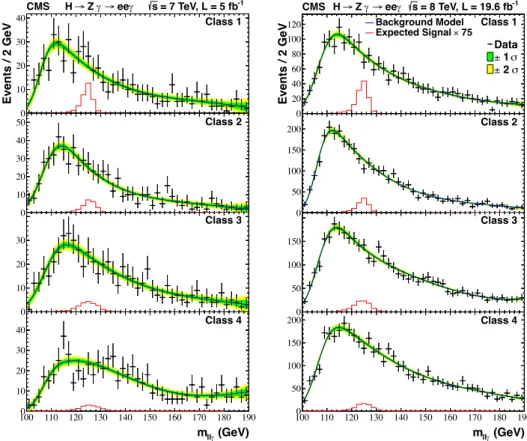
The background model is obtained by fitting the observed ``γmass distributions for each of
the five event classes in the electron and the muon channels at a center-of-mass energy of 7 and 8 TeV separately. Because of the limited number of events at 7 TeV for the dijet-tagged event class, the electron and muon channels are combined for this sample. The fitting is unbinned and is performed over the 100–190 GeV mass range. The m``γ distribution peaks around 110– 115 GeV, with a steeply rising turn-on to the left and a gradually falling tail to the right. These characteristics are fitted to the convolution of a Gaussian with a step function multiplied by a polynomial. The mean of the Gaussian is fixed to zero in the convolution and the step position and the width of the Gaussian are left floating in the fit. The background fits based on the m``γ data distributions for the electron and muon channels in the untagged event classes are shown in Fig. 3 and Fig. 4, while Fig. 5 shows the dijet-tagged class. The quality of the fits is good, with reduced χ2 between 0.49 and 1.8 for the untagged event classes and 0.16 and 0.28 for the dijet-tagged classes. Even though the H → Zγ search is limited to the mass range where the branching fraction is expected to be at least 0.1% (i.e. 120–160 GeV), the wide m``γfitting range in the background modeling is found to be needed using the bias studies described below. The potential bias on the background measurement is studied by using pseudo-data generated from background-only fits to the observed m``γspectrum. These pseudo-data sets are fitted to a signal combined with a polynomial background model. The results of these fits are used to determine an appropriate degree of polynomial model for background, such that the bias intro-duced on the limit of the signal strength measurement is smaller than a fifth of the background statistical uncertainty. This is the same method used in the search for the Higgs boson decay-ing to γγ and described in detail in [4]. A third-order polynomial is chosen for the dijet-tagged event class, a fourth-order polynomial is chosen to fit the event classes where both leptons and the photon are in the barrel, while a fifth-order polynomial is chosen to fit the event classes where the photon and at least one lepton are in the endcap.
The description of the Higgs boson signal used in the search is obtained from simulated events produced by the next-to-leading order matrix-element generator POWHEG 1.0 [27, 28] inter-faced with PYTHIA 6.4 [29] for the gluon-gluon fusion and vector boson fusion process. The
parton distribution functions (PDF) used to produce these samples is CT10 [30]. Associated production with a vector boson and associated production with a tt pair are simulated at
leading-order using PYTHIA 6.4 and the CTEQ6L [31] PDF. The SM Higgs boson cross
sec-tions and branching fracsec-tions used are taken from Refs. [32, 33]. The simulated signal events are weighted by taking into account the difference between data and simulated events so that
Events / 2 GeV 0 10 20 30 40 Class 1 CMS s = 7 TeV, L = 5 fb-1 γ ee → γ Z → H (GeV) γ ll m 0 10 20 30 40 50 Class 2 0 10 20 30 40 Class 3 (GeV) γ ll m 1000 110 120 130 140 150 160 170 180 190 10 20 30 40 Class 4 Events / 2 GeV 0 20 40 60 80 100 120 Class 1 CMS H → Z γ→ eeγ s = 8 TeV, L = 19.6 fb-1 Data σ 1 ± σ 2 ± (GeV) γ ll m 0 50 100 150 200 Class 2 Background Model 75 × Expected Signal 0 50 100 150 200 Class 3 (GeV) γ ll m 1000 110 120 130 140 150 160 170 180 190 50 100 150 200 Class 4
Figure 3: The background model fit to the meeγ distributions for event classes 1–4 for the two
data samples. The statistical uncertainty bands shown are computed from a fit to data. Also shown is the expected signal due to a 125 GeV standard model Higgs boson, scaled by 75.
the distribution of reconstructed vertices, the trigger efficiencies, the energy and momentum resolution, the energy scale, the reconstruction efficiency, and the isolation efficiency observed in data are reproduced for all reconstructed objects. An additional small correction is applied to the photons to reproduce the performance of the R9 shower shape variable, by scaling the
shower shape variable to match those observed in the Z→µµγevents [16].
6
Results
A statistical analysis to test the significance of any potential signal-like excess is performed in terms of the local p-value, the probability of observing an excess under the background-only hypothesis. The local p-value is expressed as a number of standard deviations using the one-sided Gaussian tail convention. No significant excess above background is observed, with a maximum excess of less than two standard deviations in the full mass range. The data are used to derive upper limits on the Higgs boson production cross section times the H→Zγ branch-ing fraction, σ(pp→H) × B(H→Zγ). The limits are evaluated using a modified frequentist approach taking the profile likelihood as a test statistic [34–36]. An unbinned evaluation of the likelihood over the full mass range of data is used. In addition, the limit on the inclusive cross section times the branching fraction is also provided. No theoretical uncertainties on the production cross sections are included in the latter result. The uncertainty on the limit is dom-inated by the size of the data sample and systematic uncertainties have a negligible impact. The systematic uncertainty in the limits is only due to the signal description, as the background
8 6 Results Events / 2 GeV 0 10 20 30 40 50 Class 1 CMS s = 7 TeV, L = 5 fb-1 γ µ µ → γ Z → H (GeV) γ ll m 0 10 20 30 40 50 Class 2 0 10 20 30 40 Class 3 (GeV) γ ll m 1000 110 120 130 140 150 160 170 180 190 20 40 60 Class 4 Events / 2 GeV 0 50 100 150 Class 1 CMS s = 8 TeV, L = 19.6 fb-1 γ µ µ → γ Z → H Data σ 1 ± σ 2 ± (GeV) γ ll m 0 100 200 300 Class 2 Background Model 75 × Expected Signal 0 50 100 150 Class 3 (GeV) γ ll m 1000 110 120 130 140 150 160 170 180 190 50 100 150 200 Class 4
Figure 4: The background model fit to the mµµγdistributions for event classes 1–4 for the two data samples. The statistical uncertainty bands shown are computed from the data fit. Also shown is the expected signal due to a 125 GeV standard model Higgs boson, scaled by 75.
is obtained from data and biases are avoided in the fitting procedure. The uncertainty arises from the uncertainty in the luminosity measurement (2.2% [37], 4.4% [38]), the trigger efficiency (0.5–3.5%), the effects of the choice of parton distribution functions on the signal cross sec-tion (0.3–12.5%) [39–43], the uncertainty in the Higgs boson branching fracsec-tion predicsec-tion (6.7– 9.4%) [32, 33], the event pileup modeling for the signal samples (0.4–0.8%), the corrections applied to the simulation to reproduce the performance of the lepton (0.7–1.4%), photon (0.5– 1.0%), and dijet selections (8.8–28.5%), event migration caused by the requirements on the pho-ton shower shape in the event classification (5.0%), the event migration between dijet-tagged and untagged event classes due to the jet energy scale (5.1–9.8%), and the signal modeling (1.0–5.0%). The uncertainty in the signal modeling takes into account a potential 5% contam-ination from final-state radiation in the H → µµ decay, assuming the SM branching fraction.
Based on the fit bias studies performed in the 120–160 GeV mass range, the uncertainty on the background estimation due to the chosen functional form is shown to be negligible.
The expected and observed limits are shown in Fig. 6. The limits are calculated at 0.5 GeV intervals in the 120–160 GeV mass range. The expected exclusion limits at 95% confidence level (CL) are between 5 and 16 times the SM cross section and the observed limit ranges between about 4 and 25 times the SM cross section. The observed and expected limits for m``γat 125 GeV are within one order of magnitude of the SM prediction. The data excludes models predicting
σ(pp → H) × B(H → Zγ) to be larger than one order of magnitude of the SM prediction
for most of the 125–157 GeV mass range. Hence, models predicting significant enhancements for ΓZγ [44] with respect to the SM expectations due to a pseudoscalar admixture, already
(GeV) γ ll m 100 110 120 130 140 150 160 170 180 190 Events / 2.5 GeV 0 0.5 1 1.5 2 2.5 3 3.5 4 Class Dijet-Tagged CMS H → Z γ→ llγ s = 7 TeV, L = 5 fb-1 Data Background Model 10 × Expected Signal σ 1 ± σ 2 ± (GeV) γ ll m 100 110 120 130 140 150 160 170 180 190 Events / 2.5 GeV 0 1 2 3 4 5 6 7 Class Dijet-Tagged CMS H → Z γ→ eeγ s = 8 TeV, L = 19.6 fb-1 Data Background Model 10 × Expected Signal σ 1 ± σ 2 ± (GeV) γ ll m 100 110 120 130 140 150 160 170 180 190 Events / 2.5 GeV 0 1 2 3 4 5 6 7 Class Dijet-Tagged CMS H → Z γ→µµγ s = 8 TeV, L = 19.6 fb-1 Data Background Model 10 × Expected Signal σ 1 ± σ 2 ±
Figure 5: The m``γspectrum in the electron and the muon channels combined (separately) for the 7 (8) TeV data for the dijet-tagged event class. The expected signal from a 125 GeV standard model Higgs boson has been scaled by a factor of 10.
ZZ decays [5], are now excluded.
7
Summary
A search has been performed for a Higgs boson decaying into a Z boson and a photon. The analysis used a dataset from proton-proton collisions at a center-of-mass energy of 7 and 8 TeV, corresponding to an integrated luminosity of 5.0 and 19.6 fb−1, respectively. No excess above standard model predictions has been found and the first limits on the Higgs boson production
cross section times the H → Zγ branching fraction at the LHC have been derived. The
ex-pected exclusion limits at 95% confidence level are between 5 and 16 times the standard model cross section in the 120–160 GeV mass range and the observed limit ranges between about 4 and 25 times the standard model cross section. The observed and expected limits for m``γ at 125 GeV are within one order of magnitude of the standard model prediction. Models predict-ing σ(pp→H) × B(H→Zγ)to be larger than one order of magnitude of the standard model prediction, for most of the 125–157 GeV mass range, are excluded.
We congratulate our colleagues in the CERN accelerator departments for the excellent perfor-mance of the LHC and thank the technical and administrative staffs at CERN and at other CMS institutes for their contributions to the success of the CMS effort. In addition, we gratefully ac-knowledge the computing centres and personnel of the Worldwide LHC Computing Grid for delivering so effectively the computing infrastructure essential to our analyses. Finally, we ac-knowledge the enduring support for the construction and operation of the LHC and the CMS detector provided by the following funding agencies: BMWF and FWF (Austria); FNRS and FWO (Belgium); CNPq, CAPES, FAPERJ, and FAPESP (Brazil); MES (Bulgaria); CERN; CAS, MoST, and NSFC (China); COLCIENCIAS (Colombia); MSES (Croatia); RPF (Cyprus); MoER, SF0690030s09 and ERDF (Estonia); Academy of Finland, MEC, and HIP (Finland); CEA and CNRS/IN2P3 (France); BMBF, DFG, and HGF (Germany); GSRT (Greece); OTKA and NKTH (Hungary); DAE and DST (India); IPM (Iran); SFI (Ireland); INFN (Italy); NRF and WCU (Republic of Korea); LAS (Lithuania); CINVESTAV, CONACYT, SEP, and UASLP-FAI (Mex-ico); MBIE (New Zealand); PAEC (Pakistan); MSHE and NSC (Poland); FCT (Portugal); JINR (Dubna); MON, RosAtom, RAS and RFBR (Russia); MESTD (Serbia); SEIDI and CPAN (Spain); Swiss Funding Agencies (Switzerland); NSC (Taipei); ThEPCenter, IPST, STAR and NSTDA (Thailand); TUBITAK and TAEK (Turkey); NASU (Ukraine); STFC (United Kingdom); DOE and NSF (USA).
10 References
References
[1] ATLAS Collaboration, “Observation of a new particle in the search for the Standard Model Higgs boson with the ATLAS detector at the LHC”, Phys. Lett. B 716 (2012) 1,
doi:10.1016/j.physletb.2012.08.020, arXiv:1207.7214.
[2] ATLAS Collaboration, “Evidence for the spin-0 nature of the Higgs boson using ATLAS data”, arXiv:1307.1432. Submitted to Phys. Lett. B.
[3] CMS Collaboration, “Observation of a new boson at a mass of 125 GeV with the CMS experiment at the LHC”, Phys. Lett. B 716 (2012) 30,
doi:10.1016/j.physletb.2012.08.021, arXiv:1207.7235.
[4] CMS Collaboration, “Observation of a new boson with mass near 125 GeV in pp
collisions at√s=7 and 8 TeV”, JHEP 6 (2013) 81, doi:10.1007/JHEP06(2013)081,
arXiv:1303.4571.
[5] CMS Collaboration, “Study of the mass and spin-parity of the Higgs boson candidate via its decays to Z boson pairs”, Phys. Rev. Lett. 110 (2013) 81803,
doi:10.1103/PhysRevLett.110.081803, arXiv:1212.6639.
[6] ATLAS Collaboration, “Measurements of Higgs boson production and couplings in diboson final states with the ATLAS detector at the LHC”, (2013). arXiv:1307.1427. Submitted to Phys. Lett. B.
[7] R. N. Cahn, M. S. Chanowitz, and N. Fleishon, “Higgs Particle Production by Z to H Gamma”, Phys. Lett. B 82 (1979) 113, doi:10.1016/0370-2693(79)90438-6. [8] L. Bergstrom and G. Hulth, “Induced Higgs couplings to neutral bosons in e+
e-collisions”, Nucl. Phys. B 259 (1985) 137, doi:10.1016/0550-3213(85)90302-5. [9] M. Carena, I. Low, and C. E. M. Wagner, “Implications of a modified Higgs to diphoton
decay width”, JHEP 8 (2012) 60, doi:10.1007/JHEP08(2012)060,
arXiv:1206.1082.
[10] C.-W. Chiang and K. Yagyu, “Higgs boson decays to γγ and Zγ in models with Higgs extensions”, Phys. Rev. D 87 (2013) 33003, doi:10.1103/PhysRevD.87.033003,
arXiv:1207.1065.
[11] I. Low, J. Lykken, and G. Shaughnessy, “Singlet scalars as Higgs boson imposters at the Large Hadron Collider”, Phys. Rev. D 84 (2011) 35027,
doi:10.1103/PhysRevD.84.035027.
[12] C.-S. Chen, C.-Q. Geng, D. Huang, and L.-H. Tsai, “New Scalar Contributions to
h→Zγ”, Phys. Rev. D 87 (2013) 75019, doi:10.1103/PhysRevD.87.075019,
arXiv:1301.4694.
[13] D0 Collaboration, “Search for a scalar or vector particle decaying into Zγ in p ¯p collisions at√s=1.96 TeV”, Phys. Lett. B 671 (2009) 349,
doi:10.1016/j.physletb.2008.12.009, arXiv:0806.0611.
[14] CMS Collaboration, “The CMS experiment at the CERN LHC”, JINST 3 (2008) S08004,
[15] CMS Collaboration, “Particle–Flow Event Reconstruction in CMS and Performance for Jets, Taus, and EmissT ”, CMS Physics Analysis Summary CMS-PAS-PFT-09-001, 2009. [16] CMS Collaboration, “Search for the standard model Higgs boson decaying into two
photons in pp collisions at√s=7 TeV”, Phys. Lett. B 710 (2012) 403,
doi:10.1016/j.physletb.2012.03.003.
[17] CMS Collaboration, “Measurement of the inclusive W and Z production cross sections in pp collisions at√s =7 TeV with the CMS experiment”, JHEP 10 (2011) 132,
doi:10.1007/JHEP10(2011)132.
[18] S. Baffioni et al., “Electron reconstruction in CMS”, Eur. Phys. J. C 49 (2007) 1099, doi:10.1140/epjc/s10052-006-0175-5.
[19] CMS Collaboration, “Performance of CMS muon reconstruction in pp collision events at√
s =7 TeV”, JINST 7 (2012) P10002, doi:10.1088/1748-0221/7/10/P10002.
[20] A. Firan and R. Stroynowski, “Internal conversions in Higgs decays to two photons”, Phys. Rev. D 76 (2007) 57301, doi:10.1103/PhysRevD.76.057301,
arXiv:0704.3987.
[21] M. Cacciari and G. P. Salam, “Dispelling the N3myth for the ktjet-finder”, Phys. Lett. B
641(2006) 57, doi:10.1016/j.physletb.2006.08.037, arXiv:hep-ph/0512210.
[22] M. Cacciari and G. P. Salam, “Pileup subtraction using jet areas”, Phys. Lett. B 659 (2008) 119, doi:10.1016/j.physletb.2007.09.077, arXiv:0707.1378.
[23] M. Cacciari, G. P. Salam, and G. Soyez, “The Catchment Area of Jets”, JHEP 804 (2008) 5, doi:10.1088/1126-6708/2008/04/005, arXiv:0802.1188.
[24] M. Cacciari, G. P. Salam, and G. Soyez, “FastJet User Manual”, Eur. Phys. J. C 72 (2012) 1896, doi:10.1140/epjc/s10052-012-1896-2, arXiv:1111.6097.
[25] CMS Collaboration, “Determination of jet energy calibration and transverse momentum resolution in CMS”, JINST 6 (2011) 11002, doi:10.1088/1748-0221/6/11/P11002,
arXiv:1107.4277.
[26] D. L. Rainwater, R. Szalapski, and D. Zeppenfeld, “Probing color singlet exchange in Z + two jet events at the CERN LHC”, Phys. Rev. D 54 (1996) 6680,
doi:10.1103/PhysRevD.54.6680, arXiv:hep-ph/9605444.
[27] S. Alioli, P. Nason, C. Oleari, and E. Re, “NLO Higgs boson production via gluon fusion matched with shower in POWHEG”, JHEP 4 (2009) 2,
doi:10.1088/1126-6708/2009/04/002, arXiv:0812.0578.
[28] P. Nason and C. Oleari, “NLO Higgs boson production via vector-boson fusion matched with shower in POWHEG”, JHEP 2 (2010) 37, doi:10.1007/JHEP02(2010)037,
arXiv:0911.5299.
[29] T. Sj ¨ostrand, S. Mrenna, and P. Skands, “PYTHIA 6.4 physics and manual”, JHEP 5 (2006) 26, doi:10.1088/1126-6708/2006/05/026, arXiv:hep-ph/0603175. [30] M. Guzzi et al., “CT10 parton distributions and other developments in the global QCD
12 References
[31] J. Pumplin et al., “New generation of parton distributions with uncertainties from global QCD analysis”, doi:10.1088/1126-6708/2002/07/012.
[32] LHC Higgs Cross Section Working Group Collaboration, “Handbook of LHC Higgs Cross Sections: 1. Inclusive Observables”, (2011). arXiv:1101.0593.
[33] A. Denner et al., “Standard model Higgs-boson branching ratios with uncertainties”, Eur. Phys. J. C 71 (2011) 1753, doi:10.1140/epjc/s10052-011-1753-8,
arXiv:1107.5909.
[34] A. L. Read, “Presentation of search results: the CLstechnique”, J. Phys. G 28 (2002) 2693,
doi:10.1088/0954-3899/28/10/313.
[35] T. Junk, “Confidence level computation for combining searches with small statistics”, Nucl. Instrum. Meth. A 434 (1999) 435, doi:10.1016/S0168-9002(99)00498-2, arXiv:hep-ex/9902006.
[36] ATLAS and CMS Collaboration, “Procedure for the LHC Higgs boson search combination in summer 2011”, Technical Report ATL-PHYS-PUB-2011-011, CMS-NOTE-2011/005, 2011.
[37] CMS Collaboration, “Absolute Calibration of the Luminosity Measurement at CMS: Winter 2012 Update”, CMS Physics Analysis Summary CMS-PAS-SMP-12-008, 2012. [38] CMS Collaboration, “CMS Luminosity Based on Pixel Cluster Counting - Summer 2012
Update”, CMS Physics Analysis Summary CMS-PAS-LUM-12-001, 2012.
[39] M. Botje et al., “The PDF4LHC Working Group Interim Recommendations”, (2011). arXiv:1101.0538.
[40] S. Alekhin et al., “The PDF4LHC Working Group Interim Report”, (2011).
arXiv:1101.0536.
[41] H.-L. Lai et al., “New parton distributions for collider physics”, Phys. Rev. D 82 (2010) 74024, doi:10.1103/PhysRevD.82.074024, arXiv:1007.2241.
[42] A. D. Martin, W. J. Stirling, R. S. Thorne, and G. Watt, “Parton distributions for the LHC”, Eur. Phys. J. C 63 (2009) 189, doi:10.1140/epjc/s10052-009-1072-5,
arXiv:0901.0002.
[43] NNPDF Collaboration, “Impact of Heavy Quark Masses on Parton Distributions and LHC Phenomenology”, Nucl. Phys. B 849 (2011) 296,
doi:10.1016/j.nuclphysb.2011.03.021, arXiv:1101.1300.
[44] B. Coleppa, K. Kumar, and H. E. Logan, “Can the 126 GeV boson be a pseudoscalar?”, Phys. Rev. D 86 (2012) 075022, doi:10.1103/PhysRevD.86.075022,
(GeV)
Hm
120 125 130 135 140 145 150 155 160 SMσ
/
σ
95% CL limit on
0 5 10 15 20 25 30 35 40 γ Z → H Observed σ 1 ± Expected σ 2 ± Expected CMS s = 7 TeV, L = 5.0 fb-1 s = 8 TeV, L = 19.6 fb-1(GeV)
Hm
120 125 130 135 140 145 150 155 160(pb)
95% CL)
γ
Z
→
BR(H
×σ
0 0.1 0.2 0.3 0.4 0.5 0.6 0.7 0.8 0.9 1 γ Z → H Observed σ 1 ± Expected σ 2 ± Expected SM cross section SM cross section × 10 CMS s = 8 TeV, L = 19.6 fb-1Figure 6: (a) The exclusion limit on the cross section times the branching fraction of a Higgs boson decaying into a Z boson and a photon divided by the SM value. (b) Exclusion limit on the inclusive cross section alone, where the theoretical uncertainties on the cross section have been excluded in the limit setting.
A
The CMS Collaboration
Yerevan Physics Institute, Yerevan, Armenia
S. Chatrchyan, V. Khachatryan, A.M. Sirunyan, A. Tumasyan
Institut f ¨ur Hochenergiephysik der OeAW, Wien, Austria
W. Adam, T. Bergauer, M. Dragicevic, J. Er ¨o, C. Fabjan1, M. Friedl, R. Fr ¨uhwirth1, V.M. Ghete, N. H ¨ormann, J. Hrubec, M. Jeitler1, W. Kiesenhofer, V. Kn ¨unz, M. Krammer1, I. Kr¨atschmer, D. Liko, I. Mikulec, D. Rabady2, B. Rahbaran, C. Rohringer, H. Rohringer, R. Sch ¨ofbeck,
J. Strauss, A. Taurok, W. Treberer-Treberspurg, W. Waltenberger, C.-E. Wulz1
National Centre for Particle and High Energy Physics, Minsk, Belarus
V. Mossolov, N. Shumeiko, J. Suarez Gonzalez
Universiteit Antwerpen, Antwerpen, Belgium
S. Alderweireldt, M. Bansal, S. Bansal, T. Cornelis, E.A. De Wolf, X. Janssen, A. Knutsson, S. Luyckx, L. Mucibello, S. Ochesanu, B. Roland, R. Rougny, Z. Staykova, H. Van Haevermaet, P. Van Mechelen, N. Van Remortel, A. Van Spilbeeck
Vrije Universiteit Brussel, Brussel, Belgium
F. Blekman, S. Blyweert, J. D’Hondt, A. Kalogeropoulos, J. Keaveney, M. Maes, A. Olbrechts, S. Tavernier, W. Van Doninck, P. Van Mulders, G.P. Van Onsem, I. Villella
Universit´e Libre de Bruxelles, Bruxelles, Belgium
C. Caillol, B. Clerbaux, G. De Lentdecker, L. Favart, A.P.R. Gay, T. Hreus, A. L´eonard, P.E. Marage, A. Mohammadi, L. Perni`e, T. Reis, T. Seva, L. Thomas, C. Vander Velde, P. Vanlaer, J. Wang
Ghent University, Ghent, Belgium
V. Adler, K. Beernaert, L. Benucci, A. Cimmino, S. Costantini, S. Dildick, G. Garcia, B. Klein, J. Lellouch, A. Marinov, J. Mccartin, A.A. Ocampo Rios, D. Ryckbosch, M. Sigamani, N. Strobbe, F. Thyssen, M. Tytgat, S. Walsh, E. Yazgan, N. Zaganidis
Universit´e Catholique de Louvain, Louvain-la-Neuve, Belgium
S. Basegmez, C. Beluffi3, G. Bruno, R. Castello, A. Caudron, L. Ceard, G.G. Da Silveira, C. Delaere, T. du Pree, D. Favart, L. Forthomme, A. Giammanco4, J. Hollar, P. Jez, V. Lemaitre, J. Liao, O. Militaru, C. Nuttens, D. Pagano, A. Pin, K. Piotrzkowski, A. Popov5, M. Selvaggi, J.M. Vizan Garcia
Universit´e de Mons, Mons, Belgium
N. Beliy, T. Caebergs, E. Daubie, G.H. Hammad
Centro Brasileiro de Pesquisas Fisicas, Rio de Janeiro, Brazil
G.A. Alves, M. Correa Martins Junior, T. Martins, M.E. Pol, M.H.G. Souza
Universidade do Estado do Rio de Janeiro, Rio de Janeiro, Brazil
W.L. Ald´a J ´unior, W. Carvalho, J. Chinellato6, A. Cust ´odio, E.M. Da Costa, D. De Jesus Damiao,
C. De Oliveira Martins, S. Fonseca De Souza, H. Malbouisson, M. Malek, D. Matos Figueiredo, L. Mundim, H. Nogima, W.L. Prado Da Silva, A. Santoro, A. Sznajder, E.J. Tonelli Manganote6, A. Vilela Pereira
Universidade Estadual Paulistaa, Universidade Federal do ABCb, S˜ao Paulo, Brazil
C.A. Bernardesb, F.A. Diasa,7, T.R. Fernandez Perez Tomeia, E.M. Gregoresb, C. Laganaa, P.G. Mercadanteb, S.F. Novaesa, Sandra S. Padulaa
16 A The CMS Collaboration
Institute for Nuclear Research and Nuclear Energy, Sofia, Bulgaria
V. Genchev2, P. Iaydjiev2, S. Piperov, M. Rodozov, G. Sultanov, M. Vutova
University of Sofia, Sofia, Bulgaria
A. Dimitrov, R. Hadjiiska, V. Kozhuharov, L. Litov, B. Pavlov, P. Petkov
Institute of High Energy Physics, Beijing, China
J.G. Bian, G.M. Chen, H.S. Chen, C.H. Jiang, D. Liang, S. Liang, X. Meng, J. Tao, J. Wang, X. Wang, Z. Wang, H. Xiao, M. Xu
State Key Laboratory of Nuclear Physics and Technology, Peking University, Beijing, China
C. Asawatangtrakuldee, Y. Ban, Y. Guo, Q. Li, W. Li, S. Liu, Y. Mao, S.J. Qian, D. Wang, L. Zhang, W. Zou
Universidad de Los Andes, Bogota, Colombia
C. Avila, C.A. Carrillo Montoya, L.F. Chaparro Sierra, J.P. Gomez, B. Gomez Moreno, J.C. Sanabria
Technical University of Split, Split, Croatia
N. Godinovic, D. Lelas, R. Plestina8, D. Polic, I. Puljak
University of Split, Split, Croatia
Z. Antunovic, M. Kovac
Institute Rudjer Boskovic, Zagreb, Croatia
V. Brigljevic, S. Duric, K. Kadija, J. Luetic, D. Mekterovic, S. Morovic, L. Tikvica
University of Cyprus, Nicosia, Cyprus
A. Attikis, G. Mavromanolakis, J. Mousa, C. Nicolaou, F. Ptochos, P.A. Razis
Charles University, Prague, Czech Republic
M. Finger, M. Finger Jr.
Academy of Scientific Research and Technology of the Arab Republic of Egypt, Egyptian Network of High Energy Physics, Cairo, Egypt
A.A. Abdelalim9, Y. Assran10, S. Elgammal9, A. Ellithi Kamel11, M.A. Mahmoud12, A. Radi13,14
National Institute of Chemical Physics and Biophysics, Tallinn, Estonia
M. Kadastik, M. M ¨untel, M. Murumaa, M. Raidal, L. Rebane, A. Tiko
Department of Physics, University of Helsinki, Helsinki, Finland
P. Eerola, G. Fedi, M. Voutilainen
Helsinki Institute of Physics, Helsinki, Finland
J. H¨ark ¨onen, V. Karim¨aki, R. Kinnunen, M.J. Kortelainen, T. Lamp´en, K. Lassila-Perini, S. Lehti, T. Lind´en, P. Luukka, T. M¨aenp¨a¨a, T. Peltola, E. Tuominen, J. Tuominiemi, E. Tuovinen, L. Wendland
Lappeenranta University of Technology, Lappeenranta, Finland
T. Tuuva
DSM/IRFU, CEA/Saclay, Gif-sur-Yvette, France
M. Besancon, F. Couderc, M. Dejardin, D. Denegri, B. Fabbro, J.L. Faure, F. Ferri, S. Ganjour, A. Givernaud, P. Gras, G. Hamel de Monchenault, P. Jarry, E. Locci, J. Malcles, L. Millischer, A. Nayak, J. Rander, A. Rosowsky, M. Titov
Laboratoire Leprince-Ringuet, Ecole Polytechnique, IN2P3-CNRS, Palaiseau, France
S. Baffioni, F. Beaudette, L. Benhabib, M. Bluj15, P. Busson, C. Charlot, N. Daci, T. Dahms, M. Dalchenko, L. Dobrzynski, A. Florent, R. Granier de Cassagnac, M. Haguenauer, P. Min´e, C. Mironov, I.N. Naranjo, M. Nguyen, C. Ochando, P. Paganini, D. Sabes, R. Salerno, Y. Sirois, C. Veelken, A. Zabi
Institut Pluridisciplinaire Hubert Curien, Universit´e de Strasbourg, Universit´e de Haute Alsace Mulhouse, CNRS/IN2P3, Strasbourg, France
J.-L. Agram16, J. Andrea, D. Bloch, J.-M. Brom, E.C. Chabert, C. Collard, E. Conte16, F. Drouhin16, J.-C. Fontaine16, D. Gel´e, U. Goerlach, C. Goetzmann, P. Juillot, A.-C. Le Bihan, P. Van Hove
Centre de Calcul de l’Institut National de Physique Nucleaire et de Physique des Particules, CNRS/IN2P3, Villeurbanne, France
S. Gadrat
Universit´e de Lyon, Universit´e Claude Bernard Lyon 1, CNRS-IN2P3, Institut de Physique Nucl´eaire de Lyon, Villeurbanne, France
S. Beauceron, N. Beaupere, G. Boudoul, S. Brochet, J. Chasserat, R. Chierici, D. Contardo, P. Depasse, H. El Mamouni, J. Fay, S. Gascon, M. Gouzevitch, B. Ille, T. Kurca, M. Lethuillier, L. Mirabito, S. Perries, L. Sgandurra, V. Sordini, M. Vander Donckt, P. Verdier, S. Viret
Institute of High Energy Physics and Informatization, Tbilisi State University, Tbilisi, Georgia
Z. Tsamalaidze17
RWTH Aachen University, I. Physikalisches Institut, Aachen, Germany
C. Autermann, S. Beranek, B. Calpas, M. Edelhoff, L. Feld, N. Heracleous, O. Hindrichs, K. Klein, A. Ostapchuk, A. Perieanu, F. Raupach, J. Sammet, S. Schael, D. Sprenger, H. Weber, B. Wittmer, V. Zhukov5
RWTH Aachen University, III. Physikalisches Institut A, Aachen, Germany
M. Ata, J. Caudron, E. Dietz-Laursonn, D. Duchardt, M. Erdmann, R. Fischer, A. G ¨uth, T. Hebbeker, C. Heidemann, K. Hoepfner, D. Klingebiel, S. Knutzen, P. Kreuzer, M. Merschmeyer, A. Meyer, M. Olschewski, K. Padeken, P. Papacz, H. Pieta, H. Reithler, S.A. Schmitz, L. Sonnenschein, J. Steggemann, D. Teyssier, S. Th ¨uer, M. Weber
RWTH Aachen University, III. Physikalisches Institut B, Aachen, Germany
V. Cherepanov, Y. Erdogan, G. Fl ¨ugge, H. Geenen, M. Geisler, W. Haj Ahmad, F. Hoehle, B. Kargoll, T. Kress, Y. Kuessel, J. Lingemann2, A. Nowack, I.M. Nugent, L. Perchalla, O. Pooth, A. Stahl
Deutsches Elektronen-Synchrotron, Hamburg, Germany
M. Aldaya Martin, I. Asin, N. Bartosik, J. Behr, W. Behrenhoff, U. Behrens, A.J. Bell, M. Bergholz18, A. Bethani, K. Borras, A. Burgmeier, A. Cakir, L. Calligaris, A. Campbell, S. Choudhury, F. Costanza, C. Diez Pardos, S. Dooling, T. Dorland, G. Eckerlin, D. Eckstein, G. Flucke, A. Geiser, I. Glushkov, A. Grebenyuk, P. Gunnellini, S. Habib, J. Hauk, G. Hellwig, D. Horton, H. Jung, M. Kasemann, P. Katsas, C. Kleinwort, H. Kluge, M. Kr¨amer, D. Kr ¨ucker,
E. Kuznetsova, W. Lange, J. Leonard, K. Lipka, W. Lohmann18, B. Lutz, R. Mankel,
I. Marfin, I.-A. Melzer-Pellmann, A.B. Meyer, J. Mnich, A. Mussgiller, S. Naumann-Emme, O. Novgorodova, F. Nowak, J. Olzem, H. Perrey, A. Petrukhin, D. Pitzl, R. Placakyte, A. Raspereza, P.M. Ribeiro Cipriano, C. Riedl, E. Ron, M. ¨O. Sahin, J. Salfeld-Nebgen, R. Schmidt18, T. Schoerner-Sadenius, N. Sen, M. Stein, R. Walsh, C. Wissing
18 A The CMS Collaboration
University of Hamburg, Hamburg, Germany
V. Blobel, H. Enderle, J. Erfle, E. Garutti, U. Gebbert, M. G ¨orner, M. Gosselink, J. Haller, K. Heine, R.S. H ¨oing, G. Kaussen, H. Kirschenmann, R. Klanner, R. Kogler, J. Lange, I. Marchesini, T. Peiffer, N. Pietsch, D. Rathjens, C. Sander, H. Schettler, P. Schleper, E. Schlieckau, A. Schmidt, M. Schr ¨oder, T. Schum, M. Seidel, J. Sibille19, V. Sola, H. Stadie, G. Steinbr ¨uck, J. Thomsen, D. Troendle, E. Usai, L. Vanelderen
Institut f ¨ur Experimentelle Kernphysik, Karlsruhe, Germany
C. Barth, C. Baus, J. Berger, C. B ¨oser, E. Butz, T. Chwalek, W. De Boer, A. Descroix, A. Dierlamm, M. Feindt, M. Guthoff2, F. Hartmann2, T. Hauth2, H. Held, K.H. Hoffmann, U. Husemann, I. Katkov5, J.R. Komaragiri, A. Kornmayer2, P. Lobelle Pardo, D. Martschei, Th. M ¨uller, M. Niegel, A. N ¨urnberg, O. Oberst, J. Ott, G. Quast, K. Rabbertz, F. Ratnikov, S. R ¨ocker, F.-P. Schilling, G. Schott, H.J. Simonis, F.M. Stober, R. Ulrich, J. Wagner-Kuhr, S. Wayand, T. Weiler, M. Zeise
Institute of Nuclear and Particle Physics (INPP), NCSR Demokritos, Aghia Paraskevi, Greece
G. Anagnostou, G. Daskalakis, T. Geralis, S. Kesisoglou, A. Kyriakis, D. Loukas, A. Markou, C. Markou, E. Ntomari, I. Topsis-giotis
University of Athens, Athens, Greece
L. Gouskos, A. Panagiotou, N. Saoulidou, E. Stiliaris
University of Io´annina, Io´annina, Greece
X. Aslanoglou, I. Evangelou, G. Flouris, C. Foudas, P. Kokkas, N. Manthos, I. Papadopoulos, E. Paradas
KFKI Research Institute for Particle and Nuclear Physics, Budapest, Hungary
G. Bencze, C. Hajdu, P. Hidas, D. Horvath20, F. Sikler, V. Veszpremi, G. Vesztergombi21, A.J. Zsigmond
Institute of Nuclear Research ATOMKI, Debrecen, Hungary
N. Beni, S. Czellar, J. Molnar, J. Palinkas, Z. Szillasi
University of Debrecen, Debrecen, Hungary
J. Karancsi, P. Raics, Z.L. Trocsanyi, B. Ujvari
National Institute of Science Education and Research, Bhubaneswar, India
S.K. Swain22
Panjab University, Chandigarh, India
S.B. Beri, V. Bhatnagar, N. Dhingra, R. Gupta, M. Kaur, M.Z. Mehta, M. Mittal, N. Nishu, L.K. Saini, A. Sharma, J.B. Singh
University of Delhi, Delhi, India
Ashok Kumar, Arun Kumar, S. Ahuja, A. Bhardwaj, B.C. Choudhary, S. Malhotra, M. Naimuddin, K. Ranjan, P. Saxena, V. Sharma, R.K. Shivpuri
Saha Institute of Nuclear Physics, Kolkata, India
S. Banerjee, S. Bhattacharya, K. Chatterjee, S. Dutta, B. Gomber, Sa. Jain, Sh. Jain, R. Khurana, A. Modak, S. Mukherjee, D. Roy, S. Sarkar, M. Sharan, A.P. Singh
Bhabha Atomic Research Centre, Mumbai, India
Tata Institute of Fundamental Research - EHEP, Mumbai, India
T. Aziz, R.M. Chatterjee, S. Ganguly, S. Ghosh, M. Guchait23, A. Gurtu24, G. Kole,
S. Kumar, M. Maity25, G. Majumder, K. Mazumdar, G.B. Mohanty, B. Parida, K. Sudhakar,
N. Wickramage26
Tata Institute of Fundamental Research - HECR, Mumbai, India
S. Banerjee, S. Dugad
Institute for Research in Fundamental Sciences (IPM), Tehran, Iran
H. Arfaei, H. Bakhshiansohi, S.M. Etesami27, A. Fahim28, A. Jafari, M. Khakzad,
M. Mohammadi Najafabadi, S. Paktinat Mehdiabadi, B. Safarzadeh29, M. Zeinali
University College Dublin, Dublin, Ireland
M. Grunewald
INFN Sezione di Baria, Universit`a di Barib, Politecnico di Baric, Bari, Italy
M. Abbresciaa,b, L. Barbonea,b, C. Calabriaa,b, S.S. Chhibraa,b, A. Colaleoa, D. Creanzaa,c, N. De Filippisa,c, M. De Palmaa,b, L. Fiorea, G. Iasellia,c, G. Maggia,c, M. Maggia, B. Marangellia,b, S. Mya,c, S. Nuzzoa,b, N. Pacificoa, A. Pompilia,b, G. Pugliesea,c, G. Selvaggia,b, L. Silvestrisa, G. Singha,b, R. Vendittia,b, P. Verwilligena, G. Zitoa
INFN Sezione di Bolognaa, Universit`a di Bolognab, Bologna, Italy
G. Abbiendia, A.C. Benvenutia, D. Bonacorsia,b, S. Braibant-Giacomellia,b, L. Brigliadoria,b, R. Campaninia,b, P. Capiluppia,b, A. Castroa,b, F.R. Cavalloa, G. Codispotia,b, M. Cuffiania,b, G.M. Dallavallea, F. Fabbria, A. Fanfania,b, D. Fasanellaa,b, P. Giacomellia, C. Grandia, L. Guiduccia,b, S. Marcellinia, G. Masettia, M. Meneghellia,b, A. Montanaria, F.L. Navarriaa,b, F. Odoricia, A. Perrottaa, F. Primaveraa,b, A.M. Rossia,b, T. Rovellia,b, G.P. Sirolia,b, N. Tosia,b,
R. Travaglinia,b
INFN Sezione di Cataniaa, Universit`a di Cataniab, Catania, Italy
S. Albergoa,b, M. Chiorbolia,b, S. Costaa,b, F. Giordanoa,2, R. Potenzaa,b, A. Tricomia,b, C. Tuvea,b
INFN Sezione di Firenzea, Universit`a di Firenzeb, Firenze, Italy
G. Barbaglia, V. Ciullia,b, C. Civininia, R. D’Alessandroa,b, E. Focardia,b, S. Frosalia,b, E. Galloa, S. Gonzia,b, V. Goria,b, P. Lenzia,b, M. Meschinia, S. Paolettia, G. Sguazzonia, A. Tropianoa,b
INFN Laboratori Nazionali di Frascati, Frascati, Italy
L. Benussi, S. Bianco, F. Fabbri, D. Piccolo
INFN Sezione di Genovaa, Universit`a di Genovab, Genova, Italy
P. Fabbricatorea, R. Musenicha, S. Tosia,b
INFN Sezione di Milano-Bicoccaa, Universit`a di Milano-Bicoccab, Milano, Italy
A. Benagliaa, F. De Guioa,b, M.E. Dinardo, S. Fiorendia,b, S. Gennaia, A. Ghezzia,b, P. Govoni, M.T. Lucchini2, S. Malvezzia, R.A. Manzonia,b,2, A. Martellia,b,2, D. Menascea, L. Moronia, M. Paganonia,b, D. Pedrinia, S. Ragazzia,b, N. Redaellia, T. Tabarelli de Fatisa,b
INFN Sezione di Napoli a, Universit`a di Napoli ’Federico II’ b, Universit`a della Basilicata (Potenza)c, Universit`a G. Marconi (Roma)d, Napoli, Italy
S. Buontempoa, N. Cavalloa,c, A. De Cosaa,b, F. Fabozzia,c, A.O.M. Iorioa,b, L. Listaa,
S. Meolaa,d,2, M. Merolaa, P. Paoluccia,2
INFN Sezione di Padovaa, Universit`a di Padovab, Universit`a di Trento (Trento)c, Padova, Italy
20 A The CMS Collaboration
T. Dorigoa, U. Dossellia, M. Galantia,b,2, F. Gasparinia,b, U. Gasparinia,b, P. Giubilatoa,b, A. Gozzelinoa, K. Kanishcheva,c, S. Lacapraraa, I. Lazzizzeraa,c, M. Margonia,b, A.T. Meneguzzoa,b, J. Pazzinia,b, N. Pozzobona,b, P. Ronchesea,b, M. Sgaravattoa, F. Simonettoa,b, E. Torassaa, M. Tosia,b, S. Vaninia,b, S. Venturaa, P. Zottoa,b, A. Zucchettaa,b,
G. Zumerlea,b
INFN Sezione di Paviaa, Universit`a di Paviab, Pavia, Italy
M. Gabusia,b, S.P. Rattia,b, C. Riccardia,b, P. Vituloa,b
INFN Sezione di Perugiaa, Universit`a di Perugiab, Perugia, Italy
M. Biasinia,b, G.M. Bileia, L. Fan `oa,b, P. Laricciaa,b, G. Mantovania,b, M. Menichellia, A. Nappia,b†, F. Romeoa,b, A. Sahaa, A. Santocchiaa,b, A. Spieziaa,b
INFN Sezione di Pisaa, Universit`a di Pisab, Scuola Normale Superiore di Pisac, Pisa, Italy
K. Androsova,30, P. Azzurria, G. Bagliesia, J. Bernardinia, T. Boccalia, G. Broccoloa,c, R. Castaldia, M.A. Cioccia, R.T. D’Agnoloa,c,2, R. Dell’Orsoa, F. Fioria,c, L. Fo`aa,c, A. Giassia, M.T. Grippoa,30, A. Kraana, F. Ligabuea,c, T. Lomtadzea, L. Martinia,30, A. Messineoa,b, C.S. Moona, F. Pallaa, A. Rizzia,b, A. Savoy-Navarroa,31, A.T. Serbana, P. Spagnoloa, P. Squillaciotia, R. Tenchinia, G. Tonellia,b, A. Venturia, P.G. Verdinia, C. Vernieria,c
INFN Sezione di Romaa, Universit`a di Romab, Roma, Italy
L. Baronea,b, F. Cavallaria, D. Del Rea,b, M. Diemoza, M. Grassia,b, E. Longoa,b, F. Margarolia,b, P. Meridiania, F. Michelia,b, S. Nourbakhsha,b, G. Organtinia,b, R. Paramattia, S. Rahatloua,b, C. Rovellia, L. Soffia,b
INFN Sezione di Torino a, Universit`a di Torino b, Universit`a del Piemonte Orientale (No-vara)c, Torino, Italy
N. Amapanea,b, R. Arcidiaconoa,c, S. Argiroa,b, M. Arneodoa,c, R. Bellana,b, C. Biinoa,
N. Cartigliaa, S. Casassoa,b, M. Costaa,b, A. Deganoa,b, N. Demariaa, C. Mariottia, S. Masellia, E. Migliorea,b, V. Monacoa,b, M. Musicha, M.M. Obertinoa,c, N. Pastronea, M. Pelliccionia,2, A. Potenzaa,b, A. Romeroa,b, M. Ruspaa,c, R. Sacchia,b, A. Solanoa,b, A. Staianoa, U. Tamponia
INFN Sezione di Triestea, Universit`a di Triesteb, Trieste, Italy
S. Belfortea, V. Candelisea,b, M. Casarsaa, F. Cossuttia,2, G. Della Riccaa,b, B. Gobboa, C. La Licataa,b, M. Maronea,b, D. Montaninoa,b, A. Penzoa, A. Schizzia,b, A. Zanettia
Kangwon National University, Chunchon, Korea
S. Chang, T.Y. Kim, S.K. Nam
Kyungpook National University, Daegu, Korea
D.H. Kim, G.N. Kim, J.E. Kim, D.J. Kong, S. Lee, Y.D. Oh, H. Park, D.C. Son
Chonnam National University, Institute for Universe and Elementary Particles, Kwangju, Korea
J.Y. Kim, Zero J. Kim, S. Song
Korea University, Seoul, Korea
S. Choi, D. Gyun, B. Hong, M. Jo, H. Kim, T.J. Kim, K.S. Lee, S.K. Park, Y. Roh
University of Seoul, Seoul, Korea
M. Choi, J.H. Kim, C. Park, I.C. Park, S. Park, G. Ryu
Sungkyunkwan University, Suwon, Korea
Vilnius University, Vilnius, Lithuania
I. Grigelionis, A. Juodagalvis
Centro de Investigacion y de Estudios Avanzados del IPN, Mexico City, Mexico
H. Castilla-Valdez, E. De La Cruz-Burelo, I. Heredia-de La Cruz32, R. Lopez-Fernandez, J. Mart´ınez-Ortega, A. Sanchez-Hernandez, L.M. Villasenor-Cendejas
Universidad Iberoamericana, Mexico City, Mexico
S. Carrillo Moreno, F. Vazquez Valencia
Benemerita Universidad Autonoma de Puebla, Puebla, Mexico
H.A. Salazar Ibarguen
Universidad Aut ´onoma de San Luis Potos´ı, San Luis Potos´ı, Mexico
E. Casimiro Linares, A. Morelos Pineda, M.A. Reyes-Santos
University of Auckland, Auckland, New Zealand
D. Krofcheck
University of Canterbury, Christchurch, New Zealand
P.H. Butler, R. Doesburg, S. Reucroft, H. Silverwood
National Centre for Physics, Quaid-I-Azam University, Islamabad, Pakistan
M. Ahmad, M.I. Asghar, J. Butt, H.R. Hoorani, S. Khalid, W.A. Khan, T. Khurshid, S. Qazi, M.A. Shah, M. Shoaib
National Centre for Nuclear Research, Swierk, Poland
H. Bialkowska, B. Boimska, T. Frueboes, M. G ´orski, M. Kazana, K. Nawrocki, K. Romanowska-Rybinska, M. Szleper, G. Wrochna, P. Zalewski
Institute of Experimental Physics, Faculty of Physics, University of Warsaw, Warsaw, Poland
G. Brona, K. Bunkowski, M. Cwiok, W. Dominik, K. Doroba, A. Kalinowski, M. Konecki, J. Krolikowski, M. Misiura, W. Wolszczak
Laborat ´orio de Instrumenta¸c˜ao e F´ısica Experimental de Part´ıculas, Lisboa, Portugal
N. Almeida, P. Bargassa, C. Beir˜ao Da Cruz E Silva, P. Faccioli, P.G. Ferreira Parracho, M. Gallinaro, F. Nguyen, J. Rodrigues Antunes, J. Seixas2, J. Varela, P. Vischia
Joint Institute for Nuclear Research, Dubna, Russia
S. Afanasiev, P. Bunin, M. Gavrilenko, I. Golutvin, I. Gorbunov, A. Kamenev, V. Karjavin, V. Konoplyanikov, A. Lanev, A. Malakhov, V. Matveev, P. Moisenz, V. Palichik, V. Perelygin, S. Shmatov, N. Skatchkov, V. Smirnov, A. Zarubin
Petersburg Nuclear Physics Institute, Gatchina (St. Petersburg), Russia
S. Evstyukhin, V. Golovtsov, Y. Ivanov, V. Kim, P. Levchenko, V. Murzin, V. Oreshkin, I. Smirnov, V. Sulimov, L. Uvarov, S. Vavilov, A. Vorobyev, An. Vorobyev
Institute for Nuclear Research, Moscow, Russia
Yu. Andreev, A. Dermenev, S. Gninenko, N. Golubev, M. Kirsanov, N. Krasnikov, A. Pashenkov, D. Tlisov, A. Toropin
Institute for Theoretical and Experimental Physics, Moscow, Russia
V. Epshteyn, M. Erofeeva, V. Gavrilov, N. Lychkovskaya, V. Popov, G. Safronov, S. Semenov, A. Spiridonov, V. Stolin, E. Vlasov, A. Zhokin
22 A The CMS Collaboration
P.N. Lebedev Physical Institute, Moscow, Russia
V. Andreev, M. Azarkin, I. Dremin, M. Kirakosyan, A. Leonidov, G. Mesyats, S.V. Rusakov, A. Vinogradov
Skobeltsyn Institute of Nuclear Physics, Lomonosov Moscow State University, Moscow, Russia
A. Belyaev, E. Boos, M. Dubinin7, L. Dudko, A. Ershov, A. Gribushin, A. Kaminskiy33, V. Klyukhin, O. Kodolova, I. Lokhtin, A. Markina, S. Obraztsov, S. Petrushanko, V. Savrin
State Research Center of Russian Federation, Institute for High Energy Physics, Protvino, Russia
I. Azhgirey, I. Bayshev, S. Bitioukov, V. Kachanov, A. Kalinin, D. Konstantinov, V. Krychkine, V. Petrov, R. Ryutin, A. Sobol, L. Tourtchanovitch, S. Troshin, N. Tyurin, A. Uzunian, A. Volkov
University of Belgrade, Faculty of Physics and Vinca Institute of Nuclear Sciences, Belgrade, Serbia
P. Adzic34, M. Djordjevic, M. Ekmedzic, D. Krpic34, J. Milosevic
Centro de Investigaciones Energ´eticas Medioambientales y Tecnol ´ogicas (CIEMAT), Madrid, Spain
M. Aguilar-Benitez, J. Alcaraz Maestre, C. Battilana, E. Calvo, M. Cerrada, M. Chamizo Llatas2, N. Colino, B. De La Cruz, A. Delgado Peris, D. Dom´ınguez V´azquez, C. Fernandez Bedoya, J.P. Fern´andez Ramos, A. Ferrando, J. Flix, M.C. Fouz, P. Garcia-Abia, O. Gonzalez Lopez, S. Goy Lopez, J.M. Hernandez, M.I. Josa, G. Merino, E. Navarro De Martino, J. Puerta Pelayo, A. Quintario Olmeda, I. Redondo, L. Romero, J. Santaolalla, M.S. Soares, C. Willmott
Universidad Aut ´onoma de Madrid, Madrid, Spain
C. Albajar, J.F. de Troc ´oniz
Universidad de Oviedo, Oviedo, Spain
H. Brun, J. Cuevas, J. Fernandez Menendez, S. Folgueras, I. Gonzalez Caballero, L. Lloret Iglesias, J. Piedra Gomez
Instituto de F´ısica de Cantabria (IFCA), CSIC-Universidad de Cantabria, Santander, Spain
J.A. Brochero Cifuentes, I.J. Cabrillo, A. Calderon, S.H. Chuang, J. Duarte Campderros, M. Fernandez, G. Gomez, J. Gonzalez Sanchez, A. Graziano, C. Jorda, A. Lopez Virto, J. Marco, R. Marco, C. Martinez Rivero, F. Matorras, F.J. Munoz Sanchez, T. Rodrigo, A.Y. Rodr´ıguez-Marrero, A. Ruiz-Jimeno, L. Scodellaro, I. Vila, R. Vilar Cortabitarte
CERN, European Organization for Nuclear Research, Geneva, Switzerland
D. Abbaneo, E. Auffray, G. Auzinger, M. Bachtis, P. Baillon, A.H. Ball, D. Barney, J. Bendavid, J.F. Benitez, C. Bernet8, G. Bianchi, P. Bloch, A. Bocci, A. Bonato, O. Bondu, C. Botta, H. Breuker,
T. Camporesi, G. Cerminara, T. Christiansen, J.A. Coarasa Perez, S. Colafranceschi35,
D. d’Enterria, A. Dabrowski, A. David, A. De Roeck, S. De Visscher, S. Di Guida, M. Dobson, N. Dupont-Sagorin, A. Elliott-Peisert, J. Eugster, W. Funk, G. Georgiou, M. Giffels, D. Gigi, K. Gill, D. Giordano, M. Girone, M. Giunta, F. Glege, R. Gomez-Reino Garrido, S. Gowdy, R. Guida, J. Hammer, M. Hansen, P. Harris, C. Hartl, A. Hinzmann, V. Innocente, P. Janot, E. Karavakis, K. Kousouris, K. Krajczar, P. Lecoq, Y.-J. Lee, C. Lourenc¸o, N. Magini, M. Malberti, L. Malgeri, M. Mannelli, L. Masetti, F. Meijers, S. Mersi, E. Meschi, R. Moser, M. Mulders, P. Musella, E. Nesvold, L. Orsini, E. Palencia Cortezon, E. Perez, L. Perrozzi, A. Petrilli, A. Pfeiffer, M. Pierini, M. Pimi¨a, D. Piparo, M. Plagge, L. Quertenmont, A. Racz, W. Reece, G. Rolandi36, M. Rovere, H. Sakulin, F. Santanastasio, C. Sch¨afer, C. Schwick, I. Segoni,
S. Sekmen, A. Sharma, P. Siegrist, P. Silva, M. Simon, P. Sphicas37, D. Spiga, M. Stoye, A. Tsirou, G.I. Veres21, J.R. Vlimant, H.K. W ¨ohri, S.D. Worm38, W.D. Zeuner
Paul Scherrer Institut, Villigen, Switzerland
W. Bertl, K. Deiters, W. Erdmann, K. Gabathuler, R. Horisberger, Q. Ingram, H.C. Kaestli, S. K ¨onig, D. Kotlinski, U. Langenegger, D. Renker, T. Rohe
Institute for Particle Physics, ETH Zurich, Zurich, Switzerland
F. Bachmair, L. B¨ani, L. Bianchini, P. Bortignon, M.A. Buchmann, B. Casal, N. Chanon, A. Deisher, G. Dissertori, M. Dittmar, M. Doneg`a, M. D ¨unser, P. Eller, K. Freudenreich, C. Grab, D. Hits, P. Lecomte, W. Lustermann, B. Mangano, A.C. Marini, P. Martinez Ruiz del Arbol, D. Meister, N. Mohr, F. Moortgat, C. N¨ageli39, P. Nef, F. Nessi-Tedaldi, F. Pandolfi,
L. Pape, F. Pauss, M. Peruzzi, F.J. Ronga, M. Rossini, L. Sala, A.K. Sanchez, A. Starodumov40, B. Stieger, M. Takahashi, L. Tauscher†, A. Thea, K. Theofilatos, D. Treille, C. Urscheler, R. Wallny, H.A. Weber
Universit¨at Z ¨urich, Zurich, Switzerland
C. Amsler41, V. Chiochia, C. Favaro, M. Ivova Rikova, B. Kilminster, B. Millan Mejias, P. Robmann, H. Snoek, S. Taroni, M. Verzetti, Y. Yang
National Central University, Chung-Li, Taiwan
M. Cardaci, K.H. Chen, C. Ferro, C.M. Kuo, S.W. Li, W. Lin, Y.J. Lu, R. Volpe, S.S. Yu
National Taiwan University (NTU), Taipei, Taiwan
P. Bartalini, P. Chang, Y.H. Chang, Y.W. Chang, Y. Chao, K.F. Chen, C. Dietz, U. Grundler, W.-S. Hou, Y. Hsiung, K.Y. Kao, Y.J. Lei, R.-W.-S. Lu, D. Majumder, E. Petrakou, X. Shi, J.G. Shiu, Y.M. Tzeng, M. Wang
Chulalongkorn University, Bangkok, Thailand
B. Asavapibhop, N. Suwonjandee
Cukurova University, Adana, Turkey
A. Adiguzel, M.N. Bakirci42, S. Cerci43, C. Dozen, I. Dumanoglu, E. Eskut, S. Girgis, G. Gokbulut, E. Gurpinar, I. Hos, E.E. Kangal, A. Kayis Topaksu, G. Onengut44, K. Ozdemir,
S. Ozturk42, A. Polatoz, K. Sogut45, D. Sunar Cerci43, B. Tali43, H. Topakli42, M. Vergili
Middle East Technical University, Physics Department, Ankara, Turkey
I.V. Akin, T. Aliev, B. Bilin, S. Bilmis, M. Deniz, H. Gamsizkan, A.M. Guler, G. Karapinar46, K. Ocalan, A. Ozpineci, M. Serin, R. Sever, U.E. Surat, M. Yalvac, M. Zeyrek
Bogazici University, Istanbul, Turkey
E. G ¨ulmez, B. Isildak47, M. Kaya48, O. Kaya48, S. Ozkorucuklu49, N. Sonmez50
Istanbul Technical University, Istanbul, Turkey
H. Bahtiyar51, E. Barlas, K. Cankocak, Y.O. G ¨unaydin52, F.I. Vardarlı, M. Y ¨ucel
National Scientific Center, Kharkov Institute of Physics and Technology, Kharkov, Ukraine
L. Levchuk, P. Sorokin
University of Bristol, Bristol, United Kingdom
J.J. Brooke, E. Clement, D. Cussans, H. Flacher, R. Frazier, J. Goldstein, M. Grimes, G.P. Heath, H.F. Heath, L. Kreczko, Z. Meng, S. Metson, D.M. Newbold38, K. Nirunpong, A. Poll, S. Senkin, V.J. Smith, T. Williams
Rutherford Appleton Laboratory, Didcot, United Kingdom
24 A The CMS Collaboration
S. Harper, E. Olaiya, D. Petyt, B.C. Radburn-Smith, C.H. Shepherd-Themistocleous, I.R. Tomalin, W.J. Womersley
Imperial College, London, United Kingdom
R. Bainbridge, O. Buchmuller, D. Burton, D. Colling, N. Cripps, M. Cutajar, P. Dauncey, G. Davies, M. Della Negra, W. Ferguson, J. Fulcher, D. Futyan, A. Gilbert, A. Guneratne Bryer, G. Hall, Z. Hatherell, J. Hays, G. Iles, M. Jarvis, G. Karapostoli, M. Kenzie, R. Lane, R. Lucas38, L. Lyons, A.-M. Magnan, J. Marrouche, B. Mathias, R. Nandi, J. Nash, A. Nikitenko40, J. Pela, M. Pesaresi, K. Petridis, M. Pioppi54, D.M. Raymond, S. Rogerson, A. Rose, C. Seez, P. Sharp†, A. Sparrow, A. Tapper, M. Vazquez Acosta, T. Virdee, S. Wakefield, N. Wardle, T. Whyntie
Brunel University, Uxbridge, United Kingdom
M. Chadwick, J.E. Cole, P.R. Hobson, A. Khan, P. Kyberd, D. Leggat, D. Leslie, W. Martin, I.D. Reid, P. Symonds, L. Teodorescu, M. Turner
Baylor University, Waco, USA
J. Dittmann, K. Hatakeyama, A. Kasmi, H. Liu, T. Scarborough
The University of Alabama, Tuscaloosa, USA
O. Charaf, S.I. Cooper, C. Henderson, P. Rumerio
Boston University, Boston, USA
A. Avetisyan, T. Bose, C. Fantasia, A. Heister, P. Lawson, D. Lazic, J. Rohlf, D. Sperka, J. St. John, L. Sulak
Brown University, Providence, USA
J. Alimena, S. Bhattacharya, G. Christopher, D. Cutts, Z. Demiragli, A. Ferapontov, A. Garabedian, U. Heintz, S. Jabeen, G. Kukartsev, E. Laird, G. Landsberg, M. Luk, M. Narain, M. Segala, T. Sinthuprasith, T. Speer
University of California, Davis, Davis, USA
R. Breedon, G. Breto, M. Calderon De La Barca Sanchez, S. Chauhan, M. Chertok, J. Conway, R. Conway, P.T. Cox, R. Erbacher, M. Gardner, R. Houtz, W. Ko, A. Kopecky, R. Lander, T. Miceli, D. Pellett, J. Pilot, F. Ricci-Tam, B. Rutherford, M. Searle, J. Smith, M. Squires, M. Tripathi, S. Wilbur, R. Yohay
University of California, Los Angeles, USA
V. Andreev, D. Cline, R. Cousins, S. Erhan, P. Everaerts, C. Farrell, M. Felcini, J. Hauser, M. Ignatenko, C. Jarvis, G. Rakness, P. Schlein†, E. Takasugi, P. Traczyk, V. Valuev, M. Weber
University of California, Riverside, Riverside, USA
J. Babb, R. Clare, J. Ellison, J.W. Gary, G. Hanson, J. Heilman, P. Jandir, H. Liu, O.R. Long, A. Luthra, H. Nguyen, S. Paramesvaran, A. Shrinivas, J. Sturdy, S. Sumowidagdo, R. Wilken, S. Wimpenny
University of California, San Diego, La Jolla, USA
W. Andrews, J.G. Branson, G.B. Cerati, S. Cittolin, D. Evans, A. Holzner, R. Kelley, M. Lebourgeois, J. Letts, I. Macneill, S. Padhi, C. Palmer, G. Petrucciani, M. Pieri, M. Sani, V. Sharma, S. Simon, E. Sudano, M. Tadel, Y. Tu, A. Vartak, S. Wasserbaech55, F. W ¨urthwein, A. Yagil, J. Yoo
University of California, Santa Barbara, Santa Barbara, USA
D. Barge, C. Campagnari, M. D’Alfonso, T. Danielson, K. Flowers, P. Geffert, C. George, F. Golf, J. Incandela, C. Justus, D. Kovalskyi, V. Krutelyov, S. Lowette, R. Maga ˜na Villalba, N. Mccoll, V. Pavlunin, J. Richman, R. Rossin, D. Stuart, W. To, C. West