An analysis of underlying factors for implementing privatization in
Irani-an sport
Seyed Mohammad Hossein Razavi1, Amin Amani2 and Alireza Ghanbari Firouzabadi3 1 Associate Professor, Department of Sport Management, Faculty of Sport Science, University of Mazandaran, Babolsar, Iran.
2 Ph.D Student of Sport Management, University of Shomal, Amol, Iran. E-mail: [email protected] 3 Assistant Professor, Department of Physical Education and Sport Sciences, University of Bojnoord, Bojnoord, Iran.
ABSTRACT: The purpose of this research was to analyze the underlying factors of privatization implementation in Iran's sport, which was developed by developmental approach. Statistical population of this research was consisted of all managers and experts involved in sports privat-ization in the country. Regarding that this is a qualitative research, a total of 20 people were selected using the snowball purposeful sampling technique as a statistical sample. The data collection tool was interview. Interviews continued until the theoretical saturation stage was fulfilled. The data obtained from interviews were analyzed in three stages of open, axial and selective coding. The results of the research identified 41 concepts and 5 categories including factors related to financial market, management factors, media factors, cultural factors and le-gal factors that provide the platform for implementation of privatization in the sport of the country. According to the results of this research, privatization in Iran's sport has been affected by various conditions, it is suggested that sport authorities are encouraged to provide a condi-tion in which people can be trained in order to gain specialty to enter in various areas such as advertising private sector and proper culture creation in press and TV and paying attention to philosophy of sport and culture creation among the people.
Keywords: Underlying Factors, Privatization, Sports, Sports Privatization, Data-based.
1 INTRODUCTION
Privatization is the process of transfer-ring business ownership from the public sector (government) to the private sector. In a general sense, privatization refers to the transfer of any duty or function of the governmental tasks such as earning income and law enforcement (CHOWDHURY, 2006). Privatization is a means to improve produc-tivity and increase efficiency at the level of the economy of a country, which ultimately leads to economic growth (MUNARI et al., 2002). Privatization refers to a range of acts which include asset sales, bidding, domestic sales, public-private partnerships, and liber-alization (BATCH, 2000).
The sport privatization in the western and developed countries is very important and has been seriously addressed. One of the most important reasons is the economic importance of healthy sports and recreation (SMITH, 1997). In Latin America, as well as in Eastern European countries, despite the enormous attempts for privatization, the shadow of 52 years of socialist regimes and lack of proper financial infrastructure and the limitation of facilities has made these countries fail in this area. On the other hand, the lack of entrepreneurship and the weakness of the entrepreneurial class are other factors that make it difficult to achieve domestic and foreign capital. In de-veloping countries, especially in Arab
coun-tries, the capitalist class is often home to large families who seek easy and large prof-its and avoid business risks; therefore, as far as possible, they avoid investing in industri-al units (AYUBI, 1996).
The experience of the studied countries suggests that if privatization is not carried out after comprehensive studies based on precise planning, if the necessary premises for its implementation are not provided and if its process is not monitored during and after its implementation, it will increase the injustice which will result in general dissatis-faction (GRUSKY, 2004). In the last decade, US sports have grown by 50 percent, and the value of this industry has been estimat-ed at $ 400 billion, which has lestimat-ed the indus-try to become one of the top ten industries (AYIM, 2009). The share of sport in the na-tional economy has a direct and positive relationship with the amount of investment in the sports sector (CLARK et al., 2008).
Thanos and Kriemadis (2007) in their re-search entitled "Strategic marketing plan-ning in the sports sector", in analyzing the marketing environment of sports organiza-tions has explained the objectives of envi-ronmental analysis and has identified that the strengths of sports organizations are quality of service, technical and managerial skills, and innovation. Wu Xiao & Hu, Xiao (2007) stated that China's economic devel-opment has attracted domestic and foreign investment followed by increase in popular support which ultimately leads to the de-velopment of the private sector. Also, pri-vate sector investment is comprehensive needs, which in the long run largely resists all economic structures and improve the function of the economic system, and this kind of investment is the objective need of the economy market. In a situation where
private investment is inadequate, coopera-tion of government and the private sector in building sports venues is the only solu-tion. At present, the collaboration of the government and the private sector in the construction of sports venues has increased dramatically, but the private sector has not yet found its place.
Amani et al. (2014) reviewed the man-agement problems of privatized athletic facilities in northern Khorasan and Razavi Khorasan province. They found that the most important weaknesses in the statisti-cal population is the lack of privatization methods in sports facilities, inappropriate supervision by state sector in the construc-tion of sports facilities and increased maintenance cost after the transfer to the private sector, the small number of re-search in this area. The most important threats are the transfer of state-run sports facilities to the private sector regardless of the experience and expertise of individuals participating in bids at the highest price and political instability. In the process of privati-zation, the positive and negative environ-mental factors are always influential on its process. Identification and analysis of these factors affect the overall policies of the country and affect the performance of gov-ernmental and nongovgov-ernmental organiza-tions. Among these, there are some positive factors such as good quality of services, technical and managerial skills, innovation (THANOS; KRIEMADIS, 2007), better maintenance of sporting facilities by the private sector (WU XIAO, 2007). there are also negative factors such as: failure to for-mulate a strategy for development Sports Facilities (SGL ADVISORY GROUP, 2006) and failure in providing appropriate opportuni-ties such as the growing popular acceptance
of sport, the potential for private sector investment in sport (WU XIAO, 2007). Some preventive factors include political instabil-ity (MIAO CHANG, 2008) and the Economic Downturn (KARLIS, 2007).
The main reason for developing privati-zation is to increase the efficiency of the economy and reduce the government's fis-cal deficit. Because of its high technologifis-cal skills, the private sector plays an important role in the production of more and more new products and services. The pursuit of profit and competition is one of the main elements of the private sector manage-ment. The studies show that the amount of investments made by the private sector in our country's sport is very small. In Iran, privatization was practically introduced in 1989, and the government sought to trans-fer the ownership of some of the govern-ment's economic activities to private sec-tors. This was followed by the Fourth De-velopment Planning Act, and now it has been emphasized on implementation of Article 44 of the Constitution to attract pub-lic participation in order to carry out some of the tasks that the government is respon-sible for.
In this regard, privatization has been considered as an important issue in imple-menting Article 44 of the Constitution and continuing economic, social and cultural developmental programs. So that in the goals set by the economic transformation a plan, the transfer of public activities to the private sector is seriously in progress. As a sport infrastructure of the country, Privati-zation of sports venues has a special place. Accordingly, considering that the existing sports facilities and infrastructure do not meet the needs of the community and the current financial resources do not suffice to
create the sport national movement of the country, attention to the participation and investment of the private sector is very necessary. In Iran, popular support and pri-vate sector investment are considered im-portant as sport financial resource and since the government's resources are not enough to create employment opportuni-ties and employment, private sector partic-ipation is essential to provide a good in-vestment. Therefore, the present study, with a focus on privatization, aims at under-standing the underlying factors affecting privatization implementation in Iranian sport. The results of this research will give the planners the idea to overcome the weaknesses they face. As a result, the in-centives for the private sector and the proper platform for their presence have been created and the community and the government will benefit from it.
2 METHODS
This research seeks to analyze the under-lying factors of the implementation of pri-vatization in Iran's sport based on the views of the elite and professors of the universi-ties. This research leads to an increase in existing knowledge about the subject. Therefore it is a developmental research and because the results of the research are applied in strategic management, so it is also an applied research. Since this research was to do a new and qualitative work, the data based method and qualitative analysis was used to achieve the research objec-tives.
In the field of research literature, all up-per hand documents were part of the re-search statistical population. In the strategic domain, all managers and experts involved
in sports privatization in the country were the statistical population. Regarding that this is a qualitative research, a total of 20 people were selected using the snowball purposeful sampling technique as a statisti-cal sample. One of the reasons for using this sampling method is that all subjects have a certain occupation, skill or knowledge, and their number is negligible (HOOMAN, 2007). The point to be noted is that, in a qualita-tive study, the size of the sample does not increase the validity, and it can even reduce the accuracy and richness of the sample population; because the opportunity and the accuracy of examining a large sample is
less than the small sample
(ZOLFAGHARIYAN; LATIFI, 2011). In this study, to obtain the reliability, the agree-ments between the two encoders, based on Kappa coefficient were used. The kappa coefficient was 0.736, which implies the assumption of the independence of the ex-tracted codes is rejected and their inter de-pendence is confirmed. Therefore, it can be claimed that the coding has had sufficient reliability. To collect the data and answers to the questions, first, according to the characteristics specified in the statistical population and in consultation with advisor and supervisor professors, experts were identified and then they were interviewed. The interviews were conducted in full num-ber and continued until the theoretical sat-uration was fulfilled. At the interview stage, when the 17th person was interviewed, the answers were duplicated and the research-er reached a theoretical saturation. Howev-er, in order to maintain diversity in the views of the interviewees, 20 people were interviewed but no significant change was obtained in the results of the data. So the interviews stopped. The method used in
interviews was open and semi-open. For qualitative analysis of interviews by grounded theory, after collecting the data the files extracted from the interview were examined and different stages of analysis were conducted to answer the questions.
As mentioned earlier, this research has no hypothesis, and the main purpose of this analytical research is to analyze the under-lying factors of implementation of privatiza-tion in Iran's sport with a qualitative proach. According to the research ap-proach, each interview was provided in separate files. Their common features were identified by phased investigation in the form of concepts, categories, and theo-rems.
3 FINDINGS
Qualitative approach has been used in this research. In this study, 20 experts were interviewed. The interview began with questions about the proper context for the implementation of privatization in the country, and the remaining questions were asked according to the interviewee's an-swers. All interviews were recorded and analyzed and then they were used in the study.
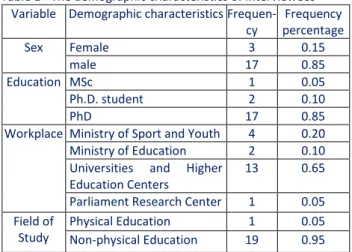
Table 1 - The demographic characteristics of interviewees Variable Demographic characteristics
Frequen-cy Frequency percentage Sex Female 3 0.15 male 17 0.85 Education MSc 1 0.05 Ph.D. student 2 0.10 PhD 17 0.85
Workplace Ministry of Sport and Youth 4 0.20 Ministry of Education 2 0.10 Universities and Higher
Education Centers
13 0.65 Parliament Research Center 1 0.05 Field of
Study
Physical Education 1 0.05 Non-physical Education 19 0.95
As shown in Table (1), most of the sam-ples were male, all had a research or execu-tive background related to the subject, and was faculty members of universities or higher education institutions, and most in-terviewees had a doctoral degree in Physi-cal Education.
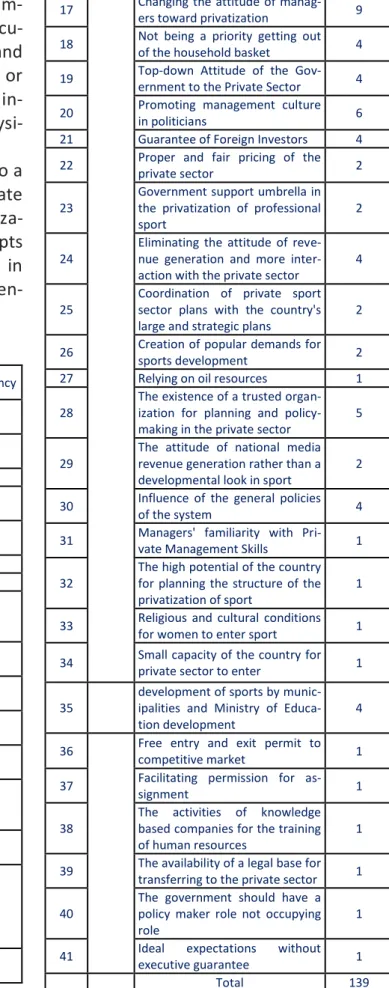
In this research, it was tried to reach to a proper understanding of the appropriate context for the implementation of privatiza-tion in Iran's sport by discovering concepts and to answer the research questions in relation to the effective field of implemen-tation of privatization in sport;
Table 2 - First level coding results Row Axial
code Open code Frequency 1 Fac to rs u n d erl yi n g th e imp le me n tati o n o f pr ivatiza ti o n in s p o rt
The contribution of sports in the national economy 4 2 Sports industry turnover
com-pared to other industries 2 3 High interest rates in sport 2 4 Training Specialized staff for
private sector to enter 11 5 Creating an investment market
for the private sector 5 6 People's attitude towards sport 1
7 3
8
Providing infrastructure for the construction and distribution of private sector
14
9 Applying Powerful Political
Managers 3
10 Transparency of law in the implementation of privatization 12 11 The role of TV in creating sport
culture 4
12 tax exemption for the private
sector 4
13
Advertising and appropriate culture creation for the private sports sector in press and TV
2
14 Lack of proper pricing of Private Clubs' services 1
15
Pessimistic attitude of people toward private sports sectors and problems related to the management and security of private clubs
1
16 The role of social networks and media in development of sport 4
17 Changing the attitude of manag-ers toward privatization 9 18 Not being a priority getting out
of the household basket 4 19 Top-down Attitude of the
Gov-ernment to the Private Sector 4 20 Promoting management culture
in politicians 6 21 Guarantee of Foreign Investors 4 22 Proper and fair pricing of the
private sector 2 23
Government support umbrella in the privatization of professional sport
2
24
Eliminating the attitude of reve-nue generation and more inter-action with the private sector
4
25
Coordination of private sport sector plans with the country's large and strategic plans
2
26 Creation of popular demands for sports development 2 27 Relying on oil resources 1 28
The existence of a trusted organ-ization for planning and policy-making in the private sector
5
29
The attitude of national media revenue generation rather than a developmental look in sport
2
30 Influence of the general policies of the system 4 31 Managers' familiarity with
Pri-vate Management Skills 1 32
The high potential of the country for planning the structure of the privatization of sport
1
33 Religious and cultural conditions for women to enter sport 1 34 Small capacity of the country for
private sector to enter 1
35
development of sports by munic-ipalities and Ministry of Educa-tion development
4
36 Free entry and exit permit to competitive market 1 37 Facilitating permission for
as-signment 1
38
The activities of knowledge based companies for the training of human resources
1
39 The availability of a legal base for transferring to the private sector 1 40
The government should have a policy maker role not occupying role
1
41 Ideal expectations without executive guarantee 1
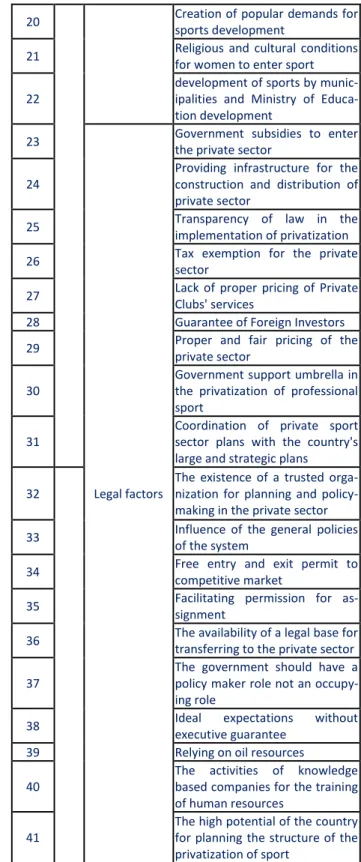
By checking the game codes in this group, it became clear that these codes could be attributed to a class above ab-straction. Hence, in this structure, the defi-nition of substructures was also discussed. This classification is presented in Table 3.
Table 3 - The results of the second level axial coding (classify-ing) Row Main struc ture Substructure (Categories) Concepts 1 Un d er lyi n g fa cto rs fo r i mp le me n ti n g p ri vatiza ti o n in Ira n Factors related to financial market
The contribution of sports in the nations economy
2 Sports industry turnover com-pared to other industries 3 High interest rates in sport 4 Creating an investment market
for the private sector
5 Small capacity of the country for private sector to enter
6
Management factors
Managers' familiarity with Private Management Skills 7 Applying Powerful Political
Managers
8 Training Specialized staff for private sector to enter
9
Media factors
People's attitude towards sport 10 The role of TV in creating sport
culture 11
Advertising and appropriate culture creation for the private sports sector in press and TV 12
The attitude of national media revenue generation rather than a developmental look in sport 13
The role of social networks and media in the development of sport
14
Cultural factors
Pessimistic attitude of people toward private sports sectors and problems related to the management and security of private clubs
15 Changing the attitude of manag-ers toward privatization
16 Not being a priority getting out of the household basket
17 Top-down Attitude of the Gov-ernment to the Private Sector 18 Promoting management culture
in politicians 19
Eliminating the attitude of reve-nue generation and more inter-action with the private sector
20 Creation of popular demands for sports development
21 Religious and cultural conditions for women to enter sport 22
development of sports by munic-ipalities and Ministry of Educa-tion development
23
Legal factors
Government subsidies to enter the private sector
24
Providing infrastructure for the construction and distribution of private sector
25 Transparency of law in the implementation of privatization 26 Tax exemption for the private
sector
27 Lack of proper pricing of Private Clubs' services
28 Guarantee of Foreign Investors 29 Proper and fair pricing of the
private sector 30
Government support umbrella in the privatization of professional sport
31
Coordination of private sport sector plans with the country's large and strategic plans 32
The existence of a trusted orga-nization for planning and policy-making in the private sector 33 Influence of the general policies
of the system
34 Free entry and exit permit to competitive market
35 Facilitating permission for as-signment
36 The availability of a legal base for transferring to the private sector 37
The government should have a policy maker role not an occupy-ing role
38 Ideal expectations without executive guarantee
39 Relying on oil resources 40
The activities of knowledge based companies for the training of human resources
41
The high potential of the country for planning the structure of the privatization of sport
As a result of the analysis of the opinions of the participants in the research, five cat-egories were identified: Factors related to financial market, management factors, me-dia factors, cultural factors and legal factors
that provide the platform for implementa-tion of privatizaimplementa-tion in the sport of the country.
4 DISCUSSION AND CONCLUSION
The results of the research identified 41 concepts and 5 categories including factors related to financial market, management factors, media factors, cultural factors and legal factors that provide the platform for implementation of privatization in the sport of the country. The detailed description of the answer to this question is as follows:
Privatization is considered as the roots of democracy and is a social concept. If society is bigger than the government then it can be stated that privatization can progress. On the other hand, wherever a strong gov-ernment exists, the private sector will be weakened. Also, due to the large size of the government in the Middle East, there re-mains little room for individual choice, and there is no sign of freedom of individual action in the Middle East;
As a result, we will have weak societies and strong government. Also, evidence sug-gests that in countries with oil economy like Iran, economic power is concentrated in the hands of the government, and there is very little space for the presence of economical, political and social activists outside the pub-lic system (SARIOLGHALAM, 2006). In coun-tries where the private sector is unhealthy and undeveloped which needs government support, the defined effectiveness is not compatible with its well-known approach; Therefore, although privatization is a policy that has been successful in many developed countries, It should be noted that if the conditions and prerequisites for it are not provided, the decision to privatize leaves no
favorable effects on the economy of the country; In Africa, for example, privatization programs encountered a lot of difficulties due to lack of financial infrastructure and private sector disability. Also in countries such as Kenya, Jamaica and Peru, lack of government support and their reliance on foreign support has been one of the rea-sons for the failure of privatization (IMF, 1996).
Den Hurk et al. (2015), in a study entitled "Public-Private Partnership in Sport Infra-structure: Interference of Complexity in Belgium", stated that the discrepancy be-tween the government complex approach and the relatively simple infrastructures is evident. Therefore, the arguments show that achieving a better understanding of future plans is required. Mohammadi Moghani et al. (2016) in a study entitled "The factor analysis of the state's political role in implementing the privatization policy of the sports industry", found that the ef-fect of political-social cohesion, rule of law and government power on the privatization on the privatization of Iran's sport is signifi-cant.
As the results of the data obtained from interview with the elite and similar research revealed, the factors associated with finan-cial market, management factors, media factors, cultural factors and legal factors are factors that provide the platform for im-plementation of privatization in the sport of the country. Prior to transferring from state ownership to private ownership, its plat-form should be provided in the country. Prior to implementing privatization in sport, the community should be prepared for this development by specialized and accurate estimates and assessing the condition. The-se measures include investigating the
pri-vate sector's financial, managerial and legal ability to privatize sport, improving the ex-ecutive capacity of the government regard-ing the regulation of private sector activities in sport and the political consensus of the community about participation of the pri-vate sector in its activities and playing a role in society. So far, not enough attention has been paid to privatization. If managers' atti-tudes toward the presence of the private sector changes and they have a collabora-tive approach, they will surely provide a more effective context for the private sec-tor. Approving and providing underlying solutions in the field of construction and assignment of facilities and equipment to the private sector can play an effective role in the presence of the private sector in the sport of the country. If the government can provide proper infrastructure and program for the transfer of sports clubs facilities and clubs to the private sector, it will provide a good platform for privatizing the sport. In management, the training of specialist to enter the private sector the use of powerful political managers and the familiarity of managers with managerial skills can strengthen this section and take steps for implementation of privatization in the country.
It is expected that this research has caused sufficient understanding of the fac-tors influencing the sport in Iran. One of the required conditions is management. Sports officials should, as far as possible, provide the conditions for the training of specialist staff to enter the private sector and the fa-miliarity of managers with the private sec-tor managerial skills, and applying work-force educated in Physical education and university professors to the private sector. Also, since one of the underlying conditions
is the attraction of the media foreign and domestic investor, the press and the media should promote the private sector of sport and try to introduce the country in order to attract foreign and domestic investors.
Considering that one of the underlying categories in the privatization of sports is cultural-social factors, it is recommended that the authorities, taking into account the philosophy of sport and culture among the people, as well as the developmental role of sports by complementary institutions such as municipalities and ministry of Education, provide the context for private sector to participate in all sectors of development of the country's sport.
5 REFERENCES
AMANI, A. et al. The management problems of privatized athletic facilities in northern Khorasan and Razavi Khorasan province. Research in Sport Management and Psy-chology, Vol. 2, Issue 4: 1-6, 2014.
ANIBAL INSFRAN PELOZO, J. "Privatization in Paraguay: some lessons," The Quarterly Review of Economics and Finance, Elsevier, vol. 41(5): 737-753, 2001. https://doi.org/ 10.1016/S1062-9769(01)00101-6
AYIM, E. M. A thesis, University of Nevada, (Las Vegas, USA), 2009.
AYUBI, N. A comparative perspective on privatization programmes in the Arab World, In Younis T., Privatization: A review of policy and implementation in selected Arab countries, International Journal of public sector management, Vol.9, No.3, pp.18-25, 1995; 1996. https://doi.org/10.11 08/09513559610124450
CHOWDHURY, F.L. Corrupt Bureaucracy and privatization of tax enforcement, pathaksa-mabesh, Dhaka, 2006.
CLARK, J. M.; CORNWELL, B. P.; STEPHEN, W. The impact of title event. Sponsorship announcements on shareholder wealth, market let, 2008. https:// doi.org/10/1007/
s11002-008-9004.
DEN HURK, M.; VERHOEST, K. The governan ce of public–private partnerships in sports infrastructure: Interfering complexities in Belgium. International Journal of Project Management, Volume 33, Issue 1, January 2015, Pages 201-211, 2015.
GRUSKY, S.; FIIL-FLYNN, M. Will the World Bank Back down? Water Privatisation in a Climate of Global Protest (Washington, D.C: Public Citizen); P: 18-19, 2004.
HOOMAN, H. Understanding the Scientific Method in Behavioral Sciences. Tehran; Samt publication, 2007.
IMF. Annual Report of the Executive Board for the Financial Year Ended April 30. IMF Publications, Washington, D.C., 1996.
KARLIS, G. The future of leisure, recreation and sport in Canada: a SWOT for small sized enterprises. The Sport Journal, 9 (2), 7, 2006.
MIAO CHANG; HIDEFUMI IMURA. Develop-ing Private Finance Initiatives (PFI) Public-Private Partnership (PPP) for Urban Envi-ronmental Infrastructure in Asia, 2008. Retrived from: http://lenviroscope.iges.or. jp/modules/envirolib/upload/23/attach/ue 2-3009.pdf.2008/08/23.
MOHAMMADI MOGHANI, H. ET AL. The fac-tor analysis of the government political role in implementing the privatization policy in sports industry, New Approaches to Sport Management. 4 (13): 61-72, 2016.
MUNARI et al. "Privatization process and the redefinition of corporate R&D bounda-ries". Journal of Research Policy, Vol.31, p. 31-53, 2002. https://doi.org/10.1016/S004 8-7333(01)00108-1
SARIOLGHALAM, M. Democracy in the Mid-dle East: Limitations and Prospects, the Bruno Kreisky Forum for International Dia-logue, 2006.
SGL CONSULTING GROUP. State Level Sport-ing Facilities Strategic Plan 2001-2017, 2006. Retrieved from: http//www.Recsport. sa.gov.au/pdf/draft-final-report-2007-2017. pdf.
SMITH, S. J. "Football, Its Values, Finances and Reputation". Informe para la Football Association, 1997.
THANOS; KRIEMADIS. Strategic marketing planning in the sport sector. Sport Man-agement International Journal 3, 1, 33-35, 2007.
WU XIAO, R.; HU, X. Consideration of Privat-isation Management of public sport facili-ties. Journal Hubei sports science 26. 10- 11, 2007.
ZOLFAGHARIYAN, M. et al. Data based The-orization by Vivo Software, Publication of Imam Sadiq University (AS), Tehran, 2011.
License information: This is an open-access article distributed under the terms of the Creative Commons Attribution License, which permits unrestricted use, distribution, and reproduction in any medium, pro-vided the original work is properly cited.
Article received on February 12, 2018. Evaluated March 02, 2018.
Accepted on March 19, 2018. Published on May 25, 2018. How cite this article (ABNT):
RAZAVI, Seyed Mohammad Hossein;
AMANI, Amin; FIROUZABADI, Alireza
Ghanbari. An analysis of underlying factors for implementing privatization in Iranian Sport. Estação Científica (UNIFAP), Macapá, v. 8, n. 1, p. 57-65, jan./abr. 2018.