Assessment of Precipitation Data Generated by GPM and TRMM Satellites
Luísa Carolina Silva Lelis
1, Raoni Wainer Duarte Bosquilia
2, Sergio Nascimento Duarte
1 1Departamento de Engenharia de Biossistemas, Universidade de São Paulo,
Piracicaba, SP, Brazil.
2
Universidade Tecnológica Federal do Paraná, Dois Vizinhos, PR, Brazil.
Received in May 17, 2017 – Accepted in November 14, 2017
Abstract
This study aimed to verify the performance of the information produced by the GPM (Global Precipitation Measure-ment) mission and TRMM (Tropical Rainfall Measurement Mission) on the eastern region of São Paulo state, based on a comparison of rainfall data from DAEE (Department of Waters and Electric Energy of São Paulo State). The comparison was done by comparing spatially aggregated information from both sources. In order to analyze the results, we mea-sured: (1) Relative Difference, (2) BIAS and (3) Root Mean Square Error (RMSE). It was found that the relative differ-ences were in the range of -20% to 20% for both missions. Analyzing the BIAS for both satellites it was observed that 68% of the measurements were overestimated. The highest agreement was obtained for the mesoregion of Campinas and the lowest for Araraquara. In the TRMM, the lowest RMSE values were found in the Araraquara mesoregion and the highest in Piracicaba. In the GPM the closest measured values were observed in the Piracicaba mesoregion, while the most distant values were identified in Araraquara. All the analyzes of this work demonstrated similarity between the er-rors generated by both satellites. New comparison studies are needed to better understand the products.
Keywords:precipitation, GPM, TRMM, rainfall estimated by satellite.
Avaliação dos Dados de Precipitação Gerados pelos Satélites
GPM e TRMM
Resumo
Este estudo objetivou verificar o desempenho das informações produzidas pela missão GPM (Global Precipitation Mea-surement) e TRMM (Tropical Rainfall Measurement Mission) sobre a região leste do estado de São Paulo, tendo como base de comparação pluviômetros do DAEE (Departamento de Águas e Energia Elétrica do Estado de São Paulo). A conferência foi feita através da comparação da informação agregada espacialmente, proveniente de ambas as fontes. A fim de se analisar os resultados, foram medidos: (1) Diferença Relativa, (2) BIAS e (3) Raiz do Erro Médio Quadrático (REMQ). Obteve-se como resultado que as diferenças relativas situaram-se na faixa de -20% a 20% para ambas as missões. Analisando-se os BIAS para ambos os satélites observou-se que 68% das aferições foram superestimadas. A maior concordância foi obtida para a mesorregião de Campinas e a menor para Araraquara. No TRMM constatou-se os menores valores de REMQ na mesorregião de Araraquara e os maiores em Piracicaba. No GPM os valores medidos mais próximos foram observados na mesorregião de Piracicaba, enquanto os valores mais distantes foram identificados em Araraquara. Todas as análises deste trabalho demonstraram similaridade entre os erros gerados por ambos os satélites. Novos estudos de comparação são necessários para melhor entendimento dos produtos.
Palavras-chave:precipitação, GPM, TRMM, chuva estimada por satélite.
1. Introduction
Precipitations, and consequently water availability, are the most important indicators in determining the weather and climate conditions of a region. It is extremely
useful to have knowledge about the quantitative rainfall information and its distribution over time, since these are fundamental factors to perform a climatic zoning and to de-termine the agricultural aptitude of a given area. In addi-tion, knowing quantitative rainfall information is important
Artigo
to identify the need for additional irrigation of several crops, the design of dams, water and sewage networks, among others (Massagli, Victoria and Andrade, 2011).
Despite the importance of the precipitation phenome-non on the environment and on social life, it is well known that the accuracy of its space-time variation measurement on planet Earth is still a problem, characterized by method-ological, technical and geographical issues (NASA, 2016).
According to Fensterseifer (2013), the traditional technique of rain measurement is performed with ground rain gauges; however, these instruments have deficiencies in the representation of rainfall distribution in larger areas, because they are punctual instruments that cover an area of about 10-1 m2. Therefore, a high density of rain gauges would be required to correctly represent the rainfall behav-ior of a region, which, for countries with large territorial ex-tensions it becomes impracticable due to the high costs of rainfall monitoring.
On the other hand, a wide range of remote sensing products in rain estimation are available in increasingly de-tailed spatial and temporal resolutions Thus, Santos (2014) states that remote sensing can contribute to the continuous representation of the distribution of rainfall events.
The Tropical Rainfall Measurement Mission (TRMM) satellite is an example of a remote rainfall gaug-ing instrument, which was launched in 1997 and was com-pleted in April 2015. Studies performed by Hiroshima
(1999), Kummerowet al.(2000) and Flaming (2004) dem-onstrated the quality of the results obtained by the mission.
Due to this success, another generation of precipita-tion satellite was projected. The GPM (Global Precipitaprecipita-tion Measurement) satellite was launched in February 2014 promising more refined precipitation data either in terms of time and as in space (NASA, 2011). However, there are still few studies that evaluate the data generated by GPM, so this work had the objective of analyze the information produced by the GPM mission and its predecessor, the TRMM, on the Eastern region of São Paulo state.
2. Materials and Methods
2.1 Characterization of the study areas
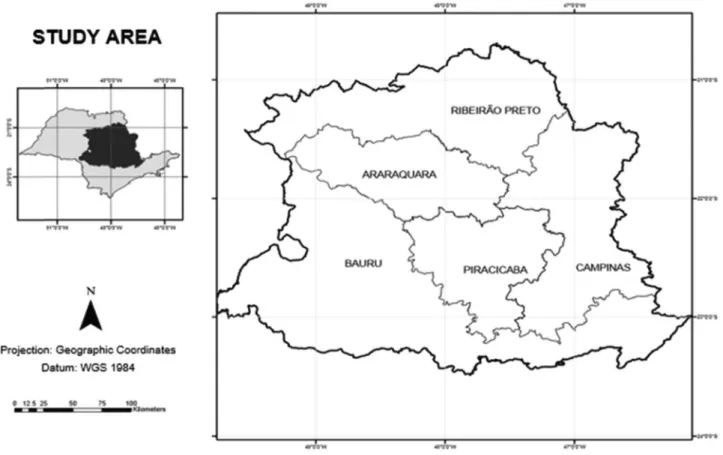
This work was applied in the eastern region of the state of São Paulo, fully contemplating Piracicaba, Cam-pinas and Araraquara mesoregions as well as parts of the mesoregions of Bauru and Ribeirão Preto (Fig. 1).
The climate of the eastern region of São Paulo is de-fined by Köppen as Cwa - superficial mesothermic - sub-tropical climate with dry winters (with temperatures below 18 °C) and hot summers (with temperatures above 22 °C) (EMBRAPA, 2016). Rainfall is concentrated in the months of October to March, with an average annual precipitation of 1250 mm, and the dry period is from April to September (Oliveira, 2012). According to the pedological survey
ried out by Oliveiraet al.(1999), the main soils found in the region are Clayey soils and Latosol. The original vegetation is known as Seasonal Semideciduous Forest (Instituto Flo-restal, 2009). However, it is practically nonexistent these days.
2.2. Data acquisition
2.2.1. Satellite data acquisition
In order to evaluate the evolution of data generated by the GPM satellite comparing it to its predecessor, precipita-tion products were downloaded from both instruments dur-ing the same time period: from March 2014 until February 2015. Regarding the TRMM, the 3B43 Version 07 (TRMM Monthly Rainfall) product was downloaded, which is a col-lection of rainfall data accumulated in millimeters per month (mm.month-1) with a spatial resolution of 0.25°.
Concerning the GPM satellite, the IMERG Version 03 product was downloaded. It is also a collection of rain-fall data accumulated in millimeters per month, but its spa-tial resolution is of 0.10°. Both products can be downloaded from NASA’s (National Aeronautics and Space Adminis-tration) Mirador portal and are briefly described in the Ta-ble 1.
2.2.2. Comparison data acquisition
Knowing that precipitation data collected on land are considered to be true (Ebert, 2003), the comparison of the data estimated by the satellites was performed regarding the information observed by meteorological stations found in the study area. This data was obtained through the web-site of the Department of Water and Electric Power of the State of São Paulo (DAEE).
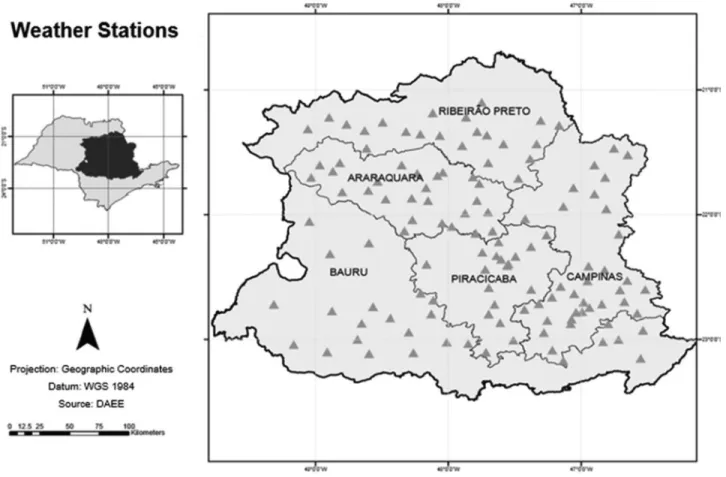
The download was made for the same period referring to the remote data, from March 2014 until February 2015. In total 372 stations were found in the study area (Fig. 2).
2.3. Data processing
In order to verify the satellite data respecting a spe-cific spatial resolution, it was decided to work at the same GPM satellite resolution, that is 0.10° x 0.10°. Therefore, it was necessary to perform the discretization of the TRMM satellite information, since it has an original resolution of 0.25° x 0.25°. This technique consists of resampling the Table 1- Remote sensing products used in this work.
Product Spatial resolution Spatial coverage TRMM 3B43 0.25° 50° N-50° S GPM IMERG 0.10° 90° N-90° S
original pixels at more detailed resolutions. The discretiza-tion was applied for every month between March 2014 and February 2015.
Ground observations represent the punctual form of collection. In order to make the information of both sensors spatially comparable, the interpolation technique was used. Thus, the values measured by the ground rain gauges were reallocated from the same levels of discretization adopted on the TRMM.
The interpolation for the weather stations was done by the method of Ordinary Kriging (OK) or Ordinary Kriging (KO) (Eq. (1)).
OK = p x1 1+p x2 2+p x3 3 ...+ +pnxn (1)
Given a point to be estimated, the actual value un-known represented byOK, the estimated value (OK*) is calculated usingnsamples located at known coordinates with valuesx1,x2,x3, ,xnin a linear manner, where pi are the weights attributes to each samplei(Landim, 2006).
This interpolator was adopted because it was the one with the smallest calculated errors in a rainfall spatial anal-ysis performed by Carvalho and Assad (2005) and Car-valho, Assad and Pinto (2012) in São Paulo state.
2.4. Data comparison
The study of the precipitation estimated by satellites has several different approaches in the literature regarding the comparison with data observed by rain gauges. Accord-ing to Soares, Paz and Piccilli (2016), each methodology adopted in the researches has advantages and disadvantages due to the enormous space-time variability of the rain phe-nomenon. In addition, the confrontation is usually per-formed between punctual rainfall data from meteorological stations and estimates made by the TRMM or GPM in terms of average values over the area of the pixel (which is giant in relation to the coverage area of the rain gauge).
Amitaiet al. (2012) and Su, Hong and Lettenmaier (2008) adopted the methodology of data comparison based on the interpolation of data from the rain gauges to the cen-ters of the TRMM grid points. The contrary was done by Chenet al.(2013) and Uddinet al.(2008), in other words, they performed the interpolation of the TRMM grid data to the rain gauge locations. In the method adopted by Nichol-sonet al. (2003), the comparison between the values of each grid point of the TRMM and the average value of the rain gauges located in each grid cell was performed.
This study worked similarly to Ochoaet al.(2014) and Pereiraet al.(2013), who obtained results through the generation and comparison of spatially aggregated infor-mation, both from the TRMM and GPM and from the rain gauges, for an entire region with greater spatial coverage, in this case the eastern region of the state of São Paulo and more specifically the mesoregions of Araraquara, Cam-pinas and Piracicaba.
2.5. Performance analyzes
2.5.1. Time-integrated analysis - Relative difference
More than analyzing the satellite’s rainfall estimation according to the comparisons with the field data, it was in-tended with this study to spatialize the differences (or er-rors) over time. Thus, using the space adaptation processes performed on the data (item 2.3) it was possible to calculate the relative difference in each cell, allowing the identifica-tion of regions in the study area where the similarity be-tween precipitation measured by the different instruments (rain gauge and satellite) is higher or lower. The relative er-ror (ER) was calculated from Eq. (2).
ER P Z P
= - *100 (2)
wherePis the precipitation interpolated from the rainfall data from the DAEE andZis the data from the satellites. At first, the relative difference calculation was performed for TRMM and then for GPM satellite.
2.5.2. Integrated analysis in space
2.5.2.1. BIAS
TheBIASindicates how the estimates of rainfall by satellite (Z) are related to the measurements obtained by the rain gauges (P) (Araujo, 2006). Negative BIAS values indi-cate that, on average, the satellite overestimates the mea-sure obtained by rain gauges, and for positive values it means that an underestimation occurred (Eq. (3))
BIAS P Z
n
=
å
( - ) (3)wherePrepresents the field measurements,Zare the esti-mates of the satellites and n is the number of pixels present in the mesoregion home. This calculation was performed for each mesoregion that the study area entirely occupies, that is, Araraquara, Campinas and Piracicaba.
2.5.2.2. Root Mean Square Error (RMSE)
The root mean square error (RMSE) evaluates the er-ror from the square of the differences between the satellite data (Z) and the rain gauge (P). It also has greater influence on errors of greater magnitude, being very useful in cases which great errors are undesirable (Eq. (4)).
RMSE P Z
n n
i n
=
å
= ( - )2
1 (4)
where (P) represents the field measurements, (Z) are the es-timates of the satellites and n is the number of pixels present in each mesoregion.
RMSE) > 0 values represent higher errors, between esti-mated and observed data (Santos, 2014).
3. Results and Discussion
3.1. Interpolation of rainfall data
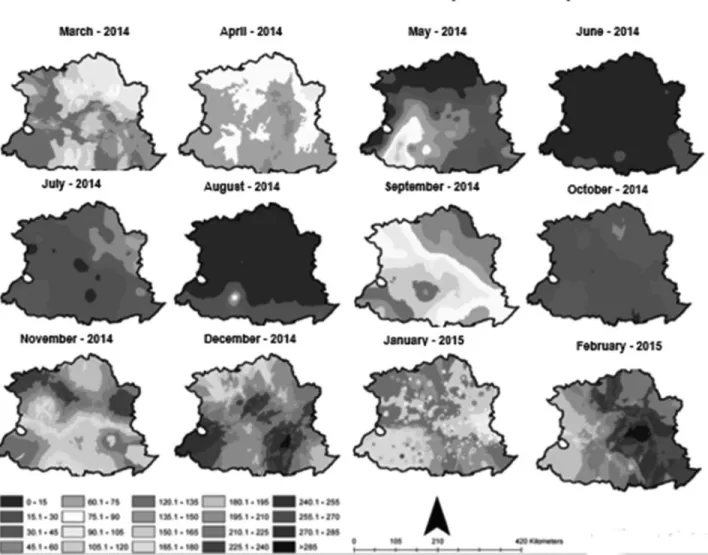
Through the Ordinary Kriging technique (Eq. (1)) it was obtained weighted precipitation data for the entire study area (Fig. 3) as a function of the measurements per-formed by the 372 rainfall stations present in the region.
During the study interval - March 2014 to February 2015 - a monthly rainfall accumulation ranging from 0 mm per month to 300 mm per month was observed. According to the interpretation of the interpolation, rainfall levels be-low the historical average, that are usually between 80 mm and 140 mm, can be observed during the months of May to October (Marengoet al., 2015). However, according to the analysis performed by ANA, Agência Nacional de Águas (2015), in southeastern Brazil, the 2014’s rainfall dynamic was especially anomalous. Taking into consideration only
stations with more than 50 years of data, it was verified that in 25% of them the 2014’s rainfall was among the 3 lowest ever registered. In the state of São Paulo, the number rises to 50% of the historical rainfall, and in 30% the event was the driest ever recorded.
According to Dobrovolski and Rattis (2015), after the drought period of 2014, the level of reservoirs only rose again in February 2015, due to above-average rainfall re-corded in this month. This event is also registered on Fig. 3 for the month of February, which, according to Marengo (2015), historically, does not exceed 210 mm accumula-tion.
3.2. Performance reviews
3.2.1. Time-integrated analysis
3.2.1.1. Relative difference - satellite TRMM
In this analysis approach, the remote precipitation es-timates made by the TRMM satellite are compared pixel by pixel with the interpolated values acquired from ground
rainfall observations. Relative difference analysis (Eq. (2)) was used for this comparison.
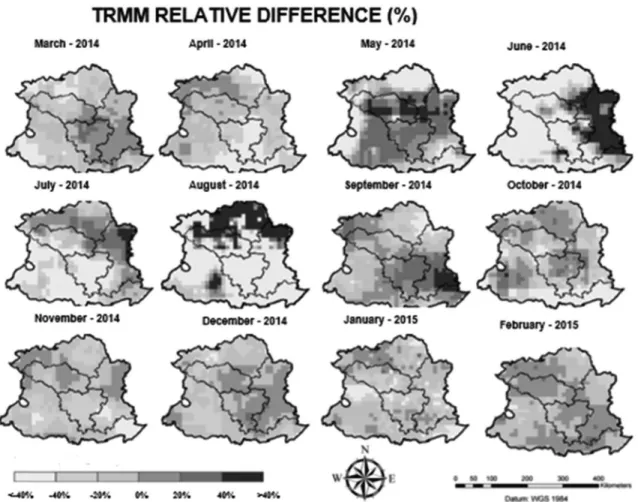
This analysis was performed for the twelve months of study - March 2014 to February 2015. Thus, twelve images (Fig. 4) were generated each one represents the spatial dis-tribution of the relative difference (under the discretization of 0.1° x 0.1°) in every month. In this scenario, it was possi-ble to observe seasonality in the results.
The relative differences in the cells were mostly in the range of -20% (the satellite overestimated the field obser-vation by 20%) and 20% (the satellite underestimated by 20%). This value is in agreement with the research pub-lished by Collischonnet al. (2006), in which the authors found relative differences ranging from -35% to 22% in the Paraguay River basin. In an analysis performed by the same author in the São Francisco river basin, Collischonn (2006) obtained mean relative differences between -15% and 15% in most cells. Araujo (2006) observed an average overesti-mation of the satellite varying between 36% and 56% in the Iguaçu basin.
As can be observed in Fig. 4, the dry period - May to August - was the one that presented the largest areas with relative differences surpassing the values of 40% above or below 0, being this result similar to that obtained by Soares,
Paz e Piccilli (2016). In this work, the authors realized that in drought periods the linear correlation between the field observations regarding the satellite estimates decreases for all the studied months in Paraíba state.
Pereiraet al.(2013), working with monthly compari-sons of rain gauges and with the product 3B43-TRMM, ob-tained higher concordances between monthly accumulated rainfall in the period where precipitation was more abun-dant. Fig. 4 shows better relative differences between the months of November / 2014 and February / 2015, which is the rainy season of the year.
Regarding space, it was possible to identify the worst results of relative difference in the Southwest region of the study area, that is, in the Bauru mesoregion. One hypothesis for this result is the lower concentration of rain gauges in this extension of territory. Thereby, the previous interpola-tion may have had a negative influence on this result. This same hypothesis was raised by Collischonn (2006) for the Tapajós basin, which had the lowest density of rain gauges per pixel among the basins analyzed by the author, resulting in the region in which the worst results were obtained in the field-satellite comparison.
3.2.1.2. Relative difference - GPM satellite
In this analysis approach, the remote precipitation es-timates realized by the GPM satellite were compared pixel by pixel with the interpolated values acquired from ground rainfall observations.
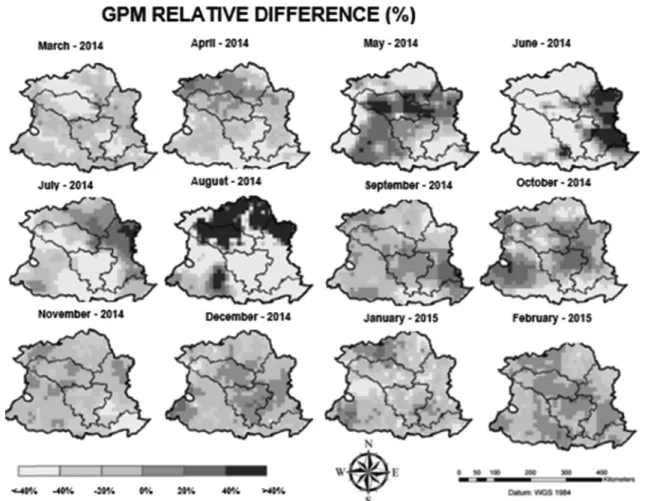
This analysis was performed for the twelve months of study - March 2014 to February 2015. Thus, twelve images were generated (Fig. 5) representing the spatial distribution of the relative difference in every month.
The relative difference results observed for the GPM satellite (Fig. 5) demonstrated a spatial similarity regarding the relative errors from the TRMM satellite, that is, the rela-tive differences in the cells were mostly in the range of -20% (the satellite overestimated the field observation by 20%) and 20% (the satellite underestimated by 20%).
Another similar point between the two missions is the seasonality in the results. During the dry season, the GPM satellite reached its worst results in comparison with the rainfall gauges. The same behavior was observed for the predecessor mission, the TRMM satellite.
Therefore, it is possible to point out the existence of similar patterns of estimation for both satellites in the study area of this work. Maet al.(2016), comparing the results of daily estimates of TRMM and GPM satellites with
observa-tions of conventional meteorological staobserva-tions, also showed a similarity between the obtained results.
3.2.2. Integrated analysis in space
3.2.2.1. BIAS
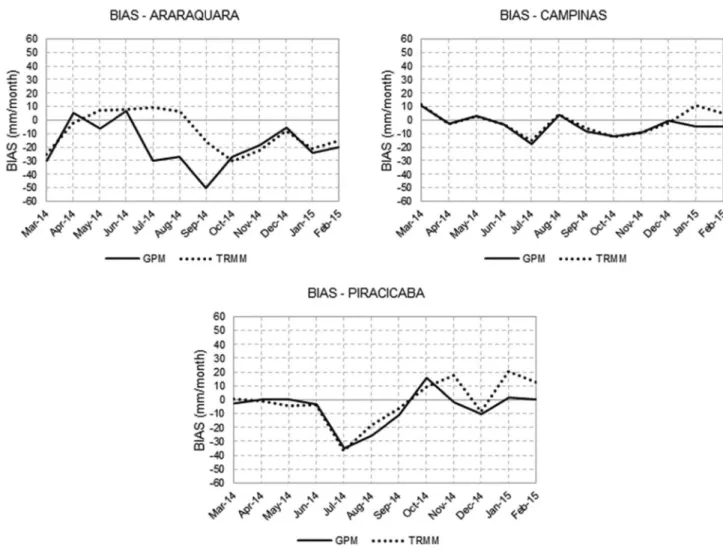
The evaluation of BIAS (Eq. (3)) was performed for the mesoregions of Araraquara, Campinas and Piracicaba. As a result, the mean sum of the differences for each of these mesoregions was obtained in each month that the study covers (Fig. 6).
Considering that the negative values of BIAS are those that overestimate the field measurements and the pos-itive values underestimate them, a predominance of mo-ments in which both satellites overestimated the ground measurements was noted. The TRMM satellite, for exam-ple, at the three mesoregions studied, 23 samples were overestimated and 13 underestimated for the study time. At the same time, the GPM satellite product overestimated 26 samples and underestimated 10. Thus, it can be stated that 68% of the measurements were overestimated and 32% were underestimated. More specifically, an overestimation of 75%, 71% and 58% was calculated for the Araraquara, Campinas and Piracicaba mesoregions respectively.
It can be observed in Fig. 6 that the Araraquara mesoregion was the one which obtained the most discrep-ant values of BIAS, and these varied between -50 mm per month-1and 10 mm per month-1. In this region, it was also possible to observe a lower similarity between the TRMM and GPM satellites, especially in the winter months of the southern hemisphere.
According to a study published by Liu (2016), the dif-ferences between the measurements of both satellites per-formed on continents are very small when compared to the differences found in ocean studies, but the same author ob-served greater discrepancies between the measurements taken on land during the austral winter for some countries, such as South Africa, Australia and Brazil.
From the interpretation of Fig. 6, it is possible to no-tice a similarity between the results of BIAS for both satel-lites concerning the comparison with ground gauges observations. In general, for the mesoregions of Campinas and Piracicaba, there is a mean BIAS with a maximum dif-ference of 20 mm.month-1 between satellites, suggesting that the two products are similar, due, according to Huffman et al. (2015), to the same standard setting for
BIAS correction being applied to both satellites in their re-spective algorithms.
The mesoregion of Campinas obtained the closest BIAS values to zero during the whole study year. Thus, this was the area that obtained the best estimation results for both satellites.
3.2.2.2. Root Mean Square Error (RMSE)
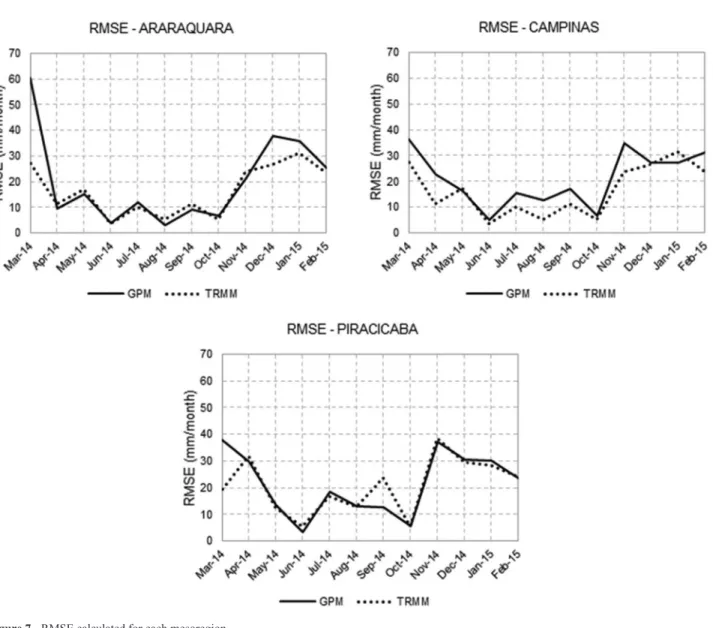
The RMSE calculation (Eq. (4)) was performed only for the mesoregions where the study area occupied entirely each mesoregion (Araraquara, Campinas and Piracicaba). Therefore, the Root Mean Square Error was obtained for each of the mesoregions in each month that the study cov-ers, that is, from March 2014 to February 2015 (Fig. 7).
When the TRMM satellite was evaluated, the lowest RMSE value was observed in the Araraquara mesoregion, with a variation of 6 to 31 mm per month, that is, the small-est difference between TRMM small-estimates and rainfall mea-surements according to such metric. The mesoregion of Campinas presented RMSE values between 7 to 33 mm.month-1and Piracicaba of 6 to 39 mm per month.
In the work of Soares, Paz and Piccili (2016) a RMSE ranging from 32 to 92 mm per month was obtained for the
state of Paraíba, where the highest values were observed to the East of the state and the lowest ones to the West (a re-gion known as ‘sertão’). In the work of Pereiraet al.(2013), performed in the Brazilian northeast, RMSE was obtained, ranging from 4 mm in the month of August to 24 mm in the month of March. Therefore, the values obtained in this re-search are different from those obtained by these authors. This reality can be explained by the fact that these works have applied different comparison methodologies and be-cause of the different rainfall dynamics among the study re-gions.
Regarding GPM satellite, a lower RMSE value was observed in the Piracicaba mesoregion, with a variation of 4 to 38 mm per month, that is, there was a smaller difference between GPM estimates and ground rainfall measurements according to this metric. The mesoregion of Campinas pre-sented RMSE values between 6 to 38 mm.month-1 and Araraquara 3 to 60 mm per month.
Again, it was possible to note a similarity between the errors of both satellites regarding the comparison with pre-cipitation observation results, suggesting that the two prod-ucts are similar, due, according to Huffmanet al.(2015), to the same standard setting for BIAS correction being ap-plied to both satellites in their respective algorithms.
4. Conclusion
From the results obtained by this research, it was drawn that the rainfall estimates from TRMM product 3B43 and IMM product GPM reproduced in a general form the spatial-temporal pattern of the rainfall regime of the eastern region of São Paulo state. The relative differences were usually in the range of -20% to 20% for both missions when compared to ground rainfall measurements. The larg-est relative errors were observed during the drought months in 2014 for both the 3B43 product and the IMERG product.
overestimated and 32% were underestimated. In this met-ric, the highest agreement between satellites estimates and ground rainfall measurements was obtained for the Cam-pinas mesoregion, while the lowest agreement was identi-fied for the Araraquara mesoregion.
Evaluating the TRMM satellite, the lowest RMSE values were found in the Araraquara mesoregion and the highest in the Piracicaba mesoregion. For the GPM satel-lite, the closest values of rainfall were observed in the Piracicaba mesoregion, while the most distant values were identified in the Araraquara mesoregion.
All analyzes of this work demonstrated similarity be-tween the errors generated by both satellites, suggesting that the two products are similar, due to the same standard adjustment for BIAS correction being applied to both in their respective algorithms.
For the time being, it is not possible to say that the similarity between satellite errors will repeat itself in the coming years, since GPM mission data only started to be launched in March 2014 and there is big amount of data which will be collected in the next years. Such fact suggests the necessity for new studies, which may open new hori-zons in hydrological planning in remote parts of the world.
References
AMITAI, E.; UNKRICH, C.L.; GOODRICH, D.C.; HABIB, E.; THILL, B. Assessing satellite based rainfall estimates in semiarid watersheds using the USDA-ARS Walnut Gulch gauge network and TRMM PR.J. Hydrometeorol., v. 13, n. 5, p. 1579-1588, 2012.
ANA. Boletins de Monitoramento dos Reservatórios do Sistema Hidráulico do Rio Paraíba do Sul, v.10, Brasília, 2015. ARAUJO, A.N. Simulação hidrológica com o uso de chuva
estimada por satélite. 2006. 130 f. Dissertação (Mestrado em Engenharia de Recursos Hídricos e Ambiental) – Uni-versidade Federal do Paraná, Curitiba, 2006.
CARVALHO, J.R.P.; ASSAD, E.D. Análise espacial da preci-pitação pluviométrica no estado de São Paulo: comparação de métodos de interpolação.Eng. Agríc., Jaboticabal, v. 25, n. 2, p. 377-384, 2005.
CARVALHO, J.R.P.; ASSAD, E.D; PINTO, H.S. Interpoladores geoestatísticos na análise da distribuição espacial da preci-pitação anual e de sua relação com altitude.Pesq. agropec. bras. Brasília, v. 47, n. 9, p. 1235-1242, 2012.
CHEN, Y.; EBERT, E.E.; WALSH, K.E.; DAVIDSON, N.E. Evaluation of TRMM 3B42 precipitation estimates of tropi-cal cyclone rainfall using PACRAIN data.J. Geophys. Res. Atmos., v. 118, n. 5, p. 2184-2196, 2013.
COLLISCHONN, B. Estimativas de precipitação por sensoria-mento remoto passivo: desempenho do satélite TRMM na bacia do rio Paraguai até Descalvados. In: 1° Simpósio de Geotecnologias do Pantanal, 2006.Anais... Embrapa Infor-mática Agropecuária/INPE, p. 47-56.
COLLISCHONN, B.Uso de precipitação estimada pelo satélite TRMM em modelo hidrológico distribuído. 2006. 128 f. Dissertação (Mestrado em Recursos Hídricos e Saneamento Ambiental) – Universidade Federal do Rio Grande do Sul, Porto Alegre, 2006
DOBROVOLSKI, R.; RATTIS, L. Water Collapse in Brazil: the Danger of Relying on What You Neglect.Natureza e Con-servação, v. 3, ed. 1, 2015.
EBERT, E.E.; DAMRATH, U.; Wergen, W.; BALDWIN, M.E. The WGNE assessment of short-term quantitative precipita-tion forecasts. Bulletin of the American Meteorological Society, v. 84, n. 4, p. 481-492, 2003.
EMBRAPA. EMPRESA BRASILEIRA DE PESQUISA
AGRO-PECUÁRIA. Clima. Disponível em:
http://www.cnpf.embrapa.br/pesquisa/efb/clima.htm. Acesso em: 16 de Maio de 2016.
FENSTERSEIFER, C.A.Qualidade das estimativas de precipitação derivadas de satélites na Bacia do Alto Jacuí -RS. 2013. 110 f. Dissertação (Mestrado em Engenharia Civil e Ambiental) - Universidade Federal de Santa Maria, Santa Maria, 2013.
FLAMING, G.M. Measurement of global precipitation. In: Inter-national Geoscience and Remote Sensing Symposium. 9, 2004; Anchorage, AK, EUA.
HIROSHIMA, K. Rainfall observation from Tropical Rainfall Measuring Mission (TRMM) satellite.Journal of Visual-ization. v. 2, n. 1, p. 93-98, 1999.
HUFFMAN, G.; BOLVIN, D.; NELKIN, E.Day 1 IMERG final run release notes, 2015. Disponível em:
https://pmm.nasa.gov/sites/default/files/docu-ment_files/IMERG_ FinalRun_Day1_release_notes. pdf. Acesso em: 14 de Novembro de 2016.
INSTITUTO FLORESTAL.Mapa da cobertura vegetal nativa
paulista, 2009. Disponível em:
http://revistapesquisa.fapesp.br/wp-content/uploads/2012/0 8/mapa.pdf?170b85. Acesso em: 16 de Maio de 2016. KUMMEROWA, C.; SIMPSON, J.; THIELEA, O.; BARNESA,
W.; CHANGA, A.T.C.; STOCKERA, E. The Status of the Tropical Rainfall Measuring Mission (TRMM) after Two Years in Orbit.Journal of Applied Meteorology, v. 39, p. 1965-1982, 2000.
LANDIM, P.M.B. Sobre geoestatística e mapas.Terræ Didatica, v. 2, n. 1, p. 19-33, 2006.
MARENGO, J. A.; NOBRE, C.A.; SELUCHI, M.E; CUARTAS, A.; ALVES, L.M. A seca e a crise hídrica de 2014-2015 em São Paulo.Revista USP, n. 106, p. 31-44, São Paulo, 2015. LIU, Z. Comparison of Integrated Multisatellite Retrievals for
GPM (IMERG) and TRMM Multisatellite Precipitation Analysis (TMPA) Monthly Precipitation Products: Initial Results.Journal of Hydrometeorology, v. 17, p. 777-790, 2016.
MA, Y.; TANG, G.; LONG, D.; YONG, B.; ZHONG, L. Similar-ity and error intercomparison of the gpm and its predecessor trmm multisatellite precipitation analysis using the best available hourly gauge network over the Tibetan Plateau. Remote Sensing, v. 8, n. 569, p. 1-17, 2016.
MASSAGLI, G.; VICTORIA, D.; ANDRADE, R. Comparação entre a precipitação medida em estações pluviométricas e estimada pelo satélite TRMM. In: 5 °Congresso Interins-titucional de Iniciação Científica - CIIC 2011 - 8, 2011. NASA. NATIONAL AERONAUTICS AND SPACE
NASA. NATIONAL AERONAUTICS AND SPACE ADMINIS-TRATION.GPM Mission Concept, 2011. Disponível em: http://pmm.nasa.gov/gpm. Acesso: 09 de Maio de 2016. NICHOLSON, S.E.; SOMEB, B.; MCCOLLUMC, J.;
NEL-KIND, E.; KLOTTER, D. Validation of TRMM and other rainfall estimates with a highdensity gauge dataset for West Africa. Part II: validation of TRMM rainfall products.J. Appl. Meteorol., v. 42, n. 10, p. 1355-1368, 2003. OCHOA, A.; PINEDA, L.; CRESPO, P.; WILLEMS, P.
Evalua-tion of TRMM 3B42 precipitaEvalua-tion estimates and WRF retro-spective precipitation simulation over the Pacific–Andean region of Ecuador and Peru.Hydrol. Earth Syst. Sci., v. 18, n. 8, p. 3179-3193, 2014.
OLIVEIRA, J.B.; CAMARGO, M.N.; ROSSI, M.;
CALDERANO, B. Mapa pedológico do estado de São
Paulo, 1999. Disponível em:
http://www.iac.sp.gov.br/solossp/pdf/mapa_pedologico_So los_Estado_de_Sao_Paulo.pdf. Acesso em: 16 de Maio de 2016.
OLIVEIRA, J.S. Avaliação de modelos de elevação na esti-mativa de perda de solo em ambiente SIG.2012, 103 f. Dissertação (Mestrado em Irrigação e Drenagem) – Escola Superior de Agricultura “Luiz de Queiroz”, Piracicaba, 2012.
PEREIRA, G.; SILVA, M. E. S.; MORAES, E. C.; CARDOZO, F. S. Avaliação dos dados de precipitação estimados pelo satélite TRMM para o Brasil.RBRH, v. 18, n. 3, p. 139-148, 2013.
SANTOS, A.S.P.Análise de desempenho dos campos de chuva estimados pelo satélite TRMM na Paraíba, para fins de modelagem hidrológica distribuída. 2014. 128 f. Dissertação (Mestrado em Engenharia Urbana e Ambiental) -Universidade Federal da Paraíba, João Pessoa, 2014. SOARES, A.S.D.; PAZ, A.R.; PICCILLI, D.G.A. Avaliação das
estimativas de chuva do satélite TRMM no Estado da Para-íba.RBRH, Porto Alegre, v. 21, n. 2, p. 288-299, 2016. SU, F.; HONG, Y.; LETTENMAIER, D.P. Evaluation of TRMM
Multisatellite Precipitation Analysis (TMPA) and its utility in hydrologic prediction in the La Plata Basin. J. Hydro-meteorol., v. 9, n. 4, p. 622-640, 2008.
UDDIN, S.; AL-DOUSARI, A.; RAMDAN, A.; AL GHADBAN, A. Site-specific precipitation estimate from TRMM data us-ing bilinear weighted interpolation technique: an example from Kuwait.J. Arid Environ., v. 72, n. 7, p. 1320-1328, 2008.