J. res.: fundam. care. online 2013. jul./set. 5(3):218-26
218
ORGANOPHOSPHATE POISONING: NURSING DIAGNOSES AND INTERVENTIONS
INTOXICAÇÃO POR ORGANOFOSFORADOS: DIAGNÓSTICOS E INTERVENÇÕES DE ENFERMAGEM INTOXICACIÓN POR ORGANOFOSFORADOS: DIAGNÓSTICOS E INTERVENCIÓNES DE ENFERMERÍA
Joyce Laíse da Silva Ribeiro1, Camila Dannyelle Fernandes Dutra Pereira2, Liva Gurgel Guerra Fernandes3, Priscilla
Delfino de Medeiros4, Stephanie Barbosa de Medeiros5, Francis Solange Vieira Tourinho6
ABSTRACT
Objetive: To identify the major nursing diagnostic labels and their respective nursing interventions for the individual
victim of organophosphate poisoning. Method: This is an integrative review, using LILACS/PubMed databases and printed publications related to the theme. Results: The compilation of the signs and symptoms of this type of accident enabled the clinical assessment and the elaboration of the main 10 nursing diagnostic labels based on the North American Nursing Diagnosis Association-International, determining the planning of nursing interventions according to the Nursing Interventions Classification. Conclusion: The identification of nursing diagnoses and interventions allows understanding patients as a whole, taking into account the various biological, psychological and social complications that may arise. Descriptors: Nursing care, Organophosphorus compounds, Poisoning.
RESUMO
Objetivo: Identificar os principais rótulos diagnósticos de enfermagem e suas respectivas intervenções de enfermagem
para o individuo vítima da intoxicação por organofosforados. Método: Trata-se de revisão integrativa, utilizando para tal as bases LILACS/PubMed e publicações impressas relacionadas à temática. Resultados: O levantamento dos sinais/sintomas deste tipo de acidente possibilitou o julgamento clínico e elaboração dos 10 principais rótulos diagnósticos de enfermagem com base na North American Nursing Diagnosis Association-International, determinando o planejamento das intervenções de enfermagem de acordo com a Nursing Interventions Classification. Conclusão: a identificação dos diagnósticos e intervenções de enfermagem permite perceber o paciente como um todo, levando em consideração as diversas complicações biológicas, psicológicas e sociais que podem surgir. Descritores: Cuidados de enfermagem, compostos organofosforados, Envenenamento.
RESUMEN
Objetivo: Identificar las principales etiquetas diagnósticas de enfermería y sus respectivas intervenciones de
enfermería para la víctima de intoxicación por organofosforados. Método: Se trata de una revisión integradora, utilizando las bases de datos LILACS/PubMed y publicaciones impresas relacionadas con el tema. Resultados: la compilación de los signos y síntomas de este tipo de accidente ha permitido la evaluación clínica y la elaboración de las 10 etiquetas diagnósticas principales de enfermería basadas en la North American Nursing Diagnosis Association-International, determinando la planificación de la intervención de enfermería de acuerdo con la Nursing Interventions Classification. Conclusión: La identificación de los diagnósticos e intervenciones de enfermería permite comprender al paciente como un todo, teniendo en cuenta las diversas complicaciones biológicas, psicológicas y sociales que puedan surgir. Descriptores: Atención de enfermería, Compuestos organofosforados, Envenenamiento.
1Nurse from the Federal University of Rio Grande do Norte (UFRN), Natal, RN, Brazil. Email: [email protected].2Master's candidate of the
Graduate Program in Nursing, Department of Nursing, Federal University of Rio Grande do Norte (UFRN), Natal, RN, Brazil. Email: [email protected]. 3Master's candidate of the Graduate Program in Nursing, Department of Nursing, Federal University of Rio Grande
do Norte (UFRN), Natal, RN, Brazil. Email: [email protected]Nurse from the Federal University of Rio Grande do Norte (UFRN), Natal, RN,
Brazil. Email:[email protected]. 5Master's candidate of the Graduate Program in Nursing, Department of Nursing, Federal University of
Rio Grande do Norte (UFRN), Natal, RN, Brazil. Scholarship holder from the National Council for Scientific and Technological Development (CNPq). Email: [email protected]. 6Adjunct professor of the Graduate Program in Nursing, Department of Nursing, Federal University of Rio
Grande do Norte (UFRN), Natal, RN, Brazil. Corresponding address: Rua Dr. José Bezerra, 120, apto 102, Bairro Barro Vermelho, Natal, RN, CEP: 59022-120. Phone: 55-84-9134-0405. Email: [email protected].
J. res.: fundam. care. online 2013. jul./set. 5(3):218-26
219 Pesticides and related products are those
with physical, chemical or biological processes used in the sectors of production, storage and processing of agricultural products, pastures, protection of native or in deployment forests and other ecosystems, as well as in urban, industrial and water areas with the purpose of changing the composition of the flora and fauna in order to preserve them from the harmful action of living beings considered harmful. Substances and products used as defoliants, desiccants, stimulators and inhibitors of growth are also considered pesticides.1.
Currently, developing countries account for 20% of the world pesticides market and, among them, Brazil stands out as the largest individual market, representing 35% of the market.2 Brazil is the third market and the eighth largest consumer of pesticides per hectare in the world. Herbicides and insecticides account for 60% of the products marketed in the country.3
Organophosphates are chemical compounds named insecticides or pesticides, derived from phosphoric acid and known as acetylcholinesterase (AChE) inhibitors, anticholinesterase or cholinergics of indirect action.4
In recent years, indiscriminate and inappropriate use of organophosphates in the field, the high toxicity of certain products, the lack of use of protective equipment, the precariousness of surveillance mechanisms, in addition to the use and illicit trade of these granular formulation, such as rodenticide, has become a serious public health problem and a challenge for health authorities of various
countries, especially in developing countries, by causing accidental and professional poisoning with varying degrees of severity.2-3,5
In 1990, the World Health Organization (WHO) estimated that approximately three million cases of acute poisoning, more than 700,000 cases of chronic adverse effects (such as neurological disorders), about 75,000 cases of cancer caused by exposure, and 220,000 deaths should occur worldwide.6
In Brazil, the Integrated Service of Toxic-Pharmacological Information of the Ministry of Health (SINITOX) recorded 10,914 cases of poisoning caused by pesticides in general, corresponding to 12.70% of intoxications in 2008.7 While the average rate of mortality due to all agents causing poisoning was 0.51%, the rate related to the use of pesticides was 5.71%.8 These figures reflect the reality of the country partially, since, according to estimates of the Ministry of Health, for each pesticide poisoning event notified there are fifty not notified.2-3
Facing accidents of this nature, the role of nursing professionals is critical. In this way, it is important that nurses have proper technical and scientific training in order to promote a rapid and appropriate care, performing the assessment of victims and paying attention to local and systemic manifestations characteristic of pesticide poisoning by organophosphate. This way, nursing care will be planned in order to ensure quality care.
In an attempt to develop proper care, nursing can make use of the Nursing Care Systematization (SAE), using the nursing process as a tool, which consists of a systematic and dynamic way to provide nursing care which is made up of
INTRODUCTION
J. res.: fundam. care. online 2013. jul./set. 5(3):218-26
220 steps, among which diagnoses and planning of
interventions and nursing actions are included.9 This study aims to establish the main nursing diagnostic labels based on the North American Nursing Diagnosis Association International (NANDA-I) Taxonomy II and nursing interventions, based on the Nursing Interventions Classification (NIC), pertinent to the main symptoms found in the literature on organophosphates poisoning, one of the pesticides most frequently used in Brazil.10-11
This research is an integrative review, i.e., it consists of a research method that presents the synthesis of multiple studies published and provides general conclusions about this specific area of study, contributing to the deepening of the knowledge of the topic investigated.
The bibliographic survey was performed through searches in indexed productions in the database of the Virtual Health Library (VHL-BIREME) in LILACS electronic database, as well as those indexed in PubMed electronics database, using the following keywords: organophosphate compounds; poisoning; and nursing care. The survey was held from July to August 2010 considering publications in English, Spanish and Portuguese, predominantly from 1990 to 2010, whose contents were available electronically.
In all, we initially obtained a large amount of articles, which were reduced to 20 references after a cursory reading of the titles and/or abstracts. Subsequently, we held the selection of the articles, which included the following inclusion criteria: 1) the articles should address organophosphate poisoning and its main signs and symptoms; and 2) they should be available in electronic media.
Then, through reading and annotation of articles, we identified the main signs and symptoms that affect people from this type of accident. Based on the results, we performed a clinical assessment and the elaboration of the main nursing diagnostic labels based on the North American Nursing Diagnosis Association International (NANDA-I) Taxonomy II. This process culminated in planning nursing interventions according to the Nursing Interventions Classification (NIC).
In the research, we used content of the Brazilian Constitution, OPAS/OMS and SINITOX institutions, and bibliographic references. The analysis and the results obtained were presented in a descriptive way.
Organophosphate Pesticides
Organophosphate pesticides (OP) are well absorbed orally, through inhalation or dermal absorption. Its half-life ranges from minutes to several hours, depending on their chemical structure and the amount to which patients have been exposed, and they are biotransformed by oxidase, hydrolase and transferase enzymes in the liver. After absorption, they are rapidly and widely distributed to various tissues and organs, reaching higher concentrations in the liver and kidneys. The main route of elimination is through urine, being a least amount eliminated via feces and exhaled air.12-13
The contact can occur during spraying, transportation, storage, preparation of solutions, handling and cleaning spray equipment, and during the disposal of empty containers. Workers involved in the application of pesticides are in some way exposed to these products.14
METHODOLOGY
J. res.: fundam. care. online 2013. jul./set. 5(3):218-26
221 The main active ingredients belonging to
the chemical group of OP are: metil paration, methamidophos, acephate, phenthoate, vamidothion, naled and fenitrothion.15 With regard to toxicity, these compounds can have low, medium or high toxicity. Orthene is an example of an organophosphate with low toxicity; Malatol, Dipterex and Diazinon are examples of organophosphates with medium toxicity; and Tamaron, Folidol, Azodrin, Ethion and Carbax are examples of trade names of organophosphate insecticides highly toxic.16-17
Organophosphate poisoning
The toxicity of OPs results from acetylcholinesterase inhibition preventing the hydrolysis of acetylcholine, leading to the accumulation of this neurotransmitter in the synaptic clefts and excessive stimulation of nicotinic and muscarinic receptors.12
The action of organophosphates in muscarinic receptors causes symptoms that include: drooling; tearing; sweating; miosis; ptosis; blurred vision; nausea; vomiting; cramps/abdominal pain; diarrhea; tenesmus; fecal incontinence; edema and spasms of the gastrointestinal tract; excessive bronchial secretion; rhinorrhea; swelling; chest pain; bronchospasm; bronchoconstriction; cough; bradyphrenia; dyspnea; bradycardia; hypotension; urinary incontinence; and increase of the urinary frequency.18
In the nicotinic receptors, OPs can induce: tachycardia; hypertension; pallor; muscle fasciculations; muscle cramps; decreased tendon reflex; generalized muscle weakness in peripheral and respiratory muscles; paralysis, rigid or flaccid tone; unrest; generalized motor agitation; acoustical stimuli response; shivering; emotional lability; and ataxia.18
The effects OPs on the central nervous system are basically: drowsiness; lethargy; fatigue; mental confusion; difficulty in concentration; headache; head pressure; generalized weakness; coma with absence of reflexes; shivering; dyspnea; seizures; respiratory depression; and cyanosis.18
In general, OPs can cause three types of poisoning to humans: acute; sub-acute; and chronic. In acute poisoning, signs appear quickly, i.e., a few hours after the excessive exposure to these products. However, intoxication can be mild, moderate or severe, depending on the amount of toxic substance absorbed. The signs and symptoms are clear and objective, which facilitates the diagnosis. Sub-acute poisoning occurs by moderate or small exposure to highly toxic products and its symptomatic evolution is slow. The symptoms tend to be subjective and vague. Chronic intoxication is characterized by late onset, in months or years, by small or moderate exposure to toxic products or multiple products, leading to irreversible damage, paralyses and neoplasms.19
In practice, the signs and symptoms of poisoning by cholinesterase inhibitors can be divided into acute cholinergic syndrome, reversible intermediate syndrome and late neuropathy. In acute cholinergic syndrome, symptoms are well characterized and include: headache; eyes irritation; fatigue; sweating; fasciculations; short breath; weakness; concentration and memory problems; anxiety; and depression.20
Reversible intermediate syndrome develops after the acute cholinergic crisis (between 24 and 96 hours) and before the late neuropathy. The largest effect is muscle weakness, which can affect the muscles responsible for breathing during this period, with potential risk of death. In
J. res.: fundam. care. online 2013. jul./set. 5(3):218-26
222 addition, the intense acute stimulation in the
neuromuscular junction can lead to necrosis of muscle fibers.21 Such cholinergic effects may disappear between 40 and 72 hours, but full recovery can take weeks.20
The third syndrome, called organophosphate-induced delayed neuropathy, arises from one to three weeks after exposure to some compounds that can inhibit notably a distinct esterase called 'neuropathy target esterase' (NTE) during a critical period of time. While all OPs inhibit AChE, only some (phosphate esters, phosphonate and phosphoramidates) act on NTE, present in the brain, spinal cord and peripheral nervous system. This syndrome is characterized by muscle weakness in the arms and legs, causing disturbed walking, replaced by clonic spasms, hypertonicity, hyperreflexia and abnormal reflexes, indicating damage to the pyramidal tracts and permanent syndrome in upper motor neurons. In many patients, the recovery was limited to the upper extremities and the damage to the lower extremities, which proved to be permanent, also suggesting damage to the spinal cord.18,20
In addition to this group of signs and symptoms, exposure to high concentrations of OPs can produce effects that persist for several months and include sudden changes of neurobehavioral, cognitive and neuromuscular functions, which cause a chronic neuropsychiatric disorder. The most evident symptoms are the high level of anxiety and depression. However, psychological syndrome, similar to chronic fatigue syndrome, and general neuropsychiatric symptoms can also occur.18,20
Other serious effects caused by long-term exposures are related to: blood coagulation disorders; congenital malformations; fertility change; transient hyperglycemia up to five times
higher than the normal values, but with contraindicated use of insulin; pancreatitis, with all abdominal manifestations; elevation of amylase in blood, with values three or more times higher than normal; parotitis; and toxic genetic effects, including cancer.22-24
Teratogenic effects may result from intrauterine exposure of the fetus during development or by mutagenic action in the gametes of the parents in the early stages of pregnancy. From congenital malformations of easy clinical diagnosis, those that stand out by the influence of OPs are Down syndrome, spina bifida and hydrocephalus.25
In a study carried out in Rio de Janeiro with farmers, 62% of them reported the appearance of some symptoms while preparing and/or applying pesticides. From the symptoms cited, the following stand out: headache (71%); nausea (50%); decreased vision (38%); dizziness (35%); skin irritation (29%); loss of appetite (24%); shriving (15%); vomiting (15%); allergic crisis (6%); diarrhea (6%); chest pain (6%); throat dryness (3%); and nervousness (3%).17
Nursing performance
In the face of intoxication, nursing professionals have a role of integration inherent in their professional practice, evidenced in the various stages of toxicological care, regarding the initial assessment and treatment of acute and chronic cases and monitoring during the ambulatory attendance and hospitalization. Nursing still has an important role related to notification and active contribution to epidemiological poisoning records in Brazil.26-27
Nurses dealing with poisoned patients are responsible for the care by systematizing nursing care, in all its stages, providing a safe and systematic quality care, intended for poisoned patients' needs, in addition to performing nursing
J. res.: fundam. care. online 2013. jul./set. 5(3):218-26
223 care to acute poisoned patients in order to
provide life support, decontamination of toxic agents and the administration of antidotes.26-27
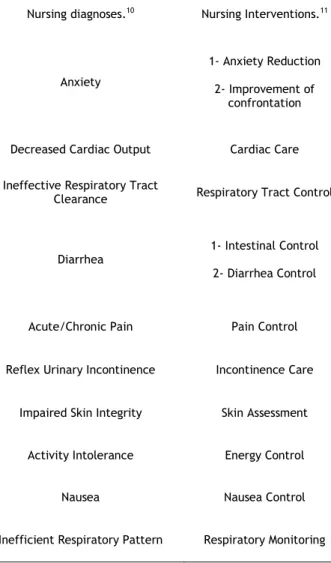
The most prevalent signs and symptoms found through the literature review made the following identifications possible: the main nursing diagnostic labels related to patients with organophosphate pesticide poisoning; nursing interventions relevant to them (Table 1) and possible nursing actions to be performed (Table 2).
Table 1. Nursing diagnoses identified and relevant
nursing Interventions.
Nursing diagnoses.10 Nursing Interventions.11
Anxiety
1- Anxiety Reduction 2- Improvement of
confrontation
Decreased Cardiac Output Cardiac Care
Ineffective Respiratory Tract
Clearance Respiratory Tract Control
Diarrhea 1- Intestinal Control
2- Diarrhea Control
Acute/Chronic Pain Pain Control
Reflex Urinary Incontinence Incontinence Care
Impaired Skin Integrity Skin Assessment
Activity Intolerance Energy Control
Nausea Nausea Control
Inefficient Respiratory Pattern Respiratory Monitoring
The appropriate diagnostic labels and their definitions, related to the most prevalent symptoms are:
Anxiety - It is defined as an indeterminate and unpleasant feeling of discomfort or fear, accompanied by autonomic response or as a
feeling of uneasiness caused by the anticipation of danger.10
Decreased cardiac output – It is a state in which the blood pumped by the heart is insufficient to meet the body's metabolic needs.10
Ineffective respiratory tract clearance - It is the difficulty to maintain clear airways due to the inability to remove secretions or obstructions from the respiratory tract.10
Diarrhea - Characterized by eliminating non-formed stools.10
Acute/chronic pain - Unpleasant experience that arises from actual or potential tissue damage and it may be sensorial or emotional.10
Reflex urinary incontinence – Involuntary urine loss when a particular bladder volume is reached.10
Impaired skin integrity – Changes in the epidermis or dermis.10
Activity intolerance - It is defined as unsatisfactory physiological or psychological energy to support or supplement the daily activities.10
Nausea - Subjective and unpleasant sensation in the epigastrium or in the abdomen, which can lead to the impulse or need to vomit.10
Inefficient respiratory pattern - Inspiration and/or expiration that do not provide satisfactory ventilation.10
Table 2. Nursing interventions and actions related to
nursing diagnoses identified.
Nursing
Interventions.11 Nursing Actions.
11 1- Anxiety Reduction 2- Improvement of Confrontation
1- Encouragement of expression of feelings, perception and fears.
2- Provision of actual information with respect to diagnosis, treatment e prognosis.
Cardiac Care
1- Chest pain assessment; 2- Observation of signs and symptoms of
decreased cardiac output;
3- Performance of a comprehensive peripheral circulation assessment
Respiratory Tract Control
1- Positioning of patients in such a way to maximize ventilatory potential; 2- Removal of secretions by stimulating cough
J. res.: fundam. care. online 2013. jul./set. 5(3):218-26
224 or aspiration;
3- Monitoring of respiratory condition and oxygenation.
1- Intestinal Control 2- Diarrhea
Control
1.1- Monitoring of intestinal movements; 1.2- Assessment of fecal incontinence
occurrence.
2.1- Determining diarrhea history; 2.2- Regular observation of skin turgor.
Pain Control
1- Performance of a comprehensive pain assessment;
2- Observation of non-verbal signs of pain; 3- Investigation of the factors that relieve/worsen pain in conjunction with
patients. Urinary
Incontinence Care
1- Identification of multifactorial causes of incontinence;
2- Monitoring of urinary elimination.
Skin Assessment
1- Assessment of the skin and mucosa; 2- Observation of the limbs regarding color, temperature, swelling, wrists, texture, edema
e ulcerations;
3- Adoption of measures for preventing further deterioration.
Energy Control
1- Monitoring of patients with respect to excessive physical and emotional fatigue; 2- Monitoring of cardiorespiratory response to
activities. Nausea Control
1- Observation of non-verbal indicators of discomfort;
2- Control of environmental factors capable of causing nausea.
Respiratory Monitoring
1- Breathing monitoring;
2- Observation of the thorax: symmetry, use of accessory muscles and supraclavicular and
intercostal muscles retraction; 3- Monitoring of noise occurrence, such as
wheezing and snores.
With the completion of the research, we observed that unfortunately there are not effective policies, supervision, control and monitoring, nor appropriate technical advice on the use of insecticides, such as organophosphates in Brazil.
Toxicology education is not yet a frequent practice in undergraduate courses and nurses should prepare themselves to provide care to these common patients in day-to-day emergencies.
Due to the high power of these toxic agents, as well as the continued exposure to them and the numerous and serious intoxications, we consider that this topic deserves to be included in the priorities of health, with the planning and implementation of care in rural and urban areas,
given the high number of poisoning caused by organophosphates used as rodenticides.
In this context, the identification of nursing diagnoses and interventions allows understanding patients as a whole, taking into account the various biological, psychological and social complications that may arise. It is, therefore, an instrument that provides a quick, effective and systematic care to these patients, easing the symptoms presented and giving them a greater prospect of recovery.
1. Brasil. Lei n.º7.802, de 11 de julho de 1989. Dispõe sobre a pesquisa, a experimentação, a produção, a embalagem e rotulagem, o transporte, o armazenamento, a comercialização, a propaganda comercial, a utilização, a importação, a exportação, o destino final dos resíduos e embalagens, o registro, a classificação, o controle, a inspeção e a fiscalização de agrotóxicos, seus componentes e afins, e dá outras providências. Diário Oficial da República Federativa do Brasil, Brasília, DF, 12 jan.1990 [acesso em 15 ago 2010]. Disponível em: http://www.antt.gov.br/legislacao/Regulacao/su erg/Lei7802-89.pdf.
2. Peres F, Rozemberg B, Alves SR, Moreira JC, Silva JJO. Pesticide use reporting in a rural area of Rio de Janeiro state, Brazil. Rev Saúde Pública [internet]. 2001. [acesso em 27 jul 2010]; 35(6):
564-70. Disponível em:
http://www.scielo.br/scielo.php?script=sci_arttex t&pid=S0034-89102001000600010.
3. Pires DX, Caldas ED, Recena MCP. Pesticide use and suicide in the State of Mato Grosso do Sul, Brazil. Cad Saúde Pública [internet]. 2005. [acesso em 27 jul 2010]; 21: 598-604. Disponível em: http://www.scielo.br/scielo.php?script=sci_arttex t&pid=S0102-311X2005000200027.
REFERENCES
J. res.: fundam. care. online 2013. jul./set. 5(3):218-26
225 4. Santos PCG, Costabile D, Benevides FB, Batista
JC, Saroba L, Segura R et al. Intoxicação por organofosforados. Revista científica eletrônica de medicina veterinária [internet]. 2004 Jul [acesso em 10 ago 2010]; 3. Disponível em: www.revista.inf.br/veterinaria03/revisao/revisao 04.pdf.
5. Silva JJO, Alves SR, Meyer A, Perez F, Sarcinelli PN, Mattos RCOC et al. Influence of social-economic factors on the pesticine poisoning, Brazil. Rev Saúde Pública [internet]. 2001 Abr. [acesso em 31 jul 2010]; 35(2): 130-35. Disponível em: http://www.scielo.br/scielo.php?pid=S0034-89102001000200005&script=sci_arttext.
6. World Health Organization. Public health impact of pesticides used in agriculture, Geneve, WHO, 1990. 128p [acesso em 16 ago
2010]. Disponível em:
http://whqlibdoc.who.int/publications/1990/9241 561394.pdf.
7. Sistema Nacional de Informações Tóxico-Farmacológicas, Centro de Informação Científica e Tecnológica, Fundação Oswaldo Cruz. Casos de Intoxicação por Agrotóxicos em Geral por Unidade Federada, Segundo Zona de Ocorrência Registrado em 2008. Brasil, 2008. [acesso em 15
ago 2010]. Disponível em:
http://www.fiocruz.br/sinitox_novo/media/tab0 4_agro_geral_2008.pdf.
8. Sistema Nacional de Informações Tóxico-Farmacológicas, Centro de Informação Científica e Tecnológica, Fundação Oswaldo Cruz. Casos, Óbitos e Letalidade de Intoxicação Humana por Agente e por Região. Brasil, 2008. [acesso em 15
ago 2010]. Disponível em:
http://www.fiocruz.br/sinitox_novo/media/tab03 _brasil_2008.pdf.
9. Pokorski S, Moraes MA, Chiarelli R, Costanzi AP, Rabelo ER. Nursing process: from literature to practice. What are we actually doing?. Rev
Latino-Am Enfermagem [internet]. 2009. [acesso em 10 ago 2010]; 17(3): 302-7. Disponível em:
http://www.scielo.br/scielo.php?script=sci_arttext
&pid=S0104-11692009000300004&lng=en.
10. North American Nursing Diagnosis Association (NANDA). Diagnósticos de enfermagem da Nanda: definições e classificação 2009-2011. Porto Alegre: Artmed. 2010.
11. Bulechek GM, Butcher HK, Dochterman JMC. Classificação das intervenções de enfermagem (NIC). 5ª ed. Elsevier. 2010.
12. Lanzarin LD. Intoxicações por agrotóxicos anticolinesterásicos – popular “chumbinho”. Florianópolis: UFSC [internet]. 2007. [acesso em 08 ago 2010]; 52 p. Disponível em: www.bibliomed.ccs.ufsc.br/SP0147.pdf.
13. Bochner R. National Poisoning Information System - SINITOX and human intoxication by pesticides in Brazil. Ciênc saúde coletiva [internet]. 2007 jan-mar [acesso em 06 ago 2010];
12(1): 73-89. Disponível em:
http://www.scielo.br/scielo.php?script=sci_arttex t&pid=S1413-81232007000100012.
14. Domingues MR, Bernardi MR, Ono EYS, Ono MA. Pesticides: Risk to Rural Worker Health. Semina: Ciências biológicas e da Saúde, Londrina/PR [internet]. 2004. [acesso em 02 ago 2010] ; 25:
45-54. Disponível em:
http://www.uel.br/revistas/uel/index.php/semin abio/article/view/3625.
15. Soares W, Almeida RMVR, Moro S. Rural work and risk factors associated with pesticide use in Minas Gerais, Brazil. Cad Saúde Pública [internet]. 2003 jul-ago. [acesso em 30 jul 2010]; 19(4):
1117-27. Disponível em:
http://www.scielo.br/scielo.php?script=sci_arttex t&pid=S0102311X2003000400033&lng=pt&nrm=is&l ng=pt.
16. Branco MC, Amaral PST. Insecticides for controlling the Diamondback Moth: how growers
J. res.: fundam. care. online 2013. jul./set. 5(3):218-26
226 use them in the Distrito Federal?. Hortic Bras
[internet]. 2002 Set. [acesso em 27 jul 2010] ;
20(3): 410-15. Disponível em:
http://www.scielo.br/scielo.php?pid=S0102053620 02000300002&script=sci_arttext.
17. Delgado IF, Paumgartten FJR. Pesticide use and poisoning among farmers from the county of Paty do Alferes, Rio de Janeiro, Brazil. Cad Saúde Pública [internet]. 2004 jan-fev. [acesso em 30 jul
2010]; 20(1). Disponível em:
http://www.scielo.br/scielo.php?pid=S0102311X2 004000100034&script=sci_arttext.
18. Júnior DSR, Botelho JOB, Fiol FSD, Oshima-Franco Y. The neurological syndromes induced by organophosphate pesticides exposition (acute/chronic) and their relation to suicide. Saúde Rev, Piracicaba [internet]. 2004. [acesso em 07 ago 2010]; 6(14): 53-60. Disponível em: www.unimep.br/phpg/editora/revistaspdf/saude1 4art07.pdf.
19. Ribeiro ACC, Mella EAC. Intoxicação ocupacional por organofosforados – a importância da dosagem de colinesterase. Iniciação Científica CESUMAR [internet]. 2007 jul-dez [acesso em 06 ago 2010]; 9(2): 125-34. Disponível em: http://www.cesumar.br/pesquisa/periodicos/inde x.php/iccesumar/article/viewArticle/553.
20. Singh S, Sharma N. Neurological Syndromes Following Organophosphate Poisoning. Neurology India [internet]. 2000. [acesso em 09 ago 2010];
48(4): 308-13. Disponível em:
http://www.neurologyindia.com/article.asp?issn= 00283886;year=2009;volume=57;issue=2;spage=119 ;epage=125;aulast=Singh.
21. Silva E, Souza ASL, Zanin M, Willrich IO. Intoxicaçäo aguda por organofosforados requerendo cuidados intensivo. Rev bras ter intensiva. 1996 jul-set; 8(3): 103-7.
22. Rojas AR, Ojeda MEB, Barraza XO. Malformaciones congénitas y exposición a
pesticidas. Rev Méd Chile [internet]. 2000 Abr. [acesso em 02 ago 2010]; 128(4): 399-404.
Disponível em:
http://www.scielo.cl/scielo.php?pid=S0034988720 00000400006&script=sci_arttext.
23. Centro de Controle de Intoxicações (CCIN) do Hospital Universitário Antônio Pedro. Intoxicações exógenas agudas por carbamatos, organofosforados, compostos bipiridílicos e piretróides. Universidade Federal Fluminense. Rio de Janeiro. 2000 [acesso em 10 ago 2010].
Disponível em:
http://www.bvsde.paho.org/bvstox/p/fulltext/int oxica/intoxica.pdf.
24. Koifman S, Ferraz I, Viana TS, Silveira CLP, Carneiro MTD, Koifman RJ et. al. Cancer cluster among young Indian adults living near power transmission lines in Bom Jesus do Tocantins, Pará, Brazil. Cad Saúde Pública [internet]. 1998 [acesso em 09 ago 2010]; 14: 161-72. Disponível em:http://www.scielosp.org/scielo.php?script=sci _arttext&pid=S0102-311X1998000700016&lng=pt. 25. OPAS/OMS. Manual de vigilância da saúde de populações expostas a agrotóxicos. Brasília: [s. n.]. 1996 [acesso em 15 ago 2010]. Disponível em: http://www.opas.org.br/sistema/arquivos/livro2. pdf.
26. Tourinho-Pereira FSV, Fonseca MRCC. Intoxicações agudas. In: Cintra EA, Nishide VM, Nunes WA. Assistência de enfermagem ao paciente crítico. São Paulo (SP): Atheneu; 2000. p. 527-542. 27. Fonseca MRCC. A Enfermeira como Integrante da Equipe Multiprofissional em Centros de Informação e Atendimento Toxicológico. CCI UNICAMP. [photocopy]. Campinas,1996.