Luis Filipe Machado Malhadas
Bachelor of Science
Perceiving is Believing
Authentication with Behavioural and Cognitive Factors
Dissertation submitted in partial fulfillment of the requirements for the degree of
Master of Science in
Computer Science and Engineering
Adviser: Henrique Domingos, Assistant Professor, NOVA University of Lisbon
Examination Committee
Chairperson: Doutora Sofia Carmen Faria Cavaco
Members: Doutor Antonio Eduardo Cardoso Pinto Dias
Perceiving is Believing
Authentication with Behavioural and Cognitive Factors
Copyright © Luis Filipe Machado Malhadas, Faculdade de Ciências e Tecnologia, Universidade NOVA de Lisboa.
A Faculty of Sciences and Technology e a NOVA University of Lisbon têm o direito, perpétuo e sem limites geográficos, de arquivar e publicar esta dissertação através de exemplares impressos reproduzidos em papel ou de forma digital, ou por qualquer outro meio conhecido ou que venha a ser inventado, e de a divulgar através de repositórios científicos e de admitir a sua cópia e distribuição com objetivos educacionais ou de investigação, não comerciais, desde que seja dado crédito ao autor e editor.
This document was created using the (pdf)LATEX processor, based in the “unlthesis” template[1], developed at the Dep. Informática of FCT-NOVA [2].
A c k n o w l e d g e m e n t s
The author gratefully acknowledge the guidance and support provided by Disser-tation adviser Henrique Domingos.
A b s t r a c t
Most computer users have experienced login problems such as, forgetting pass-words, loosing token cards and authentication dongles, failing that complicated screen pattern once again, as well as, interaction difficulties in usability. Facing
the difficulties of non-flexible strong authentication solutions, users tend to
re-act with poor acceptance or to relax the assumed correct use of authentication procedures and devices, rendering the intended security useless. Biometrics can, sort of, solve some of those problems. However, despite the vast research, there is no perfect solution into designing a secure strong authentication procedure, falling into a trade offbetween intrusiveness, effectiveness, contextual adequacy
and security guarantees.
Taking advantage of new technology, recent research on multi-modal, behavioural and cognitive oriented authentication proposals have sought to optimize trade off
towards precision and convenience, reducing intrusiveness for the same amount of security. But these solutions also fall short with respect to different scenarios.
Users perform currently multiple authentications everyday, through multiple de-vices, in panoply of different situations, involving different resources and diverse
usage contexts, with no "better authentication solution" for all possible purposes. The proposed framework enhances the recent research in user authentication ser-vices with a broader view on the problems involving each solution, towards an usable secure authentication methodology combining and exploring the strengths of each method. It will than be used to prototype instances of new dynamic multi-factor models (including novel models of behavioural and cognitive biometrics), materializing the PiB (perceiving is believing) authentication. Ultimately we show how the proposed framework can be smoothly integrated in applications and other authentication services and protocols, namely in the context of SSO Authentication Services and OAuth.
R e s u m o
A maioria dos utilizadores de computadores já experiênciaram problemas de acesso tais como esquecerem-se da palavra chave, perderem os cartões ou ’don-gles’ de autenticação, falhar outra vez o padrão do ecrã, bem como dificuldades de interacção e usabilidade. Face ás dificuldades da não-flexibilidade das soluções de autenticação forte, utilizadores tendem a reagir com fraca aceitação ou relaxando o suposto correcto uso do procedimento de autenticação e aparelhos, tornando a segurança pretendida inútil. A biometria, de certa forma, resolve alguns desses problemas. No entanto apesar da vasta pesquisa, não existe uma solução perfeita para desenhar um procedimento de autenticação forte seguro, caindo num equilí-brio entre intrusividade, adequação ao contexto e garantias de segurança.
Tirando partido das novas tecnologias, propostas recentes de pesquisas em multi-modelo, cognição e orientadas ao comportamento têm procurado optimizar o equilíbrio no sentido da precisão e conveniência, reduzindo a intrusividade para a mesma quantidade de segurança. Mas estas soluções também ficam à quem no que diz respeito a cenários diferentes. Os utilizadores realizam correntemente múltiplos acessos de autenticação todos os dias, através de múltiplos aparelhos, numa panóplia de diferentes situações, envolvendo recursos diferentes e diversos contextos de uso, sem "melhor solução de autenticação"para qualquer propósito. A framework proposta completa a recente pesquisa em serviços de autenticação de utilizadores com uma visão larga sobre os problemas envolvidos em cada solução de autenticação, com vista à usabilidade combinam-se e exploram-se os pontos fortes de cada método. Será então utilizada para prototipar instâncias de modelos dinâmicos e multi-factor (incluindo novos modelos de biometria comportamental e cognitiva), denominando-se assim a autenticação PiB (Percecionar é Acreditar). Em suma, mostramos como se pode facilmente integrar a framework proposta em aplicações entre outros serviços e protocolos, nomeadamente no contexto de serviços SSO e OAuth.
C o n t e n t s
1 Introduction 1
1.1 Security Issues in User Authentication . . . 3
1.2 Authentication Factors . . . 4
1.3 Authentication Evolution . . . 6
1.4 Objectives and Contributions: the PiB Approach . . . 7
1.4.1 Objectives and Contributions . . . 7
1.5 Report Organization . . . 8
2 Related Work 11 2.1 Classic and Biometric Authentication Factors . . . 12
2.1.1 Something you know . . . 12
2.1.2 Something you have . . . 14
2.1.3 Something you are. . . 15
2.1.4 Multifactor Authentication . . . 16
2.2 Behavioural and Contextual Factors . . . 16
2.2.1 Something you do . . . 16
2.2.2 Multimodal Biometric Factors . . . 18
2.2.3 Something you perceive. . . 19
2.2.4 Fusion of Multimodal and Multifactor Authentication . . . 21
2.3 Authentication Modes . . . 21
2.3.1 One-shot Authentication . . . 22
2.3.2 Continuous Authentication . . . 22
2.3.3 Invisible Authentication . . . 23
2.4 Multimodal and Multifactor Frameworks . . . 23
2.5 SSO Authentication Backends and Identity Management . . . 24
2.5.1 Single Sign On Systems . . . 24
2.5.2 Federated Identity Management . . . 26
2.6 Critical Analysis . . . 27
CO N T E N T S
2.6.2 Identification Recovery . . . 28
2.6.3 Public Acceptance . . . 29
3 PiB Model 31 3.1 Framework Overview . . . 31
3.2 Back-End Information Management . . . 33
3.2.1 Ontological Model . . . 33
3.3 Information Assembly. . . 34
3.4 Design and Architecture . . . 35
3.4.1 Core System . . . 36
3.5 Framework API . . . 38
3.6 Programming Model and Application-Level Support . . . 40
4 Prototype Development 43 4.1 Integration with SSO Backend Services . . . 43
4.2 Technology . . . 46
4.3 Prototype Implementation . . . 47
4.3.1 Authorization Endpoint & Token Endpoint . . . 47
4.3.2 Login Endpoint . . . 50
4.3.3 PiB Oauth Client. . . 51
4.4 API . . . 52
4.4.1 Web API . . . 53
4.4.2 Software API . . . 54
5 Validation and Experimental Evaluation 57 5.1 PiB Operation and Performance Indicators . . . 58
5.1.1 Single Factor Authentication . . . 59
5.1.2 Two-Factor Authentication . . . 60
5.2 Evaluation of Validity . . . 61
5.3 Impact on Application Development . . . 62
6 Conclusions 65 6.1 Concluding Remarks . . . 65
6.2 Relevant Open Issues . . . 66
6.3 Future Work Directions . . . 66
Bibliography 67
C
h
a
p
t
e
r
1
I n t r o d u c t i o n
In most (if not all) computer systems nowadays, user authentication is consid-ered as a fundamental building block and a primary line of defence of computer security. It is also the basis for most types of access-control principles and user accountability systems. In the IETF RFC 4049 [19], authentication is defined in general as the process of verifying an identity claimed by or for a system entity. The authentication property is instantiated in two different steps of an
authenti-cation process: the identifiauthenti-cation step and the verifiauthenti-cation step.
Identification involves proofs of a claimed identities, with identifiers correspond-ing to unique digital representations of non ambiguous namcorrespond-ing entities, estab-lishing also the identification of principals as subjects of access-control policies. Verification involves the corroboration information as verifiable proofs of correct bindings between the entity and the claimed identity.
According to the above reference definition authentication always involve the process of determining whether someone or something is, in fact, who or what is claimed to be. Despite the direct concern of the authentication requirement as the basis to establish access-control and auditing activities, there are structural differences between such services as materializations of different security
C H A P T E R 1 . I N T R O D U C T I O N
key distribution protocols or establishment of network based security associations between principals, regarded as naming entities acting as endpoints at different
abstraction levels of any secure network protocol.
In the context of the thesis authentication is particularly focused on the authentication abstraction level. At this level, authentication is related to user-authentication guarantees established by user user-authentication services, based on correspondent building block mechanisms and authentication factors, as believ-ing means by which a user provides the correct claimed user identity representa-tion to the system. In summary, user level authenticarepresenta-tion is the means of establish-ing validity and correctness assumptions on user names and identification claims [49], to be able of reporting what events took place and who or what triggered them (in the context of User-Audibility or User-Accountability services), as well as of significance the application of a policy that restricts what actions can a user do at a certain point of time and space (as the Authorization dimension) [44]. A security policy is used to define what security means for a system and can have multiple purposes [4]:
Confidentiality
Many government organizations and military enforce such policies in order to maintain information secret.
Integrity
Banks, insurance companies and others care more about keeping informa-tion correct and precise than its confidentiality [36].
Hybrid
Is a mix of confidentiality and integrity (e.g. access control systems).
Composition
It’s often useful to combine security policies and some are modelled to allow just that.
An example of a system application of a policy is an access control, which is responsible for the verification of a principal’s identity and permissions at a secure context [49].
From the above definitions, although authentication and access-control are closely coupled fundamental properties, the results of user authentication processes are orthogonal to different access-models for user operations on authorized system
resources. In this we include MAC, DAC, RBAC or ABAC control models and management policies.
1 . 1 . S E C U R I T Y I S S U E S I N U S E R AU T H E N T I CAT I O N
Mandatory Access Control is defined by a policy modifiable only by system ad-ministration.
Discretionary Access Control is similar toMACbut permissions are transferable and not only by the administrator.
Role Based Access Control can be seen as a generalization of the previous, given that can implement both. Permissions are assigned using the notion of role, which can aggregate several users.
Attribute Based Access Control defines a different paradigm that relates the
en-tity to the resource the action and the environment through the use of at-tributes, becoming the most flexible of the access controls.
Another key concept in the security realm is the notion of trust, as something that is attributed. Being trusted by another principal means that such principal has been given that property of integrity, on the other hand the principal might not be worthy of the attributed trust (said not trustworthy) [30]. Because trust can be broken assurance plays a key part in building a trustworthy system. Assurance is the guaranty that a principal applies its security requirements [1], [44]. In order for assurance to be provided evidences need to be obtainable. An evidence may take many forms, such as: credentials, logs, biometric, tokens, . . .
But a new problem arises, as how to present these assurances without compro-mising ones privacy or allowing someone else to impersonate the presenter. The use of cryptography is almost mandatory to achieve secrecy and anonymity, may it be for messaging or safe keeping of information. It’s a vast field of research that dates from 1500 B.C. by ancient Assyrian merchants with simple substitution cyphers (replacing one symbol by another) [42].
Transposition consists on the scrambling of the symbols position.
Substitution consists on the switching of one symbol by another.
Asymmetrical previously the key to cipher is the same to decipher, but with asymmetrical cryptography the ciphering is done with one key and the re-verse process with a different key, reducing the key exchange problem.
1.1 Security Issues in User Authentication
C H A P T E R 1 . I N T R O D U C T I O N
the requirements are for one to remember a password, which is many times a very short simple sequence of characters with an almost obvious relation to the user [44]. Among them it can be found (better summarized at table1.1):
Phishing which is an act of deception to make others relinquish their creden-tials, most commonly by impersonating some authority requesting the user credentials either for confirmation or updating.
Social Engineering is an act of deception that tricks people into breaking their security procedures. Usually by influence to security relaxation or plain unfamiliarity.
Exploiting is the set of actions towards exploring system design flaws to bypass the security procedures or disabling them.
Denial of Service is a particular attack where one or more principals keep au-thenticating in order to overwhelm the system disabling its ability to reply to more clients who will end up not even knowing if the server still exists.
Impersonation is the act of claiming the identity of another principal. If some other principal is enrolling the identity of an unregistered principal is called Identity Squatting.
Over the Shoulder a particular attack in which it’s attempted to see the user pass-word by peeking over his shoulder. It’s of particular interest for biometrics, that are often kept or introduced in plain sight
Human error is the act of losing the credentials or just lack of knowledge in security engaging in high risk behaviours.
1.2 Authentication Factors
In the more current approach, user authentication services involve the adoption of different types of authentication factors that can be validated by system targets,
such as passwords or pass-phrases (used as a shared secrecy-factors), token-based secrets stored on physical memory cards or USB dongles (as a way to locally store secrets in a physical device the user possesses), smart cards (as processing devices that can store and process secrets or cryptographic keys in the context of supported cryptographic functions and protocols, with additional guarantees for proofs of user possession processing capabilities and biometry, associated to
1 . 2 . AU T H E N T I CAT I O N FAC TO R S
Attacks Authentication Threads Typical Defenses
User Device Target (Client)
Passwords Guessing, exhaustive search
Large entropy; limited attempts;
long passwords; robustness checking techniques. Tokens, Dongles Exhaustive search
Large entropy; limited attempts; theft of object requires presence. Static Biometric
False match (difficulties in combining
false negative/positive tradeoffs) Large entropy; limited attempts.
Server Side Target
Passwords Plain text theft; dictionary/exhaustive search
Hashing; large entropy; protection of password database. Token Pass-code theft
Same as password; use of Dynamic OTP (One-time pass-codes). Biometric Template theft
Capture device authentication; challenge response.
Eavesdropping, theft, and copying of user authentication factors
Passwords "Over-the-Shoulder surfing"
User diligence to keep secret; administrator diligence to quickly revoke
compromised passwords; multi-factor authentication.
Token; Beacons
Theft; counterfeiting hardware; substitution-attacks; non-physical protection
Multi-factor authentication; tamper resistant/evident token; location verification strategies. Biometric Copying (spoofing) biometric
Copy detection at capture device and capture device authentication. Authentication Factor
Replay Issues
Passwords Replay stolen password response Challenge-response protocol. Token Replay stolen pass-code response Challenge-response protocol; OTP.
Biometric Replay stolen biometric template response
Copy detection at capture device and capture device authentication
via challenge-response protocol. Intrusion Threats Password; Token; Biometric Installation of rogue client or capture device
Authentication of client or capture device within trusted security perimeter. Denial of service Issues Password; Token; Biometric Lockout by multiple failed Authentications Multi-factor with token.
Table 1.1: Some Potential Attacks, Susceptible Authenticators, and Typical De-fences [49]
proofs of static physical properties of the user, as a human being.
Those classic authentication factors are today supported by well known technol-ogy in the context of specific authentication services and applications, with a well known roadmap of advantages and drawbacks, as well as trade-offs in different
issues, when used as strong authentication factors. To maximize possible advan-tages, to overcome the drawbacks, or to optimize trade-offs, classic factors can be
combined as independent factors, in a multi factor authentication strategy. Exam-ples of simple combinations (for example in the case of two-factor authentication approaches) usually involves password based authentication and one of the other factors as a complementary proof of authentication, when strong authentication guarantees are required. Later we will discuss the trade offissues in the context
of the related work against the vision of the dissertation objectives.
Also, with the emergence of mobile computing systems, complementary approaches to the classic authentication factors, looked as context-aware authentication fac-tors, began to be considered as extended factors for additional proofs of authen-tication and access control. In this we include location aware authenauthen-tication and time frame verifications, with particular interest as factors for attribute based access-control models [49], [23], [2], [24], [20], [17].
C H A P T E R 1 . I N T R O D U C T I O N
authentication services, using new authentication factors that have been envis-aged in the more recent research on user authentication.
1.3 Authentication Evolution
Even though humans age and can change their appearance we have been iden-tifying each other based on our looks, sounds smells and other aspects of ones physiology since ever. Biometrics is the automated measurement of biological or behavioural features that identify a person [4]. A principal can’t get his biometrics stolen or lost, it can’t deny them and are mostly impossible to fake (extremely hard to get mimicked), which makes biometrics a very interesting method of au-thentication.
With technology enhancements is now possible to diversify the authentication methods towards a sensory perspective. Sensors became more reliable, smaller as well as cheaper they are starting to appear on smaller and portable devices, such as mobile phones. Even for developers these technologies become easier to use, easier to combine, allowing people to move towards a perceptive authentication philosophy. Where one no longer needs to remember his password but instead needs to fulfil a set of requirements that only it can fulfil. This is based on the premise that all humans are distinguishable among themselves, although tech-nology has not yet evolved to get such level of accuracy it is possible to increase it by combining multiple models [45].
Every authentication method has its pros and cons, and choosing the correct one for any context is a trade offtask, so it comes easily that combining multiple
au-thentication factors will enhance the robustness of the auau-thentication procedure, e.g. using a token with a PIN (ATM card) makes the token safer to loose because it’s useless without the PIN. So the procedure would becomesomething you have, something you know, something you are and something you do.
Multi-modal authentication systems are like many people trying to guess the total number of marbles in the jar, no one will likely be right but their average will be pretty close if not correct. Such a system can also take advantage of each modality best features, but they face many challenges like, how is each peace of evidence collected, how much noise does the evidence contain, how to merge all evidences, false positives and false negatives, how much intrusiveness is required, ...
1 . 4 . O B J E C T I V E S A N D CO N T R I B U T I O N S : T H E P I B A P P R OAC H
1.4 Objectives and Contributions: the PiB Approach
By designing a multi-modal dynamic context aware authentication system, one should be able to mitigate noise, bias, imperfections, accidental errors, imperson-ation attacks and complexity for the user when authenticating. For such, it’s pro-jected a framework that provides abstractions and mechanisms to cope with and manage the multiple models, contexts and resources. To illustrate the advantages, the smooth integration of mechanisms in the framework approach for extended authentication services is a relevant issue. In this we include, namely: cloud-web based OAuth authorization services, with verifiable authentication factors on remote applications using access-control leases requiring continuous pervasive authentication proofs. while noise is removed from context either by restricting the allowed authentication models or by balancing their relevance against each other, exploring multi-factor authentication in complementarity.
1.4.1 Objectives and Contributions
The dissertation proposal addresses the above considerations in the PiB (Perceiv-ing is Believ(Perceiv-ing) approach, a proposal for the design and implementation of a multi-modal dynamic context-aware authentication framework.
The main contributions in this objective are:
• Design a framework able to extract environmental information that is cate-gorized and formatted into contexts which in turn are modelled to produce and process authentication proofs.
• Easy extension of new authentication methods, e.g., invisible authentication models.
• Example integration with established, well known authorization protocol, OAuth 2.0, making it easily pluggable in current authentication providers.
For the experimental validation of the above contributions, we implemented and tested the PiB framework in a controlled environment, where some evaluation metrics were collected and analysed for validation, addressing the following ques-tions:
• How to evaluate the performance of the proposed system, comparing with other authentication factors and methods, for example, in the context of well-known authentication protocols and services?
C H A P T E R 1 . I N T R O D U C T I O N
1. The concerns related to the comparison of the performance indicators when we use our framework to combine PiB factors complementarily to conventional factors in concrete authentication services, namely OAuth v2.0
2. The concerns on the adoption of the proposed framework, to be smoothly integrated in current applications and other authentication services and protocols, namely in the context of SSO (Single Sign On) authenti-cation services.
• How can we validate the proposal in the context of the complementarity of multi-factor authentication methods, performing the validation of multiple authentication factors evaluated in hierarchical sequences?
For example, for the case of two-factor authentication (using passwords and face-recognition), if a second factor (a continuous face recognition) fails to see the correct user for some time window, then first step must be dy-namically re-activated and users must be forced to insert their password to proceed to the second factor evaluation again.
• How can we evaluate the impact in the adoption of our proposal in the development or upgrading process of different applications?
In answering the above questions, we need to evaluate the impact of the solution in terms of specific analysis criteria and metrics. We focused our analysis in the following metrics:
Time observing the latency of authentication processes to fully execute correctly and completely the authentication procedures.
Memory observing the memory consumption in system operation.
Energy observing the impact in energy consumption, particularly relevant when we use mobile and resource constrained devices.
Impact on application-development when the proposed PiB framework is adopted to develop new or to update existent applications.
1.5 Report Organization
The rest of the document is as follows: Related Work (in chapter2), which is an
exposéof the relevant similar research followed by the Critical Analysis summa-rizing the contrast between the current research and the proposed framework,
1 . 5 . R E P O R T O R GA N I Z AT I O N
C
h
a
p
t
e
r
2
R e l a t e d Wo r k
Authentication is a deeply studied and worked problem that has, an yet to be invented perfect solution. With the open use of new emergent technology and the evaluation of new adversary models and threats in new contexts of use opens the opportunity for new research directions in the topic. The concept has always been an intrinsic part of our species due to all the differences that provide looks
and character, we are able to identify each other visually and behaviourally, but in computer authentication the problem is one of representation and assumptions that can be exploited.
So by devising authentication in factors, there are:
• Something you know
• Something you have
• Something you are
• Something you do
• Something you perceive
The relation between the context at which the factor of authentication is used affects the credibility of the system and by having the system perceive the context,
it will be able to fine tune the best models [17]. Perceiving is Believing (PiB) is the augmentation of user authentication with the perception of it is purpose and environment.
C H A P T E R 2 . R E L AT E D WO R K
reference to published work as well as introduce new concepts in biometrics, authentication modes and context awareness, discussing identification recovery and the public acceptance of the contemplated authentication methods.
2.1 Classic and Biometric Authentication Factors
Classic factors refer to the well know and widely used factors such as knowing a secret (password), possessing an authorization (smart card) and being of a certain physiological characteristic such as a fingerprint. All those factors have been in use for a long time and subjected to extensive research and where some prove to have high maintenance or have an expensive implementation, others prove to be of low assurance (easy or guessable passwords) or cumbersome to use.
Authentication systems based in biometrics have been in development for many years and have inspired much research, becoming nowadays ever more popular due to mobile devices and the reduction of resources required to process the big amounts of data that are characteristic of these systems.
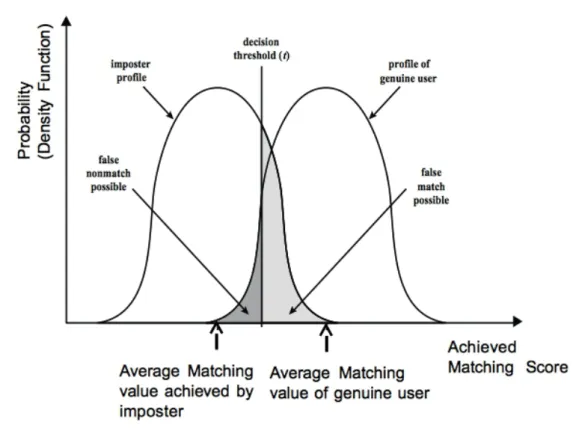
Such systems take their input information from sensors and compare that pro-cessed information with templates that have been previously arranged to deter-mine if the user can get access or which kind of access it is allowed [44]. The issue with any biometric system is the decision boundary (see figure 2.1), trying to balance the strength of the security provided with the usability. If that threshold is more on the imposter curve then the system will accept more often intruders, if more to the right then will become increasingly annoying for the genuine user denying him access more frequently.
2.1.1 Something you know
In a ever growing digital world, where personal and private information is spread all over thecloud. The need for a safe access to information has never been more present, specially with the possibility of quantum computing breaking many of the cryptographic ciphers in usage.
Something you know, most commonly it is a simple memory challenge such as remembering a sequence of characters (also know as password). A password based memory challenge is composed of two parts:
Identifier
A public label that is uniquely associated to his profile. It can be used in a discretionary access control.
2 . 1 . C L A S S I C A N D B I OM E T R I C AU T H E N T I CAT I O N FAC TO R S
Figure 2.1: Equal Error Rate
Password
A sequence of characters, commonly hashed for comparison.
Human memory is flawed and degrades over time, in particular if the user keeps accumulating different accounts with different passwords, eventually it is near
impossible to know which is from what account. People get old and careless about security, share their passwords or write them down loosing them, some use one single password for everything, others just use a very simple password. Even with all the research that has been done to try and tackle these problems either by slightly changing the authentication methods used, by trying to enforce policies (e.g. forbid the use of common passwords, periodic mandatory password change) or by the use of cryptography (e.g. hashing a password with salt) but they either delay the problem or just solve a part of it [49].
Challenge-response is a general purpose authentication method to verify knowl-edge of a secret different from a value in an attempt to solve the insecure channel
problem. There are many examples of such systems from salted one-way hashed passwords, Kerberos, Zero-Knowledge till key agreement systems. A different
C H A P T E R 2 . R E L AT E D WO R K
environment at which the authentication takes place, forcing users to use cum-bersome tokens to access it is account.
A recognition-based system, instead of a recall-based, such as the user/password scheme, is said to aid the user while preventing it from having insecure behaviours (e.g. harder to share its password) [9]. Déjà Vuis a system designed to take advan-tage of the human episodic memory (which is the memory of autobiographical events) that allows humans to recall images easier. The system randomly selects
mimages, among which arenimages belonging to the user chosen set (withm−n
decoy images). This method makes it very difficult for the user to share its
pass-word because it is highly complex to describe, but at the same time is easy to recall the correct images for the user [9], or is it? It presents a relaxation of the security considering that there should be an equilibrium between the number of images (password length) and the recall ability of the user, plus there is no contemplation of contexts as well (e.g. blind users will not be able to use it at all).
2.1.2 Something you have
While authentication systems became more complex, knowing something became knowing a lot of some-things. A token-based authentication is the sort of authen-tication where the user possesses a token that needs to be presented to the system, that in turn is going to validate such object as valid and with the proper access level.
Something you have, allows for the complexity of system access to increase po-tentially without the user perceiving it making the information more secure, but doesn’t address the weakest link in the security chain, the user itself. Tokens are either a simple memory card that holds the information and requires spe-cial reader for usage rendering them expensive, or a smart card that is equipped with a microprocessor and is capable of performing calculations for cryptography, which doesn’t decrease the cost. They can also be connected requiring physical link in order to work, or disconnected such as RFIDdevices, but they might be cumbersome to carry (e.g. when in a beach), can be lost or get damaged prevent-ing access to the system and the special readers are not compellprevent-ing either. To overcome the readability problem there are USB connectable devices (a.k.a. USB Dongle), which use a widely available connection standard. Of particular interest are also the mobile phones and tablet devices that can, in theory, be used in the form of a smart token.
2 . 1 . C L A S S I C A N D B I OM E T R I C AU T H E N T I CAT I O N FAC TO R S
2.1.3 Something you are
If taking metrics that aren’t immediately changeable like iris patterns or finger prints. These are usually stored as a vector of its features and is later used to compare against the provided identification.
Finger Print
It is a widespread typical example of a static biometric method, available already in many cellphones, computer keyboards, among other devices and used mostly by law enforcement and justice. A set of feature distances and numbers of the ridges and valleys are stored [44],[49].
Iris Print
It is currently possible to scan the iris with common low cost cameras and even mitigate intrusiveness [3] while collecting a stable texture consisting of crypts, furrows, corona and freckles [46].
Retina Scan
Harder then an iris print due to the need of infra-red light for the capture of the unique blood vessels cross-sections distances.
Palm Print
A derivative of the finger print but with the advantage of easier visibility of the pattern due to its size. Collects principal lines, wrinkles and palm texture from low quality source and ridges, singular points and minutiae points from high quality source [46].
Facial Recognition
Due to its natural use by almost every human it is a topic of interest for research and carries a high public acceptance. Collecting 2D and 3D metrics of the human face is a very complex task that can be defrauded with the use of glasses, cosmetics, surgery or even time [46], [4].
D.N.A.
For precision and undeniable proof there’s always the code that truthfully identifies almost each and every thing alive (unless they are twins). It is also a very expensive and still a lengthy process although not intrusive in terms of usability. It is characterized by a sequence of 3 billion bases of four different types (in the human case): Adenine, Guanine, Cytosine and
C H A P T E R 2 . R E L AT E D WO R K
2.1.4 Multifactor Authentication
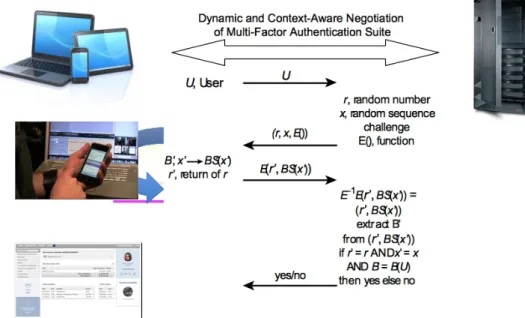
Multi-Factor authentication is on the rise, with many starting to provide two-factor authentication (e.g. Google), it is an easy step until more two-factors are counted in, but they haven’t. Some argue that multi-factor introduces redundancy and therefore reduces usability. Every authentication method carries advantages and disadvantages and the best way to exploit the advantages while mitigating the disadvantages is by aggregating the multiple sources of authentication [8]. The aggregation can be achieved by a multitude of methods, voting strategies, Bayes Factoring [14], in sequence, policies, ... see figure2.2.
Figure 2.2: Multifactor Context-aware Authentication Schema
2.2 Behavioural and Contextual Factors
Life has been developing authentication systems for as long as interaction among different parts has been occurring. Mammals have been performing
authentica-tion since they are born, bounding immediately with their progenitors by smell or memorizing their looks, voice, actions, ...
2.2.1 Something you do
If the metrics are modifiable or specific user behaviour such as voice pattern or signature. These are highly dependable on what is being measured and how for the identification.
2 . 2 . B E H AV I O U R A L A N D CO N T E X T UA L FAC TO R S
Voice Print
Also know as Speaker verification uses either a set of utterances that need to be spoken on a static context for the verification or under a dynamic context, the collected features can be: Spectrum, Glottal pulse features, pitch, energy, duration, rhythm, temporal features, phones, idiolects, semantics, accent, pronunciation, ... providing over 90% of success rates [46]. Keystroke
Gait Traits
Allows for recognition from greater distances by using human motion fea-tures techniques such as Moving Lights Displays, Maximal Principal Gait Angle, Motion history image, Hough Transform, Scaled Prismatic Model [25]. Similarly to Face recognition can have a very low intrusive level, and therefore has a widespread acceptance by the public. It is also a biometric that can easily be sensed by mobile devices with inertial measuring units [18].
Keystroke Pattern
Well studied biometric extracted from features such as key hold time, inter-keystroke times, duration of a inter-keystroke, . . . [21].
Handwriting Pattern
Signature is a static example of handwriting recognition, extracting features like signature shape, pen position, pressure, pen direction, acceleration, length of strokes, tangential acceleration, curvature radius, azimuth [46]. It has been under use for a very long time, but is easily falsifiable.
Gestures Patterns
May it be touch-screen gestures or hand gestures these can be used to iden-tify a person and are not hard to extract [33]. If used with enough features it is a reliable authentication method that is adaptive, computationally effi
-cient and trainable [7]. Further more if coupled with touch gestures separat-ing palm from fseparat-ingers this authentication method can be used in a pattern lock scenario enhancing its resilience against attacks [38].
Mouse-based challenges
C H A P T E R 2 . R E L AT E D WO R K
User Habits
Daily habits like buying freshly baked bread or going to work every week day in a schedule following the same route may be used as a biometry spe-cially due to its extensive potential features. It is one of the least intrusive, if not the least, authentication methods considering that there’s no need for special interface or any new input from the user making it even more prone to securing its phone. Apple already provides an API for dynamically con-figuring the authentication process according to the phone’s location [34], in [39] rhythms are used arguing that a person can use its preferred music as the input, other sources of information may include browser or phone call history, calendar, . . . [40].
2.2.2 Multimodal Biometric Factors
The idea on implementing multimodal biometrics is similar to the multifactor but by making use of multiple modalities instead of factors, in particular if there is already in place a biometric system, the same information source is used (sensors) to be processed by multiple algorithms and applied a fusion technique. All with cost and scalability trade-offs.
Typical multimodal system may have one or more modes of operation [37]:
Serial executes modalities in a sequence restricting each time the possibilities but not requiring all the information at once.
Parallel executes modalities at the same time but requires all the information to be available at start.
Hierarchical executes modalities in an hybrid method. Particularly useful when many classifiers are to be fused.
[27] Uses fusion at the scoring level to identify users according to their palm print and face image. [12] Uses another fusion technique to continuously aggregate keystroke dynamics, mouse movement and stylometry. [22] Proposes a bi-modal system that is able to authenticate users with a mobile in a noisy environment through a Gaussian mixture of inter-session models, merged by multi-fusion al-gorithms. Other methods include sparse trees or similarity preserving hashing, ... No approach leaves space for the environment to be included, some may try to adapt to poor conditions but not in a dynamic fashion, rendering them inflexible.
2 . 2 . B E H AV I O U R A L A N D CO N T E X T UA L FAC TO R S
2.2.3 Something you perceive
People react differently to the same context because everyone experiences the
world differently (e.g. a lumberjack looks at a forest as a resource but a camper
would see it as leisure). Perception is defined as a identification, interpretation and organization of sensory information in a context or environment. An example of application is the targeting of advertisements, but towards a security context is of particular interest applied in identification and peer authentication. It is a relatively new area of biometrics that draws inspiration from psychology and neu-roscience and aims to capture a cognitive signature of the individual broadening the context at which biometrics can be applied (e.g. while playing on-line game). BioCatch is an application developed by a start-up company that makes use of cognitive challenges in order to spot intruders and other attacks with an accuracy of over 80% in parallel with other behavioural biometrics [50], [29].
Some behavioural biometrics might be considered cognitive due to the influence of some cognitive processes in behaviour, others, in literature, restrict cognitive biometrics to those from bio-signals only. Cognitive biometrics are here pre-sented as a solution to such influence (which may actually be noise), i.e., where a gait analyser would fail to authenticate a physically tired user a cognitive system would not because the cognitive process being measured is not muscle dependent. These systems carry however an higher level of complexity and in some cases a large intrusion degree, e.g., many of these systems depend on brain signals being captured which is possible through the use of electrode caps (figure2.3) attached eventually to a computer interpreting them through a series of cables.
Stimulus-Reaction
Similar to the challenge-response mechanism, the authentication process takes place by extracting features from the reactions of the central nervous system to stimuli such as image, audio or video observation [35], but can also include taste and smell or touch.
The reaction can be measured by electroencephalogram (EEG), electrocar-diogram (ECG), electrodermal response (EDR), blood pulse volume (BVP), near-infrared spectroscopy (NIR), electromyogram (EMG), eye trackers ( pupilometry ) and hemoencephalography (HEG) [35].
Image Recognition Puzzles
C H A P T E R 2 . R E L AT E D WO R K
Figure 2.3: Electrode Cap with 256 electrode slots.
among others [50]. The objective is to explore the visual memory of the user.
Visual search
One interesting challenge is the mouse courser disappearance, in which peo-ple will uniquely take different times until they start the search for it, they
will start the search in different ways as well and take different approaches
[29], exploring the decision making abilities of the human brain. Searching for a target in an image and track eyes movement and pupil dilatation [13] is another example.
Working memory and information processing speed
Humans are capable of reasoning, problem solving and learning from mis-takes by using working memory, that can be explored despite its decay.
Automatic Processing and Priming Effects
A variation of the Stimulus-Reaction explores the Priming effect, where
the stimulus is designed to trigger specific reaction, such as a picture of a spider will trigger a feeling of fear but not all will react with the same
2 . 3 . AU T H E N T I CAT I O N M O D E S
amount of fear, people even have different reactions to fear, where some
might flee others will fake death and remain static. All this happens in the sub-conscious mind triggering muscles and hormones involuntary with different times, quantities and structures [13].
2.2.4 Fusion of Multimodal and Multifactor Authentication
There are many proposals on fusion techniques of models or factors used in au-thentication, focused on decision/score level, feature level or low level (sensors and information sources), in particular for biometrics whose measures are filled with noise and imprecisions.
[48] Proposes an expert fusion at the decision level based on similarity algorithm between the template and the claim. [26] Proposes a differential evolutionary
algorithm that scores according to an adaptive weight-exponent fusion technique which is parametrized with the help of an heuristic. [12] Developed a distributed fusion scheme for sensor level that combines local decisions by minimizing the global Bayes risk assessment of the sensors. Other example are voting strategies, averaging, ... [37]
The problems being addressed are with respect to:
Decision Problem The moment at which the multiple information sources pro-duce a result. If they disagree how should they be mixed towards a single result.
Load Problem How many models or how many factors are to be used, from the available set.
Cost Problem If it can be achieved with cheaper devices, or if it targets specific environments that require unique, secret settings.
And despite the vast choice of fusion methods there is no best solution, not even a standard for which developers may guide while implementing multimodal or multifactor authentication systems.
2.3 Authentication Modes
Different methods of authentication have different impacts, i.e., it is not very
C H A P T E R 2 . R E L AT E D WO R K
vehicles it might make sense to use fingerprint as a continuous authentication method. Different methods for different reasons imply different modes and each
mode has its own advantages, but they are most complementary among each other having a trade offbetween complexity and intrusiveness. A continuous mode of
authentication may be more intrusive than a one-shot mode of authentication were the user has to introduce his credentials only once, compared to constantly (every other time window, the least). Unless the user is constantly observed and tracked on a controlled environment allowing the system to identify specific traits that uniquely identify each user. Such system executes an invisible authentication method, one that requires no user interaction (that is perceivable) and is the least intrusive but of very high complexity and reduced extensibility.
2.3.1 One-shot Authentication
In this mode of authentication one’s credentials are verified once and if authenti-cation is successful then access is granted until next iteration. The use of static biometric measures are best suited for this type of authentication. Usually it is a simpler implementation and with better performance results because of the one to one comparison nature of the authentication process (principal claiming an identity by matching credentials or fulfilling a challenge), but if authentication fails then the user needs to repeat it, and it could be doing thisad infinitum, if is the incorrect user it could go on until a false accepted arises, or enough practice has been achieved. A barrier or limit needs to be imposed in order to mitigate this problem.
Another approach may comprise the complexity escalation of the challenges pro-posed.
2.3.2 Continuous Authentication
In a continuous model the authentication process takes place "uninterruptedly" until an imposter is detected, which can be achieved by taking multiple readings along a fixed length of time and extracting the features from there (e.g. by av-erage) or take a single sample of a window of time and compare the snapshot against the template. Due to noise and irregularities of sensor readings continu-ous authentication needs to handle with care how to react to authentication fails therefore a thresholds or tolerance is required before failing [10]. This method is more intrusive for the user than one-shot, so it needs to be designed with care. Despite it is of an higher processing complexity and the trade off between the
2 . 4 . M U LT I M O DA L A N D M U LT I FAC TO R F R A M E WO R K S
time to identify an intruder and its false acceptance rate it is widely used [12], [28].
2.3.3 Invisible Authentication
Drawing inspiration from [29], their invisible challenges pose a new perspective on authentication modes. The key concept is the unawareness of the user that it is being authenticated, so a face recognition can operate as an invisible authen-tication if the user needs not to interact with the system to be recognized (e.g. a casino trying to identify card counters) as opposed to a system that requires you to hold the camera or sit in a certain place to be recognized. So information used in the authentication can be extracted from continuous and cognitive biometrics and is the least intrusive and most complex of designing and processing.
2.4 Multimodal and Multifactor Frameworks
Although the concept is actually old and has been somewhat explored, e.g., auto-matic bank machines from where one draws money by using a card (token) and a code (password) is a two factor authentication method, it has not been generalized to a standard or hardly extended beyond the integration of three factors. Some focus on problems such as modalities or factor fusion [15], [48], [12], while others focus on usability problems such as intrusiveness.
An interesting approach to the integration problem is found on [11], who de-veloped a system (CYOA) that allows users to chose authentication models and is implemented making use of the know authorization protocol OAuth. While accommodating multiple models of authentication, CYOA relays heavily on the users choices who tend to relax in order to achieve easier usage, and lacking other forms of configuration is of arguable adaptability.
On the other end is CASA [17] (Context Aware Scalable Authentication) a system that automatically selects the authentication models to be used according to a naive Bayes classifier to access the risk given a set of factors that don’t require user interaction. Stripping the users of almost all control makes it a black box and as such may get knowledgeable users suspicious of its workings.
C H A P T E R 2 . R E L AT E D WO R K
2.5 SSO Authentication Backends and Identity
Management
Single sign on systems, as well as Federated Identity management aim at cen-tralizing who holds the user credentials with the intent to reduce possible leacks while user confort is enhanced with less accounts to remember credentials for.
2.5.1 Single Sign On Systems
Single Sign On (and Single Sign Out) systems aim at reducing the need for the authentication moments to occur, and once authenticated by a peer, then all trusted partners accept the same user without question (or an authentication), just by presenting the certificates obtained at the authentication moment. Usually to access a resource held by a third party, which also translates in an enhanced security in the sense that the user information is no longer spread over the cloud and he can actually memorize a small set of username/password pairs of widely trusted entities, on the other side, the certificates must be managed with care not to be leaked and if the trusted partner gets attacked then many peers may get compromised as well.
2.5.1.1 OAuth
Oauth is an authorization framework and related protocol, enabling a third-party application to obtain limited access to WEB services, either on behalf of a resource owner by orchestrating an approval interaction between the resource owner and the service, or by allowing the third-party application to obtain access on its own behalf [16].
OAuth has "de facto" become a highly influential protocol due to its visible swift and wide adoption in the industry and in well known large scale web services and internet cloud computing providers. The initial objective of the protocol was specifically oriented to serve the authorization needs for users and web applica-tions, but the protocol has been significantly re-purposed, re-targeted and evolved over the years as a standard adopted by the major identity providers, and more recently Facebook, Google, Amazon, and Microsoft, have re-purposed OAuth for user authentication and developers have re-targeted OAuth to be used as native authentication and access-control services in mobile platforms. The abstract flow (as observed in figure2.4) is composed by the following procedure:
1. A thrid party application requests the user to access a protected resource.
2 . 5 . S S O AU T H E N T I CAT I O N BAC K E N D S A N D I D E N T I T Y M A N AG E M E N T
Figure 2.4: OAuth Abstract Flow
2. User grants, or not, permission. If not then the process terminates here.
3. If user grants permission then the application requests the authorization provider by presenting the permission grant from the user.
4. The authorization provider, if all checks out, gives the application an access token.
5. The application requests access to the resource provider by presenting the access token.
6. The application is granted access to the resource.
2.5.1.2 SAML
C H A P T E R 2 . R E L AT E D WO R K
Identity Management) approach [49].
SAML is developed by the Security Services Technical Committee of OASIS [32] [5] and evolved from 2001 until today (with a on-going agenda of new extensions, not only from the industrial community, but also in the interests of academic and research communities).
2.5.2 Federated Identity Management
Federated Identity Management (FIM) is a relatively new concept dealing with the adoption of common identity management services and functions across multiple authentication domains. The FIM is particularly oriented to act as an orthogo-nal, generic and scalable identity management solution, application independent and neutral to a possible extensible set of attributes representing user identifiers and associated proof of authentication elements. The central concept between the FIM approach is the aggregation in a Single Sign-On verification system of different conjugated elements, which is particularly interesting to be explored as
a conceptual base for the purpose of the present dissertation, namely:
Peer-entity authentication as a verifiable association or binding of authentica-tion proofs and identities in logical connecauthentica-tions providing the required bind-ing confidence.
Authorization describing and granting access-control policies for specific end-services or registered resources.
Accounting as a process for logging access and authorization.
Provisioning as enrolment process for subjects as end-naming entities (such as users, processes, services, computers, devices or any abstract identifier).
Work flow automation as a declarative way expressing data movements and cor-rect information flows in the context of authentication and access control protocols.
Delegated administration as the support for Role Based Access Control (RBAC) models to grant permissions.
Password or secret-sharing synchronization supported as a process for SSO or RSO (Reduced Sign-On) function, enabling a user to access any resource in a Federated Identity Domain, to access all the remote resources.
2 . 6 . C R I T I CA L A N A LYS I S
Self-Service Passwords Reset as a function enabling end-entities to modify iden-tification credentials for possible use as future claims.
Federation as the architectural model where authentication and permissions are passed on from one entity to another entity, usually across multiple iden-tification boundaries, thereby reducing the number of required proofs of authentication, or as possible chains of incremental authentication proofs.
2.6 Critical Analysis
From the previous overview it can be seen the potential and flexibility of aggregat-ing the many authentication procedures, of the authentication methods in a new dynamic enhanced multi-factor authentication approach poses as an opportunity to increase the resilience of the authentication against both attackers and users. While reducing usage complexity and therefore making more user friendly as well as promoting a secure behaviour. It is worthy of note that no system com-pletely perceives its environment in order to override the defined authentication procedure and optimize it towards an increased usability and effectiveness.
Although there is much research done and already some commercial application of some of the methods presented, even with aggregation of modal or multi-factor, none (to the best of my knowledge) is a complete extendible multi-factor multi-modal multi-mode context aware type of system.
Coupled with the comprehensive approach to the authentication problem, there are the following contributions:
Environment Management
After proper identification of the environment in which the authentication takes place it is intended to chose the appropriate combination of authentica-tion methods. This should take into consideraauthentica-tion ambient noise, available sensors, user preferences and authentication history. Perceiving contexts with resources and evaluating their validity.
Extensibility
C H A P T E R 2 . R E L AT E D WO R K
be implemented.
Integration
Integrating the implemented framework on other platforms serves both as proof of concept and serves the adaptable nature of the proposed framework, enabling it to be used over a wide range of devices.
2.6.1 Context Awareness
One way of removing noise from recordings is by taking samples from the "silent" environment and use them to ignore similar frequencies from the authentication phase, that is the idea behind context awareness, i.e., by distinguishing contexts at which multi-factor and multi-modal authentication takes place makes possible to adapt dynamically the importance attributed or even possible to be used, as well as predict changes in the expected measures. If a developer wishes to assure that the principal is looking at the requested info, and that it really is him, then it may draw the a manager to only accept a context in which a photo is collected from a camera resource. It is also possible to take into consideration user preferences about privacy, e.g. the user may be willing to use its habits as an authentica-tion factor for a company login but not for an email account. The user may be coerced into authenticating, and the authentication should fail in such context [30]. These scenarios are not contemplated in a broad dynamic relational authen-tication scheme, even though many of the referenced implementations take into consideration instances of usage cases, where noise and bias are considered.
2.6.2 Identification Recovery
Every now and then the user looses its token or forgets its password and it is as if its identification is lost, so every system provides an alternative method of authentication, often a token sent through a secondary channel (such as an email or sms) that is valid for a short period of time. With continuous authentication methods it is common practice to revert to a classical authentication procedure once the continuous authentication deems the current user as an imposter or the user himself changed its metrics. For biometric systems it needs to be possible for the user to re-enrol its biometrics or update them if they are to be used for a long time, but in the case of perceptive then it might be under short periods of time (one may change opinion often).
2 . 6 . C R I T I CA L A N A LYS I S
Despite its apparent importance it is not a very researched subject and therefore there are very few approaches on how to recover one’s identity.
2.6.3 Public Acceptance
Comfort applied to usefulness, is the main goal of user friendly devices. Inserting a password or pattern every time the screen goes offis at least annoying, causing
an interruption of the objective task, even promoting the relaxation of security towards easier patterns and passwords. So it is easy to see the advantage of some of the introduced authentication methods but with the increased performance of these methods came an increase of personal information provided to unknown systems that can potentially be stolen or misused. What for some people does not pose a privacy issue for others may be a sensitive question.
The issue is more relevant over biometrics research, and most studied implemen-tations have some measure of user acceptance, but for the focused research there is no user impact study that comprise multi-models along with multi-factor au-thentication systems.
So as it has been referenced, the authentication realm is a vast field of knowledge that has been among us for as long as life exists. Populated by many different
C
h
a
p
t
e
r
3
P i B M o d e l
As seen previously no system has yet accomplished a full integration between usability, efficiency, adequacy and security guarantees, which is understandable
due to the nature of the problems that were tackled. With this understanding the objective is to design a prototype of an authentication system, that when an identity is claimed it is able to verify the credentials and adapt to the environment, may it be in whichever mode or combination of them, sequential or not, but dynamically adapted to the context in which is occurring while accountability is provided and both user and system have some control over the procedure. How, when and with what is defined in the remaining of the chapter.
3.1 Framework Overview
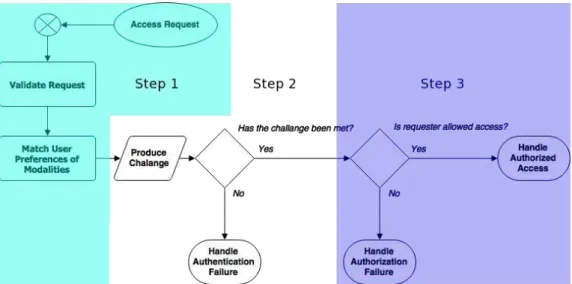
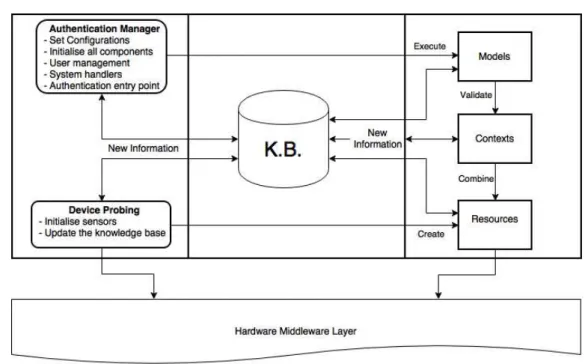
The authentication process may be devised in 3 steps: claiming an identity, fulfil a challenge, accessing the resource.
C H A P T E R 3 . P I B M O D E L
the process. Only after the challenge has been successfully solved the access can be granted, otherwise a different behaviour should take place, maybe a failure
message and a new form, but it could also imply a new model to be executed with different authentication procedure or even maybe there is a threshold for failure
as it happens in the case of many biometrics. Figure 3.1 further illustrates the process flow.
Figure 3.1: Authorisation Flow Chart
In order to break the identified steps into manageable problems the PiB frame-work is split in three basic modules:
Information Storage is provided by means of a knowledge base with an ontology designed by the Ontology Engineering Group. Departamento de Inteligencia Artificial. Facultad de Informátíca, Universidad Politécnica de Madrid, the mIO! Ontology Network is aimed to gather multiple other ontologies in order to represent context where information such as location, time, device, schedule can all be combined [31]. A relational database would have worked as well. But this choice allows for an extension point, along with extra information that can be inferred, from the current state of affairs.
Information Assembly aims at gathering information on the devices in which it runs (e.g. auditing of available sensors, memory, ...) as well as preferences on which authentications methods to use or how to use them or not, providing an abstraction over the hardware and preference management mechanisms to all authentication parties.
Core System is responsible for handling the authentication process. Transform-ing the sensory inputs, as well as received credentials, accordTransform-ing to the
3 . 2 . BAC K- E N D I N F O R M AT I O N M A N AG E M E N T
model for all considered contexts and preferences into authentication decla-rations, that ultimately allow, or not, the access to the resources. Therefor the authorization flow may be represented within this module.
3.2 Back-End Information Management
The used approach to represent and store the collected information is supported by the semantic web framework for Java, Apache Jena. Due to its persistence of information capabilities it is possible to use the framework similarly to a rela-tional database while providing an extensibility point for new ways to combine the collected information and reason about it producing new, possibly unforeseen information. Its feature for transactions is also an enhancement towards perfor-mance, allowing a higher scalability, in particular for systems where multiple users are considered.
3.2.1 Ontological Model
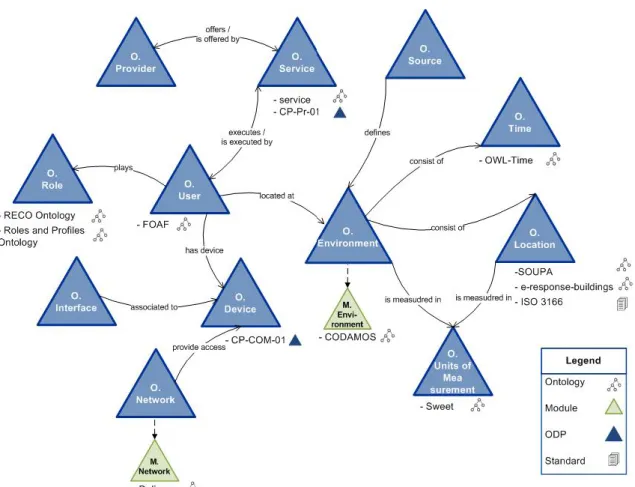
To semantically represent the collected knowledge themIO! ontology networkis used and is defined as an interface ontology to gather the multiple composing sub-ontologies to produce semantic information about complex contexts [31]. It unites the following concepts as ontologies: Device, Environment, Interface, Location, Network, Provider, Role, Service, Source, Time and User (see Figure3.2).
Device The composing ontology represents knowledge modelling devices, their components, charging modes, ...
Environment Models information about conditions such as humidity, tempera-ture, noise, ...
Interface Represents knowledge about types, modalities and characteristics of interfaces.
Location The location ontology contains concepts that describe spatial units, en-tities, location coordinates, ...
Network Containing descriptions of network topologies, operators, administra-tors, price, ... underlying is theDelivery Contextontology.
C H A P T E R 3 . P I B M O D E L
Figure 3.2: mIO! Ontology Network Conceptual Model
Role Represents information about preferences, profiles, roles, ...
Service Aiming to model knowledge such as: services provided by organizations or devices that use services. This is a more complex ontology that is able to describe the many functionalities of any service.
Source As in source of context information. Users, devices, services and groups of them may act as sources of information.
Time Models the knowledge about temporal units, entities, intervals, ...
User The operating ontology is Friend of a Friend (FOAF), modelling names, employment status, skills, and much more knowledge about users, groups or organizations.
3.3 Information Assembly
For complex applications, such as the proposed prototype, it is extremely diffi
-cult to account for every possible preference the user may consider. Gathering
3 . 4 . D E S I G N A N D A R C H I T E C T U R E
all authentication mechanics in one big set of configurable preferences would also be a task users would greatly discard. In order to mitigate such problem, some could come with default values, but even then some of these default val-ues could prove incompatible with deployment environments specificities. The implemented prototype, due to its limited set of mechanisms, uses mostlystatic variablesorenumerationsto define those default values.
Probing for the hardware can solve some of the configurations issues as well. Ac-counting for all possible combinations of hardware is another daunting task, and not in the scope of this dissertation. So, in order to reduce the problem, there are abstract formalism in place to trigger hardware operation, gather and format the expected information that should later be used for the authentication process. More specifically a Factory making use of Java reflection mechanism, producing hardware probing objects that will map the devices to workable well defined ob-jects. By ignoring what hardware, and the internal mechanics of the hardware it is possible to extend towards maybe any type of sensor or hardware resource, allowing then the developer to adapt the library to their needs.
The other perspective on collecting information concerns the environment aware-ness that dynamically affects the authentication mechanisms used, e.g., forcing
more steps, choosing a more reliable authentication algorithm or simpler because you are within the boundaries of a safe localization. All of the information that can be gathered is done by interpreting sensors output in the core system and acting according to them. These readings may or may not be stored for historical usages, knowing where you were in the past may still influence the present, e.g., consider a regular scheduled job for someone who always takes the same route back and forth every Monday to Friday, if phone localization is too far from his route it would immediately enhance its authentication requests. The information in focus is represented trough resources.
3.4 Design and Architecture
C H A P T E R 3 . P I B M O D E L
(see figure3.3).
Figure 3.3: PiB Abstract Level Architecture Design
3.4.1 Core System
In order for the framework to overcome all the difficulties of authenticating a
principal we propose some concepts to suggest a representation of the parts, com-ponents and other entities involved in the process of creating an authentication.
Resource
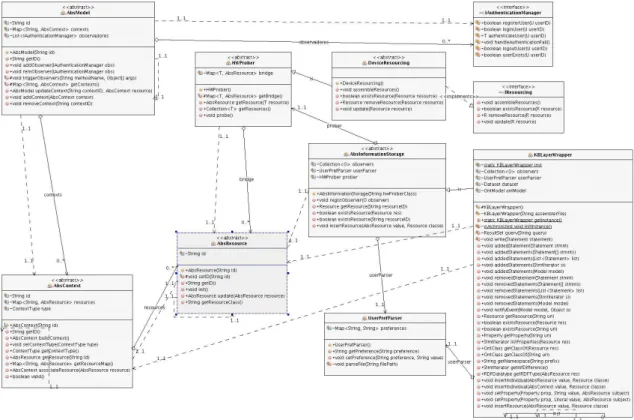
A resource encloses the consumable information collected about hardware and high level entities such as call history, or system folder. The resource object is by default uniquely characterized by a String object, and requires implementation of an initialization method that defines the starting point of the resource, along with an update method that will update the information within the resource.
Context
The context refers to a set of resources available in an environment or condi-tions and how and when to use them. Consider any web-camera as an image input resource, that may be filming at night, i.e., in a low light environment. In such a context the camera resource should turn a flash light in order to get a better picture. So context defines the usage of the resources. Contexts are build-able and updated-able as well.
![Table 1.1: Some Potential Attacks, Susceptible Authenticators, and Typical De- De-fences [49]](https://thumb-eu.123doks.com/thumbv2/123dok_br/16532024.736336/19.892.130.762.132.469/table-some-potential-attacks-susceptible-authenticators-typical-fences.webp)