RECURSOS LOCAIS E AS CAPACIDADES TECNOLÓGICAS DAS PEQUENAS
EMPRESAS
Marisa Cesário and Maria Teresa de Noronha Vaz
ABSTRACT
The main objective of the present work is to empirically show how a set of environmental variables affects the adoption of new technologies by small firms. We report the results of the application of a common questionnaire to a sample of 167 small and medium sized firms from clothes, textile and leather sectors (TCL) belonging to the following southern European areas: North (Portugal), Valencia (Spain), Macedonia (Greece) and South Italy (Italy). The following variables were considered as possible predictors: employees, type of ownership and management, supply/distribution/customers’ networks and institutional links. A binary logistic regression was computed allowing the characterisation of the process of adoption of new technologies such as: developed internally, supplier dominated and motivated by the international market.
Keywords: Technological Change, Localised Assets, Labour-intensive Sectors.
RESUMO
O principal objetivo do presente trabalho é mostrar empiricamente de que forma um conjunto de variáveis relacionadas com o ambiente envolvente afeta a adoção de novas tecnologias pelas pequenas empresas. São apresentados os resultados da aplicação de um inquérito comum a uma amostra de 167 pequenas e médias empresas dos sectores dos têxteis, vestuário e calçado, localizadas nas seguintes regiões sul Europeias: Norte (Portugal), Valência (Espanha), Macedónia (Grécia) e Sul de Itália (Itália). As seguintes variáveis explicativas foram consideradas: características dos empregados, tipo de propriedade e de gestão, redes de fornecedores/distribuidores/clientes e relações institucionais. Foi determinada uma regressão logística binária que permitiu caracterizar o processo de adoção de novas tecnologias como um processo: desenvolvido internamente, influenciado pelas relações com fornecedores e motivado pelo mercado internacional.
Palavras-chave: mudança tecnologica, Ativos locias, sectores de trabalho-intensivo JEL Classification: O300, L670
1. INTRODUCTION: TIME AND PLACE MATTERS
Economic globalisation is leading firms to face an increasing openness to rival producers, regardless of the original location of production. In addition to firms, industries and regions are now much more vulnerable to price and quality competition (hyper-competition, in the words of D’Aveni, 1994). The increased sense of risk stimulates regions to search for new paths to resilience (Hudson, 2010). We assume the evolutionary approach to gain an understanding of regional change. Human action and social relations are determinants of regional competitiveness; territories compete with one another, and both attractiveness and local competitiveness depend on similar, common factors which go beyond physical conditions and refer to relational capital and the learning capacity expressed by the territory (Camagni, 2002). The path- and place-dependent nature of these assets stresses the importance of geographic proximity for the strategic positioning of firms.
Despite the increasing global flow of ideas, capital, goods, and labour, the role of proximity in the creation of economically useful knowledge appears to be even more important than before (Scott, 2000; Scott, Agnew and Storper, 2001; Scott and Storper, 2003; Sonn and Storper, 2008; Storper, 2009). Indeed, the ‘dead of geography’ thesis cannot be sustained, because it wrongly assumes that the rapid diffusion of information and codified knowledge means the rapid diffusion of understanding, and that is not correct (Morgan, 2004). Even in the presence of the ‘ubiquitification’ phenomena1, direct face-to-face communication is still an important aspect because some types of knowledge travel more easily than others. While analytical knowledge, which results from the application of scientific laws, has a relatively constant meaning by location, the same is not true for synthetic or symbolic knowledge2, the meaning of which is substantially variable (Gertler, 2008).
Agglomeration is important because it facilitates transactional interactions and increases opportunities for matching needs and capabilities; for instance, it eases the dynamics of the backward and forward inter-linkage of firms, allows the formation of dense, local labour markets around multiple workplaces, and facilitates the emergence of localised, relational assets promoting learning and innovation effects (Storper and Harrison, 1991; Scott and Storper, 1992). Although we do not intend to measure the three marshallian forces, as in Ellison and Glaeser (2010), we use their findings to confirm that the advantages of location proximity go beyond transactional efficiencies and include various kinds of externalities, such as knowledge spillovers and dependence on human relations, rules, and customs that enable firms to coordinate under conditions of uncertainty3.
This nexus of untraded interdependencies (as labelled by Storper, 1995) corresponds to that of regionalised relationships that extend beyond traditional customer/supplier links and embrace collaborative and information networks that are both formal and informal. Inspired by evolutionary economics, this argument states that technological change is path dependent because it involves interdependencies between choices made over time. These choices have a spatial dimension; although direct input-output relations may play a role, when organisations travel along a technological trajectory they have interdependencies that are untraded and include labour markets, conventions, common languages, and rules. We 1 Although technological trajectories are largely territorially path dependent, there is a growing list of territorial inputs being transformed
into ubiquities as an outcome of the ongoing globalisation process. Maskell and Malmberg (1999) and Maskell, et al. (1998) use the term ‘ubiquitification’ to describe the process whereby former, tacit knowledge gradually becomes codified, so that firms in low-cost areas become more competitive in open markets and when knowledge of new technologies and new organisational designs becomes globally available.
2 By ‘synthetic knowledge’ the authors mean the application or combination of existing knowledge, mainly through interactive learning with
customers and suppliers; ‘symbolic knowledge’ means creating meaning through highly, context-specific, learning-by-doing processes.
3 When considering innovative activities, for instance, the importance of geographic proximity promoting interaction has been defended by
authors such as Gambardella and Malerba (1999), Arndt and Sternberg (2000), and Cassiman and Veugelers (2002). Inter-firm linkages, in the form of regional networks, are proven to be important prerequisites for successful innovation activities in firms. Similar approaches can also be found in Malmberg and Maskell (1997), Kirat and Lung (1999), Hudson (1999), and Porath (2012).
believe that those links are the bases of regional economic resilience and contribute to the ability of regions to react to the challenges of globalisation and economic integration. The argument on path-dependency is even truer when considering the specific case of small firms. Unlike big firms, SMEs interact intensely with the territory in which they locate, as a sign of their embeddedness. The particularly tight links they develop with the external environment also reduce uncertainty risks. In general, SMEs do not only locate near the residence of their owners, but they also have geographical and sociological proximities as their main sources of assets and information (Julien 1995; Vaz 2006, 2012). This fact constrains the perspectives and strategic choices of the firms, because most of the market perception arises from the inputs supplied by the territorial institutional context. Small firms learn from close interaction with suppliers, customers, and competitors; additionally, knowledge processes are deeply influenced by local resources, institutions, and social and cultural structures (what we call localised capabilities4). Most SMEs and the respective entrepreneurs are generated, to a large extent, by the local context; to face changing and uncertain economic conditions, their decision-making process is firmly based on socialised practices, thereby stressing the importance of geographic proximity as a mediating factor (Camagni, 2002).
When referring to technological trajectories, Dosi et al. (1988) mention the importance of both the public elements of knowledge, constructed upon the interdependencies between sectors, technologies, and firms that represent a structured set of technological externalities for individual companies, and the firm-specific technological competences. Cohen and Levinthal (1990) labelled those competences as the firm’s absorptive capacity. The authors argue that the ability of a firm to recognise the value of new, external information, assimilate it, and apply it to commercial ends is critical to its innovative capabilities. A similar idea is given by Julien et al. (1999), who argue that the main factors distinguishing SMEs using new technologies from those continuing to use traditional equipment are management quality and the organisation’s ability to obtain and process technological information. The authors define technological scanning as the activity through which the external information needed for technological change is gathered, analysed, and disseminated in the firm.
2. CONCEPTUAL FRAMEWORK AND RESEARCH HYPOTHESES
In accordance, we argue that firms may decide differently about their employees (their origin and type of upgrading of skills provided), ownership and management, as well as the way they relate with suppliers, customers, universities or trade associations. Firms may also have different geographical scales in terms of their supply, distribution and customers’ networks. All these decisions are believed to be influenced by the different territorial attributes. We label this set of public and firm-specific elements of knowledge as a firm’s networking aptitudes and human capital endowment (Cesário and Vaz 2008; Vaz et al,. 2006; Vaz and Cesário, 2008).
Assuming the importance of localised assets for the technological capabilities of small firms, the main question addressed in this paper is: How do firms’ networking aptitudes and human capital endowment affect their technological adjustment strategies?
More than just proving such cause-effect relations, we expect to identify the most significant effects produced by localised assets upon the technological capabilities of European labour-intensive firms.
The following variables are considered as indicators of a) human capital and b) networking aptitudes:
i. Source of employees, type of ownership/management, upgrading of skills; ii. Supply/distribution/customers’ networks and institutional links.
These variables will be used as predictors of technological behaviours. We rely on Hall (1987), who distinguishes between general environments and specific (or task) environments. The general environments of firms include technological, legal, economic, demographic, and cultural conditions. The specific (or task) environments include customers, suppliers, competitors, industry associations, universities, and so on. While firms can hardly influence the general environment, task environments correspond to the firms’ decisional space, allowing different strategic options, particularly those that concern technology.
The literature review suggests that regional settings can provide an essential level of economic coordination and can be a major source of region-specific material and non-material assets (network collaborations, untraded interdependencies, and associational behaviours are concepts supporting this idea). As mentioned by Pavitt (quoted in Dosi, 1988), the TCL sectors belong to what he called the supplier-dominated group of sectors, where‘…innovations are mainly process innovation: innovative opportunities are generally embodied in new varieties of capital equipment and intermediate inputs, originated by firms whose principal activity is outside these sectors themselves. Thus the process of innovation is primarily a process of diffusion of best-practice capital-goods and of innovative intermediate inputs…The knowledge base of innovation in these sectors mainly relates to incremental improvements in the equipment produced elsewhere, to its efficient use and to organisational innovations.’
In this argument we highlight two major ideas: the importance of the contacts developed among firms along the productive chain as important sources of technological knowledge, and the importance of efficiency and organisational innovations, in which employees and managers play an essential role.
Malecki and Poehling (1999) suggest that the ‘personality’ of the small firm reflects the personality of its owner/manager. With regard to the search for external information, the authors classify this personality as an extrovert or introvert type, distinguishing between different abilities to obtain technical and engineering information.
In agreement with these considerations, the following research hypotheses regarding firms’ human capital endowment are proposed:
H1: The origin of the firms’ employees is a significant predictor of the adoption of new technologies. H2: The upgrading of the skills of employees is a significant predictor of the adoption of new technologies. H3: The type of ownership is a significant predictor of the adoption of new technologies.
H4: The type of management is a significant predictor of the adoption of new technologies.
The review of the literature also suggests the importance of supply, distribution, and customer links, recognising that small firms frequently form component parts of extended networks with different possible geographies (local, regional, national, EU, and international). By accessing other markets, assets, and technologies, the firms release themselves from the limits of local and internal competences and gain control over the technological trajectories of their competitors (Camagni, 1991, 1995).
Additionally, the informal contacts that occur inside firms, or between them and other surrounding agents, are also seen in the literature as important sources of technological knowledge. Storper (1995) uses the term ‘untraded interdependencies’; with a similar view but a different conceptualisation, Cooke and Morgan (1998) refer to a collective social order that induces firms to collaborate and display ‘associational behaviours’. The interactive learning among business networks is argued to be the most effective and credible way for
knowledge acquisition (Morgan, 1996). In agreement, the following research regarding hypotheses for firms’ networking aptitudes are proposed:
H5: The scope and geography of firms’ networks are significant predictors of the adoption of new technologies.
H6: The nature of institutional links is a significant predictor of the adoption of new technologies.
3. METHOD 3.1. Sampling
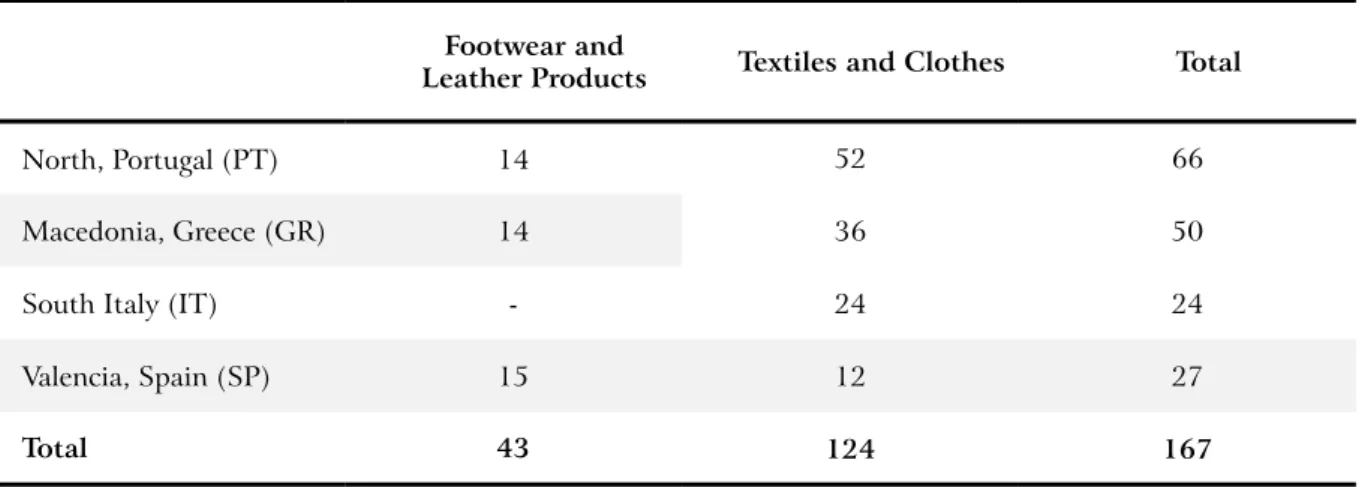
Empirically, the analysis is based on the application of a common questionnaire to a sample of 167 SMEs from the TCL sectors belonging to the following southern European areas: North (Portugal), Valencia (Spain), Macedonia (Greece), and South Italy (Italy) (table one). Appendix one gives the design of the questionnaire and sampling procedures.
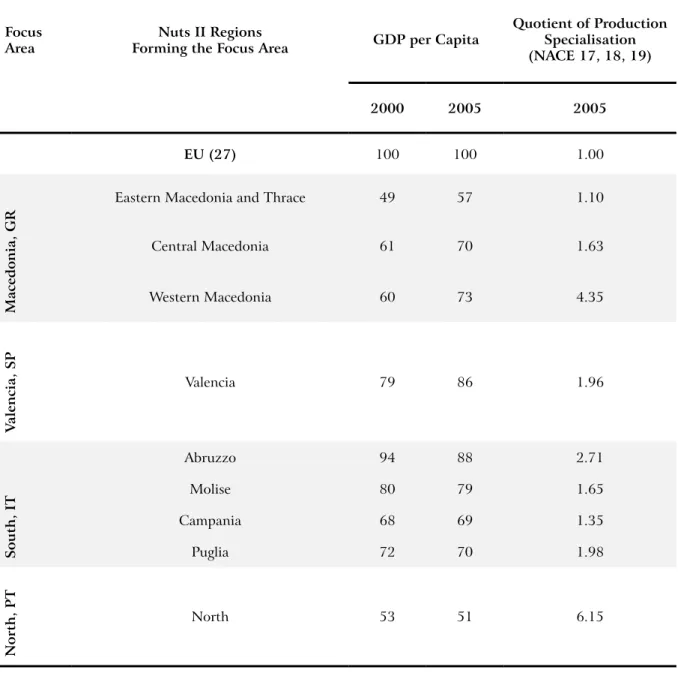
These areas are composed of one or more Nomenclature of Units for Territorial Statistics (NUTS) II regions and were selected because of their economic vulnerability, established in three common features: a) these areas are lagging behind the EU-27 average in terms of gross domestic product (GDP) per capita; b) their heavy industrial issues are mainly composed of labour-intensive activities, the ones most affected by low-wage competition; and c) their peripheral geographic location constitutes an economic restraint (table two). Considering the NUTS II regions forming the focus areas, all of them were eligible under the EU objective 1 status in the 2000-2006 period. Only the Italian regions of Abruzzo and Molise were not; nevertheless, these regions registered, in 2005, a GDP per head as a percentage of EU-27 of 88 percent and 79 percent, respectively, which are values relatively close to the upper limit of the criterion. Moreover, the entire group presented high levels of dependence on the labour-intensive industries under analysis (quotients of product specialisation above one mean that the proportion of employment in sectors from NACE 17, 18, and 19 is more relevant in that region than it is in the EU-27).
Table 1: Sample Distribution by Focus Area and Sector Footwear and
Leather Products Textiles and Clothes Total
North, Portugal (PT) 14 52 66 Macedonia, Greece (GR) 14 36 50
South Italy (IT) - 24 24
Valencia, Spain (SP) 15 12 27
Total 43 124 167
Table 2: GDP per capita and QPS values
Focus
Area Forming the Focus AreaNuts II Regions GDP per Capita
Quotient of Production Specialisation (NACE 17, 18, 19) 2000 2005 2005 EU (27) 100 100 1.00 Macedonia, GR
Eastern Macedonia and Thrace 49 57 1.10 Central Macedonia 61 70 1.63 Western Macedonia 60 73 4.35 V alencia, SP Valencia 79 86 1.96 South, IT Abruzzo 94 88 2.71 Molise 80 79 1.65 Campania 68 69 1.35 Puglia 72 70 1.98 North, PT North 53 51 6.15 Source: Eurostat
3.2. Statistical Data and Methodology
3.2.1. The Predictors
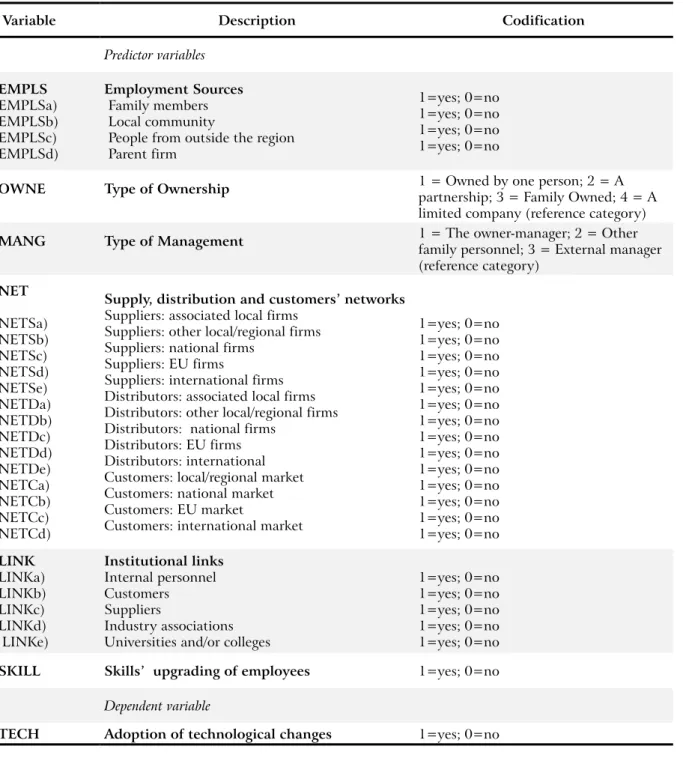
The following variables (listed in table three) are used as predictors of the probability of firms adopting new technologies: employment sources (EMPLS); type of ownership (OWNE); type of management (MANG); supply, distribution, and customer networks (NETS, NETD, NTEC); institutional links (LINK); and skills’ upgrading of employees (SKILL).
Table 3: Description of Database Variables
Variable Description Codification
Predictor variables EMPLS EMPLSa) EMPLSb) EMPLSc) EMPLSd) Employment Sources Family members Local community
People from outside the region Parent firm
1=yes; 0=no 1=yes; 0=no 1=yes; 0=no 1=yes; 0=no
OWNE Type of Ownership 1 = Owned by one person; 2 = A partnership; 3 = Family Owned; 4 = A
limited company (reference category)
MANG Type of Management 1 = The owner-manager; 2 = Other family personnel; 3 = External manager
(reference category) NET NETSa) NETSb) NETSc) NETSd) NETSe) NETDa) NETDb) NETDc) NETDd) NETDe) NETCa) NETCb) NETCc) NETCd)
Supply, distribution and customers’ networks
Suppliers: associated local firms Suppliers: other local/regional firms Suppliers: national firms
Suppliers: EU firms
Suppliers: international firms Distributors: associated local firms Distributors: other local/regional firms Distributors: national firms
Distributors: EU firms Distributors: international Customers: local/regional market Customers: national market Customers: EU market
Customers: international market
1=yes; 0=no 1=yes; 0=no 1=yes; 0=no 1=yes; 0=no 1=yes; 0=no 1=yes; 0=no 1=yes; 0=no 1=yes; 0=no 1=yes; 0=no 1=yes; 0=no 1=yes; 0=no 1=yes; 0=no 1=yes; 0=no 1=yes; 0=no LINK LINKa) LINKb) LINKc) LINKd) LINKe) Institutional links Internal personnel Customers Suppliers Industry associations Universities and/or colleges
1=yes; 0=no 1=yes; 0=no 1=yes; 0=no 1=yes; 0=no 1=yes; 0=no
SKILL Skills’ upgrading of employees 1=yes; 0=no
Dependent variable
TECH Adoption of technological changes 1=yes; 0=no Source: Own elaboration
The variable EMPLS distinguishes among four different sources of employment: family members, local community, people from outside the region, and parent firm (four different, binary variables are considered). Regarding the type of ownership (OWNE), firms may be owned by one person, a partnership, a family, or a limited company. According to the type of ownership, different management situations are possible. The variable MANG aggregates the following options regarding the firm’s manager: owner-manager, other family personnel, or external manager.
The variable NET includes supply (NETS), distribution (NETD), and customer (NETC) links. The first two distinguish among five different, network geographies that are possible: associated local firms, other local/regional firms, national firms, EU firms, and international
firms. The destination of firms’ sales may be local/regional markets, national markets, EU markets, or international markets.
The variable LINK is used to identify the contacts (mostly informal) used as sources of technological knowledge by the sample firms, and it differentiates among internal personnel, customers, suppliers, industry associations, and universities/colleges.
Finally, the sample firms were examined with respect to the upgrading of their employees’ skills. The variable SKILL is measured by a binary scale (1 = yes; 0 = no).
3.2.2. The Dependent Variable
The adoption of new technologies by the sample firms, TECH, was also measured by a binary scale (1= yes; 0= no) and used as a dependent variable. To obtain observable measures of technology, Chennells and Van Reenen (2002) distinguish between three types of measures: inputs into the knowledge production function, outputs from the knowledge production function, and subsequent diffusion of these outputs around the economy. Inputs are generally measured by research and development (R&D) activities. Although R&D expenditure has the advantage of being measured in a reasonably standard way, it has a disadvantage related to spillovers. A firm might invest significantly in R&D without receiving any benefit from it, either in the form of innovation for the firm or in the form of the ability to learn from other firms’ innovations. Patents, on the other hand, are a widely available and standard way of measuring the outputs of knowledge. However, a large number of patents appear to be of very low value, and there is no obvious method of measuring them when this factor is taken into account.
According to Chennells and Van Reenen (2002), diffusion measures seem to be closely related to what is usually considered technology. Examples of diffusion measures proposed by these authors are the use of computers in a firm (word processors, mainframes), production-based technologies (lasers, robots, CAD, CAM), and the weight of usage (the proportion of people using the computer). Based on these ideas, and considering that the sample is composed of SMEs from low-tech sectors and located in vulnerable European regions (where R&D departments and patents are remote realities), the following technology measures were considered in the present survey:
(a) inventory control (e.g., PC, software) (b) production process technology (e.g., CAM) (c) product design technology (e.g., CAD)
(d) marketing technology (e.g., internet, websites) (e) e-mail/website/internet
(f) business-to-business electronic networks
The firm was considered to have adopted new technologies if at least two of the previous technologies were adopted in the past three years. This criterion was considered as common sense, taking into account the possible combinations of answers given by the firms.
3.2.3. The Model
The quantitative contribution of each of the previous predictors was compared using a binomial logistic regression model constructed by iterative maximum likelihood estimation (MLE), as given by the following equation:
r r r r r r
logit(TECH)= + EMPLS + SKILL+ OWNE+ MANG+ NET + LINK
α β
γ
δ
ε
ζ
η
(1) where r stands for the option of the corresponding question, when variables are subdivided in different yes/no options, each one corresponding to a binary variable itself (see table three).For the binomial logistic regression, the predicted dependent variable is a function of the probability that a particular subject will be in one of two categories—in this case, the
probability that sample firms adopted new technologies in the past three years (TECH=1). The logistic regression will predict the logit, that is, the natural log of the odds, given by
[
]
{
}
ln P(TECH 1) 1 P(TECH 1)= − = . Section five presents the results for the set of recommended
procedures and statistical tests developed to assure the adequacy of the model.
4. RESULTS
4.1. Adequacy of the Model
According to Menard (1995), the first and most important assumption in logistic regression is that the model is correctly specified. One crucial component of correct specification is the correct functional form of the model. Logistic regression does not require linear relationships between the independent factors or covariates and the dependent – as does OLS regression – but it does assume a linear relationship between the independents and the log odds (logit) of the dependent. When the assumption of linearity in the logit is violated, then logistic regression will underestimate the degree of relationship of the independents to the dependent and will lack power (generating type II errors, assuming that there is no relationship when there actually is). To assess linearity, as suggested by Menard (1995), the proposed model was compared with a larger model, including the square and cubic values of the original independent variables5. The coefficients associated with these variables are jointly non-statistically significant (p=0.531), that is, there is no evidence of nonlinearity between the logit of the dependent variable and the set of independent variables.
Another issue to avoid is multicollinearity among variables. High multicollinearity is a problem as it affects the reliability of the coefficients. In this case, the highest correlation registered between two independent variables was 0.633, which does not represent a problem.
4.2. Results of the Estimation of a Logistic Regression Model
Following these procedures, the logistic regression results for equation (1) are presented. These results include statistics for: the goodness-of-fit of the model (chi-square statistics), the estimated parameters, and the predictive capacity of the model (annex 4.1 provides detailed information). The model’s goodness-of-fit was assessed using the Omnibus test of model coefficients – the null hypothesis that the coefficients of the variables are all jointly equal to zero was rejected (p = 0.000) – and the Hosmer and Lemeshow test – the null hypothesis that the model adjusts well to the data is not rejected (p = 0.574).
Table four lists the b coefficients, the Wald statistic and its significance, and the odds ratio for the final independent variables in the model. The Nagelkerke R-square is also presented. Logit coefficients (logits), also called unstandardized logistic regression coefficients, are interpreted as the expected change in the propensity (log odds) to adopt new technologies for a unit change in the associated explanatory variable, holding all the other variables constant. Logit coefficients are easier to interpret when converted to an odds ratio using the exponential function. The odds ratios are simply measures of effect size and will be used to comment on their relative sizes when comparing independent variables effects.
The Wald statistic is used to test the significance of individual logistic regression coefficients for each independent variable (that is, to test the null hypothesis in the logistic regression that a particular logit [effect] coefficient is zero). Of the list of independents initially considered, the following ones are statistically significant: type of ownership (OWNE), suppliers – international firms (NETSe), customers – international market (NETCd), sources of technological knowledge – internal personnel (LINKa), sources of
technological knowledge – suppliers (LINKc), and employees’ skills upgrading (SKILL). All the others are not statistically significant.
Table 4: Results of the Estimation of a Logistic Regression Model with the Final Independent Variables Predictors B S.E. Wald
ᵪ
2 p-value EXP(B) OWNE - Type of Ownership 16.902 .001OWNE(1) – owned by one person (dummy) -1.338 1.352 .980 .322 .262 OWNE(2) – a partnership (dummy) .335 1.182 .080 .777 1.398 OWNE(3) – family owned (dummy) -2.270 1.202 3.565 .059 .103
NET - Supply, distribution and customers’ networks
NETSe) – suppliers: international firms 1.883 .693 7.393 .007 6.573 NETCd) – customers: international market 1.687 .610 7.646 .006 5.402
LINK - Institutional links
LINKa) – internal personnel 1.081 .499 4.692 .030 2.947 LINKc) – suppliers 1.926 .573 11.303 .001 6.860
SKILL - Skills’ upgrading of employees 2.751 .616 19.923 .000 15.663
Constant -3.201 1.359 5.552 .018 .041 Source: Own elaboration Nagelkerke R2=0.601
As indicated earlier, the analysis of the odds ratios allows comparing the effect size of each one of the independents to the odds of the dependent. In other words, among the significant predictors earlier identified, it is possible to identify which ones produce greater positive (odds ratios > 1) or negative (odds ratios < 1) effects on the odds of adoption of new technologies.
For instance, the odds that a firm in a partnership will adopt new technologies are 1.398 times the odds of a limited company6 doing so, while the odds that a firm owned by one person or a family owned firm will adopt new technologies are 0.262 and 0.103 times, respectively, the odds of a limited company doing so. The odds of a firm using international firms as suppliers and customers, respectively, are 6.573 and 5.402 times the odds of a firm not using these networks. On the other hand, the odds of firms using internal personnel and suppliers as sources of technological knowledge are, respectively, 2.947 and 6.860 times the odds of firms not using these sources. Finally, the odds of adopting new technologies by firms upgrading employees’ skills are 15.663 times the odds of firms not doing it.
From the 84 firms that adopted new technologies, 90.5 percent were correctly predicted (sensitivity), while from the 63 firms that did not adopt new technologies, 77.8 percent were
6 When the independent variable is categorical, the odds ratios need to be interpreted in terms of the left-out reference category, which in this
correctly predicted (specificity)7. The overall percentage of correctly predicted cases is 85 percent, which is very reasonable.
In order to test research hypotheses H1, H2, H3, H4, H5, and H6, the likelihood of the model with all the independent variables was compared with the likelihood of the model without the variables implicated in each research hypothesis. In testing the first research hypothesis, H1, that the origin of firms’ employees is a significant predictor of technological behaviour, the null hypothesis is
H :
01β = β = β = β =
1 2 3 40
. In this case, H01 was not rejected (p=0.899), meaning that the origin of employees (family members, local community or outsiders) is not a significant predictor.With respect to the second hypothesis, H2, that the employees’ skills upgrading is a significant predictor, the null hypothesis (
H :
02γ =
0
) was rejected (p=0.000), indicatingthe importance of employment qualification as one basic condition for the industry capacity to survive in the present, competitive environment.
In the third research hypothesis (H3), which states that the type of ownership is a significant predictor, the null hypothesis (
H :
03δ =
0
) was rejected (p = 0.002), meaningstatistical evidence was in favour of H3. The individual parameter results (in table four) demonstrate that the category ‘a partnership’ produces the higher positive effect on the probability of adoption of new technologies when compared with the other categories, indicating that the responsibility towards the partners (not necessarily family members) increases the pressure for better results and necessary changes.
Regarding the fourth research hypothesis, H4, that the type of management is a significant predictor, there is statistical evidence in favour of
H :
04ε =
0
(p=0.472), leading to therejection of H4.
Concerning the fifth research hypothesis, H5, that the scope and geography of the firms’ networks are significant predictors, the test was performed for the three network scopes considered – supply, distribution, and customer networks – thereby separately testing three null hypotheses:
H , H , H
05S 05D 05C. For the first case,H
05S, the likelihood of the modelwith all the independent variables was compared with the likelihood of the model without the variables NETr, considering r=1...5, that is, variables NETSa, NETSb, NETSc, NETSd, and NETSe. For the second case,
H
05D, the variables dropped were NETr, with r=6...10, thatis, the variables NETDa, NETDb, NETDc, NETDd, and NETDe. Finally, for the last case,
05C
H
, the restricted model dropped the variables NETr, with r=10...14, that is, the variables NETCa, NETCb, NETCc, and NETCd. The null hypothesis, H :05s ζ = ζ = ζ = ζ = ζ =1 2 3 4 5 0 , was rejected (p=0.016), confirming the importance of the relationships with suppliers as a way of creating critical mass and exploiting standardisation opportunities in the TCL sectors. The null hypothesis, H05D:ζ = ζ = ζ = ζ = ζ =6 7 8 9 10 0, was not rejected (p=0.454), meaning that the use of different geographically located distributors is not a significant predictor. Regarding the null hypothesis, H05C:ζ = ζ = ζ = ζ =11 12 13 14 0 , the result for the qui-square statistic with 4 degrees of freedom just barely means the rejection of this null hypothesis (p=0.062), indicating that the variables related with different geographically located customers are jointly nonstatistically significant. Nevertheless, considering such a small p-value, and taking into account the individual parameter result (table four) for the use of international customers (p=0.006), this variable should not be ignored when drawing conclusions.Indeed, the individual parameter results demonstrate that, in both the situations of suppliers and customers’ networks, the contacts with international firms (networks’ geography) were the ones with statistical significance, producing positive effects on the odds 7 Sensitivity and specificity are statistical measures of the performance of a binary classification test. Sensitivity measures the proportion of
of the adoption of new technologies by the sample firms. The importance of exploring international and quality conscious markets is corroborated by these results.
Finally, considering the sixth research hypothesis, H6, that the nature of institutional links is a significant predictor, the null hypothesis H :06 η = η = η = η = η =1 2 3 4 5 0 was rejected (p=0.000). Individual parameter results confirm the importance of the use of internal personnel (p=0.030) and suppliers (p=0.001) as sources of technological knowledge. These results validate again the importance of employment qualification and skills, but they also suggest that the technological adjustment process in TCL sectors is substantially driven by supplier-demanding mechanisms. An easier reading of the results is given in table five.
Table 5: Summary of the results
Question Addressed Research Hypothesis Results Reading
Q: How do firms’ networking aptitudes and human capital endowment affect their technological adjustment strategies?
H1: The origin of the firms’ employees is a significant
predictor. H01 is not rejected (p=0.899) The origin of employees is not a significant predictor.
H2: The upgrading of skills of employees is a significant
predictor. H02 is rejected (p=0.000)
Employment qualification determines the adoption of new technologies.
H3: The type of ownership is
a significant predictor. H03 is rejected (p=0.002)
The type of ownership is a significant predictor: the category “a partnership” produces the higher positive effects.
H4: The type of management
is a significant predictor. H04 is not rejected (p=0.472) The type of management is not a significant predictor.
H5: The scope and geography of firms’ networks are significant predictors.
H05S is rejected (p=0.016) H05D is not rejected (p=0.454)
H05C is rejected (p=0.062)
The use of international suppliers and customers is a significant predictor.
H6: The nature of institutional links is a
significant predictor. H06 is rejected (p=0.000)
The use of internal personnel and suppliers as sources of technological knowledge is a significant predictor. Source: Own elaboration
Considering the different effect sizes produced by each one of the significant predictors (given by the individual parameter estimates, correspondent Wald statistics, and odds ratios – table four), it may be concluded that the adoption of new technologies in labour-intensive industries from Southern Europe is a process:
• Developed internally, depending largely on the skills of the workforce;
• Supplier dominated, in the sense that the ideas, suggestions, and/or impositions of suppliers (even more strongly, if international) play an important role in the technological process;
• Motivated by the international market, given the importance of international customers for firms engaged in technological changes.
5. FINAL REMARKS
The process of economic globalisation has brought peripheral regions into the centre of rapid technological and economic change. A great deal of research has focused on the factors behind the technological change in central European regions. In this work, however, the concern was limited to those geographical environments that are not “…blessed by clusters, special factors, or new growth industries. Rather our focus has been on provincial regions with labour-intensive industries vulnerable to low-wage competition from within and without Europe.” (RASTEI, 2002).
The main goal was to identify the factors affecting the adoption of new technologies by such industries, considering technological adjustments as the needed way for the promotion of productivity and local development in vulnerable areas.
We conclude that the learning and technological capacity of TCL firms from southern regions is largely influenced by the relationship patterns that producers develop with their suppliers and customers. Those patterns are essential to information exchange in sectors where the process of technological adjustment is primarily a process of diffusion of best-practice along the value-chain. In addition to being a supplier-dominated process, the technological advances in these sectors are largely dependent on the qualifications of the workforce as well as strongly motivated by the appeal of the international market. These two characteristics are interdependent, as firms committed to export production recognise the need to offer specialised and differentiated products, which is not compatible with low-cost production that indicates the use of unskilled labour and firm inadequacy to absorb and diffuse knowledge.
ACKNOWLEDGEMENTS
This paper has been partially supported by the Portuguese Foundation for Science and Technology (FCT). We are also grateful to the coordinator, as well as to the consortium of the European project RASTEI – Regional Adjustment Strategies to Technological Change in the Context of European Integration, who generously provided the survey results for the Greek, Italian and Spanish firms.
REFERENCES
Arndt, O., and R. Sternberg (2000). Do Manufacturing Firms Profit from Interregional Innovation Linkages? An Empirical Based Answer. European Planning Studies, 8 (4): 465 - 485. D’Aveni, R. (1994). Hypercompetition: Managing the dynamic strategic maneuvering. Aru Press.
New York.
Camagni, R. (1991). Local Milieu, Uncertainty and Innovation Networks: Towards a New Theory of Economic Space. In R. Camagni (ed.). Innovation networks: spatial perspectives. London and New York: Belhaven Press, 121 - 144.
Camagni, R. (1995). Global Network and Local Milieu: Towards a Theory of Economic Space. In S. Conti, E. Malecki and P. Oinas (eds.). The Industrial Enterprise and its environment: Spatial Perspectives. England: Avebury, 195 - 213.
Camagni, R. (2002). On the Concept of Territorial Competitiveness: Sound or Misleading? Urban Studies, 39(13): 2395 - 2411.
Cassiman, B. and R. Veugelers (2002). R&D Cooperation and Spillovers: Some Empirical Evidence From Belgium. The American Economic Review, 92 (4): 1169 - 1184.
Cesário, M. and M. T. N. Vaz (2008). How do Small Firms from European Rural Regions Learn and Innovate? WSEAS Transactions on Environment and Development, 4 (10): 835 - 845.
Chennells, L. and J. Van Reenen (2002). Technical Change and The Structure of Employment and Wages: A Survey of the Microeconometric Evidence. In Source Productivity, inequality and the digital economy: a transatlantic perspective, MIT Press, 175 - 223.
Cohen, W. and D. A. Levinthal (1990). Absorptive Capacity: A New Perspective on Learning and Innovation. Administrative Science Quarterly, 35: 128 - 152.
Cooke, P. and K. Morgan (1998). The Associational Economy: Firms, Regions and Innovation. Oxford University Press. Oxford.
Dosi, G., C. Freeman, R. Nelson, G. Silverberg and L. Soete (1988). Technical Change and Economic Theory. Pinter Publishers. London.
Ellison, G., L. Glaeser and W. Kerr (2010). What causes industry agglomeration? Evidence from coagglomerative patterns. American Economic Review, 100: 1195-1213.
Gambardella, A. and F. Malerba (1999). The Organisation of Economic Innovation in Europe. Cambridge University Press. Cambridge.
Gertler, M. S. (2008). Buzz Without Being There? Communities of Practice in Context, Community, Economic Creativity and Organisation. Oxford Scholarship Online Monographs, 203 - 227.
Hall, R. H. (1987). Organizations: Structures, Processes and Outcomes. Englewood Cliffs: N.J. Prentice-Hall.
Julien P. A. (1995). Economic Theory, Entrepreneurship and New Economic Dynamics. In S. Conti, E. Malecki and P. Oinas (eds.) The Industrial Enterprise and its Environment: Spatial Perspectives. England: Avebury, 123 - 142.
Julien P.A., L. Raymond, R. Jacob and C. Ramangalahy (1999). Types of Technological Scanning in Manufacturing Smes: An Empirical Analysis of Patterns and Determinants. Entrepreneurship and Regional Development, 11: 281 - 300.
Hudson, R. (1999). The Learning Economy, The Learning Firm And The Learning Region. European Urban and Regional Studies, 6 (1): 59 - 72.
Hudson, R. (2010). Resilient Regions in an Uncertain World: Wishful Thinking or a Practical Reality? Cambridge Journal of Regions, Economy and Society, 3: 11 - 25.
Kirat, T., and Y. Lung. (1999). Innovation and Proximity: Territories as Loci of Collective Learning Processes, European Urban and Regional Studies, 6 (1): 27 - 38.
Malecki, E. and R. Poehling (1999). Extroverts and Introverts: Small Manufacturers and their Information Sources. Entrepreneurship and Regional Development, 11: 247 - 268. Malmberg, A. and P. Maskell (1997). Towards an Explanation of Regional Specialization
and Industry Agglomeration. European Planning Studies, 5 (1): 25 - 42.
Maskell, P. and A. Malmberg (1999). The Competitiveness of Firms and Regions: ‘Ubiquitification’ and the Importance of Localized Learning. European Urban and Regional Studies, 6 (1): 9 - 25.
Maskell, P., H. Eskelinen, I. Hannibalsson, A. Malmberg and E. Vatne (1998). Competitiveness, Localised Learning and Regional Development. Specialisation and Prosperity in Small Open Economies. Routledge. London.
Menard, S. (1995). Applied Logistic Regression Analysis. Thousand Oaks: Sage Publications. Morgan, K. (1996). L’apprentissage par L’interaction : Réseaux D’entreprises et Services
D’appui aux Entreprises, In Réseaux D’entreprises et Développement. Ed. OCDE.
Morgan, K. (2004). The Exaggerated Death of Geography: Learning, Proximity and Territorial Innovation Systems. Journal of Economic Geography, 4: 3 - 21.
Porath, A. (2012). Collaborative Research as a Source of Innovation. Spatial and Organizational Dynamics Discussion Papers, CIEO-Research Centre for Spatial and Organizational Dynamics, University of Algarve, 11: 6-12.
Porfírio, J. (2011). The Portuguese Economic Divergence with European Union: A Call for Corporate Strategy in Light of New Economic Geography Principles. Spatial and Organizational Dynamics Discussion Papers, CIEO-Research Centre for Spatial and Organizational Dynamics, University of Algarve, 6: 7-22.
RASTEI (2002). Regional Adjustment Strategies to Technological Change in the Context of European Integration. Final Report, HPSE-1999-00035.
Scott, A. (2000). Regions and the World Economy - The Coming Shape of Global Production, Competition, and Political Order. Oxford University Press. Oxford.
Scott, A., J. Agnew and M. Storper (2001). Global City-Regions: an Overview. In A. Scott (ed.), Global City-Regions: Trends, Theory, Policies. Oxford: Oxford University Press, 11-30. Scott, A. and M. Storper (1992). Industrialisation and Regional Development. In M.
Storper and A. Scott (eds.) Pathways to industrialisation and Regional Development, London: Routledge, 3-17.
Scott, A. and M. Storper (2003). Regions, Globalization, Development. Regional Studies, 37 (6-7): 579-593.
Storper, M. (1995). The Resurgence of Regional Economies, Ten Years Later: The Region as a Nexus of Untraded Interdependencies. European Urban and Regional Studies, 2: 191 - 221.
Storper (2009). Roepke Lecture in Economic Geography—Regional Context and Global Trade. Economic Geography, 85 (1): 1 - 21.
Storper, M. and B. Harrison (1991). Flexibility, Hierarchy and Regional Development: The Changing Structure of Industrial Production Systems and Their Forms of Governance in the 1990s. Research Policy, 20: 407 - 422.
Sonn, J.W. and M. Storper (2008). The Increasing Importance of Geographical Proximity in Knowledge Production: An Analysis of US Patent Citations, 1975- 1997. Environment and Planning A, 40 (5): 1020 - 1039.
Vaz, M.T.N. (2006). Entrepreneurship in Small Firms and Local Development. In M.T.N. Vaz, E. Morgan, and P. Nijkamp (eds.) The New European Rurality: Strategies for Small Business. London: Ashgate, 13-25.
Vaz, M.T.N. (2012). KIBS in Peripheral Regions: Major Outlines, Spatial and Organizational Dynamics Discussion Papers, CIEO-Research Centre for Spatial and Organizational Dynamics, University of Algarve, 11: 44-61.
Vaz, M. T. N., and M. Cesário (2008). Driving Forces for Innovation: Are They Measurable? International Journal of Foresight and Innovation Policy, 4 (1-2): 30 – 50.
Vaz, M. T. N., M. Cesário and S. Fernandes (2006). Interaction Between Innovation in Small Firms and Their Environments: An Exploratory Study. European Planning Studies, 14 (1): 95 - 117.
APPENDIX 1 – DESIGN OF QUESTIONNAIRE AND SAMPLING PROCEDURES
The questionnaire used in the present research was designed, tested, and applied in the scope of the EU FP5 Project RASTEI - Regional Adjustment Strategies to Technological Change in the Context of European Integration - HPSE-1999-00035.
This project aimed to study how local adjustment strategies, designed to enhance productivity utilising technological change in labour-intensive industries, has affected, and will affect in the future, European non-metropolitan regions in terms of their employment potential.
The results for the Greek, Italian and Spanish firms were generously provided by the project coordinator for the present research. The same questionnaire was applied to the Portuguese sample firms during 2005.
Using common questions and an agreed coding system, the data set allows for the pooling of data by question across a group of European southern regions.
The questionnaire has eight separate sections that can be summarised as follows:
I. Background: The questionnaire begins with the responsibility of the respondent, as well
as the size of the firm as indicated by sales and employees.
II. Ownership: In the next section, the questionnaire seeks information about the formal
ownership structure of the SME, recognising that these types of organisations vary in form and in practice between jurisdictions and in relation to related firms.
III. Supply and distribution links: In this section, the questionnaire sought to elicit
information about the geographical and functional origin and destination of inputs to production and outputs of production.
IV. Competitive strategies: In this section, firms were asked about the pattern of total sales
over the past three years, as well as the nature of the SME response to changes in total sales.
V. Investment strategies: Here, the questionnaire asks for information on the nature of
investment, the sources of funds used to finance investment, the effect of investment on employment, and the desired results of investment for the firm.
VI. Technology adoption: This section explicitly links to the adoption of technology
(broadly defined).
VII. Labour and technological change: The effect of technology change on employment
is explicitly tackled here.
VIII. Policy and policy institutions: Finally, the connection is created between decisions
made and identified in previous sections and the relevance and usefulness of existing regional, national, and EU policy instruments.