ABSTRACT
RESUMO
Submitted on February 19th, 2015 and accepted on August 05th, 2016.
1 Research funded by FAPEMIG.
2 Epamig, Viçosa, Minas Gerais, Brazil. [email protected]; [email protected]
3 Universidade Federal de Viçosa, Departamento de Fitotecnia, Viçosa, Minas Gerais, Brazil. [email protected]; [email protected]; [email protected]
*Corresponding author: [email protected]
Yield performance of taro (
Colocasia esculenta
L.) cultivated with
topdressing nitrogen rates at the Zona da Mata region of Minas Gerais
1Response of taro to amount of nitrogen applied and time of application has been the subject of discussion. The objective of this study was to evaluate the effect of nitrogen topdressing on taro yield. Two experiments were conducted in Oratórios - MG from September 2010 to July 2011 (Year 1) and from September 2011 to July 2012 (Year 2). Both experiments were arranged in a randomized block design, with four replications. The treatments consisted of five N rates (0; 40; 60; 80 and 160 kg ha-1) applied as topdressing at urea form. The corms of Japanese clone (BGH 5925) were planted
in the 0.90 x 0.30 m spacing. In the two experimental years, yield increased in almost all corm classes with the increase in N rates. The estimated maximum yields of marketable corms were 22.23 Mg ha-1 in Year 1 and 9.81 Mg ha-1 in Year 2, with
109 and 118 kg ha-1 of N, respectively. The total number of corms per plant was similar in both years (16.45 corms/plant
in Year 1 and 17.76 corms/plant in Year 2). Unmarketable corms represented 35.32 and 46.51% of the total per plant, in Year 1 and Year 2, respectively, indicating less corm growth in Year 2. The curve of taro response to topdressing N rates was similar in the two years and, the estimates were influenced by the difference in rainfall between the years. With the management of nitrogen fertilization, the maximum yield of marketable taro corms was achieved with N rates varying from 109 to 118 kg ha-1.
Key words:Colocasia esculenta L.; fertilization; yield; urea.
Sanzio Mollica Vidigal2*, Iza Paula de Carvalho Lopes3, Mário Puiatti3, Maria Aparecida Nogueira Sediyama2,
Marcelo Resende de Freitas Ribeiro3
10.1590/0034-737X201663060019
Desempenho produtivo do taro (
Colocasia esculenta
L.) cultivado com doses de nitrogênio em
cobertura na região Zona da Mata de Minas Gerais
A resposta do taro ao nitrogênio tem sido objeto de discussão em relação a quanto de N a ser aplicado e quando aplicar. Objetivou-se avaliar o efeito de nitrogênio aplicado em cobertura sobre a produtividade de taro. Foram condu-zidos dois experimentos em Oratórios – MG, nos períodos de setembro de 2010 a julho de 2011 (Ano 1) e de setembro de 2011 a julho de 2012 (Ano 2). Nos dois experimentos, utilizou-se o delineamento experimental de blocos casualizados, com quatro repetições. Os tratamentos consistiram de cinco doses de N (0; 40; 60; 80 e 160 kg de N ha-1), aplicado em
cobertura, na forma de ureia, parceladas em três aplicações. As mudas do clone Japonês (BGH 5925), foram distribuídas no espaçamento de 0,90 x 0,30 m. Nos dois anos, aumento nas doses de N promoveu incrementos na produtividade de praticamente todas as classes de rizomas. A produtividade máxima estimada de rizomas comercializáveis foi de 22,23 t ha -1 no Ano 1 e de 9,81 t ha-1 no Ano 2 com, respectivamente, 109 e 118 kg ha-1 de N. O número total de rizomas filho por
INTRODUCTION
Taro, Colocasia esculenta (L.) Schott, a species of the family Araceae known as “inhame” in the south-central region of Brazil is an important food crop, as its corms are sources of minerals, proteins, vitamins, and an excellent source of carbohydrates (Puiatti & Pereira, 2007).
Minas Gerais is the largest taro producer in Brazil, and Campo das Vertentes is the main producing region in the state with 4,000 to 6,000 tons marketed at CEASA Minas from 2010 to 2013 (CEASA-MG, 2014). The crop average yield is 20 Mg ha-1, however, it varies greatly among
producing municipalities and thus requires technology development to its improvement (Mascarenhas & Resende, 2002).
Taro absorbs large amounts of nitrogen, which is surpassed only by potassium, and according to Puiatti et al. (1992b) and Sediyama et al. (2009), corms of Japanese taro exported 192.8 and 132.9 kg ha-1 of N, respectively.
Macronutrient uptake by taro is less than 10% of the total absorbed by the plant until 75 days after planting. From 75 to 225 days after planting the amount of absorbed macronutrients is increased from 5 to 10 times depending on the nutrient. The N absorption increases from 0.7 to 6.2 g of N per plant (Puiatti et al., 1992b); thus, the crop needs greater availability of this nutrient at this time. Considering the amount of nutrients extracted and exported by the corms, the replacement fertilization should be programmed, especially with N, after the taro has been harvested, so that there is no yield decrease in the subsequent cultivations.
N availability in the soil is directly dependent on the processes of microbiological mineralization and/or immobilization; it is also affected by leaching, especially in sandy soils, and other processes such as volatilization and denitrification that lead to losses. Therefore, N requires accurate recommendations for each crop, soil and climate conditions because of its interactions and complex behavior in the soil determined by chemical characteristics and microbiological activity in each soil and climatic conditions (Fontes & Araújo, 2007).
The fertilizer recommendation for vegetables established by the Soil Fertility Commission of the State of
rizomas no Ano 2. A curva de resposta do taro a aplicação de doses de N em cobertura foi semelhante nos dois anos de estudo, porém os valores estimados foram influenciados pela diferença na precipitação pluvial entre os anos. No manejo da adubação nitrogenada a produtividade máxima de rizomas comercializáveis de taro foi alcançada com a aplicação de dose de N variando de 109 a 118 kg ha-1 de N.
Palavras-chave: Colocasia esculenta L.; fertilização; rendimento; ureia.
Minas Gerais - CFSEMG - 5th Approach (Ribeiro et al.,
1999) has not varied in the last 15 years, mainly regarding nitrogen fertilization. Thus, taro producers have used the most diverse amounts of N, both in planting and topdressing.
Heredia Zarate et al. (2004) evaluated the effect of urea on the production of taro cultivars ‘Chinês’ and ‘Macaquinho’ and found that 108 kg ha-1 of N provided
greater production and income for both cultivars. Positive production response to N application has been reported by other authors with N applied either through organic fertilizer sources or associated with them, such as chicken litter (Heredia Zarate et al., 2003; Oliveira et al., 2008), sugarcane bagasse (Puiatti et al., 1992a; Puiatti et al., 2004) and coffee husk and, sugarcane bagasse and swine manure biofertilizer (Sediyama et al., 2009).
The objective of this study was to evaluate the effect of nitrogen rates on the yield of the ‘Japanese’ taro in the region of Vale do Piranga, Zona da Mata of Minas Gerais.
MATERIAL AND METHODS
Two experiments were carried out at the Vale do Piranga EPAMIG Experimental Farm, in Oratórios - MG, from September 2010 to July 2011 (Year 1) and from September 2011 to July 2012 (Year 2), in the same experimental area. The area is located at approximately 20°30' S and 43°00' W, 450 m altitude, with average annual maximum temperature of 21.8 °C and minimum of 19.5 °C, and 1,250 mm rainfall.
The experiments were arranged in randomized comple-te block design, with four replications. The treatments consisted of five topdressing N rates (0; 40; 60; 80 and 160 kg of N ha-1) applied as urea dissolved in water and split in
three applications: 10% of the rate applied at 45 days after planting (DAP); 25% at 90 DAP and 65% at 150 DAP, at both years.
was 0.90 m between rows and 0.30 m between plants and the harvested area consisted of 16 plants from the two central lines.
Soil characteristics in the layer 0-20 cm in Year 1 were: pH (water) = 5.4; Ca, Mg, Al and H + Al were 1.7; 0.8; 0.0 and 2.4 cmolc dm-3, respectively; P = 23.3 mg dm-3 and K =
103 mg dm-3, and organic matter = 2.0 dag kg-1. In Year 2,
the soil characteristics in the layer 0-20 cm were: pH (water) = 5.6; Ca, Mg, Al and H + Al were 1.6; 0.6; 0.0 and 2.9 cmolc dm-3, respectively; P = 17.1 mg dm-3 and K = 95.0 mg dm-3,
and organic matter = 2.2 dag kg-1.
The soil preparation consisted of plowing, harrowing, and row furrowing at 12 cm depth. At planting, the furrow fertilization consisted of 50 kg ha-1 of P
2O5 (single
superphosphate) and 40 kg ha-1 of K
2O (potassium chloride),
in addition to 10 Mg ha-1 of bovine manure compost. Sprinkler
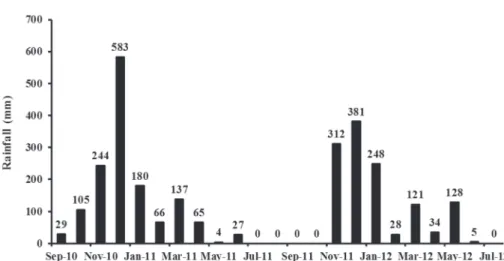
irrigation was carried out by applying water depth to com-plete 40 mm per week, in the absence of rainfall, according to Soares (1991). Manual weeding and other cultural practices were performed according to Puiatti (2002) and Puiatti & Pereira (2007). In the growing season, during the two years, rainfall in the area was recorded (Figure 1).
The crop was harvested at 289 DAP (Year 1) and 274 DAP (Year 2), after the plants mature, that is, when shoots were totally dry. Mother corms were separated and corms were classified, counted and weighed. The corms were classified based on fresh weight into the classes: extra A (> 200 grams), extra (100-200 grams), special (50-100 grams), first (25-50 grams), and unmarketable (< 25 grams).
Yield of marketable corms was obtained by summing the productions of extra A, extra, special, and first classes of corms. Total yield consisted of summing the production of mother corms and all the classes of corms. The statistical analyzes were carried out using the program SAEG 9.1 (SAEG, 2007), relating the dependent variables with the N rates applied. The data analysis was performed to evaluate the main effect within each year of the experiments. The regression models were selected based on the biological meaning of the model, the significance of the regression coefficients and the highest coefficient of determination. Data referring to the number of marketable corms per plant were transformed into +1.
RESULTS AND DISCUSSION
In Year 1, the maximum estimated yield of total corms (mother corms + corms) was 37.69 Mg ha-1 with the rate
117 kg ha-1 of N while in Year 2, the maximum estimated
yield of total corms was 18.97 Mg ha-1 with the rate 122 kg
ha-1 of N (Figure 2A). In Year 2, there was a reduction of
49.66% of maximum yield of total corms. This reduction in total yield can be attributed to the climatic difference (rainfall) between the two years of cultivation (Figure 1),
when excess rainfall (128 mm) in May, during leaf senescence, induced vegetative regrowth of shoots, hindering photoassimilate accumulation in the corms and reducing growth in Year 2. However, the estimated maximum yield, in Year 1, was close to 36.30 Mg ha-1 reported by
Pereira et al. (2003) for the Japanese clone (BGH 5925), which is one of the most productive among the 36 taro accessions of BGH/UFV grown in high fertility soil without fertilization. That is, in the experimental year with no interference of climatic conditions, the Japanese clone (BGH 5925) showed its high productive characteristics.
Yield of mother corms was not influenced by the N rates in Year 1, producing an average of 10.32 Mg ha-1,
ranging from 9.88 to 11.03 Mg ha-1. In Year 2, under climatic
interference, there was influence of the N rates and the maximum estimated yield of mother corms was 4.16 Mg ha -1, with the rate 139 kg ha-1 of N (Figure 2B). Heredia Zarate et al. (2009) reported yield of 4.22 Mg ha-1 for mother corms
of the Japanese clone applying 10 Mg ha-1 of
semi-composted chicken litter. On the other hand, in the Zona da Mata Mineira, Sediyama et al. (2009) found average yield of mother corms of Japanese taro slightly higher (11.23 Mg ha-1).
In Year 1, the estimated maximum yield of marketable corms was 22.23 Mg ha-1, with 109 kg ha-1 of N (Figure 3);
this yield represents about 80.9% of the total corm production, which is extremely desirable. In this study, the result obtained for marketable corms is higher than the average of Minas Gerais state, which is 20 Mg ha-1
(Mascarenhas & Resende, 2002). However, in Year 2, the estimated maximum yield of marketable corms was only 9.81 Mg ha-1, with the rate 118 kg ha-1 of N (Figure 3),
representing about 66.11% of the total corm production. Based on the fitted equations, the use of 44.58 kg ha-1
and 69.98 kg ha-1 of N would provide yield estimates of
20.01 Mg ha-1 and 8.83 Mg ha-1, which would be equivalent
to 90% of the maximum corm production in Years 1 and 2, respectively. The N rate recommended for the taro crop in the state of Minas Gerais is 60 kg ha-1 (Ribeiro et al., 1999).
Considering the conditions of this study, if 60 kg ha-1 of N
was applied, the yield estimated would be 20.94 Mg ha-1
and 8.38 Mg ha-1 (Years 1 and 2, respectively), which would
be equivalent to 94.19% and 85.41% of maximum yield in Years 1 and 2, respectively. The productive potential of the Japanese clone (BGH 5925) was adversely affected by the climatic conditions in Year 2 (Figure 1). Heredia Zarate et al. (2004) evaluated the effect of urea on the clones Macaquinho and Chinese and found that 240 kg ha-1 of
urea (108 kg ha-1 of N) provided the highest yield of
marketable corms, corresponding to 37.05 Mg ha-1 and 26.49
Mg ha-1, respectively, nevertheless for a population of
73,260 ha-1 plants. On the other hand, Oliveira et al. (2008),
with 130 kg ha-1 of N in the form of chicken litter (4.4 Mg
ha-1) under organic cropping. Heredia Zarate et al. (2009)
reported for the Japanese clone, yield of 16.67 Mg ha-1
with 10.0 Mg ha-1 of semi-composted chicken litter. The
difference in yield obtained in these works can be attributed to the type of soil, plant population and clone used, in addition to the characteristics of the organic fertilizer. Heredia Zarate et al. (2004) found that the corm yield was significantly dependent on the clone and nitrogen fertilization.
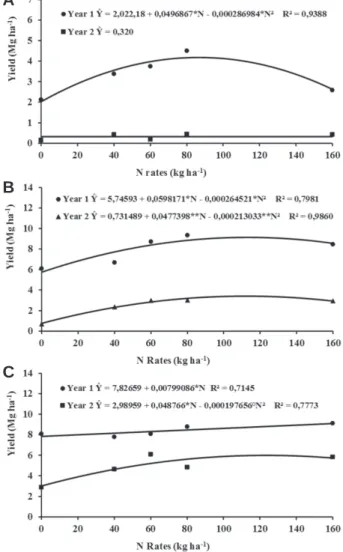
Among the four classes of marketable cormels (Extra A, Extra, Special and First), the first three classes reach higher market prices. Pereira et al. (2003) showed that the yield of marketable corms correlates positively with the production of heavier corms (classes Extra A and Extra). In this work, the production of Extra A corms occurred only in Year 1, with average yield of 353.63 kg ha-1, and was not
influenced by the N rates applied.
The N rates influenced the yield of Extra class corms only in Year 1, with maximum yield estimate of 4.17 Mg ha -1 with 87 kg ha-1 of N, whereas in Year 2, the mean yield was
only 0.32 Mg ha-1.
Yields of the special and first classes represented 82% and 96% of the marketable daughter corm yield in Years 1 and 2, respectively. In Year 1, the special class had maximum yield estimate of 9.13 Mg ha-1 with 113 kg ha-1 of N, and the
first class had 9.10 Mg ha-1 with 160 kg ha-1 of N (Figure 4).
In year 2, the yield of corms of the special class was lower than the first class, with maximum yield estimate of 3.41 Mg ha-1 with 112 kg ha-1 of N in the special class and 5.99 Mg ha -1 with 123 kg ha-1 of N in the first class.
The mean mass of the marketable corms reached the maximum estimates of 55.09 g and 43.31 g with the application of 95 kg ha-1 and 104 kg ha-1 N in Year 1 (v =
48.006 + 0.148422*N - 0.00077734*N²; R² = 0.9114*) and in Year 2 (v = 38.9735 + 0.083321*N - 0.000399725*N²; R² = 0.8925*), respectively.
The maximum yields estimated for unmarketable corms were similar in both years: 5.95 Mg ha-1 with 160 kg ha-1 of
N in Year 1 and 5.03 Mg ha-1 with 121 kg ha-1 of N in Year 2.
The number of total corms per plant was 17.70 corm/ plant (Y = 13.784 + 0.0244818**N; R² = 0.8720*) with the highest N rate applied (160 kg ha-1). However, for marketable
corms, there was no significant effect of N rates in Year 1, with mean of 10.22 corms/plant. In Year 2, the number of total and marketable corms per plant was lower than in Year 1, with a maximum estimate of 14.36 corms/plant (Y = 7.32732 + 0.1117055**N - 0.000487302**N²; R² = 0.9944**) and 6.09 corms/plant (Y = 2.62336 + 0.0580281*N -Figure 1: Rainfall during the period of experiments (BGH 5295) in Year 1 and Year 2.
Figure 2: Yield of total corms (A) and mother corms (B) of ‘Japanese’ taro (BGH 5295), in Year 1 and Year 2, as a function of topdressing nitrogen rates.
A
0.000242565*N²; R² = 0.8932*) with the rate 120 kg ha-1 of
N, respectively.
The number of unmarketable corms per plant was higher in Year 2, with maximum estimate of 8.26 corm/plant (Y = 4.70396 + 0.0590273*N - 0.000244737*N²; R² = 0.9557*) with 121 kg ha-1 of N whereas in Year 1, it was 6.54 corm/plant (Y
Figure 3: Yield of corms of ‘Japanese’ taro (BGH 5295) in Year 1 and Year 2, as a function of doses of topdressing nitrogen rates.
= 4.266311 + 0.0142423*N; R² = 0.7027*) with the highest rate applied (160 kg ha-1 of N).
At the N rate for maximum yield of marketable corms (109 kg ha-1 for Year 1 and 118 kg ha-1 of N for Year 2), the
number of unmarketable corms represented 35.32% of the total number of corms per plant in Year 1 while in Year 2, the number of unmarketable corms represented 46.51% of the total corms per plant. These results show the lower growth of corms in Year 2, since the total number of corms per plant was very close in the two years (16.45 corms/ plant in Year 1 and 17.76 corms/plant in Year 2); therefore, there was lower yield in Year 2 with the application of very similar rates of nitrogen. It is worth noting that the yield response pattern of marketable corms was similar in the two-year study, with a correlation r = 0.8143 (p < 0.05), allowing the estimation of maximum yield at the rates from 109 kg ha-1 to 118 kg ha-1 of N, very similar, in Year 1 and
Year 2, respectively (Figure 3). Therefore, the difference in yield between Years 1 and Year 2 is due to the number of unmarketable corms, because the number of corms was similar; however, they did not increase in Year 2. A possible explanation for the smaller growth of these unmarketable corms in Year 2 is the large rainfall volume (128 mm) occurred in May of 2012 (Figure 1). This excess rainfall during the leaf senescence, when photoassimilates were transferred to the reserve organs of the plant (corms), induced the taro plants to resume the vegetative growth of shoots, hindering photoassimilate accumulation in the corms and promoting a change in the source-drain relationship. Therefore, the smaller growth of the corms led to lower yields of marketable corms in Year 2.
CONCLUSIONS
The response curve of taro to topdress N rates was similar in the two years of study, but the yield estimates were influenced by the difference in rainfall between the years.
In the management of nitrogen fertilization, the maximum yield of marketable taro corms was achieved with the application of N rates ranging from 109 kg ha-1 to 118 kg ha -1 of N.
REFERENCES
CEASA-MG (2014) Informações de mercado. Procedência de pro-dutos. Período consolidado: inhame (taro). Disponível em: <http://www.ceasaminas.com.br>. Acessado em: 04 de dezem-bro de 2014.
Fontes PCR & Araújo C (2007) Adubação nitrogenada de hortali-ças: princípios e práticas com o tomateiro. Viçosa, Editora UFV. 148p.
Heredia Zarate NA, Vieira MC & Bratti R (2004) Produção dos tarôs ‘Chinês’ e ‘Macaquinho’ em função de diferentes doses de ureia. Ciência e Agrotecnologia, 28:552-560.
Figure 4: Yield of corms in the classes extra (A), special (B) and first (C) of ‘Japanese’ taro (BGH 5295) in Year 1 and Year 2, as a function of topdressing nitrogen rates.
A
B
Heredia Zarate NA, Vieira MC, Graciano JD, Giuliani AR, Helmich M & Gomes HE (2009) Produção e renda bruta de quatro clones de taro cultivados em Dourados, Estado do mato Grosso do Sul. Acta Scientiarum - Agronomy, 31:301-305.
Heredia Zarate NA, Vieira MC, Rosa Junior EJ & Alves JC (2003) Cama-de-frango de corte semidecomposta na produção dos tarôs Chinês e Macaquinho. Acta Scientiarum - Agronomy, 25:177-181.
Oliveira FL, Guerra JGM, Almeida DL, Ribeiro RLD, Silva EE, Silva VV & Espindola JAA (2008) Desempenho de taro em função de doses de cama de aviário, sob sistema orgânico de produção. Horticultura Brasileira, 26:149-153.
Pereira FHF, Puiatti M, Miranda GV, Silva DJH & Finger FL (2003) Caracterização agronômica da produção de rizomas de clones de taro. Horticultura Brasileira, 21:99-105.
Puiatti M (2002) Manejo da cultura do taro. In: Carmo CAS do (Ed.) Inhame e taro: sistemas de produção familiar. Vitória, Incaper. p.203-252.
Puiatti M, Campos JP, Casali VWD & Cardoso AA (1992a) Siste-mas de colocação do bagaço de cana-de-açúcar e do capim gor-dura associados ao sulfato de amônio em inhame cv. Chinês. Horticultura Brasileira, 10:13-17.
Puiatti M, Greeman S, Katsumoto R & Favero C (1992b) Cresci-mento e absorção de macronutrientes pelo inhame ‘Chinês’ e ‘Japonês’. Horticultura Brasileira, 10:89-92.
Puiatti M & Pereira FHF (2007) Taro (Colocasia esculenta (L.) Schott). In: Paula Junior TJ & Venzon M (Eds.) 101 Culturas: manual de tecnologias agrícolas. Belo Horizonte, EPAMIG. p.729-734.
Puiatti M, Pereira FHF & Aquino LA (2004) Crescimento e pro-dução de taro ‘Chinês’ influenciados por tipos de mudas e cama-das de bagaço de cana-de-açúcar. Horticultura Brasileira, 22:722-728.
Ribeiro AC, Guimarães PTG & Alvarez VH (1999) Recomenda-ções para o uso de corretivos e fertilizantes em Minas Gerais: 5ª Aproximação. Viçosa, Comissão de Fertilidade do Solo do Esta-do de Minas Gerais. 359p.
SAEG (2007) Sistema para Análises Estatísticas e Genéticas. Ver-são 9.1. Viçosa, UFV. CD-ROM.
Sediyama MAN, Santos MR, Salgado LT, Puiatti M & Vidigal SM (2009) Produtividade e exportação de nutrientes por rizomas de taro cultivado com resíduos orgânicos. Revista Brasileira de Ciências Agrárias, 4:421-425.
Soares JG (1991) Crescimento do inhame (Colocasia esculenta