Carlos Augusto Oliveira de Andrade(1), Emerson Borghi(2), Leandro Bortolon(3),
Elisandra Solange Oliveira Bortolon(3), Francelino Peteno de Camargo(3), Junior Cesar Avanzi(4), Jones Simon(3), Rubens Ribeiro da Silva(1) and Rodrigo Ribeiro Fidelis(1)
(1)Universidade Federal do Tocantins, Rua Badejós, Lote 7, Chácaras 69/72, Zona Rural CEP 77402-970 Gurupi, TO, Brazil. E-mail:
[email protected], [email protected], [email protected] (2)Embrapa Milho e Sorgo, Rodovia MG-424, Km 65,
CEP 35701-970 Sete Lagoas, MG, Brazil. E-mail: [email protected] (3)Embrapa Pesca e Aquicultura, Prolongamento da Avenida
NS 10, Cruzamento com a Avenida LO 18, Sentido Norte, Loteamento Água Fria, CEP 77008-900 Palmas, TO, Brazil. E-mail: leandro. [email protected], [email protected], [email protected], [email protected] (4)Universidade
Federal de Lavras, Departamento de Ciência do Solo, Avenida Doutor Sylvio Menicucci, no 1001, Kennedy, CEP 37200-000 Lavras, MG,
Brazil. E-mail: [email protected]
Abstract – The objective of this work was to evaluate the straw production and the agronomic performance of soybean intercropped with oversown forage species, in no-tillage system. A randomized complete block design was carried out with four replicates, in a 5×2+2 factorial arrangement, as follows: five forage species – Urochloa brizantha 'Marandu', Urochloa ruziziensis, Panicum maximum 'Mombaça', Panicum maximum 'Massai', and Pennisetum americanum –, intercropped with soybean over two crop years (2013/2014 and 2014/2015), plus two controls, with P. americanum sowed in succession to soybean or with soybean monocropping followed by winter fallow (traditional cultivation). Soybean yield components and forage straw yield were evaluated. None of the intercropping systems reduced soybean grain yield, compared with monocropped soybean. The oversown species can significantly improve soybean productivity, as is the case for soybean intercropped with P. maximum 'Mombaça', compared with soybean monocropping, followed or not by millet. Panicum maximum 'Mombaça' is the most effective forage species for dry matter accumulation in the fall/spring period.
Index terms: Glycine max, integrated crop-livestock system, oversowing, plant cover, soil cover crops.
Produção de palha e desempenho agronômico de soja consorciada
com espécies forrageiras em sistema plantio direto
Resumo – O objetivo deste trabalho foi avaliar a produção de palha e o desempenho agronômico de soja consorciada com espécies forrageiras sobressemeadas, em sistema plantio direto. Utilizou-se um delineamento de blocos ao acaso, com quatro repetições, em um arranjo fatorial 5x2+2, conforme a seguir: cinco espécies forrageiras – Urochloa brizantha 'Marandu', Urochloa ruziziensis, Panicum maximum 'Mombaça', Panicum maximum 'Massai' e Pennisetum americanum – consorciadas com soja, em duas safras agrícolas (2013/2014 e 2014/2015), além de dois tratamentos-padrão, com P. americanum em sucessão à soja ou com cultivo tradicional de soja e pousio no inverno (soja solteira). Avaliaram-se os componentes de produção da soja e a produtividade de palha das forrageiras. Nenhum dos consórcios diminuiu a produtividade de grãos da soja, em comparação ao cultivo solteiro. As espécies sobressemeadas podem aumentar significativamente a produtividade da soja, como no caso do consórcio da soja com P.maximum 'Mombaça' comparado ao cultivo da soja solteira, com ou sem milheto em sucessão. Panicum maximum 'Mombaça' é a espécie forrageira mais eficiente quanto ao acúmulo de matéria seca, no período outono/primavera.
Termos para indexação: Glycine max, integração lavoura-pecuária, sobressemeadura, cobertura vegetal, cultivos de cobertura do solo.
Introduction
No-tillage and integrated crop-livestock systems are alternative methods for soil management that maintain,
or even increase soil use efficiency with a more rational
required for this system to function efficiently (Calvo et al., 2010; Correia & Gomes, 2015). To prevent soil
from erosion, these soil cover species should have a high-phytomass yield and remain for a certain time on soil surface (Kliemann et al., 2006), in order to favor
a greater retention of moisture during water deficit
conditions and to make nutrients available to crops in succession, or even to provide pasture during the off-season (Flores et al., 2008; Pariz et al., 2011).
Various crops for straw production and soil coverage have been tested for use in fall/winter periods, in
no-tillage system, in the Cerrado region of the state of Mato Grosso do Sul, Brazil (Machado & Assis,
2010). Among the most promising species are bulrush millet (Pennisetum americanum), grain sorghum or forage sorghum (Sorghum bicolor), and tropical forage grasses, in particular species from the genera
Urochloa and Panicum (Macedo, 2009), which can be optionally intercropped with the primary crop. These species produce a large quantity of dry matter, with straw of high potential to cover soil for an extended
period, even in hotter regions (Costa, 2014), such as the Cerrado region in the Brazilian state of Tocantins.
The smaller size and competitive power of certain primary crops, in comparison to these forage species, makes it unsuitable to sow them at the same time. Moreover, the greater vegetative growth of the forage species can make harvesting the primary crop more
difficult (Vilela et al., 2011). Therefore, oversowing soybean plants with forage species before flowering, specifically during the reproductive stages R5, R6, or
R7, could make intercropping viable (Pacheco et al., 2009, 2013; Silva et al., 2013).
The objective of this work was to evaluate the straw production and the agronomic performance of soybean intercropped with oversown forage species, in a no-tillage system.
Materials and Methods
The experiment was carried out at Fazenda Experimental of Universidade Federal de Tocantins (11º43'45"S, 49º04'07"W, at 278 maltitude), during the 2012/2013, 2013/2014, and 2014/2015 crop years.
Before the experiment began, soil samples were collected at 0 – 0.20 m soil depths, and their chemical
analysis showed the following results: pH (CaCl2), 3.98;
P, 1.09 mg dm-3; K, 32.0 mg dm-3; Cu, 0.90 mg dm-3; Zn,
0.30 mg dm-3; Mn, 12.20 mg dm-3; Ca, 0.17 cmol c dm-3;
Mg, 0.06 cmolc dm-3; Al, 0.75 cmolc dm-3;
H+Al, 4.34 cmolc dm-3; effective CEC (t), 1.06 cmolc
dm-3; CEC (T), 4.65 cmol
c dm-3; Al saturation (m),
70.75%; basis saturation (BS), 6.71%; and organic matter, 15.40 g dm-3. The granulometric analysis showed
690 g dm-3 sand, 100 g dm-3 silt, and 210 g dm-3 clay
(Claessen, 1997). Based on these results, 2,500 kg ha-1
limestone and 1,000 kg ha-1 gypsum were applied on
Andropogon gayanus residues remaining in the area,
in the first 15 days of December 2012. In addition,
250 kg ha-1 P
2O5, in the form of single superphosphate,
and 100 kg ha-1 K
2O, in the form of KCl, were applied
to the soil surface. Dolomite limestone was used as a
filler (100% PRNT) to increase the soil base saturation to 60%, according to Sousa & Lobato (2004).
The soil was prepared on December 16, 2012, using a 32-inch grid to incorporate plaster at 0 – 0.40 m soil depths. The remaining fertilizers and correctors that were applied over the entire area made use of a 28-inch grid, incorporated to soil at 0 – 0.20 m depths.
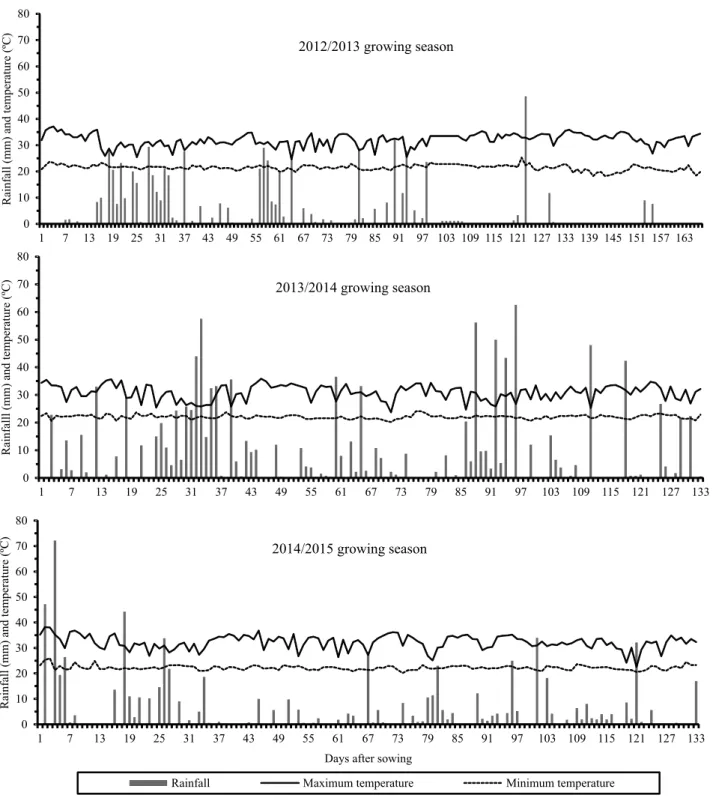
Data for rainfall and maximum and minimum temperatures over the experiment were recorded at the Estação Meteorológica of the Universidade Federal de
Tocantins, in the Campus Gurupi (Figure 1).
Forage species were manually sowed on the surface, on April 5, 2013, and dried on November 1, 2013 using glyphosate herbicide, at 1.8 kg ha-1 a.e., and 200 L ha-1
application volume. Thus, the 2012/2013 crop year was used strictly for forage straw production, to achieve an adequate no-tillage system for soybean yield in the 2013/2014 crop year.
The experiment was performed in a Latossolo Amarelo distrófico (Xanthic Oxisol) exhibiting a
medium texture (Santos et al., 2013a). A randomized complete block design was used with four replicates,
and a 5×2+2 factorial arrangement, with five forage
species (U. brizantha 'Marandu', U. ruziziensis,
P. maximum 'Mombaça', P. maximum 'Massai', and
P. americanum 'ADR 300') intercropped with soybean, over two crop years (2013/2014, and 2014/2015). Besides, two controls were employed: P. americanum
sowed after soybean cultivation; and a monocropped soybean cultivation followed by winter fallow.
Early cycle soybean cultivar SYN1279 RR was used for both crop years. At the moment of sowing, seed were inoculated with the Bradyrhizobium japonicum
Semia 5079 and Semia 5080, at 300 g for every 50 kg of seed.
In addition, 120 kg ha-1 P
2O5, in the form of single
superphosphate, was applied on the sowing lines, while 30 kg ha-1 of FTE BR 12 was added to provide
micronutrients. The soil was fertilized with potassium 10 days before soybean sowing, using 80 kg ha-1 K
2O in
Figure 1. Daily rainfall and minimum and maximum temperatures during the experiment in the 2012/2013, 2013/2014, and
2014/2015 crop years.
0 10 20 30 40 50 60 70 80
1 7 13 19 25 31 37 43 49 55 61 67 73 79 85 91 97 103 109 115 121 127 133 139 145 151 157 163
Rainfall (mm) and temperature (ºC)
2012/2013 growing season
0 10 20 30 40 50 60 70 80
1 7 13 19 25 31 37 43 49 55 61 67 73 79 85 91 97 103 109 115 121 127 133
Rainfalll (mm) and temperature (ºC)
2013/2014 growing season
0 10 20 30 40 50 60 70 80
1 7 13 19 25 31 37 43 49 55 61 67 73 79 85 91 97 103 109 115 121 127 133
Rainfall (mm) and temperature (ºC)
Days after sowing
2014/2015 growing season
the form of potassium chloride. Soybean was sown on November 20, with 0.45 m between lines and 17 plants per meter. The same planting date and spacing were used for both seasons.
Oversowing of forage species was completed manually once soybean plants reached the reproductive
stage R5, defined as the point at which 50% of the plants show pod filling. Sowing densities recommended by Machado & Assis (2010) were used. The specific
on-line sowing values were 5 kg ha-1 for viable pure seeds,
except for P. americanum whose value was 15 kg ha-1.
In order to determine the exact quantity of seed to be used, the culture value of each species was taken into consideration (Pacheco et al., 2008).
Before soybean sowing, the phytomass of forage
species sowed in the preceding season was quantified
for each experimental unit (kg ha-1), using four
randomly selected rectangular samples (1.0x0.25 m). Dry matter yield per hectare was estimated by placing
the samples in a forced-air circulation oven at 60°C,
until the obtention of constant mass. Forage species desiccation was performed with 1.8 kg ha-1 glyphosat
a.e., with 200 L ha-1 spray solution.
The following components related to soybean yield were evaluated: plant height (cm), from the stem base to the apex of the plant, measured in ten plants chosen at random from the useful area within each
plot; final plant population, determined on March 18,
in the eve of harvest in both years, by counting the number of plants within 3 m of the two central lines of each experimental unit; number of pods per plant, and their relation to the total number of plants within the useful area of each experimental unit, determined in ten plants harvested at random; number of grain per pod, determined using the total number of grain and pods obtained for these ten plants; mass of 100 grains, obtained by four separate weighings of 100 grains for each plot; and grain yield, determined within 3 m of the two central lines of each experimental unit. Plants were harvested manually, then dried and subjected to mechanical threshing. Afterward, grains were weighed to determine yield, with values corrected for 13% of moisture content.
The data were subjected to the analysis of variance, and the means were compared using the Tukey's test, at 5% probability, with the aid of the computer
software Sisvar (Universidade Federal de Lavras, Lavras, MG).
Results and Discussion
The interaction between the intercropping systems
and crop years was significant for final population,
number of pods per plant, number of grain per pod, and dry matter of residues (Table 1); therefore, the systems had different performances, depending on the evaluation year for these characters. However, plant height, mass of 100 grains, and grain yield were not
significantly affected by this interaction.
The intercropping soybean and P. maximum
'Mombaça' was the only combination that showed a
significantly greater value for soybean plant height
than monocropped soybean (Table 2). This is most likely due to the greater quantity of straw produced from this forage species during the off-seasons. The amount of incident solar radiation would have been reduced due to the quantity of straw in the area, at the initial development of soybean, resulting in a etiolation of plants in their search for light (Muraishi et al., 2005).
Significant effects of crop years also occurred for
height (Table 2), and the 2013/2014 season yielded the highest means, which might be attributed to the greater
amount of rainfall in this first season, in comparison to
the second one (Figure 1) when average rainfall was
48% of the observed in first crop year.
The treatments affected the final plant populations only in the first year (Table 2). The soybean intercropped
systems, both with P. maximum 'Mombaça' and
U. ruziziensis, differed significantly from the soybean
monocroped and from soybean with P. americanum
in succession (Table 2). Intercropped systems showed
an immediate beneficial effect on the initial plant
development, and yielded greater plant populations than the nonintercropped systems. Soil protection and water retention, afforded by forage straw on soil surface, may have provided better conditions for soybean germination and establishment. Krutzmann et al. (2013) found higher-soybean populations in areas with greater surface phytomass, especially for those derived from U. brizantha 'Marandu' and P. maximum
'Tanzânia'.
Although intercropping had a significant effect on
the number of pods per plant, the number of grains
per pod showed no effect (Table 2). Generally, the
behavior of the number of pods per plant, in the
first crop year, was similar to that of the number of
seasons. Crusciol et al. (2012) did not observe any
effect from intercropping for U. brizantha 'Marandu' system on any yield components. The authors argued that a longer intercropping period could affect soybean development, which did not happen in the present study, since our intercropping period was even shorter (73 days).
As to the crop year, a greater number of pods per
plant were observed in the first year, independently
of the foraging species (Table 2), while the number
of grain per pod in the first year was significant only
for P. maximum 'Massai', U. brizantha 'Marandu', and
P. americanum systems. The average improvement in performance for these treatments was approximately 43% for the number of pods per plant, and 17% for the number of grain per pod. The quantity and distribution of rainfall over the two crop years are certainly related to the observed results (Figure 1). According to Farias et al. (2010), the amount of required water for soybean
cultivation to fulfill the physiological cycle is between
650 and 700 mm of rainfall. This means that the
amount of rain observed in both years was sufficient;
however, in the 2013/2014 season, rainfall was better distributed over the period of cultivation. Rainfall in
the 2014/2015 season did not provide sufficient water for each of the reproductive stages. Water deficits were observed during the full flowering and grain filling stages, which are the two stages during which
soybean demands the most water. In this work, those stages corresponded to 45 and 103 days after sowing, respectively.
The demand for water increases progressively as crop development proceeds, peaking at the full
flowering stage, which extends until the beginning of
pod development; nonetheless, water demand remains
high through physiological maturation (Thomas & Costa, 2010). Thus, from a physiological vantage
point, soybean tends to consume more water as the
plant ages, showing minimal sensitivity during the vegetative phase and maximum sensitivity during the reproductive phase (Santos et al., 2013b).
Crop years had also a significant effect for the mass
of 100 grains (Table 2), whose largest values were
observed in the second season. In the first season,
values ranged from 16.02 to 17.20 g among the different intercropped systems, while in the second season values ranged from 18.50 to 23.16 g. However,
none of the variations was statistically significant. Pacheco et al. (2009) also observed no significant
variation in this parameter, when they studied soybean cultivated over straw produced from different plants. The observed difference between crop years, for this parameter, could be explained by the inverse relation that it showed with the number of pods per plant. Thus, the lower number of pods per plant in the second season favored the increase of soybean grain mass, as the drain represented by seeds was lower.
As to grain yield, the P. maximum 'Mombaça'
system differed significantly from the P. americanum
one, and from the monocropped trials followed either by fallow or by P. americanum cultivation. These results, associated to the fact that all intercropped systems yielded higher-production values than the nonintercropped ones (although they were not
statistically significant) shows the benefit of straw
produced by forage species on soybean cultivation.
Similarly, Pacheco et al. (2009) confirmed that grain
yield was positively affected by the presence of straw on the soil surface, which resulted in a higher-soybean yield from intercropping with U. ruziziensis, in comparison to fallow treatment.
Improvements in the chemical, physical, and biological characteristics of the soil due to the presence of surface straw could explain the positive effects on soybean yield observed in the intercropping trials. According to Rheinheimer et al. (1998), crop residues
Table 1. F values for the yield components of soybean (Glycine max) and dry matter weight of residues of different forage species, in the different intercroppings and agricultural seasons.
Source of variation Plant height
Final population
Number of pods per plant
Number of grains per pod
Mass of 100 grains
Grain yield
Dry weight of residues
Cultivation system (CS) 3.497** 8.89** 6.83** 0.64ns 2.21ns 4.86** 59.70**
Agricultural season (A) 26.209** 0.55ns 346.60** 12.20** 148.59** 3.29ns 87.65**
CS x A 1.809ns 4.78** 6.354** 2.62* 2.04ns 1.56ns 4.31**
Coefficient of variation (%) 12.45 13.57 11.41 9.08 8.08 15.86 22.35
on the soil surface function as a kind of reservoir of nutrients for the next cultivation, which are released by the action of microorganisms. Furthermore, the residues improve the structural stability of the soil,
thereby preventing erosion. Cultivation systems that
include straw can also promote an increase of soil organic matter, also increasing the fertility of acidic soils with pH-dependent charges associated with organic matter. According to Macedo (2009), the successful adoption of a no-tillage system is highly
dependent on the production and continued presence
of surface straw (Calvo et al., 2010).
The intercropped forage species ranged significantly for the amount of straw they produced, both in the first
and second crop years (Table 2). The absence of the value of straw yield in the post-soybean P. americanum
treatment is due to the failure of seed to germinate, caused by the lack of water after seed were planted (Figure 1).
Table 2. Yield components of soybean (Glycine max) for the intercroppings with Urochloa ruziziensis, Urochloa brizantha
'Marandu', Panicum maximum 'Mombaça', Panicum maximum 'Massai', and Pennisetum americanum 'ADR 300', for the crop years of 2013/2014 and 2014/2015(1).
Treatment 2013/2014 2014/2015 Mean 2013/2014 2014/2015 Mean
Plant height (cm) Final population (plant m-1)
Soybean x P. maximum 'Massai' 60.80 61.53 61.17ab 11.21ab 11.47a 11.34
Soybean x P. maximum 73.70 61.25 67.48a 13.21Aa 9.05Ba 11.13
Soybean x U. brizantha 63.53 53.00 58.26ab 10.87ab 11.47a 11.17
Soybean x U. ruziziensis 59.25 55.40 57.33ab 12.42 10.69 11.55
Soybean x P. americanum 64.53 56.20 60.36ab 8.33bc 9.69a 9.01
Soybean followed by P. americanum 59.71 42.76 51.23b 6.46Ac 8.80Ba 7.63
Soybean followed by fallow 67.95 48.78 58.36ab 10.37ab 9.75a 10.06
Mean 64.21A 54.13B - 10.41 10.13
-Number of pods per plant Number of grains per pod
Soybean x P. maximum 'Massai' 60.58Abc 42.40Ba 51.49 2.30A 1.90B 2.10
Soybean x P. maximum 64.76Abc 38.63Ba 51.69 2.12 2.21 2.16
Soybean x U. brizantha 55.79Ac 33.30Ba 44.54 2.43A 1.96B 2.19
Soybean x U. ruziziensis 53.29Ac 31.03Ba 42.16 2.26 2.05 2.16
Soybean x P. americanum 79.19Aa 30.08Ba 54.63 2.42A 2.09B 2.26
Soybean followed by P. americanum 71.57Aab 42.33Ba 56.95 2.23 2.27 2.25
Soybean followed by fallow 64.75Abc 33.17Ba 48.96 2.16 2.16 2.16
Mean 64.27 35.85 2.28 2.09
-Mass of 100 grains (g) Grain yield (kg ha-1)
Soybean x P. maximum 'Massai' 16.05 23.16 19.61a 3,747 3,556 3,652ab
Soybean x P. maximum 16.44 22.04 19.24a 4,319 4,157 4,238a
Soybean x U. brizantha 16.25 22.38 19.32a 3,788 3,529 3,658ab
Soybean x U. ruziziensis 17.20 20.96 19.08a 3,772 3,091 3,432ab
Soybean x P. americanum 15.84 20.76 18.30a 3,740 2,924 3,332b
Soybean followed by P. americanum 16.02 18.50 17.26a 2,495 3,180 2,837b
Soybean followed by fallow 16.40 21.02 18.71a 3,498 3,044 3,271b
Mean 16.32B 21.26A - 3,623A 3,354A
-Straw dry weight (kg ha-1)
Soybean x P. maximum 'Massai' 3,661Bbc 7,838Ab 5,750 - -
-Soybean x P. maximum 7,571Ba 11,394Aa 9,483 - -
-Soybean x U. brizantha 3,549Bbc 8,159Ab 5,854 - -
-Soybean x U. ruziziensis 4,659Bb 8,396Ab 6,527 - -
-Soybean x P. americanum 1,939Ac 2,149Ac 2,044 - -
-Soybean followed by P. americanum - - -
-Soybean followed by fallow - 1,948c 974 - -
-Mean 3,563 6,647 - - -
In the first crop year, the values of forage straw
yielded by P. maximum 'Massai', U. brizantha
'Marandu', and U. ruziziensis differed significantly.
However, these systems showed lower-straw yield than P. maximum 'Mombaça', which showed 3,910, 4,022, 2,912, and 5,632 kg ha-1 more than P. maximum
'Massai', U. brizantha 'Marandu', U. ruziziensis, and P. americanum, respectively, in the first season
(Table 2). The behavior of these systems, in the second
crop year, was similar to that of the first one, and
P. maximum 'Mombaça' showed again the highest-dry matter values, which was 3,556, 3,235, 2,998, 9,245 and 9,446 kg ha-1 higher than those for the
intercroppings with 'Massai', 'Marandu', U. ruziziensis,
P. americanum, and the post-soybean P. americanum, respectively.
Krutzmann et al. (2013) could not verify any
significant differences in straw yield, when studying
tropical Poaceae species under different intercropping conditions. They attributed this result to the fact that members of this family – which have similar physiological characteristics – underwent the same techniques and management periods, and were subjected to the same climactic and soil fertility
conditions. Also Garcia et al. (2014) confirmed
similarities in the straw yield between Panicum and
Urochloa species, which showed 13,499 kg ha-1 as
mean dry matter yield.
Conclusions
1. The intercropping of soybean (Glycine max) with the oversown forage species Urochloa ruziziensis,
Urochloa brizantha 'Marandu', Panicum maximum
'Mombaça', Pennisetum. maximum 'Massai', and
Pennisetum americanum does not reduce soybean yield.
2. The intercropping of soybean with P. maximum
'Mombaça' increases plant height and grain yield, in comparison with monocropped soybean.
3. Panicum maximum 'Mombaça' is the most effective forage species for dry matter yield during the fall-spring growing period.
References
CALVO, C.L.; FOLONI, J.S.S.; BRANCALIÃO, S.R. Produtividade de fitomassa e relação C/N de monocultivos e
consórcios de guandu-anão, milheto e sorgo em três épocas de
corte. Bragantia, v.69, p.77-86, 2010. DOI: 10.1590/S0006-87052010000100011.
CLAESSEN, M.E.C. (Org.). Manual de métodos de análise de
solo. 2.ed. rev. e atual. Rio de Janeiro: Embrapa-CNPS, 1997.
212p. (EMBRAPA-CNPS. Documentos, 1).
CORREIA, N.M.; GOMES, L.J.P. Sobressemeadura de soja com
Urochloa ruziziensis e a cultura do milho em rotação. Pesquisa
Agropecuária Brasileira, v.50, p.1017-1026, 2015. DOI: 10.1590/ S0100-204X2015001100004.
COSTA, N.R. Desempenho técnico e econômico da produção
de milho e sorgo para silagem e soja em sucessão em sistema irrigado de integração lavoura-pecuária no Cerrado. 2014.
226p. Tese (Doutorado) – Universidade Estadual Paulista “Júlio
de Mesquita Filho”, Ilha Solteira.
CRUSCIOL, C.A.C.; MATEUS, G.P.; NASCENTE, A.S.; MARTINS, P.O.; BORGHI, E.; PARIZ, C.M. An innovative
crop–forage intercrop system: early cycle soybean cultivars and palisadegrass. Agronomy Journal, v.104, p.1085-1095, 2012. DOI: 10.2134/agronj2012.0002.
FARIAS, J.R.B.; NEUMAIER, N.; NEPOMUCENO, A.L.
Soja. In: MONTEIRO, J.E.B.A. (Org.). Agrometeorologia dos
cultivos: o fator meteorológico na produção agrícola. Brasília: Inmet, 2010. p.263-277.
FLORES, J.P.C.; CASSOL, L.C.; ANGHINONI, I.; CARVALHO, P.C. de F. Atributos químicos do solo em função da aplicação superficial de calcário em sistema de integração lavoura-pecuária
submetido a pressões de pastejo em plantio direto. Revista Brasileira de Ciência do Solo, v.32, p.2385-2396, 2008. DOI: 10.1590/S0100-06832008000600017.
GARCIA, C.M. de P.; ANDREOTTI, M.; TEIXEIRA FILHO, M.C.M.; LOPES, K.S.M.; BUZETTI, S. Decomposição da
palhada de forrageiras em função da adubação nitrogenada após o consórcio com milho e produtividade da soja em sucessão. Bragantia, v.73, p.143-152, 2014. DOI: 10.1590/brag.2014.016.
KLIEMANN, H.J.; BRAZ, A.J.P.B.; SILVEIRA, P.M. da.
Taxas de decomposição de resíduos de espécies de cobertura
em Latossolo Vermelho Distroférrico. Pesquisa Agropecuária
Tropical, v.36, p.21-28, 2006.
KRUTZMANN, A.; CECATO, U.; SILVA, P.A.; TORMENA, C.A.; IWAMOTO, B.S.; MARTINS, E.N. Palhadas de gramíneas
tropicais e rendimento da soja no sistema de integração lavoura-pecuária. Bioscience Journal, v.29, p.842-851, 2013.
MACEDO, M.C.M. Integração lavoura e pecuária: o estado da
arte e inovações tecnológicas. Revista Brasileira de Zootecnia, v.38, p.133-146, 2009. Suplemento especial. DOI: 10.1590/S1516-35982009001300015.
MACHADO, L.A.Z.; ASSIS, P.G.G. de. Produção de palha
e forragem por espécies anuais e perenes em sucessão à soja. Pesquisa Agropecuária Brasileira, v.45, p.415-422, 2010. DOI: 10.1590/S0100-204X2010000400010.
MARCHÃO, R.L.; BALBINO, L.C.; SILVA, E.M. da; SANTOS JÚNIOR, J. de D.G. dos; SÁ, M.A.C. de; VILELA, L.; BECQUER, T. Qualidade física de um Latossolo Vermelho sob
Agropecuária Brasileira, v.42, p.873-882, 2007. DOI: 10.1590/ S0100-204X2007000600015.
MURAISHI, C.T.; LEAL, A.J.F.; LAZARINI, E.; RODRIGUES, L.R.; GOMES JUNIOR, F.G. Manejo de espécies vegetais
de cobertura de solo e produtividade do milho e da soja em semeadura direta. Acta Scientiarum. Agronomy, v.27, p.199-207, 2005. DOI: 10.4025/actasciagron.v27i2.1903.
PACHECO, L.P.; MONTEIRO, M.M. de S.; SILVA, R.F. da; SOARES, L. dos S.; FONSECA, W.L.; NÓBREGA, J.C.A.; PETTER, F.A.; ALCÂNTARA NETO, F. de; OSAJIMA, J.A. Produção de fitomassa e acúmulo de nutrientes por plantas de
cobertura no cerrado piauiense. Bragantia, v.72, p.237-246, 2013. DOI: 10.1590/brag.2013.041.
PACHECO, L.P.; PIRES, F.R.; MONTEIRO, F.P.; PROCÓPIO, S. de O.; ASSIS, R.L. de; CARMO, M.L. do; PETTER, F.A.
Desempenho de plantas de cobertura em sobressemeadura na cultura da soja. Pesquisa Agropecuária Brasileira, v.43, p.815-823, 2008. DOI: 10.1590/S0100-204X2008000700005.
PACHECO, L.P.; PIRES, F.R.; MONTEIRO, F.P.; PROCÓPIO, S.O.; ASSIS, R.L.; CARGNELUTTI FILHO, A.; CARMO, M.L.; PETTER, F.A. Sobressemeadura da soja como técnica
para supressão da emergência de plantas daninhas. Planta Daninha, v.27, p.455-463, 2009. DOI: 10.1590/S0100-83582009000300005.
PARIZ, C.M.; ANDREOTTI, M.; BUZETTI, S.;
BERGAMASCHINE, A.F.; ULIAN, N. de A.; FURLAN, L.C.; MEIRELLES, P.R. de L.; CAVASANO, F.A. Straw decomposition
of nitrogen-fertilized grasses intercropped with irrigated maize in an integrated crop-livestock system. Revista Brasileira de Ciência do Solo, v.35, p.2029-2037, 2011. DOI: 10.1590/S0100-06832011000600019.
RHEINHEIMER, D.S.; KAMINSKI, J.; LUPATINI, G.C.; SANTOS, E.J.S. Modificações em atributos químicos de solo
arenoso sob sistema plantio direto. Revista Brasileira de
Ciência do Solo, v.22, p.713-721, 1998. DOI: 10.1590/S0100-06831998000400017.
SANTOS, G.G.; SILVEIRA, P.M. da; MARCHÃO, R.L.; BECQUER, T.; BALBINO, L.C. Macrofauna edáfica associada a plantas de cobertura em plantio direto em um Latossolo Vermelho
do Cerrado. Pesquisa Agropecuária Brasileira, v.43, p.115-122,
2008. DOI: 10.1590/S0100-204X2008000100015.
SANTOS, H.G. dos; JACOMINE, P.K.T.; ANJOS, L.H.C. dos; OLIVEIRA, V.A. de; LUMBRERAS, J.F.; COELHO, M.R.; ALMEIDA, J.A. de; CUNHA, T.J.F.; OLIVEIRA, J.B. de.
Sistema brasileiro de classificação de solos. 3.ed. rev. e atual.
Brasília: Embrapa, 2013a. 353p.
SANTOS, H.P.; FONTANELI, R.S.; SPERA, S.T.; MALDANER, G.L. Rendimento de grãos de soja em diferentes sistemas de
produção integração lavoura-pecuária. Revista Brasileira de Ciências Agrárias, v.8, p.49-56, 2013b. DOI: 10.5039/agraria. v8i1a2077.
SILVA, W.B.; PETTER, F.A.; LIMA, L.B. de; ANDRADE, F.R.
Desenvolvimento inicial de Urochloa ruziziensis e desempenho agronômico da soja em diferentes arranjos espaciais no cerrado
Mato-Grossense. Bragantia, v.72, p.146-153, 2013. DOI: 10.1590/
S0006-87052013000200006.
SOUSA, D.M.G. de; LOBATO, E. (Ed.). Cerrado: correção do
solo e adubação. 2.ed. Brasília: Embrapa Informação Tecnológica;
Planaltina: Embrapa Cerrados, 2004. 416p.
THOMAS, A.L.; COSTA, J.A. Estresse hídrico em soja: impacto no potencial de rendimento de grãos. In: THOMAS, A.L.; COSTA,
J.A. (Org.). Soja: manejo para alta produtividade de grãos. Porto
Alegre: Evangraf, 2010. p.141-175.
VILELA, L.; MARTHA JUNIOR, G.B.; MACEDO, M.C.M.; MARCHÃO, R.L.; GUIMARÃES JÚNIOR, R.; PULROLNIK, K.; MACIEL, G.A. Sistemas de integração lavoura-pecuária na
região do Cerrado. Pesquisa Agropecuária Brasileira, v.46,
p.1127-1138, 2011. DOI: 10.1590/S0100-204X2011001000003.