ISSN1981-1268 BAPTISTA et al.(2015) 53
T
HE USE OF DRAWINGS AS TOOLS FOR INVESTIGATING STUDENTS
’
PRIOR CONCEPTIONS IN
S
CIENCE
TEACHING
:
T
HE
A
MPHISBAENIA CASE IN
B
AHIA
,
B
RAZIL
G
EILSAC
OSTAS
ANTOSB
APTISTA1,
E
RALDOM
EDEIROSC
OSTAN
ETO2,
M
ARIAC
ELESTEC
OSTAV
ALVERDE2,
R
AFAELS
ERRANOG
ONZÁLEZ31Department of Education, State University of Feira de Santana, Feira de Santana, Bahia, Brazil.
2Department of Biological Sciences, State University of Feira de Santana, Feira de Santana, Bahia, Brazil. E-mail: [email protected]. 3Laboratory of Paleoentozoology, National School of Anthropology and History, Mexico City, Mexico.
Recebido em maio de 2014. Aceito em dezembro de 2014. Publicado em abril de 2015.
___________________________________________________________________________________________________________ ABSTRACT – This article presents students’ prior conceptions about the Amphisbaenia group by means of schematic drawings made by them. Visits to two public state schools were made, where a photograph of an amphisbaenian was presented to the students who agreed to participate in the study. They were asked about their prior knowledge on this reptile. Sheets of legal paper and colored pencils were given to students, in order to make a drawing representing their knowledge about the life of these animals. The analysis of drawings took into account the cultural representativeness expressed by them. The results showed that, for the students participating in the study, the amphisbaenians have two heads, located at opposite ends of the animal’s body. Conceptions about the group’s biology were recorded, such as aspects of external morphology, feeding behavior, and habitat. Drawings may be used as a tool to investigate students’ prior knowledge about nature. We hope that the data presented here will be useful for teachers at the schools involved in the study, as well as for those working in similar schools, in order to teach based on a cultural dialogue with science and foster the construction of scientific knowledge by students.
KEY WORDS: Amphisbaenia; Drawing; Prior knowledge; Teaching.
___________________________________________________________________________________________________________
A UTILIZAÇÃO DOS DESENHOS COMO FERRAMENTAS PARA INVESTIGAR OS CONCEITOS PRÉVIOS DOS ALUNOS NO ENSINO DE CIÊNCIAS: O CASO
AMPHISBAENIA NA BAHIA,BRASIL
RESUMO –Este artigo apresenta as concepções prévias de estudantes sobre o grupo Amphisbaenia por meio de desenhos esquemáticos feitos por eles. Foram realizadas visitas a duas escolas públicas estaduais, mostrando-se a fotografia de um anfisbênio aos estudantes que concordaram participar do estudo. Eles foram questionados sobre o que sabiam sobre o réptil. Papel ofício e lapis de cor foram distribuídos para que os estudantes representassem seu conhecimento acerca da vida desses animais. A análise dos desenhos considerou a representatividade cultural expressa por eles. Os resultados mostram que, para os estudantes, os anfisbênios têm duas cabeças, localizadas nas extremidades do corpo. As concepções sobre a biologia do grupo foram registradas, como sua morfologia externa, alimentação e habitat. Os desenhos podem ser usados como uma ferramenta de ensino para investigar o conhecimento prévio dos estudantes sobre a natureza. Esperamos que os dados apresentados sejam úteis para os professores nas escolas envolvidas no estudo a fim de que ensinem com base num diálogo cultural com a ciência e encorajar a construção do conhecimento científico pelos estudantes.
PALAVRAS CHAVE: Amphisbaenia; Desenho; Conhecimento prévio; Ensino.
___________________________________________________________________________________________________________
EL USO DE DIBUJOS COMO HERRAMIENTAS PARA INVESTIGAR LAS CONCEPCIONES PREVIAS DE LOS ESTUDIANTES EN LA ENSEÑANZA DE CIENCIA: EL
CASO AMPHISBAENIA EN BAHÍA,BRASIL
RESUMEN – Este artículo presenta las ideas preconcebidas de los estudiantes acerca del grupo Amphisbaenia a través de dibujos esquemáticos hechos por ellos. Se realizaron visitas a dos escuelas públicas, donde una fotografía de una anfisbena se presentó a los estudiantes que aceptaron participar. Se les preguntó sobre su conocimiento previo acerca de este reptil. Hojas de papel A4 y lápices de colores se les dio a los estudiantes para que hicieran un dibujo que representara a sus conocimientos sobre la vida de estos animales. El análisis de los dibujos tuvo en cuenta la representación cultural expresada por ellos. Los resultados mostraron que, para los estudiantes que participaron en el estudio, anfisbénidos tienen dos cabezas, situados en lados opuestos del cuerpo del animal. Se registraron las concepciones de la biología del grupo, como aspectos de la morfología externa, el comportamiento de alimentación y el hábitat. Los dibujos pueden ser utilizados como una herramienta para investigar los conocimientos previos de los alumnos sobre la naturaleza. Esperamos que los datos presentados aquí son útiles para los profesores de las escuelas que participan en el estudio, así como para los que trabajan en escuelas similares para enseñar sobre la base de un diálogo cultural con la ciencia y fomentar la construcción de conocimiento científico por los estudiantes.
PALABRAS CLAVE: Amphisbaenia; Dibujo; Conocimiento previo; Enseñanza.
___________________________________________________________________________________________________________
I
NTRODUCTIONCurrently, in Science teaching, several studies highlight the importance of knowledge that students bring along with them into the classroom, in order to learn more about issues of this field. Some scholars recognize that students’ prior knowledge is strongly grounded on their social and cultural context and that this knowledge does not represent an obstacle to understand scientific concepts (Cobern and Loving 2001, Mortimer and Scott 2003). Prior knowledge constitutes an organized corpus of ideas and mental models arising from the interaction a person has with the
world (de la Gándara et al. 2002). This kind of knowledge comprises all wisdom repertoires and culturally grounded ideas. Therefore, prior knowledge is not necessarily derived from school education. This means that within prior knowledge we may find out both scientific knowledge and knowledge derived from other systems, such as, for instance, traditional knowledge, which is generated, selected, and transmitted within traditional communities.
According to Cobern (1996), taking into account the different ways how students see nature allows a scientific education
54 ISSN1981-1268 THE USE OF DRAWINGS AS TOOLS FOR INVESTIGATING STUDENTS’... BAPTISTA et al.(2015)
sensitive to cultural diversity, able to promote a dialogue between different kinds of knowledge in the classroom. For Alice Lopes (1999), the dialogue in this environment allows students to evaluate the different ways of knowledge through validation criteria, inherent to the contexts wherein they were generated. As a result, students will be able to apply this knowledge in the adequate contexts (Cobern and Loving 2001).
Students’ cultural knowledge can be observed in classes of Science only if teachers investigate and analyze it (Cobern 1996). Thus, it is worth highlighting language’s role as a crucial element revealing this kind of knowledge. According to Vigotsky (1991), language plays a key role in the individual’s intellectual development, constituting a symbolic system of human groups which expresses the knowledge derived from socio-historical processes. Bakhtin (1997) sees language as a collective creation, being part of a dialogue between “me” and the “other”, between many “us” and many “others”.
According to Mortimer (1998), investigating different languages helps the teacher to understand the utterances by the various subjects. This means that teachers, when investigating the different languages presented by students, will be able to understand how they address knowledge in the dialogic relationship process into the classroom, without losing sight of the aim of teaching Science, which, according to El-Hani and Mortimer (2007), consists in conveying and discussing scientific theories, concepts, and models.
Regarding the relationship between language and students’ prior conceptions, there is a need to take into account that different languages are observed in the classrooms, either having a verbal (consisting of spoken or written words) or non-verbal origin (consisting of codes which are not represented by words). Among the various examples of languages which are observed in the classroom we can find drawing. Drawings, which may combine the written and non-verbal language, constitute an important tool for investigating students’ knowledge about a certain theme in Science teaching (Costa et al. 2006). This is so because drawing has, above all, a symbolic meaning. A drawing reveals how a person experiences the symbolic meanings attributed to it within her/his cultural context (Grubits 2003). Drawing constitutes a means to know and communicate and it may participate in knowledge acquisition and production.
The motivation for carrying out this study emerged from authors’ observations and questions about knowledge and daily practices of people regarding the amphisbaenians, as well as from analyses and comparisons of this knowledge to the literature on Zoology (Barros-Filho and Valverde 1996; Navega-Gonçalves 2004). Usually, amphisbaenians specimens are regarded by people as snakes and, for this reason, as dangerous, i.e. putting human life at risk. As a consequence, people have aggressive attitudes towards these reptiles, causing their death. This belief, however, is not consistent with what is known about these animals, which are not classified as snakes and do not represent a risk for human beings (Vizotto 2003; Navega-Gonçalves, 2004).
The amphisbaenians are fossorial reptiles that live strictly underground, presenting an elongated, cylindrical body, surrounded by rings (Pough et al. 1999). They constitute a small group of Squamata with 197 species around the world, including Central and South American countries and the Iberian Peninsula. In Brazil, there are 67 species, all belonging to the family Amphisbaenidae, with 57 species representing the genus Amphisbaenia, nine species of Leposternon and only one species representing the genus Mesobaena (Bérnils and Costa 2012), inhabiting different ecosystems. These animals move both forward and backward with remarkable skill, something which provided the group with its name (from the Greek amphi, double, baen, walking). The skin has virtually no connection to the underlying tissues, playing the role of a tube which allows the
animal’s body to freely slide back and forth. This peculiarity, along with the smooth skin arrangement, reduces friction with the ground, supporting creep and promoting an effective locomotion in tunnels. The ability to move combined to the similarity between the ends, i.e. tail and head, of some species gave rise to the popular name “two-headed snake” (Vizotto 2003; Navega-Gonçalves 2004). Taking their ecological importance into account, Navega-Gonçalves (2004) claims that these reptiles play a role as important as that of earthworms. By permanently excavating the soil, they contribute to penetration of water and air into the soil, favoring the development of vegetation.
Science has a poor knowledge about these reptiles, due to the difficulty to observe them in wild environments and to collect specimens. In turn, traditional knowledge regarding the amphisbaenians is abundant, however, it is hardly addressed, discussed, and used to teach Science (Baptista et al. 2008; Mateus et al. 2011).
It is believed that this context does not provide teachers with means for adopting a relativist position, as claimed by some multiculturalists (Stanley and Brickhouse 1994; Ogawa 1995); all knowledge systems represented in the classroom are equally valid, and school science also does not have an epistemological superiority over other cultural kinds of knowledge, according to some universalists (Siegel 1997; Matthews 1998). It is believed that the differences observed may constitute a basis for teachers to allow students establishing values and contexts where each of these knowledge systems (scientific and popular) is applicable, which were developed under different social and cultural conditions (Cobern and Loving 2001). As a result, this may broaden students’ views on nature, thus allowing them to think through their conceptions and attitudes towards the Amphisbaenia group, aiming at the preservation of regional species.
This article aims to discuss how the use of schematic drawings may contribute to investigate students’ knowledge on the elements of nature, specifically the Amphisbaenia species. This animal group has been selected for this study due to the cultural conceptions towards its members, especially the folk belief that these animals are snakes. Our results are derived from a research carried out at the Laboratory for Comparative Morphology of Vertebrates (LAMVER), of the State University of Feira de Santana, addressing in Science teaching students’ prior conceptions about Amphisbaenia.
This article also aims to contribute to study Science education on an empirical basis, in order to understand students’ views with regard to natural elements. And this is achieved not only through oral language, used more frequently by scholars concerned with Science teaching, and by means of techniques adopted by qualitative methods (observation, interviews, etc.), but also through graphic language, still poorly explored in Science teaching (Costa et al. 2006).
Thus, it is worth pointing out that we conducted this study along with biology teachers at the school involved, in order to rely on the participation of a large number of students for developing course materials representing their previous conceptions about the biology of Amphisbaenia, as well as the scientific conceptions in this regard (school and academic). Along with teachers, we also aim at developing and applying strategies that allow a cultural dialogue in the classroom, thus contributing to broaden students’ views about nature, i.e. the biology of Amphisbaenia, as we believe that this will provide individuals with opportunities to think through their knowledge and its applications to the appropriate contexts.
M
ETHODSThis study, with a qualitative nature (Johnson and Christensen 2008), was carried out in 2007 at two public state
55 ISSN1981-1268 THE USE OF DRAWINGS AS TOOLS FOR INVESTIGATING STUDENTS’... BAPTISTA et al.(2015)
schools in Bahia, namely: Escola Papa João Paulo I (Elementary School) and Colégio Estadual Dr. Renato Medeiros Neto (High School), both in the town of Serra Preta (Figure 1), in Bravo District, into the semiarid region of Bahia.
At first, visits were made to the schools mentioned above, in order to select individuals to participate in the study. At these schools, in different classes at the 7th grade (Elementary School) and the 10th grade (High School), the research purposes were introduced to students; those willing to participate read and signed a Free and Informed Consent Term (FICT). This is a document that the participant in a research involving human individuals should sign and hand in to the researcher. It constitutes a voluntary agreement to participate in the research, being aware of its consequences. The FICT is a requirement provided for the Resolution CNS 196/96, from the Brazilian National Health Council, which addresses researches involving human beings (Brasil 2003). The selections of classes was due to the content “living beings” (where the theme under study is included), according to prior information obtained from teachers at the schools. During the reading of the FICT, researchers explained to students the main purpose of this study, which was “address their knowledge regarding the two-headed snakes and the way how they perceive the use of their knowledge in Science and Biology teaching at school”. The students were also informed that this research is intended to provide Science and Biology teachers with the information required to appreciate their knowledge about regional animal species.
Figure 1. Location of the town of Serra Preta, Bahia, Brazil. Source: Google Maps® 2013.
This research had the participation of 39 students, 6 at Elementary School (4 boys and 2 girls), aged between 12 and 15 years, and 33 at High School (18 boys and 15 girls), aged between 16 and 24 years.
We showed a picture of an animal representing the Amphisbaenia group (Amphisbaena vermicularis Wagler, 1824) to the students who agreed to participate in the research (Figure 2), asking them to make free drawings according to their conceptual inference regarding this animal’s life. For this, we gave them an A4 sheet paper and color pencils. Our purpose was allowing students to freely explain their prior knowledge, without any prompting from the researchers. At that time, we asked the address of each student, for collecting the drawings. It is worth saying that we assume they had some prior knowledge about the life of these animals; they are occasionally seen on the surface, especially within rainy periods, when their tunnels get flooded.
Once collected, drawings were selected taking into account readability, graphic clarity, and details that facilitate their analysis. During this analysis, we defined categories according to five criteria: 1) kinds of messages observed in students’ drawings, which, according to Joly (2007), may be written, coded iconic, and non-coded iconic; 2) representativeness of prior conceptions regarding the various characteristics of the amphisbaenians’ biology; 3) similarities and/or differences between students’ prior conceptions and zoological scientific knowledge; 4) colors used (primary, secondary, tertiary, complementary, and neutral), and their adequacy to the image, i.e. an animal representing the Amphisbaenia group (see Figure 2); and 5) differences between students’ education levels, i.e. Elementary School or High School.
Figure 2. Picture of an amphisbaenian (Amphisbaena vermicularis Wagler, 1824) shown to the students. Source: Valverde and Ferreira (2005).
It is worth mentioning that this comparison between school levels is due to the fact that they may influence the representation of students’ prior conceptions, as this research was conducted within the school environment, a space that, as claimed by Vigotsky (1991), greatly contributes to the individual’s social interaction and mental development, as well as her/his knowledge construction.
R
ESULTSAll students participating in this research made drawings of amphisbaenians, however, not all drawings were used due to lack of readability. For instance, there are two drawings made by students at Elementary School and High School where it is not possible to assert the intended meaning, due to lack of clarity in shape (Figures 3A and 3B). In this regard, out of 39 drawings, 25 were unreadable and only 14 could be analyzed; 10 were made by High School and 4 by Elementary School students. The categories where these drawings were included are discussed below.
Kinds of message observed in the drawings
All drawings have a written message, since written content was added to represent students’ knowledge about amphisbaenians. For instance, two High School female students made drawings representing a head in both ends of the animal’s body (Figures 4A and 4B).
Drawings also depict two kinds of message: coded iconic and non-coded iconic. Regarding the first, 92.85% of students sought to represent the animal the same way as the picture shown to them (see Figure 4).
As for the non-coded iconic message, 1 student (7.14%) represented the animal as a two human-headed snake; these heads are located in both ends of the animal’s body (Figure 5).
56 ISSN1981-1268 THE USE OF DRAWINGS AS TOOLS FOR INVESTIGATING STUDENTS’… BAPTISTA et al.(2015)
Figure 3. Unreadable drawings made by High School and Elementary School students about Amphisbaenians.
Figure 4. Schematic drawings made by two High School female students (17-year-old), representing a head in both ends of the animal’s body.
Figure 5. Schematic drawing made by a 17-year-old High School student depicting a two human-headed amphisbaenian.
Similarities and/or differences between the previous conceptions represented by students and scientific knowledge from the Zoology field.
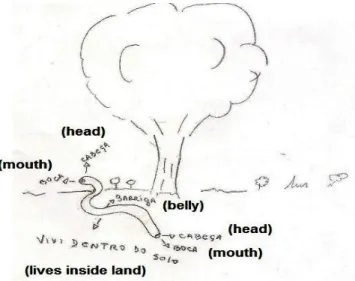
Usually, drawings revealed that for 85.71% of students the amphisbaenans are two-headed, one of them is located at the front and the other at the back of the animal’s body. Drawings made by Elementary School and High School students constitute examples of this (figures 6 and 7). In turn, two students (14.28%) represented the amphisbaenians with only one head, located at the front of the
animal’s body. See, for instance, figures 8 and 12. Two students wrote the term snake in their drawings (figures 5 and 11).
Figure 6. Schematic drawing made by a 15-year-old female student at Elementary School, depicting two heads in both ends of the animal’s body.
Figure 7. Schematic drawing made by a 17-year-old High School student, indicating the presence of two heads in the amphisbaenian’s body.
Figure 8. Drawing made by a 24-year-old student at Elementary School, indicating the presence of a head at the front of the amphisbaenian’s body.
57 ISSN1981-1268 THE USE OF DRAWINGS AS TOOLS FOR INVESTIGATING STUDENTS’… BAPTISTA et al.(2015)
Students used 12 terms to refer to the amphisbaenians, namely: belly (barriga), mouth (boca), head (cabeça), shell (casca), rattlesnake (cascavel), rattle (“chucaio”), body (corpo) scales (escamas), tongue (língua), eyes (olhos), skin (pele), and tail (cauda). Associated with these terms, we could identify some interesting conceptions about the animal’s morphology and biology:
- The amphisbaenians’ body as being coated with “scales”, something, which was found in 64% of drawings. See, for instance, Figure 7. - The presence of a tongue. See, for instance, Figure 9.
Figure 9. Schematic drawing made by a 14-year-old female student at Elementary School, indicating the external morphology of an amphisbaenian with the presence of tongue.
- Carnivorous feeding. A 19-year-old student made a drawing that shows the animal with its mouth open eating a mouse (Figure 10). In the same drawing, the student relates the amphisbaenian to a venomous snake, having its dentition as a basis. We can see the animal with long curved teeth, something typical of solenoglyph fangs connected to a venom gland in snakes.
Figure 10. Drawing made by a 19-year-old High School male student showing an amphisbaenian eating a rat.
- One student at High School drew the occurrence of amphisbaenians in the Brazilian Amazon region (Figure 11).
Figure 11. Drawing made by a 17-year-old High School male student showing the occurrence of amphisbaenians in the Amazon region.
- The presence of a rattle (Figure 12).
Figure 12. Schematic drawing made by a 19-year-old student at High School, indicating the body parts and the presence of a rattle (“chucaio”) in an amphisbaenian.
The colors used
Although students had at their disposal pencils of various colors to paint their drawings, not all of them used colors to indicate the characteristics of amphisbaenians; 4 students did not use colors to paint their drawings (see figures 5 and 10). Green was the most used color (5 drawings; see Figure 13), followed by brown (3 drawings; see figures 7 and 12), and gray (1 drawing; see Figure 6). Only one student combined different colors to express his conceptions in the drawing (Figure 14).
Figure 13. Schematic drawing made by a 13-year-old Elementary School female student indicating the external morphology of an amphisbaenian in green.
Figure 14. Schematic drawing made by a 17-year-old High School student, indicating the use of various colors to paint the animal's body.
Differences between the education levels of students participating in the study (Elementary School or High School)
Some important differences were observed in the drawings produced by High School students, when compared to Elementary School students. The first ones (27%) were more detailed, showing their conceptions about some aspects of the amphisbaenians’ biology
58 ISSN1981-1268 THE USE OF DRAWINGS AS TOOLS FOR INVESTIGATING STUDENTS’… BAPTISTA et al.(2015) (habitat) and morphology (body parts) (see Figure 15). As for
Elementary School students, drawings were limited to the animals’ external morphology (Figures 8 and 9).
Figure 15. Schematic drawing made by a 17-year-old student at High School, representing aspects related to the amphisbaenians’ morphology and biology.
D
ISCUSSIONRegarding the unreadable drawings, we must take into the possibility that not all students are able to make drawings and, thus, not all could communicate their ideas through drawings. However, all of them were willing to participate in the study.
According to Barthes (1964), images, among them drawings, may offer three types of message: 1) linguistic (written); 2) coded iconic (denoted, something which is objectively seen); and 3) non-coded iconic (connoted, something which is subjectively seen). As we can observe, students’ drawings expressed three types of message: 1) written, by naming the amphisbaenians’ body parts and, likewise, aspects related to the animal’s biology; 2) coded iconic, when their own drawings showed up as informative, suggesting that the only purpose of students was informing their conceptions about the amphisbaenians’ morphology and biology, without involving their emotions towards these reptiles; and 3) non-coded iconic, when a student represented the animal as having two human heads, possibly involving their emotions towards the animal.
Regarding the written message (1), it is worth highlighting that it is possible that students have made drawings accompanied by words due to the transmissive education model, still very active in Brazilian schools, which overestimates writing at the expense of other ways of communication that may be observed in the classrooms. Regarding this fact, as well discussed by Joly (2007), the written message contributes only to lead students to identify the elements of an action, however, it hinders interpretation. According to the author, the written message makes it more difficult to uncover connoted meanings, since they are subjective. The written message promotes a literal message, which only helps students to identify the elements of a scene (Barthes 1964).
It is also worth highlighting non-coded iconic message (3) found in the drawing of one student. This may mean an anthropocentric view of nature on the part of this student, as well as the understanding that fauna is represented by strange, fantastic animals, such as a two-headed reptile. An altruistic sense of man’s dominion over other living beings, including the amphisbaenians. As a consequence, it can also mean a feeling of repulsion with regard to
the life of these reptiles, up to the point of wishing their death (Vizotto 2003). According to Martins (2002), the ways how societies have degraded nature are the result of an anthropocentric world view. Thus, school may contribute to keep the conditions and needs of living beings, talking to the students, making them aware of the importance of animal species for nature and, besides, leading them to acknowledge the existence of different kinds of knowledge, emphasizing the domains where each of them may be applied. As a result of defining the contexts where knowledge produced by different cultural systems may be applied, students will be able to recognize the contributions and limitations of the various kinds of knowledge with regard to their lives, being prepared to use them in appropriate situations (Southerland 2000).
Concerning the differences between concepts revealed in drawings and scientific knowledge from Zoology, it is possible that students have related the animal depicted in the image which was shown to another animal, something which may also be an indication that these students have no knowledge about amphisbaenians, but only of snakes, for instance.
Regarding the fact that two students wrote in their drawings the term snake, it is worth highlighting that the popular name for the amphisbaenians is not always associated with the idea that the members of this group are two-headed snakes. This may vary between different cultures. The population, usually, regard the amphisbaenians as snakes, as two-headed snakes, each of them located at the opposite ends of their body (Jared et al. 1997). For some Brazilian indigenous tribes, for instance, an amphisbaenian is ibirajara or ibiyara, which means lord of the land. Other names derive from the association with ants: the mother of ants or the king of ants, because, seemingly, the underground cavities of anthills offer a useful territorial extension, easily conquered by the amphisbaenians (Jared et al. 1997). It is possible that the conception revealed by students that the amphisbaenians are two-headed snakes have stemmed from local and daily observations of the external morphology of these reptiles (with a snake-like body shape – head and tail seemingly indistinct), associated with the behavior of moving forward and backward with the same skill. According to Pough et al. (1999), the scientific name of the group is based on the Greek roots amphi (double) and baen (walking).
It must be noticed that to literature on Zoology, the amphisbaenians have only one head, which may have a rounded or tapering shape (Navega-Gonçalves 2004). In fact, the head and tail of these animals have a shape that may confuse the viewer, making it seems as if they were two-headed. Thus, the conception that amphisbaenians are two-headed is not supported by the literature on Zoology, therefore, it differs from scientific knowledge.
The conception presented by students that the amphisbaenians’ body is coated with “scales” is similar to the scientific conceptions pointed out by Navega-Gonçalves (2004, p. 67): “The amphisbaenians’ skin is made up of scales typically arranged into rings along the body and tail”.
Regarding the presence of tongue, Navega-Gonçalves (2004) argues that in the amphisbaenians it is, as in most reptiles, bifurcated. According to this author, the presence of bifurcated tongue allows these animals to have a unique perception of the environment, compensating their limited vision, due to the fact that their eyes are small and covered by scales.
Student’s conception that the amphisbaenians occur in the Amazon region is the correct from the scientific perspective. According to Vanzolini (2002), the amphisbaenians have a wide geographical distribution in Brazil, including the northern states.
As for the presence of a “rattle” at one end of the amphisbaenians’ body, drew by a High School student, it is worth discussing if this is not a conception consistent with the literature on
59 ISSN1981-1268 THE USE OF DRAWINGS AS TOOLS FOR INVESTIGATING STUDENTS’… BAPTISTA et al.(2015) Zoology. According to Vizotto (2003), the rattle consists of hardened
segments observed in the rattlesnake’s body, a species from the Squamata order and Caudisona (Crotalus) genus, from North America and distributed in Central and South America. For reasons not well understood, at the time of skin exchange, the old tissue is not fully released, keeping coiled around the tail as a coarse gray ring. Over the years, these pieces of dry skin that form the rattles, which, when the animal vibrates its tail, shake and produce the characteristic noise. It is often used when the animal feels threatened, when vibrates its tail, producing that noise, and moves away from danger.
Some students did not use colors to indicate the amphisbaenians’ characteristics, while others used green and brown; besides, one student used various colors in his drawing. In this regard, we may consider the possibility that these students have sought information about the animal’s description only in their memory. Thus, students drew the amphisbaenians with the colors inherent to their knowledge and, likewise, their imagination. According to Natividade et al. (2008), when preparing a drawing, imagination is also present, as the person observes reality and registers what is meaning for her/his. The drawing confronts what is real, perceived, and imagined.
Regarding the fact that High School students’ drawings were more detailed when compared to those made by Elementary School students, it is worth saying that this may have happened due to the influence of school to increase knowledge. It is possible that High School students, because they are at higher grades, have more scientific knowledge when compared to Elementary School students. Thus, it is worth informing that the Amphisbaenia group has been poorly explored as a teaching content in the Brazilian schools. Usually, this group is addressed only as an example of reptiles, leaving aside the possibility of exploring its ecological importance that, according to Navega-Gonçalves (2004), is equivalent to that of earthworms, because, due to the permanent soil excavation, they contribute to the penetration of water and air on the soil, favoring vegetation growth.
The conception revealed in students’ drawings is that the amphisbaenians have dentition in order to inoculate venom. Such a feature is not consistent with the scientific knowledge about the amphisbaenians’ dentition, which has a peculiar tooth structure, with teeth forming a set of tweezers able to cut tissue into pieces, instead of constituting an inoculator of venom (Navega-Gonçalves 2004). The conception, revealed through the drawing, that the amphisbaenians are carnivorous animals is consistent with scientific studies on the feeding habits of these reptiles (Navas et al. 2004).
As the amphisbaenians have strictly fossorial habits (underground life), a serpent-like body, and due to the fact that their skin is made up of scales arranged into rings freely around the body, these animals can move forward and backward with equal skill (Barros and Valverde 1996; Navega-Gonçalves 2004). Concerning the conception that the amphisbaenians are snakes and that they are venomous, regarded as incorrect from the scientific perspective, it is important that Science teachers, when establishing the cultural dialogue, try to argue with students why this point of view is incorrect.
According to Cobern (1996), when students fail to realize the meanings in explanations provided by teachers during classes, there is a “cognitive apartheid”. That is, the concepts worked on in the classroom, due to a lack of compatibility with students’ worldviews, will be isolated in a cognitive compartment and, as soon as students no longer need them (as, for instance, after the assessment days), they will be eliminated or resignified in order to become consistent with their own worldview. Students may construct, thus, incorrect knowledge from the scientific perspective
or completely disregard the scientific information worked on by teachers in the classroom.
The results reported herein will constitute the basis for preparing a course material containing students’ prior conceptions about the amphisbaenians. With this course material, it is intended to apply a teaching strategy that allows a dialogue between these prior conceptions and school scientific knowledge. The purpose is that the material to be prepared can be used by teachers of Science and Biology in the classroom, as mediators, in order to provide students with opportunities to improve their prior conceptions about the Amphisbaenia group and, likewise, for thinking through the ecological importance and the preservation of these reptiles.
The results reported herein will also provide a basis for implementing a new strategy to investigate students’ prior conceptions about the Amphisbaenia group. We hope that this strategy can contribute to the expression of encoded iconic and non-encoded iconic messages this way: 1) asking that drawings about the amphisbaenians have no texts; 2) collecting the drawings; 3) based on these drawings, preparing key questions about some issues to conduct semi-structured interviews addressing the Amphisbaenia group’s morphology and biology; 4) conducting semi-structured interviews addressing aspects regarded as important about the amphisbaenians’ morphology and biology observed in students’ drawings; 5) comparing the drawings made by students to the data obtained during the interviews, in order to understand students’ prior conceptions about this group as a whole, either on an intellectual and/or emotional basis. We emphasize that the purpose of using narratives on the part of students during the interviews is justified because it is believed that verbalizations, which play an important role in the development of social interactions (Vigotsky 1991), will allow us to understand students’ experiences and the meanings expressed by means of their drawings.
Educational implications
Drawings made by students involved in this study allowed investigating their conceptions about the amphisbaenians’ morphology and biology. Thus, we may infer that drawing can be used as a tool for investigating students’ prior knowledge about nature, however, it should not be regarded as an a priori communication method. This is so because drawing may also be regarded as an art which may be learned. Thus, it is worth taking into account that not all students – even if they are willing to participate in the making of drawings for the purpose of representing their knowledge about a certain content addressed in Science classes – are able to draw and communicate through this language. In the study reported herein, some unreadable drawings were found, something which may indicate that not all students were able to communicate their ideas about the amphisbaenians through drawings.
Therefore, we suggest that Science teachers use other tools for investigating prior knowledge, in addition to drawings. For instance, it is possible to conduct semi-structured interviews with students and fieldwork to take photographs of nature elements, with subsequent discussions about them. The goal must be leading students to experience and explore various possibilities to communicate their knowledge through different languages. Moreover, they may express their feelings and emotions, something which will not be easily understood just by means of drawings.
The conceptions revealed by students through their drawings have similarities and differences with regard to scientific conceptions. Therefore, it is expected that the data presented herein can be used by Science teachers at the schools involved in this study. Similarly, it can be used by teachers experiencing other educational realities who are willing to investigate which students’ previous conceptions about nature may be revealed through drawings.
60 ISSN1981-1268 THE USE OF DRAWINGS AS TOOLS FOR INVESTIGATING STUDENTS’… BAPTISTA et al.(2015) Specifically, there is a need for using these conceptions in order to
create teaching strategies that aim at broadening the dialogue between students’ cultural conceptions and Science education, as an aspect facilitating the construction of scientific knowledge. This is so because we understand that students’ ideas constitute an important reference for the teacher, and they may guide the teacher when planning her/his classes and pedagogical actions.
A proposal is that, during these dialogues, some opportunities are offered for students to explain their knowledge about the amphisbaenians – or other nature contents addressed in Science teaching –, both for those students who showed conceptions similar to the scientific ones and those who expressed conceptions different from the scientific ones. This way, students will be able to understand the values and application contexts of each kind of knowledge (scientific or non-scientific), which derive from different socio-cultural conditions (Cobern and Loving, 2001). The main aim should always be enriching prior conceptions with scientific ideas, without losing sight of the goals set up for Science teaching.
R
EFERENCESBakhtin M. 1997. Estética da criação verbal. São Paulo: Martins e Fontes, 358 p.
Baptista GCS, Costa-Neto EM, Valverde MCC. 2008. Diálogo entre concepções prévias dos estudantes e conhecimento científico escolar: relações sobre os Amphisbaenia. Revista Iberoamericana de Educación, 47: 1-16.
Barros Filho JD & Valverde MCC. 1996. Notas sobre os Amphisbaenia (Reptilia, Squamata) da microrregião de Feira de Santana, Estado da Bahia, Brasil. Sitientibus 14: 57-68.
Barthes R. 1964. Elements of semiology. Communications 4: 91-135.
Bérnils RS & Costa HC. 2012. Brazilian reptiles: list of species. Version 2012.1.Available at: http://www.sbherpetologia.org.br/. Sociedade Brasileira de Herpetologia. Accesed 27 Sep. 2014. Brasil. 2003. Normas para pesquisa envolvendo seres humanos (Res. CNS no 196/96 e outras). 2ª ed. Brasília: Ministério da Saúde, 106 p.
Cobern WW. 1996. Constructivism and non-Western science education research. International Journal of Science Education, 4(3): 287-302.
Cobern WW and Loving CC. 2001. Defining “Science” in a multicultural world: implications for science education. Science Education, 85(1): 50-67.
Costa MAF, Costa MFB, Lima MCAB, Leite SQM. 2006. O desenho como estratégia pedagógica no ensino de ciências: o caso da biossegurança. Revista Electrónica de Enseñanza de las Ciencias 5(1): 184-191.
de la Gándara M, Gil Quílez MJ, Sanmartí Puig N. 2002. Del modelo científico de “adaptación biológica” al modelo de “adaptación biológica” en los libros de enseñanza secundaria obligatoria. Enseñanza de las Ciencias 20(2): 303-314.
El-Hani CN & Mortimer EF. 2007. Multicultural education, pragmatism, and the goals of science teaching. Culture Studies of Science Education 2(3): 657-702.
Grubits S. 2003. Casa: cultura e sociedade na expressão do desenho infantil. Psicologia em Estudo 8: 97-105.
Hoogmoed MS, Pinto RR, Rocha WA, Pereira EG. 2009. A new species of Mesobaena Mertens, 1925 (Squamata: Amphisbaenidae) from Brazilian Guiana, with a key to the Amphisbaenidae of the Guianan Region. Herpetologica 65 : 436-448.
Jared C, Burman A, Leon N. 1997. Les amphisbènes, folklore et etbiologie. La Recherche 302: 38-40.
Joly M. 2007. Introdução à análise da imagem. Lisboa: Editora 70, 152 p.
Johnson B & Christensen L. 2008. Educational research: quantitative, qualitative, and mixed approaches. 3ª ed. Oaks: Sage Publications, 621 p.
Lopes ARC. 1999. Pluralismo cultural em políticas de currículo nacional. In: MOREIRA A (Ed), Currículo: políticas e práticas. Campinas: Papirus, p. 59-79.
Martins EF. 2002. As concepções de natureza nos livros didáticos de ciências. Revista Ensaio - Pesquisa em Educação em Ciências 4(2): 1-14.
Mateus MB, Pinto LCL, Moura MR, Pires MRS. 2011. A cobra-de-duas-cabeças na percepção dos moradores do povoado de Itatiaia, Minas Gerais. Biotemas 24(3); 111-117.
Matthews MR. 1998. In defense of modest goals when teaching about the nature of science. Journal of Research in Science Teaching 35(2): 161-174.
Mortimer EF. 1998. Multivoicedness and univocality in classroom discourse: an example from theory of matter. International Journal of Science Education 20(1): 67-82.
Mortimer EF & Scott PH. 2003. Meaning making in secondary science classrooms. Maidenhead: Open University Press. 160 p. Navas CA, Antoniazzi MM, Carvalho JE, Chaui-Berlink JG, James RS, Jared C, Kohlsdorf T, Pai-Silva MD, Wilson RS. 2004. Morphological and physiological specializations for digging in amphisbaenians, an ancient lineage of fossorial vertebrates. Journal of Experimental Biology 207: 2433-2441.
Navega-Gonçalves MEC. 2004. Anfisbênias: quem são essas desconhecidas? Ciência Hoje 34(204): 66-68.
Natividade MR, Coutinho MC, Zanella AV. 2008. Desenho na pesquisa com crianças: análise na perspectiva histórico-cultural. Contextos Clínicos 1(1): 9-18.
Ogawa M. 1995. Science education in a multiscience perspective. Science Education 79(5): 583-593.
Pough FH, Heiser JB, Janis CM. 1999. A vida dos vertebrados. São Paulo: Atheneu, 718 p.
Siegel H. 1997. Science education: multicultural and universal. Interchange 28(2-3): 97-108.
Southerland SA. 2000. Epistemic universalism and the shortcomings of curricular multicultural science education. Science & Education 9(3): 289-307.
61 ISSN1981-1268 THE USE OF DRAWINGS AS TOOLS FOR INVESTIGATING STUDENTS’… BAPTISTA et al.(2015) Stanley WB & Brickhouse NW. 1994. Multiculturalism,
universalism, and science education. Science Education 78(4): 387-398.
Valverde MCC & Ferreira DJ. 2005. Nem cobra, nem duas cabeças: quem sou eu? Uma abordagem sobre os Amphisbaenia. Feira de Santana: Grafinort, 14 p.
Vanzolini PE. 2002. A second note on the geographical differentiation of Amphisbaena fuliginosa L., 1758 (Squamata, Amphisbaenidae), with a consideration of the forest refuge model of
speciation. Anais da Academia Brasileira de Ciências 74(4): 609-648.
Vigotsky LS. 1991. Pensamento e linguagem. 3ª ed. São Paulo: Martins Fontes, 194 p.
Vizotto LD. 2003. Serpentes: lendas, mitos, superstições e crendices. São Paulo: Plêiade, 240 p.