Essential oils of flowers of Citrus sinensis (L.) Osbeck and Citrus clementina
Hort. Ex Tan. cultivated in Algarve (Portugal)
M. G. Miguel1*, S. Dandlen1, A. C. Figueiredo2, José G. Barroso2, Luis G. Pedro2, A.
Duarte1, João Faisca1
1 Faculdade de Engenharia de Recursos Naturais, Centro de Desenvolvimento de Ciências e Técnicas de Produção Vegetal, Universidade do Algarve, Campus de Gambelas, 8005-139 Faro Portugal
2 Universidade de Lisboa, Faculdade de Ciências de Lisboa, DBV, Centro de Biotecnologia Vegetal, C2, Campo Grande, 1749-016 Lisbon, Portugal
* Corresponding author. Maria da Graça Costa Miguel, Phone number: +351289800900, Fax number: +351289818419 E-mail address: [email protected]
Abstract
The essential oils, isolated by hydrodistillation, from the flowers of different cultivars of
Citrus sinensis (L.) Osbeck (Cs) and Citrus clementina Hort. Ex Tan. (Cc) collected at different
harvesting times, were analyzed by GC and GC-MS. All the samples studied afforded yellowish oil which yields ranged from 0.05 to 0.08 % (v/w). The monoterpene fraction dominated both oils (66-91%), being the monoterpene hydrocarbons the main components of this fraction (45-69%). Sabinene (31-48%), linalool (15-32%) and limonene (4-10%) dominated both Cs and Cc oils. trans-Nerolidol was the major sesquiterpene component, attaining 3-10%. Cluster analysis of the essential oil composition from the twelve samples studied, confirmed a major chemical homogeneity (Scorr>0.95) despite the fact of having used different periods of hydrodistillation, different harvesting times and being flowers of two different Citrus species.
Keywords: Citrus sinensis (L.) Osbeck (Cs), Citrus clementina Hort. Ex Tan., Rutaceae, flowers, essential oils, Valencia late, Newhall, Barnfield, Rohde.
Introduction
Citrus is a genus of evergreen, often spiny trees and shrubs. The gland-dotted leaves are alternate and simple, usually with winged stalks and the shallowly cup-shaped, 5-pettaled white fragrant flowers. The fruits in the form of hesperidium, take from five months to about one year to mature. Various species are useful, such as C. limon (lemon), C. medica (citron), C. aurantium (sour orange), C. paradisi (grapefruit), C. sinensis (sweet orange), C. reticulata (mandarin, tangerine) and C. clementina (Clementine). Although much research work has been done on the Citrus fruit essential oils, much less is found on the Citrus flower oils, even though this can be of high relevance due to the importance of the Citrus floral aroma in perfumery.
Previous studies on the floral aroma of C. sinensis addressed the relationship between the water status of the plant and the terpenoid emission, showing that the total terpenoid carbon emission of a flowering branch was 7.8 fold the emission of a non-flowering branch and that a considerable emission of linalool was linked to the presence of flowers (Hansen and Seufert, 1999). More recently, studies of the floral orange aroma have used solvent extracts, at 25ºC, that showed linalool to be the major component of orange (52%) and tangerine (75%) flowers, followed by sabinene (27% and 11% in orange and tangerine, respectively) (Alissandrakis et al. 2003). Sabinene (35%), myrcene (19%), linalool (19%) and trans-ocimene (10%) were the main components of the solid-phase micro-extraction (SPME) of the whole flowers of Citrus deliciosa (Flamini et al. 2003). The petals seemed to contribute largely to this composition since the petals volatiles included all these compounds in high amounts, whereas the other flower parts (gynoecia, stamens and pollen) showed a quite different blend of compounds.
Given the importance of Citrus flowers on orange blossom honey production and perfumery and since no previous study was made on their essential oil composition, the aim of this work was the detailed chemical characterization of the floral essential oils of Citrus species.
Materials and Methods
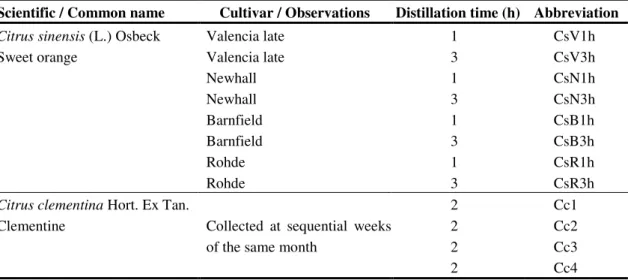
Plant materialCollective flower samples of Citrus sinensis and C. clementina were collected during May 2005 in Tavira and Silves (Algarve), respectively. Citrus sinensis, C. clementina common names, cultivars, harvesting moments and distillation times are listed in Table 1.
Essential oil isolation procedure
hydrodistillation, for different periods, Table 1, using a Clevenger-type apparatus (Anonymous, 1996).
Gas Chromatography
GC analyses were performed using a Perkin Elmer 8700 gas chromatograph equipped with two FIDs, a data handling system and a vaporizing injector port into which two columns of different polarities were installed: a DB-1 fused-silica column (30m x 0.25mm i.d., film thickness 0.25µm; J & W Scientific Inc., Rancho Cordova, CA, USA) and a DB-17HT fused-silica column (30m x 0.25mm i.d., film thickness 0.15µm; J & W Scientific Inc.). Oven temperature was programmed, 45-175°C, at 3°C/min, subsequently at 15°C/min up to 300°C, and then held isothermal for 10min; injector and detector temperatures, 280°C and 290°C, respectively; carrier gas, hydrogen, adjusted to a linear velocity of 30cm/s.
Samples were injected using the split sampling technique, ratio 1:50. The percentage composition of the oils was computed by the normalization method from the GC peak areas, which were calculated as mean values of two injections of each oil sample, without using response factors.
Gas Chromatography-Mass Spectrometry
The GC-MS unit consisted on a Perkin Elmer Autosystem XL gas chromatograph, equipped with DB-1 fused-silica column (30mx0.25mm i.d., film thickness 0.25µm; J & W Scientific, Inc.), and interfaced with Perkin-Elmer Turbomass mass spectrometer (software version 4.1). Injector and oven temperatures were as above; transfer line temperature, 280°C; ion trap temperature, 220°C; carrier gas, helium, adjusted to a linear velocity of 30cm/s; split ratio, 1:40; ionization energy, 70eV; ionization current, 60µA; scan range, 40-300u; scan time, 1s.
The identity of the components was assigned by comparison of their retention indices, relative to C8-C25 n-alkanes, and GC-MS data with corresponding data of components of reference oils, laboratory-synthesized components and commercially available standards from a home-made library.
Statistical analysis
The percentage composition of the essential oil samples was used to determine the relationship between the different samples of Citrus by cluster analysis using the NTSYS-pc software (version 2.02, Exeter Software, Setauket, New York) (Rohlf 1998). Correlation coefficient was selected as a measure of similarity among the twelve accessions, and the unweighted pair-group method with arithmetic average (UPGMA) was used for cluster definition. The degree of correlation was evaluated according to Pestana and Gageiro (2000) as very high if correlation ranged between 0.9 and 1, high between 0.7 and 0.89, moderate between 0.4 and 0.69, low between 0.2 and 0.3, and very low if <0.2.
Results and Discussion
All the flower oils studied from Citrus sinensis (L.) Osbeck (Cs) and Citrus clementina Hort. Ex Tan. (Cc), Table 1, afforded a yellowish oil in a yield ranging from 0.05 to 0.08 % (v/w). The identified oil components are listed in Table 2 in order of their elution on the DB-1 column.
The monoterpene fraction dominated both the Cs and Cc oils (66-89% and 85-91%, respectively), the monoterpene hydrocarbons being the main components of this fraction (45-66% for Cs and 50-69% for Cc oils). Both Cs and Cc oils were dominated by sabinene (31-41% and 35-48%, respectively), linalool (15-32% and 17-29%, respectively) and limonene (4-10% and 6-10%, respectively). trans-Nerolidol was the major sesquiterpene component, attaining 3-10% in Cs and 4-7% in Cc oils.
Although the cluster analysis of the oils showed four groups, Fig. 1, they all revealed a very high correlation coefficient varying between 0.95 and 1. Two groups of samples showed a very high
degree of correlation in the oil composition (Scorr>0.99). One group was formed by six of the twelve oil samples studied (CsV3h, CsB1h, CsR1h, Cc1, Cc4 and CsR3h), Fig.1, being dominated by sabinene (31-41%), linalool (20-23%), limonene (6-10%) and trans-nerolidol (4-9%). The group of CsN3h, CsB3h and Cc3 oils (Scorr>0.99) showed slightly higher amounts of sabinene (39-48%), similar of limonene (9-10%) and lower of linalool (15-17%) and trans-nerolidol (3-4%). A third group was composed of just one oil, CsV1h, with a degree of correlation of 0.96 with the former two groups, showed an intermediate composition with the two previous groups and the highest amount of trans-nerolidol (10%). CsN1h and Cc2 oils, although showing a very high correlation between themselves (Scorr>0.99) were the less correlated with the remaining oils (Scorr=0.95). Even though sabinene was still the main component in these oils (32-35%), they showed the highest linalool content (29-32%), limonene (5-5%) and trans-nerolidol (6-7%) occurring in relative amounts similar to the first group.
As shown by the very high correlation coefficient of the isolated oils, although different periods of hydrodistillation were used and flowers of C. sinensis and C. clementina were studied, no particular correlation was found grouping the different flower species, different harvesting times, or the hydrodistillation times.
References
Anonymous (1996) European Pharmacopoeia, 3rd ed. Strasbourg, Council of Europe, p. 121. Alissandrakis E., D. Daferera, P.A. Tarantilis, M. Polissiou, P.C. Harizanis (2003)
Ultrasound-assisted extraction of volatile compounds from citrus flowers and citrus honey. Food Chemistry 82: 575-582.
Flamini G., P. Luigi, I. Morelli (2003) Use of solid-phase micro-extraction as a sampling technique in the determination of volatiles emitted by flowers, isolated flower parts and pollen. Journal of Chromatography A, 998: 229-233.
Hansen U., G. Seufert (1999) Terpenoid emission from Citrus sinensis (L.) Osbeck under drought stress. Phys. Chem. Earth (B) 42: 681:687.
Pestana, M.H.; Gageiro J.N. Análise de Dados para Ciências Sociais. A complementaridade do SPSS. Edições Sílabo, Lisboa, 2000.
Rohlf, F.J. NTSYS-pc. Numerical Taxonomy and Multivariate Analysis System, Exeter Software, Setauket, New York (1998).
Table 1. Scientific and common names of the studied species, their cultivars and distillation times.
Scientific / Common name Cultivar / Observations Distillation time (h) Abbreviation
Citrus sinensis (L.) Osbeck Valencia late 1 CsV1h
Sweet orange Valencia late 3 CsV3h
Newhall 1 CsN1h Newhall 3 CsN3h Barnfield 1 CsB1h Barnfield 3 CsB3h Rohde 1 CsR1h Rohde 3 CsR3h
Citrus clementina Hort. Ex Tan.
Collected at sequential weeks of the same month
2 Cc1
Clementine 2 Cc2
2 Cc3
Table 2. Composition of the essential oils, isolated by hydrodistillation, from the flowers of Citrus sinensis (L.) Osbeck and Citrus clementina Hort. Ex Tan. For abbreviations, see Table 1.
Citrus species Citrus sinensis Citrus clementina
Cultivars Valencia late Newhall Barnfield Rohde
Distillation time 1h 3h 1h 3h 1h 3h 1h 3h 2h Components RI CsV1h CsV3h CsN1h CsN3h CsB1h CsB3h CsR1h CsR3h Cc1 Cc2 Cc3 Cc4 α-Thujene 924 t t t t t t t t t t t t Benzaldehyde 927 0.3 0.3 0.1 0.3 0.2 0.2 0.2 0.2 0.2 0.2 0.3 0.2 α-Pinene 930 0.9 1.2 0.6 1.4 1.0 1.3 0.9 1.0 1.2 0.8 1.2 0.9 Sabinene 958 33.0 38.1 32.1 39.4 41.4 39.2 38.7 31.4 40.7 34.8 47.9 40.3 β-Pinene 963 2.6 2.1 1.7 2.1 1.9 2.0 1.9 1.7 2.1 1.8 2.2 2.0 Myrcene 975 2.1 2.9 2.4 3.5 3.5 3.7 3.2 3.2 2.7 2.4 3.4 3.2 δ-3-Carene 1000 0.1 0.2 0.4 0.7 0.2 0.5 0.2 0.4 0.4 0.2 0.3 0.3 Benzene acetaldehyde 1002 t 0.1 0.1 0.3 0.3 0.6 0.2 0.3 0.1 0.1 0.1 t p-Cymene 1003 1.6 1.9 2.0 2.0 1.5 1.5 1.5 2.6 1.7 2.3 2.4 2.0 β-Phellandrene 1005 0.3 0.4 0.4 0.5 0.5 0.6 0.5 0.5 0.7 0.5 0.5 0.6 Limonene 1009 4.0 5.7 5.2 10.0 6.8 9.7 6.6 8.7 9.6 6.2 8.5 8.2 cis-β-Ocimene 1017 t 0.1 0.2 0.2 0.1 0.2 0.1 0.1 0.1 t 0.1 t trans-β-Ocimene 1027 t 2.3 1.0 4.6 2.4 4.8 1.9 3.5 1.1 0.5 1.4 1.0 γ-Terpinene 1035 0.3 0.8 0.2 1.3 1.2 1.6 1.0 1.3 0.2 0.1 0.6 0.4
trans-Sabinene hydrate 1037 0.4 0.2 0.2 0.3 0.3 0.4 0.2 0.3 0.2 0.3 0.3 0.1
n-Octanol 1045 t t 0.1 t t t t t t 0.1 t 0.1
Terpinolene 1064 t 0.2 0.1 0.5 0.4 0.6 0.3 0.4 0.1 0.2 0.2 0.2
cis-Sabinene hydrate 1066 t 0.2 0.2 0.2 0.2 0.3 0.2 0.3 0.1 0.2 0.2 0.1
Linalool 1074 18.0 20.2 31.8 15.0 22.5 16.4 21.8 20.5 22.7 28.9 16.8 22.4
trans-p-2-menthen-1-ol 1095 t 0.3 0.3 0.3 0.2 0.4 0.2 0.1 0.2 0.3 0.2 0.3
cis-p-2-menthen-1-ol 1110 t 0.3 0.1 0.2 0.1 0.3 0.3 0.4 0.3 0.3 0.2 0.1
Terpinen-4-ol 1148 2.3 3.8 3.4 4.2 3.4 4.4 3.7 5.6 3.0 3.9 3.5 3.8
α-Terpineol 1159 t 0.7 0.8 0.7 0.5 0.8 0.7 1.0 0.5 0.9 0.6 0.7
α-Ethyldiene benzene acetaldehyde* 1235 t 0.2 0.1 0.1 0.2 0.2 0.1 0.3 t 0.1 t 0.1
Indole 1255 0.1 0.4 t 0.5 0.2 0.1 0.5 0.1 0.2 0.2 0.1 0.1 Methyl anthranilate 1300 t 0.3 0.5 0.3 0.3 0.2 0.3 0.3 0.4 0.3 0.1 t trans-Jasmone* 1368 t 0.2 t t 0.1 t t 0.1 0.1 t t t Ethyl anthranilate* 1376 1.0 0.1 t 0.1 t 0.1 0.2 0.1 0.1 0.1 t t β-Elemene 1388 1.0 0.8 t 0.6 0.3 0.7 0.5 0.7 0.2 0.3 0.2 0.7 β-Caryophyllene 1414 4.9 0.6 t 0.3 0.3 0.4 0.3 0.5 0.2 0.4 0.6 1.3 Geranyl acetone 1434 t 0.1 t t t t t t 0.1 t t t α-Humulene 1447 t 0.2 0.1 0.1 0.1 0.1 0.1 0.2 0.2 0.3 t t trans-β-Farnesene 1455 2.8 0.6 0.4 0.3 0.3 0.3 0.3 0.4 t 0.1 0.4 t α-trans,trans-Farnesene 1500 t 0.2 0.5 0.1 0.3 0.1 0.2 0.2 0.2 t t t trans-Nerolidol 1549 10.0 8.6 5.8 3.6 3.8 2.9 5.4 5.4 4.2 7.1 3.5 4.4 β-Caryophyllene oxide 1561 3.9 0.2 t 0.1 t 0.1 t 0.1 0.3 0.5 0.5 0.9 Tetradecanal 1596 t 0.3 t 0.1 t 0.4 t 0.1 0.1 t t t Heptadecene 1668 t 0.5 0.9 0.3 0.9 0.5 1.5 1.2 0.2 0.6 0.4 0.5 Pentadecanal 1688 t 0.2 t 0.1 t t t 0.1 t 0.1 t t trans,cis-Farnesol 1693 t 1.9 4.6 1.5 2.0 1.2 3.8 2.7 1.3 1.7 1.1 0.7 % Identification 89.6 97.4 96.3 95.8 97.4 96.8 97.5 96.0 95.7 96.8 97.8 95.6 Grouped components Monoterpene hydrocarbons 44.9 55.9 46.3 66.2 60.9 65.7 56.8 54.8 60.6 49.8 68.7 59.1
Oxygen containing monoterpenes 20.8 26.4 36.8 21.4 27.5 23.1 27.6 28.4 27.4 35.0 21.9 27.6
Sesquiterpene hydrocarbons 8.7 2.2 0.5 1.3 1.0 1.5 1.2 1.8 0.6 1.1 1.2 2.0
Oxygen containing sesquiterpenes 13.9 10.9 10.9 5.3 6.1 4.3 9.4 8.4 6.0 9.3 5.1 6.0
Others 1.3 2.0 1.8 1.6 1.9 2.2 2.5 2.6 1.1 1.6 0.9 0.9
RI = Retention index relative to C8-C17 n-alkanes on the DB-1 column t = trace (<0.05 %)
Correlation Coefficient 0.90 0.92 0.94 0.96 0.98 1.00 CsV1h CsV3h CsB1h CsR1h Cc1 Cc4 CsR3h CsN3h CsB3h Cc3 CsN1h Cc2
Figure 1. Dendrogram obtained by cluster analysis of the percentage composition of essential oils from Citrus sinensis (Cs) and Citrus clementina (Cc) samples examined, based on correlation and using the unweighted pair-group method with arithmetic average (UPGMA). For abbreviations, see Table 1.