AGROFORESTRY PRACTICES FOR WATER QUALITY
AND QUANTITY BENEFITS
Udawatta RP1*
(1) The Center for Agroforestry, School of Natural Resources, University of Missouri, Columbia, MO 65211, USA *Corresponding author: [email protected]
Abstract
Footprints of global agriculture and food will grow over the next few decades. This analysis examined water quality and quantity benefits of agroforestry. Riparian and upland buffers effectively remove sediment and nutrients from agricultural watersheds with efficiencies approaching 100%. Soils of multispecies buffers degrade and store antibiotics and herbicides. Windbreaks established in Canada, USA, and Russia during 1901-2013 have reduced the impacts of droughts and protected soils. Government supported programs helped plant 610 and 217 million trees in Canada and USA and 5.7 million ha of trees in Russia. Plot and small watershed research have shown increased soil water storage in agroforestry areas than conventional farming which supports regional scale observations. The increased soil water was attributed to soil carbon and soil properties. The study indicated that strategically placed agroforestry with proper species selection could further improve water quality and quantity while minimizing the amount of land taken out of production.
Keywords: buffers; nutrients; runoff; sediment; trees; windbreaks
Introduction
Nonpoint source pollution (NPSP) remains a major challenge in protecting and restoring water quality. Globally hypoxia zones have increased by 400% over the last century from less than 10 in 1910 to over 400 by 2010. Despite improvements in soil conservation practices, crop rotation and nutrient management programs, significant concerns still exist regarding soil erosion and nutrient runoff from agriculture (Udawatta et al. 2006, 2017). The U.S. Environmental Protection Agency (2009) noted that agriculture is the leading cause for water pollution which has impacted 44%, 64%, and 30% of evaluated river, lake, and estuary areas, respectively. Values estimated for soil erosion in USA and Europe were about 4-40 times less than the actual losses (Cox 2011).
Establishment of perennial vegetation on agricultural watersheds as upland buffers and streamside riparian buffers improve water quality parameters (Schultz et al. 2009; Udawatta et al. 2011, 2017). Buffers with fast growing trees along water bodies followed by slow growing trees, shrubs, and native grass strips have been effective in removing sediment, nutrients, antibiotics, and herbicides in surface and subsurface water before water enters water bodies (Schultz et al. 2009; Chu et al. 2010). This is because incorporation of permanent vegetation on row crop and pastured watersheds improves soil physical and biological properties compared to row crop management alone (Udawatta et al. 2017). Strategically positioned buffers can enhance environmental benefits by filtering nutrients and reducing sediment losses more effectively. This strategy might include conversion of sensitive areas such as variable source areas or areas with greater runoff potential to perennial vegetation or wetlands.
Agroforestry practices also have been shown to improve soil water holding capacity, soil carbon (C), and crop yields. Windbreaks established in Canada, USA, and Russia to combat drought and soil erosion also helped improve land productivity. These three projects implemented between 1901 and 2013 planted over 800 million trees in Canada and USA. Canadian shelter belt program implementation of water quality protection includes establishing vegetative buffers, protecting streams and stream banks, and managing grazing.
The paper integrated research findings from peer-reviewed manuscripts, reviews, and other published materials to elucidate beneficial effects of agroforestry on water quality and quantity.
Materials and methods
This manuscript used results from existing long-term watershed studies, review papers, and regional projects to describe agroforestry benefits on improvements in water quality and quantity. Two long-term projects with agroforestry and grass buffers on row crop watersheds and grazing watersheds in Missouri were used to explain water quality benefits and reduction of antibiotics in runoff water from these watersheds. Two review papers on water quality were used to elucidate buffer width and water quality benefits. Windbreaks in Canada, USA, and former Soviet Russia were used to explain regional scale soil and water improvements of agroforestry. The relationship between soil carbon and soil properties and water storage and availability were used to describe how agroforestry can be used to improve soil water relationships, soil carbon, and land productivity.
Results and discussion
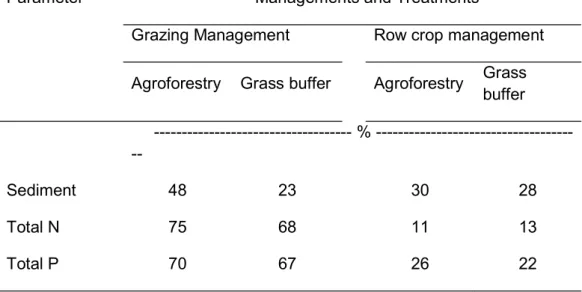
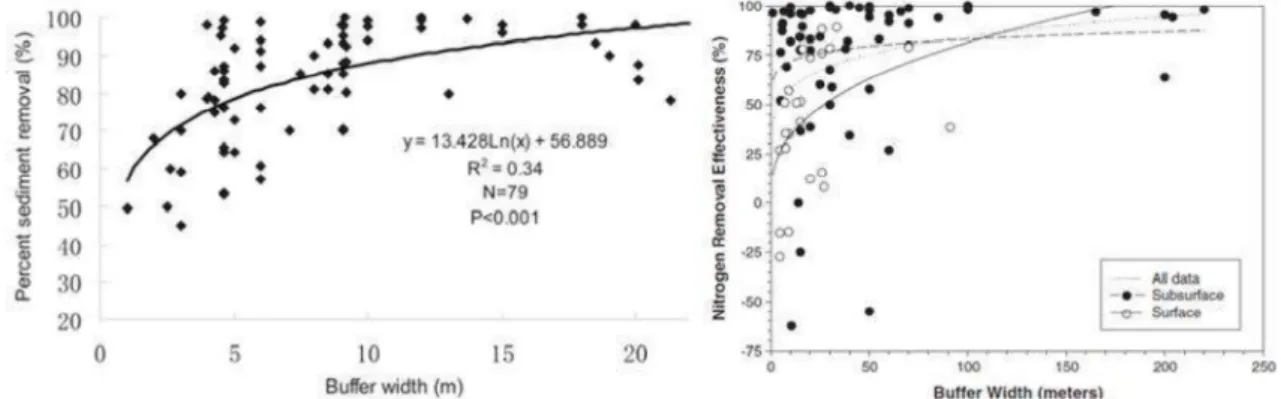
Two long-term studies in Missouri, one using a paired watershed approach under corn (Zea mays L.)-soybean (Glycine max (L.) Merr.) rotational management and the second with cattle grazing have shown reductions in runoff, sediment, and nutrients ranging from 45 to 48% with agroforestry and grass buffers as compared to respective control (Table 1). The grazing study was located in deep loess soils and indicated greater filtration efficiencies as compared to the row crop study with clay pan soils. This emphasizes the importance of buffer design factors and selection of site suitable trees for enhanced benefits. In reviewing published data, Liu et al. (2008) and Mayer et al. (2007) showed that 15-m and 110-m wide buffers could remove 90% of the sediment and nitrogen in runoff water, respectively (Figure 1). Although wider buffers have been shown to be more effective, buffers wider than 7 m have often resulted in diminishing filtration of NPSP. Establishment of wider buffers and integration of income generating species could help generation of additional income and to recover the lost income due to wider buffers and loss of productive lands. Shrubs, nut bearing species, ornamental plants, and biomass crops could be integrated within buffers for water quality and other ecosystem benefits.
Table 1: Percent reduction of sediment, total nitrogen, total phosphorus losses on grazing and row crop management practices with agroforestry and grass buffers compared to the respective control treatment (Udawatta et al. 2011).
Parameter
Managements and Treatments
Grazing Management
Row crop management
Agroforestry Grass buffer
Agroforestry
Grass
buffer
%
---
Sediment
48
23
30
28
Agroforestry systems with greater biodiversity promotes greater degradation and
stronger binding of contaminants including antibiotics, herbicides, personnel care
products and other toxic compounds (Chu et al. 2010; Lin et al. 2011). On grazing
watersheds in Missouri, Chu et al (2010) demonstrated stronger sorption capacity of
Sulfadimethoxine and Oxytetracycline by soils under agroforestry as compared to soils
from crop and grass areas. They have attributed these differences to organic
compounds within agroforestry soils. For example, root exudates and root
decomposition products including phenolic and carboxyl groups, N-heterocyclic
compounds, and lignin decomposition products serve as binding sites (Cheng and
Kuzyakov 2005; Chu et al. 2010; Lin et al. 2011). In another study buffers with poplar,
eastern gamma grass, and native grasses exhibited stronger degradation potential of
parent compounds as compared to the control and individual species (Lin et al. 2011).
Some tree root exudates in the rhizosphere promote degradation by soil fauna and
bonding of chemical compounds to soil particles (Chu et al. 2010). In another study
Chu et al. (2013) noticed that antibiotic transport is governed non-equilibrium
processes and AF buffers retained more antibiotics due to enhanced sorption attributed
to higher levels of C. Integration of agroforestry can help reduce degradation of water
quality by stronger sorption to soils and/or degradation of chemicals.
Figure 1: Relationship between buffer width and sediment (Liu et al. 2008) and nitrogen removal (Mayer et al. 205).
Prolong droughts, severe wind erosion, and improper land management which caused economic losses and depression resulted in even death in some areas and these have caused establishment of wind breaks in Canada, USA and Russia (Figure 2). The Prairie Farm Rehabilitation Act (PFRA) funded field shelterbelts program since 1901 with over 610 million trees planted during the last 110 years in Canada. In the US, President Franklin Roosevelt initiated a program in 1934 to stabilize blowing wind. A 100-mile (160-km) wide strip from Texas to North Dakota contained 223 million trees and stretched for 18,599 square miles (48,000 km2) 1948 due to the 1946 drought, subsequent 1947 famine, estimated 0.5 to 1 million deaths, poor land management, and lower crop yields. The program was based on the findings of Vasily Dokuchaev who has documented damages on steppes for centuries of agriculture and proposed measures for water and soil conservation. Over the last sixty years, the Soviets have planted an exceedingly extensive system of shelter belts throughout much of the steppe region from west bluff of the Volga River from Volgograd in the south to Ulyanovsk in the north and in the Kulunda Steppe in Altay Kray of western Siberia. Shelter belts usually lined both sides of major highways and were often augmented by 15-20 rows of apple trees back from the highway between the shelter belts and the open fields, thus serving both to break the wind and to supply much-needed fruit.
Figure 2: Major shelterbelt areas in Canada (west of Indian Head), USA (Texas to North Dakota) and Russia.
Shelter belt trees increased soil C and thus soil water holding capacity. A white spruce tree, a species planted in Canada shelter belts, contained 287 and 86 kg of above- and below-ground biomass. Assuming 50% C in the biomass, a single white spruce tree would have sequestered 186 kg of C. Hybrid poplar sequesters 367 kg C tree-1 in above- and below-ground compared to 110 kg C tree-1 in green ash (Koth and Turncock 1999). The Canadian government estimated that all the seedlings distributed by the PFRA program would have sequestered 218 mega tons of C. Increasing soil C increases available water capacity of soils in addition to other ecosystem benefits (Box 1). Available soil water content doubles (from 32 to 65%) for OM increase from 1 to 4%. Plot and watershed research have shown increased AWC in soils under agroforestry in support of the above regional observations. Rehabilitated soils improved soil water storage, soil health, land productivity, and crop yields.
Box 1: Available Water Capacity (AWC) as a function of organic matter (OM) for sand, silt loam, and silty clay loam (Hudson 1994).
Conclusion
In spite of differences in approaches and management systems, results support the hypothesis that integration of agroforestry significantly reduce NPSP losses from grazed and row cropped sites. Furthermore, agroforestry also helped improve available soil water and soil water storage. These improvements can be attributed to changes in soil properties including soil carbon, soil porosity, infiltration, aggregate stability, and other hydraulic parameters. Regional studies have showed that agroforestry windbreaks have helped reduce soil degradation and improved soil properties including soil carbon, soil hydraulic parameters, soil water relationships and land productivity. Water quality and water quantity can be further improved by strategic placement of buffers, selection of site-soil-climate suitable buffer dimensions, improved design factors, and establishment of proper species.
References
Cheng W, Kuzyakov Y (2005) Root e ects on soil organic matter decomposition. In Zobel R, Wright S (ed) Roots and
Sand: AWC=3.8 + 2.2*OM, r2 0.79 Silt Loam: AWC=9.2 + 3.7*OM; r2 0.58 Silty Clay Loam: AWC=6.3 + 2.8*OM; r2 0.76
Cox C (2011) Losing Ground. Environmental working group. www.ewg.org/losingground (accessed 11/04/2018). Hudson DD (1994) Soil organic matter and available water capacity. J Soil Water Conserv 49: 189-194.
Lin C-H, Lerch RN, Goyne KW, and Garrett HE (2011) Reducing herbicides and veterinary antibiotic losses from agroecosystems using vegetative buffers. J Environ Qual 40: 791-799.
Liu X, Zhang X, Zhang M (2008) Major factors influencing the efficacy of vegetated buffers on sediment trapping: a review and analysis. J Environ Qual 37: 1667-1674
Kort J, Turnock R (1999) Carbon Reservoir and Biomass in Canadian Prairie Shelterbelts. Agrofor Syst 44: 175-186. Mayer PM, Reynolds SK, McCutchen MD, Canfield TJ (2007) Meta-analysis of nitrogen removal in riparian buffers. J
Environ Qual 36: 1172-1180.
Schultz RC, Isenhart TM, Colletti JP, Simpkins WW, Udawatta RP, Schultz PL (2009) Riparian and upland buffer practices. In: Garrett HE (ed) North American Agroforestry an Integrated Science and practice. American Society of Agronomy, Inc, Madison, Wisconsin, USA, pp 163-218.
Udawatta RP, Motavalli PP, Garrett HE (2006) Nitrogen losses in runoff from three adjacent agricultural watersheds with claypan soils. Agr Ecosyst Environ 117: 39-48.
Udawatta RP, Garrett HE, Kallenbach RL (2011). Agroforestry buffers for nonpoint source pollution reductions from agricultural watersheds. J Environ Qual 40: 800-806.
Udawatta RP, Gantzer CJ, Jose S (2017) Agroforestry practices and soil ecosystem services. In: Al-Kaisi MM, Lowry B (eds) Soil Health and Intensification of Agroecosystems. London Academic Press, pp. 305-308.
USEPA (U.S. Environmental Protection Agency) (2009) National Water Quality Inventory: Report to Congress, 2004 reporting cycle: findings. https://www.epa.gov/waterdata/2004-national-water-quality-inventory-report-congress (accessed 12/04/2018).