Deposited in Repositório ISCTE-IUL: 2018-10-11
Deposited version: Post-print
Peer-review status of attached file: Peer-reviewed
Citation for published item:
Garcia-Marques, T., Prada, M. & Mackie, D. M. (2016). Familiarity increases subjective positive affect even in non-affective and non-evaluative contexts. Motivation and Emotion. 40 (4), 638-645
Further information on publisher's website: 10.1007/s11031-016-9555-9
Publisher's copyright statement:
This is the peer reviewed version of the following article: Garcia-Marques, T., Prada, M. & Mackie, D. M. (2016). Familiarity increases subjective positive affect even in non-affective and non-evaluative contexts. Motivation and Emotion. 40 (4), 638-645, which has been published in final form at https://dx.doi.org/10.1007/s11031-016-9555-9. This article may be used for non-commercial purposes in accordance with the Publisher's Terms and Conditions for self-archiving.
Use policy
Creative Commons CC BY 4.0
The full-text may be used and/or reproduced, and given to third parties in any format or medium, without prior permission or charge, for personal research or study, educational, or not-for-profit purposes provided that:
• a full bibliographic reference is made to the original source • a link is made to the metadata record in the Repository • the full-text is not changed in any way
The full-text must not be sold in any format or medium without the formal permission of the copyright holders.
Serviços de Informação e Documentação, Instituto Universitário de Lisboa (ISCTE-IUL) Av. das Forças Armadas, Edifício II, 1649-026 Lisboa Portugal
Phone: +(351) 217 903 024 | e-mail: [email protected] https://repositorio.iscte-iul.pt
NOTICE: this is the author’s version of a work that was accepted for publication in Motivation & Emotion. Changes resulting from the publishing process, such as peer review, editing, corrections,
structural formatting, and other quality control mechanisms may not be reflected in this document. Changes may have been made to this work since it was submitted for publication. A definitive version was subsequently published as:
Garcia-Marques, T., Prada, M., & Mackie, D. (2016). Familiarity increases subjective positive affect even in non-affective and non-evaluative contexts. Motivation & Emotion, 40, 638-645. doi: 10.1007/s11031-016-9555-9
Running Head: FAMILIARITY FEELS GOOD
Familiarity increases subjective positive affect even in non-affective and non-evaluative contexts
Teresa Garcia-Marques ISPA-Instituto Universitário, Lisboa
William James Centre for Research
Marília Prada
ISCTE - Instituto Universitário de Lisboa CIS-IUL
Diane M. Mackie
University of California, Santa Barbara
Send correspondence to:
Teresa Garcia-Marques [email protected]
ISPA-Instituto Universitário, Rua Jardim do Tabaco, 34, 1149-041, Lisboa, Portugal.
Abstract
Previous research shows that the experience of familiarity involves the experience of positive affect. In two experiments we clarify and extend this research by showing that the experience of familiarity involves the experience of positive affect even when the nature of the experimental task is non-affective and non-evaluative and even when participants are actively performing other cognitive operations – that the association of familiarity and positive affect is not disrupted by (non-affective and non-evaluative) judgments regardless of whether familiarity does or does not play a role in those judgments. Experiment 1 used a non-affective but evaluative task and Experiment 2 a completely non-evaluative task. Both studies manipulated familiarity through re-exposure and showed that processing familiar stimuli induced a pleasurable subjective
Familiarity, wrote Titchener in 1910, is a “pleasant feeling” (p.411). Decades later, Pittman (1992, p.280) also characterized familiarity as “a feeling with a positive affective tone.” Instead of breeding the contempt suggested by the popular idiom, familiarity in these views induces hedonic content – a subjective experience of feeling good.
The relationship between familiarity and positive affect was taken for granted in the literature which, for years, continued to accumulate replications of the mere-exposure effect: People like familiar stimuli (Zajonc, 1968; for a review see Bornstein, 1999). Preference or liking judgments, however, are only an indirect measure of the experience of positive affect (e.g., de Vries, Holland, Chenier, Starr, & Winkielman, 2010) and it was not until 2000 that researchers used a number of methodological strategies to focus on the possibility that a subjectively positive affective state might be experienced by participants when processing familiar stimuli.
Harmon-Jones and Allen (2001), for example, provided further support for the association of familiarity with subjective positive affect using psychophysiological measures. Participants exhibited greater activity in facial muscles associated with positive affect (zygomatic muscle region) after exposure to familiar rather than unfamiliar photos. In addition, Garcia-Marques, Mackie, Claypool, and Garcia-Marques (2010) provided evidence that familiarity and positive affect share the same type of subjective experience, by showing that positivity and familiarity exert a bi-directional impact on each other’s judgment latencies. In an adaptation of the implicit
association test (Greenwald, McGhee, & Schwartz, 1998), participants categorized a series of words appearing in lowercase as positive or negative, intermixed with trials in which they
categorized city names appearing in all capital letters as having been previously presented or not. The pattern of responses was the one typically found in IAT studies when two dimensions are closely related: when familiarity and positivity judgments shared the same response key, performance was facilitated (and inhibited when positivity and familiarity judgments required different response keys).
If the experience of familiarity is equally the experience of positive affect, manipulations of one of these can be expected to bias judgments on the other, and they do. For example, Garcia-Marques et al. (2004) showed that by subliminally priming stimuli with happy faces (activating positive affect), individuals falsely recognized the stimuli as familiar (Experiment 2), and that smiling faces (activating positive affect) were also more likely to be falsely recognized as familiar than neutral ones (Experiment 1; see also Monin, 2003). Similarly, Phaf and Rotteveel (2005) demonstrated that a subjective experience of “happiness” (induced by asking participants to contract their zygomaticus muscles) led to neutral words falsely being judged as familiar. Other studies corroborated the association between positivity and familiarity by providing evidence that the manipulation of familiarity biases affective judgments. Claypool, Hugenberg, Housley, and Mackie, (2007), for example, showed that manipulations of facial familiarity triggered differential perceptions of facial affect, such that familiar faces seem happier and less angry than unfamiliar ones.
Together, this body of research clearly suggests that as Titchener and Pittman maintained, the experience of familiarity involves the experience of a diffuse positive affective state.
Interestingly, however, all of the experiments described here in support of this contention implicitly or explicitly primed an affective context. Thus, evidence for the link between familiarity and
affective experiences in this body of research has been demonstrated in conditions under which familiarity is associated with an affective context, induced by asking participants preference or liking or attractiveness or emotion judgments.
Only one study, and the very first to broach the issue, assessed subjective mood while not asking participants to make evaluative or affective judgments. Monahan, Murphy, and Zajonc (2000, Experiment 1) asked participants to attend to a “blank screen” and subsequently to report “how do you feel?” Half of the participants were unknowingly exposed on that screen to 5 Chinese ideographs (subliminal presentations), each repeated five times. The other half of the participants
were exposed to 25 different ideographs. Participants in the first condition reported being in a better “current mood” than participants in the second condition. Note, however, that this effect occurred under conditions in which familiarity was induced unconsciously and performance of no other task was required, so that participants just stared at what appeared to be a blank screen. In addition, the experience of repetition (in and of itself) was exclusive to participants in the familiar stimuli condition. This single study is thus the only one to provide evidence that exposure to repeated, and therefore familiar, stimuli seems to generate a diffuse positive affective state, and the conditions under which this result was obtained were very restricted.
Our research was thus intended to make three contributions. First, we wished to provide evidence that familiarity is experienced as a diffuse positive state even under conditions that are independent of the affective or evaluative nature of the experimental task (that is, when
participants' goals are not to express their “preferences” or “likes” or so forth). In doing so we would also provide a conceptual replication of the single study in the literature that appears to support this point. Second, we wished to demonstrate that familiarity is experienced as a diffuse positive state even when participants are actively performing other cognitive operations – that the association of familiarity and positive affect is strong enough that it is not easily disrupted by other (non-affective and non-evaluative) judgments being made. Such disruption is easily imagined taking a misattributional perspective, for example, where the use of any current experience to support one task may prevent it being attributed to affect (e.g. Bornstein & D'Agostino, 1994). To our knowledge, no previous experiment has assessed incidental affect when participants were actively performing another non-affective task, leaving open the question about whether the familiarity-positive affect association holds when individuals have other goals. We thus sought evidence that familiarity is indeed felt positively even when individuals are actively performing another task, and also investigated whether that effect occurred when the simultaneous task was unrelated to any current feelings of familiarity or even when the task required those feelings of
familiarity. Third, we intended to provide this evidence in paradigms in which the experience of repetition (by itself) is experimentally controlled for. Thus our experiments were designed to show that it is not the “experience of repetition” that feels good (a possibility left open by the Monahan et al. study), but the “processing of familiar stimuli” that does so. In two experiments we predicted that even under these conditions, the experience of familiarity leads participants to also report being in a better mood.
EXPERIMENT 1
In this experiment, participants were required to rate the perceived truth of both repeated and novel statements. Previous research has repeatedly demonstrated a familiarity-truth effect, such that the experience of familiarity increases truth judgments, with familiar statements perceived as truer than unfamiliar statements (Bacon, 1979; Begg, Armour, & Kerr, 1985). Thus, if participants’ responses revealed a familiarity-truth effect, we could reasonably infer that they were experiencing appropriate levels of familiarity when processing each statement. We predicted that in contrast to when they processed novel statements, participants processing familiar statements would not only rate them as truer, but more relevant to our goals, they would also report a pleasurable subjective experience. Such results would thus advance multiple goals. First, they would confirm that familiarity is experienced positively, even when the judgments that participants are asked to make are non-affective. Second, they would show that familiarity is experienced as a diffuse positive state even when participants are actively performing another task at the same time, and even when performance of that task is known to depend on the experience of familiarity itself.
Method Participants and Design
One hundred seventy one undergraduate students (72.4% females, aged between 17-23, from ISPA- Instituto Universitário, Portugal) volunteered to participate. Participants were randomly
distributed to the 16 cells created by crossing the two experimental conditions (Novel or Repeated) and eight versions of the materials.
Stimulus materials
Our stimuli set comprised recordings of 96 plausible sentences of uncertain truth-value (following Bacon, 1979), half of which were actually true. These statements were divided randomly into four subsets. Each subset contained 12 true statements (i.e., "A baby elephant sucks with its mouth") and 12 false ones (i.e., "A baby elephant sucks with its trunk"). As illustrated by the previous example, the false statements were false versions of the true ones. The false and true versions of a sentence never appeared in the same subset, with the result that list A1 and A2 were true or false versions of the same sentences and lists B1 and B2 were true or false versions of the same sentences. All items were randomly organized within each list, and each list was preceded by four similarly-rated buffer items. The lists were recorded by the same female voice (one sentence every 10s). Eight different lists were created to ensure that materials and status of the stimuli as repeated or novel was counterbalanced.
Procedure
The procedure closely followed the typical truth effect paradigm (see, Dechêne, Stahl, Hansen, & Wänke, 2010). Participants were told they would perform several tasks. The first task was the exposure phase, in which participants listened to one of the lists (A1, A2, B1, or B2; approximately one-fourth of the participants heard each list) while circling a number that best represented their rating of how interesting each of the 24 sentences was (1 = Not Interesting to 7 =
Very Interesting).
The second task comprised the familiarity manipulation. Participants were exposed to 46 written statements that they were required to judge as true or false: participants were informed that half of the sentences were true and half were false. The first 36 items were randomly presented items. The experience of familiarity was manipulated by the status of the last 10 statements in the
list. In the unfamiliar condition, the last 10 items were all novel (that is, from a list other than the one participants had heard in the exposure phase), whereas in the familiar condition, the last 10 statements were all repeated (that is, they had been encountered in the exposure phase). To make sure that participants experienced overall an equal number of familiar and novel items, the first 36 items in unfamiliar condition (where the final 10 items were all novel) included 16 novel items interspersed with 20 repeated items (that is, items encountered during the exposure phase) whereas the first 36 items in the familiar condition (where the final 10 items were all repeated) included 16 repeated items interspersed with 20 novel items. As it was presented, participants rated the likelihood of each statement's being true or false on a scale from 1 = Certainly False to 7 =
Certainly True, with the midpoint labeled Completely Uncertain.
The third task assessed the dependent measure. Immediately after processing the final 10 either repeated or novel items, participants responded to a “current mood” scale (following Monahan et al., 2000) developed for the Portuguese population (Garcia-Marques, 1999; 2004). Participants used an 11-point scale (1= It describes my current mood very badly to 11 = It describes
my current mood state very well) to react to three statements: “My state of mind is positive”, “I am
feeling a little bit down”, and “I am not feeling good”. The two negative items were reversed scored so that high scores indicated positive mood. Finally, participants were asked if they had noticed that some items had been repeated from the alleged first study (statement interest ratings) and if they had purposefully rated as true any item they thought was repeated (“yes” or “no” answers).
Results and Discussion
Eleven participants reported explicitly using recall of items from the interest exposure phase to decide if a statement was true or false. Since such a strategy might provide an alternative
explanation of the results, data from these participants were excluded from further analysis. Three participants failed to answer the mood items, resulting in variation in reported degrees of freedom.
Truth Ratings
We first examined truth ratings of the first 36 items in the list. Participants' estimations of the truth of the first 36 statements, averaged across repeated and novel statements, were entered as a within-subjects factor in 2 (Repeated vs. Novel statements) x 8 (versions of material) x 2 (Final block: Repeated vs. Novel items) mixed analysis of variance (ANOVA). The ratings revealed a truth effect with repeated statements rated truer (M = 5.51, SE = 0.07) than novel statements (M = 4.26, SE= 0.03), F(1, 154) = 267.75, p < .001, h2= 0.63, with no other significant effects. These
results confirmed that participants experienced different levels of familiarity as they heard repeated and novel statements.
Even more importantly, an identical ANOVA revealed a truth effect in participants’ ratings of the final 10 items, where the average rating of repeated statements in the familiar condition was higher (M = 5.43, SE = 0.114) than ratings of the novel items in the unfamiliar condition (M = 4.12,
SE = 0.06), F(1, 155) = 99.10, p < .001, hp2=0.40. Mood Ratings
Our dependent measure was assessed by participants’ responses to the three mood items (Cronbach’s alpha = .85). These responses were averaged and analysed in a by 2 (Repeated vs. Novel final items) x 8 (versions of material) ANOVA. As expected, participants reported feeling significantly more positive (M = 7.10, SE =0.28) after evaluating repeated statements than after evaluating novel statements (M = 6.32, SE =0.27), F(1, 151)=4.17, p=.043, hp2=0.03.
These results demonstrate that even with the goal of rating the truth of a statement, participants had a more positive hedonic experience, and thus reported being in a better mood, when they processed familiar (repeated) rather than unfamiliar (novel) items. This effect held even when participants were cognitively engaged in making judgments, and even when those judgments were non-affective. Even more importantly, they occurred when participants were using their experience of familiarity to support making those other judgments. If the association between
familiarity and ratings of subjective positive affect were the merely the result of a misattribution of feelings of familiarity, it is unlikely that such misattribution could have resulted in familiarity effects on truth judgments and on hedonic effect judgments. Here we show that the experience of familiarity altered truth judgments just as it typically does but nevertheless, at the same time, participants experiencing familiarity also felt more positive. This pattern of results suggests that positivity is intrinsic to familiarity as the attribution of feelings of familiarity to truth judgments does not disrupt such positivity. Thus, the pattern of results obtained in Experiment 1 supports both our claim that positivity is intrinsic to familiarity and that this positive experience occurs even when participants are actively engaged in a simultaneous task to which familiarity is also relevant.
In this experiment we relied on the truth effects paradigm to ensure that participants were in fact experiencing familiarity and relying on those feelings in making judgments. We also used the truth effects paradigm because making truth judgments is evaluative but not affective (as are preference judgments). However, it is possible that evaluating statements as true may be more affectively positive than evaluating statements as false. We tested that possibility by analyzing the relation between participants’ ratings of the perceived truth of the last 10 items and their assessed mood across the two conditions and found no significant relationship (t<1). Nevertheless, it was perhaps possible that those participants who ended the experiment by evaluating statements as true may have felt that they performed more successfully (and were thus happier) than those who ended my making more ‘false” judgments, an alternative explanation that is eliminated in Experiment 2.
EXPERIMENT 2
In this experiment, we replicated Monahan et al. (2000) more closely in promoting
familiarity with repetition occurring outside participants' conscious awareness, but at the same time included a control group that had the same type of repetition experience. Thus the experiment was designed to reveal whether the “experience of repetition” feels good (a possibility left open by the
Monahan et al. study) or the “processing of familiar stimuli” (as we claim) feels good. In addition, in this experiment participants made simultaneous judgments that were not only non-affective but were also non-evaluative: location judgments. Location judgments were also used in Experiment 2 because the relative ease of making these judgments meant that all participants experienced equal amounts of “success.” During the first part of the experimental task participants were subliminally exposed to stimuli that were either the same as or different from stimuli they processed at the end of the task. Participants then performed a task that did not rely on the experience of familiarity, was completely independent of any affective cues, and generated the same level of success and thus confidence in both the unfamiliarity and familiarity conditions.
We once again expected those experiencing familiarity (because of re-exposure to previously encountered stimuli) to report enhanced positive mood.
Method Participants and Design
Forty-six undergraduate students (71.7% female, aged between 17-26, from ISPA- Instituto Universitário, Portugal) were randomly assigned to conditions in which they saw either familiar or unfamiliar items. Materials were counterbalanced so that the novel items in one condition were the repeated items in the other condition. The design was thus a 2 (Novel vs. Repeated items) x 2 (Stimulus Set) factorial design.
Stimulus Materials and Procedure
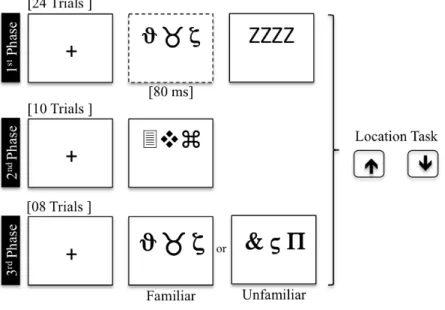
Participants took part in an alleged study about perception. In each trial, participants were instructed to focus on a plus sign presented in the center of the computer screen and to indicate whether a stimulus string was presented above (key labeled with a upwards arrow) or below (key labeled with a downwards arrow) the plus sign. These keys were the S and the L of a regular keyboard and were counterbalanced in order to control for handedness. Although the experiment had three phases (see Figure 1), participants engaged in this same location task throughout,
responding to the different symbol sets that appeared on the screen. Those symbols belonged to one of two sets of 8 strings of 2 or 3 symbols (see Figure 1) which were counterbalanced as Novel or Repeated targets, and were intermixed with fillers composed of symbols not used as targets.
In the first phase, participants were supraliminarly presented (until participants pressed a key) with four different strings of four repeated letters (XXXX, ZZZZ, WWWW, KKKK) that masked a subliminal (80 ms) randomized presentation of each symbol string in the target set. Since each of the eight targets was presented three times, participants saw a total of 24 stimuli strings. Half of the participants were subliminally exposed to one of the target sets, and the other half to the other target set. In the second phase, participants were presented supraliminally with ten of the filler strings and continued to make location judgments. The third phase manipulated the activation of a feeling of familiarity. Participants in the unfamiliar condition were presented supraliminally with a final block of eight novel strings (i.e., selected from the set not previously presented), whereas participants in the familiarity condition saw a supraliminal final block of eight repeated strings (i.e., selected from the subliminally presented block).
To assess the dependent measures, participants immediately completed a
“post-experimental questionnaire" where, among other items, they reported how they felt “right now" by using three 9-point scales (where 1 = Sad, Negative, Bad, and 9 = Happy, Positive, Good
respectively; see Garcia-Marques, 2004).
Results and Discussion
Responses to the three mood scales (Cronbach’s alpha = .62) were averaged and analyzed in a 2 (Repeated vs. Novel final block) x 2 (Stimulus Set) ANOVA, revealing only a significant main effect for familiarity, F (1, 42) = 5.37, p = .025, h2=0.11. Participants reported their mood to be
significantly more positive (M = 6.61, SE = 0.24) after exposure to a final block of familiar stimuli than after exposure to unfamiliar stimuli (M = 5.76, SE = 0.27). No other effects were significant (Stimuli set: F(1, 42)=1.62, p = .210; Interaction F < 1).
The task was performed both accurately (96% correct responses) and relatively quickly, with no effect of condition in response latencies (t < 1).
As expected, participants re-exposed to previously encountered items reported being happier than participants exposed to novel items. This re-exposure to familiar items improved mood relative to those in the unfamiliar condition. This is of particular interest given that the goal of the task participants were performing (i.e., location determination) was entirely independent of stimuli familiarity and was completely non-affective. Moreover, all participants were submitted to the same subliminal experience of items being repeated and were never consciously aware of the repetition manipulation.
These results support our claim that familiarity is experienced as a diffuse positive state even when the experimental task involves neither an affective nor even an evaluative dimension. They also provide a conceptual replication of the single study in the literature (Monahan et al., 2000) that shows familiarity is sufficient for the generation of positive mood (while making
methodological changes that show the results to be independent of the repetition process itself). Further, the results show that the familiarity induces positive affect even when other judgments are actively made. Finally, these results show that the findings from Experiment 1 did not depend on the ease with which the task was performed or any condition-dependent feelings of success.
General Discussion
Results from two experiments demonstrate that the experience of familiarity induced by re-exposure increases the subjective experience of positivity. We manipulated familiarity via both supraliminal and subliminal repetition and showed that exposure to familiar stimuli was
accompanied by enhanced ratings of subjective positive affect even if participants simultaneously performed a non-affective and non-evaluative task. Familiarity was experienced as a diffuse positive state regardless of whether the familiarity they experienced was used in a simultaneously performed task (truth judgments) or not (perception and location task). That is, even when the experience of familiarity appeared to be used to make truth judgments, increased subjective positive affect was still experienced. Moreover, increased positive affect was observed even in a very easy successfully accomplished task only when accompanied by the experience of processing familiar stimuli. Even when familiarity did not increase processing speed because detection of the stimuli was already very easy, it impacted subsequent mood rating. Thus, the link between
familiarity and positive affect is not influenced by whether or not a) a simultaneous cognitive task is performed; b) the context has an affective or evaluative nature; c) a simultaneous task engages affective or evaluative goals; d) task performance depends on the experience of familiarity; or e) task performance is facilitated by the ease of processing familiar stimuli.
Our findings thus make three contributions. First, we provided evidence that familiarity is experienced as a diffuse positive state even under conditions that are independent of the affective or evaluative nature of the experimental task (that is, when participants' goals are not to express their
“preferences” or “likes” or so forth). Second, we demonstrated that familiarity is experienced as a diffuse positive state even when participants are actively performing other cognitive operations. Familiarity was experienced positively even when the experience of familiarity was being used to perform a simultaneous task, and even when familiarity was irrelevant to the task at hand. Third, we provide evidence that it is not the “experience of repetition” that feels good but the “processing of familiar stimuli” that does so. Our experiments thus extend the range of conditions under which the familiarity-affect association has been found, as well as eliminate alternative explanations for its occurrence, while adding another conceptual replication to the very small body of work that shows that the subjective experience of familiarity involves the subjective experience of a positive affective state.
The idea that the experience of familiarity is itself an inherently positive experience (e.g., Garcia-Marques & Mackie, 2000, 2004; Harmon-Jones & Allen, 2001; Reber et al., 1989) is argued to rely on the fact that re-exposure to stimuli is associated with memory activation promoting an ease or fluency of processing. Manipulations other than repetition (e.g., high colour contrast and fonts that are easier to read) that enhance stimulus fluency also increase stimulus liking (Reber, Winkielman, & Schwarz, 1998; Winkielman & Cacioppo, 2001). This suggests that any increase of fluency would also increase positive feelings. Our results suggest that even when the task is a very easy fluent one (Experiment 2), processing of a familiar stimuli is still associated with positive affect. The experience associated with the processing of repeated stimuli is detected even when fluency is already high, suggesting that there may be other features of processing familiar stimuli other than processing fluency itself that contribute to the experience of familiarity as one of positive affect. However, this is an empirical question yet to be addressed.
Our work further strengthens the evidential base for a claimed link between familiarity and positive affect by demonstrating that familiarity is associated with subject positive affect across a
range of conditions never previously tested. It should be noted that although the literature claims that familiarity breeds content, some studies challenge the universality of this link either because they do not find evidence to support it or because they show that it can be moderated. For example, Sergerie et al. (2007) show opposite effects to the ones reported by Garcia-Marques et al. (2004) by demonstrating that in their experiment participants tended to perceive sad faces as familiar and happy faces as “new.” Also, De Vries et al. (2010) showed that happy mood eliminates the preference for familiar stimuli and the absence of familiarity effects on physiological measures of affect (EMG, zygomaticus muscle activity). Likewise, Liao, Shimojo, and Yeh’s (2013) findings suggest that the affective nature of the stimuli is a moderator of the link between familiarity and positive affect by showing that it only is observed for sad faces but not for happy ones. Together, these studies may challenge either the idea that familiarity is inherently positive, or at least that the association between familiarity and positive affect is an intrinsic one (in the sense that both are experienced in similar ways). However, there are alternative explanations for all these data (as the authors themselves acknowledge), the most important of which is the idea that familiarity is a relative feeling (Whittlesea, 1993; Whittlesea & Leboe, 2003). Thus, if positive affect is already high, the affective component of the experience of familiarity is already present, making an increase (or noticing an increase) less likely. Alternatively, even if familiarity is experienced as positive, the emotional context may lead it to be discounted by misattributing it to the preexisting happy state. These possibilities are starting places for the empirical research that needs to be conducted to better understand how these apparently contradictory effects were observed.
The implications of familiarity being charged with positive affect have been widely discussed (for a review see Winkielman, Schwarz, Fazendeiro, & Reber, 2003). We also have argued elsewhere that an inherent relationship between familiarity and positive affect may help explain several other well-established effects (see Garcia-Marques & Mackie, 2000). For example,
both the experience of positivity (for a review see Schwarz & Clore, 1996; Garcia-Marques, 1998) and the experience of familiarity (Garcia-Marques & Mackie, 2001; Johnston & Hawley, 1994; Reder & Ritter, 1992) increase top-down, less detailed processing in a variety of domains, but the two effects have not previously been thought of as emanating from a common process. On an even more far-reaching level, the notion that familiarity is affectively charged challenges traditional distinctions between affect and cognition. If such distinctions break down, the classic view of affect and cognition as independent systems is equally undermined. In turn, this challenges the
assumption that affect impacts cognitive processing only as one more external variable (see also Damasio, 1994; Oatley & Johnson- Laird, 1987; Simon, 1967). Instead, it suggests that affect is an integral part of cognition: that “to think” may also mean “to feel.” If so, Titchener’s (1910)
References
Bacon, F. T. (1979). Credibility of repeated statements: Memory for trivia. Journal of Experimental
Psychology: Human Learning and Memory, 5, 241-252. doi:10.1037/0278-7393.5.3.241
Begg, I., Anas, A., & Farinacci, S. (1992). Dissociation of processes in belief: Source recollection, statement familiarity, and the illusion of truth. Journal of Experimental Psychology:
General, 121, 446-458. doi:10.1037/0096-3445.121.4.446
Begg, I., Armour, V., & Kerr, T. (1985). On believing what we remember. Canadian Journal of
Behavioural Science, 17, 199-214.doi:10.1037/h0080140
Bornstein, R. F. (1989). Exposure and affect: Overview and meta-analysis of research, 1968-1978.
Psychological Bulletin, 106, 265-289. doi:10.1037/0033-2909.106.2.265
Bornstein, R. F., & D'Agostino, P. (1994). The attribution and discounting of perceptual fluency: Preliminary tests of a perceptual fluency/attributional model of the mere exposure effect.
Social Cognition, 12, 103-128. doi:10.1521/soco.1994.12.2.103
Butler, L. T. & Berry, D. C (2004). Understanding the relationship between repetition priming and mere exposure. British Journal of Psychology, 95, 467-487. doi:10.1348/0007126042369776
Clore, G. L, Gasper, K., & Garvin, E. (2001). Affect as information. In J.P Forgas, (Ed.).
Handbook of affect and social cognition (pp. 121-144). Mahwah, NJ: Lawrence Erlbaum
Damásio, A. R. (1994). Decartes’ error: Emotion, reason and the human brain. London, UK: Picador
Dechêne, A., Stahl, C., Hansen, J., & Wänke, M. (2010). The truth about the truth: A meta-analytic review of the truth effect. Personality and Social Psychology Review. 14(2) 238–257
Duckworth, K.L, Bargh, J. A, Garcia, M., & Chaiken, S. (2002). The automatic evaluation of novel stimuli. Psychological Science, 13, 513 - 519. doi:10.1111/1467-9280.00490
Garcia-Marques, T., & Mackie, D. M. (2000). The positive feeling of familiarity: Mood as an information processing regulation mechanism. In J. Forgas and H. Bless (Eds.), The
message within: The role of subjective experiences in social cognition and behavior (pp.
240-261). Philadelphia, PA: Psychology Press.
Garcia-Marques, T. Mackie, D.M, Claypool, H.M, & Garcia-Marques, L. (2004). Positivity can cue familiarity, Personality and Social Psychology Bulletin, 30, 1-9.
doi:10.1177/0146167203262856
Greenwald, A. G., McGhee, D. E., & Schwartz, J. L. K. (1998). Measuring individual differences in implicit cognition: The implicit association test. Journal of Personality and Social Psychology, 74, 1464–1480. doi:10.1037/0022-3514.74.6.1464
Jacoby, L. L., & Whitehouse, K. (1989). An illusion of memory: False recognition influenced by unconscious perception. Journal of Experimental Psychology: General, 118, 126-135. doi:10.1037/0096-3445.118.2.126
Jacoby, L. L., Allan, L. G., Collins, J. C., & Larwill, L. K. (1988). Memory influences subjective experience: Noise judgments. Journal of Experimental Psychology: Learning, Memory
and Cognition, 14, 240-247. doi:10.1037/0278-7393.14.2.240
Jacoby, L. L., Kelley, C. M., & Dywan, J. (1989). Memory attributions. In H. L. Roediger & F. I. M. Craik (Eds.), Varieties of memory and consciousness: Essays in honor of Endel Tulving (pp. 39-422). Hillsdale, NJ: Erlbaum.
Johnston W. A., & Hawley K. J. (1994). Perceptual inhibition of expected inputs: The key that opens closed minds. Psychonomic Bulletin and Review, 1, 56-72. doi:10.3758/bf03200761
Mandler, G., Nakamura, Y. & Van Zandt, B. J. S. (1987). Nonspecific effects of exposure on stimuli that cannot be recognized. Journal of Experimental Psychology: Learning,
Memory and Cognition, 113, 646-648. doi:10.1037/0278-7393.13.4.646
Manza, L., Zizak, D., & Reber, A. S. (1998). Artificial grammar learning and the mere exposure effect. In M. A. Stadler & P. A. Frensch (Eds.), Handbook of implicit learning (pp. 201– 222). Thousand Oaks, CA: Sage
Monahan, J. L., Murphy, S. T., & Zajonc, R. B.(2000). Subliminal mere exposure: Specific, general and diffuse effects. Psychological Science, 11, 462-466. doi:10.1111/1467-9280.00289 Monin, B. (2003). The warm glow heuristic: When liking leads to familiarity. Journal of
Personality and Social Psychology, 85, 1035-1048. doi:10.1037/0022-3514.85.6.1035
Murphy, S. T., & Zajonc, R. B. (1993). Affect, cognition, and awareness: Affective priming with optimal and suboptimal stimulus exposures. Journal of Personality and Social Psychology,
64, 723-739. doi:10.1037/0022-3514.64.5.723
Niedenthal, P.M. (1990). Implicit perception of affective information. Journal of
Experimental Social Psychology, 26, 505-527. doi:10.1016/0022-1031(90)90053-o
Norman, D. A., & Wickelgren, W. A. (1965). Short-term recognition memory for single digits and pairs of digits. Journal of Experimental Psychology, 70, 479-489. doi:10.1037/e572342012-007
Oatley, K., & Johnson-Laird, P. N. (1987). Towards a cognitive theory of emotions. Cognition and
Emotion, 1, 29–50. doi:10.1080/02699938708408362
Phaf, R. H., & Rotteveel, M.(2005). Affective modulation of recognition bias. Emotion, 5, 309-18. doi:10.1037/1528-3542.5.3.309
Pittman, T. S. (1992). Perception without awareness in the stream of behavior: Processes that produce and limit nonconscious biasing effects. In R. F. Bornstein & T. S. Pittman (Eds.),
Perception without awareness (pp. 277-296). New York, NY: Guilford Press.
Reber, R., Winkielman, P., & Schwarz, N. (1998). Effects of perceptual fluency on affective judgments. Psychological Science, 9, 45-48. doi:10.1111/1467-9280.00008
Schachter, S., & Singer, J. (1962). Cognitive, social, and physiological determinants of emotional states. Psychological Review, 69, 379-399. doi:10.1037/h0046234
Schwarz, N. (1990). Feelings as information: Informational and motivational functions of affective states. In E. T. Higgins & R. M. Sorrentino (Eds.), The handbook of motivation and
cognition (Vol. 2, pp. 527—561). New York, NY: Guilford Press.
Schwarz, N., & Clore, G. L. (1996). Feelings and phenomenal experiences. In E. T. Higgins & A.W. Kruglanski (Eds.), Social psychology: Handbook of basic
principles (pp.433-465). New York, NY: Guilford Press .
Sedikides , C. (1992). Mood as a determinant of attentional focus. Cognition and Emotion,
6, 129-148 . doi:10.1080/02699939208411063
Simon, H. (1967). Motivational and emotional controls of cognition. Psychological Review,
74, 29-39. doi:10.1037/h0024127
Smith, E. R. (2000). Subjective experience of familiarity: Functional basis in connectionist memory. In H. Bless & J. P. Forgas (Eds.), The message within: The role of subjective
experience in social cognition and behavior (pp. 109-124). Philadelphia, PA: Psychology
Press/Taylor & Francis.
Unkelbach, C. (2006). The learned interpretation of cognitive fluency. Psychological Science, 17, 339-345. doi:10.1111/j.1467-9280.2006.01708.x
De Vries, M., Holland, R. W., Chenier, T., Starr, M. J., & Winkielman, P. (2010). Happiness cools the warm glow of familiarity psychophysiological evidence that mood modulates the familiarity-affect link. Psychological Science, 21, 321-328.
doi:10.1177/0956797609359878
Whittlesea, B. W. A. & Williams, L. D. (2000). The source of feelings of familiarity: The discrepancy-attribution hypothesis. Journal of Experimental Psychology: Learning,
Memory, and Cognition, 26, 547-565. doi:10.1037/0278-7393.26.3.547
Winkielman, P., & Cacioppo, J. T. (2001). Mind at ease puts a smile on the face:
Psychophysiological evidence that processing facilitation elicits positive affect. Journal of
Personality and Social Psychology, 81, 989-1000. doi:10.1037/0022-3514.81.6.989
Winkielman , P., Zajonc , R. B.& Schwarz , N.(1997). Subliminal affective priming resists attributional interventions. Cognition and Emotion, 11, 433-465.
doi:10.1080/026999397379872
Winkielman, P., Schwarz, N., Fazendeiro, T. A., & Reber, R. (2003). The hedonic marking of processing fluency: Implications for evaluative judgment. In J. Musch, K. C. Klauer, J. Musch, K. C. Klauer (Eds.), The psychology of evaluation: Affective processes in cognition and emotion (pp. 189-217). Mahwah, NJ, US: Lawrence Erlbaum.
Yonelinas, A. P. (1994). Receiver-operating characteristics in recognition memory: Evidence for a dual-process model. Journal of Experimental Psychology: Learning, Memory, and
Cognition, 20, 1341-1354. doi:10.1037/0278-7393.20.6.1341
Zajonc, R. B. (1968). Attitudinal effects of mere exposure. Journal of Personality and Social
Zajonc, R. B. (1980). Feeling and thinking: Preferences need no inferences. American Psychologist,
Author Notes
Preparation of this manuscript was supported by a Fundação para a Ciência e a Tecnologia grant PTDC/PSI-PCO/121916/2010 to Teresa Garcia-Marques. Correspondence concerning this article should be addressed to Teresa Garcia-Marques, ISPA- Instituto Universitário, Rua Jardim do Tabaco, 34, 1149-041, Lisbon, PORTUGAL or [email protected].