MODELLING AGROFORESTRY SYSTEMS WITH
WEB-ECOYIELD-SAFE
Palma JHN1*, Tomás A1
(1) Forest Research Centre, School of Agriculture, University of Lisbon *Corresponding author: [email protected]
Abstract
Models may help improve understanding of agroforestry systems by being more cost and time-efficient than experiments. However it is lacking is the ability for stakeholders to directly use and understand models and a mechanism for the modelling experts to effectively communicate obtained results and interpretations with such stakeholders. The model EcoYield-SAFE, a development of the agroforestry process base model Yield-SAFE, is here presented as a web application allowing stakeholders to better understand and use the model. Any potentially interested person with an internet-connected device can make use of it, which in turn leads to more informed decision making and wider model acceptance, while providing feedback for improvements. An example is shown on how to use the online model comparing a) land use scenarios, i.e. arable, agroforestry and forestry and b) an agroforestry setup under different future climate scenarios.
Keywords: online platform; stakeholders; user-friendly; model; scenario comparison; climate change
Introduction
Agroforestry is a promising land use which delivers greater socio-economic and environmental externalities than conventional agricultural and forestry systems (Warner et al. 2016). Although much to be done to promote agroforestry worldwide, in a free, direct and simple way (Mosquera-Losada et al. 2009). In this sense, and considering also the lack of long-term data on the productivity of agroforestry systems, models may help improve understanding of these systems, by being more cost and time-efficient than experiments (Ford 1999). This was one of the motivations for the Yield-SAFE model (van der Werf et al. 2007) development. It is a parameter-sparse, process-based dynamic model that has been used to estimate long term productivity of agroforestry systems. However, it is currently lacking the ability for stakeholders to directly use and understand this model and a mechanism for the modelling experts to effectively communicate obtained results and interpretations with such stakeholders. For this reason, the model has recently been implemented as a web application, i.e. a web service together with an interface for ease of use. Any potentially interested person with an internet-connected device can make use of it, which in turn leads to more informed decision making and wider model acceptance (Walker and Chapra 2014). There are several advantages of naturally evolving models like this to web based versions, mainly: a) allowing an immediate access to the model without needing to download desktop software of browser plugins; b) simplifying maintenance in terms of fixing bugs and applying model updates, which can be done instantaneously with a single deployment to the server, being immediately available to all users; c) directly updating web page content from within the browser allows for improved user interfaces to access, visualize and analyse the results of the model; f) facilitating collaboration between multiple users (Byrne et al. 2010; Walker and Chapra 2014).
Web-EcoYield-SAFE aims to be a teaching instrument, an explorative environment for farm management and a versatile tool for further agroforestry research, while bringing stakeholders closer to modelling tools to support their management decisions.
Materials and methods EcoYield-SAFE model
Yield-SAFE (van der Werf et al. 2007) was developed during the SAFE project (Dupraz et al. 2005). It is a parameter-sparse, process-based dynamic model that has been used to estimate long term productivity of agroforestry systems. Within the AGFORWARD project (Burgess et al. 2015) it has undergone a series of improvements (Palma et al. 2016a, b; Palma et al. 2017). EcoYield-SAFE now has an ecosystem approach, integrating livestock, soil carbon, microclimate effects, pasture productivity and non-timber forest products (fruit, cork) (Palma et al. in preparation).
Web implementation
The implementation of the model followed a hybrid architecture, with simulations performed on the server and visualizations generated in the browser. For the server-side, the model equations were implemented in Python, while fully integrated with Clipick (Palma et al. 2017) to retrieve current and future daily climate data, and is continuously being improved following the updates made to the model. Under python, the model provides a web service (Palma et al. 2016a), i.e. a server-side interface that accepts requests from clients with parameters instructing a model run simulation, returning a response with model output data. As a service, the model may be reached directly within the browser itself, or any software able to perform an HTTP GET request.
However, it is not visually attractive nor user friendly to perform http requests and therefore a user friendly web interface layer that provides simple usage of the model and interpretation of results was further developed. This web interface was implemented using HTML, CSS and Javascript (VueJS framework and helper libraries) that work in any of the modern web browsers.
Case studies
To demonstrate the usage of the model in the visual interface we set a case study focused on climate change assessment, by comparing a silvoarale poplar system with a density of 156 trees ha-1 with a rotation of natural grasslands as understorey in current and future climate
scenarios, considering a rotation period of 80 years (Graves et al. 2010).
Results and discussion
Web implementation of the model The interface
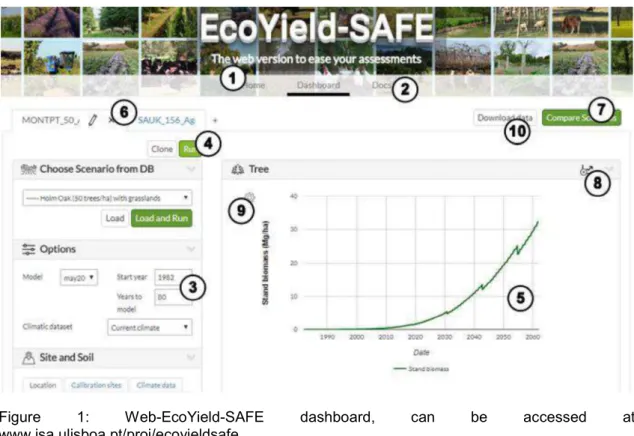
where all documentation related to the model is available (model information, related articles tion, where the arguments can be manipulated (3), the run order is given (4), and the outputs visualized (5). The user is able to create multiple scenarios (6) and make comparisons between them (7). Under each scenario tab, there are two main areas: on the left there are several tabs for each of the argument families (options, site and soil, tree, crop, livestock and soil carbon); on the right is where the graphics for the outputs will show up after the model is run. The outputs are displayed in the form of graphics (using the Google Charts tool), where some of the main output variables are shown by default, although the user may add new graphics (8) or edit (9) the existing ones.
ge (10).
This structure enables the user to a) evaluate and compare the performance of different land uses; b) simulate different management alternatives combining trees, crops and livestock (or for each individually); c) evaluate different management intensities and options; d) compare different long term effects of climate; e) simulate pastures; f) evaluate the influence of the trees presence in crop/pasture development; g) analyse different database stored scenarios; and
Figure 1: Web-EcoYield-SAFE dashboard, can be accessed at www.isa.ulisboa.pt/proj/ecoyieldsafe
Case study - Future climate scenarios
EcoYield-SAFE runs over climate data retrieved from the tool CliPick, which provides datasets used by the International Panel On Climate Change (Palma 2017). By using this tool, the user may not only simulate the current climate but also for future climate changes. CliPick adopted two datasets, the Representative Concentrations Pathways (RCP): an optimistic scenario, the RCP 4.5, and a pessimistic scenario, the RCP 8.5.
Figure 2: Poplar silvoarable systems in the UK simulated for different climatic scenarios (current climate and future RCP 8.5)
Figure 2 shows the overlapping of the standing biomass series of each simulation. It is clear the effect of climate change over the growth of the stand, where the RCP 8.5 shows a slower
Future developments
Planned future developments include:
Profiling of the interface towards different user groups: for farmers and farm advisors deal with the components that are manageable by or otherwise of importance to them. This will imply having numerous parameters assumed as constant or as directly linked to other input variables.
Making intelligent suggestions to users Including financial evaluations
Allowing users to submit new calibrations and manipulate model parameters
Adding a commenting and discussion system, enabling collaboration between researchers, students, farm advisors and farmers
improve the application ability to facilitate model understanding, including its accessibility to mobile devices (improve to a more responsive design).
Acknowledgements
We acknowledge support of the European Commission through the AGFORWARD FP7 research project (contract 613520) and INCREdible H2020 project (grant agreement 774632). This work was also partially supported by the Portuguese Science Foundation (FCT) under Project SOLAR (PTDC/GEOMET/7078/2014) and CEF PEst (UID/AGR/00239/2013).
References
Burgess PJ, Crous-Duran J, den Herder M, Dupraz C, Fagerholm N, Freese D, Garnett K, Graves AR, Hermansen JE, Liagre F, Mirck J, Moreno G, Mosquera-Losada MR, Palma JHN, Pantera A, Plieninger T, Upson M (2015). AGFORWARD Project Periodic Report: January to December 2014. Cranfield University, AGFORWARD. Byrne J, Heavey C, Byrne PJ (2010) A review of Web-based simulation and supporting tools. Simul Model Pract Theory
18: 253 276.
Dupraz C, Burgess P, Gavaland A, Graves A, Herzog F, Incoll L, Jackson N, Keesman K, Lawson G, Lecomte I, Liagre F, Mantzanas K, Mayus M, Moreno G, Palma J, Papanastasis V, Paris P, Pilbeam D, Reisner Y, Vincent G, Werf Van der W (2005) Synthesis of the Silvoarable Agroforestry For Europe project. INRA-UMR System Editions, Montpellier, pp.254. https://www1.montpellier.inra.fr/safe/english/results/final-report/SAFE%20Final%20Synthesis%20Report.pdf (accessed 24/04/2018).
Ford A (1999) Modeling the Environment: An Introduction to System Dynamics Modeling of Environmental Systems. Andrew Ford Island Press, Washington DC.
Graves AR, Burgess PJ, Palma JHN, Keesman KJ, van der Werf W, Dupraz C, van Keulen H, Herzog F, Mays M (2010) Implementation and calibration of the parameter-sparse Yield-SAFE model to predict production and land equivalent ratio in mixed tree and crop systems under two contrasting production situations in Europe. Ecol Modell 221: 1744 1756.
Mosquera-Losada MR, McAdam J, Rigueiro-Rodríguez A (2009) Future Directions of Agroforestry in Europe. In: Rigueiro-Rodróguez A., McAdam J., Mosquera-Losada M.R. (eds) Agroforestry in Europe. Advances in Agroforestry, vol 6. Springer, Dordrecht, pp 435 438.
Palma JHN, Graves AR, Crous-Duran J, Garcia de Jalon S, Oliveira TS et al. (in preparation) EcoYield-SAFE: maintaining a parameter-sparse approach in modelling silvopastoral systems.
Palma JHN, Graves AR, Crous-Duran J, Paulo JA, Oliveira TS, Garcia de Jalon S, Kay S, Burgess PJ, (2016b) Keeping a parameter sparse concept in agroforestry modeling while integrating new processes and dynamics: new developments in Yield-SAFE. 3rd European Agroforestry Conference, Montpellier, France.
Palma JHN (2017) CliPick Climate change web picker. A tool bridging daily climate needs in process based modelling in forestry and agriculture. For Syst 26. Tool available @ http://www.isa.ulisboa.pt/proj/clipick/ (accessed 27/04/2018).
Palma JHN, Crous-Duran J, Graves AR, Garcia de Jalon G, Upson M, Oliveira TS, Paulo JA, Ferreiro-Domínguez N, Moreno G, Burgess PJ (2017) Integrating belowground carbon dynamics into Yield-SAFE, a parameter sparse agroforestry model, Agrofor Syst. https://doi.org/10.1007/s10457-017-0123-4.
van der Werf W, Keesman K, Burgess P, Graves A, Pilbeam D, Incoll LD, Metselaar K, Mayus M, Stappers R, van Keulen H, Palma J, Dupraz C (2007) Yield-SAFE: A parameter-sparse, process-based dynamic model for predicting resource capture, growth, and production in agroforestry systems. Ecol Eng 29: 419 433.
Walker JD, Chapra SC (2014) A client-side web application for interactive environmental simulation modeling. Environ Model Softw 55: 49 60
Warner DJ, Tzilivakis J, Green A, Lewis KA (2016) A guidance tool to support farmers with ecological focus areas - the benefits of agroforestry services and biodiversity. 3rd European Agroforestry Conference, Montpellier, France.