The New England
Journal
of
Medicine
© Co pyr ight, 19 9 9, by the Massachus etts Medic al S o ciet y
V O L U M E 3 4 0 MA R C H 4, 1999 N U M B E R 9
A MULTICOMPONENT INTERVENTION TO PREVENT DELIRIUM
IN HOSPITALIZED OLDER PATIENTS
SHARON K. INOUYE, M.D., M.P.H., SIDNEY T. BOGARDUS, JR., M.D., PETER A. CHARPENTIER, M.P.H.,
LINDA LEO-SUMMERS, M.P.H., DENISE ACAMPORA, M.P.H., THEODORE R. HOLFORD, PH.D., AND LEO M. COONEY, JR., M.D.
A
BSTRACTBackground
Since in hospitalized older patients delirium is associated with poor outcomes, we eval-uated the effectiveness of a multicomponent strate-gy for the prevention of delirium.Methods
We studied 852 patients 70 years of age or older who had been admitted to the general-med-icine service at a teaching hospital. Patients from one intervention unit and two usual-care units were en-rolled by means of a prospective matching strategy. The intervention consisted of standardized protocols for the management of six risk factors for delirium: cognitive impairment, sleep deprivation, immobility, visual impairment, hearing impairment, and dehy-dration. Delirium, the primary outcome, was assessed daily until discharge.Results
Delirium developed in 9.9 percent of the intervention group, as compared with 15.0 percent of the usual-care group (matched odds ratio, 0.60; 95 percent confidence interval, 0.39 to 0.92). The total number of days with delirium (105 vs. 161, P=0.02) and the total number of episodes (62 vs. 90, P=0.03) were significantly lower in the intervention group. However, the severity of delirium and recurrence rates were not significantly different. The overall rate of adherence to the intervention was 87 percent, and the total number of targeted risk factors per patient was significantly reduced. Intervention was associat-ed with significant improvement in the degree of cognitive impairment among patients with cognitive impairment at admission and with a significant reduc-tion in the rate of use of sleep medicareduc-tions among all patients. Among the other risk factors, there were trends toward improvement in immobility, visual im-pairment, and hearing impairment.Conclusions
The risk-factor intervention strategy that we studied resulted in significant reductions in the number and duration of episodes of delirium in hospitalized older patients. The intervention had no significant effect on the severity of delirium or on re-currence rates; this finding suggests that primary prevention of delirium is probably the most effective treatment strategy. (N Engl J Med 1999;340:669-76.)©1999, Massachusetts Medical Society.
From the Departments of Internal Medicine (S.K.I., S.T.B., D.A., L.M.C.) and Epidemiology and Public Health (P.A.C., L.L.-S., T.R.H.), Yale University School of Medicine, New Haven, Conn. Address reprint re-quests to Dr. Inouye at the Yale University School of Medicine, 20 York St., Tompkins 15, New Haven, CT 06504.
ELIRIUM, also known as acute
confu-sional state, is a common, serious, and
po-tentially preventable source of morbidity
and mortality among hospitalized older
patients.
1-3Delirium has particular importance
be-cause patients over 65 years of age account for more
than 48 percent of all days of hospital care.
4Each
year, delirium complicates hospital stays for more
than 2.3 million older people, involves more than
17.5 million inpatient days, and accounts for more
than $4 billion (in 1994 dollars) of Medicare
ex-penditures.
5Substantial additional costs accrue after
discharge from the hospital, because of the increased
need for institutionalization, rehabilitation, and home
care.
6,7Moreover, the incidence of delirium will
prob-ably increase with the aging of the population.
8Previous interventional studies of delirium have
fo-cused on four types of intervention: general geriatric
approaches,
9-14nursing care,
15-19family interventions,
20and anesthesia.
21-23Although in most of the studies
there were trends toward a reduction in delirium in
the intervention group, in most cases the reduction
was not statistically significant. Many studies had
methodologic limitations, such as small samples, use
of nontargeted interventions, and use of relatively
insensitive outcome measures (e.g., screening
men-tal-status tests or confusion checklists). Finally, most
previous studies focused on the treatment of
deliri-um rather than on primary prevention, which was
the goal of the present study.
Rarely is delirium caused by a single factor; rather,
it is a multifactorial syndrome, resulting from the
in-teraction of vulnerability on the part of the patient
The New Eng land Jour nal of Medicine
(i.e., the presence of predisposing conditions, such
as cognitive impairment, severe illness, or visual
im-pairment) and hospital-related insults (i.e.,
medi-cations and procedures).
1,24The risk of delirium
in-creases with the number of risk factors present.
24,25Therefore, a multicomponent approach targeted to
the patient’s risk factors is the most clinically relevant
and potentially effective intervention for delirium.
We conducted a controlled clinical trial of a
mul-ticomponent strategy to reduce the number of risk
factors for delirium with the goal of preventing
de-lirium in hospitalized older patients. Our aims were
to compare the effectiveness of a multicomponent
strategy for reducing the risk of delirium with that
of a usual plan of care for hospitalized older patients,
to determine the level of adherence to the
interven-tion protocol, and to measure the effect of the
in-tervention on the targeted risk factors.
METHODS
Study Design
This controlled clinical trial used prospective, individual match-ing to compare patients admitted to one intervention and two usual-care (control) units at a teaching hospital. Random assign-ment of subjects to the intervention or usual-care units was not possible because of the large number of patients in all medical units during the time of the study. A pilot study confirmed that randomization was not feasible, because beds in the units intend-ed for study were often unavailable.
The prospective, individual matching strategy was chosen as an alternative to randomization that would ensure that patients in our study groups were comparable at base line. This strategy has been described in detail previously.26 In brief, all the subjects in the intervention unit who met the eligibility criteria were en-rolled. Concurrently, eligible patients from two usual-care units were identified, so that the subject pool was sufficiently large to permit the use of a computerized algorithm27 designed to match patients according to age within five years, sex, and base-line risk of delirium (intermediate or high) as defined by our previously developed predictive model.25 The predictive model included four of the risk factors for delirium: visual impairment, severe illness, cognitive impairment, and a high ratio of blood urea nitrogen to creatinine. Intermediate risk was defined as the presence of one or two risk factors at base line, and high risk as the presence of three or four risk factors at base line. The matching factors were selected because previous work had established them as impor-tant predictors of the development of delirium.25,28 To control for changing patterns of care over time, patients in the intervention group and matched usual-care patients were required to have been admitted within 180 days of each other. The computerized algorithm matched patients prospectively, strictly on the basis of their characteristics at admission.
Setting and Patients
Potential participants in the study were consecutive patients ad-mitted to the general-medicine service (non-intensive care) at Yale–New Haven Hospital from March 25, 1995, through March 18, 1998. Yale–New Haven Hospital, an 800-bed urban teaching hospital with 200 medical beds, serves a large number of patients from the community as well as a population of referred patients. A total of 2434 patients were potentially eligible to participate: they were admitted to one of three general-medicine units, were at least 70 years old, had no delirium at the time of admission, and were at intermediate or high risk for delirium at base line. Of these, 1265 patients were excluded because of inability to
partic-ipate in interviews (because of profound dementia that precluded verbal communication [154 patients], a language barrier [92], profound aphasia [38], or intubation or respiratory isolation [14]), coma or terminal illness (69 patients), a hospital stay of 48 hours or less (219), prior enrollment in this study (324), or other reasons (e.g., unavailability of an interviewer or unavailability of the patient because of examinations or procedures elsewhere in the hospital) (355). Of the remaining 1169 eligible patients, the patient, family, or physician refused enrollment in 250 cases and a matching patient could not be found in 67 cases. Thus, the final study sample included 852 patients, who were matched as 426 pairs of patients receiving the study intervention and usual care.
The 1265 patients who were excluded did not differ significant-ly from the 852 patients who were enrolled in terms of age, sex, or base-line risk of delirium; however, a larger proportion of pa-tients receiving usual care were excluded (63 percent, vs. 50 per-cent in the intervention group; P=0.001), mainly because more patients were available for screening in the two usual-care units. The 250 patients who declined to participate did not differ sig-nificantly from the 852 who enrolled in terms of age, sex, base-line risk of delirium, or group assignment. Of the 919 qualified patients who agreed to enroll, 67 (7 percent) could not be matched (24 in the intervention group and 43 in the usual-care group). These 67 unmatched patients, as compared with the 852 enrolled patients, were significantly older (mean age, 84 and 80 years, respectively), had a higher risk of delirium at base line (high risk, 42 percent vs. 28 percent), and were more likely to be ad-mitted to a usual-care unit (64 percent vs. 50 percent). These dif-ferences were due to the inherent difficulty of finding matches for patients who were at extreme ends of the matching criteria (e.g., extremely old); patients receiving usual care predominated be-cause of the matching algorithm, which kept a pool of unmatched patients receiving usual care available to facilitate subsequent matching.
Informed consent for participation was obtained orally from the patients or, for those with substantial cognitive impairment, from a proxy (usually the closest relative), according to proce-dures approved by the institutional review board of the Yale Uni-versity School of Medicine.
Assessments
All the assessments were carried out by members of a research staff who had no role in the intervention and who were unaware of the nature of the study and of the patients’ group assignments. The staff was composed of research nurses and experienced clin-ical researchers, all of whom underwent intensive training and fol-lowed standard procedures outlined in a detailed training and coding manual. At base line, standardization of assessments and measurements of interrater reliability verified the consistency of ratings among all the staff members. Subsequently, researchers met monthly to review procedural and coding issues. Quality checks of interviews and assessments of the interrater reliability with respect to the primary outcomes and targeted risk factors were performed every six months. All the data were collected on standardized, precoded forms, and the data were entered twice into a computerized data base and underwent extensive checks of error and validity.
A M U LT I C O M P O N E N T I N T E RV E N T I O N TO P R EV E N T D E L I R I U M I N H O S P I TA L I Z E D O L D E R PAT I E N T S
Activities of Daily Living assesses the ability to perform seven basic-care skills (feeding, bathing, grooming, dressing, using the toilet, transferring between bed and chair, and walking) on a scale of 0 to 14, with lower scores indicating functional impairment.
Eligible patients then underwent the base-line assessment, which included the collection of demographic data, assessment of instrumental activities of daily living,34 the Whisper Test35 for hearing, and assessment of sleep. Visual impairment was defined as binocular near vision, after correction, worse than 20/70 as measured by the standard Jaeger test. The APACHE II score measures severity of illness on a scale of 0 to 71, with higher scores indicating increased severity. The instrumental Activities of Daily Living scale assesses the ability to perform seven complex activities (using the telephone, grocery shopping, using transpor-tation, cooking, housekeeping, taking medications, and handling finances) on a scale of 0 to 14, with lower scores indicating func-tional impairment. The Whisper Test measures hearing according to the number of 12 whispers heard, with 6 or fewer indicating hearing impairment. A family member was interviewed at the time of admission and asked to describe the patient’s cognitive functioning before admission and any recent cognitive changes and to complete the modified Blessed Dementia Rating Scale,36,37 an observer-rated score that correlates directly with the number of neuritic plaques found on postmortem examination of the brain. The modified (shortened) version has been tested37; scores greater than 2 on the modified Blessed Dementia Rating Scale indicate possible dementia. A ratio of blood urea nitrogen to cre-atinine (both measured in milligrams per deciliter) of 18 or great-er was used as an index of dehydration. Screening and base-line assessments were completed within 48 hours after admission.
Subsequently, patients were evaluated daily until discharge with a structured interview consisting of the Digit Span Test, Mini– Mental State Examination, and Confusion Assessment Method
rating. On hospital day 5 or at discharge (if discharge was before day 5), patients were reassessed for risk factors for delirium (Table 1). After discharge, medical records were reviewed for evidence of delirium, final diagnoses, medications, laboratory results, and des-tination after discharge.
Intervention
The intervention strategy, called the Elder Life Program, was implemented by a trained interdisciplinary team, which consisted of a geriatric nurse-specialist, two specially trained Elder Life spe-cialists, a certified therapeutic-recreation specialist, a physical-therapy consultant, a geriatrician, and trained volunteers. The performance of each staff member, including volunteers, was eval-uated quarterly, with completion of checklists to ensure compe-tency and consistent and complete adherence to all intervention protocols.
Six risk factors for delirium were targeted for intervention: cog-nitive impairment, sleep deprivation, immobility, visual impair-ment, hearing impairimpair-ment, and dehydration.24,25,28,38 These fac-tors were selected on the basis of evidence of their association with the risk of delirium and because they were amenable to in-tervention strategies considered feasible in the context of current hospital practice. Table 1 describes the risk group that received each intervention, the standardized intervention protocols for each risk factor, and the targeted outcome for each intervention protocol.
Usual Care
Usual care consisted of standard hospital services provided by physicians, nurses, and support staff (e.g., physical therapists, pharmacists, and nutritionists) in the other general-medicine units. Members of the intervention team did not provide services
*The orientation score consisted of results on the first 10 items on the Mini–Mental State Examination (MMSE). †Sedative drugs included standard hypnotic agents, benzodiazepines, and antihistamines, used as needed for sleep.
TABLE 1. RISK FACTORSFOR DELIRIUMAND INTERVENTION PROTOCOLS.
TARGETED RISK FACTORAND ELIGIBLE PATIENTS STANDARDIZED INTERVENTION PROTOCOLS
TARGETED OUTCOME FOR REASSESSMENT
Cognitive impairment*
All patients, protocol once daily; patients with base-line MMSE score of <20 or orientation score of <8, protocol three times daily
Orientation protocol: board with names of care-team members and day’s schedule; communication to reorient to surroundings Therapeutic-activities protocol: cognitively stimulating activities
three times daily (e.g., discussion of current events, structured reminiscence, or word games)
Change in orientation score
Sleep deprivation
All patients; need for protocol assessed once daily
Nonpharmacologic sleep protocol: at bedtime, warm drink (milk or herbal tea), relaxation tapes or music, and back massage Sleep-enhancement protocol: unit-wide noise-reduction strategies
(e.g., silent pill crushers, vibrating beepers, and quiet hallways) and schedule adjustments to allow sleep (e.g., rescheduling of medications and procedures)
Change in rate of use of sedative drug for sleep†
Immobility
All patients; ambulation whenever possible, and range-of-motion exercises when patients chronically non-ambulatory, bed or wheel-chair bound, immobilized (e.g., because of an extremity fracture or deep venous thrombosis), or when prescribed bed rest
Early-mobilization protocol: ambulation or active range-of-motion exercises three times daily; minimal use of immobilizing equip-ment (e.g., bladder catheters or physical restraints)
Change in Activities of Daily Living score
Visual impairment
Patients with <20/70 visual acuity on binocular near-vision testing
Vision protocol: visual aids (e.g., glasses or magnifying lenses) and adaptive equipment (e.g., large illuminated telephone key-pads, large-print books, and fluorescent tape on call bell), with daily reinforcement of their use
Early correction of vision, «48 hr after admission
Hearing impairment
Patients hearing «6 of 12 whispers on Whisper Test
Hearing protocol: portable amplifying devices, earwax disimpaction, and special communication techniques, with daily reinforcement of these adaptations
Change in Whisper Test score
Dehydration
Patients with ratio of blood urea nitrogen to creatinine»18, screened for protocol by geriatric nurse-specialist
Dehydration protocol: early recognition of dehydration and volume repletion (i.e., encouragement of oral intake of fluids)
The New Eng land Jour nal of Medicine
to patients assigned to usual care. However, the same attending and resident physicians provided care to patients in both study groups.
Outcomes
The primary outcome was delirium, defined according to the Confusion Assessment Method criteria,31 which consisted of acute onset and a fluctuating course of symptoms of delirium, inatten-tion, and either disorganized thinking or an altered level of con-sciousness. Each of these features was rated by the researchers on the basis of observations made during the daily interviews. The Confusion Assessment Method criteria provided a standardized rat-ing of delirium, which has been validated against geropsychiatric diagnoses, with a sensitivity of 94 to 100 percent, a specificity of 90 to 95 percent, and high interobserver reliability.31
For the primary analysis of the effectiveness of the intervention, delirium was considered a binary outcome (present or absent) ac-cording to its earliest occurrence, and only one episode of delir-ium per patient was counted. We also counted the total number of days of delirium (the total person-days of all episodes of delir-ium) and the number of episodes of delirium in each study group, and we evaluated recurrence (two or more episodes) and severity. The severity of delirium was measured by an additive score for the four designated symptoms (symptom fluctuation, inattention, disorganized thinking, and an altered level of con-sciousness). Each symptom of delirium except fluctuation was rat-ed by the interviewers as absent (0 points), mild (1 point), or marked (2 points); symptom fluctuation was rated as absent (0 points) or present (1 point). The sum of these ratings yielded a delirium-severity score, ranging from 0 to 7, with higher scores indicating increased severity.
Confusion Assessment Method ratings were completed in 4848 of 4857 daily interviews (99.8 percent). Interrater reliability for these ratings was confirmed in 16 paired observations that in-volved all the members of the research staff (kappa, 1.0). A total of 108 uncertain ratings, ratings with missing Confusion Assess-ment Method items, or possible episodes of delirium occurring between interviews were assessed for the presence or absence of delirium by two independent reviewers (a geriatrician and a neu-ropsychologist who were unaware of the patients’ study-group as-signments) on review of all interview data and medical records.
Adherence
The level of adherence to the intervention, with reasons for nonadherence, was recorded daily by the intervention staff. Daily adherence was complete if the patient received all parts of the as-signed protocol for the total number of times it was to be given. Partial adherence indicated that the patient either received some but not all parts of the protocol or did not receive the protocol for the required number of times that day. Nonadherence indi-cated that none of the parts of the assigned protocol were re-ceived that day.
Statistical Analysis
Characteristics at admission were compared between patients within matched pairs by matched statistical analyses, either paired t-tests for continuous variables or McNemar’s test for binary measures. These results were confirmed with unmatched analyses. All analyses of the effectiveness of the intervention with regard to the primary outcome used the intention-to-treat approach. The effectiveness of the intervention strategy in reducing the in-cidence of delirium was evaluated by a method of conditional lo-gistic regression developed by Holford et al.39 for prospectively sampled, individually matched data. To identify potential con-founders, all the base-line characteristics were examined in bivari-ate analyses, and factors associbivari-ated at a level of P=0.20 with the type of treatment (intervention or usual care) were further exam-ined. Each potential covariate was added individually to the mod-el and was retained if its presence resulted in a modification of
the log-linear parameter for an intervention effect of 10 percent or more.40,41 Subsequently, unmatched analyses by means of tra-ditional logistic regression for new cases of delirium during the hospital stay and Cox proportional-hazards analysis for the risk of delirium per hospital day, with adjustment for the matching fac-tors, were carried out to provide comparisons and alternatives to the matched analyses, as advocated by previous investigators.42 Kaplan–Meier analysis and the log-rank test were used to com-pare the cumulative incidence of delirium, defined as the proba-*Plus–minus values are means ±SD. There were no significant differenc-es in any of thdifferenc-ese characteristics between the intervention and control groups in matched or unmatched analyses. APACHE II denotes the Acute Physiology, Age, and Chronic Health Evaluation, and MMSE Mini–Men-tal State Examination. Because of rounding, percentages may not toMini–Men-tal 100. †Sleep deprivation is not included here since all the patients were con-sidered to be at risk for this factor. Targeted risk factors were defined as follows: cognitive impairment, orientation score of <8; immobility, Ac-tivities of Daily Living score of «12; visual impairment, visual acuity of <20/70 on binocular near-vision testing; hearing impairment, score of «6 on the Whisper Test; dehydration, ratio of blood urea nitrogen to creati-nine of »18.
TABLE 2. CHARACTERISTICSOFTHE PATIENTSON ADMISSION,
ACCORDINGTO STUDY GROUP.*
CHARACTERISTIC
INTERVENTION
GROUP
(N=426)
USUAL-CARE
GROUP
(N=426)
Age — yr 79.6±6.1 79.8±6.2
Female sex — no. (%) 259 (61) 259 (61)
White race — no. (%) 378 (89) 362 (85)
Married — no. (%) 163 (38) 144 (34)
Residence in nursing home — no. (%) 24 (6) 27 (6)
Education — yr 11.3±3.3 11.0±3.7
APACHE II score 15.5±4.0 15.6±4.1
Any impairment in activities of daily living — no. (%)
145 (34) 149 (35)
Any impairment in instrumental activities of daily living — no. (%)
350 (82) 336 (79)
MMSE
Mean score 23.7±4.6 23.3±4.9
Patients with score of <24 — no. (%) 175 (41) 192 (45) Modified Blessed Dementia Rating Scale
Mean score 0.53±1.2 0.47±1.1
Patients with score of >2 — no. (%) 50 (12) 45 (11) Base-line risk of delirium
Intermediate — no. (%) High — no. (%)
307 (72) 119 (28)
307 (72) 119 (28) Targeted risk factors — no. (%)†
Cognitive impairment Immobility Visual impairment Hearing impairment Dehydration
130 (31) 97 (23) 97 (23) 120 (28) 248 (58)
128 (30) 98 (23) 98 (23) 98 (23) 254 (60)
Total no. of risk factors 2.5±1.1 2.5±1.1
Principal diagnosis — no. (%) Pneumonia
Chronic lung disease Congestive heart failure Ischemic heart disease Gastrointestinal disease
Diabetes mellitus or metabolic disorder Cancer
Cerebrovascular disease Renal failure Anemia Other
51 (12) 41 (10) 43 (10) 33 (8) 65 (15) 20 (5) 12 (3) 9 (2) 9 (2) 7 (2) 136 (32)
A M U LT I C O M P O N E N T I N T E RV E N T I O N TO P R EV E N T D E L I R I U M I N H O S P I TA L I Z E D O L D E R PAT I E N T S
bility that delirium would develop by a specified time, between the study groups.
Total days of delirium, defined as the total number of days with delirium among all the patients in each study group, and the number of episodes of delirium in each group were calculated. Statistical comparisons were carried out in the matched analyses with use of the sign test to assess pairwise differences. The sever-ity and rate of recurrence of delirium among patients with delir-ium were compared between study groups by means of appropri-ate statistical analyses for unmatched comparisons.
Adherence rates were calculated according to patient-day in the intervention group. Eligible patient-days were defined as those on which patients were assigned to receive the specified part of the intervention protocol. Changes in risk factors or targeted out-comes at the time of reassessment (on day 5 or at discharge, if earlier) were compared between the subgroups of patients in the intervention and usual-care groups who had the risk factor in question at base line by means of unmatched statistical analyses, including chi-square analysis for categorical variables. Adjusted mean scores at reassessment were calculated as least-squares means with use of analysis of covariance with adjustment for the base-line score.
All statistical tests were two-tailed, and a P value of less than 0.05 was considered to indicate statistical significance.
RESULTS
The characteristics of the patients in each study
group at the time of admission are shown in Table
2. The intervention and usual-care groups did not
differ significantly in terms of any of the
characteris-tics. Many patients with dementia were included in
the study; scores on the Mini–Mental State
Exami-nation ranged from 7 to 30, with 25 percent of the
patients having a score of 20 or less. The mean
num-bers of risk factors per patient at admission were
similar in the two groups. The median lengths of
stay were 7.0 and 6.5 days in the intervention and
usual-care groups, respectively (P=0.95). Six patients
in the intervention group (1.4 percent) and seven in
the usual-care group (1.6 percent) died during
hos-pitalization (P=0.78); complete information on
de-lirium was available for these subjects.
Overall Effectiveness
The rate of incidence of delirium was significantly
lower in the intervention group than in the
usual-care group (9.9 percent vs. 15.0 percent, P=0.02).
The matched odds ratio of 0.60 (95 percent
confi-dence interval, 0.39 to 0.92) in matched
multivari-able analyses indicates that a substantial reduction in
risk was associated with the intervention (Table 3).
After examination of all the potential base-line
co-variates (Table 2), only a Mini–Mental State
Exam-ination score of less than 24 was significantly
associ-ated with outcome (P<0.01). Adjustment for the
score, however, did not substantially affect the
over-all results, and thus we did not control for this
vari-able in subsequent models. Unmatched
multivari-able analyses, including both logistic-regression and
Cox proportional-hazards analyses, with adjustment
for matching factors, confirmed the matched results.
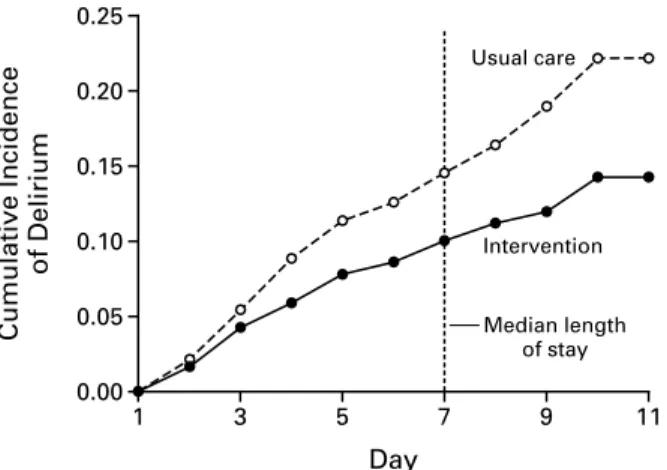
The cumulative incidence of delirium was
signifi-cantly lower in the intervention group than in the
usual-care group (Fig. 1).
The total number of days of delirium was
signifi-cantly lower in the intervention group than in the
*All analyses were based on the intention-to-treat strategy. OR denotes odds ratio, and CI confidence interval.†This analysis was conducted with conditional logistic-regression models appropriate for matched analyses; 88 discord-ant pairs were used.
‡This analysis was conducted with unmatched logistic-regression analysis, with control for matching factors. §For total days of delirium, the mean (±SE) value per patient was 0.25±0.05 in the intervention group and 0.38±0.06 in the usual-care group. The mean within-pair difference was 0.13±0.08 fewer day in the intervention group.
¶For this matched analysis, the sign test was applied on within-pair differences.
¿For the number of episodes of delirium, the mean (±SE) value per patient was 0.15±0.03 in the intervention group and 0.21±0.03 in the usual-care group. The mean within-pair difference was 0.07±0.04 fewer episode in the intervention group.
**The delirium-severity score ranged from 0 to 7 according to the presence and severity of four symptoms of delirium; higher scores indicate increased severity. This unmatched comparison was conducted with the t-test.
††This unmatched comparison was conducted with the chi-square test.
TABLE 3. DELIRIUM-RELATED OUTCOMESDURING HOSPITALIZATION, ACCORDINGTO STUDY GROUP.*
OUTCOME STUDY GROUP STATISTICAL ANALYSIS
INTERVENTION USUALCARE MATCHED UNMATCHED
All matched patients (n=852) First episode of delirium — no. of
patients (%) Total days of delirium§ No. of episodes of delirium¿
42 (9.9)
105 62
64 (15.0)
161 90
OR, 0.60 (95% CI, 0.39–0.92); P=0.02†
P=0.02¶ P=0.03¶
OR, 0.61 (95% CI, 0.40–0.93); P=0.02‡
Patients with delirium (n=106) Mean ±SD delirium-severity score Recurrence (two or more episodes)
— no. of patients (%)
3.85±1.27 13 (31.0)
3.52±1.44 17 (26.6)
The New Eng land Jour nal of Medicine
group that received usual care (105 vs. 161 days,
P=0.02) (Table 3). The total number of episodes of
delirium was also significantly lower in the
interven-tion group (62 episodes, vs. 90 in the usual-care
group; P=0.03); however, this effect appeared to
re-sult primarily from the effects of the intervention on
the first episode of delirium rather than on recurrent
episodes. Among cases of delirium, severity scores
and rates of recurrence did not differ significantly
between the two study groups.
In matched-subgroup analyses, the intervention
significantly reduced the rate of incidence of
deliri-um in the group at intermediate risk for delirideliri-um at
base line (odds ratio, 0.52; 95 percent confidence
interval, 0.29 to 0.92). In the group at high risk for
delirium at base line, the intervention was associated
with a reduction in incidence (odds ratio, 0.73; 95
percent confidence interval, 0.38 to 1.38), but the
reduction was not statistically significant.
Level of Adherence
The overall rate of adherence (complete and
par-tial adherence) to all the intervention protocols was
87 percent (8716 of 10,056 patient-days). The
over-all adherence rates for the individual protocols were
96 percent for the orientation protocol (2443 of
2534 patient-days), 92 percent for the vision
proto-col (487 of 531 patient-days), 92 percent for the
hearing protocol (514 of 561 patient-days), 86
per-cent for therapeutic activities (2188 of 2542
pa-tient-days), 84 percent for early mobilization (2054
of 2452 patient-days), 81 percent for volume
reple-tion (68 of 84 patient-days), and 71 percent for the
nonpharmacologic sleep protocol (962 of 1352
pa-tient-days). The most common reasons for
nonad-herence included refusal by the patient, lack of
avail-ability of the patient because of procedures elsewhere
in the hospital, medical contraindications, and lack
of availability of intervention staff members. No
ad-verse effects were associated with the intervention
protocols.
Effect on Targeted Risk Factors
The change in risk factors or targeted outcomes at
the reassessment on day 5 or at discharge is shown
in Table 4. At reassessment, there was significant
im-provement in the orientation score and a significant
reduction in the rate of use of sedative drugs for
sleep in the intervention group as compared with
the usual-care group. The Activities of Daily Living
score and the score on the Whisper Test
demonstrat-ed trends toward improvement in the intervention
group. Receipt of early vision correction was also
as-sociated with a trend toward improvement in this
group. Overall, there were significantly fewer risk
factors present in the intervention group than in the
usual-care group at reassessment.
Cost of Intervention
The total cost of the intervention, including staff
time spent in intervention activities, equipment,
sup-plies, and consultant costs, was $139,506, or an
av-erage of $327 per patient in the intervention group.
The cost of intervention per case of delirium
pre-vented was $6,341 ($139,506 for 22 cases
prevent-ed [64 cases of delirium occurrprevent-ed in patients
receiv-ing usual care, as compared with 42 cases in those
receiving the intervention]).
DISCUSSION
This controlled clinical trial provides evidence that
a multicomponent, targeted intervention strategy,
the Elder Life Program, is effective for the
preven-tion of delirium in hospitalized older medical
pa-tients. The intervention prevented the initial
devel-opment of delirium and reduced the total number
of days of delirium. It was most effective in patients
who were at intermediate risk for delirium at base
line. Once an initial episode of delirium had
oc-curred, however, the intervention had no significant
effect on the severity of delirium or on the
likeli-hood of recurrence. This finding has an important
implication for the treatment of delirium: primary
prevention is probably the most effective strategy.
Once delirium has occurred, our intervention
strat-egy will be less effective and less efficient.
The strengths of this study include the daily
as-sessment of patients for delirium with a
standard-ized, validated instrument; the completeness of the
Figure 1. Cumulative Incidence of Delirium According to Study Group.
The cumulative incidence of delirium was defined as the prob-ability of the development of delirium by a specified time. Data on patients were censored at the time of discharge or death. The difference between the groups was significant (chi-square= 4.77; P=0.03 by the log-rank test). Kaplan–Meier estimates of the incidence of delirium at the median length of the hospital stay (seven days, indicated by the dotted line) were 0.100 for the intervention group and 0.145 for the usual-care group.
0.00 0.25
1 11
0.05 0.10 0.15 0.20
3 5 7 9
Day
Intervention
Median length of stay Usual care
Cumulative Incidence
A M U LT I C O M P O N E N T I N T E RV E N T I O N TO P R EV E N T D E L I R I U M I N H O S P I TA L I Z E D O L D E R PAT I E N T S
outcome data, with no losses to follow-up; the
tar-geting of at-risk patients for intervention, an
ap-proach that maximizes the efficiency and clinical
rel-evance of the intervention; and the detailed tracking
of adherence to the intervention protocols.
More-over, the practical, realistic nature of the
interven-tion protocols, designed to target well-documented
risk factors for delirium, enhances their feasibility
and the extent to which they can be applied in other
settings.
These findings lend strong support to the use of
a multicomponent intervention to prevent delirium.
The positive trends in the reduction of risk factors
at the time of reassessment validate the effectiveness
of each intervention protocol. The significant
reduc-tion in the total number of risk factors with
inter-vention as compared with usual care suggests that
risk-factor reduction contributed at least in part to
the effectiveness of the intervention strategy.
Several important limitations of this study deserve
comment. Logistic constraints precluded random
as-signment of the patients to the two treatment groups.
However, the prospective, individual-matching
strat-egy allowed balanced assignment of the patients to
the two groups. Furthermore, a contamination
ef-fect in the usual-care group probably decreased the
overall rates of delirium. Contamination was evident
in the rates of delirium, which were substantially
lower than anticipated on the basis of earlier studies
in the same study population,
24,25and it was also
ev-ident in the substantial reduction in risk factors that
occurred in the usual-care group. Although efforts
were made to avoid contamination, some
interven-tion protocols were disseminated by word of mouth
to staff members in usucare units. Moreover,
al-though the intervention strategies most often
in-volved the nursing staff, the physicians rotated on all
hospital floors and carried over some intervention
protocols to the usual-care group. Despite these
con-tamination effects, which would have tended to bias
the results toward the null hypothesis, the significant
overall results substantiate the robustness of the
ef-fects of the intervention.
The estimated cost of $6,341 per case of delirium
prevented compares favorably with the estimated
costs in other studies of $7,727 to $11,834 (in 1996
dollars) per fall prevented
43and $19,800 to $42,900
(in 1993 dollars) per myocardial infarction
prevent-ed.
44Although a formal cost-effectiveness analysis was
beyond the scope of this study, a complete analysis
of health care costs related to delirium may
demon-strate that the intervention yields a net savings.
This trial holds substantial promise for the
pre-vention of delirium in hospitalized older patients.
Further evaluation is needed to determine the cost
effectiveness of the intervention; its effects on
relat-ed outcomes, such as mortality, rehospitalization,
institutionalization, use of home health care, and
long-term cognitive functioning; and its
effective-ness in other settings.
Supported in part by grants from the National Institute on Aging (R01 AG12551), the Commonwealth Fund (95-47 and 94-90), the Retirement Research Foundation (94-71), the Community Foundation for Greater New Haven (940862/SF, 950775/SF, 961081/SF, and 970342/SF), and the Patrick and Catherine Weldon Donaghue Medical Research Founda-tion (DF98-105).
*Plus–minus values are means ±SD. These results are based on un-matched analyses. All the adjusted scores were calculated at reassessment (on day 5 or at discharge, if earlier). These scores were calculated as least-squares means with use of analysis of covariance with adjustment for the base-line score. Targeted risk factors were defined as follows: cognitive im-pairment, orientation score of <8; immobility, Activities of Daily Living score of «12; visual impairment, visual acuity of <20/70 on binocular near-vision testing; hearing impairment, score of «6 on the Whisper Test; and dehydration, ratio of blood urea nitrogen to creatinine of »18.
TABLE 4. CHANGEIN RISK FACTORSOR TARGETED OUTCOMES AT REASSESSMENT, ACCORDINGTO STUDY GROUP.*
RISK FACTOR INTERVENTION
USUAL
CARE
P VALUE
Cognitive impairment No. (%) of patients assessed
Improved by 2 points Same
Worse by 2 points Adjusted orientation score at
reassessment
128 51 (40) 76 (59) 1 (1) 7.2±0.2
125 33 (26) 88 (70) 4 (3) 6.8±0.2
0.04
0.06
Sleep deprivation
No. (%) of patients assessed Use of sedative drug for sleep
during hospital stay
426 148 (35)
426
195 (46) 0.001
Immobility
No. (%) of patients assessed Improved by 2 points Same
Worse by 2 points
Adjusted Activities of Daily Living score at reassessment
96 6 (6) 68 (71) 22 (23) 9.7±0.3
98 13 (13) 54 (55) 31 (32) 9.3±0.3
0.06
0.34
Vision impairment
No. (%) of patients assessed Early vision correction
57 21 (37)
62
17 (27) 0.27
Hearing impairment No. (%) of patients assessed
Improved by 1 point Same
Worse by 1 point
Adjusted Whisper Test score at reassessment
120 61 (51) 37 (31) 22 (18) 5.3±0.3
98 39 (40) 44 (45) 15 (15) 4.5±0.4
0.10
0.09
Dehydration
No. (%) of patients assessed Improved by 5 points Same
Worse by 5 points Adjusted ratio of blood urea
nitrogen to creatinine at reassessment
240 107 (45) 110 (46) 23 (9) 20.7±0.5
254 98 (39) 127 (50) 29 (11) 20.7±0.5
0.40
0.22
Total no. of risk factors No. (%) of patients assessed
Improved (fewer risk factors) Same
Worse (more risk factors) Adjusted no. of risk factors per
patient at reassessment
426 272 (64) 110 (26) 44 (10) 1.7±0.1
426 236 (55) 124 (29) 66 (15) 1.9±0.1
0.02
The New Eng land Jour nal of Medicine
We are indebted to the patients, families, nurses, and volunteers at Yale–New Haven Hospital who participated in the study; to the Project Recovery research staff (Annette Hopkins, Andrea Ben-jamin, Jean Bonyai, Wanda Carr, Sandra Ginter, Geraldine Haw-thorne, Bernie Hebert, Lynne Iannone, Linda Johnson, Alice Kos-sack, Nancy Votto, Alice Van Wie, and Karen Wu); to the Elder Life Program intervention and development staff (Leslie Hurst, Jane McDowell, Dana Kalina, Diane Carroll, Kurt Acker, Sandra Al-fano, Steve Allegretto, Richard Beattie, Lynn Chapman-Adler, Bea Clary, Eileen Coppola, Pam Corbett, Howard Goldberg, Jean Gra-nata, Derek Heard, Jeannette Hodge, Stephanie Johnson, Joanne Lamb, Steven Leder, Dixie Losey, Courtney Lyder, Thomas Lydon, Lisa Mastroianni, Denna Niedzwiecki, Sally Palumbo, Michael Pa-risi, Valentine Pascale, Meg Pechar, Janet Shen, and Stephen Zink); to the Elder Life Program Community Advisory Board (Patricia Anderson, Dorothy Baker, Edith Berrios, Edward Dobihal, Mar-garet Edgerly, Dorothy Giannini-Meyers, Thomas Hardin, Carla Hayes, William Heinrichs, Cynthia Matthews, Paula Milone-Nuz-zo, Robert Morgan, Cheryl Pierson, Judy Rolnick, Sam Slie, Agnes Timpson, Hattie Turner, and Edith Wilson); to the Elder Life Pro-gram Executive Committee (Dr. Edwin Cadman, Brian Condon, Donna Ukanowicz, and Laura Walsh); to the executive committee for the research project (Drs. Ralph Horwitz, Lorraine Mion, Robert Makuch, and Mary Tinetti); to Dr. Emily Richardson for adjudica-tion of delirium outcomes; to Dr. Richard Marottoli, Dr. Mary Tinetti, and Christianna Williams for helpful review of the manu-script; and especially to Robbin Bonanno and Stephen Helfand.
REFERENCES
1.Inouye SK. The dilemma of delirium: clinical and research controversies regarding diagnosis and evaluation of delirium in hospitalized elderly med-ical patients. Am J Med 1994;97:278-88.
2.Rummans TA, Evans JM, Krahn LE, Fleming KC. Delirium in elderly patients: evaluation and management. Mayo Clin Proc 1995;70:989-98. 3.Francis J, Kapoor WN. Delirium in hospitalized elderly. J Gen Intern Med 1990;5:65-79.
4.The Administration on Aging. A profile of older Americans. Washing-ton, D.C.: American Association of Retired Persons, 1995.
5.Statistical abstract of the United States. Washington, D.C.: Bureau of the Census, 1996:116.
6.Inouye SK, Rushing JT, Foreman MD, Palmer RM, Pompei P. Does de-lirium contribute to poor hospital outcomes? A three-site epidemiologic study. J Gen Intern Med 1998;13:234-42.
7.Cole MG, Primeau FJ. Prognosis of delirium in elderly hospital patients. CMAJ 1993;149:41-6.
8.Hobbs FB, Damon BL. Special studies, 65+ in the United States. Cur-rent population reports. Series P23. No. 190. Washington, D.C.: Bureau of the Census, 1996.
9.Hogan DB, Fox RA, Gadley BWD, Mann OE. Effect of a geriatric con-sultation service on management of patients in an acute care hospital. CMAJ 1984;136:713-7.
10.Cole MG, Fenton FR, Englesmann F, Mansouri I. Effectiveness of geriatric psychiatry consultation in an acute care hospital: a randomized clinical trial. J Am Geriatr Soc 1991;39:1183-8.
11.Layne OL Jr, Yudofsky SC. Postoperative psychosis in cardiotomy pa-tients: the role of organic and psychiatric factors. N Engl J Med 1971;284: 518-20.
12.Schindler JA, Shook J, Schwartz GM. Beneficial effects of psychiatric intervention on recovery after coronary artery bypass graft surgery. Gen Hosp Psychiatry 1989;11:358-64.
13.Cole MG, Primeau FJ, Bailey RF, et al. Systematic intervention for elderly inpatients with delirium: a randomized trial. CMAJ 1994;151:965-70.
14.Rubenstein LZ, Josephson KR, Wieland GD, English PA, Sayre JA, Kane RL. Effectiveness of a geriatric evaluation unit: a randomized clinical trial. N Engl J Med 1984;311:1664-70.
15.Wanich CK, Sullivan-Marx EM, Gottlieb GL, Johnson JC. Functional status outcomes of a nursing intervention in hospitalized elderly. Image J Nurs Sch 1992;24:201-7.
16.Nagley SJ. Predicting and preventing confusion in your patients. J Gerontol Nurs 1986;12:27-31.
17.Williams MA, Campbell EB, Raynor WJ, Mlynarczyk SM, Ward SE. Reducing acute confusional states in elderly patients with hip fractures. Res Nurs Health 1985;8:329-37.
18.Budd S, Brown W. Effect of a reorientation technique on postcardiot-omy delirium. Nurs Res 1974;23:341-8.
19.Owens JF, Hutelmyer CM. The effect of preoperative intervention on delirium in cardiac surgical patients. Nurs Res 1982;31:60-2.
20.Chatham MA. The effect of family involvement on patients’ manifes-tations of postcardiotomy psychosis. Heart Lung 1978;7:995-9. 21.Riis J, Lomholt B, Haxholdt O, et al. Immediate and long-term men-tal recovery from general versus epidural anesthesia in elderly patients. Acta Anaesthesiol Scand 1983;27:44-9.
22.Williams-Russo P, Urquhart RN, Sharrock NE, Charlson ME. Post-operative delirium: predictors and prognosis in elderly orthopedic patients. J Am Geriatr Soc 1992;40:759-67.
23.Gustafson Y, Brannstrom B, Berggren D, et al. A geriatric-anesthesio-logic program to reduce acute confusional states in elderly patients treated for femoral neck fractures. J Am Geriatr Soc 1991;39:655-62.
24.Inouye SK, Charpentier PA. Precipitating factors for delirium in hos-pitalized elderly persons: predictive model and interrelationship with base-line vulnerability. JAMA 1996;275:852-7.
25.Inouye SK, Viscoli CM, Horwitz RI, Hurst LD, Tinetti ME. A pre-dictive model for delirium in hospitalized elderly medical patients based on admission characteristics. Ann Intern Med 1993;119:474-81.
26.Makuch RW, Zhang Z, Charpentier PA, Inouye SK. Prospective indi-vidual matching: covariate balance and power in a comparative study. Stat Med 1998;17:1517-26.
27.Charpentier PA, Inouye SK. Prospective individualized matching in a non-randomized geriatric intervention trial. Gerontologist 1995;35(Spe-cial Issue I):181.
28.Elie M, Cole MG, Primeau FJ, Bellavance F. Delirium risk factors in elderly hospitalized patients. J Gen Intern Med 1998;13:204-12. 29.Folstein MF, Folstein SE, McHugh PR. “Mini–Mental State”: a prac-tical method for grading the cognitive state of patients for the clinician. J Psychiatr Res 1975;12:189-98.
30.Cummings JL. Clinical neuropsychiatry. Orlando, Fla.: Grune & Strat-ton, 1985:9.
31.Inouye SK, van Dyck CH, Alessi CA, Balkin S, Siegal AP, Horwitz RI. Clarifying confusion: the Confusion Assessment Method: a new method for detection of delirium. Ann Intern Med 1990;113:941-8.
32.Katz S, Ford AB, Moskowitz RW, Jackson BA, Jaffe MW. Studies of illness in the aged: the index of ADL, a standardized measure of biological and psychosocial function. JAMA 1963;185:914-9.
33.Knaus WA, Draper EA, Wagner DP, Zimmerman JE. APACHE II: a severity of disease classification system. Crit Care Med 1985;13:818-29. 34.Lawton MP, Brody EM. Assessment of older people: self-maintaining and instrumental activities of daily living. Gerontologist 1969;9:179-86. 35.MacPhee GJ, Crowther JA, McAlpine CH. A simple screening test for hearing impairment in elderly patients. Age Ageing 1988;17:347-51. 36.Blessed G, Tomlinson BE, Roth M. The association between quanti-tative measures of dementia and of senile change in the cerebral grey mat-ter of elderly subjects. Br J Psychiatry 1968;114:797-811.
37.Uhlmann RF, Larson EB, Buchner DM. Correlations of Mini–Mental State and modified Dementia Rating Scale to measures of transitional health status in dementia. J Gerontol 1987;42:33-6.
38.Beresin EV. Delirium in the elderly. J Geriatr Psychiatry Neurol 1988; 1:127-43.
39.Holford TR, Bracken MB, Eskenazi B. Log-linear models for the analysis of matched cohort studies. Am J Epidemiol 1989;130:1247-53. 40.Greenland S. Modeling and variable selection in epidemiologic analy-sis. Am J Public Health 1989;79:340-9.
41.Mickey RM, Greenland S. The impact of confounder selection criteria on effect estimation. Am J Epidemiol 1989;129:125-37. [Erratum, Am J Epidemiol 1989;130:1066.]
42.Lynn HS, McCulloch CE. When does it pay to break the matches for analysis of a matched-pairs design? Biometrics 1992;48:397-409. 43.Rizzo JA, Baker DI, McAvay G, Tinetti ME. The cost-effectiveness of a multifactorial targeted prevention program for falls among community elderly persons. Med Care 1996;34:954-69.