This is the peer reviewed version of the following article: Lafuente, E., Vaillant, Y., Vendrell-Herrero, F. and Gomes, E. (forthcoming). Bouncing back from failure:
Entrepreneurial resilience and the internationalization of subsequent ventures created by serial entrepreneurs, Applied Psychology: An International Review, which has been published at https://doi.org/10.1111/apps.12175. This article may be used for non-commercial purposes in accordance with Wiley Terms and Conditions for Use of Self-Archived Versions
0
Bouncing back from failure: Entrepreneurial resilience and the
internationalization of subsequent ventures created by serial entrepreneurs
Esteban Lafuente
Department of Management, Universitat Politècnica de Catalunya (Barcelona Tech) EPSEB, Av. Gregorio Marañón, 44-50, E-08028 Barcelona, Spain
Email: [email protected] Yancy Vaillant
Department of Strategy and Entrepreneurship. Toulouse Business School (TBS) 1 Place Alphonse Jourdain, 31068 TOULOUSE Cedex 7, France
Email: [email protected] Ferran Vendrell-Herrero
Birmingham Business School, University of Birmingham Edgbaston, B15 2TT, Birmingham, UK
Email: [email protected] Emanuel Gomes
Nova School of Business and Economics, Universidade Nova, Campus de Campolide 1099-032 Lisbon, Portugal
Email:[email protected]
Abstract:
This paper examines the impact over international propensity of past negative entrepreneurial experience for those who re-enter into entrepreneurial activity; referred to as resilient serial entrepreneurs. We first hypothesize on the effects over entrepreneurial re-entry that such negative past experience may have and highlight the link between the past entrepreneurial experience of resilient entrepreneurs and their subsequent propensity towards international markets. Building on insights from the generative experiential learning process of entrepreneurial activity and from cognition theories, we propose that resilient entrepreneurs who re-enter business despite having faced negative entrepreneurial experiences in the past benefit from enriched cognitive schemas leading them to greater export propensity. The proposed hypotheses are tested on a unique sample drawn from a Spanish adult population survey. Results from the sequential deductive triangulation
1 analysis (QUAN à qual) reveal that practical experience is an essential prerequisite for
entrepreneurial learning, and that the resilience of those with negative entrepreneurial experience induces the generative entrepreneurial learning especially suitable for subsequent internationally oriented ventures.
Keywords: Entrepreneurial experience, resilience, serial entrepreneurs, cognitive theory, internationalization, Spain.
JEL classification: L26, M13, M2
Acknowledgements: Esteban Lafuente acknowledges financial support from the Spanish Ministry of Economy, Industry and Competitiveness (grant number: ECO2017-86305-C4-2-R). Ferran Vendrell-Herrero received financial support from the Spanish Ministry of Science and Innovation (Grant: ECO2014-58472-R) and from the European Union (Horizon 2020 Marie Skłodowska-Curie Actions Project MAKERS: Smart Manufacturing for EU Growth and Prosperity – Grant: 691192). Emanuel Gomes would like to acknowledge financial support from Fundação para a Ciência e Tecnologia (UID/ECO/00124/2013) and Social Sciences Data Lab (LISBOA-01-0145- FEDER007722 and Project 22209).
2 1. Introduction
According to several studies into the influence of entrepreneurial experience on
performance, serial entrepreneurs potentially run ever more successful businesses over time (Audia, Locke, & Smith, 2000; Baron, 1998; McGrath, 1999). This is so becausethe capabilities and know-how necessary to run a business have a predominantly experiential nature (Simmons, Carr, Hsu, & Shu, 2016). These entrepreneurs, who sequentially pass from one business venture to another, representing between a third and one half of the entrepreneurially active population (Sarasvathy, Menon, & Kuechle, 2013; Ucbasaran, Westhead, Wright, & Flores, 2010), have gained experience that allows them to learn and better confront future entrepreneurial situations, even those that may be new to the entrepreneur (Cope, 2005).
This generative process of experiential learning is gained as much from successful past experiences as from those that may be perceived as failure. We understand resiliency as “the capacity to rebound or bounce back from adversity, conflict, failure, or even positive events, progress, and increased responsibility” (Luthans, 2002, p. 702). Therefore, those resilient serial entrepreneurs who are able to bounce back from past negative entrepreneurial experiences are potentially better with their subsequent ventures
(
Cartwright & Cooper, 2009). Serial entrepreneurs have been found to have superior subsequent performances in terms of employment (van Praag & Cramer, 2001), economic value (Parker, 2013), opportunity recognition (Ucbasaran, Westhead, & Wright, 2009), creativity (Weinberger, Wach, Stephan, & Wegge, 2018),
and innovativeness (Mooradian, Matzler, Uzelac, & Bauer, 2016; Ucbasaran et al., 2010); but the importance of past entrepreneurial experience for the international orientation of subsequent ventures has yet to be fully addressed, and particularly for those resilient serial entrepreneurs with negative past entrepreneurial experience. International entrepreneurial venturing is considered as an act to3 discover, evaluate, and exploit opportunities in global markets in order to present new and
innovative products or services (Oviatt & McDougall, 2005). The role of opportunity recognition and how entrepreneurs exploit these opportunities to innovate new means/ends is crucial for the success of these ventures.
Linking international orientation and resilient serial entrepreneurship is important, since experiential learning has been identified as being key to both of these entrepreneurial processes (Politis, 2008). In both of these processes, what an entrepreneur learns in one period is found to build upon what was learnt in previous periods to shape the ‘stock’ of knowledge that will guide future entrepreneurial/international behavior (Minniti & Bygrave, 2001). This generative learning is what enables serial entrepreneurs to ‘abstract and generalize across contexts, to recognize patterns and build relationships between different situations and events’ (Cope, 2005, p. 386). Research on resilience in entrepreneurial contexts is important because it can help understand how entrepreneurs operating in adverse circumstances can develop international flexibility, ambidexterity,
technological capabilities and other entrepreneurial competencies (Bullough, Renko, & Myatt, 2014;Bustinza, Vendrell-Herrero, Perez-Arostegui, & Parry, 2016; Junni, Sarala, Taras, & Tarba, 2013), as well as mental and emotional competences (Stephan, 2018;
Weinberger et al., 2018)
like hope, optimism, and confidence (Luthans et al., 2006, 2007), that help them bounce back from failure (Jenkins, Wiklund, & Brundin, 2014; Simmons et al., 2016). Most studies assume a
homogeneous effect of previous entrepreneurial experience on future business creation where the details and specific outcomes of such past experience are not considered, but rather all
entrepreneurial experience is assumed to lead to the same impact (Birley & Westhead, 1993; Kolvereid, Shane, Starr, Westhead., & Bullvag, 1991; Schollhammer, 1991; Westhead & Wright, 1998). Yet, the negative outcome of past entrepreneurial ventures may affect not only the potential for entrepreneurial re-entry (Shepherd, Wiklund & Haynie, 2009), but also future international orientation. There is unclear evidence of the true benefits associated with entrepreneurial experience when it comes to internationalization and whether the resilience of those having suffered past
4 negative experiences could affect their ability to carry over what was learnt to subsequent ventures. Luthan et al. (2007) suggest that less self-efficacious (confident) individuals are more prone to despair when faced with negative setbacks and obstacles than those possessing psychological competences like optimism, confidence, hope and resilience. The literature is not clear whether resilient entrepreneurs who persist with their entrepreneurial activity despite negative past business experience subsequently own firms that are less/more internationally oriented.
The study presented in this paper looks into the role of past entrepreneurial experience on the internationalization of serial entrepreneurs’ subsequent ventures for those resilient entrepreneurs who have had to overcome negative past entrepreneurial experience. In doing so we answer the call made by Cope (2005) for the study of serial entrepreneurs’ subsequent ventures through a
generative entrepreneurial learning lens, as well as that of Ucbasaran, Westhead and Wright (2008) and Gorgievski and Stephan (2016) for more research on the performance of serial entrepreneurs that emphasizes the role of the entrepreneurs rather than the firm. We also add to the understanding of the psychological aspects of resilient serial entrepreneurs by analyzing the entrepreneurial
learning and decision-making process through sequential deductive triangulation methods (Morse & Niehaus, 2009).
We aim to uncover whether resilient serial entrepreneurs are able to benefit from the
generative process of experiential entrepreneurial learning, producing new organizations that will be better able to be international. In this vein, our research objective is to determine whether resilient serial entrepreneurs are better able to learn and bounce back from past negative experiences so that their subsequent ventures outperform those of novice entrepreneurs in terms of international orientation.
The importance of this study stretches beyond a purely academic discussion and has implications for policy making within the area of business and economic development. Appropriate policy depends on the likeliness for serial entrepreneurs to improve. Thus, if serial entrepreneurs learn from their venturing experiences and/or acquire valuable knowledge from them, they may
5 perform better, on average, in subsequent ventures (Parker, 2013). If subsequent ventures do build upon prior entrepreneurial experiences, calls for policy to encourage entrepreneurial resilience, re-entries and further internationalization efforts by resilient entrepreneurs may be warranted, irrespective of the performance of their previous ventures.
2. Theoretical underpinning and hypotheses development
Individuals who repeat as entrepreneurs, exiting one venture before entering into a subsequent one, are referred to as serial entrepreneurs (Wright, Robbie, & Ennew, 1997). Serial entrepreneurs are relatively common. They represent a proportion of business owners that range from up to 52% in the UK (Westhead & Wright, 2015), to 51-63% in the US (Schollhammer, 1991), 49% in Australia (Taylor, 1999), and 34% in Norway (Kolvereid & Bullvag, 1993) (as compiled by Uscasaran, Westhead, & Wright, 2006, p.1). There is growing evidence of the
economic contribution of serial entrepreneurs (Westhead, Ucbasaran, & Wright, 2003; Ucbasaran et al. 2006, 2008; Sarasvathy et al., 2013). It has been found that individuals with past entrepreneurial experience are more likely to re-enter into business (Amaral, Baptista, & Lima, 2011; Spivack, McKelvie, & Haynie, 2014; Stam, Audretsch, & Meijaard, 2008) and when they do so tend to have subsequent firms that improve on the performance of their past ventures (Alsos & Carter 2006; Gompers, Kovner, Lerner, & Scharfsteina, 2010; Toft-Kehler, Wennberg, & Kim, 2014; Westhead et al., 2003). According to Luthans et al. (2007) self-efficacy (confidence) enhances cognitive processes through mastery experiences derived from successive ventures. Parker (2013) concluded that venturing of serial entrepreneurs generates learning and economic benefits which spill over from one venture into subsequent ones. Similarly, Toft-Kehler et al. (2014) find a compounded relation between past entrepreneurial experience and entrepreneurial earnings.
An entrepreneur’s perception of new situations is linked to distinct aspects of their own personality, e.g. motivations, traits, identities, and skills (Stephan & Drencheva, 2017) prior
6 (2005) the interaction between the past and the future that stimulates intention, entrepreneurial resilience and further action lies in the generative process of entrepreneurial learning (Junni et al., 2013). Generative learning is described as ‘the ability to extrapolate and bring forward one’s learning from critical events to new situations, incidents and experiences’ (Cope, 2005, p. 386). Entrepreneurial learning is primarily experiential (Keith, Unger, Rauch, & Frese, 2016; Politis, 2008) and what an entrepreneur learns builds upon what was previously learnt to shape the ‘stock’ of knowledge and action that will guide future entrepreneurial behavior (Minniti & Bygrave, 2001). Generative learning is what enables serial entrepreneurs to ‘abstract and generalize across contexts, to recognize patterns and build relationships between different situations and events’ (Cope, 2005, p. 386).
The higher-order learning created through generative processes allows serial entrepreneurs to reach greater outcomes and levels of effectiveness, and can do so across a broader range of new situations (Cope, 2005; Keith et al., 2016). The relatedness of events makes serial entrepreneurs better able to understand and deal with current challenges. This generative entrepreneurial learning is comparable to building a greater reference frame leading serial entrepreneurs to form a cognitive schema that enables them to better comprehend and manage future entrepreneurial experiences (Huber, 1991; Cope, 2005). Individuals with past entrepreneurial experience are therefore better equipped to re-enter into entrepreneurial activity as compared to those without such experience. Positive past entrepreneurial experiences have been found to be conducive to further re-entry into self-employment (Amaral et al. 2011; Stam et al. 2008; Ucbasaran, Wright, & Westhead, 2003; Ucbasaran et al., 2006; Westhead et al. 2003). However, there is an intense debate regarding the consequences of negative previous business outcomes (Liu, Wang & Lü, 2013). While some scholars view failure as a learning opportunity (McGrath 1999), others have argued that it may be difficult to learn from business failure (Shepherd 2003). Ucbasaran et al. (2010) suggest that both views have some validity. Experience of business failure offers opportunities for learning but, according to these authors, only under certain conditions (Carmeli & Markman, 2011; Carmeli,
7 Friedman, & Tishler, 2013; Carmeli, Yitzhak-Halevy, & Weisberg, 2009). The more the negative entrepreneurial experience is appraised as stressful in terms of its implications for harm or loss, the greater the feeling of grief may impede lessons to be learnt from failure (Carmeli & Gittell, 2009; Jenkins et al. 2014). Failure is not a desirable outcome when it comes to entrepreneurial activity and in many cases can be painful and costly (Coelho and McClure 2005), having a negative impact on the entrepreneur’s confidence, self-efficacy and risk-taking propensity. A negative past venturing experience can be a distressing event that generates negative emotions which interferes with entrepreneurial audacity. This seems to be particularly the case when entrepreneurs take a
pessimistic stance and internalize negative events and attribute them to permanent events (Luthans and Youssef, 2007). Failure has a large impact on the stigmatization of the entrepreneur and entrepreneurship within the local area, as well as on the individual entrepreneur’s view of
themselves following failure (Williams & Shepherd, 2016). Despite the cognitive gains from past entrepreneurial experience, negative past experience may have affective consequences that deter individuals with such experience to re-enter into an entrepreneurial career. It is therefore
hypothesized that:
H1: The probability to re-enter into entrepreneurial activity is lower among serial entrepreneurs
with negative past entrepreneurial experience
A serial entrepreneur’s cognitive schemas resulting from the generative learning of entrepreneurial experience play a central role in their subsequent entrepreneurial process (Baron, 2004; Baron & Ensley, 2006). Cognitive schemas are the content and organization of knowledge, which develop as a consequence of an individual’s cumulative experience and learning (Mitchell, Busenitz, Lant, McDougall, Morse, & Smith, 2004; Ucbasaran et al., 2009). Such schemas play a crucial role in pattern recognition (Krueger, 2003; Baron & Ensley, 2006), which contributes to opportunity identification abilities (Gaglio, 2004). Serial entrepreneurs are known to develop cognitive schemas that facilitate abstract representation and the retrieval of relevant information
8 (Baron & Ward, 2004; Simmons et al., 2016). In fact, the cognitive schemas of serial entrepreneurs were found to be more clearly concerned with factors and conditions related to successfully running a new venture (Baron & Ensley, 2006). Baron (2004) sees that serial entrepreneurs, as a result of their prior entrepreneurial experience, do not face the same cognitive biases that hamper the entrepreneurial performance of novice entrepreneurs. Therefore, because of their particular cognitive schemas resulting from the generative process of experiential entrepreneurial learning, serial entrepreneurs are able to identify not only more opportunities but also better opportunities (Ucbasaran et al., 2009). As opposed to inexperienced entrepreneurs, serial entrepreneurs are better able to ‘connect the dots’ between seemingly unrelated changes or events and detect meaningful patterns (Baron & Ensley, 2006).
Empirically, the cognitive schemas developed from the generative process of
entrepreneurial learning have been found to exert a positive effect upon different types of skills that are critical for greater venturing capacity, and therefore better entrepreneurial outcomes (Van Gelderen & Jansen, 2006). Past entrepreneurship has been shown to increase survival rates by influencing expectations and strengthening the perception of preparedness (Headd, 2003; Simmons et al., 2016). Therefore, entrepreneurs with previous entrepreneurial experience will do better than those without such experience (Alsos & Kolvereid, 1998). Richer entrepreneurial cognitive schemas as a result of the generative learning of serial entrepreneurs have been found to determine superior subsequent performance in terms of employment (van Praag & Cramer, 2001), economic value (Parker, 2013), opportunity recognition (Simmons et al., 2016; Ucbasaran et al., 2009), and innovativeness (Ucbasaran et al., 2010).
Nevertheless, the importance of past entrepreneurial experience for serial entrepreneurs’ subsequent international orientation has yet to be addressed. The generative learning process of entrepreneurial experience indicates that serial entrepreneurs may reach better business outcomes when measured in terms of international orientation. International opportunity recognition is related to pattern recognition which, in the case of serial entrepreneurs who have gained pattern recognition
9 abilities through their entrepreneurial experience, helps explain why they may be better able to recognize international opportunities and are therefore more likely to internationalize as compared to novice entrepreneurs with no prior experience (Baron & Ensley, 2006). The knowledge and skills required to run an internationally oriented firm has a predominantly experiential nature (Sarasvathy et al., 2013). The persons who recognize specific opportunities are able to do so because they possess relevant cognitive schemas that help them accomplish such tasks. These frameworks enable them to perceive the emergent patterns that underlie many international opportunities (Baron & Ensley, 2006). Past entrepreneurial experience therefore influences an individual’s cognitive schemas in a way that is important for the decision to internationalize.
Prior experience, especially if distressing, may shape the way in which current challenges are framed (Bullough et al., 2014; Jenkins et al., 2014; Keith et al., 2016). Therefore, the question rises whether negative past entrepreneurial experience shape the outcome of subsequent ventures promoted by resilient serial entrepreneurs that have been able to rebound from failure (Ucbasaran et al., 2009; Ward, 2004). Resilient individuals seem to have a high degree of optimism which enables them to overcome self-doubt and negative expectancies and “build positive expectancies that motivate their goal pursuit and approach coping behavior in the future” (Luthans and Youssef, 2007: 331).When it comes to business opportunity identification, for those resilient entrepreneurs who are able to surpass the affective impact of negative past entrepreneurial experience, business failure may encourage learning without dampening motivation (Ucbasaran et al., 2009). In some cases, it may be conducive to serial entrepreneurial resilience capabilities (Bullough et al., 2014; Kossek, & Perrigino, 2016) required to successfully bounce back from failure (Jenkins et al., 2014; Simmon et al., 2016). Resilience capability is the capacity ‘to dynamically reinvent business models and strategies as circumstances change’ (Tarba, Cooper, Ahammad, Khan, & Rao-Nickolson, 2017, p. 197). Resilient serial entrepreneurs who re-enter into business venturing despite having suffered a negative entrepreneurial experience in the past are likely to do so not only with greater cognitive perspective but also implementing new strategies to take advantage of this expanded capability
10 frontier resulting from the generative learning of past entrepreneurial experience. If these resilient serial entrepreneurs would not benefit from such an expanded cognitive schema, we would expect them to do more of the same when it comes to their entrepreneurial practices; which would amount either to a perpetuation of their mediocre performance or to at the least a performance that is non-differentiable of that of average first-time novice entrepreneurs.
Ellis and Davidi (2005) point out that failure represents an ‘important database’ for
learning, pushing affected past entrepreneurs to conduct a ‘post-mortem’ to ask the ‘why’ questions in relation to failure (Van de Velde, Hooykaas, & van der Pligt, 1992). Failure has been described as the ‘fuel that intensifies cognitive processes’ (Ucbasaran et al., 2010). This way, failure might encourage resilient entrepreneurs to be more realistic about their own skills and their expectations with regard to a subsequent venture(s), thus improving the cognitive schema of resilient serial entrepreneurs who bounce back and re-enter into entrepreneurial activity (Ucbasaran et al., 2009). Whereas the generative experiential learning extracted from past successes may have negative effects and lead to over-confidence causing what has been termed as superstitious learning where fortuitous outcomes are misattributed to the entrepreneur’s abilities (McGrath, 2011); such hubris is less likely in the case of past experiences perceived as entrepreneurial failures.
It is often easier to pinpoint why failure has occurred than to explain a success (McGrath, 1999). This is why, despite the fact that sometimes entrepreneurs try to delay recognizing business failure in order to protect their mental well-being (Shepherd, Wiklund, & Haynie, 2009; Stephan, 2018; Wach, Stehan, & Gorgievski, 2016), negative entrepreneurial experiences may offer benefits. Such failures are described as intelligent failures (Sitkin, 1992). In such cases, expectations are not reached but something beneficial for the future is learnt (McGrath, 1999). Resilient entrepreneurs, who are able to bounce back from negative entrepreneurial experiences, learn not only about themselves and their ventures, but also about the nature of venture management (Cope, 2011). These powerful learning outcomes are future-oriented and have a generative scope, thus increasing
11 the entrepreneur’s level of entrepreneurial preparedness for potential international opportunity identification.
Politis (2008) finds that resilient serial entrepreneurs credit past failures as a critical experiential-based component. By recognizing the importance of their past experience, the cognitive errors that result from interpretation processes are less common among those who
previously experienced failure (McGrath, 1999). In the case of exports, interpretation process errors stemming from what have been described as ‘a system where it is better not to fail than to succeed’ (Tezuka, 1997) might drive novice entrepreneurs towards lower export propensity. This is less likely to affect resilient entrepreneurs with a negative past entrepreneurial experience. The distinct cognitive schema from the generative learning process of entrepreneurial experience encourages resilient serial entrepreneurs to explore new alternatives with greater international openness, and subsequently seek to exploit more export opportunities. Despite negative past performance, the generative learning gains from entrepreneurial experience may contribute to greater export propensity for subsequent ventures (Cooper, Gimeno-Gascon, & Woo, 1994). Therefore it is hypothesized that:
H2: The international orientation—in terms of export propensity—of businesses owned by resilient
serial entrepreneurs with negative past entrepreneurial experience is greater than that of novice entrepreneurs.
3. Methodology
Whilst the empirical hypotheses are testable through common quantitative techniques we resort to methodological triangulation (Greene, Caracelli, & Graham, 1989). More concretely, we employ sequential methodological triangulation (QUAN à qual) (Morse, 2001) to ensure a more comprehensive analysis of the psychological aspects/nuances of resilient entrepreneurs (Morse & Niehaus, 2009). This deductive methodological triangulation “is the use of at least two methods, usually quantitative and qualitative to address the same research problem” (Morse & Niehaus, 2009:
12 120). The main advantage of this sequential triangulation approach is to raise accuracy of
information and to create a more holistic picture of the phenomenon analyzed (Bryman & Bell, 2015).
3.1 Participants
As opposed to an experimental setting, Ucbasaran et al. (2009) observe that the evidence obtained from a representative sample of the adult population that includes both serial and novice entrepreneurs is more suitable for examining questions related to the nature and limits of previous entrepreneurial experience. The model proposed in this study is therefore tested using a unique primary dataset about the past entrepreneurial experience of the Catalan adult population.
The survey data on entrepreneurial experience was collected specifically for the purpose of this study and incorporated within the Catalan Global Entrepreneurship Monitor’s (GEM) adult population survey for the year 2010. This was done in order to benefit from a rigorous and
academically accepted source of randomly collected representative data offering a source of profile information on individuals and ventures. The robustness and quality of GEM’s data collection process has been confirmed through the publication of several studies in leading scholarly journals (see, e.g., Lafuente, Vaillant, & Rialp, 2007; Autio & Acs, 2010; Klyver, Nielsen, & Evald, 2013).
The survey was conducted by a leading professional market investigation and public opinion service firm selected and monitored directly by the International GEM Consortium. The sample was built based on a multiple stage sampling method using a computer-assisted telephone interview system. First, randomly selected municipalities were chosen according to population quotas. Second, telephone numbers from these municipalities were randomly obtained from the annually updated ‘España Office v5.2’ database of fixed and mobile telephones. Finally, individuals aged between 18 and 65, inclusively, were randomly selected by the aforementioned software, and the data was collected between May and June 2010.
13 Specific questions dealing with the respondent’s entrepreneurial experience were added to the structured questionnaire. Explicitly, individuals were asked whether they were first-time entrepreneurs (novice) or serial entrepreneurs. Also, serial entrepreneurs were asked whether they perceived their previous entrepreneurial experience as positive or negative. This specific data not only allows for the study of the impact of past entrepreneurial experience on current business creation decisions, but also permits the analysis of the effect on current international orientation (export propensity) of previous entrepreneurial experience.
The original database included 2000 individuals. In order to ensure the robustness of the results, the final dataset includes only those observations for which a complete set of valid responses was obtained. The final stratified random sample comprises information for 1984 respondents, of which 246 are current entrepreneurs (12.40%) and 380 respondents (19.15%) have previous entrepreneurial experience.
3.2 Quantitative approach: measures and empirical strategy
The quantitative analysis is based on various variables. We proceed to present the variables and its measurement plus the empirical strategy.
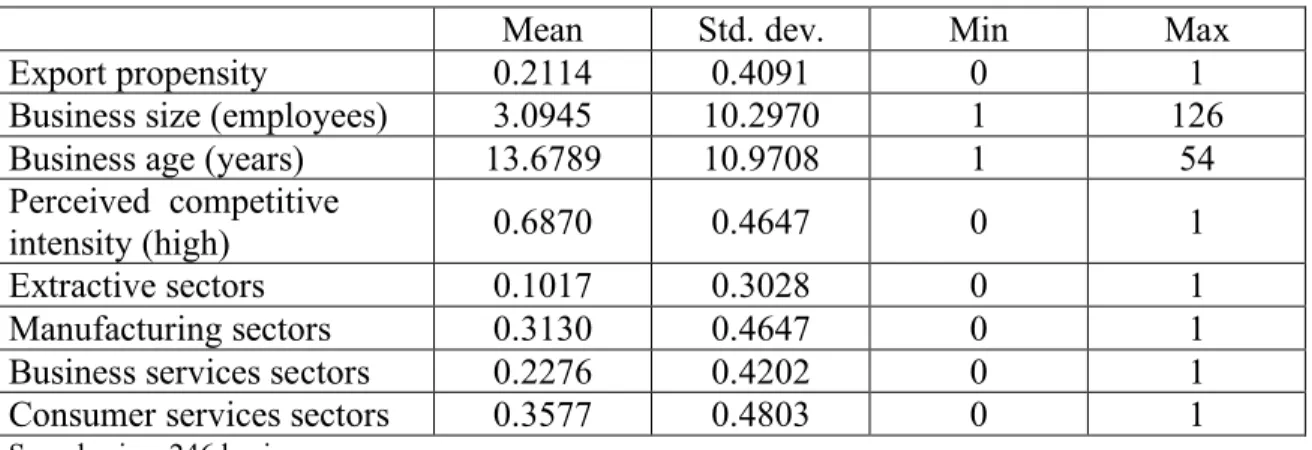
International orientation. To evaluate the impact of entrepreneurial experience on the international orientation of the entrepreneur’s current business, the dependent variable used to test the proposed hypotheses is export propensity and it is measured through a dummy variable taking the value of one for exporting businesses, and zero otherwise. Among the sampled entrepreneurs, 21.14% operate in foreign markets (Table 2).
At this point, we discuss two aspects related to the selection of the dependent variable. First, according to DeTienne and Koberg (2002) key informants provide reliable information about the characteristics of their firms, including export valuations. More concretely, the adopted variable identifies the proportion of total sales volume coming from international markets. Second, the selection of the business’ international activity responds to the argument that past entrepreneurial
14 experience provides entrepreneurs with specific knowledge and managerial capabilities that may help them develop more successful strategies in different areas, including internationalization (Leonidou, Katsikeas, & Piercy, 1998; Westhead, Wright, & Ucbasaran, 2001). Additionally, entrepreneur’s capital—including past entrepreneurial experience—is a valuable asset for the organization (Estrin, Mickiewicz, & Stephan, 2013, 2016), which not only compensate the scarcity of other relevant ones (i.e., tangible assets), but also is critical to decision-making processes. Thus, and different from alternative and equally reliable performance metrics (e.g., growth or economic performance), our dependent variable is strictly linked to endogenous valuations of the business’ resources and capabilities made by the entrepreneur and is not distorted by market-driven effects (Lafuente, Stoian, & Rialp, 2015).
Entrepreneurial experience. Entrepreneurial experience represents a key source of
generative knowledge. Individuals with such entrepreneurship-specific cognitive schemas raise their probability of international orientation in subsequent business ventures. Respondents reported whether they have owned a business in the past (yes=1, no=0). Additionally we explore the nature of the entrepreneurial experience. As we indicated above, the generative learning process of entrepreneurial experience is not task specific but rather contributes to improve the outcomes and effectiveness of serial entrepreneurs across a broader range of organizational domains. Therefore, the export activity of the current business is the result of a decision-making process in which cognitive schemas and accumulated knowledge resulting from past entrepreneurial experience play a key role. By definition novice entrepreneurs have no entrepreneurial experience.
To evaluate the distinct effect of the type of entrepreneurial experience, serial entrepreneurs who have launched at least two businesses provided information as to whether their prior
entrepreneurial experience was positive or negative. We distinguish between serial entrepreneurs with positive entrepreneurial experience (yes=1, no=0) from those resilient entrepreneurs who had a negative experience in the past (yes=1, no=0). Note that a negative entrepreneurial experience described by the entrepreneur as failure is not necessarily an indication of financial unfeasibility. In
15 fact, Headd (2003) found that about one third of firms were profitable at the time of closure. There is a need to differentiate between economic failure and emotional failure (Simmons et al., 2016; Ucbasaran et al., 2010). Emotional failure is the termination of an initiative that has fallen short of its goals (McGrath, 1999). As with prior related studies, the failure to meet expectations is the negative entrepreneurial experience taken into account within this study (Ucbasaran et al., 2010).
In the final sample of 380 serial entrepreneurs, 31% are resilient entrepreneurs with past negative entrepreneurial experience. This rate is similar to that reported in previous studies (Ucbasaran et al., 2010).
Control variables. We control for gender, entrepreneur’s age, education attainment, business size, business age, perceived competitive intensity and industry in the different model specifications. Gender identifies whether the individual is a male (yes=1, no=0), whereas age is expressed in years. The individual’s education attainment is captured through a set of dichotomous variables distinguishing individuals with primary studies (yes=1, no=0), secondary studies (yes=1, no=0), and post-secondary studies (yes=1, no=0). These variables have been used in prior studies on entrepreneurial activity (e.g., Lafuente et al., 2007; Driga, Lafuente, & Vaillant, 2009; Autio & Acs, 2010; Bosma et al., 2012).
Concerning the control variables related to the business, size is measured by the number of employees, while business age is expressed in years since the current business started its operations. These two variables measure the vulnerability of the firm to market conditions due to liabilities of smallness and newness (Ucbasaran, Shepherd, Lockett, & Lyon, 2013; Wiklund, Baker, & Shepherd, 2010). The business’ competitive environment can play a key role in explaining the decision to engage in international activities. We include two sets of variables to capture the business’ competitive environment. Entrepreneurs were asked to provide information about the number of competitors that the business has according to the following categories: ‘none’, ‘few’ and ‘many’. These dummy variables are not significantly correlated to export propensity. Thus, a single dichotomous variable was introduced indicating if the business has many competitors or not
16 (yes=1, no=0). Respondents indicated the business’ primary activity with regard to the following categories: extractive sectors, manufacturing, business services, and consumer services. Based on these data a set of industry dummy variables were created. Finally, the variables linked to the entrepreneur’s age, business size and business age were logged to reduce skewness.
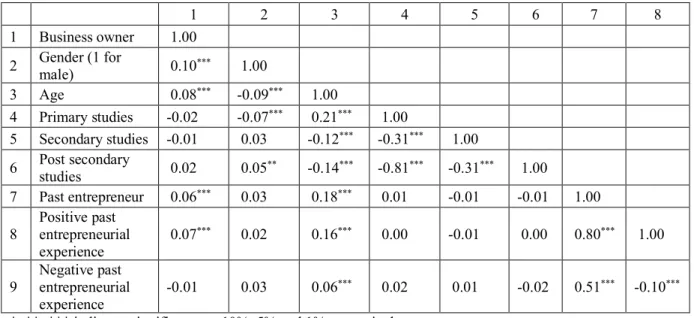
--- Insert Tables 1 and 2 about here ---
Following the theory that underpins this study, the characteristics of the proposed analysis lead to suggest that the econometric problem of the entrepreneurial experience–current business internationalization relationship is a perfect candidate for a sample selection model (Heckman, 1979). The endogenous nature of entrepreneurial engagement implies that covariates explaining this decision are likely correlated to the error term of any model used to assess current business’
outcomes (Heckman & Robb, 1985). Also, the export propensity of average current businesses that were created by serial entrepreneurs may originate in factors other than those strictly related to the decision of becoming an entrepreneur (Greene, 2003). To address potential sample selection problems, we use the Heckman two-step procedure (Heckman, 1978). The Heckman two-step model represents a solution for the omitted variables bias (Heckman, 1979), and it allows us to control for potential sample selection bias and obtain consistent estimates for the effect of previous entrepreneurial experience on both subsequent business ownership and the internationalization of current businesses. The Heckman two-step model involves two equations. In the first step (selection equation), the probability of entrepreneurship is estimated on the full sample through the probit model. The main purpose of this first step is to test our first hypothesis that proposes a negative relationship between negative past entrepreneurial experience and the probability of subsequent business ownership (H1).
17 In addition, from this first step the correction factor of selection bias for the entire sample, called the inverse of the Mills ratio , is computed. The selection bias term depends on the
known parameters from the entrepreneurship probit model and is estimated as
for entrepreneurs, and as for the non-treated sub-sample
(non-entrepreneurs), where and denote the density function and the cumulative distribution function of the standard normal distribution, respectively (Heckman, 1979).
The second step estimates the outcome equation—that is, the export propensity model— including the inverse of the Mills ratio in the model. Given that the variable capturing export propensity is binary coded a probit-to-probit method is used to estimate the effect of the different types of past entrepreneurial experience on the internationalization of current businesses, and test our second hypothesis that states that the international orientation—in terms of export propensity— of businesses owned by resilient serial entrepreneurs with negative past entrepreneurial experience is greater than that of novice entrepreneurs (H2).
3.3. Qualitative approach
To better understand ‘how’ the past entrepreneurial experience of resilient entrepreneurs benefits the internationalization of their subsequent venturing, it is useful to complement the ‘what’ of our study’s causal variance-based model with a more qualitative process analysis (Van de Ven, 2007). From our quantitative variance model, we found that the international orientation—in terms of export propensity—of businesses owned by resilient serial entrepreneurs with negative past entrepreneurial experience is greater than that of novice entrepreneurs. Underlying this empirical finding is the theoretical presumption that undesirable prior experience may shape the way in which future challenges are framed by encouraging generative experiential learning and resilience
capabilities. To find out how these processes may be engendered by past negative entrepreneurial experience (input) and lead to greater international propensity (output), we specifically analyzed the
( )
l
( )
l
i(
X
i) (
X
i)
f b
F
b
(
X
i)
1
(
X
i)
f b
b
-
- F
f
F18 entrepreneurial learning and decision making that connects the input-output link identified through the results of our variance model described in the previous section.
To do so we have undertaken the second step of the proposed sequential deductive
triangulation approach (Morse, 1991) by conducting in-depth and repeated conversations about the personal entrepreneurial learning process and entrepreneurial decision-making of individuals with past entrepreneurial experience. The efficiency of the proposed triangulation is not conditioned by the selection of the same subjects for both samples (Morse, 1991: 121-122). Following this method, we have selected subjects for the qualitative analysis based on their appropriateness for the studied objectives rather than randomness (Greene et al., 1989). Therefore, the studied entrepreneurs were deliberately chosen from a purpose-based premise to highlight the contrast of the different potential scenarios analyzed in our model: First-time entrepreneur (novice); resilient serial entrepreneur with negative past entrepreneurial experience (resilient-serial); and individual with negative past
entrepreneurial experience that did not re-enter entrepreneurship (non-resilient-non-serial).
4. Empirical results
This section presents the empirical findings of the study. Results in section 4.1
quantitatively analyze the international orientation of resilient serial entrepreneurs by using the Heckman probit-to-probit model. Section 4.2 adopts a qualitative approach to scrutinize the entrepreneurial learning process and entrepreneurial decision-making of individuals with past entrepreneurial experience.
4.1 Heckman regression models: International orientation of resilient serial entrepreneurs Table 3 presents the results for the different Heckman models (probit-to-probit) that evaluate the effect of previous entrepreneurial experience both on the probability of entrepreneurial re-entry and on the export propensity of the analyzed entrepreneurial businesses. We are aware that the results of the final models could be contaminated by collinearity. To address the threat of
19 collinearity, we computed the variance inflation factor (VIF) to test if coefficients are amplified due to correlations across the explanatory variables. Table 3 reports the average VIF value for each regression. The results for the diagnostic test indicate that for all models and all independent variables the variance inflation factor is below the commonly used cut-off threshold of ten, confirming that the model specifications do not suffer from collinearity problems (Greene, 2003).
The results in Table 3 come from two different Heckman models according to which type of past entrepreneurial experience is being considered. The first specification considers the effect of previous entrepreneurial experience both on current entrepreneurial activity and on current export propensity. To test the proposed hypotheses, we split the previous entrepreneurial experience into two components according to the type of experience (positive and negative experience) and the results are presented in specification 2. Results indicate that the advantage of serial entrepreneurs over first time novice is consistent across the different model specifications. Serial entrepreneurs were found to have a significantly greater international market propensity as compared to that of first time novice entrepreneurs (Specification 1 in Table 3).
--- Insert Table 3 about here ---
The results in model specification 2 indicate that, contrary to the case of entrepreneurs with past positive entrepreneurial experience, resilient entrepreneurs with negative past entrepreneurial experience are not more likely to engage in new entrepreneurial venturing than first time novice entrepreneurs. Additionally, note that the coefficient for the variable associated with past negative entrepreneurial experience is significantly lower than the parameter linked to past positive entrepreneurial experience (Chi2 value: 3.84 and p-value = 0.0490). These results are in line with our first hypothesis (H1) proposing that the probability to re-enter into
(b = - 0.0231) (b = 0.2289)
20 entrepreneurial activity is lower among serial entrepreneurs with negative past entrepreneurial experience.
The second hypothesis (H2) states that the international orientation—in terms of export propensity—of businesses owned by resilient serial entrepreneurs with negative past entrepreneurial experience is greater than that of novice entrepreneurs. The empirical results in model 2 of Table 3 strongly support this hypothesis. The international market propensity of current businesses is significantly higher for experienced serial entrepreneurs than for first time novice entrepreneurs, and this is so as well for resilient serial entrepreneurs who have bounced back into entrepreneurial activity following a prior business experience that they considered as a negative one.
Additionally, the comparison of the coefficients linked to past positive and negative entrepreneurial experience indicates that both variables have the same significant influence on the internationalization of serial entrepreneurs’ subsequent ventures (Chi2 value: 0.04 and p-value = 0.8061). We therefore conclude that the cognitive benefits of
entrepreneurial experience on the internationalization of subsequent venturing are realized not only by entrepreneurs who have had a positive past experience but also by resilient entrepreneurs who have been able to learn and bounce back from past negative entrepreneurial experiences.
4.2. Qualitative analysis of the entrepreneurial learning process of resilient serial entrepreneurs
The qualitative analysis is based on in-depth interviews with three entrepreneurs, each of them representing one of the relevant groups for this study on entrepreneurial resilience; novice entrepreneur, resilient-serial entrepreneur and non-resilient-non-serial entrepreneur. The conversations were deliberately guided towards the subjects of: entrepreneurial experience, entrepreneurial skills, entrepreneurial learning, and international orientation. Details on the analyzed entrepreneurs and their businesses are presented in Tables 4 and 5, respectively.
(b = 0.4703) (b =0.4407)
21 All three entrepreneurs expressed similar views that venture creation contrasted with their expectations. They all mentioned that following an entrepreneurial career was much more
complicated and challenging than originally expected. For our resilient-serial entrepreneur, the challenge was anticipated and better prepared on his subsequent ventures. Whereas the entrepreneur with the most formal entrepreneurship training abandoned the entrepreneurial career (non-resilient-non-serial), the one with the most experiential entrepreneurial training was the resilient-serial entrepreneur who led the firm with the most successful and international of the analyzed cases. All three of the entrepreneurs did mention learning a great deal from their entrepreneurial experience; with the novice entrepreneur saying that he “learns as he goes along”, whilst the resilient-serial entrepreneur attributed much of his success to what he gained from his past venturing (and this despite being in very different industries and types of businesses). The entrepreneur who chose not to continue with his entrepreneurial career (non-resilient-non-serial) did recognize that he had learnt a great deal from the experience and that he would probably be “more successful were he to start the business over again”. His decision not to continue his entrepreneurial career (by launching another venture) was justified by him saying that “it is not worth the effort”. He is currently employed, working in an unrelated industry and position to that of his venture.
What the resilient-serial entrepreneur identified as the most valuable cognitive gain from his past negative entrepreneurial experience was the enhanced ability to identify and more easily recognize “what not to do”. He says that he is much less likely to improvise than he once did with his previous ventures. He is more confident in the strategic decisions he makes and is more confident to innovate. By contrast the novice entrepreneur has adopted a more effectual attitude where he states to adapt and develop his business as it moves along.
The main contrast observed between the non-resilient-non-serial and the resilient-serial entrepreneurs that may explain ‘resilience’ and their different decisions regarding entrepreneurial re-entry is that the former assumes a lesser part of the blame for the outcome of his venture than the latter. The entrepreneur who abandoned his entrepreneurial career mainly identifies external factors
22 such as access to distribution channels and difficult market conditions as the main reasons for the negative performance of his venture. The resilient-serial entrepreneur, on the contrary, mostly took personal blame for his past failures that he attributed to bad planning, personal errors and lack of preparedness leading to less than expected revenues and profits. This is consistent with Ng, Van Dyne and Ang (2009) who state that errors must be recognized if they are to be the basis of experiential learning.
The reason why the non-resilient-non-serial entrepreneur now sees entrepreneurship as an unattractive career choice where the cards are stacked against him may be explained by the fact that he attributes his failure to external factors, which he has little control over. In contrast, the resilient-serial entrepreneur, who recognizes that he is a better entrepreneur this time around, is more optimistic of his future chances of entrepreneurial success and expressed a greater level of self-efficacy. Based on the cases observed, error recognition and intrinsic motives would appear to be closely linked to the entrepreneurial resilience that drives business re-entry despite past failures and enabled the resilient-serial entrepreneur to fully optimize the generative learning gained from his prior business venturing.
As for the manifest contrast between the resilient-serial entrepreneur and the novice entrepreneur in what concerns their entrepreneurial learning and decision process, the greatest distinction can be found in the breath of their perceived business knowledge. The novice
entrepreneur identified himself more of a technical and production person who relied a lot on third persons for administrative, human resource, sales or financial assistance. On the other hand, the resilient-serial entrepreneur claimed to have a fairly good grasp of all aspects of his firm, despite originally coming from sales. The resilient-serial entrepreneur showed much greater signs of understanding the complex interrelation of internal and external systems at work that influenced the development of his firm. The novice entrepreneur stated that he directed the progress of his venture much more in a heuristic, trial and error, basis.
23 The overall sense of preparedness and knowledge of what to expect is something that was repeatedly expressed by the resilient-serial entrepreneur, that went against the general impression received from the conversations with the novice entrepreneur. Both entrepreneurs run relatively successful ventures, but the resilient-serial entrepreneur seems keener on exploring new avenues, including international ones, for the development of his business. The novice entrepreneur launched his venture based on the production and commercialization of fairly innovative products in its field, but has since concentrated on developing the domestic market with little new product or market innovations since start-up. He did mention long-held plans for the introduction of new products and expansion to neighbouring markets, but says that he has yet to initiate them, expressing caution over the complexity this may bring to his business. In contrast, the resilient-serial entrepreneur said that his firm had been configured from the start to have an international scope.
According to Rialp et al. (2005) the internationalization of SMEs tends to be much more successful if the entrepreneur has an international orientation from the very beginning. And whereas Vaillant et al. (2006) identified past international management experience as an important factor for early internationalization, the generative learning process brought on by entrepreneurial experience appears to compensate this deficit and have allowed our resilient-serial entrepreneur to contemplate internationalization and innovation with a feeling of preparedness, despite these not being
characteristics of his previous ventures.
5. Discussion, implications and concluding remarks 5.1 Theoretical implications
This study looks into the international propensity of resilient serial entrepreneurs who have re-entered into entrepreneurial activity following a negative past venturing experience. The focus is on those entrepreneurs who are able to bounce back from past negative experiences, and how this negative past entrepreneurial experience influences their international orientation. A model
24 to greater subsequent international orientation in terms of export propensity was proposed from a cognitive theoretical framework derived from the generative process of experiential entrepreneurial learning.
Our theoretical approach offers a compelling vision of how serial entrepreneurs capitalize accumulated knowledge resulting from their past entrepreneurial experience. Our findings shed light on the question posed by various scholars about the role of generative learning on the contribution of serial entrepreneurs’ subsequent ventures (Cope, 2005; Gorgievski and Stephan, 2016; Ucbasaran, Westhead et al., 2008). Our results show that resilient serial entrepreneurs who re-enter into business venturing despite having suffered a negative entrepreneurial experience in the past are likely to do so not only with greater cognitive perspective but also implementing new strategies to take advantage of this expanded capability frontier resulting from the generative learning of their experience.
It was found that the distress of a perceived entrepreneurial failure significantly limited the propensity of those affected from re-entering into entrepreneurial activity. Despite the possible learning benefits from past entrepreneurial experience, those that considered their past venturing experience as a negative one were less likely to re-initiate their entrepreneurial career. This finding attests to the importance of emotions in recovery processes identified by other scholars (Weinberger et al., 2018). Nevertheless, by focusing on those resilient serial entrepreneurs who surmounted the affective challenge of past entrepreneurial failure it was found that the subsequent ventures these resilient entrepreneurs created had a significantly greater international orientation when compared to their novice counterparts. This suggests that resilient entrepreneurs who bounce back from adverse past entrepreneurial experience are likely to demonstrate cognitive benefits from the generative process of experiential entrepreneurial learning leading them towards superior levels of internationalization in subsequent venturing. This finding strengthens previous views that resilient entrepreneurs are likely to possess, not only strategic capabilities but also mental and emotional competences (Simmons et al., 2016; Stephan, 2018;
Weinberger et al., 2018
) and other forms of25 psychological capital like optimism, hope and self-efficacy (Luthans et al., 2006, 2007). If these resilient serial entrepreneurs would not benefit from such an expanded cognitive schema resulting from their past experience, we would expect them to do more of the same when it comes to their subsequent entrepreneurial practices. This would amount either to a perpetuation of their mediocre performance or to at the least a performance that is non-differentiable of that of first-time novice entrepreneurs. Resilient serial entrepreneurs were in-fact found to demonstrate increased levels of international orientation, similar to those of other serial entrepreneurs with past entrepreneurial successes. In other words, prior entrepreneurial experience provides cumulative benefits that build upon past experience, regardless of whether this experience was negative. This is an important contribution of this study as while previous studies have been able to investigate the effects of serial entrepreneurship on innovation (Ucbasaran et al., 2010), job creation (van Praag & Cramer, 2001) and economic value (Parker, 2013), this is the first study showing how serial entrepreneurship resilience leads to higher levels of international orientation. In an economic context where
internationalization is critical for business competitiveness, policy encouraging serial entrepreneurs and entrepreneurial re-entry is called for. This is particularly important in the case of international markets characterized by high levels of uncertainty and competitive challenges, which require entrepreneurial resilience capabilities as a necessary condition to learn and bounce back from previous failures, and to encourage additional internationalization attempts.
These findings bring some light to the longstanding theoretical debate on the affective distress or the cognitive learning repercussions dominate the consequence of entrepreneurial failure. In line with some scholars who suggest that a negative past venturing experience can be a
distressing event that generates negative emotions that interfere with entrepreneurial audacity (Carmeli & Gittell, 2009; Jenkins et al. 2014; Coelho & McClure 2005). The results show that the affective consequences of entrepreneurial failure would tend to direct the entrepreneurial re-entry decision of individuals having suffered such negative experience. But when it comes to the minority of resilient entrepreneurs who have been able to surmount the affective challenges of past negative
26 experience and have re-entered into business venturing, it is the cognitive learning benefits that appear to drive these serial resilient entrepreneurs to bounce back from failure and achieve greater entrepreneurial outcomes when it comes to internationalization.
5.2 Practical implications
From a practical perspective, the results of this study suggest that novice entrepreneurs should be encouraged to initiate their entrepreneurial career even when the expected international outcome of their initial venture, in terms of exports, is low. This may only be a sign of coherence between the cognitive capacity of novice entrepreneurs and their ventures. Through this initial venture, cognitive improvements will be made and will allow the entrepreneur to increase the internationalization of subsequent ventures. The relevance of encouraging entrepreneurs with negative entrepreneurial experience to re-initiate their entrepreneurial career flows from the fact that, by developing resilience capabilities and learning from previous failure, their subsequent ventures are more likely to demonstrate greater outcomes in terms of international orientation as compared to novice entrepreneurs.
From a policy perspective, the study suggests that it is important not to discriminate against entrepreneurs with a negative entrepreneurial experience. If discrimination is made based on quality or characteristics of the past venture, many potentially successful serial entrepreneurs of the future may never get a fresh start to re-launch their entrepreneurial career. Focusing policy either on ‘quality’ entrepreneurship, high-impact entrepreneurship and sector-specific entrepreneurship might be incomplete, because this policy orientation excludes many potential entrepreneurs that start with modest firms, gain entrepreneurship specific experience and develop resilience capability, even from previous negative past experience, and then move towards more complex ventures as their cognitive capabilities grow. When focusing on quantity, policy possibly gives more individuals a chance to learn from mistakes and generate their entrepreneurship specific cognitive benefits.
27 Practical experience is an essential prerequisite for entrepreneurial learning and resilience. For practitioners, the study results highlight the importance of capitalizing the learning benefits of past experience. Resilient entrepreneurs with a negative past experience should acknowledge that business failure may be temporary and certainly does not equate to individual failure. For example, in a context of economic downturn business failures are not only caused by entrepreneurs’ mistakes, but mostly by exogenous factors that indiscriminately affect business performance. Negative past experience should be regarded as an opportunity to learn and develop the necessary resilience capability to operate in increasingly complex, uncertain and challenging business environments.
5.3 Limitations of the study and avenues for further research
To conclude, it must be mentioned a series of limitations to the present research that, in turn, represent opportunities for future research. The paper is based on the concept of resilient serial entrepreneurs based on surmounted negative past entrepreneurial experience as indication of resilience; and although an initial qualitative analysis was carried-out to explore the psychological aspects of resilient serial entrepreneurship, a more in-depth process research of these aspects would be warranted. Future research can introduce greater detail as to the resilient nature of the
entrepreneurial behavior and decision-making. From a methodological perspective, data collected regarding to the nature of serial entrepreneurs’ prior ventures are perceptual and retrospective in nature. Baron and Ensley (2006) comment that memory is subject to distortion and changes over time. As a result, the presented findings should be read with caution. What may have been initially perceived as an entrepreneurial failure may be given a less harsh appreciation as the serial
entrepreneur recognizes the cognitive benefits of such a prior experience on a current venture. The same can hold for the emotional consequences of past entrepreneurial experience which might dilute over time. Controls were included into our model to try to detect and counter such limitations. Nevertheless, resulting distortion may not be completely eliminated. Similarly, the study is based on self-reported metrics and despite taking many steps to assure confidence in the validity and
28 robustness of our analysis, common method bias is a remote but possible concern. Likewise, the quantitative nature of the study has made use of categorical variables that do not necessarily capture the full range of possible outcomes. Only specifically designed future research can completely eliminate this limitation from being a potential contributor to the present findings. From a qualitative perspective, future studies could adopt a more extensive mixed-method or a
simultaneous triangulation approach to further examine the entrepreneurial resilience phenomena (Creswell, 2014; Denscombe, 2008).
Second, there is a multiplicity of business outcomes that can be used beyond the business’ international orientation. Future research should therefore introduce more outcome variables into the analysis (see, e.g., Toft-Kehler et al., 2014). Third, as in the study by Baron and Ensley (2006), we should note that current entrepreneurs in this study headed firms that had existed for several years, which implies that they have achieved at least some modest success. Finally, the
geographical specificity of the study and the cross-sectional nature of its dataset call for obvious caution when interpreting and generalizing its findings.
References
Alsos, G.A., & Carter, S. (2006). Multiple business ownership in the Norwegian farm sector: Resource transfer and performance consequences. Journal of Rural Studies, 22, 313-322. Alsos, G.A., & Kolvereid, L. (1998). The business gestation process of novice, serial, and parallel
business founders. Entrepreneurship, Theory & Practice, 22(4), 101-114.
Amaral, M., Baptista, R., & Lima, F. (2011). Serial entrepreneurship: impact of human capital on time to re-entry. Small Business Economics, 37, 1-21.
Audia, P.G., Locke, E.A., & Smith, K.G. (2000). The paradox of success. Academy of Management Journal, 43(5), 837-853.
Autio, E., & Acs, Z. (2010). Intellectual property protection and the formation of entrepreneurial growth aspirations. Strategic Entrepreneurship Journal, 4(3), 234-251.
29 Baron, R. (1998). Cognitive mechanisms in entrepreneurship: why and when entrepreneurs think
differently than other people. Journal of Business Venturing, 13, 275-294.
Baron, R. (2004). The cognitive perspective: a valuable tool for answering entrepreneurship’s basic “why” questions. Journal of Business Venturing, 19, 221-239.
Baron, R., & Ensley, M. (2006). Opportunity Recognition as the Detection of Meaningful Patterns: Evidence from Comparisons of Novice and Experienced Entrepreneurs. Management Science, 52(9), 1331-1344.
Baron, R., & Ward, T. (2004). Expanding Entrepreneurial Cognition’s Toolbox: Potential Contributions from the Field of Cognitive Science. Entrepreneurship Theory & Practice, 28, 553-573.
Birley, S., & Westhead, P. (1993). A comparison of new businesses established by ‘novice’ and ‘habitual’ founders in Great Britain. International Small Business Journal, 12(1), 38-60. Bosma, N., Hessels, J., Schutjens, V., Van Praag, M., & Verheul, I. (2012). Entrepreneurship and
role models. Journal of Economic Psychology, 33(2), 410-424.
Bryman, A., & Bell, E. (2015). Business research methods. Oxford University Press, USA. Bullough, A., Renko, M., & Myatt, T. (2014). Danger zone entrepreneurs: The importance of
resilience and self-efficacy for entrepreneurial intentions. Entrepreneurship Theory & Practice, 38(3), 473-499.
Bustinza, O.F., Vendrell-Herrero, F., Perez-Arostegui, M., & Parry, G. (2016). Technological capabilities, resilience capabilities and organizational effectiveness. International Journal of Human Resource Management, in press.
Carmeli, A., Friedman, Y. & Tishler, A. (2013). Cultivating a resilient top management team: The importance of relational connections and strategic decision comprehensiveness. Safety Science, 51(1), 148-159.
Carmeli, A. & Gittell, J.H. (2009). High-quality relationships, psychological safety, and learning from failures in work organizations. Journal of Organizational Behavior, 30(6), 709-729.
30 Carmeli, A. & Markman, G.D. (2011). Capture, governance, and resilience: strategy implications
from the history of Rome. Strategic Management Journal, 32(3), 322-341.
Carmeli, A., Yitzhak-Halevy, M. & Weisberg, J. (2009). The relationship between emotional intelligence and psychological wellbeing. Journal of Managerial Psychology, 24(1), 66-78. Cartwright, S., & Cooper, C.L. (2009). The Oxford Handbook of Organizational Well-being.
Oxford: Oxford University Press.
Coelho, P.R.P., & McClure, J.E. (2005). Learning from failure. Mid-American Journal of Business, 20(1), 13-20.
Cooper, A.C., Gimeno-Gascon, F.J., & Woo, C.Y. (1994). Initial human and financial capital predictors of new venture performance. Journal of Business Venturing, 9(5), 371-395.
Cope, J. (2003). Entrepreneurial learning and critical reflection: discontinuous events as triggers for higher-level learning. Management Learning, 34(4), 429-450.
Cope, J. (2005). Toward a dynamic learning perspective of entrepreneurship. Entrepreneurship Theory & Practice, 29(4), 373-397.
Cope, J. (2011). Entrepreneurial learning from failure: An interpretative phenomenological analysis. Journal of Business Venturing, 26(6), 604-623.
Creswell, J. W. (2014). Research design: Qualitative, quantitative, and mixed methods approaches (4. ed.). Los Angeles: SAGE Publications.
Denscombe, M. (2008). Communities of practice: A research paradigm for the mixed methods approach. Journal of Mixed Methods Research, 2, 270-283.
DeTienne, D., & Koberg C. (2002). The impact of environmental and organizational factors on discontinuous innovation within high-technology industries. IEEE Transactions on Engineering Management, 49(4), 352-364.
Driga, O., Lafuente, E., & Vaillant, Y. (2009). Reasons for the relatively lower entrepreneurial activity levels of rural women in Spain. Sociologia Ruralis, 49(1), 70-96.
31 Ellis, S., & Davidi, I. (2005). After-event reviews: drawing lessons from successful and failed
experience. Journal of Applied Psychology, 90(5), 857-871.
Estrin, S., Mickiewicz, T., & Stephan, U. (2013). Entrepreneurship, social capital, and institutions: Social and commercial entrepreneurship across nations. Entrepreneurship Theory and Practice, 37(3), 479–504.
Estrin, S., Mickiewicz, T., & Stephan, U. (2016). Human capital in social and commercial entrepreneurship. Journal of Business Venturing, 31(4), 449-467.
Gaglio, C.M. (2004). The role of mental simulations and counterfactual thinking in the opportunity identification process. Entrepreneurship Theory & Practice, 28(6), 533-552.
Gompers, P., Kovner, A., Lerner, J., & Scharfsteina, D. (2010). Performance persistence in entrepreneurship. Journal of Financial Economics, 96, 18-32.
Gorgievski, M.J., & Stephan, U. (2016). Advancing the psychology of entrepreneurship: A review of the psychological literature and an introduction. Applied Psychology: An International Review, 65(3), 437-468.
Greene, W. (2003). Econometric Analysis, fifth edition. NJ: Prentice Hall.
Greene, J.C., Caracelli, V.J., & Graham, W.F. (1989). Toward a conceptual framework for mixed-method evaluation designs. Educational Evaluation and Policy Analysis, 11(3), 255-274. Headd, B. (2003). Redefining business success: Distinguishing between closure and failure. Small
Business Economics, 21, 51-62.
Heckman, J.J. (1978). Dummy Endogenous Variables in a Simultaneous Equation System. Econometrica, 46(4), 931-959.
Heckman, J.J. (1979). Sample Selection Bias as a Specification Error. Econometrica, 47(1), 153-161.
Heckman, J.J., & Robb, R. (1985). Alternative Methods for Evaluating the Impact of Interventions: An Overview. Journal of Econometrics, 30, 239-267.
32 Huber, G. P. (1991). Organizational learning: The contributing processes and the literatures.
Organization Science, 2, 88-115.
Jenkins, A., Wiklund, J., & Brundin, E. (2014). Individual responses to firm failure: Appraisals, grief, and the influence of prior failure experience. Journal of Business Venturing, 29(1), 17-33. Junni, P., Sarala, R., Taras, V., & Tarba, S. (2013). Organizational ambidexterity and performance:
A meta-analysis. Academy of Management Perspectives, 27(4), 299-312.
Keith, N., Unger, J.M., Rauch, A., & Frese, M. (2016). Informal learning and entrepreneurial success: A longitudinal study of deliberate practice among small business owners. Applied Psychology: An International Review, 65(3), 515-540.
Klyver, K., Nielsen, S. L., & Evald, M. R. (2013). Women's self-employment: An act of
institutional (dis) integration? A multilevel, cross-country study. Journal of Business Venturing, 28(4), 474-488.
Kolvereid, L., & Bullvag, E. (1993). Novices versus experienced business founders - an exploratory investigation. In S. Birley and I.C. MacMillan (Eds.), Entrepreneurship research: global
perspectives (pp. 275-285). Amsterdam: Elsevier Science Publisher.
Kolvereid, L., Shane, S., Starr, J., Westhead., P, & Bullvag, E. (1991). A three country survey of Novices and experienced entrepreneurs. Proceedings, 21st European Small Business Seminar. Barcelona, September 18-20.
Kossek, E.E., & Perrigino, M.B. (2016). Resilience: A Review Using a Grounded Integrated Occupational Approach. The Academy of Management Annals, 10(1), 729-797.
Krueger, N. (2003). The Cognitive Psychology of Entrepreneurship. International Handbook Series on Entrepreneurship, 1, 105-140.
Lafuente, E., Stoian, M.C., & Rialp, J. (2015). From export entry to de-internationalisation through entrepreneurial attributes. Journal of Small Business and Enterprise Development, 22(1), 21-37. Lafuente, E., Vaillant, Y., & Rialp, J. (2007). Regional differences in the influence of role models: