Soil variability in different landscape...
477
SOIL VARIABILITY IN DIFFERENT LANDSCAPE POSITIONS IN THE
PORTO ALEGRE BOTANICAL GARDEN, SOUTHERN BRAZIL
Variabilidade de solos em posições distintas da paisagem no Jardim Botânico de Porto Alegre, sul do Brasil
Luís Fernando da Silva1, Paulo César do Nascimento2, Alberto Vasconcellos Inda2, Edsleine Ribeiro Silva2
ABSTRACT
Knowledge of soil characteristics in areas where activities related to the environment are developed, such as Porto Alegre Botanical Garden (JB-PoA), is a fundamental condition for the sustainable use of this natural resource. The objective of this study was to characterize, classify and evaluate some issues about soil formation in Porto Alegre Botanical Garden, as well as relate their distribution on the landscape according to environmental characteristics. For the morphological description and collecting samples
four profiles were selected (P1 to P4), located in the summit-shoulder transition, backslope, footslope and toeslope, respectively. Granulometric distribution of the P1 and P3 profiles indicated sharp textural gradient, with presence of textural and “plânico” B horizons, respectively, according to Brazilian System of Soil Classification. There is predominance of low values of pH, and low base saturation, with exception of P4, indicating probable deposition of solution material at this area. The Fed/Fes relationship was greater in the profile located in the summit-shoulder transition (P1), indicating higher weathering. The Feo/Fed relationship increased in P3 and P4 profiles, indicating greater participation of iron oxides of low crystallinity in reducing environment. The occurrence of some pedogenic processes may be inferred, like lessivage in P1 (Ultic Hapludalf), due to clay skins and higher values of fine
clay:total clay relationship in subsurface; ferrolysisand gleization,by low pH value and high Feo/Fed relationship in E and EB
horizons of P3 (Oxyaquic Hapludalf), being the last also present in P4 (Humaqueptic Endoaquent), indicating gleization occurrence.
Index terms: Soil-landscape relationship; pedogenic processes; lessivage; ferrolysis; gleization.
RESUMO
O conhecimento das características dos solos em áreas onde são desenvolvidas atividades relacionadas ao meio ambiente, como no Jardim Botânico de Porto Alegre (JB-PoA), é condição fundamental para o uso sustentável desse recurso natural. Objetivo-se, com este estudo, foi caracterizar, classificar e avaliar aspectos da formação dos solos do Jardim Botânico de Porto Alegre, bem como relacionar a sua distribuição na paisagem às características do ambiente. Para a descrição morfológica e coleta de amostras foram selecionados quatro perfis (P1 a P4) localizados, respectivamente, no terço superior, terço médio, sopé e planície de inundação. A granulometria dos perfis P1 e P3 indicou gradiente textural acentuado, com horizonte B textural e B plânico, respectivamente, segundo o Sistema Brasileiro de Classificação de Solos. A relação Fed/Fes foi maior no perfil do terço superior (P1), indicando maior intemperismo. Houve predomínio de baixos valores de pH e de distrofismo, com exceção do P4, indicando provável deposição de materiais em solução nessa área. A relação Feo/Fed aumentou nos perfis P3 e P4, com maior participação dos óxidos de ferro de baixa cristalinidade em ambiente redutor. Alguns processos de formação predominantes podem ser inferidos, como a lessivagem, pela cerosidade e maior relação argila fina:argila total em P1 (Argissolo); a ferrólise e gleização, pelo baixo valor de pH e alta relação Feo/Fed nos horizontes E e EB de P3 (Planossolo), sendo esta última também presente em P4 (Gleissolo), indicando ocorrência de gleização.
Termos para indexação: Relação solo-paisagem; processos pedogenéticos; lessivagem; ferrólise; gleização.
1Universidade Federal do Rio Grande do Sul/UFRGS – Departamento de Solos – 91540-000 – Porto Alegre – RS – Brasil – [email protected] 2Universidade Federal do Rio Grande do Sul/UFRGS – Departamento de Solos – Porto Alegre – RS – Brasil
Received in april 14, 2015 and approved in june 2, 2015 INTRODUCTION
Knowledge of the characteristics of natural resources in areas where are developed activities related to the environment is a fundamental condition for the sustainable use of these resources. In these, the soil
occupies a prominent position, because it is expression
of environmental factors related their formation (Buol et
al., 2003). In areas for Environmental Conservation Unit,
soil characterization constitutes a subsidy for planning
in order to optimize the use of this resource within the inherent activities to these places. In the Porto Alegre Botanical Garden (JB-PoA), site where are carried out
research activities of flora of the Rio Grande do Sul State
(RS), environmental education, leisure and recreation, there are no detailed studies that investigate the soil
characteristics of park associated with their formation
environment.
In the city of Porto Alegre, preliminary soil
Brazilian System of Soil Classification (EMBRAPA, 2013), the occurrence of Argissolo on top and slope
of hills with gently sloping relief; Cambissolo and Neossolo in granitic hills with moderately steep and
steep relief; and Hydromorphic/Aluvial soils in low and floodplain areas. The steep relief of hill areas
contributes to the formation of thinner soil and chemical
characteristics which reflect a low weathering degree (Medeiros et al., 2013).
The insertion area of JB-PoA shows smooth relief and less steep than hill areas of Porto Alegre. The
geomorphic characteristics indicate an area with knoll forms, with flat or convex summit positions, and more gentle slopes in relation to hill areas (Moura; Dias, 2012). These features are reflected in major water infiltration, resulting in deeply weathered soil profiles. Based on this knowledge, the hypothesis is that specific characteristics
of relief and parent material of the study area imply in similarities with hill areas, but with formation processes
in greater definition and intensity, resulting in soils with
high degree of pedogenetic development. The objectives were: characterize and classify the representative soil
profiles of the occurrence of taxonomic units in the JB-PoA, according to Brazilian System of Soil Classification (EMBRAPA, 2013) and the Soil Taxonomy (Soil Survey Staff, 2010); and indicate the influence of
soil-environment relationship, through soil forming process of JB-PoA.
MATERIAL AND METHODS
The Porto Alegre Botanical Garden (JB-PoA) covers an
area of 39 hectares, limited to the coordinates 30°02’51” and 30°03’20” (S) – 51°10’19” and 51°10’51” (W) in the urban area of Porto Alegre (FZB, 2009). The weather is humid subtropical with a long-term average annual temperature of 19.5 °C and long-term average annual rainfall of 1,300 mm, with rainfall
well distributed throughout the year. The long-term annual effective rainfall (precipitation minus evapotranspiration) is
430 mm (SEMA, 2010). The parent material is composed of “Gnaisse Porto Alegre” and “Alterito Serra de Tapes”. The gneiss has dark color to black, with quartz, feldspars and biotite
composition. The alterite was formed from coluvial deposits,
consisting of kaolinite and iron oxides (Schneider et al., 2008). The local relief consists in smooth hills, with influence of aluvial terraces of the “Arroio Dilúvio”.
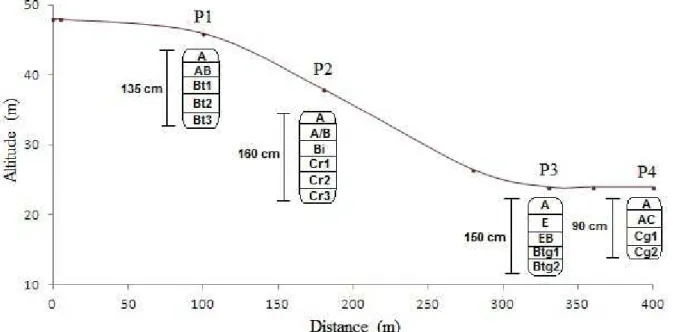
To study the soil genesis were selected four profiles (Figure 1), located in the summit-shoulder transition (P1), sloping from 13 to 15%; backslope (P2), sloping from 18 to 20%; footslope (P3), sloping from 0 to 2%; toeslope (P4), sloping from 2 to 3%.
The trenches were opened to the description of the main pedogenetic horizons of the soil, according to methodology
described by Santos et al. (2005). Horizons Bt3 (P1), Cr2 and Cr3 (P2), Btg2 (P3) and Cg2 (P4), were collected by auger. The
soil samples were dried, ground and sieved in mesh 2 mm for
separation of fine earth fraction dried in air (TFSA).
The granulometric distribution and clay dispersed
in water were determined according to EMBRAPA (1997), while the fine clay fraction (< 0.2 µm) according to method of Jackson (1956). With these data were calculated the fine clay/total clay relationship (Claf/Cla) and soil flocculation
(SoF). To identify possible lithologic discontinuities
in the soil profiles were calculated fine sand/total sand relationship (FS/TS) and the uniformity value (VU) (Schaetzl, 1998).
In relation to chemical characteristics, the pH in water and KCl, the exchangeable cations (Ca2+, Mg2+, Na+,
K+ and Al3+), the potential acidity (H++Al3+) and the organic
carbon content were determined according to EMBRAPA (1997). Were calculated cation exchange capacity (CEC), clay fraction activity (CFA) and base saturation (V). The sulfuric attack was carried out to quantify the Fe2O3, Al2O3
and SiO2 constituents of clay minerals (EMBRAPA, 1997).
Selective dissolutions were performed to iron oxides with dithionite-citrate-bicarbonate (DCB) at 80 °C by Mehra and Jackson (1960), and ammonium oxalate (OXA) according to Schwertmann (1964) to determine the Fe and Al content in pedogenic oxides (Fed; Ald) and low crystallinity (Feo, Alo).
The content of the elements Fe, Si and Al was determined
by atomic absorption spectroscopy. With these data were calculated Ki index, Fed/Fes and Feo/Fed relationships, used
to evaluate the soil weathering stage and the crystallinity
degree of oxides (Kämpf; Curi; Marques, 2009).
Mineralogical composition was determined by X-ray diffractometry analysis, conducted in sand, silt and clay granulometric fractions, with a Bruker-D2 Phaser equipment in non-oriented blades (powder samples). The samples were irradiated in the range from 4 to 40° 2θ, with a scan rate of 2° 2θ min-1. Halite was added as an internal
standard for the measurements of the spacings in clay fraction. The results are interpreted according Brindley
and Brown (1980).
RESULTS AND DISCUSSION
The soils developed significant variation of
thickness (Table 1), being observed thicker solum in P1 (Ultic Hapludalf) and P3 (Oxyaquic Hapludalf). The greatest slope (20%) in P2 (Oxic Dystrudept) influenced its low pedogenetic development compared to P1, through the low water infiltration, which resulted lower weathering in depth (Kämpf; Curi; Marques, 2009). This characteristic
of P2 is evidenced by contact with Cr horizon less than
90 cm depth (Figure 2). The P4 profile (Humaqueptic Endoaquent) also showed lower development, having contact with the Cg horizon from 40 cm depth, which can
be attributed to the stagnant water and lower weathering intensity in this landscape position.
In the profiles of upper portion of the landscape (P1 and P2) there are red and yellow colors (hues between 2.5YR and 7.5YR), which indicates the predominance of crystalline iron oxides as hematite (Fe2O3) and goethite
(FeOOH) in good to moderate drainage conditions (Kämpf; Schwertamnn, 1983).
In the Bi horizon of P2, the more reddish (2.5YR 4/8) and variegate colors (7.5YR 4/6) in condition of good drainage, indicated a weathered clay matrix, with presence
of minerals that have a low stage of weathering (Schneider;
Klamt; Giasson, 2007). Gray colors in the P3 and P4 profiles suggest the occurrence of anaerobic bacterial activity, which reduces soil oxidized compounds, resulting
in low chroma related to iron mobility and occurrence of
soil gleization (Ponnamperuma, 1972).
In the Bt2 horizon of P1, the presence of clay skins coating surface of aggregates and the blocky structure may be related to illuvial clays (Costa; Libardi, 1999). The surface horizons of the profiles studied showed weak or
moderate structure, small to medium, granular or crumb, condition associated with increase of organic matter on the soil surface. The massive structure in the deeper
horizons of P2 (Cr), P3 (Btg1) and P4 (Cg1) shows the
little pedogenetic evolution.
The P1 and P3 profiles showed sharp textural gradient (Table 2). In the P1 profile, the B/A textural relationship was 1.88, classified as B textural horizon. In the P3 profile, the abrupt textural change between EB and Btg1 horizons, associated with hue 10YR and chroma lower or equal to 3 in the B horizon, classified it as B “plânico” horizon (EMBRAPA, 2013).
Unlike P1 and P3, the P2 and P4 profiles showed little textural variation between horizons. However, in P2 stood out the clayey texture compared to other landscape profiles, being possible the change in parent material. According to Teramoto, Lepsch and Vidal-Torrado (2001), marked differences in soil texture on a topographic transect
may indicate the variation of parent material.
In all profiles the variation of fine sand/total sand relationship between horizons was lower than 0.14, which combined with uniformity value (VU) lower than 0.60, rule
out possibility of lithologic discontinuity between horizons
of each profile (Schaetzl, 1998). The P1 profile showed low soil flocculation in A and AB horizons, favoring the vertical transport of fine clay by water from eluvial A
horizon and the deposition in illuvial B horizon, when the
Table 1: Morphological attributes of Porto Alegre Botanical Garden soils.
Hor(1) Depth, moist Munsell color, texture, structure, moist consistence, waxiness, transition ---(P1) Ultic
Hapludalf---A 0-15 cm; 7.5YR 4/3 (moist); sandy loam; weak/moderate, small/medium, granular; very friable; slightly plastic
and slightly sticky; gradual and plan boundary.
AB 15-46 cm; 7.5YR 3/3 (moist); sandy clay loam; moderate, small/medium, subangular blocky; very friable;
slightly plastic and sticky; gradual and plan boundary.
Bt1 46-68 cm; 7.5YR 4/6 (moist); clay loam; moderate, medium/big, subangular blocky; friable; plastic and sticky;
clear and plan boundary.
Bt2 68-102 cm; 5YR 4/6 (moist); clay loam; moderate, medium/big, subangular blocky; friable; plastic and sticky;
common and moderate waxiness.
Bt3 102-135+ cm (collected by auger); 5YR 4/6 with small and little mottle 10YR 5/6 (moist); clay loam/clay. ---(P2) Oxic Dystrudept---
A 0-25/30 cm; 10YR 3/4 (moist); sandy clay loam; moderate, small, granular, moderate, small/medium, subangular
blocky; very friable; slightly plastic and slightly sticky; clear and irregular boundary.
A/B 25/30-55/60 cm; 2.5YR 4/8 with small and little mottle 10YR 3/6 (moist); clay loam; moderate, small/medium, subangular blocky; firm; slightly plastic and sticky; clear and wavy boundary.
Bi 55/60-80/85 cm; 2.5YR 4/8 with variegate 7.5YR 4/6 (moist); clay loam; moderate, medium/big, subangular
blocky; firm; slightly plastic and sticky; gradual and wavy boundary.
Cr1 80/85-120 cm; 5YR 5/8 (moist); sandy clay/sandy clay loam; massive, which breaks in subangular blocky; very friable; slightly plastic and slightly sticky.
Cr2 120-140 cm (collected by auger); 5YR 4/6 with small and little mottle 2.5Y 8/1 (moist); sandy clay/sandy clay loam.
Cr3 140-160+ cm (collected by auger); 7.5YR 8/4 (moist); sandy clay/sandy clay loam. ---(P3) Oxyaquic
Hapludalf---A 0-20/27 cm; 10YR 3/3 (moist); loamy sand; moderate, small, granular, moderate, small/medium, subangular
blocky; very friable; not plastic and not sticky; clear and wavy boundary.
E 20/27-60/62 cm; 10YR 4/4 (moist); sand; moderate, small, granular, moderate, small, subangular blocky; loose; not plastic and not sticky; gradual and plan/wavy boundary.
EB 60/62-105 cm; 7.5YR 4/3 (moist); sandy loam; moderate, medium/big, subangular blocky; friable; slightly plastic and slightly sticky; clear and plan boundary.
Btg1 105-120 cm; 10YR 4/3 (moist); sandy clay loam; massive; plastic and sticky.
Btg2 120-150+ cm (collected by auger); 10YR 6/1 with medium and abundant mottle 10YR 5/8 (moist); clay; firm;
very plastic and sticky.
---(P4) Humaqueptic
Endoaquent---A 0-15 cm; 7.5YR 3/2 (moist); sandy clay loam; crumb; very friable; not plastic and slightly sticky; clear and plan boundary.
AC 15-40 cm; 10YR 3/2 with small and little mottle 5YR 4/6 (moist); sandy clay loam; weak, medium, subangular
blocky; friable; slightly plastic and slightly sticky; clear and plan boundary.
Cg1 40-60 cm; 10YR 3/1 (moist); sandy clay loam; massive; slightly plastic and slightly sticky.
Cg2 60-90+ cm (collected by auger); 10YR 4/2 with small and little mottle 10YR 5/6 (moist); clay loam; very
plastic and sticky.
Figure 2: Looking from left to right, profile image of the Ultic Hapludalf (P1), Oxic Dystrudept (P2), Oxyaquic
Hapludalf (P3) and Humaqueptic Endoaquent (P4), showing the variation of solum depth (depth of A and B horizons)
related to soil development.
The occurrence of clay skins in the Bt horizon and increase of fine clay/total clay relationship from A horizon to Bt horizon indicated lessivage of clays in P1. Besides the low soil flocculation be a prerequisite to lessivage, according to Quénard et al. (2011) the translocation of clays
is favored in humid weather (when the precipitation is higher
than evapotranspiration at least 150 mm) and in planar or
sub-planar surfaces. Therefore, the humid weather of Porto
Alegre and the location of P1 profile (summit-shoulder
transition) in the landscape allow lessivage process.
The soil profiles showed low pH with values lower than 5.5 (Table 3). The pH KCl are smaller than 5.0 in all profiles, and in conjunction with negative ΔpH (pH KCl – pH H2O), indicate the absence of “ácrico” character and,
therefore, the predominance of negative charges in all profiles (EMBRAPA, 2013). The higher base saturation found in the A and Cg2 horizons of P4 seems indicate the importance of
the concave relief in the formation of eutrophic character,
with the lateral movement of soluble cations by water flow, towards the upper third for the flood area. The CEC of clay fraction (CFA) of B or C horizons in all profiles was lower than 27 cmolc kg-1, featuring soils with low clay activity.
In the P3 profile, besides the sharp acidity (pH of 4.5 in water) in E and EB horizons, soil CEC is less than 4.0 cmolc kg-1. According to Brinkman (1970) the soil
condition under successive cycles of wetting and drying favors the destruction of clay minerals by pedogenetic
process of ferrolysis, resulting in horizons with low pH, low clay content and low soil CEC, these characteristics found in P3. These results are similar to those obtained by
Mafra et al. (2001), noting that ferrolysis is manifested in sharp acidity (pH 3.0 to 4.0) and produces sandy horizons. Also in the Cg1 horizon of P4, low pH (4.4) associated with the lower clay content and exchangeable cations, even as high exchangeable aluminum content, may indicate an initial process of ferrolysis of clays in this profile section. Barbiero et al. (2010) monitored changes in pH and
electrical conductivity of soil at different times of the year
to explain the occurrence of ferrolysis. During the rainy season, they observed an increase in the pH of soil solution due to reduction reactions that consume H+ ions. At the end
of the rainy season happened high weathering, resulting
in low pH, where oxidation reactions in soil produce H+
protons which penetrate the octahedral structure of clay minerals, destabilizing them.
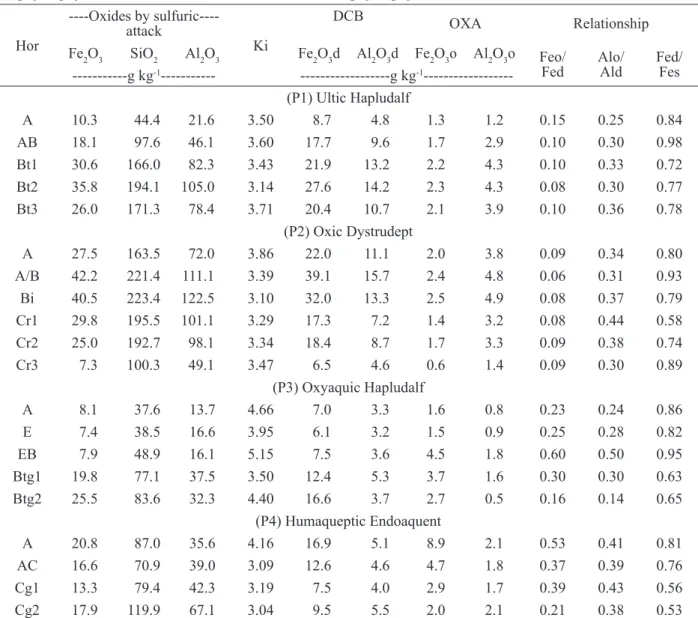
The Fed/Fes relationship in all profiles showed values between 0.53 and 0.98 (Table 4), which indicates
a moderate to advanced weathering for all soils. In the
P2 profile, the high Fed/Fes relationship in A, A/B and Bi horizons identifies front of weathering, with clear reduction in this value in Cr1 horizon less weathered. However, the Cr3 horizon showed an increase of Fed/Fes relationship (0.89), highlighting the sudden decrease in Fes content of Cr3. This data allows note small amount of iron in this horizon, which was observed in field descriptions
through the light color and low chroma. Smaller values of
The Ki index in all profiles was higher than 3.0, not agreeing with values of low clay activity and Fed/Fes relationship moderate to high, that confirm a moderate to advanced weathering for all soils. An explanation for the high Ki index observed in all profiles is the solubilization of silicon from silt and sand fractions, indicating inadequate extraction method for soils with high quartz content in these fractions (Oliveira, 2011). The high Ki index in P3 reinforces
this hypothesis, given the fact that the silt and sand fractions
have significant participation in soil texture. Remarks of this condition were cited in Rolim Neto et al. (2009), Medeiros et al. (2013), and Nascimento, Lani and Zoffoli (2013).
In P1 and P2, the Feo/Fed relationship was equal or less than 0.1, indicating the predominance of crystalline forms such as hematite and goethite (Pereira; Anjos, 1999; Meireles et al., 2012). This condition is coherent with the
soil location in landscape, because they are located in upper positions and good drainage, therefore favorable condition
for formation of crystalline oxides.
The higher values of Feo/Fed relationship were observed in P3 and P4, indicating greater participation of low crystallinity iron oxides, which represents an environment
with poor drainage and favorable to pedogenetic process
of gleization (Costa; Bigham, 2009). In the Btg2 and Cg2
Table 2: Physical attributes of Porto Alegre Botanical Garden soils.
Hor Gra% CS FS Silt Clay FS/TS VU Sil/Cla Claf/Cla SoF% ---g kg-1
---(P1) Ultic Hapludalf
A 5 396 284 150 170 0.42 -0.41 0.88 0.60 29
AB 4 251 249 220 280 0.50 0.04 0.79 0.69 11
Bt1 4 214 196 190 400 0.48 -0.06 0.48 0.78 16
Bt2 3 181 159 190 470 0.47 0.22 0.40 0.77 21
Bt3 3 232 188 180 400 0.45 - 0.45 0.69 100
(P2) Oxic Dystrudept
A 11 213 177 200 410 0.45 -0.03 0.49 0.71 13
A/B 12 166 114 190 530 0.41 0.33 0.36 0.73 82
Bi 17 181 69 180 570 0.28 0.51 0.32 0.67 97
Cr1 8 288 92 170 450 0.24 -0.08 0.38 0.44 100
Cr2 8 246 74 170 510 0.23 0.14 0.33 0.56 94
Cr3 6 315 115 160 410 0.27 - 0.39 0.16 100
(P3) Oxyaquic Hapludalf
A 1 478 262 160 100 0.35 -0.32 1.60 0.61 30
E 2 397 333 180 90 0.46 0.24 2.00 0.64 28
EB 1 431 229 230 110 0.35 -0.56 2.09 0.58 14
Btg1 1 232 178 360 230 0.43 0.23 1.57 0.58 9
Btg2 1 270 200 320 210 0.43 - 1.52 0.58 5
(P4) Humaqueptic Endoaquent
A 2 288 232 270 210 0.45 0.09 1.29 0.67 26
AC 5 307 223 270 200 0.42 0.26 1.35 0.70 33
Cg1 4 356 264 190 190 0.43 -0.35 1.00 0.70 26
Cg2 4 240 190 280 290 0.44 - 0.97 0.58 3
* Hor: horizon. Gra: gravel. CS: coarse sand. FS: fine sand. VU: uniformity value = {[(Silt+FS)/(TS-FS)]SURFACE HORIZON / [(Silt+FS)/
(TS-FS)]SUBSURFACE HORIZON} – 1,0. FS/TS: fine sand/total sand relationship. Sil/Cla: silt/clay relationship. Claf/Cla: fine clay/total
horizons of P3 and P4, respectively, it perceives a decrease of Feo/Fed relationship, indicating greater participation of crystalline forms of iron oxides, which can be attributed to
the presence of mottles in these horizons.
Duarte et al. (2000) observed these decreasing values in profiles with poor drainage, because the iron
minerals precipitated in mottles had higher degree of
crystallinity than those located in the soil matrix. In the EB horizon of P3, the high values of Feo/Fed (0.60) and Alo/ Ald (0.50) may be related to the existence of temporary water table in this profile section, with the interference of ferrolysis in the low crystallinity of iron oxides and
aluminosilicates, above of the clayey Btg1 horizon (Coelho; Vidal-Torrado, 2003).
The X-ray diffraction (Figure 3) in the sand and silt of P1, P2, P3, and similarly P4 (data not shown) showed the occurrence of feldspar and quartz, with higher occurrence of feldspar in P2. The predominance of kaolinite in the
clay fraction of all soils is related to an environment with
moderate to advanced weathering, which was confirmed by low clay CEC. The presence of mica reflections in the
clay of P2 indicated that the steep position occupied in the landscape (transition to steep slope relief) caused the lower weathering compared to other soils.
Table 3: Chemical attributes of Porto Alegre Botanical Garden soils.
Hor
pH ---Sorption
complex---V m SOC
H2O KCl
Ca2+ Mg2+ K+ Na+ SB H+Al Al3+ CEC CFA
---cmolc kg-1--- ---%--- g kg-1
(P1) Ultic Hapludalf
A 5.2 4.2 1.3 0.6 0.26 0.02 2.18 2.6 0.2 4.78 28 46 8 9.7
AB 5.2 4.1 2.0 0.5 0.20 0.02 2.72 3.0 0.6 5.72 20 47 18 5.0
Bt1 5.0 3.8 1.4 0.7 0.21 0.01 2.32 4.5 1.8 6.82 17 34 44 4.9
Bt2 4.9 4.0 1.1 1.2 0.10 0.02 2.42 3.0 1.1 5.42 12 44 31 2.2
Bt3 5.0 3.9 1.1 1.3 0.09 0.02 2.51 3.1 1.2 5.61 14 45 32 1.8
(P2) Oxic Dystrudept
A 5.2 4.3 2.5 1.8 0.73 0.03 5.06 3.9 0.5 8.96 22 57 9 12.0
A/B 4.9 3.9 1.8 1.5 0.62 0.03 3.95 4.7 2.1 8.65 16 46 34 8.5
Bi 4.9 3.9 1.2 1.6 0.30 0.03 3.13 4.5 2.6 7.63 13 41 46 2.5
Cr1 5.0 3.9 0.7 1.2 0.11 0.03 2.04 3.8 2.2 5.84 13 34 52 1.3 Cr2 4.9 3.8 0.5 1.1 0.09 0.03 1.72 4.3 3.0 6.02 12 28 64 2.7
Cr3 5.0 3.9 0.5 1.0 0.08 0.02 1.60 2.8 2.7 4.40 11 36 63 1.0
(P3) Oxyaquic Hapludalf
A 4.9 3.8 0.6 0.3 0.10 0.01 1.01 3.2 0.8 4.21 42 24 44 6.8
E 4.5 3.7 0.4 0.1 0.04 0.01 0.55 2.6 1.1 3.15 35 19 65 1.7 EB 4.5 3.8 0.4 0.1 0.05 0.02 0.57 2.8 1.0 3.37 28 18 63 2.3
Btg1 4.8 3.7 0.7 0.4 0.05 0.04 1.19 3.2 1.1 4.39 20 27 48 3.2
Btg2 5.1 3.7 1.2 1.3 0.08 0.10 2.68 1.7 0.6 4.38 21 61 18 0.8
(P4) Humaqueptic Endoaquent
A 5.4 4.8 6.6 1.5 0.13 0.22 8.45 3.3 0.1 11.75 56 72 1 27.0
AC 4.8 4.0 2.3 0.7 0.10 0.15 3.25 5.0 0.4 8.25 41 40 11 18.0
Cg1 4.4 3.6 0.9 0.5 0.13 0.07 1.60 3.6 0.9 5.20 27 31 36 6.3
Cg2 5.7 4.6 1.9 1.8 0.23 0.11 4.04 1.2 0.1 5.24 18 77 2 2.6
The P1 profile, with B textural horizon was classified as Argissolo Vermelho-Amarelo Distrófico típico (EMBRAPA, 2013), being classified as Ultic Hapludalf in the Soil Taxonomy (Soil Survey Staff, 2010). The attributes of P2 profile did not suggest a more developed
formation process, and the occurrence of B incipiente
horizon was decisive to classify it as Cambissolo Háplico Tb Distrófico típico, being classified as Oxic Dystrudept.
In the P3 profile, the presence of B “plânico” diagnostic horizon, according EMBRAPA (2013), defined the occurrence of Planossolo Háplico Distrófico gleissólico, being classified as Oxyaquic Hapludalf. In the P4 profile,
the presence of glei horizon and organic carbon content
suitable for A “húmico” horizon (EMBRAPA, 2013), defined as Gleissolo Melânico Tb Eutrófico típico, being classified as Humaqueptic Endoaquent.
Table 4: Content of sulfuric attack oxides (Fe2O3, SiO2, Al2O3), oxides extracted by dithionite-citrate-bicarbonate (Fe2O3, Al2O3), oxides extracted by ammonium oxalate (Fe2O3, Al2O3), and relationship between them.
Hor
----Oxides by sulfuric----attack
Ki
DCB OXA Relationship
Fe2O3 SiO2 Al2O3 Fe2O3d Al2O3d Fe2O3o Al2O3o Feo/
Fed Alo/Ald Fed/Fes
---g kg-1--- ---g kg-1 ---(P1) Ultic Hapludalf
A 10.3 44.4 21.6 3.50 8.7 4.8 1.3 1.2 0.15 0.25 0.84
AB 18.1 97.6 46.1 3.60 17.7 9.6 1.7 2.9 0.10 0.30 0.98
Bt1 30.6 166.0 82.3 3.43 21.9 13.2 2.2 4.3 0.10 0.33 0.72 Bt2 35.8 194.1 105.0 3.14 27.6 14.2 2.3 4.3 0.08 0.30 0.77
Bt3 26.0 171.3 78.4 3.71 20.4 10.7 2.1 3.9 0.10 0.36 0.78 (P2) Oxic Dystrudept
A 27.5 163.5 72.0 3.86 22.0 11.1 2.0 3.8 0.09 0.34 0.80
A/B 42.2 221.4 111.1 3.39 39.1 15.7 2.4 4.8 0.06 0.31 0.93
Bi 40.5 223.4 122.5 3.10 32.0 13.3 2.5 4.9 0.08 0.37 0.79
Cr1 29.8 195.5 101.1 3.29 17.3 7.2 1.4 3.2 0.08 0.44 0.58 Cr2 25.0 192.7 98.1 3.34 18.4 8.7 1.7 3.3 0.09 0.38 0.74
Cr3 7.3 100.3 49.1 3.47 6.5 4.6 0.6 1.4 0.09 0.30 0.89 (P3) Oxyaquic Hapludalf
A 8.1 37.6 13.7 4.66 7.0 3.3 1.6 0.8 0.23 0.24 0.86
E 7.4 38.5 16.6 3.95 6.1 3.2 1.5 0.9 0.25 0.28 0.82
EB 7.9 48.9 16.1 5.15 7.5 3.6 4.5 1.8 0.60 0.50 0.95 Btg1 19.8 77.1 37.5 3.50 12.4 5.3 3.7 1.6 0.30 0.30 0.63
Btg2 25.5 83.6 32.3 4.40 16.6 3.7 2.7 0.5 0.16 0.14 0.65
(P4) Humaqueptic Endoaquent
A 20.8 87.0 35.6 4.16 16.9 5.1 8.9 2.1 0.53 0.41 0.81
AC 16.6 70.9 39.0 3.09 12.6 4.6 4.7 1.8 0.37 0.39 0.76
Cg1 13.3 79.4 42.3 3.19 7.5 4.0 2.9 1.7 0.39 0.43 0.56
Cg2 17.9 119.9 67.1 3.04 9.5 5.5 2.0 2.1 0.21 0.38 0.53
* Ki: relationship (1.7*SiO2)/Al2O3. Feo: Fe2O3 extracted by ammonium oxalate. Alo: Al2O3 extracted by ammonium oxalate. Fed:
Fe2O3 extracted by dithionite-citrate-bicarbonate. Ald: Al2O3 extracted by dithionite-citrate-bicarbonate. Fes: Fe2O3 extracted by
CONCLUSIONS
The soil distribution in the landscape of the Porto Alegre Botanical Garden followed the form
observed in hill and knoll areas of Porto Alegre, with major pedogenic development in P1 (depth, soil
forming process development), whereas incipient soil development occurred in P2, in condition of steep slope, which was corroborated by high presence of feldspar and mica. It is believed that steep slope implies
lower infiltration of water in this landscape position,
affecting the clay translocation in depth (non-occurrence of lessivage) or the progress of other soil forming processes.
The good drainage in summit-shoulder transition
and backslope, and the sharp hydromorphism in footslope and toeslope positions, showed the influence of the relief
forms in the soil genesis, which was corroborated by
attributes like soil color and degree of crystallinity of iron oxides. The highest degree of soil weathering was observed in P1 located in upper third of landscape, not in steep slope, which was confirmed by the high Fed/Fes relationship.
The lessivage process could be inferred in P1 by clay skins and increase of fine clay/total clay relationship
until the beginning of illuvial horizon; while the ferrolysis
and gleization processes were indicated by low pH and high
Feo/Fed relationship in E and EB horizons of P3, being the last also present in P4, indicating occurrence of gleization.
Figure 3: X-ray diffraction of sand, silt and clay of the pedogenetic horizons of P1, P2 and P3. Qz – quartz; Ft –
ACKNOWLEDGMENTS
To “Fundação Zoobotânica” of Rio Grande do Sul
State (FZB-RS), for supporting the study. To biologist
Robberson Setubal and agronomist Walmir Gamboa, for their efforts to carry out the work. To “Conselho Nacional de Desenvolvimento Científico e Tecnológico” (CNPq – 471446/2012-2) and “Coordenação de Aperfeiçoamento de Pessoal de Nível Superior” (CAPES), for the financial support and scholarship to the first author.
REFERENCES
ALMEIDA, J. A.; KLAMT, E.; KÄMPF, N. Gênese do contraste textural e da degradação do horizonte B de um Podzólico Vermelho-Amarelo da Planície Costeira do
Rio Grande do Sul. Revista Brasileira de Ciência do Solo. 21(2):221-233, 1997.
BARBIERO, L. et al. Ferrolysis induced soil
transformation by natural drainage in Vertisols of
sub-humid South India. Geoderma. 156(3):173-188, 2010.
BRINDLEY, G. W.; BROWN, G. Crystal structures of
clay minerals and their X-ray identification. London:
Mineralogical Society, 1980. 495p.
BRINKMAN, R. Ferrolysis, a hydromorphic soil
forming process. Geoderma. 3(3):199-206, 1970.
BUOL, S. W. et al. Soil Genesis and Classification.
Yowa: Blackwell Publishing, 2003. 494p.
COELHO, M. R.; VIDAL-TORRADO, P.
Caracterização e gênese de perfis plínticos
desenvolvidos de arenito do Grupo Bauru: I - química.
Revista Brasileira de Ciência do Solo. 27(3):483-494,
2003.
COSTA, A. C. S.; BIGHAM, J. M. Óxidos de ferro. In:
ALLEONI, L. R. F.; MELO, V. F. (Eds.). Química e mineralogia do solo. Viçosa: Sociedade Brasileira de
Ciência do Solo, 2009. p.506-520.
COSTA, A. C. S.; LIBARDI, P. L. Caracterização físico-hídrica de um perfil de terra roxa estruturada latossólica pelo método do perfil instantâneo. Revista Brasileira de Ciência do Solo. 23(3):669-677, 1999.
DUARTE, M. N. et al. Mineralogia, química e
micromorfologia de solos de uma microbacia nos
Tabuleiros Costeiros do Espírito Santo. Pesquisa Agropecuária Brasileira. 35(6):1237-1250, 2000.
EMPRESA BRASILEIRA DE PESQUISA AGROPECUÁRIA - EMBRAPA. Manual de métodos de análise de solo.2.ed. Rio de Janeiro,
1997. 212p.
______. Sistema Brasileiro de Classificação de Solos.
3.ed. Brasília, 2013. 353p.
FUNDAÇÃO ZOOBOTÂNICA DO RIO GRANDE DO SUL - FZB. Jardim Botânico de Porto Alegre: 50
anos conservando a flora gaúcha. Porto Alegre: Jardim Botânico de Porto Alegre, 2009. 72p. (Publicações Avulsas FZB, 15).
JACKSON, M. L. Soil chemical analysis: advanced
course. Madison: University of Wisconsin, 1956. 894p.
KÄMPF, N.; CURI, N.; MARQUES, J. J. Intemperismo e ocorrência de minerais no ambiente do solo. In:
ALLEONI, L. R. F.; MELO, V. F. (Eds.). Química e mineralogia do solo. Viçosa: Sociedade Brasileira de
Ciência do Solo, 2009. p.334-371.
KÄMPF, N.; SCHWERTMANN, U. Goethite and hematite in a climosequence in Southern Brasil and their application in classification of kaolinitic soils.
Geoderma.29(1):27-39, 1983.
MAFRA, A.L. et al. Pedogênese de uma seqüência de solos desenvolvidos de arenito na região de Piracicaba
(SP). Revista Brasileira de Ciência do Solo.
25(2):355-369, 2001.
MEDEIROS, P. S. C. et al. Caracterização e
classificação de solos graníticos em topossequência na região sul do Brasil. Ciência Rural. 43(7):1210-1217,
2013.
MEHRA, O. P.; JACKSON, M. L. Iron oxide removal
from soils and clays by a dithionite-citrate system
buffered with sodium bicarbonate. In: ADA, S. (Ed.).
Clays clay mineralogy. Elmsdorf: Pergamon Press,
1960. p.317-342.
MOURA, N. S. V.; DIAS, T. S. Elaboração do mapa geomorfológico do município de Porto Alegre – RS. Ciência e Natura. 34(2):113-138, 2012.
NASCIMENTO, P. C.; LANI, J. L.; ZOFFOLI, H. J. O. Caracterização, classificação e gênese de solos hidromórficos em regiões litorâneas no Estado do Espírito Santo. Científica. 41(1):82-93,
2013.
OLIVEIRA, J. B. Pedologia aplicada. 4.ed.
Jaboticabal: FEALQ, 2011. 414p.
PEREIRA, M. G.; ANJOS, L. H. C. Formas extraíveis de ferro no Estado do Rio de Janeiro. Revista
Brasileira de Ciência do Solo. 23(2):371-382, 1999.
PONNAMPERUMA, F. N. The chemistry of submerged soils. Los Baños: Academic Press, 1972.
68p. (Advances in Agronomy, v.24).
QUÉNARD, L. et al. Lessivage as a major process of soil formation: A revisitation of existing data.
Geoderma. 167-168:135-147, 2011.
ROLIM NETO, F. C. et al. Topolitossequências do Alto Paranaíba: atributos químicos, físicos e mineralógicos.
Revista Brasileira de Ciência do Solo.
33(6):1795-1809, 2009.
SANTOS, A. C. et al. Gênese e classificação de solos numa topossequência no ambiente de Mar de Morros do Médio Vale do Paraíba do Sul, RJ. Revista Brasileira de Ciência do Solo. 34(4):1297-1314, 2010.
SANTOS, R. D. et al. Manual de descrição e coleta de solos no campo. 5.ed. Viçosa: Sociedade Brasileira de
Ciência do Solo, 2005. 100p.
SCHAETZL, R. J. Lithologic discontinuities in some
soils on drumlins: theory, detection and application. Soil Science. 163(7):570-590, 1998.
SCHNEIDER, P.; KLAMT, E.; GIASSON, E. Morfologia do Solo: subsídios para caracterização e classificação de
solos a campo. Guaíba: Agrolivros, 2007. 72p.
SCHNEIDER, P. et al. Solos de Porto Alegre. In: HASENACK, H. (Coord.). Diagnóstico ambiental de Porto Alegre:Geologia, Solos, Drenagem, Vegetação/
Ocupação e Paisagem. Porto Alegre: Secretaria Municipal do Meio Ambiente, 2008. p.28-43.
SCHWERTMANN, U. Differenzierung der eisenoxide des bodens durch extraction mit
ammoniumoxalat-lösung. Zeitschrift für Pflanzenernährung und
Bodenkunde. 105(3):194-202, 1964.
SECRETARIA ESTADUAL DO MEIO AMBIENTE - SEMA. Zoneamento ambiental da silvicultura: estrutura, metodologia e resultados. Porto Alegre:
Secretaria Estadual do Meio Ambiente, 2010. 137 p.
SOIL SURVEY STAFF. Keys to soil taxonomy.
11.ed. Washington DC: United States Department of Agriculture (NRCS), 2010. 346p.
TERAMOTO, E. R.; LEPSCH, I. F.;
VIDAL-TORRADO, P. Relações solo, superfície geomórfica e substrato geológico na microbacia do Ribeirão Marins