AND INFESTATION BY INSECT PESTS IN POTATO CROPS
Influência de silício no desenvolvimento de batateiras e na ocorrência de insetos-praga
Valkíria Fabiana da Silva1, Jair Campos Moraes2, Bruno Almeida Melo2
ABSTRACT
Potato crops are susceptible to various insect pests including the aphid Myzus persicae (Hemiptera, Aphididae) and the
beetle Diabrotica speciosa (Coleoptera, Chrysomelidae). Induced resistance through silicon treatment of plants represents a potential
strategy in pest management. The objective of the present study was to evaluate the effects of silicic acid on the development, productivity and level of infestation by beetles and aphids following foliar application to potato plants cultivated in the presence of organic compost or chemical fertiliser. Four experimental groups were studied, namely, plants cultivated in soil supplied with organic compost (30 t/ha) and either treated or non-treated with 0.5% silicic acid, and plants cultivated in soil supplied with NPK fertiliser (4:14:8; 4 t/ha) and either treated or non-treated with 0.5% silicic acid. The number of aphids and beetles detected on the leaves and the number of lesions caused by the beetles were evaluated. The height and the stem diameter of the plants were determined 60 days after the emergence and the productivity was determined 95 days after the planting of the seed potatoes. The results demonstrated that there were no interactions between silicic acid treatment and way of cultivation. Moreover, the incidence of beetles and aphids was not influenced by weekly application of silicon, and neither were the development and the productivity of plants. Although the development and productivity of organically cultivated plants were inferior to those grown in the presence of chemical fertiliser, plants cultivated on organic compost were less susceptible to attack by beetles.
Index terms: Solanum tuberosum, silicon acid, pest resistance.
RESUMO
A cultura da batata é suscetível a diversos insetos-praga, incluindo os pulgões (Hemiptera: Aphididae) e a vaquinha
Diabrotica speciosa (Coleoptera: Chrysomelidae). A indução de resistência, por meio do tratamento com silício, é uma das
táticas usadas no manejo integrado de pragas. Objetivou-se, no presente trabalho avaliar o efeito da aplicação foliar de ácido silícico sobre o desenvolvimento, produtividade e grau de infestação por pulgões e vaquinhas, em batateiras cultivadas em composto orgânico ou fertilizante químico. Foram testados quatro tratamentos: plantas cultivadas em solo suplementado com composto orgânico (30 t/ha) (tratadas e não tratadas com 0,5% de ácido silícico) e plantas cultivadas em solo suplementado com fertilizante NPK (4:14:8; 4 t/ha; tratadas e não tratadas com 0,5% de ácido silícico). O número de pulgões e vaquinhas observados nas folhas, assim como o número de lesões causadas pelas vaquinhas, foi determinado durante o desenvolvimento das plantas. A altura e o diâmetro da haste foram determinados 60 dias após a emergência das hastes, enquanto a produtividade foi determinada 95 dias após o plantio da batata-semente. Pelos resultados demonstrou-se que não houve interação entre a aplicação de silício e o tipo de cultivo. Além disso, a incidência de vaquinhas e pulgões não foi influenciada pela aplicação foliar semanal de silício, bem como o desenvolvimento e produtividade da cultura. Embora o desenvolvimento e produtividade das plantas cultivadas na presença de composto orgânico tenha sido inferior àquelas cultivadas em presença de fertilizante químico, as primeiras mostraram-se menos suscetíveis ao ataque das vaquinhas.
Termos para indexação: Solanum tuberosum, ácido silícico, resistência a insetos-praga.
(Received in june 17, 2009 and approved in july 12, 2010)
1Federal University of Lavras/UFLA – Departament of Entomology/DEN – Cx. P. 3037 – 37200-000 – Lavras, MG – [email protected] 2Federal University of Lavras/UFLA – Departament of Entomology/DEN – Lavras, MG
INTRODUCTION
Potato (Solanum tuberosum L.) is the fourth most
important crop worldwide after wheat, rice and maize (SINGH, 1999; FONTES, 2005). In 2007, the average productivity of potatoes in Brazil was approximately 24 t/ha, with the South and Southeast regions being responsible for more than 85% of national production and the State of Minas Gerais alone contributed around one third of the total (AGRA FNP, 2008).
In the conventional cultivation of potato, health is maintained with the intensive use of pesticides. However, the effects of these agents over time pose a great risk to public health and the environment, requiring monitoring and surveillance of these products in water, soil, food and air (DAROLT, 2007).
ensuring the production healthy and nutritious foods (SOUZA & RESENDE, 2003).
Potato crops in Brazil are, however, susceptible to many insect pests that can cause significant losses in productivity and/or a reduction in the quality of tubers (FURIATTI et al., 2008). Amongst the most devastating of such pests are the aphids, since they exhibit great suction capacity and they are phytovirus vectors (LARA et al., 2004). The aphid Myzus persicae (Sulzer, 1776)
(Hemiptera, Aphididae) is a cosmopolitan species that is able to transmit more than 100 kind of phytovirus for more than 30 different plant families. This aphid is considered the most important vector for the potato leaf roll virus (PLRV) and the potato virus Y (PVY) (SALLES, 2002), and its control is based almost entirely on the use of agrochemicals. Unfortunately, preventative treatment is often applied improperly, particularly in the main potato-growing regions of the country such as the south of Minas Gerais (PINTO et al., 2000).
Another pest associated with potato culture is the beetle Diabrotica speciosa (Germar, 1824) (Coleoptera,
Chrysomelidae), which is widespread in Brazil and other South American countries (MACHADO et al., 2007). The adult beetles cause indirect damage by consuming the leaves of the potato plant, while during the larval stage direct damage reduces the value of the tubers (AZEREDO et al., 2004). In order to control the larvae, either liquid or granulated insecticide is normally applied during the cultivation cycle or incorporated into the potato mounds. Such procedures demand relatively large amounts of active ingredient per cropping area thereby increasing the cost of production and causing environmental contamination, particularly in sandy soils (PEREIRA et al., 2005).
An alternative strategy based on the induced resistance could reduce the amount of agrochemicals employed, minimising the environmental impact caused by insecticides, and conferring sustainability to potato production (FIGUEIRA, 2005). In this context, there is evidence that silicon can induce pest resistance in various plant species. Although silicon is not an essential plant nutrient, it has been reported to increase photosynthetic rate, plant erection and mechanical resistance, as well as reducing the transpiration rate (LANA et al., 2003; MORAES et al., 2005).
The aim by the present study was to evaluate the effects of silicic acid on the development, on the productivity and on the level of infestation by D. speciosa
and M. persicae following foliar application to potato
plants cultivated in the presence of organic compost or chemical fertiliser.
MATERIALS AND METHODS
The trial was conducted in the experimental field at the Universidade Federal de Lavras from March to June 2008. The experimental design consisted of randomised blocks arranged according to a 2 x 2 factorial scheme that included two treatments (silicon-treated and non-treated potato plants) x two cultivation conditions (organic and
conventional culture), with six repetitions each. The experimental groups consisted of: (i) plants cultivated in soil supplied with organic compost (30 t/ha, equivalent to 2.8 ± 0.2 kg/plot); (ii) plants grown in soil supplied with organic compost (30 t/ha) and treated with 0.5% silicic acid application leaf; (iii) plants cultivated in soil supplied with NPK fertiliser (4:14:8; 4 t/ha, equivalent to 7.2 ± 0.4 kg/ plot); and (iv) plants cultivated in soil supplied with NPK fertiliser (4:14:8; 4 t/ha) and treated with 0.5% silicic acid.
The soil was ploughed, graded, trenched, and finally prepared for cultivation by incorporating either organic compost (organic culture) or chemical fertiliser (conventional culture) into the trenches 7 and 5 days, respectively, prior to sowing. Seed potatoes (cultivar Cupido) were cultivated in lines spaced 0.8 m and the plants spaced at 0.2 m. Each plot consisted of four lines (4 m length), but only the two central lines were used for evaluations. Manual weeding was performed twice and the soil around the potatoes was mounded 30 days after seedlings emergence. The leaves were sprayed weekly with of silicic acid solution and the treatment was applied from the time of emergence of seedlings until the end of tuberisation, resulting in nine applications total.
The total numbers of M. persicae and D. speciosa
on 10 randomly selected plants per plot were determined at four evaluation times, at, 20, 40, 60 and 80 days after seedlings emergence. The number of aphids was evaluated by counting those present on two leaves located on the lowest third of each plant, while the number of beetles was counted over the whole plant. The leaf damage caused by
D. speciosa was determined by counting the lesions present
on the fourth and fifth leaves from the top of each plant. The heights of the plants and diameters of the stems were measured for 10 plants per plot at 60 days after leaf emergence. In order to determine potato productivity per plot, the tubers were harvested and weighed 95 days after planting seed potatoes.
RESULTS AND DISCUSSION
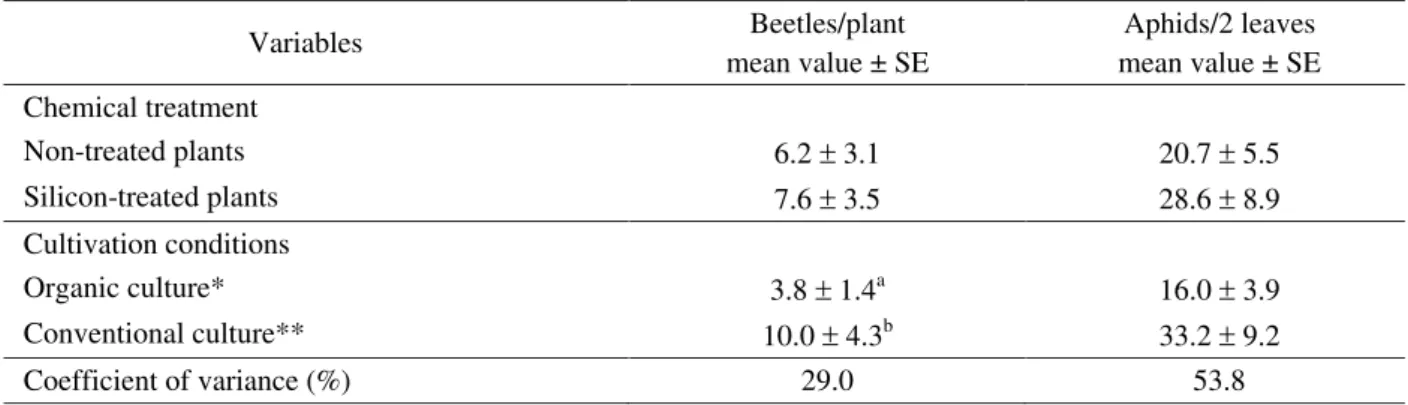
There were no interactions with respect to insect frequency and phytotechnical parameters between silicic acid treatment and type of cultivation. Moreover, there were no significant differences relating to the intensity of aphid and beetle infestation between silicon-treated and non-treated potato plants (Table 1). Gomes et al. (2008) have reported a similar lack of effect of silicon treatment on the preference and biology and consequently affects colonization of insects on potatoes. In the present study, however, the results obtained may have been due to the generally low insect density found on the crop and require further confirmation since it is known that climatic conditions can influence the occurrence of aphids and can affect the population (DIXON, 1998). Additionally, one single harvesting season may not be sufficient to clarify the influence of silicon on the incidence of aphids on potato crops (GOMES et al., 2008).
In contrast to the above, the number of adult beetles was significantly lower on plants cultivated under organic compared with those cultivated in the presence of chemical fertilisers (Table 1). According to Schulze & Djuniadi (1998), the nutritional status of a plant may exert a significant influence on the occurrence of insect pests. Soluble fertilizers can affect the internal balance of the plant and generate the accumulation of substances that are important for the development of insects, such as amino acids and sugars in their sap concentrates reduced (Trophobiosis Theory) provoking the attack of unwanted agents; unlike what occurs with plants that grow through organic fertilization with higher resistance to attack by pests and diseases (GUAZZELLI et al., 2007). The nutrients provided by organic compounds are less soluble and, therefore, less attractive to adult D. speciosa
(DAROLT et al., 2003). In agreement with the results presented in this paper, a high incidence of D. speciosa
has been reported on potatoes cultivated on substrates containing elevated levels of soluble nitrogen (AZEREDO et al., 2004), the presence of which probably give rise to an accumulation of free amino acids that attract insects (GLIESSMAN, 2001).
The numbers of lesions caused by beetles to plants cultivated under convention seedlings conditions were consistently larger (P 0.05) than observed on plants cultivated under organic conditions (Table 2), reflecting the greater number of beetles present in the former group. Twenty days after leaf emergence, the numbers of lesions detected on silicon-treated plants were larger (P 0.05) than those found on non-treated plants, but on the others evaluations the differences between silicon-treated and non-treated plants were not statistically significant.
Independent of the treatment received and the cultivation conditions applied, all plants presented tubers that had been damaged by D. speciosa larvae. Plants
cultivated in the presence of organic compost were significantly smaller (P 0.05) than those cultivated under conventional conditions, and they showed minor stem diameters (Table 3). Moreover, the productivity of plants cultivated under organic conditions was significantly lower than those cultivated in the presence of chemical fertiliser. This may be related to the higher release rate of nutrients in chemical fertilizer. Thus, these compounds become readily available, changing the internal physiology and metabolism of the plant. Therefore, their development is accelerated, unlike organic farming, where the elements present in the organic fertilizer are released slowly. Weekly silicon treatment had no influence on these parameters (Table 3).
Table 1 – Total number of beetles (D. speciosa) and aphids (M. persicae) detected on potato plants after four evaluations.
Values in the same column bearing dissimilar superscript letters are significantly different according to the F test (P 0.05). * Plants cultivated in soil supplied with organic compost.
** Plants cultivated in soil supplied with chemical fertiliser.
Variables Beetles/plant
mean value ± SE
Aphids/2 leaves mean value ± SE Chemical treatment
Non-treated plants 6.2 3.1 20.7 5.5
Silicon-treated plants 7.6 3.5 28.6 8.9
Cultivation conditions
Organic culture* 3.8 1.4a 16.0 3.9
Conventional culture** 10.0 4.3b 33.2 9.2
Table 2 – Total number of injuries produced by beetles (D. speciosa) on the potato leaves as observed at different
evaluation periods.
Days after emergence of stems Variables
20 40 60 80
Chemical treatment
Non-treated plants 28.0 4.2a 67.0 5.1 177.0 27.5 106. 0 15.2
Silicon-treated plants 43.1 7.2b 66.2 7.8 171.0 25.6 106.1 12.0
Cultivation conditions
Organic culture* 24.7 4.0a 58.2 6.0a 110.3 11.7a 76.2 9.1a
Conventional culture** 46.3 6.5b 75.1 6.1b 238.5 23.0b 135.8 11.3b
Coefficient of variance (%) 48.1 31.1 37.3 29.0
Values in the same column bearing dissimilar superscript letters are significantly different according to the F test (P 0.05). * Plants cultivated in soil supplied with organic compost.
** Plants cultivated in soil supplied with chemical fertiliser.
Table 3 – Parameters of silicon-treated and non-treated potato plants cultivated in the presence of organic compost or chemical fertiliser.
* Determined on the 60th day after stems emergence.
** Determined on the 95th day after planting seed potatoes.
Variables Plant height* (cm) Stem diameter* (cm) Productivity** (kg/plot)
Chemical treatment
Non-treated plants 34.1 3.5 0.7 0.0 4.7 0.7
Silicon-treated plants 33.8 3.4 0.7 0.0 5.3 0.7
Cultivation conditions
Organic culture 23.2 0.5b 0.6 0.0 b 2.8 0.2 b
Conventional culture 44.8 1.6a 0.8 0.1 a 7.2 0.4 a
Coefficient of variance (%) 12.45 10.16 22.88
These results corroborate the findings of GOMES et al. (2008), who reported that the heights the stem diameters of potato plants and the productivity were not influenced by silicon treatment. Also LANA et al. (2003) reported that the productivity of tomato plants was not influenced by treatment with calcium silicate.
CONCLUSIONS
The incidence of beetles and aphids, as well as the development and productivity of potato plants, were not influenced by weekly application of silicic acid. Although the development and productivity of organically cultivated plants were inferior to those cultivated in the presence of chemical fertiliser, however
plants cultivated on organic compost were less susceptible to attack by D. speciosa beetles.
ACKNOWLEDGEMENTS
The authors wish to thank the Conselho Nacional de Desenvolvimento Científico e Tecnológico (CNPq) and Coordenação de Aperfeiçoamento de Pessoal de Nível Superior (CAPES) for scholarships, and Fundação de Amparo à Pesquisa de Minas Gerais (FAPEMIG) for financial support given to this project.
REFERENCES
AZEREDO, E.H.; LIMA, E., CASSINO, P.C.R. Impacto dos nutrientes N e K e de açúcares solúveis sobre populações de Diabrotica speciosa (Germar)
(Coleoptera, Chrysomelidae) e Agrotis ipsilon
(Hüfnagel) (Lepidoptera, Noctuidae) na cultura da batata, Solanum tuberosum L. (Solanaceae). Revista
Brasileira de Entomolgia, São Paulo, v. 48, n.1, p.105-113, 2004.
DAROLT, M.R.; RODRIGUES, A.; NAZARENO, N.; BRISOLLA, A.; RÜPPEL, O. Análise comparativa entre o sistema orgânico e convencional de batata comum. 2003 Available at <http://
www.planetaorganico.com.br/trabdarnut1.htm>. Accessed on: 25 November 2007.
DIXON, A.F.G. Aphid ecology an optimization approach. 2. ed. London: Chapman and Hall, 1998. 300 p.
FIGUEIRA, A.R. Implantação de produção integrada de batata no Brasil deverá se tornar realidade num futuro próximo. Batata Show, Itapetininga, ano 5, v. 11, p. 4l, 2005.
FONTES, P.C.R. Olericultura: teoria e prática. In: FONTES, P.C.R. Cultura da batata. Viçosa: Suprema Gráfica e Editora, 2005, p. 323-343.
FURIATTII, R.S.; JÚNIOR, A.R.P.; PEREIRA, P.R.V.S. Controle de Myzus persicae (Sulzer, 1778) (Hemiptera,
Aphididae) em batata (Solanum tuberosum). Revista
Acadêmica: Ciências Agrárias e Ambientais, Curitiba, v. 6, n. 1, p. 83-87, 2008.
GLIESSMAN, S.R. Agroecologia - Processos ecológicos em agricultura sustentável. Porto Alegre: Universidade Federal do Rio Grande do Sul, 2001. 653 p.
GOMES, F.B.; MORAES, J.C.; SANTOS, C.D.D.; ANTUNES, C.S. Uso de silício como indutor de resistência em batata a Myzus persicae (Sulzer)
(Hemiptera: Aphididae). Neotropical
Entomology, Londrina, v. 37, n. 2, p.185-190, 2008.
GUAZZELLI, M.J.; MEIRELLES, L.; BARRETO, R.; GONÇALVES, A.; MOTTER, C.; RUPP, L.C. Aplicação da teoria da trofobiose no controle de pragas e doenças: uma experiência na serra gaúcha. Agriculturas, Rio de Janeiro, v. 4, n. 1, p.1-19, 2007.
LANA, R.M.Q.; KORNDÖRFER, G.H.; JÚNIOR, L.A. Z.; SILVA, A.F.; LANA, A.M.Q. Efeito do silicato de cálcio sobre a produtividade e a acumulação de silício no tomateiro. Bioscience Journal, Uberlândia, v. 19, n. 2, p. 15-20, 2003.
LARA, F.M., CORBO, A.; FIGUEIRA, L.K.; STEIN, C.P. Resistência de genótipos de batata ao pulgão. Horticultura Brasileira, Brasília, v. 22, n. 4, p. 775-779, 2004.
MACHADO, R.T.; ROSALINO, P.; RODRIGUES, J.; JUNGES, E.; RIBEIRO, L.P.; MANZONI, C.G. Avaliação da bioatividade de extratos vegetais sobre Diabrotica
speciosa em casa de vegetação. Revista Brasileira de
Agroecologia, Santa Maria, v. 2, n. 2, p. 1461-1464, 2007.
MORAES, J.C.; GOUSSAIN, M.M.; CARVALHO, G.A. Não-preferência do pulgão-da-folha Rhopalosiphum
maidis (Fitch, 1856) (Hemiptera: Aphididae) para plantas
de milho (Zea mays L.) tratadas com silício. Ciência e
Agrotecnologia, Lavras, v. 29, n. 4, p. 761-766, 2005.
PEREIRA, T.; VENTURA, M.U.; MARQUES, F.A. Comportamento de larvas de Diabrotica speciosa
(Coleoptera: Chrysomelidae) em resposta ao CO2 e a plântulas de espécies cultivadas. Ciência Rural, Santa Maria, v. 35, n. 5, p. 981-985, 2005.
PINTO, R.M.; BUENO, V.H.P.; SANTA-CECÍLIA, L.V.C. Flutuação populacional de afídeos (Hemiptera: Aphididae) associados à cultura da batata, Solanum
tuberosum L., no plantio de inverno em Alfenas, Sul de
Minas Gerais. Anais da Sociedade Entomológica do Brasil, Londrina, n. 4, v. 29, p. 649-657, 2000.
SALLES, L.A. As pragas da batata. Revista Cultivar, Hortaliças e Frutas, Embrapa Clima Temperado, Pelotas, v. 15, n. 2, p.16-28, 2002.
SCHULZE, W.; DJUNIADI, D. Introduction of integrated pest management in rice cultivation in Indonesia. Pflanzen Nachrichten, v. 1, p. 97-105, 1998.
SINGH, R.P. Development of the molecular methods for potato virus and viroid detection and prevention. Genome, v. 42, p. 592-604, 1999.